Australia

by María López Alonso
2014
Australia
Australia is a continent and country.
● World's smallest continent but sixth-largest country
and it is the only continent without glaciers.
● Oceania is the continent between the Indian Ocean
and the South Pacific Ocean.
The capital is Canberra.
●
Australia
Population: 23,363,150 estimate (2014).
Land area: 7,682,300 sq km.
Languages: English 78.5%, Chinese 2.5%, Italian 1.6%,
Greek 1.3%, Arabic 1.2%, Vietnamese 1%, other 8.2%,
unspecified 5.7% .
Main cities: Sydney, Melbourne, Brisbane.
Monetary unit: Australian dollar (AUD).
Government: Constitutional monarchy.
Head of state/president/king/queen: Elizabeth II.
Australia

Additional data: Australia Day: 26 January.
Australia
Origins and history: The Australian continent is a
unique land, full of contrasts. It is the earth's biggest
island and the sixth-biggest country in the world in
land area. Australia is the only nation to govern an
entire continent. Today, Australia is a stable,
democratic, culturally diverse nation with a skilled
workforce and a strong, competitive economy.
Britain's Statute of Westminster 1931 formally ended
most of the constitutional links between Australia and
the UK.
Australia
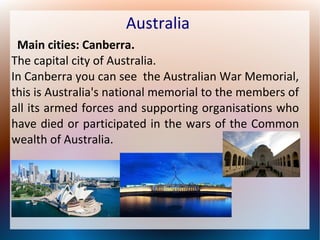
Main cities: Canberra.
The capital city of Australia.
In Canberra you can see the Australian War Memorial,
this is Australia's national memorial to the members of
all its armed forces and supporting organisations who
have died or participated in the wars of the Common
wealth of Australia.
Australia
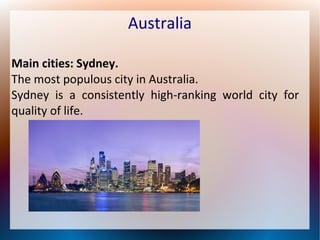
Main cities: Sydney.
The most populous city in Australia.
Sydney is a consistently high-ranking world city for
quality of life.
Australia
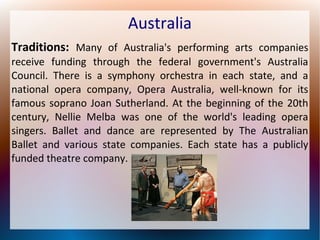
Traditions: Many of Australia's performing arts companies
receive funding through the federal government's Australia
Council. There is a symphony orchestra in each state, and a
national opera company, Opera Australia, well-known for its
famous soprano Joan Sutherland. At the beginning of the 20th
century, Nellie Melba was one of the world's leading opera
singers. Ballet and dance are represented by The Australian
Ballet and various state companies. Each state has a publicly
funded theatre company.
Australia
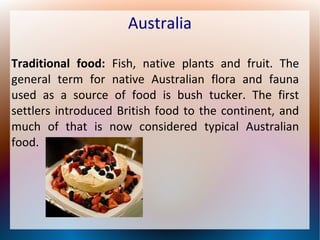
Traditional food: Fish, native plants and fruit. The
general term for native Australian flora and fauna
used as a source of food is bush tucker. The first
settlers introduced British food to the continent, and
much of that is now considered typical Australian
food.
Australia
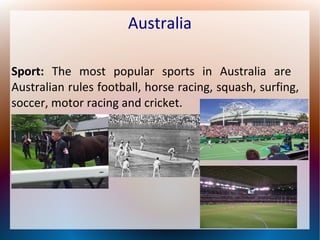
Sport: The most popular sports in Australia are
Australian rules football, horse racing, squash, surfing,
soccer, motor racing and cricket.
Australia
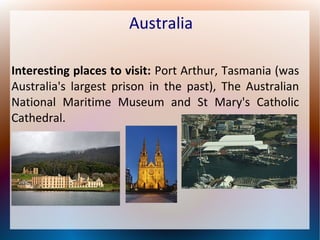
Interesting places to visit: Port Arthur, Tasmania (was
Australia's largest prison in the past), The Australian
National Maritime Museum and St Mary's Catholic
Cathedral.
Australia

Reference:
●Mention all the websites you have used to get the
information mentioned in your presentation. These
sites might be helpful:
● www.cia.gov
● http://en.wikipedia.org/wiki/Australia
● www.en.wikipedia.org
● www.infoplease.com/countries.html

Australia

  • 1.
  • 2.
    Australia Australia is acontinent and country. ● World's smallest continent but sixth-largest country and it is the only continent without glaciers. ● Oceania is the continent between the Indian Ocean and the South Pacific Ocean. The capital is Canberra. ●
  • 3.
    Australia Population: 23,363,150 estimate(2014). Land area: 7,682,300 sq km. Languages: English 78.5%, Chinese 2.5%, Italian 1.6%, Greek 1.3%, Arabic 1.2%, Vietnamese 1%, other 8.2%, unspecified 5.7% . Main cities: Sydney, Melbourne, Brisbane. Monetary unit: Australian dollar (AUD). Government: Constitutional monarchy. Head of state/president/king/queen: Elizabeth II.
  • 4.
  • 5.
    Australia Origins and history:The Australian continent is a unique land, full of contrasts. It is the earth's biggest island and the sixth-biggest country in the world in land area. Australia is the only nation to govern an entire continent. Today, Australia is a stable, democratic, culturally diverse nation with a skilled workforce and a strong, competitive economy. Britain's Statute of Westminster 1931 formally ended most of the constitutional links between Australia and the UK.
  • 6.
    Australia Main cities: Canberra. Thecapital city of Australia. In Canberra you can see the Australian War Memorial, this is Australia's national memorial to the members of all its armed forces and supporting organisations who have died or participated in the wars of the Common wealth of Australia.
  • 7.
    Australia Main cities: Sydney. Themost populous city in Australia. Sydney is a consistently high-ranking world city for quality of life.
  • 8.
    Australia Traditions: Many ofAustralia's performing arts companies receive funding through the federal government's Australia Council. There is a symphony orchestra in each state, and a national opera company, Opera Australia, well-known for its famous soprano Joan Sutherland. At the beginning of the 20th century, Nellie Melba was one of the world's leading opera singers. Ballet and dance are represented by The Australian Ballet and various state companies. Each state has a publicly funded theatre company.
  • 9.
    Australia Traditional food: Fish,native plants and fruit. The general term for native Australian flora and fauna used as a source of food is bush tucker. The first settlers introduced British food to the continent, and much of that is now considered typical Australian food.
  • 10.
    Australia Sport: The mostpopular sports in Australia are Australian rules football, horse racing, squash, surfing, soccer, motor racing and cricket.
  • 11.
    Australia Interesting places tovisit: Port Arthur, Tasmania (was Australia's largest prison in the past), The Australian National Maritime Museum and St Mary's Catholic Cathedral.
  • 12.
    Australia Reference: ●Mention all thewebsites you have used to get the information mentioned in your presentation. These sites might be helpful: ● www.cia.gov ● http://en.wikipedia.org/wiki/Australia ● www.en.wikipedia.org ● www.infoplease.com/countries.html