Rwanda
Background Information RWANDA gained independence in 1962 The official languages are  KINYARWANDA, FRENCH AND ENGLISH     The capital city is Kigali located in Central Rwanda  Land area is  26340  km2 Current 2011 population is 10.9 million Ethnic composition  90% HUTU, 9% TUTSI and 1% OTHER 42%  of the population is under 15 years of age
Background Hutus Majority - 80% Migrated from southern Africa General: found themselves as laborers and farmers
Background Tutsis Minority - 20% Migrated from Northern Africa (Egypt) General: found themselves as the elite and political rulers
Before the Genocide Rwanda was  originally ruled by Germany  but  later by Belgium after World War 1 . The Belgians used a “divide and conquer”   strategy  to rule over Rwanda. The Belgians  favoured the Tutsi Minority  and used them to help govern the country. In 1926, Belgians introduced a  ethnic identification system . Tutsis were given privileges  such as Western style education, which the Hutu Majority was excluded from.   Hutus could only be laborers or low level workers In the 1950’s Educated Tutsi’s began to question Colonial rule
Belgians pulled a  “turn face”  in which they began to favour the Hutu majority instead of the Tutsis In the Early 1960’s  Belgium organized  elections and elected Hutus to power. Over 200,000 Tutsis fled to neighboring countries and formed a rebel guerrilla army, the Rwandan Patriotic Front  RPF . In  1962  Belgium Withdrew from Rwanda giving them independence Gregoire Kayibanda  was the first president but was later  ousted by Juvenal Habyarimana  who ruled from 1973-1994 Habyarimana used the RPF as a way to gain support from Hutus by increasing hatred of the Tutsis
A picture of Belgium’s former Rwanda, which broke up into Rwanda and Burundi in 1962
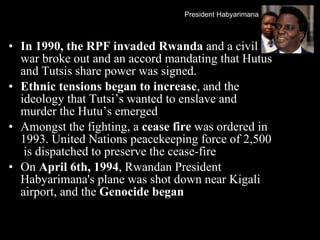
In 1990, the RPF invaded Rwanda  and a civil war broke out and  an accord mandating that Hutus and Tutsis share power was signed.  Ethnic tensions began to increase , and the ideology that Tutsi’s wanted to enslave and murder the Hutu’s emerged Amongst the fighting, a  cease fire  was ordered in 1993.  United Nations peacekeeping force of 2,500  is dispatched to preserve the cease-fire  On  April 6th, 1994 , Rwandan President Habyarimana's plane was shot down near Kigali airport, and the  Genocide began   President Habyarimana
The Genocide After the death of Habyariman,  instantly  killings began  Agathe Uwilingiyimana the first female prime minister took power, but was  assassinated The  Hutu extremist radio  - RTLM, and also the state supported radio - Radio Rwanda, encouraged the mass murder of the " cockroaches ". These cockroaches were  Tutsis and Hutu moderates   Mass killings, organized and not, began to plague the country.
The Genocide Most Victims were  Killed in their own villages  and towns  by neighbors  usually by being hacked to death by machetes. Those who did not get involved in the murders were often murdered themselves Some massacres that occurred include the massacure at  Nyarubuye , where 1500 Tutsis took refuge in a church.  The Interahamwe began bulldozing the church, those who tried to escape were hacked to death. Rape  was also used as a weapon during the Genocide, up to 500 000 Tutsi women were raped.
Aftermath Between April and June 1994, an estimated 800,000 Rwandans were killed in the space of 100 days.   An estimated  10 000  people were murdered  each day . 400 000 children were left  orphans .
Bodies found in mass graves.  Some mass graves contained over 50 000 bodies.
Bullet Holes on a school where Hutus raided and murdered hiding Tutsis
Thousands of murdered Tutsis were left to rot in ditches around Rwanda or in Rivers.
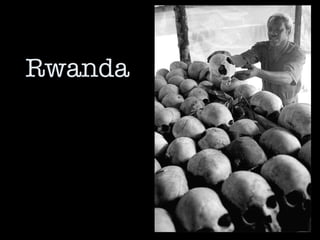
Skulls of those murdered during the Genocide at a memorial at Nayamata Church. WARNING: THE NEXT SLIDE IS VERY GRAPHIC – Decomposing bodies
Decomposing bodies found by Ugandan Fishermen in Lake Victoria.
Now a memorial, this is the corner where 10 Belgian UNIMIR soldiers were murdered. The Belgians were protecting Agathe Uwilingiyimana along with 5 Ghanaian soldiers, but due to mandate were unable to fire at Rebel groups.  The Ghanaian soldiers were let go but the Belgians “were castrated, gagged with their own genitalia, and then murdered.”(Scott Peterson (2001). Me Against My Brother: At War in Somalia, Sudan and Rwanda.)
International Involvement UN and international involvement was limited due to little national interest. The U.N. Security Council votes unanimously to abandon Rwanda. The remainders of U.N. peacekeeping troops are pulled out, leaving only a tiny force of 200 soldiers for the entire country.  International troops were deployed,  but to evacuate foreigners only.
After the Genocide The  Rwandan Patriotic front , the Tutsi rebel ground eventually took power of Rwanda and has maintained power for the past 9 years. General Paul Kagame  was the  leader of the invasion in 1994 , and is now the president of Rwanda. In 2003 Kagame became Rwanda’s first elected president since the genocide. Not only did he win, he received  95%  of the votes
After the Genocide Rwanda was left with a crisis amongst the children.  Many of which were either  orphaned or forced to join in the massacre , leaving them with haunting memories. UNICEF has worked with the Rwandan youth to educate and help cope with the Genocide Rwanda is also facing an Aids outbreak, greatly due to the mass Rape that occurred during the Genocide.
After the Genocide However, Rwanda now looks towards the  future , By promoting  forgiveness  and tackling Economic growth, Human rights, and Environmental concerns Rwanda is considered a  success story  after the genocide based on its growth and way of dealing with the Genocide

Rwanda overview

  • 1.
  • 2.
    Background Information RWANDAgained independence in 1962 The official languages are KINYARWANDA, FRENCH AND ENGLISH   The capital city is Kigali located in Central Rwanda Land area is 26340 km2 Current 2011 population is 10.9 million Ethnic composition  90% HUTU, 9% TUTSI and 1% OTHER 42% of the population is under 15 years of age
  • 3.
    Background Hutus Majority- 80% Migrated from southern Africa General: found themselves as laborers and farmers
  • 4.
    Background Tutsis Minority- 20% Migrated from Northern Africa (Egypt) General: found themselves as the elite and political rulers
  • 5.
    Before the GenocideRwanda was originally ruled by Germany but later by Belgium after World War 1 . The Belgians used a “divide and conquer” strategy to rule over Rwanda. The Belgians favoured the Tutsi Minority and used them to help govern the country. In 1926, Belgians introduced a ethnic identification system . Tutsis were given privileges such as Western style education, which the Hutu Majority was excluded from. Hutus could only be laborers or low level workers In the 1950’s Educated Tutsi’s began to question Colonial rule
  • 6.
    Belgians pulled a “turn face” in which they began to favour the Hutu majority instead of the Tutsis In the Early 1960’s Belgium organized elections and elected Hutus to power. Over 200,000 Tutsis fled to neighboring countries and formed a rebel guerrilla army, the Rwandan Patriotic Front RPF . In 1962 Belgium Withdrew from Rwanda giving them independence Gregoire Kayibanda was the first president but was later ousted by Juvenal Habyarimana who ruled from 1973-1994 Habyarimana used the RPF as a way to gain support from Hutus by increasing hatred of the Tutsis
  • 7.
    A picture ofBelgium’s former Rwanda, which broke up into Rwanda and Burundi in 1962
  • 8.
    In 1990, theRPF invaded Rwanda and a civil war broke out and an accord mandating that Hutus and Tutsis share power was signed. Ethnic tensions began to increase , and the ideology that Tutsi’s wanted to enslave and murder the Hutu’s emerged Amongst the fighting, a cease fire was ordered in 1993. United Nations peacekeeping force of 2,500 is dispatched to preserve the cease-fire On April 6th, 1994 , Rwandan President Habyarimana's plane was shot down near Kigali airport, and the Genocide began President Habyarimana
  • 9.
    The Genocide Afterthe death of Habyariman, instantly killings began Agathe Uwilingiyimana the first female prime minister took power, but was assassinated The Hutu extremist radio - RTLM, and also the state supported radio - Radio Rwanda, encouraged the mass murder of the " cockroaches ". These cockroaches were Tutsis and Hutu moderates Mass killings, organized and not, began to plague the country.
  • 10.
    The Genocide MostVictims were Killed in their own villages and towns by neighbors usually by being hacked to death by machetes. Those who did not get involved in the murders were often murdered themselves Some massacres that occurred include the massacure at Nyarubuye , where 1500 Tutsis took refuge in a church. The Interahamwe began bulldozing the church, those who tried to escape were hacked to death. Rape was also used as a weapon during the Genocide, up to 500 000 Tutsi women were raped.
  • 11.
    Aftermath Between Apriland June 1994, an estimated 800,000 Rwandans were killed in the space of 100 days. An estimated 10 000 people were murdered each day . 400 000 children were left orphans .
  • 12.
    Bodies found inmass graves. Some mass graves contained over 50 000 bodies.
  • 13.
    Bullet Holes ona school where Hutus raided and murdered hiding Tutsis
  • 14.
    Thousands of murderedTutsis were left to rot in ditches around Rwanda or in Rivers.
  • 15.
    Skulls of thosemurdered during the Genocide at a memorial at Nayamata Church. WARNING: THE NEXT SLIDE IS VERY GRAPHIC – Decomposing bodies
  • 16.
    Decomposing bodies foundby Ugandan Fishermen in Lake Victoria.
  • 17.
    Now a memorial,this is the corner where 10 Belgian UNIMIR soldiers were murdered. The Belgians were protecting Agathe Uwilingiyimana along with 5 Ghanaian soldiers, but due to mandate were unable to fire at Rebel groups. The Ghanaian soldiers were let go but the Belgians “were castrated, gagged with their own genitalia, and then murdered.”(Scott Peterson (2001). Me Against My Brother: At War in Somalia, Sudan and Rwanda.)
  • 18.
    International Involvement UNand international involvement was limited due to little national interest. The U.N. Security Council votes unanimously to abandon Rwanda. The remainders of U.N. peacekeeping troops are pulled out, leaving only a tiny force of 200 soldiers for the entire country. International troops were deployed, but to evacuate foreigners only.
  • 19.
    After the GenocideThe Rwandan Patriotic front , the Tutsi rebel ground eventually took power of Rwanda and has maintained power for the past 9 years. General Paul Kagame was the leader of the invasion in 1994 , and is now the president of Rwanda. In 2003 Kagame became Rwanda’s first elected president since the genocide. Not only did he win, he received 95% of the votes
  • 20.
    After the GenocideRwanda was left with a crisis amongst the children. Many of which were either orphaned or forced to join in the massacre , leaving them with haunting memories. UNICEF has worked with the Rwandan youth to educate and help cope with the Genocide Rwanda is also facing an Aids outbreak, greatly due to the mass Rape that occurred during the Genocide.
  • 21.
    After the GenocideHowever, Rwanda now looks towards the future , By promoting forgiveness and tackling Economic growth, Human rights, and Environmental concerns Rwanda is considered a success story after the genocide based on its growth and way of dealing with the Genocide