Chapter 23

Central Africa
Section 1

Physical Geography
Physical Features
   Borders Atlantic Ocean
   Borders Western Rift Valley
   High Mts.
   Biggest rivers in Africa
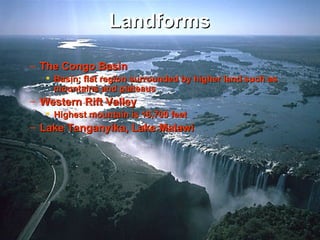
Landforms

– The Congo Basin
    Basin; flat region surrounded by higher land such as
     mountains and plateaus
– Western Rift Valley
    Highest mountain is 16,700 feet
– Lake Tanganyika, Lake Malawi
Rivers
– The Congo River
    Fed by thousands of smaller rivers
      – Waterfalls & rapids make it impossible
        for ships to travel from Central Africa
        to Atlantic Ocean
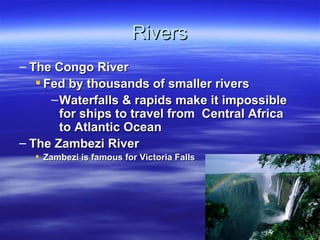
– The Zambezi River
   Zambezi is famous for Victoria Falls
Climates, Vegetation, and
               Animals
 Humid tropical climate in the Congo Basin and on the
  Atlantic coast
    – Warm temps & lots of rain
    – dense, tropical rain forest
    – Animal like: antelopes, hyenas, elephants, okapis, insects, birds,
      monkeys, bats, and snakes are found here
    – Trees form a canopy, preventing much life on the rain forest floor
 Tropical savanna climate found north and south of the
  basin
    – Distinct dry & wet seasons
    – grasslands, scattered trees, & shrubs
   Highland climate found in the high eastern mountains
   Dry steppe and deserts in the far south
Resources
 Tropical Environment good for growing crops
   – Most are subsistence farmers
   – Moving towards growing crops for sale
 Tropical Forests
   – Provides timber
   – Rivers provide way to travel & trade & hydroelectricity
 Oil, natural gas, and coal
 Minerals: copper, uranium, tin, zinc, diamonds, gold, and
  cobalt
 Subsistence farmers
   – Some beginning to grow more crops for sale
 Crops: coffee, bananas, & corn
   – Sold in periodic markets: open air markets set up at
     crossroads or in a town
Section 2

History & Culture
History
 Early humans lived in central Africa thousands of
  years ago
 2,000 years ago new peoples migrated & formed several
  kingdoms
   – Kongo Kingdom most important
       Est. trade routes
 Europeans
   – Came in 1400s for forest products & other resources like
     ivory
   – Also traded for slaves
 Kingdoms were weakened and destroyed by
  Europeans
   – region was divided into colonies in the late 1800s by the
     France, Portugal, Britain, Spain, Belgium, & Germany
   – Borders created ignored homelands of Africa’s ethnic groups
       Each had different languages, ways of life, & resulted in conflicts
Modern Central Africa

 Independence came after WWII
  – Some fought bloody wars to gain
    independence
 Many ethnic groups continued to fight even
  after independence
 Became battleground of the Cold War
  between U.S. & Soviet Union
  – Many people died and great damage was
    caused
Culture
 100 million people in Central Africa
 Many different ethnic groups w/ different
  customs
People & Languages
 Hundreds of different languages & dialects
   – Due to number of ethnic groups
 Official languages are European
   – French, English, Spanish, Portuguese
 Religion
   – Influenced by colonial history
   – Roman Catholic, Protestant Christianity, traditional African
     religions, Christian, Muslim, & Hindu are the practiced religions of
     Central Africa
 The Arts
   – Influenced by traditional cultures
   – Famous for sculpture, carved wooden masks, & cotton gowns dyed
     in bright colors
   – Popular styles of music & dance
Section 3


Central Africa Today
Countries of Central Africa
 Most are very poor
 Years of colonial rule & civil war
  – Struggling to build stable gov’ts & strong
    economies
Democratic Republic of the
                      Congo
 Former Belgian colony
  Former Belgian colony
   – Many Belgians left after independence (few doctors,
     teachers, & other professionals remained)
 Ethnic conflicts after independence
   – Caused country to remain poor
 Joseph Mobutu
   – a dictator, came to power in 1965
   – Changed the country’s name to Zaire in 1971 & his name to
     Mobutu Sese Seko
   – Country suffered from economic problems & political
     corruption during his rule
        Mobutu became very wealthy & used violence against those who
         challenged him
 After a civil war in 1997 a new government took over
   – Name changed to the Democratic Republic of the Congo
        Fighting between ethnic groups has continued
 Treasure chest of minerals & tropical resources
 South is part of central Africa’s rich copper belt
 Gold, diamonds, & cobalt
 Tropical rain forests supply wood, food, rubber, &
  other products
 Civil war, bad government, & crime have scared
  many foreign businesses away
 Countries rich resources have helped few people
The People
   Most are poor
   Live in rural areas & farm and trade for food
   Many people live in Kinshasa, the capital &
    largest city
    – Along Congo River; crowded; consists of poor
      slum areas mainly
Central African Republic &
          Cameroon
 Central African Republic
   – Struggled w/ military coups, corrupt leaders, & improper
     elections
   – Weak economy
   – Most people are farmers
   – Diamonds & gold present, but no railroads or ports to
     transport resources for export
   – Receives some aid from foreign countries
 Cameroon
   – Fairly stable Republic (president is elected & holds most
     power)
   – Economy is growing
   – Oil reserves & farming support economy
   – Good roads & railways people w/ transportation needs
   –
Equatorial Guinea & Sao Tome
          and Principe
 Equatorial Guinea
  – Divided between mainly & 5 islands
  – Republic w/ elections (possibly flawed though,
    same president for 25 years)
  – Recent oil discovery, but living conditions for
    most are still poor
 Sao Tome & Principe
  – Struggled w/ political stability
  – Poor country w/ few resources
  – Produces cacao, but has to import food
Gabon & Republic of the Congo
 Gabon
  – 1 president since 1967
  – Economy provides highest standard of living in
    region
  – ½ of country’s income comes from oil
 Republic of the Congo
  – Much of income comes from oil
  – Income from forest products
  – Civil war in last 1990s hurt economy
  – Mostly urban
Angola
 Civil war following independence from
  Portugal
    – Ended in 2002
   Now republic w/ elected president
   Economy is struggling
   85% rely of subsistence farming for income
    – Land mines from civil war makes farming
      dangerous
 High rate of inflation has also hurt economy
Zambia & Malawi
 Zambia
  – 85% of workers are farmers
  – Rich copper mines
  – Economy growing slowly
  – High levels of debt & inflation
 Malawi
  – Most farm for a living
  – 75% live in villages in rural areas
  – Aid from foreign countries & religious groups
    help economy
Issues & Challenges
 Unstable governments & poor economies
  – Have been either cause or effect of other issues
    & challenges in the region
 Ethnic & Regional Conflict
  – Mixing of ethnic groups & competing for power
    has resulted in civil wars
      Thousands killed, contributed to poor economies,
       land destroyed, & other resources destroyed
 Health
  – Malaria: kills many people (1 child every 30
    seconds)
  – International health organizations trying to
    control malaria
     Use nets & medicine, but both are expensive
  – HIV
     Causes AIDS
     Hundreds of thousands die each year
     No cure & medicines are expensive
Resources & Environment
 To help economy & people
  – Develop natural resources more effectively
      Food production has declined in some areas (does
       not support growing population) resulting in food
       shortages & malnutrition
  – Manage the environment
      Industries are destroying the environment
        – Cutting down forests and mining diamonds & copper

 National parks have been set up to protect
  the environment

Central africa

  • 1.
  • 2.
  • 3.
    Physical Features  Borders Atlantic Ocean  Borders Western Rift Valley  High Mts.  Biggest rivers in Africa
  • 4.
    Landforms – The CongoBasin  Basin; flat region surrounded by higher land such as mountains and plateaus – Western Rift Valley  Highest mountain is 16,700 feet – Lake Tanganyika, Lake Malawi
  • 5.
    Rivers – The CongoRiver  Fed by thousands of smaller rivers – Waterfalls & rapids make it impossible for ships to travel from Central Africa to Atlantic Ocean – The Zambezi River  Zambezi is famous for Victoria Falls
  • 6.
    Climates, Vegetation, and Animals  Humid tropical climate in the Congo Basin and on the Atlantic coast – Warm temps & lots of rain – dense, tropical rain forest – Animal like: antelopes, hyenas, elephants, okapis, insects, birds, monkeys, bats, and snakes are found here – Trees form a canopy, preventing much life on the rain forest floor  Tropical savanna climate found north and south of the basin – Distinct dry & wet seasons – grasslands, scattered trees, & shrubs  Highland climate found in the high eastern mountains  Dry steppe and deserts in the far south
  • 7.
    Resources  Tropical Environmentgood for growing crops – Most are subsistence farmers – Moving towards growing crops for sale  Tropical Forests – Provides timber – Rivers provide way to travel & trade & hydroelectricity  Oil, natural gas, and coal  Minerals: copper, uranium, tin, zinc, diamonds, gold, and cobalt  Subsistence farmers – Some beginning to grow more crops for sale  Crops: coffee, bananas, & corn – Sold in periodic markets: open air markets set up at crossroads or in a town
  • 8.
  • 9.
    History  Early humanslived in central Africa thousands of years ago  2,000 years ago new peoples migrated & formed several kingdoms – Kongo Kingdom most important  Est. trade routes  Europeans – Came in 1400s for forest products & other resources like ivory – Also traded for slaves  Kingdoms were weakened and destroyed by Europeans – region was divided into colonies in the late 1800s by the France, Portugal, Britain, Spain, Belgium, & Germany – Borders created ignored homelands of Africa’s ethnic groups  Each had different languages, ways of life, & resulted in conflicts
  • 10.
    Modern Central Africa Independence came after WWII – Some fought bloody wars to gain independence  Many ethnic groups continued to fight even after independence  Became battleground of the Cold War between U.S. & Soviet Union – Many people died and great damage was caused
  • 11.
    Culture  100 millionpeople in Central Africa  Many different ethnic groups w/ different customs
  • 12.
    People & Languages Hundreds of different languages & dialects – Due to number of ethnic groups  Official languages are European – French, English, Spanish, Portuguese  Religion – Influenced by colonial history – Roman Catholic, Protestant Christianity, traditional African religions, Christian, Muslim, & Hindu are the practiced religions of Central Africa  The Arts – Influenced by traditional cultures – Famous for sculpture, carved wooden masks, & cotton gowns dyed in bright colors – Popular styles of music & dance
  • 13.
  • 14.
    Countries of CentralAfrica  Most are very poor  Years of colonial rule & civil war – Struggling to build stable gov’ts & strong economies
  • 15.
    Democratic Republic ofthe Congo  Former Belgian colony Former Belgian colony – Many Belgians left after independence (few doctors, teachers, & other professionals remained)  Ethnic conflicts after independence – Caused country to remain poor  Joseph Mobutu – a dictator, came to power in 1965 – Changed the country’s name to Zaire in 1971 & his name to Mobutu Sese Seko – Country suffered from economic problems & political corruption during his rule  Mobutu became very wealthy & used violence against those who challenged him  After a civil war in 1997 a new government took over – Name changed to the Democratic Republic of the Congo  Fighting between ethnic groups has continued
  • 16.
     Treasure chestof minerals & tropical resources  South is part of central Africa’s rich copper belt  Gold, diamonds, & cobalt  Tropical rain forests supply wood, food, rubber, & other products  Civil war, bad government, & crime have scared many foreign businesses away  Countries rich resources have helped few people
  • 17.
    The People  Most are poor  Live in rural areas & farm and trade for food  Many people live in Kinshasa, the capital & largest city – Along Congo River; crowded; consists of poor slum areas mainly
  • 18.
    Central African Republic& Cameroon  Central African Republic – Struggled w/ military coups, corrupt leaders, & improper elections – Weak economy – Most people are farmers – Diamonds & gold present, but no railroads or ports to transport resources for export – Receives some aid from foreign countries  Cameroon – Fairly stable Republic (president is elected & holds most power) – Economy is growing – Oil reserves & farming support economy – Good roads & railways people w/ transportation needs –
  • 19.
    Equatorial Guinea &Sao Tome and Principe  Equatorial Guinea – Divided between mainly & 5 islands – Republic w/ elections (possibly flawed though, same president for 25 years) – Recent oil discovery, but living conditions for most are still poor  Sao Tome & Principe – Struggled w/ political stability – Poor country w/ few resources – Produces cacao, but has to import food
  • 20.
    Gabon & Republicof the Congo  Gabon – 1 president since 1967 – Economy provides highest standard of living in region – ½ of country’s income comes from oil  Republic of the Congo – Much of income comes from oil – Income from forest products – Civil war in last 1990s hurt economy – Mostly urban
  • 21.
    Angola  Civil warfollowing independence from Portugal – Ended in 2002  Now republic w/ elected president  Economy is struggling  85% rely of subsistence farming for income – Land mines from civil war makes farming dangerous  High rate of inflation has also hurt economy
  • 22.
    Zambia & Malawi Zambia – 85% of workers are farmers – Rich copper mines – Economy growing slowly – High levels of debt & inflation  Malawi – Most farm for a living – 75% live in villages in rural areas – Aid from foreign countries & religious groups help economy
  • 23.
    Issues & Challenges Unstable governments & poor economies – Have been either cause or effect of other issues & challenges in the region  Ethnic & Regional Conflict – Mixing of ethnic groups & competing for power has resulted in civil wars  Thousands killed, contributed to poor economies, land destroyed, & other resources destroyed
  • 24.
     Health – Malaria: kills many people (1 child every 30 seconds) – International health organizations trying to control malaria  Use nets & medicine, but both are expensive – HIV  Causes AIDS  Hundreds of thousands die each year  No cure & medicines are expensive
  • 25.
    Resources & Environment To help economy & people – Develop natural resources more effectively  Food production has declined in some areas (does not support growing population) resulting in food shortages & malnutrition – Manage the environment  Industries are destroying the environment – Cutting down forests and mining diamonds & copper  National parks have been set up to protect the environment