Uzbekistan: A Brief Country StudySeth Banks
Brief HistoryRussia conquered Uzbekistan in the late 19th century. Stiff resistance to the Red Army after World War I was eventually suppressed and a socialist republic set up in 1924. During the Soviet era, intensive production of "white gold" (cotton) and grain led to overuse of agrochemicals and the depletion of water supplies, which have left the land poisoned and the Aral Sea and certain rivers half dry. Independent since 1991, the country seeks to gradually lessen its dependence on agriculture while developing its mineral and petroleum reserves. Current concerns include terrorism by Islamic militants, economic stagnation, and the curtailment of human rights and democratization. https://www.cia.gov/library/publications/the-world-factbook/geos/uz.html#Intro
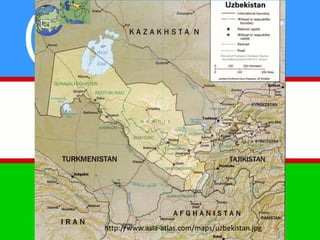
Geographic InfoArea:total: 447,400 sq km land: 425,400 sq km water: 22,000 sq kmArea - comparative: slightly larger than CaliforniaLand boundaries: total: 6,221 km border countries: Afghanistan 137 km, Kazakhstan 2,203 km, Kyrgyzstan 1,099 km, Tajikistan 1,161 km, Turkmenistan 1,621 kmCoastline:  0 km (doubly landlocked); note - Uzbekistan includes the southern portion of the Aral Sea with a 420 km shorelineMaritime claims: none (doubly landlocked)Climate:  mostly midlatitude desert, long, hot summers, mild winters; semiarid grassland in eastTerrain:  mostly flat-to-rolling sandy desert with dunes; broad, flat intensely irrigated river valleys along course of Amu Darya, Syr Darya (Sirdaryo), and Zarafshon; Fergana Valley in east surrounded by mountainous Tajikistan and Kyrgyzstan; shrinking Aral Sea in west https://www.cia.gov/library/publications/the-world-factbook/geos/uz.html#Intro
http://www.asia-atlas.com/maps/uzbekistan.jpg
PeoplePopulation: 	27,606,007 (July 2009 est.)Age structure: 0-14 years: 28.1% (male 3,970,386/female 3,787,371) 15-64 years: 67% (male 9,191,439/female 9,309,791) 65 years and over: 4.9% (male 576,191/female 770,829) (2009 est.)Median age:total: 24.7 years male: 24.2 years female: 25.2 years (2008 est.)Population growth rate: 0.935% (2009 est.)Birth rate:	17.99 births/1,000 population (2008 est.)Death rate:	5.3 deaths/1,000 population (2008 est.)Net migration rate: -2.94 migrant(s)/1,000 population (2009 est.)Sex ratio:at birth: 1.06 male(s)/female under 15 years: 1.05 male(s)/female 15-64 years: 0.99 male(s)/female 65 years and over: 0.75 male(s)/female total population: 0.99 male(s)/female (2009 est.)Infant mortality rate: total: 23.43 deaths/1,000 live births male: 27.7 deaths/1,000 live births female: 18.9 deaths/1,000 live births (2009 est.)Life expectancy at birth: total population: 71.96 years 	  male: 68.95 years female: 75.15 years (2009 est.)https://www.cia.gov/library/publications/the-world-factbook/geos/uz.html#Intro
People (cont’d.)Ethnic groups: Uzbek 80%, Russian 5.5%, Tajik 5%, Kazakh 3%, Karakalpak 2.5%, Tatar 1.5%, other 2.5% (1996 est.)Religions:  Muslim 88% (mostly Sunnis), Eastern Orthodox 9%, other 3%Languages:  Uzbek 74.3%, Russian 14.2%, Tajik 4.4%, other 7.1Literacy:definition: age 15 and over can read and write total population: 99.3% male: 99.6% female: 99% (2003 est.)School life expectancy (primary to tertiary education):	total: 11 years male: 12 years female: 11 years (2007)Education expenditures:  9.4% of GDP (1991) https://www.cia.gov/library/publications/the-world-factbook/geos/uz.html#Intro
EconomyGDP (purchasing power parity):		$71.63 billion (2008 est.) 	$65.77 billion (2007) 	$60.07 billion (2006)GDP - real growth rate: 8.9% (2008 est.)GDP - per capita (PPP): $2,600 (2008 est.)GDP - composition by sector:agriculture: 28.2% industry: 33.9% services: 37.9% (2008 est.)Labor force:  15.28 million (2008 est.)Labor force - by occupation: agriculture: 44% industry: 20% services: 36% (1995)Unemployment rate:  0.9% officially by the Ministry of Labor, plus another 20% underemployed (2008 est.) https://www.cia.gov/library/publications/the-world-factbook/geos/uz.html#Intro
Economy (Cont’d.)Budget:revenues: $8.005 billion expenditures: $8.127 billion (2008 est.)Public debt:  13.6% of GDP (2008 est.)Inflation rate (consumer prices): 13.5% officially, but 38% based on analysis of consumer prices (2008 est.)Market value of publicly traded shares:  $36.89 million (2005)Agriculture - products:  cotton, vegetables, fruits, grain; livestockIndustries: textiles, food processing, machine building, metallurgy, gold, petroleum, natural gas, chemicalsIndustrial production growth rate: 11.2% (2008 est.) https://www.cia.gov/library/publications/the-world-factbook/geos/uz.html#Intro
Economic PartnershipsExports: $9.96 billion f.o.b. (2008 est.)Exports - commodities: cotton, gold, energy products, mineral fertilizers, ferrous and non-ferrous metals, textiles, food products, machinery, automobilesExports - partners: Russia 22.4%, Poland 10.4%, Turkey 9.4%, Kazakhstan 6.1%, Hungary 6%, China 5.6%, Ukraine 4.8%, Bangladesh 4.3% (2007)Imports: $6.5 billion f.o.b. (2008 est.)Imports - commodities: machinery and equipment, foodstuffs, chemicals, ferrous and non-ferrous metalsImports - partners: Russia 30.1%, China 13.3%, South Korea 13%, Germany 6.3%, Kazakhstan 6.2%, Ukraine 4% (2007)Exchange rates: Uzbekistani soum (UZS) per US dollar - 1,317 (2008 est.), 1,263.8 (2007), 1,219.8 (2006), 1,020 (2005), 971.265 (2004) https://www.cia.gov/library/publications/the-world-factbook/geos/uz.html#Intro
LegislatureCalled OliyMajlis, meaning Supreme AssemblyOriginally unicameral, with 150 deputies elected by single member territorial districtsConstitution amended in 2002, added an upper house with 100 deputies, 84 being appointed by regional councils and 16 by the President, and reduced the lower house to 120 deputiesMany of the same powers as the US Congress on paper, but in reality serves merely as the President’s rubber stampFive year terms
JudiciaryConstitutional Court, which reviews constitutionality of laws and acts of government much like the US Supreme CourtSupreme Court which supervises the administration of justice in lower courtsHigher Economic Court which arbitrates any economic or trade related disputesVarious lower courts in the regions and cities which are supervised by the national governmentJudges are elected by the OliyMajlis every five years, calling their independence into question
ExecutivePresident Islam Karimov has been in power since 1990, before the fall of the Soviet UnionElections are rigged and determined not to be legitimate by most international observersWhile not constitutional, the President controls most state functions including the courts and the OliyMajlisPresident has a Cabinet of Ministers, which functions much like the US cabinet
Rigged ElectionsOnly pro-government, pro-Karimov parties are allowed to stand for election to the OliyMajlisOnly pro-Karimov candidates are allowed to challenge him in presidential elections.  These “opponents” have openly endorsed him while campaigningKarimov uses voter intimidation to secure more votes, including forcing pilgrims en route to Mecca for the Hajj to fill out absentee ballots voting for him or risk being denied an exit visa
AndijanOn May 13th, during the trial of 23 businessmen being accused of being Islamic extremists, riots broke out during a protest against the unfair treatment of the dissidentsWhile there was violence from the crowd, including the storming of the prison holding the businessmen and the killing of some government officials, the army opened fire indiscriminately on the crowdUzbek government figures cite 180 dead, but independent observers estimate up to 800 civilians were killed, including women and childrenSubsequent roundups of suspected protest leaders resulted in show trials, many of which were in secret and most of which denied the defendants access to counselAndijan led to heavy criticism by the West, which led Karimov to seek to renew close ties with Russia, as well as strengthening ties with Chinahttp://www.youtube.com/watch?v=OI_Oz_Ryem4  (5 mins)
Other Human Rights AbusesJournalists go missing or turn up deadHuman rights advocates are often illegally detained, brought up on false charges, and given lengthy prison sentencesTorture, including beatings, asphyxiation, and sexual humiliation is common to extract confessions from detainees facing trial and to secure compliance from prisoners
Works CitedAmnesty International.  (2008).  In Danger for Speaking Out:  Human Rights Defenders in Europe and Central Asia.  Retrieved April 13 from http://www.amnesty.org/en/library/asset/EUR01/015/2008/en/b3a0e63e-8be9-11dd-8e5e-43ea85d15a69/eur010152008en.pdfCentral Intelligence Agency.  (2009).  Uzbekistan.  Retrieved April 10, 2009, from https://www.cia.gov/library/publications/the-world-factbook/geos/uz.htmlEmbassy of Uzbekistan to the United States.  (2009).  About Uzbekistan - History. Retrieved April 10, 2009 from http://www.uzbekistan.org/uzbekistan/history/Embassy of Uzbekistan to the United States.  (2009).  About Uzbekistan - Political Structure: Constitution and Government.  Retrieved April 10, 2009 from http://www.uzbekistan.org/uzbekistan/political/Freedom House.  (2008).  Freedom in the world: Uzbekistan (2008).  Retrieved April 12, 2009 from http://www.freedomhouse.org/inc/content/pubs/fiw/inc_country_detail.cfm?year=2008&country=7517&pfHill, F. & Jones, K.  (2006).  Fear of Democracy or Revolution: The Reaction to Andijon.  Washington Quarterly, 29 (3).  Retrieved April 12, 2009 from Brookings Institute web site:http://www.brookings.edu/~/media/Files/rc/articles/2006/summer_asia_hill/20060606.pdfMirovalev, M.  (2007).  Uzbekistan’s president seeks third term.  USA Today.  Retrieved April 11, 2009 from http://www.usatoday.com/news/world/2007-12-20-464936655_x.htmNeuss, S.  (2008).  Country Profile: Uzbekistan.  The New Internationalist.  Retrieved April 11, 2009 from http://www.newint.org/columns/country/2008/06/01/uzbekistan/Republic of Uzbekistan.  (1992).  Constitution of the Republic of Uzbekistan.  Retrieved April 10, 2009, from http://www.uta.edu/cpsees/UZBEKCON.htm

Uzbekistan Powerpoint

  • 1.
    Uzbekistan: A BriefCountry StudySeth Banks
  • 2.
    Brief HistoryRussia conqueredUzbekistan in the late 19th century. Stiff resistance to the Red Army after World War I was eventually suppressed and a socialist republic set up in 1924. During the Soviet era, intensive production of "white gold" (cotton) and grain led to overuse of agrochemicals and the depletion of water supplies, which have left the land poisoned and the Aral Sea and certain rivers half dry. Independent since 1991, the country seeks to gradually lessen its dependence on agriculture while developing its mineral and petroleum reserves. Current concerns include terrorism by Islamic militants, economic stagnation, and the curtailment of human rights and democratization. https://www.cia.gov/library/publications/the-world-factbook/geos/uz.html#Intro
  • 3.
    Geographic InfoArea:total: 447,400sq km land: 425,400 sq km water: 22,000 sq kmArea - comparative: slightly larger than CaliforniaLand boundaries: total: 6,221 km border countries: Afghanistan 137 km, Kazakhstan 2,203 km, Kyrgyzstan 1,099 km, Tajikistan 1,161 km, Turkmenistan 1,621 kmCoastline: 0 km (doubly landlocked); note - Uzbekistan includes the southern portion of the Aral Sea with a 420 km shorelineMaritime claims: none (doubly landlocked)Climate: mostly midlatitude desert, long, hot summers, mild winters; semiarid grassland in eastTerrain: mostly flat-to-rolling sandy desert with dunes; broad, flat intensely irrigated river valleys along course of Amu Darya, Syr Darya (Sirdaryo), and Zarafshon; Fergana Valley in east surrounded by mountainous Tajikistan and Kyrgyzstan; shrinking Aral Sea in west https://www.cia.gov/library/publications/the-world-factbook/geos/uz.html#Intro
  • 4.
  • 5.
    PeoplePopulation: 27,606,007 (July2009 est.)Age structure: 0-14 years: 28.1% (male 3,970,386/female 3,787,371) 15-64 years: 67% (male 9,191,439/female 9,309,791) 65 years and over: 4.9% (male 576,191/female 770,829) (2009 est.)Median age:total: 24.7 years male: 24.2 years female: 25.2 years (2008 est.)Population growth rate: 0.935% (2009 est.)Birth rate: 17.99 births/1,000 population (2008 est.)Death rate: 5.3 deaths/1,000 population (2008 est.)Net migration rate: -2.94 migrant(s)/1,000 population (2009 est.)Sex ratio:at birth: 1.06 male(s)/female under 15 years: 1.05 male(s)/female 15-64 years: 0.99 male(s)/female 65 years and over: 0.75 male(s)/female total population: 0.99 male(s)/female (2009 est.)Infant mortality rate: total: 23.43 deaths/1,000 live births male: 27.7 deaths/1,000 live births female: 18.9 deaths/1,000 live births (2009 est.)Life expectancy at birth: total population: 71.96 years male: 68.95 years female: 75.15 years (2009 est.)https://www.cia.gov/library/publications/the-world-factbook/geos/uz.html#Intro
  • 6.
    People (cont’d.)Ethnic groups:Uzbek 80%, Russian 5.5%, Tajik 5%, Kazakh 3%, Karakalpak 2.5%, Tatar 1.5%, other 2.5% (1996 est.)Religions: Muslim 88% (mostly Sunnis), Eastern Orthodox 9%, other 3%Languages: Uzbek 74.3%, Russian 14.2%, Tajik 4.4%, other 7.1Literacy:definition: age 15 and over can read and write total population: 99.3% male: 99.6% female: 99% (2003 est.)School life expectancy (primary to tertiary education): total: 11 years male: 12 years female: 11 years (2007)Education expenditures: 9.4% of GDP (1991) https://www.cia.gov/library/publications/the-world-factbook/geos/uz.html#Intro
  • 7.
    EconomyGDP (purchasing powerparity): $71.63 billion (2008 est.) $65.77 billion (2007) $60.07 billion (2006)GDP - real growth rate: 8.9% (2008 est.)GDP - per capita (PPP): $2,600 (2008 est.)GDP - composition by sector:agriculture: 28.2% industry: 33.9% services: 37.9% (2008 est.)Labor force: 15.28 million (2008 est.)Labor force - by occupation: agriculture: 44% industry: 20% services: 36% (1995)Unemployment rate: 0.9% officially by the Ministry of Labor, plus another 20% underemployed (2008 est.) https://www.cia.gov/library/publications/the-world-factbook/geos/uz.html#Intro
  • 8.
    Economy (Cont’d.)Budget:revenues: $8.005billion expenditures: $8.127 billion (2008 est.)Public debt: 13.6% of GDP (2008 est.)Inflation rate (consumer prices): 13.5% officially, but 38% based on analysis of consumer prices (2008 est.)Market value of publicly traded shares: $36.89 million (2005)Agriculture - products: cotton, vegetables, fruits, grain; livestockIndustries: textiles, food processing, machine building, metallurgy, gold, petroleum, natural gas, chemicalsIndustrial production growth rate: 11.2% (2008 est.) https://www.cia.gov/library/publications/the-world-factbook/geos/uz.html#Intro
  • 9.
    Economic PartnershipsExports: $9.96billion f.o.b. (2008 est.)Exports - commodities: cotton, gold, energy products, mineral fertilizers, ferrous and non-ferrous metals, textiles, food products, machinery, automobilesExports - partners: Russia 22.4%, Poland 10.4%, Turkey 9.4%, Kazakhstan 6.1%, Hungary 6%, China 5.6%, Ukraine 4.8%, Bangladesh 4.3% (2007)Imports: $6.5 billion f.o.b. (2008 est.)Imports - commodities: machinery and equipment, foodstuffs, chemicals, ferrous and non-ferrous metalsImports - partners: Russia 30.1%, China 13.3%, South Korea 13%, Germany 6.3%, Kazakhstan 6.2%, Ukraine 4% (2007)Exchange rates: Uzbekistani soum (UZS) per US dollar - 1,317 (2008 est.), 1,263.8 (2007), 1,219.8 (2006), 1,020 (2005), 971.265 (2004) https://www.cia.gov/library/publications/the-world-factbook/geos/uz.html#Intro
  • 10.
    LegislatureCalled OliyMajlis, meaningSupreme AssemblyOriginally unicameral, with 150 deputies elected by single member territorial districtsConstitution amended in 2002, added an upper house with 100 deputies, 84 being appointed by regional councils and 16 by the President, and reduced the lower house to 120 deputiesMany of the same powers as the US Congress on paper, but in reality serves merely as the President’s rubber stampFive year terms
  • 11.
    JudiciaryConstitutional Court, whichreviews constitutionality of laws and acts of government much like the US Supreme CourtSupreme Court which supervises the administration of justice in lower courtsHigher Economic Court which arbitrates any economic or trade related disputesVarious lower courts in the regions and cities which are supervised by the national governmentJudges are elected by the OliyMajlis every five years, calling their independence into question
  • 12.
    ExecutivePresident Islam Karimovhas been in power since 1990, before the fall of the Soviet UnionElections are rigged and determined not to be legitimate by most international observersWhile not constitutional, the President controls most state functions including the courts and the OliyMajlisPresident has a Cabinet of Ministers, which functions much like the US cabinet
  • 13.
    Rigged ElectionsOnly pro-government,pro-Karimov parties are allowed to stand for election to the OliyMajlisOnly pro-Karimov candidates are allowed to challenge him in presidential elections. These “opponents” have openly endorsed him while campaigningKarimov uses voter intimidation to secure more votes, including forcing pilgrims en route to Mecca for the Hajj to fill out absentee ballots voting for him or risk being denied an exit visa
  • 14.
    AndijanOn May 13th,during the trial of 23 businessmen being accused of being Islamic extremists, riots broke out during a protest against the unfair treatment of the dissidentsWhile there was violence from the crowd, including the storming of the prison holding the businessmen and the killing of some government officials, the army opened fire indiscriminately on the crowdUzbek government figures cite 180 dead, but independent observers estimate up to 800 civilians were killed, including women and childrenSubsequent roundups of suspected protest leaders resulted in show trials, many of which were in secret and most of which denied the defendants access to counselAndijan led to heavy criticism by the West, which led Karimov to seek to renew close ties with Russia, as well as strengthening ties with Chinahttp://www.youtube.com/watch?v=OI_Oz_Ryem4 (5 mins)
  • 15.
    Other Human RightsAbusesJournalists go missing or turn up deadHuman rights advocates are often illegally detained, brought up on false charges, and given lengthy prison sentencesTorture, including beatings, asphyxiation, and sexual humiliation is common to extract confessions from detainees facing trial and to secure compliance from prisoners
  • 16.
    Works CitedAmnesty International. (2008). In Danger for Speaking Out: Human Rights Defenders in Europe and Central Asia. Retrieved April 13 from http://www.amnesty.org/en/library/asset/EUR01/015/2008/en/b3a0e63e-8be9-11dd-8e5e-43ea85d15a69/eur010152008en.pdfCentral Intelligence Agency. (2009). Uzbekistan. Retrieved April 10, 2009, from https://www.cia.gov/library/publications/the-world-factbook/geos/uz.htmlEmbassy of Uzbekistan to the United States. (2009). About Uzbekistan - History. Retrieved April 10, 2009 from http://www.uzbekistan.org/uzbekistan/history/Embassy of Uzbekistan to the United States. (2009). About Uzbekistan - Political Structure: Constitution and Government. Retrieved April 10, 2009 from http://www.uzbekistan.org/uzbekistan/political/Freedom House. (2008). Freedom in the world: Uzbekistan (2008). Retrieved April 12, 2009 from http://www.freedomhouse.org/inc/content/pubs/fiw/inc_country_detail.cfm?year=2008&country=7517&pfHill, F. & Jones, K. (2006). Fear of Democracy or Revolution: The Reaction to Andijon. Washington Quarterly, 29 (3). Retrieved April 12, 2009 from Brookings Institute web site:http://www.brookings.edu/~/media/Files/rc/articles/2006/summer_asia_hill/20060606.pdfMirovalev, M. (2007). Uzbekistan’s president seeks third term. USA Today. Retrieved April 11, 2009 from http://www.usatoday.com/news/world/2007-12-20-464936655_x.htmNeuss, S. (2008). Country Profile: Uzbekistan. The New Internationalist. Retrieved April 11, 2009 from http://www.newint.org/columns/country/2008/06/01/uzbekistan/Republic of Uzbekistan. (1992). Constitution of the Republic of Uzbekistan. Retrieved April 10, 2009, from http://www.uta.edu/cpsees/UZBEKCON.htm