Communist Revolutions in
Russia and China
 Before the revolutions – monarchs from a long
lasting dynasty
• QING – 1644-1912
• Romanov Tsars – 1300s to 1918
 PROBLEMS – economic, social class tensions,
rebellions
 Revolution part 1 – Dynasty fell and a provisional
government took over
 Problems continue, Provisional government fails,
radicals gain power
 Civil War –
 Communists win
 1921-1991 Soviet Union
 1949 - ? Peoples Republic of China
-Socialism –
The means of production (businesses and services) are
owned by the ―public‖ and operated for the good of all.
The government controls key industries and thus parts
of the economy.
-Marxism / Communism -
 A radical type of socialism based upon the belief that:
 the working class majority would unite and forcibly
take the political and economic power from the wealthy
minority—who took advantage of them.
 The working class would then control the government,
industry and agriculture.
 Worker councils would govern ―democratically‖. Goods
and services, profits and benefits would be shared
equally. Eventually, a classless society would develop.
http://www.diffen.com/difference/Co
mmunism_vs_Fascism
Russian Revolution &
Communist Russia
Russia = Soviet Union = USSR
THE FALL of TSAR’s Government
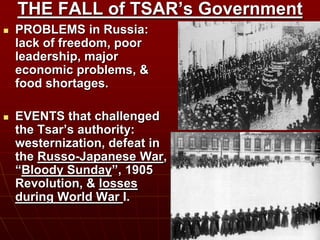
 PROBLEMS in Russia:
lack of freedom, poor
leadership, major
economic problems, &
food shortages.
 EVENTS that challenged
the Tsar’s authority:
westernization, defeat in
the Russo-Japanese War,
“Bloody Sunday”, 1905
Revolution, & losses
during World War I.
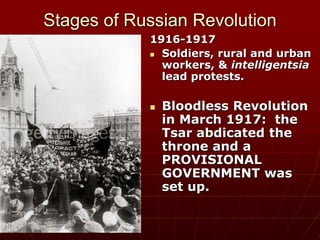
Stages of Russian Revolution
1916-1917
 Soldiers, rural and urban
workers, & intelligentsia
lead protests.
 Bloodless Revolution
in March 1917: the
Tsar abdicated the
throne and a
PROVISIONAL
GOVERNMENT was
set up.
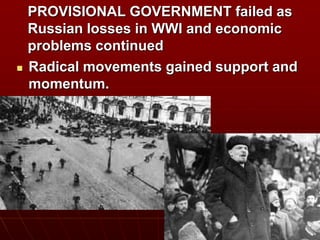
PROVISIONAL GOVERNMENT failed as
Russian losses in WWI and economic
problems continued
 Radical movements gained support and
momentum.
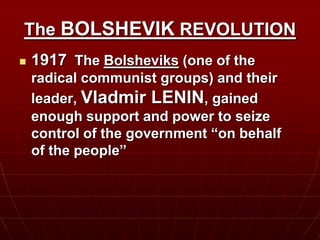
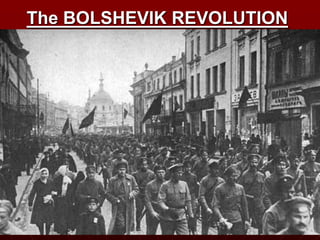
The BOLSHEVIK REVOLUTION
 1917 The Bolsheviks (one of the
radical communist groups) and their
leader, Vladmir LENIN, gained
enough support and power to seize
control of the government “on behalf
of the people”
The BOLSHEVIK REVOLUTION
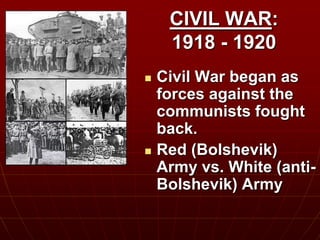
CIVIL WAR:
1918 - 1920
 Civil War began as
forces against the
communists fought
back.
 Red (Bolshevik)
Army vs. White (anti-
Bolshevik) Army
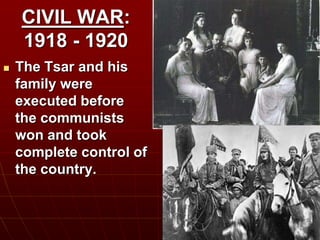
CIVIL WAR:
1918 - 1920
 The Tsar and his
family were
executed before
the communists
won and took
complete control of
the country.
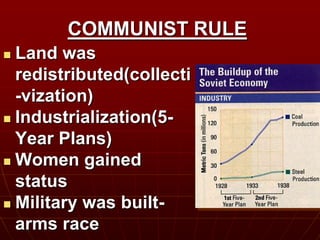
COMMUNIST RULE
 Land was
redistributed(collecti
-vization)
 Industrialization(5-
Year Plans)
 Women gained
status
 Military was built-
arms race
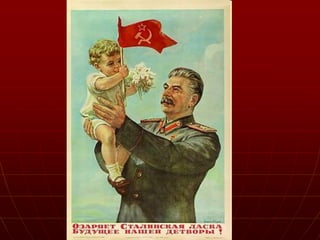
Joseph StalinJoseph Stalin
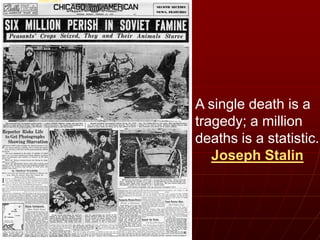
A single death is a
tragedy; a million
deaths is a statistic.
Joseph Stalin
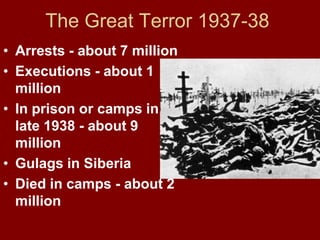
The Great Terror 1937-38
• Arrests - about 7 million
• Executions - about 1
million
• In prison or camps in
late 1938 - about 9
million
• Gulags in Siberia
• Died in camps - about 2
million
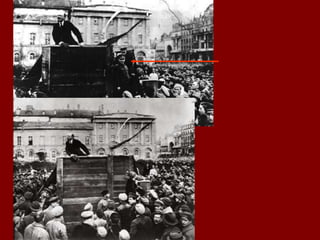
There’s Trotsky at a
Lenin speech.
Where’d he go?
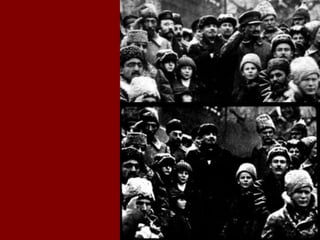
There’s Trotsky again
with Lenin.
Where’d he go?
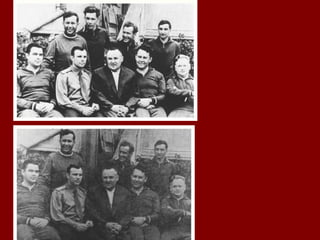
Original cosmonauts
The guy in the back fell
out of favor. Where’d
he go?
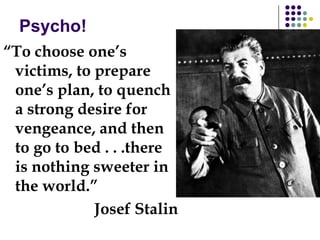
Psycho!
“To choose one’s
victims, to prepare
one’s plan, to quench
a strong desire for
vengeance, and then
to go to bed . . .there
is nothing sweeter in
the world.”
Josef Stalin

Intro ussr communist 2014

  • 1.
    Communist Revolutions in Russiaand China  Before the revolutions – monarchs from a long lasting dynasty • QING – 1644-1912 • Romanov Tsars – 1300s to 1918  PROBLEMS – economic, social class tensions, rebellions  Revolution part 1 – Dynasty fell and a provisional government took over  Problems continue, Provisional government fails, radicals gain power  Civil War –  Communists win  1921-1991 Soviet Union  1949 - ? Peoples Republic of China
  • 2.
    -Socialism – The meansof production (businesses and services) are owned by the ―public‖ and operated for the good of all. The government controls key industries and thus parts of the economy. -Marxism / Communism -  A radical type of socialism based upon the belief that:  the working class majority would unite and forcibly take the political and economic power from the wealthy minority—who took advantage of them.  The working class would then control the government, industry and agriculture.  Worker councils would govern ―democratically‖. Goods and services, profits and benefits would be shared equally. Eventually, a classless society would develop.
  • 3.
  • 4.
    Russian Revolution & CommunistRussia Russia = Soviet Union = USSR
  • 5.
    THE FALL ofTSAR’s Government  PROBLEMS in Russia: lack of freedom, poor leadership, major economic problems, & food shortages.  EVENTS that challenged the Tsar’s authority: westernization, defeat in the Russo-Japanese War, “Bloody Sunday”, 1905 Revolution, & losses during World War I.
  • 6.
    Stages of RussianRevolution 1916-1917  Soldiers, rural and urban workers, & intelligentsia lead protests.  Bloodless Revolution in March 1917: the Tsar abdicated the throne and a PROVISIONAL GOVERNMENT was set up.
  • 7.
    PROVISIONAL GOVERNMENT failedas Russian losses in WWI and economic problems continued  Radical movements gained support and momentum.
  • 8.
    The BOLSHEVIK REVOLUTION 1917 The Bolsheviks (one of the radical communist groups) and their leader, Vladmir LENIN, gained enough support and power to seize control of the government “on behalf of the people”
  • 9.
  • 10.
    CIVIL WAR: 1918 -1920  Civil War began as forces against the communists fought back.  Red (Bolshevik) Army vs. White (anti- Bolshevik) Army
  • 11.
    CIVIL WAR: 1918 -1920  The Tsar and his family were executed before the communists won and took complete control of the country.
  • 12.
    COMMUNIST RULE  Landwas redistributed(collecti -vization)  Industrialization(5- Year Plans)  Women gained status  Military was built- arms race
  • 15.
    Joseph StalinJoseph Stalin Asingle death is a tragedy; a million deaths is a statistic. Joseph Stalin
  • 16.
    The Great Terror1937-38 • Arrests - about 7 million • Executions - about 1 million • In prison or camps in late 1938 - about 9 million • Gulags in Siberia • Died in camps - about 2 million
  • 17.
    There’s Trotsky ata Lenin speech. Where’d he go?
  • 18.
    There’s Trotsky again withLenin. Where’d he go?
  • 19.
    Original cosmonauts The guyin the back fell out of favor. Where’d he go?
  • 20.
    Psycho! “To choose one’s victims,to prepare one’s plan, to quench a strong desire for vengeance, and then to go to bed . . .there is nothing sweeter in the world.” Josef Stalin