


A.A.J.K.Eranga
11/AG/765
EG - 765
Oct,03, 2016
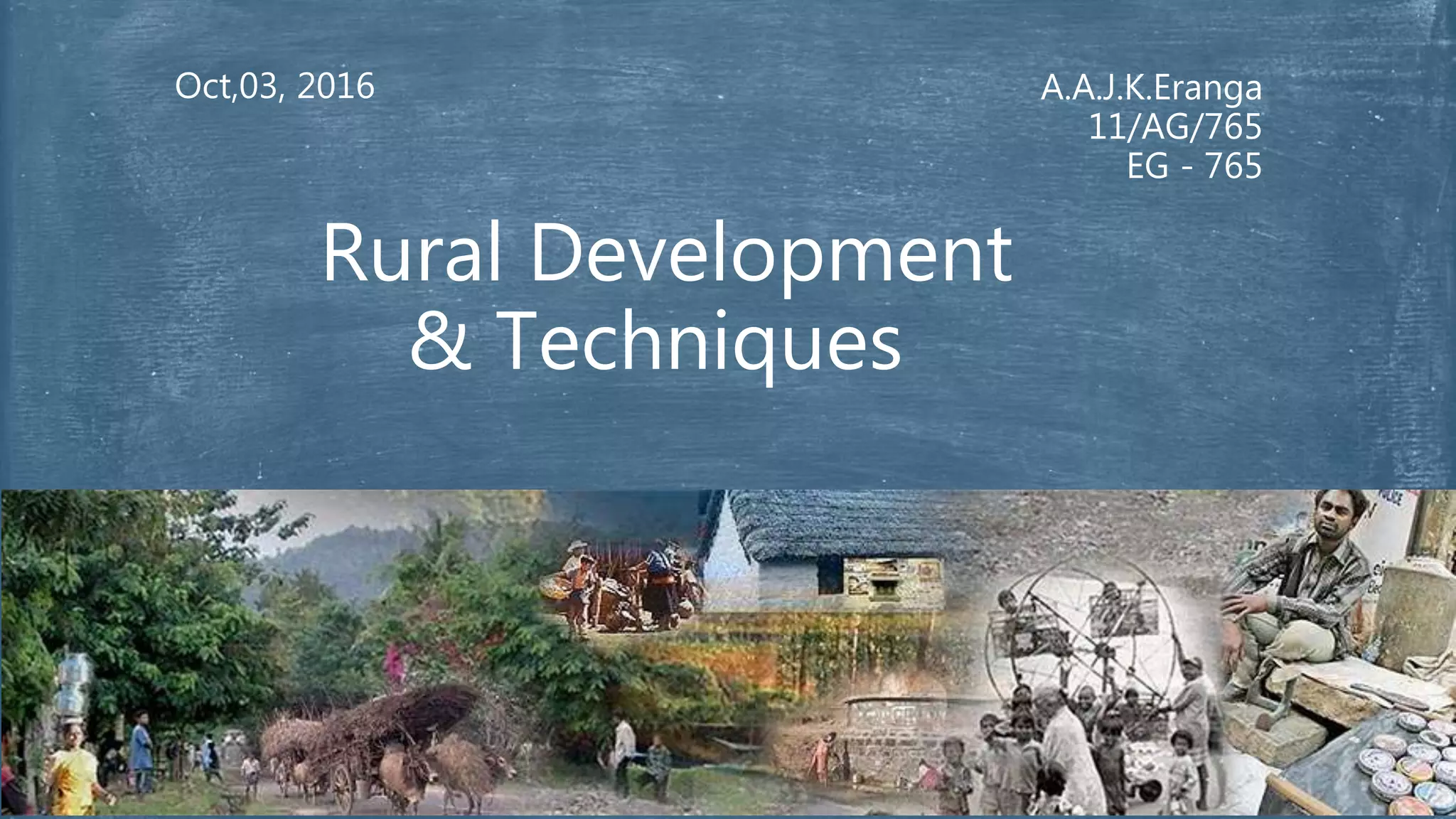
Rural Development
& Techniques
2
 Introduction
 Summary of rural development
 Development techniques & methods
 Empowerment of rural
 Keys to empowerment
 Power decentralization
 Good governance
 Participation of rural community
 Integrated system of rural development
 Present status & Programmes
 Conclusion
 Questions & discussion
Content
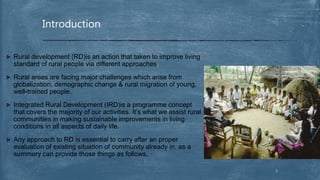
 Rural development (RD)is an action that taken to improve living
standard of rural people via different approaches.
 Rural areas are facing major challenges which arise from
globalization, demographic change & rural migration of young,
well-trained people.
 Integrated Rural Development (IRD)is a programme concept
that covers the majority of our activities. It’s what we assist rural
communities in making sustainable improvements in living
conditions in all aspects of daily life.
 Any approach to RD is essential to carry after an proper
evaluation of existing situation of community already in. as a
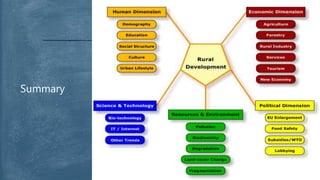
summery can provide those things as follows,
Introduction
3
Summary
4
 Key aspects
 Empowerment of rural people
 Power decentralization
 Good governance
 Participation of rural community
Add your procedure here
RD techniques / Methods
5
 Empowerment of rural people
 Earlier strategies stated that they’re lack of efficiency &
productive to meet economical aspects of rural community.
 It requires management structure to change their attitudes &
behavior.
 Important decades of 1950 – 1960s & 1970 – 1980s
 There are several pros and cons in such programs
 Self – help groups & role of NGO in RD.
6
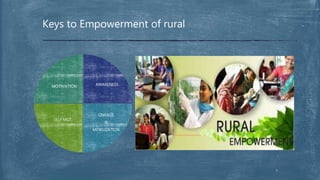
AWARENESS
LINKAGE
&
MOBILIZATION
SELF MGT.
MOTIVATION
Keys to Empowerment of rural
7
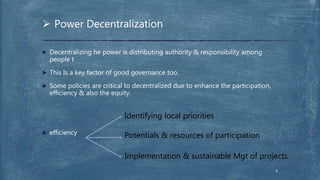
 Decentralizing he power is distributing authority & responsibility among
people t
 This Is a key factor of good governance too.
 Some policies are critical to decentralized due to enhance the participation,
efficiency & also the equity.
 efficiency
 Power Decentralization
Identifying local priorities
Potentials & resources of participation
Implementation & sustainable Mgt of projects
8
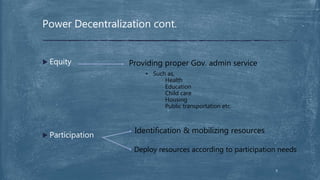
 Equity
 Participation
Power Decentralization cont.
Providing proper Gov. admin service
• Such as,
Health
Education
Child care
Housing
Public transportation etc.
Identification & mobilizing resources
Deploy resources according to participation needs
9
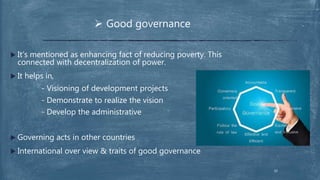
 It’s mentioned as enhancing fact of reducing poverty. This
connected with decentralization of power.
 It helps in,
- Visioning of development projects
- Demonstrate to realize the vision
- Develop the administrative
 Governing acts in other countries
 International over view & traits of good governance
 Good governance
10
 Sensitizing people to make them more responsive to development programs & to
encourage local initiatives & self-help.
 The more participation is better than less & that past development strategies failed
through its absence.
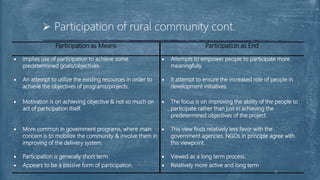
 Participation as a mean - use of participation to achieve some pre-determined goals,
achieve aims & objectives of development programs & projects more efficiently,
effectively or cheaply (Burkey, 1993; Nelson and Wright, 1995; Oakley, 1991).
 Participation as an end - an active, dynamic, genuine process which unfolds over time
& whose purpose is to develop, strengthen capabilities of rural people to intervene
more directly in development initiatives (Cooke and Kothari, 2001; Oakley, 1991)
 Participation of rural community
11
Participation as Means Participation as End
 Implies use of participation to achieve some
predetermined goals/objectives.
 Attempts to empower people to participate more
meaningfully.
 An attempt to utilize the existing resources in order to
achieve the objectives of programs/projects.
 It attempt to ensure the increased role of people in
development initiatives.
 Motivation is on achieving objective & not so much on
act of participation itself.
 The focus is on improving the ability of the people to
participate rather than just in achieving the
predetermined objectives of the project.
 More common in government programs, where main
concern is to mobilize the community & involve them in
improving of the delivery system.
 This view finds relatively less favor with the
government agencies. NGOs in principle agree with
this viewpoint.
 Participation is generally short term.  Viewed as a long term process.
 Appears to be a passive form of participation.  Relatively more active and long term.
 Participation of rural community cont.
12
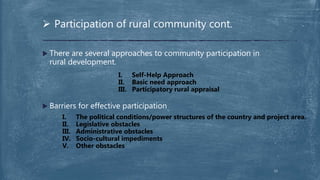
 There are several approaches to community participation in
rural development.
 Barriers for effective participation
 Participation of rural community cont.
I. Self-Help Approach
II. Basic need approach
III. Participatory rural appraisal
I. The political conditions/power structures of the country and project area.
II. Legislative obstacles
III. Administrative obstacles
IV. Socio-cultural impediments
V. Other obstacles
13
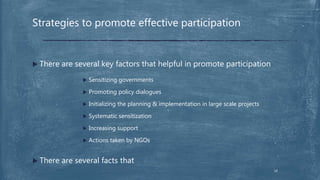
 There are several key factors that helpful in promote participation
 Sensitizing governments
 Promoting policy dialogues
 Initializing the planning & implementation in large scale projects
 Systematic sensitization
 Increasing support
 Actions taken by NGOs
 There are several facts that
Strategies to promote effective participation
14
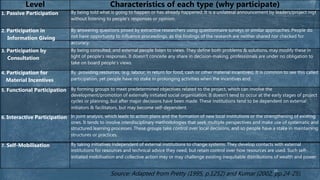
Level Characteristics of each type (why participate)
1. Passive Participation By being told what is going to happen or has already happened. It is a unilateral announcement by leaders/project mgt
without listening to people’s responses or opinion.
2. Participation in
Information Giving
By answering questions posed by extractive researchers using questionnaire surveys or similar approaches. People do
not have opportunity to influence proceedings, as the findings of the research are neither shared nor checked for
accuracy.
3. Participation by
Consultation
By being consulted, and external people listen to views. They define both problems & solutions, may modify these in
light of people’s responses. It doesn’t concede any share in decision-making, professionals are under no obligation to
take on board people’s views.
4. Participation for
Material Incentives
By providing resources, (e.g. labour, in return for food, cash or other material incentives). It is common to see this called
participation, yet people have no stake in prolonging activities when the incentives end.
5. Functional Participation By forming groups to meet predetermined objectives related to the project, which can involve the
development/promotion of externally initiated social organisation. It doesn’t tend to occur at the early stages of project
cycles or planning, but after major decisions have been made. These institutions tend to be dependent on external
initiators & facilitators, but may become self-dependent.
6. Interactive Participation In joint analysis, which leads to action plans and the formation of new local institutions or the strengthening of existing
ones. It tends to involve interdisciplinary methodologies that seek multiple perspectives and make use of systematic and
structured learning processes. These groups take control over local decisions, and so people have a stake in maintaining
structures or practices.
7. Self-Mobilisation By taking initiatives independent of external institutions to change systems. They develop contacts with external
institutions for resources and technical advice they need, but retain control over how resources are used. Such self-
initiated mobilisation and collective action may or may challenge existing inequitable distributions of wealth and power.
Source: Adapted from Pretty (1995, p.1252) and Kumar (2002, pp.24-25).
15
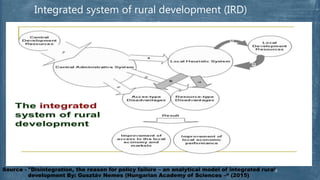
Integrated system of rural development (IRD)
Source - "Disintegration, the reason for policy failure – an analytical model of integrated rural
development By: Gusztáv Nemes (Hungarian Academy of Sciences –“ (2015)
16
Integrated rural development (IRD)
 It’s a process through which one economic, social,
environmental, cultural resources of rural communities are
organized in order to achieve & sustain the long term viability
of those communities.
 Differences of integrated & non integrated development models
are,
Flow of resources
Flow of information
Level of advancement & local development systems
17
Present status & Programmes
18
19
 Rural women in sustainable development
 Aids & NGOs role
 Government role of rural development
 What actually people required??
Conclusion
20
Questions & Discussion
21

Rural developement methods & techniques

  • 1.
    A.A.J.K.Eranga 11/AG/765 EG - 765 Oct,03,2016 Rural Development & Techniques
  • 2.
    2  Introduction  Summaryof rural development  Development techniques & methods  Empowerment of rural  Keys to empowerment  Power decentralization  Good governance  Participation of rural community  Integrated system of rural development  Present status & Programmes  Conclusion  Questions & discussion Content
  • 3.
     Rural development(RD)is an action that taken to improve living standard of rural people via different approaches.  Rural areas are facing major challenges which arise from globalization, demographic change & rural migration of young, well-trained people.  Integrated Rural Development (IRD)is a programme concept that covers the majority of our activities. It’s what we assist rural communities in making sustainable improvements in living conditions in all aspects of daily life.  Any approach to RD is essential to carry after an proper evaluation of existing situation of community already in. as a summery can provide those things as follows, Introduction 3
  • 4.
  • 5.
     Key aspects Empowerment of rural people  Power decentralization  Good governance  Participation of rural community Add your procedure here RD techniques / Methods 5
  • 6.
     Empowerment ofrural people  Earlier strategies stated that they’re lack of efficiency & productive to meet economical aspects of rural community.  It requires management structure to change their attitudes & behavior.  Important decades of 1950 – 1960s & 1970 – 1980s  There are several pros and cons in such programs  Self – help groups & role of NGO in RD. 6
  • 7.
  • 8.
     Decentralizing hepower is distributing authority & responsibility among people t  This Is a key factor of good governance too.  Some policies are critical to decentralized due to enhance the participation, efficiency & also the equity.  efficiency  Power Decentralization Identifying local priorities Potentials & resources of participation Implementation & sustainable Mgt of projects 8
  • 9.
     Equity  Participation PowerDecentralization cont. Providing proper Gov. admin service • Such as, Health Education Child care Housing Public transportation etc. Identification & mobilizing resources Deploy resources according to participation needs 9
  • 10.
     It’s mentionedas enhancing fact of reducing poverty. This connected with decentralization of power.  It helps in, - Visioning of development projects - Demonstrate to realize the vision - Develop the administrative  Governing acts in other countries  International over view & traits of good governance  Good governance 10
  • 11.
     Sensitizing peopleto make them more responsive to development programs & to encourage local initiatives & self-help.  The more participation is better than less & that past development strategies failed through its absence.  Participation as a mean - use of participation to achieve some pre-determined goals, achieve aims & objectives of development programs & projects more efficiently, effectively or cheaply (Burkey, 1993; Nelson and Wright, 1995; Oakley, 1991).  Participation as an end - an active, dynamic, genuine process which unfolds over time & whose purpose is to develop, strengthen capabilities of rural people to intervene more directly in development initiatives (Cooke and Kothari, 2001; Oakley, 1991)  Participation of rural community 11
  • 12.
    Participation as MeansParticipation as End  Implies use of participation to achieve some predetermined goals/objectives.  Attempts to empower people to participate more meaningfully.  An attempt to utilize the existing resources in order to achieve the objectives of programs/projects.  It attempt to ensure the increased role of people in development initiatives.  Motivation is on achieving objective & not so much on act of participation itself.  The focus is on improving the ability of the people to participate rather than just in achieving the predetermined objectives of the project.  More common in government programs, where main concern is to mobilize the community & involve them in improving of the delivery system.  This view finds relatively less favor with the government agencies. NGOs in principle agree with this viewpoint.  Participation is generally short term.  Viewed as a long term process.  Appears to be a passive form of participation.  Relatively more active and long term.  Participation of rural community cont. 12
  • 13.
     There areseveral approaches to community participation in rural development.  Barriers for effective participation  Participation of rural community cont. I. Self-Help Approach II. Basic need approach III. Participatory rural appraisal I. The political conditions/power structures of the country and project area. II. Legislative obstacles III. Administrative obstacles IV. Socio-cultural impediments V. Other obstacles 13
  • 14.
     There areseveral key factors that helpful in promote participation  Sensitizing governments  Promoting policy dialogues  Initializing the planning & implementation in large scale projects  Systematic sensitization  Increasing support  Actions taken by NGOs  There are several facts that Strategies to promote effective participation 14
  • 15.
    Level Characteristics ofeach type (why participate) 1. Passive Participation By being told what is going to happen or has already happened. It is a unilateral announcement by leaders/project mgt without listening to people’s responses or opinion. 2. Participation in Information Giving By answering questions posed by extractive researchers using questionnaire surveys or similar approaches. People do not have opportunity to influence proceedings, as the findings of the research are neither shared nor checked for accuracy. 3. Participation by Consultation By being consulted, and external people listen to views. They define both problems & solutions, may modify these in light of people’s responses. It doesn’t concede any share in decision-making, professionals are under no obligation to take on board people’s views. 4. Participation for Material Incentives By providing resources, (e.g. labour, in return for food, cash or other material incentives). It is common to see this called participation, yet people have no stake in prolonging activities when the incentives end. 5. Functional Participation By forming groups to meet predetermined objectives related to the project, which can involve the development/promotion of externally initiated social organisation. It doesn’t tend to occur at the early stages of project cycles or planning, but after major decisions have been made. These institutions tend to be dependent on external initiators & facilitators, but may become self-dependent. 6. Interactive Participation In joint analysis, which leads to action plans and the formation of new local institutions or the strengthening of existing ones. It tends to involve interdisciplinary methodologies that seek multiple perspectives and make use of systematic and structured learning processes. These groups take control over local decisions, and so people have a stake in maintaining structures or practices. 7. Self-Mobilisation By taking initiatives independent of external institutions to change systems. They develop contacts with external institutions for resources and technical advice they need, but retain control over how resources are used. Such self- initiated mobilisation and collective action may or may challenge existing inequitable distributions of wealth and power. Source: Adapted from Pretty (1995, p.1252) and Kumar (2002, pp.24-25). 15
  • 16.
    Integrated system ofrural development (IRD) Source - "Disintegration, the reason for policy failure – an analytical model of integrated rural development By: Gusztáv Nemes (Hungarian Academy of Sciences –“ (2015) 16
  • 17.
    Integrated rural development(IRD)  It’s a process through which one economic, social, environmental, cultural resources of rural communities are organized in order to achieve & sustain the long term viability of those communities.  Differences of integrated & non integrated development models are, Flow of resources Flow of information Level of advancement & local development systems 17
  • 18.
    Present status &Programmes 18
  • 19.
    19  Rural womenin sustainable development  Aids & NGOs role  Government role of rural development  What actually people required?? Conclusion
  • 20.
  • 21.