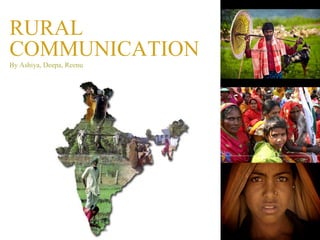
RURAL
COMMUNICATION
By Ashiya, Deepa, Reenu
SUMMARY
           Definition of rural market
                Nature of the market
Factors affecting consumer behavior
           Communication strategies
              Communication media
                                Cases
 Census definition: ‘that which is not urban’
• Urban areas are all locations with a municipality/corporation or a notified town
  area
• Urban areas are all other locations satisfying the following criteria
 A minimum population of 5000
 At least 75% of male working population engaged in non agricultural activities
 A population density of over 400 per sq km

 Rural market: The set of consumers who are located in rural area and who exhibit
  behavior that is different from those of consumers in urban areas. (Rural marketing
  opp. & challenges by sanal kumar velayudhan)
 Large but scattered population
 69.9% of Indians in rural areas as of 2010 (world bank report 2012)
 700 million people spread around 6,27,000 villages.
 87.5% of the rural population belongs to bottom of the pyramid (Dr. Simon j
  Evenet)
 More than 16 scheduled languages and 114 vernaculars

 Income
 Average income of less Rs.2000/- per month
 Rising monthly per capita expenditure (MPCE) increase of 64.6% in 2004-10
  period. (National Sample Survey)
 54 % to GDP
 About 50% of income comes from agriculture.
   Value consciousness
   Increasing literacy levels (10%)
   Accessibility and connectivity (273.5 million mobile connections),
   acceptance of technology
   brand consciousness
COMMUNICATION STRATEGY
   Education instead of promotion
   Interactive interesting and entertaining
   How benefits outweigh the costs
   Benefits in accordance with the needs and lifestyle.
   Demonstrations will help in achieving the purpose

 Regionalization of the advertisement
 Perceptions traditions and values vary from state to state
 MRF bullock cart tyres: in west UP bullock carts were small pulled by
  single bullock: East UP, bigger pulled by two bullocks: West UP spoke
  Hindusthani while east UP spoke Bhojpuri.
 Emami signed Amithabh and Madhuri for north, but in Andhra they signed
  Chiranjeevi.
 Philips radio: TN -enga veetu super star (Rajanikant), AP- Maa inti mega
  star (Chiranjeevi). Has they used superstar it would have meant late N.T.
  Rao
 Philips used photo of villages own girl – to sell transistor TV’s so that rural
  audience can relate and perceives that product is for them

   Customisation of promotional message
   Use of Human elements
   Life stories having characters that customer can identify with
   Using aspirational urban model, but simple and direct communication
   Local language and dialect

 Role of mass media (reaches around 57% rural population)
 Cinema reaches 26%
 2 out of 5 Indians are unreachable by mass media
FORMAL/ CONVENTIONAL MEDIA

Do not provide the touch and feel of the product
 TV
• Tv is the most preferred (36% access to TV, 60% B&W) – power cuts are
  common and this restricts viewing time.
• Doordarshan most popular channel
 Print media (Print media reaches 23%)
 Radio (Reaches20.5% of rural population)
 Cinema (reach 26%)
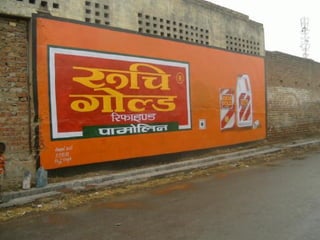
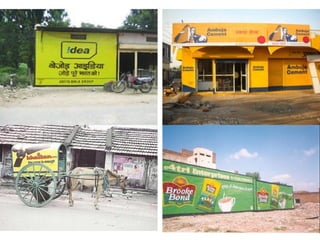
 Outdoor (wall paintings, hoardings, tree boards)
• Radio can reach a large number of poor people because it is
   affordable and uses little electricity.
• In 2000, AIR programmes could be heard in two-third of all Indian
   households in 24 languages and 146 dialects, over some 120 million
   radio sets.
• There are specific programmes for agriculturists like ‘Farm and
   Home Programme’ or ‘Krishi Darshan’ in all regional languages,
• Thus there is regular listener ship
• The main advantage is that it is cost effective medium.
• Colgate, Jyoti Laboratories, Zandu Balm, Juari Industries are
   somecompanies using radio for communication.
Eg. Nirma Jingle
http://www.youtube.com/watch?v=i-sx_NduQZs
Eg. Johnson & Johnson getting into rural markets through radio ads
https://www.youtube.com/watch?v=nYqK4Vy67Ns
INFORMAL/ RURAL SPECIFIC MEDIA
source: rural marketing: concepts and practices by Dogra


• Farm to farm/ house to house
 Hindustan lever (fair and lovely) in villages with population of 2000+ to
  expand user base
 Reached 10% of villages and 17% of households in MP,UP and Bihar
 46% brand conversions (35% was from non users)

• Group meetings
 MRF tractor owners meet (TOMEE)
 TAFE (direct contact exercises in 9 states – 44 centres): sales growth of
  12% after one month of campaign
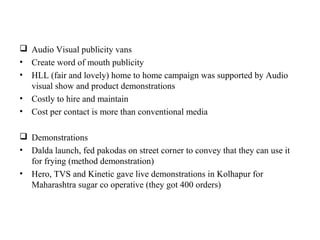
 Audio Visual publicity vans
• Create word of mouth publicity
• HLL (fair and lovely) home to home campaign was supported by Audio
  visual show and product demonstrations
• Costly to hire and maintain
• Cost per contact is more than conventional media

 Demonstrations
• Dalda launch, fed pakodas on street corner to convey that they can use it
  for frying (method demonstration)
• Hero, TVS and Kinetic gave live demonstrations in Kolhapur for
  Maharashtra sugar co operative (they got 400 orders)
   Opinion leaders
   Asian paints launched Utsav range during pre Diwali season.
   Painted house of pardhaan
   Paints doesn’t peel off
   Necessary for high value consumer durables and agricultural inputs.

 Mandis
 These are agricultural markets set up by govt. to procure agri. Produce
  from farmers
 Serve as a platform for product demo and on the spot sales
 In areas with population of 10000+ mandies can cater to 136000 people
 Used for promoting durables and agricultural products
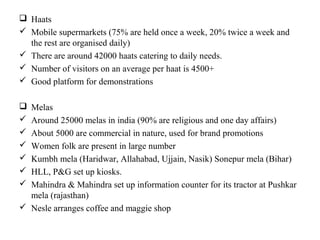
 Haats
 Mobile supermarkets (75% are held once a week, 20% twice a week and
  the rest are organised daily)
 There are around 42000 haats catering to daily needs.
 Number of visitors on an average per haat is 4500+
 Good platform for demonstrations

 Melas
 Around 25000 melas in india (90% are religious and one day affairs)
 About 5000 are commercial in nature, used for brand promotions
 Women folk are present in large number
 Kumbh mela (Haridwar, Allahabad, Ujjain, Nasik) Sonepur mela (Bihar)
 HLL, P&G set up kiosks.
 Mahindra & Mahindra set up information counter for its tractor at Pushkar
  mela (rajasthan)
 Nesle arranges coffee and maggie shop
 Good for introducing new brands and building brands
 When MART and IDE (International development enterprises) used haats
  and melas to promote and demonstrate treadle pumps and minor irrigation
  devices
 Sale went up by from less than 10000 to more than 100000

   Product display contests
   The manufacturer informs retailers about the contest in advance
   The best displays win prizes.
   Encourage stocking of the merchandise

 Pilgrim sites, Rural games etc are other avenues which can be utilized.
 Folk dances
 By Ogilvy rural for breeze soap (HLL)
 Rose was the symbol and was attack from Nirmas rose
 Breeze had essence of rose
 Wall paintings not effective (difficult to paint a realistic rose)
 Wheeled in an outsized bar of breeze (thermo Cole) on stage and smashed
  it and heaps of roses fell out
 Message went through

   Puppetry
   Popular in Rajasthan
   LIC uses it to educate masses in UP, Bihar and MP
   The number of inquiries at LIC offices after the show was higher.
 Street theatre
• Deeply rooted in the Indian tradition.
• This form is used to propagate social and political messages and to
  create an awareness regarding critical issues.
• Street theatre breaks the formal barriers and approaches the people
  directly.
Eg.
• http://www.youtube.com/watch?v=OsWzWCFvVyA

 Games
• Rajdoot (Yamaha) organizes wrestling competition for the villagers
  in which one of the wrestler brought by them. The other one is a
  villager.
• The winner get to test ride their bikes. The wrestling is a symbol of
  their products USP i.e ruggedness
ITC e- choupal

   ITC’s rural networking project.
https://www.youtube.com/watch?v=Fx4guk
• Initiative by ITC (2000)
• directly links the rural farmers with the company for the
  procurement of agriculture and aquaculture products, such
  as soybeans, coffee, and prawns
• Traditionally, these commodities were procured by such
  companies from mandis .
• The long supply chain resulted in high procurement costs
  for ITC and in lost profit opportunities for the farmers and
  reduction in quality.
• The PCs and Internet access at certain centres enable the
  farmers to obtain information on mandi prices , good
  farming practices, and to place orders for agricultural inputs,
  such as seeds and fertilizers.

• This access to information helps farmers in improving the
  quality of produce and obtaining better prices.

• A literate farmer elected from the village acts as the
  interface between the illiterate farmers and the computer.
How they did it
• A choupal was converted into an e-choupal by setting up a
  computer and Internet connectivity. An investment of
• Rs 40,000 was needed to establish an e-choupal with dial-up
  connectivity.
• E-choupals are operated by a sanchalak (operator), a literate
  person who is elected from among the farmers of the village
• ITC covers the cost of equipment, the sanchalak pays for day-to-
  day operational costs, such as electricity and Internet charges.
• Training is given to the sanchalak, who also act as an ITC
  salesman. He is paid a commission
• Roles of Intermediaries were redefined as samayojaks
  (coordinators), who assist ITC in setting up new e-choupals by
  conducting village surveys and by identifying the best
  sanchalaks.
• These coordinators earn a commission on product
  processed.
• The farmer carries a sample of his produce to a local kiosk
  and receives a spot quote from the sanchalak.
• If the farmer accepts the quote, he can then transport the
  produce directly to an ITC collection center and get
  payment within two hours.
• ITC coordinates its activities with institutions such as the
  national meteorological department ,several universities and
  and with companies supplying agricultural inputs to enable
  e commerce.
• The farmers prefer this system to the mandi system, where
  they had to wait for hours, or even days, before the produce
  was sold.
• Transaction costs such as bagging, transportation, loading, and
  unloading had to be incurred by the farmers.
• Access to information, inclusion of the representative and
  accountability of the system made this system very successful.
• covers 1,300 choupals, links 7,500 villages, and serves almost
  1 million farmers.
• ITC sourced US$15 million worth of commodities from e-
  choupals in 2001.
• The substantial quantity, already procured through this
  channel has resulted in overall savings of more than US$1
  million. These savings are shared between ITC and the
  farmers.
Selling Health: Hindustan Lever
 Limited and the Soap Market
Health Messages and the Rural Consumers

• HLL researched hygiene and hand washing practices and the
  trigger points for using soap among rural consumers.


• HLL determined the trigger for a consumer to wash his or her
  hands was to remove unpleasant contaminants, not to kill germs
  that cause infections.


• It was also found this perception of “visual clean is safe clean”
  leads to infrequent hand washing and limited use of soap.
• Results of research done among focus group in rural areas.


   – 5 of 13 washed their hands before eating
   – 10 of 18 washed their hands before preparing food
   – If they did wash hands, often used water or a proxy
     product for soap such as mud or ash.
   – after handling cow dung 5 of 7 rinsed their hands with
     water
   – one washed with mud, and one used soap.
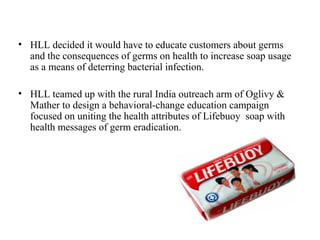
• HLL decided it would have to educate customers about germs
  and the consequences of germs on health to increase soap usage
  as a means of deterring bacterial infection.

• HLL teamed up with the rural India outreach arm of Oglivy &
  Mather to design a behavioral-change education campaign
  focused on uniting the health attributes of Lifebuoy soap with
  health messages of germ eradication.
• Firstly, HLL and Mather brainstormed a way to
  communicate the negative effects of “invisible” germs in an
  easily understandable and relevant message to the rural
  consumer.

• Highlighted the unique attribute of Lifebuoy soap, Active-
  B.

• HLL and Oglivy & Mather outlined the following key
  messages:

   – Invisible germs everywhere
• Germs cause diseases common to rural families including
  painful stomach, eye,and skin infections

• Lifebuoy soap with Active-B can protect you from germs.

• Wash your hands with Lifebuoy soap to prevent infection.
• HLL next embarked on the creation of a comprehensive
  program aimed at reaching all members in a rural village to
  create a sustained behavioral change.

• HLL titled the program Lifebuoy Swasthya Chetna, or
  Lifebuoy Glowing Health.

• HLL hoped to change the trigger for washing hands from
  “visual clean is safe clean” to social convention of frequent
  hand washing.
School and village presentation
• Children aged 5- 13
• Through stories
• Learn about germs how they cause diseases
• Importance of using soap and when to use
• Demonstration to show that Visual clean is not safe clean

Lifebuoy village health day
• Health camp and check up
• Village doctor as opinion leader
• Healthy child award
• Health skits and poems by kids to gain involvement
• Demonstrations and awards for best presenters
Diarrhea management workshop
• For young mothers and pregnant women
• Dangers of diarrhea
• Health checks

Launch of the Lifebuoy health club
• Formation of health club which includes activities centered
  on hygiene and keeping the village clean
• Facilitators return 4-6 times more
•   HLL created health based brand differentiation
•   Increased the sale of its low cost mass market soap
•   Built new habits, involving its brand
•   Built brand loyalty
•   Fulfilling its corporate purpose ‘to raise the quality of life’
India’s
Thirst for Rural Market
K subhadra & Sanjib Dutta. -ICFAI University
                   press
Coca cola India’s Rural Marketing
                   Strategy
•   Based on three A’s

1. Availability : availability of the product to customer

2. Affordability: Product Pricing

3. Acceptability : convincing the customer to buy the product
Acceptability
 Extensive marketing in the mass media and outdoor advertising

 Aggressive rural communication campaign consisting of

 Hoardings

 Participation in weekly mandis and annual haats

 3 TV commercials

 Print Advertisement in several regional newspapers
Hoardings and wall painting

• Put up hoardings in the
  villages

• Painted the name Coca cola
  on the compounds of the
  residences in the villages
Weekly mandies and haats
• Weekly Mandies :Weekly fairs where villages gather and
  sell their produce

• Annual Haats: Annual exhibitions conducted during festival
  season
      major sources of business activity and entertainment in
                                                   Rural India

                             By setting up temporary outlets
TV commercials
• Targeted at Rural consumers
• Increased Ad- spend on
  Doordarshan
• 2002
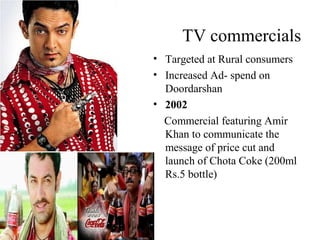
  Commercial featuring Amir
  Khan to communicate the
  message of price cut and
  launch of Chota Coke (200ml
  Rs.5 bottle)
2003 March- September
• To strengthen the brand image-
   aimed at making Coke a generic name for “thanda”- a popular
  dialect of North.

• Launched 3 commercials with tagline “Thanda matlab Coca- cola”-
  Aimed to make rural and semi urban consumers connect with Coca-
  Cola

• The 3 commercials showed progression in associating ‘Coke’ with
  ‘Thanda’.
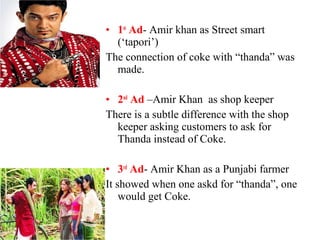
• 1st Ad- Amir khan as Street smart
  (‘tapori’)
The connection of coke with “thanda” was
  made.

• 2nd Ad –Amir Khan as shop keeper
There is a subtle difference with the shop
  keeper asking customers to ask for
  Thanda instead of Coke.

• 3rd Ad- Amir Khan as a Punjabi farmer
It showed when one askd for “thanda”, one
    would get Coke.
• Analysts says that the three commercials succeeded in
  making rural consumers connect to Coke

• It increased the brand awareness of the brand Coca cola
  among them.

Rural communication

  • 1.
  • 2.
    SUMMARY Definition of rural market Nature of the market Factors affecting consumer behavior Communication strategies Communication media Cases
  • 3.
     Census definition:‘that which is not urban’ • Urban areas are all locations with a municipality/corporation or a notified town area • Urban areas are all other locations satisfying the following criteria  A minimum population of 5000  At least 75% of male working population engaged in non agricultural activities  A population density of over 400 per sq km  Rural market: The set of consumers who are located in rural area and who exhibit behavior that is different from those of consumers in urban areas. (Rural marketing opp. & challenges by sanal kumar velayudhan)
  • 4.
     Large butscattered population  69.9% of Indians in rural areas as of 2010 (world bank report 2012)  700 million people spread around 6,27,000 villages.  87.5% of the rural population belongs to bottom of the pyramid (Dr. Simon j Evenet)  More than 16 scheduled languages and 114 vernaculars  Income  Average income of less Rs.2000/- per month  Rising monthly per capita expenditure (MPCE) increase of 64.6% in 2004-10 period. (National Sample Survey)  54 % to GDP  About 50% of income comes from agriculture.
  • 5.
    Value consciousness  Increasing literacy levels (10%)  Accessibility and connectivity (273.5 million mobile connections),  acceptance of technology  brand consciousness
  • 6.
    COMMUNICATION STRATEGY  Education instead of promotion  Interactive interesting and entertaining  How benefits outweigh the costs  Benefits in accordance with the needs and lifestyle.  Demonstrations will help in achieving the purpose  Regionalization of the advertisement  Perceptions traditions and values vary from state to state  MRF bullock cart tyres: in west UP bullock carts were small pulled by single bullock: East UP, bigger pulled by two bullocks: West UP spoke Hindusthani while east UP spoke Bhojpuri.  Emami signed Amithabh and Madhuri for north, but in Andhra they signed Chiranjeevi.
  • 7.
     Philips radio:TN -enga veetu super star (Rajanikant), AP- Maa inti mega star (Chiranjeevi). Has they used superstar it would have meant late N.T. Rao  Philips used photo of villages own girl – to sell transistor TV’s so that rural audience can relate and perceives that product is for them  Customisation of promotional message  Use of Human elements  Life stories having characters that customer can identify with  Using aspirational urban model, but simple and direct communication  Local language and dialect  Role of mass media (reaches around 57% rural population)  Cinema reaches 26%  2 out of 5 Indians are unreachable by mass media
  • 8.
    FORMAL/ CONVENTIONAL MEDIA Donot provide the touch and feel of the product  TV • Tv is the most preferred (36% access to TV, 60% B&W) – power cuts are common and this restricts viewing time. • Doordarshan most popular channel  Print media (Print media reaches 23%)  Radio (Reaches20.5% of rural population)  Cinema (reach 26%)  Outdoor (wall paintings, hoardings, tree boards)
  • 9.
    • Radio canreach a large number of poor people because it is affordable and uses little electricity. • In 2000, AIR programmes could be heard in two-third of all Indian households in 24 languages and 146 dialects, over some 120 million radio sets. • There are specific programmes for agriculturists like ‘Farm and Home Programme’ or ‘Krishi Darshan’ in all regional languages, • Thus there is regular listener ship • The main advantage is that it is cost effective medium. • Colgate, Jyoti Laboratories, Zandu Balm, Juari Industries are somecompanies using radio for communication. Eg. Nirma Jingle http://www.youtube.com/watch?v=i-sx_NduQZs Eg. Johnson & Johnson getting into rural markets through radio ads https://www.youtube.com/watch?v=nYqK4Vy67Ns
  • 12.
    INFORMAL/ RURAL SPECIFICMEDIA source: rural marketing: concepts and practices by Dogra • Farm to farm/ house to house  Hindustan lever (fair and lovely) in villages with population of 2000+ to expand user base  Reached 10% of villages and 17% of households in MP,UP and Bihar  46% brand conversions (35% was from non users) • Group meetings  MRF tractor owners meet (TOMEE)  TAFE (direct contact exercises in 9 states – 44 centres): sales growth of 12% after one month of campaign
  • 13.
     Audio Visualpublicity vans • Create word of mouth publicity • HLL (fair and lovely) home to home campaign was supported by Audio visual show and product demonstrations • Costly to hire and maintain • Cost per contact is more than conventional media  Demonstrations • Dalda launch, fed pakodas on street corner to convey that they can use it for frying (method demonstration) • Hero, TVS and Kinetic gave live demonstrations in Kolhapur for Maharashtra sugar co operative (they got 400 orders)
  • 14.
    Opinion leaders  Asian paints launched Utsav range during pre Diwali season.  Painted house of pardhaan  Paints doesn’t peel off  Necessary for high value consumer durables and agricultural inputs.  Mandis  These are agricultural markets set up by govt. to procure agri. Produce from farmers  Serve as a platform for product demo and on the spot sales  In areas with population of 10000+ mandies can cater to 136000 people  Used for promoting durables and agricultural products
  • 15.
     Haats  Mobilesupermarkets (75% are held once a week, 20% twice a week and the rest are organised daily)  There are around 42000 haats catering to daily needs.  Number of visitors on an average per haat is 4500+  Good platform for demonstrations  Melas  Around 25000 melas in india (90% are religious and one day affairs)  About 5000 are commercial in nature, used for brand promotions  Women folk are present in large number  Kumbh mela (Haridwar, Allahabad, Ujjain, Nasik) Sonepur mela (Bihar)  HLL, P&G set up kiosks.  Mahindra & Mahindra set up information counter for its tractor at Pushkar mela (rajasthan)  Nesle arranges coffee and maggie shop
  • 16.
     Good forintroducing new brands and building brands  When MART and IDE (International development enterprises) used haats and melas to promote and demonstrate treadle pumps and minor irrigation devices  Sale went up by from less than 10000 to more than 100000  Product display contests  The manufacturer informs retailers about the contest in advance  The best displays win prizes.  Encourage stocking of the merchandise  Pilgrim sites, Rural games etc are other avenues which can be utilized.
  • 17.
     Folk dances By Ogilvy rural for breeze soap (HLL)  Rose was the symbol and was attack from Nirmas rose  Breeze had essence of rose  Wall paintings not effective (difficult to paint a realistic rose)  Wheeled in an outsized bar of breeze (thermo Cole) on stage and smashed it and heaps of roses fell out  Message went through  Puppetry  Popular in Rajasthan  LIC uses it to educate masses in UP, Bihar and MP  The number of inquiries at LIC offices after the show was higher.
  • 18.
     Street theatre •Deeply rooted in the Indian tradition. • This form is used to propagate social and political messages and to create an awareness regarding critical issues. • Street theatre breaks the formal barriers and approaches the people directly. Eg. • http://www.youtube.com/watch?v=OsWzWCFvVyA  Games • Rajdoot (Yamaha) organizes wrestling competition for the villagers in which one of the wrestler brought by them. The other one is a villager. • The winner get to test ride their bikes. The wrestling is a symbol of their products USP i.e ruggedness
  • 19.
    ITC e- choupal ITC’s rural networking project. https://www.youtube.com/watch?v=Fx4guk
  • 20.
    • Initiative byITC (2000) • directly links the rural farmers with the company for the procurement of agriculture and aquaculture products, such as soybeans, coffee, and prawns • Traditionally, these commodities were procured by such companies from mandis . • The long supply chain resulted in high procurement costs for ITC and in lost profit opportunities for the farmers and reduction in quality.
  • 21.
    • The PCsand Internet access at certain centres enable the farmers to obtain information on mandi prices , good farming practices, and to place orders for agricultural inputs, such as seeds and fertilizers. • This access to information helps farmers in improving the quality of produce and obtaining better prices. • A literate farmer elected from the village acts as the interface between the illiterate farmers and the computer.
  • 22.
    How they didit • A choupal was converted into an e-choupal by setting up a computer and Internet connectivity. An investment of • Rs 40,000 was needed to establish an e-choupal with dial-up connectivity. • E-choupals are operated by a sanchalak (operator), a literate person who is elected from among the farmers of the village • ITC covers the cost of equipment, the sanchalak pays for day-to- day operational costs, such as electricity and Internet charges. • Training is given to the sanchalak, who also act as an ITC salesman. He is paid a commission • Roles of Intermediaries were redefined as samayojaks (coordinators), who assist ITC in setting up new e-choupals by conducting village surveys and by identifying the best sanchalaks.
  • 23.
    • These coordinatorsearn a commission on product processed. • The farmer carries a sample of his produce to a local kiosk and receives a spot quote from the sanchalak. • If the farmer accepts the quote, he can then transport the produce directly to an ITC collection center and get payment within two hours. • ITC coordinates its activities with institutions such as the national meteorological department ,several universities and and with companies supplying agricultural inputs to enable e commerce.
  • 24.
    • The farmersprefer this system to the mandi system, where they had to wait for hours, or even days, before the produce was sold. • Transaction costs such as bagging, transportation, loading, and unloading had to be incurred by the farmers. • Access to information, inclusion of the representative and accountability of the system made this system very successful. • covers 1,300 choupals, links 7,500 villages, and serves almost 1 million farmers. • ITC sourced US$15 million worth of commodities from e- choupals in 2001. • The substantial quantity, already procured through this channel has resulted in overall savings of more than US$1 million. These savings are shared between ITC and the farmers.
  • 25.
    Selling Health: HindustanLever Limited and the Soap Market
  • 26.
    Health Messages andthe Rural Consumers • HLL researched hygiene and hand washing practices and the trigger points for using soap among rural consumers. • HLL determined the trigger for a consumer to wash his or her hands was to remove unpleasant contaminants, not to kill germs that cause infections. • It was also found this perception of “visual clean is safe clean” leads to infrequent hand washing and limited use of soap.
  • 27.
    • Results ofresearch done among focus group in rural areas. – 5 of 13 washed their hands before eating – 10 of 18 washed their hands before preparing food – If they did wash hands, often used water or a proxy product for soap such as mud or ash. – after handling cow dung 5 of 7 rinsed their hands with water – one washed with mud, and one used soap.
  • 28.
    • HLL decidedit would have to educate customers about germs and the consequences of germs on health to increase soap usage as a means of deterring bacterial infection. • HLL teamed up with the rural India outreach arm of Oglivy & Mather to design a behavioral-change education campaign focused on uniting the health attributes of Lifebuoy soap with health messages of germ eradication.
  • 29.
    • Firstly, HLLand Mather brainstormed a way to communicate the negative effects of “invisible” germs in an easily understandable and relevant message to the rural consumer. • Highlighted the unique attribute of Lifebuoy soap, Active- B. • HLL and Oglivy & Mather outlined the following key messages: – Invisible germs everywhere
  • 30.
    • Germs causediseases common to rural families including painful stomach, eye,and skin infections • Lifebuoy soap with Active-B can protect you from germs. • Wash your hands with Lifebuoy soap to prevent infection.
  • 31.
    • HLL nextembarked on the creation of a comprehensive program aimed at reaching all members in a rural village to create a sustained behavioral change. • HLL titled the program Lifebuoy Swasthya Chetna, or Lifebuoy Glowing Health. • HLL hoped to change the trigger for washing hands from “visual clean is safe clean” to social convention of frequent hand washing.
  • 32.
    School and villagepresentation • Children aged 5- 13 • Through stories • Learn about germs how they cause diseases • Importance of using soap and when to use • Demonstration to show that Visual clean is not safe clean Lifebuoy village health day • Health camp and check up • Village doctor as opinion leader • Healthy child award • Health skits and poems by kids to gain involvement • Demonstrations and awards for best presenters
  • 33.
    Diarrhea management workshop •For young mothers and pregnant women • Dangers of diarrhea • Health checks Launch of the Lifebuoy health club • Formation of health club which includes activities centered on hygiene and keeping the village clean • Facilitators return 4-6 times more
  • 34.
    HLL created health based brand differentiation • Increased the sale of its low cost mass market soap • Built new habits, involving its brand • Built brand loyalty • Fulfilling its corporate purpose ‘to raise the quality of life’
  • 35.
    India’s Thirst for RuralMarket K subhadra & Sanjib Dutta. -ICFAI University press
  • 36.
    Coca cola India’sRural Marketing Strategy • Based on three A’s 1. Availability : availability of the product to customer 2. Affordability: Product Pricing 3. Acceptability : convincing the customer to buy the product
  • 37.
    Acceptability  Extensive marketingin the mass media and outdoor advertising  Aggressive rural communication campaign consisting of  Hoardings  Participation in weekly mandis and annual haats  3 TV commercials  Print Advertisement in several regional newspapers
  • 38.
    Hoardings and wallpainting • Put up hoardings in the villages • Painted the name Coca cola on the compounds of the residences in the villages
  • 39.
    Weekly mandies andhaats • Weekly Mandies :Weekly fairs where villages gather and sell their produce • Annual Haats: Annual exhibitions conducted during festival season  major sources of business activity and entertainment in Rural India  By setting up temporary outlets
  • 40.
    TV commercials • Targetedat Rural consumers • Increased Ad- spend on Doordarshan • 2002 Commercial featuring Amir Khan to communicate the message of price cut and launch of Chota Coke (200ml Rs.5 bottle)
  • 41.
    2003 March- September •To strengthen the brand image- aimed at making Coke a generic name for “thanda”- a popular dialect of North. • Launched 3 commercials with tagline “Thanda matlab Coca- cola”- Aimed to make rural and semi urban consumers connect with Coca- Cola • The 3 commercials showed progression in associating ‘Coke’ with ‘Thanda’.
  • 42.
    • 1st Ad-Amir khan as Street smart (‘tapori’) The connection of coke with “thanda” was made. • 2nd Ad –Amir Khan as shop keeper There is a subtle difference with the shop keeper asking customers to ask for Thanda instead of Coke. • 3rd Ad- Amir Khan as a Punjabi farmer It showed when one askd for “thanda”, one would get Coke.
  • 43.
    • Analysts saysthat the three commercials succeeded in making rural consumers connect to Coke • It increased the brand awareness of the brand Coca cola among them.

Editor's Notes

  • #7 Product demonstrations : if chik, colgate etc had relied on a 10 sec commercial, they would nt have been able to create a huge customer base. 30% population own tv sets (75% is black and white) Coca cola in 1990’s invested heavily on colourful ads, effect was lost.