ISSUES AND CHALLENGES RURAL MARKETING :   BY : Mahavir jain (M.B.A,MKTG.) 2005-2007 Faculty of management studies  Udaipur ,Rajasthan
 
Structure of the presentation  Rural India –an introduction Importance of rural marketing The rural market size Factors driving the growth Hurdles in rural marketing Major challenges for an Indian MBA Strategies for rural marketing Examples from the Indian corporate
DEFINATION OF URBAN AREA ACCORDING TO CENSUS-2001 1.  All places falling within the administrative limits of a municipal corparation,municipality,etc. and having a population of at least 5000. 2.  At least 75% male working population in outside the primary sector. 3.  The density of population should be at least 400 per square k.m.
Rural marketing framework : 1.  THE RURAL TO URBAN TRANSACTIONS These mainly include agricultural products like food grains ,oilseeds, cotton ,sugarcane etc.and finished products like handlooms, textiles, earthenware, brass- ware etc by rural industries, craftsmen and artisans that find a market in the urban areas.
2.  THE RURAL TO RURAL TRANSACTIONS Here production and consumption is limited to rural areas. It includes agricultural tools,baskets,ropes, household goods, earthenware etc produced by artisans like blacksmiths ,carpenters and cobblers.
3.  URBAN TO RURAL FLOW It is the flow of manufactured traded  goods namely consumables ,durables and agricultural inputs etc.
IMPORTANCE OF RURAL    MARKETING 1. Urban markets are becoming increasingly complex, competitive and saturated.  2. Large size of rural markets – 742 million people (73  %  of the population) 200 million households  (70% of total households)
FACTS SAYS IT ALL The annual consumer durable market for products like colour t.v’s,washing machines, refrigerators and air conditioners is growing at 7-10 %. While the rural market is zooming at 25 % . HAVE A LOOK….. F.m.c.g – Rs.65000 crores (53 % share in total revenues) Rs.5000 cr.for agri inputs
Rs.45000 cr.for tractors Rs.8000 cr.for two and four wheelers. 50 % of India’s national income is generated in rural India. HLL,Colgate Palmolive ,Toyato – 50 % revenues coming from rural areas. Hero Honda- 40 % Kinetic motors – 30 % Godrej- 30%
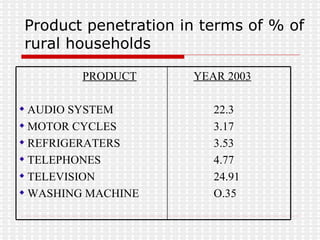
Product penetration in terms of % of rural households YEAR 2003 22.3 3.17 3.53 4.77  24.91 O.35 PRODUCT AUDIO SYSTEM MOTOR CYCLES REFRIGERATERS TELEPHONES TELEVISION  WASHING MACHINE
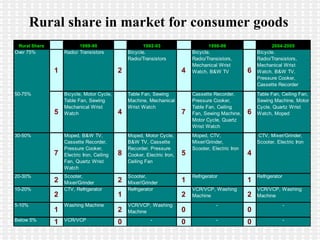
Rural share in market for consumer goods
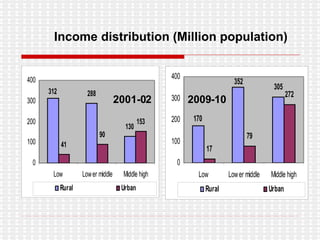
Income distribution (Million population) 2001-02 2009-10 2001-02
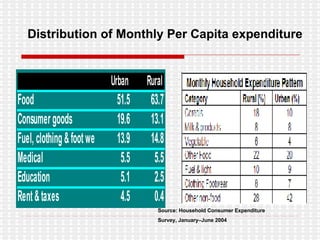
Distribution of Monthly Per Capita expenditure Source: Household Consumer Expenditure  Survey, January–June 2004
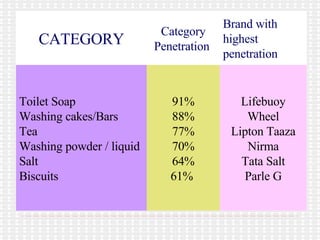
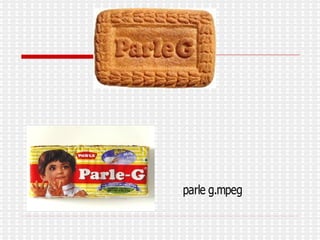
Lifebuoy Wheel Lipton Taaza Nirma Tata Salt Parle G 91% 88% 77% 70% 64% 61%  Toilet Soap Washing cakes/Bars Tea Washing powder / liquid Salt Biscuits  Brand with highest penetration Category Penetration   CATEGORY
 
CONTRIBUTING FACTORS 1.  Agriculture revolution Consistent good monsoons Better procurement prices fixed for various crops. Better yields due to many research  programs (HYV seeds provided by the government)
2. New improved tax structures 3. Spread of education 4. Improved infrastructure 5. Better banking facilities (financial assistance given by NABARD) 6. Government schemes like IRDP,JRY. 7. Increased expenditure in plan outlay (from 14000 cr.in 7 th  plan to 30,000 cr.in 8  th  plan.
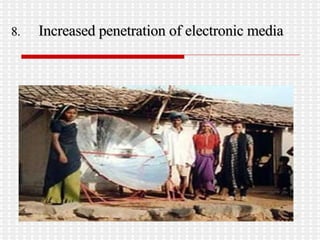
8.  Increased penetration of electronic media
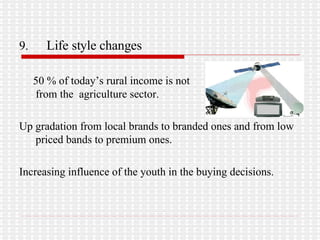
9.  Life style changes 50 % of today’s rural income is not  coming from the  agriculture sector. Up gradation from local brands to branded ones and from low  priced bands to premium ones. Increasing influence of the youth in the buying decisions.
HURDLES IN RURAL MARKETING High distribution costs Low per capita disposable income that is half the urban disposable income. Large no. of daily wage earners Acute dependence on the vagaries of the monsoons Seasonal consumption linked to harvest and festivals
6.   Inaccessibility to conventional advertising  media 7.   Poor roads,power problems 8.  Banking and credit problems 9.  High initial market development expenditure  10. Wholesaler and dealer network problems Contd.
11.  Highly dispersed and thinly populated markets  12.  Social and cultural backwardness of the rural  masses.  13.  Low  level of exposure to different product  categories and product brands. 14.  Cultural gap  between urban based marketers and  rural consumers.  Contd.
MAJOR CHALLENGES AVAILABLITY   First and the foremost challenge India's 6,38,365 villages are spread over 3.2 mn.sq.kms. 720 mn people-reaching them is not easy Given the poor state of roads ,it is an even greater challenge.
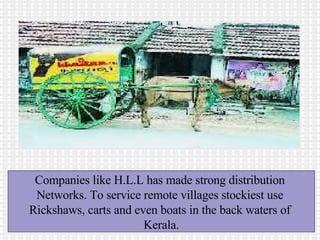
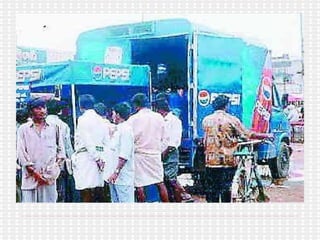
Companies like H.L.L has made strong distribution  Networks. To service remote villages stockiest use  Rickshaws, carts and even boats in the back waters of  Kerala.
AFFORDABLITY With low disposable incomes, products need to be affordable to rural consumers ,most of them are on daily wages. Some companies have addressed the affordability problem by introducing small unit packs : GODREJ   Introduced Cinthol and Fairglow in 50 gram  packs priced at rs.4 coca-cola   introduced  Sunfill ( a  powdered soft drink concentrate )  25 gram pack priced at rs.2
ACCEPTABLITY N ext challenge is to gain acceptability for the  product or service. Therefore there is a need to offer  products that suit the rural markets and conditions. coca-cola   is providing low cost ice-boxes because of the lack of electricity and refrigerators  in the rural areas.
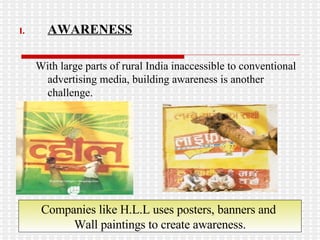
AWARENESS With large parts of rural India inaccessible to conventional advertising media, building awareness is another challenge. Companies like H.L.L uses posters, banners and  Wall paintings to create awareness.
STRATEGIES FOR RURAL MARKETING
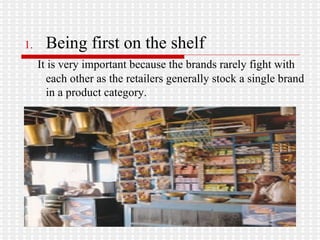
Being first on the shelf   It is very important because the brands rarely fight with each other as the retailers generally stock a single brand in a product category.
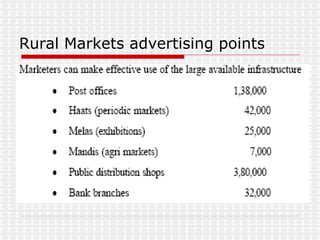
Different means of advertising A. H aats and melas A survey by MART (marketing and research team revealed that 47000 haats and 25000 melas take place every year in India. B.  Performance arts including theatres,songs,dance puppetry, magic shows etc.
Advantages Large visitor turnaround. These melas are held during post harvest season,  when the purchasing power of the people is more. The companies provide touch and feel demonstrations and  distributed  free samples.
 
Rural Markets advertising points
 
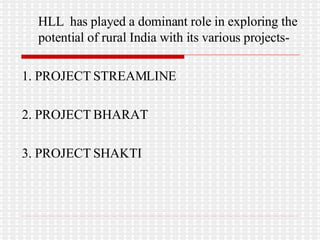
HLL  has played a dominant role in exploring the potential of rural India with its various projects- 1. PROJECT STREAMLINE 2. PROJECT BHARAT 3. PROJECT SHAKTI
CAVIN CARE This company first come out with the concept of sachets and it revolutionize the whole market, making the Chic shampoo the 2 nd  largest selling shampoo in India What followed was the flood of products  in small packing ranging from toothpaste,facecreams,soaps,hairoil etc.
NIRMA This company introduced the innovative technique of using video vans for marketing Nirma products . Advantages   Reach to interior parts Offer opportunity for personal interaction . Similar strategies helped Ghadi  to become the 3 rd  largest selling detergent.
L.G The top brass closed down on 2 points 1. The company figured that it needed new cheaper products to lure the rural buyers . The company did this by introducing a cheaper range of  TV's by the name of  “ Sampoorna”. 2. More offices in small town was the need of the hour. The company went on in a office opening spree  and currently it has 178 branch offices.
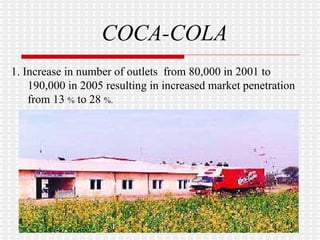
COCA-COLA 1. Increase in number of outlets  from 80,000 in 2001 to 190,000 in 2005 resulting in increased market penetration from 13  %  to 28  %.
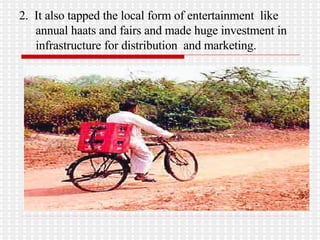
2.  It also tapped the local form of entertainment  like annual haats and fairs and made huge investment in infrastructure for distribution  and marketing.
3. It brought down the average price of its products from rs.10 to rs.5,therby bridging the gap between soft drinks and other local options like tea, buttermilk or lemon water. 4. It doubled the spend on doordarshan
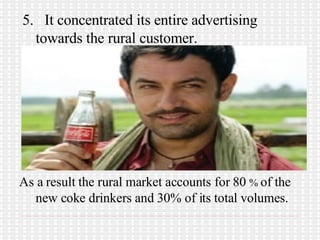
5.  It concentrated its entire advertising towards the rural customer. As a result the rural market accounts for 80  %  of the new coke drinkers and 30% of its total volumes.
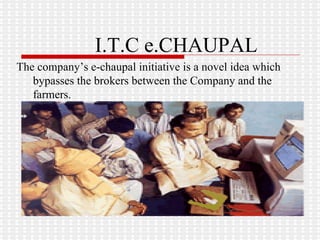
I.T.C e.CHAUPAL The company’s e-chaupal initiative is a novel idea which bypasses the brokers between the Company and the farmers.
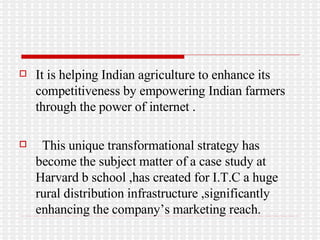
It is helping Indian agriculture to enhance its competitiveness by empowering Indian farmers through the power of internet . This unique transformational strategy has become the subject matter of a case study at Harvard b school ,has created for I.T.C a huge rural distribution infrastructure ,significantly enhancing the company’s marketing reach.
Formed in 1946,it is a brand name managed by an apex cooperative organization ,Gujarat co-operative milk marketing federation limited which today is jointly owned by some 2.41 million milk producers in Gujarat. It has been a sterling example of right mix of rural marketing and has established itself as a uniquely appropriate model for rural development.
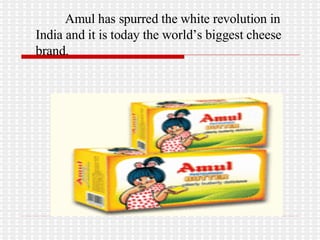
Amul has spurred the white revolution in India and it is today the world’s biggest cheese brand.
 
ONIDA The company introduced  its igo range  of t.v’s  priced cheaply at rs.5000 for 14 inches particularly to  cater  to the backward states like Bihar, Rajasthan and Uttar Pradesh.
CONCLUSION Looking at the challenges and the opportunities which rural markets offer to the marketers ,it can be said that the future is very promising for those who can understand the dynamics of rural markets and exploit them to their best advantage.
 

Rural Marketing

  • 1.
    ISSUESAND CHALLENGES RURAL MARKETING : BY : Mahavir jain (M.B.A,MKTG.) 2005-2007 Faculty of management studies Udaipur ,Rajasthan
  • 2.
  • 3.
    Structure of thepresentation Rural India –an introduction Importance of rural marketing The rural market size Factors driving the growth Hurdles in rural marketing Major challenges for an Indian MBA Strategies for rural marketing Examples from the Indian corporate
  • 4.
    DEFINATION OF URBANAREA ACCORDING TO CENSUS-2001 1. All places falling within the administrative limits of a municipal corparation,municipality,etc. and having a population of at least 5000. 2. At least 75% male working population in outside the primary sector. 3. The density of population should be at least 400 per square k.m.
  • 5.
    Rural marketing framework: 1. THE RURAL TO URBAN TRANSACTIONS These mainly include agricultural products like food grains ,oilseeds, cotton ,sugarcane etc.and finished products like handlooms, textiles, earthenware, brass- ware etc by rural industries, craftsmen and artisans that find a market in the urban areas.
  • 6.
    2. THERURAL TO RURAL TRANSACTIONS Here production and consumption is limited to rural areas. It includes agricultural tools,baskets,ropes, household goods, earthenware etc produced by artisans like blacksmiths ,carpenters and cobblers.
  • 7.
    3. URBANTO RURAL FLOW It is the flow of manufactured traded goods namely consumables ,durables and agricultural inputs etc.
  • 8.
    IMPORTANCE OF RURAL MARKETING 1. Urban markets are becoming increasingly complex, competitive and saturated. 2. Large size of rural markets – 742 million people (73 % of the population) 200 million households (70% of total households)
  • 9.
    FACTS SAYS ITALL The annual consumer durable market for products like colour t.v’s,washing machines, refrigerators and air conditioners is growing at 7-10 %. While the rural market is zooming at 25 % . HAVE A LOOK….. F.m.c.g – Rs.65000 crores (53 % share in total revenues) Rs.5000 cr.for agri inputs
  • 10.
    Rs.45000 cr.for tractorsRs.8000 cr.for two and four wheelers. 50 % of India’s national income is generated in rural India. HLL,Colgate Palmolive ,Toyato – 50 % revenues coming from rural areas. Hero Honda- 40 % Kinetic motors – 30 % Godrej- 30%
  • 11.
    Product penetration interms of % of rural households YEAR 2003 22.3 3.17 3.53 4.77 24.91 O.35 PRODUCT AUDIO SYSTEM MOTOR CYCLES REFRIGERATERS TELEPHONES TELEVISION WASHING MACHINE
  • 12.
    Rural share inmarket for consumer goods
  • 13.
    Income distribution (Millionpopulation) 2001-02 2009-10 2001-02
  • 14.
    Distribution of MonthlyPer Capita expenditure Source: Household Consumer Expenditure Survey, January–June 2004
  • 15.
    Lifebuoy Wheel LiptonTaaza Nirma Tata Salt Parle G 91% 88% 77% 70% 64% 61% Toilet Soap Washing cakes/Bars Tea Washing powder / liquid Salt Biscuits Brand with highest penetration Category Penetration CATEGORY
  • 16.
  • 17.
    CONTRIBUTING FACTORS 1. Agriculture revolution Consistent good monsoons Better procurement prices fixed for various crops. Better yields due to many research programs (HYV seeds provided by the government)
  • 18.
    2. New improvedtax structures 3. Spread of education 4. Improved infrastructure 5. Better banking facilities (financial assistance given by NABARD) 6. Government schemes like IRDP,JRY. 7. Increased expenditure in plan outlay (from 14000 cr.in 7 th plan to 30,000 cr.in 8 th plan.
  • 19.
    8. Increasedpenetration of electronic media
  • 20.
    9. Lifestyle changes 50 % of today’s rural income is not coming from the agriculture sector. Up gradation from local brands to branded ones and from low priced bands to premium ones. Increasing influence of the youth in the buying decisions.
  • 21.
    HURDLES IN RURALMARKETING High distribution costs Low per capita disposable income that is half the urban disposable income. Large no. of daily wage earners Acute dependence on the vagaries of the monsoons Seasonal consumption linked to harvest and festivals
  • 22.
    6. Inaccessibility to conventional advertising media 7. Poor roads,power problems 8. Banking and credit problems 9. High initial market development expenditure 10. Wholesaler and dealer network problems Contd.
  • 23.
    11. Highlydispersed and thinly populated markets 12. Social and cultural backwardness of the rural masses. 13. Low level of exposure to different product categories and product brands. 14. Cultural gap between urban based marketers and rural consumers. Contd.
  • 24.
    MAJOR CHALLENGES AVAILABLITY First and the foremost challenge India's 6,38,365 villages are spread over 3.2 mn.sq.kms. 720 mn people-reaching them is not easy Given the poor state of roads ,it is an even greater challenge.
  • 25.
    Companies like H.L.Lhas made strong distribution Networks. To service remote villages stockiest use Rickshaws, carts and even boats in the back waters of Kerala.
  • 26.
    AFFORDABLITY With lowdisposable incomes, products need to be affordable to rural consumers ,most of them are on daily wages. Some companies have addressed the affordability problem by introducing small unit packs : GODREJ Introduced Cinthol and Fairglow in 50 gram packs priced at rs.4 coca-cola introduced Sunfill ( a powdered soft drink concentrate ) 25 gram pack priced at rs.2
  • 27.
    ACCEPTABLITY N extchallenge is to gain acceptability for the product or service. Therefore there is a need to offer products that suit the rural markets and conditions. coca-cola is providing low cost ice-boxes because of the lack of electricity and refrigerators in the rural areas.
  • 28.
    AWARENESS With largeparts of rural India inaccessible to conventional advertising media, building awareness is another challenge. Companies like H.L.L uses posters, banners and Wall paintings to create awareness.
  • 29.
  • 30.
    Being first onthe shelf It is very important because the brands rarely fight with each other as the retailers generally stock a single brand in a product category.
  • 31.
    Different means ofadvertising A. H aats and melas A survey by MART (marketing and research team revealed that 47000 haats and 25000 melas take place every year in India. B. Performance arts including theatres,songs,dance puppetry, magic shows etc.
  • 32.
    Advantages Large visitorturnaround. These melas are held during post harvest season, when the purchasing power of the people is more. The companies provide touch and feel demonstrations and distributed free samples.
  • 33.
  • 34.
  • 35.
  • 36.
    HLL hasplayed a dominant role in exploring the potential of rural India with its various projects- 1. PROJECT STREAMLINE 2. PROJECT BHARAT 3. PROJECT SHAKTI
  • 37.
    CAVIN CARE Thiscompany first come out with the concept of sachets and it revolutionize the whole market, making the Chic shampoo the 2 nd largest selling shampoo in India What followed was the flood of products in small packing ranging from toothpaste,facecreams,soaps,hairoil etc.
  • 38.
    NIRMA This companyintroduced the innovative technique of using video vans for marketing Nirma products . Advantages Reach to interior parts Offer opportunity for personal interaction . Similar strategies helped Ghadi to become the 3 rd largest selling detergent.
  • 39.
    L.G The topbrass closed down on 2 points 1. The company figured that it needed new cheaper products to lure the rural buyers . The company did this by introducing a cheaper range of TV's by the name of “ Sampoorna”. 2. More offices in small town was the need of the hour. The company went on in a office opening spree and currently it has 178 branch offices.
  • 40.
    COCA-COLA 1. Increasein number of outlets from 80,000 in 2001 to 190,000 in 2005 resulting in increased market penetration from 13 % to 28 %.
  • 41.
    2. Italso tapped the local form of entertainment like annual haats and fairs and made huge investment in infrastructure for distribution and marketing.
  • 42.
    3. It broughtdown the average price of its products from rs.10 to rs.5,therby bridging the gap between soft drinks and other local options like tea, buttermilk or lemon water. 4. It doubled the spend on doordarshan
  • 43.
    5. Itconcentrated its entire advertising towards the rural customer. As a result the rural market accounts for 80 % of the new coke drinkers and 30% of its total volumes.
  • 44.
    I.T.C e.CHAUPAL Thecompany’s e-chaupal initiative is a novel idea which bypasses the brokers between the Company and the farmers.
  • 45.
    It is helpingIndian agriculture to enhance its competitiveness by empowering Indian farmers through the power of internet . This unique transformational strategy has become the subject matter of a case study at Harvard b school ,has created for I.T.C a huge rural distribution infrastructure ,significantly enhancing the company’s marketing reach.
  • 46.
    Formed in 1946,itis a brand name managed by an apex cooperative organization ,Gujarat co-operative milk marketing federation limited which today is jointly owned by some 2.41 million milk producers in Gujarat. It has been a sterling example of right mix of rural marketing and has established itself as a uniquely appropriate model for rural development.
  • 47.
    Amul has spurredthe white revolution in India and it is today the world’s biggest cheese brand.
  • 48.
  • 49.
    ONIDA The companyintroduced its igo range of t.v’s priced cheaply at rs.5000 for 14 inches particularly to cater to the backward states like Bihar, Rajasthan and Uttar Pradesh.
  • 50.
    CONCLUSION Looking atthe challenges and the opportunities which rural markets offer to the marketers ,it can be said that the future is very promising for those who can understand the dynamics of rural markets and exploit them to their best advantage.
  • 51.