PRICING STRATEGYPRICING STRATEGY
Most Important “P”Most Important “P”
 Price is the exchange valuePrice is the exchange value
of the product. It is theof the product. It is the
amount of money needed toamount of money needed to
acquire a product/ service.acquire a product/ service.
 Pricing is the most importantPricing is the most important
strategy in rural marketing.strategy in rural marketing.
Factors affecting Pricing: Internal & ExternalFactors affecting Pricing: Internal & External
Internal Influences: includes cost and company’s
pricing objectives. These are under the firm’s
control to make compatible with external
environment.
 Cost:Cost: the company has no choice but to devote
enough resources for production, distribution,production, distribution,
proper packaging, credits andproper packaging, credits and communicationcommunication
strategiesstrategies suitable for marketing.
Regional and local players take advantage of low
distribution costs and focused marketing efforts to
offer their products at competitive prices.
 Pricing:Pricing: must be compatible with the marketing
strategy, including target market selection and
positioning. This should have a balance between
quality on offer and price.
Pricing ObjectivesPricing Objectives
 Objectives include:Objectives include:
-profit maximizationprofit maximization in the long run (sell more
nos. and cheaper)
-minimum returnsminimum returns initially till consumers get
hooked (recover distribution and production
costs)
-deeper penetrationdeeper penetration of market (smaller packs)
-keeping up with the competitionkeeping up with the competition (Videocon
radios) etc.
-OthersOthers such as social & ethical reasons, Prestige
pricing etc.
Videocon StrategyVideocon Strategy
 Videocon was one of the first companies to
enter the rural market with a plethora of
products in the home appliances category. It
attacked market leader Philips by launching a
radio set for Rs.180 (Philips radio costs
Rs.250) and grabbed a major chunk of the
market. It continued with a similar strategy for
its black & white TV, ‘Washer’ washing
machine and Walky range of cassette players.
 External Influences:External Influences: The customers, suppliers,
competitors and the legal environment are key
issues that the company can do little about.
 Customers: their price-sensitivity is what affects
the company strategies. More than 90% of
rural population earns less than Rs. 1 lakh
per annum and income is seasonal for many.
 Thus biggies like Samsung and LG promote
their products during harvest season which also
coincides with the marriage season. Others
extend installment payment facilities to push
sales during the lean period by collaborating
with banks and finance companies.
Factors affecting Pricing: Internal & ExternalFactors affecting Pricing: Internal & External
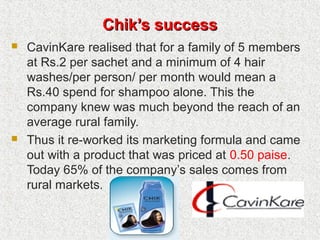
Chik’s successChik’s success
 CavinKare realised that for a family of 5 members
at Rs.2 per sachet and a minimum of 4 hair
washes/per person/ per month would mean a
Rs.40 spend for shampoo alone. This the
company knew was much beyond the reach of an
average rural family.
 Thus it re-worked its marketing formula and came
out with a product that was priced at 0.50 paise.
Today 65% of the company’s sales comes from
rural markets.
 Suppliers:Suppliers: Companies have to consider the compatibility with
the retail format and mode of payment. Usually the retailer in a
village is compelled to extend credit to his customers, while the
retailer in a haat sells only on cash as his customers come from
many surrounding villages. Companies may need to have sub-
stockists to extend distribution but again this would increase
channel costs.
 Competitors:Competitors: With rural market showing lots of potential, every
company has taken interest and stepped in to service the wants
of the consumer. With such a huge number of firms in this
market, both local players and MNCs find challenges from each
other.
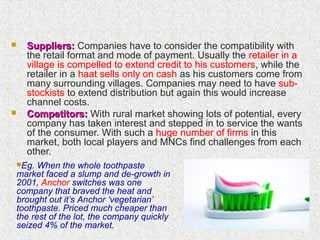
Eg. When the whole toothpaste
market faced a slump and de-growth in
2001, Anchor switches was one
company that braved the heat and
brought out it’s Anchor ‘vegetarian’
toothpaste. Priced much cheaper than
the rest of the lot, the company quickly
seized 4% of the market.
Honda: Self finance strategyHonda: Self finance strategy
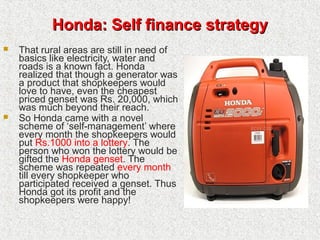
 That rural areas are still in need of
basics like electricity, water and
roads is a known fact. Honda
realized that though a generator was
a product that shopkeepers would
love to have, even the cheapest
priced genset was Rs. 20,000, which
was much beyond their reach.
 So Honda came with a novel
scheme of ‘self-management’ where
every month the shopkeepers would
put Rs.1000 into a lottery. The
person who won the lottery would be
gifted the Honda genset. The
scheme was repeated every month
till every shopkeeper who
participated received a genset. Thus
Honda got its profit and the
shopkeepers were happy!
Pricing StrategiesPricing Strategies
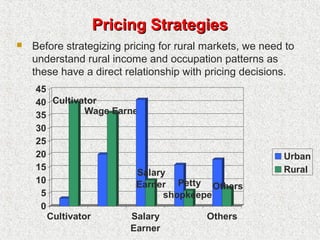
 Before strategizing pricing for rural markets, we need to
understand rural income and occupation patterns as
these have a direct relationship with pricing decisions.
Cultivator
Wage Earner
Salary
Earner Petty
shopkeeper
Others
0
5
10
15
20
25
30
35
40
45
Cultivator Salary
Earner
Others
Urban
Rural
 Optional Product Pricing: is the pricing of optional or
accessory products along with the main products. Eg.
Mahindra can sell its tractors for a lower price but
charge higher prices for servicing and spare parts.
Consumer durable giants like LG, Samsung, Onida and
Videocon are using this pricing strategy to penetrate into
villages and small towns.
 Captive Product Pricing: this is setting a price for products
that must be used along with the main product (similar to
Gillette’s strategy of pricing a ton for the blades). Also called
two-part pricing there is a fixed fee and variable usage
rates. Eg. BSNL offered free telephone connections to
rural consumers. ITC also kept no charges for its net
facilities but charged for other transactions when using
its e-Choupal
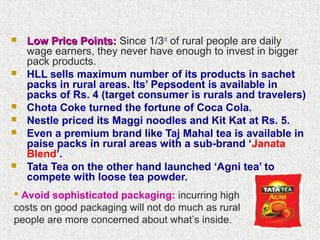
 Low Price Points:Low Price Points: Since 1/3rd
of rural people are daily
wage earners, they never have enough to invest in bigger
pack products.
 HLL sells maximum number of its products in sachet
packs in rural areas. Its’ Pepsodent is available in
packs of Rs. 4 (target consumer is rurals and travelers)
 Chota Coke turned the fortune of Coca Cola.
 Nestle priced its Maggi noodles and Kit Kat at Rs. 5.
 Even a premium brand like Taj Mahal tea is available in
paise packs in rural areas with a sub-brand ‘Janata
Blend’.
 Tata Tea on the other hand launched ‘Agni tea’ to
compete with loose tea powder.
 Avoid sophisticated packaging: incurring high
costs on good packaging will not do much as rural
people are more concerned about what’s inside.
 Refill and reusable packs: This would do wonders as
rural people associate such products with more value.
Thus Shell lubrication oil attracted a stream of truck
owners with its high-quality reusable containers.
 Highlight value, not price: Hero Honda CD 100Hero Honda CD 100
motorcycles are popular in rural areas as themotorcycles are popular in rural areas as the
company highlights mileage, maintenance costs andcompany highlights mileage, maintenance costs and
higher resale valuehigher resale value
 Product-bundled pricing: by combining several products
and offering as a bundle at a reduced price, the consumer
again sees it as increased value. It is extensively used
during the marriage season and festival times.
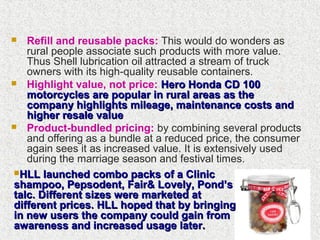
HLL launched combo packs of a ClinicHLL launched combo packs of a Clinic
shampoo, Pepsodent, Fair& Lovely, Pond’sshampoo, Pepsodent, Fair& Lovely, Pond’s
talc. Different sizes were marketed attalc. Different sizes were marketed at
different prices. HLL hoped that by bringingdifferent prices. HLL hoped that by bringing
in new users the company could gain fromin new users the company could gain from
awareness and increased usage later.awareness and increased usage later.
Market Entry StrategiesMarket Entry Strategies
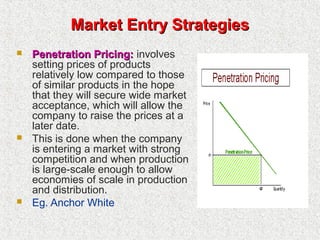
 Penetration Pricing:Penetration Pricing: involves
setting prices of products
relatively low compared to those
of similar products in the hope
that they will secure wide market
acceptance, which will allow the
company to raise the prices at a
later date.
 This is done when the company
is entering a market with strong
competition and when production
is large-scale enough to allow
economies of scale in production
and distribution.
 Eg. Anchor White
Farmers in Jeans?Farmers in Jeans?
 Arvind MillsArvind Mills did the same by
revolutionizing the concept of
Jeans pants. Studying the rural
market it found that an average
pair of jeans priced at Rs. 300
was much above the reach of
the rural consumer. There was
also scepticism in wearing
ready-made fit clothing.
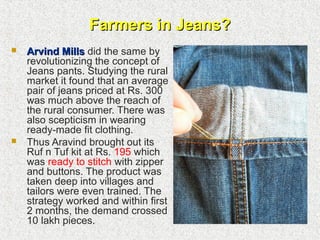
 Thus Aravind brought out its
Ruf n Tuf kit at Rs. 195 which
was ready to stitch with zipper
and buttons. The product was
taken deep into villages and
tailors were even trained. The
strategy worked and within first
2 months, the demand crossed
10 lakh pieces.
 Economy Pricing:Economy Pricing: no-frills low price. Cost of
marketing and manufacturing are minimized with
limited investments in branding. Targeting people
who are not bent on brands. Best for commodities
such as pulses, rice and spices.
 Value Pricing:Value Pricing: Done when increased competition
forces company to provide ‘value’ products at lower
prices. Eg. Godrej soaps offered rose,
sandalwood and neem ingredients at economic
prices.
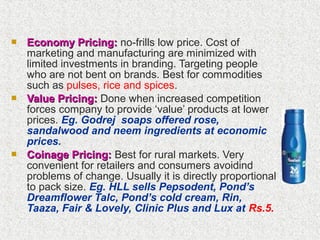
 Coinage Pricing:Coinage Pricing: Best for rural markets. Very
convenient for retailers and consumers avoidind
problems of change. Usually it is directly proportional
to pack size. Eg. HLL sells Pepsodent, Pond’s
Dreamflower Talc, Pond’s cold cream, Rin,
Taaza, Fair & Lovely, Clinic Plus and Lux at Rs.5.
 Psychological Pricing:Psychological Pricing: Pricing Bata at Rs.199.95 can have
tremendous results, although the consumer knows he is
paying Rs. 200. Consumers on the other hand also tend to
equate quality with pricing and so consider LG a better buy
than most other TVs since it is costlier. Thus the snop appeal
to R1 consumers also needs to be taken into consideration.
 Discounts:Discounts: Since rural people are highly price sensitive,
discounts are always a welcome sign to buy. But there might
also be a risk that consumers start believing that the
discounted price was the actual price and earlier the
company was charging a higher price!
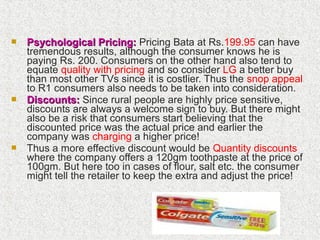
 Thus a more effective discount would be Quantity discounts
where the company offers a 120gm toothpaste at the price of
100gm. But here too in cases of flour, salt etc. the consumer
might tell the retailer to keep the extra and adjust the price!
 Free gift:Free gift: Most effective as a price adjustment strategy in rural
India. Must ensure the compatibility of the gift. Eg. Toothbrush
with toothpaste, cup with tea etc.
 The problem is that with bigger companies, the gifts usually do
not reach the end consumers. Retailers or stockists do not pass
on the free gift to end consumers. As rural consumers are
illiterate and ill-informed, they would not know even if it were
printed on pack. In many cases the retailer replaces the gift with
another substandard item which does more harm than good for
the company image.
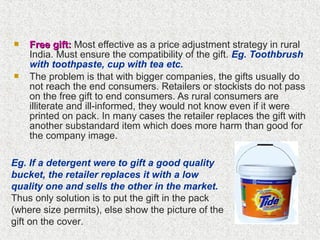
Eg. If a detergent were to gift a good quality
bucket, the retailer replaces it with a low
quality one and sells the other in the market.
Thus only solution is to put the gift in the pack
(where size permits), else show the picture of the
gift on the cover.
 Alternatively, paint the price as done by
asian paints and nerolac on the pack itself
for direct and easy communication.
 Special event pricing – Ex: Hero Honda
ran a van campaign before the harvest
season in rural areas and took bookings
against a token deposit of Rs. 500 and
gave a watch free in return. At harvest
time customers surrendered their booking
coupons to purchase bikes at discounted
rates.
Discriminatory pricingDiscriminatory pricing
 Customer segment pricing – Ex: A hospital
targeting the rural masses could charge
lower fees for women and senior citizen.
 Ex: Retailers do not pass information about
schemes and sell products at MRP to people
who buy on credit while offer the same
product at lower prices to people who buy on
cash.
 Product form pricing – Ex: Mosquito repellant
coils or mat packs are opened and sold piece
by piece at a higher unit price compared to
the pack price
 Locational pricing – Ex: People can buy
the product at a lower price in nearby
towns as compared to the price they
would be charged by the village retailer.
The product is also sold at a cheaper
price in haats.

Rural Pricing strategy

  • 1.
  • 2.
    Most Important “P”MostImportant “P”  Price is the exchange valuePrice is the exchange value of the product. It is theof the product. It is the amount of money needed toamount of money needed to acquire a product/ service.acquire a product/ service.  Pricing is the most importantPricing is the most important strategy in rural marketing.strategy in rural marketing.
  • 3.
    Factors affecting Pricing:Internal & ExternalFactors affecting Pricing: Internal & External Internal Influences: includes cost and company’s pricing objectives. These are under the firm’s control to make compatible with external environment.  Cost:Cost: the company has no choice but to devote enough resources for production, distribution,production, distribution, proper packaging, credits andproper packaging, credits and communicationcommunication strategiesstrategies suitable for marketing. Regional and local players take advantage of low distribution costs and focused marketing efforts to offer their products at competitive prices.  Pricing:Pricing: must be compatible with the marketing strategy, including target market selection and positioning. This should have a balance between quality on offer and price.
  • 4.
    Pricing ObjectivesPricing Objectives Objectives include:Objectives include: -profit maximizationprofit maximization in the long run (sell more nos. and cheaper) -minimum returnsminimum returns initially till consumers get hooked (recover distribution and production costs) -deeper penetrationdeeper penetration of market (smaller packs) -keeping up with the competitionkeeping up with the competition (Videocon radios) etc. -OthersOthers such as social & ethical reasons, Prestige pricing etc.
  • 5.
    Videocon StrategyVideocon Strategy Videocon was one of the first companies to enter the rural market with a plethora of products in the home appliances category. It attacked market leader Philips by launching a radio set for Rs.180 (Philips radio costs Rs.250) and grabbed a major chunk of the market. It continued with a similar strategy for its black & white TV, ‘Washer’ washing machine and Walky range of cassette players.
  • 6.
     External Influences:ExternalInfluences: The customers, suppliers, competitors and the legal environment are key issues that the company can do little about.  Customers: their price-sensitivity is what affects the company strategies. More than 90% of rural population earns less than Rs. 1 lakh per annum and income is seasonal for many.  Thus biggies like Samsung and LG promote their products during harvest season which also coincides with the marriage season. Others extend installment payment facilities to push sales during the lean period by collaborating with banks and finance companies. Factors affecting Pricing: Internal & ExternalFactors affecting Pricing: Internal & External
  • 7.
    Chik’s successChik’s success CavinKare realised that for a family of 5 members at Rs.2 per sachet and a minimum of 4 hair washes/per person/ per month would mean a Rs.40 spend for shampoo alone. This the company knew was much beyond the reach of an average rural family.  Thus it re-worked its marketing formula and came out with a product that was priced at 0.50 paise. Today 65% of the company’s sales comes from rural markets.
  • 8.
     Suppliers:Suppliers: Companieshave to consider the compatibility with the retail format and mode of payment. Usually the retailer in a village is compelled to extend credit to his customers, while the retailer in a haat sells only on cash as his customers come from many surrounding villages. Companies may need to have sub- stockists to extend distribution but again this would increase channel costs.  Competitors:Competitors: With rural market showing lots of potential, every company has taken interest and stepped in to service the wants of the consumer. With such a huge number of firms in this market, both local players and MNCs find challenges from each other. Eg. When the whole toothpaste market faced a slump and de-growth in 2001, Anchor switches was one company that braved the heat and brought out it’s Anchor ‘vegetarian’ toothpaste. Priced much cheaper than the rest of the lot, the company quickly seized 4% of the market.
  • 9.
    Honda: Self financestrategyHonda: Self finance strategy  That rural areas are still in need of basics like electricity, water and roads is a known fact. Honda realized that though a generator was a product that shopkeepers would love to have, even the cheapest priced genset was Rs. 20,000, which was much beyond their reach.  So Honda came with a novel scheme of ‘self-management’ where every month the shopkeepers would put Rs.1000 into a lottery. The person who won the lottery would be gifted the Honda genset. The scheme was repeated every month till every shopkeeper who participated received a genset. Thus Honda got its profit and the shopkeepers were happy!
  • 10.
    Pricing StrategiesPricing Strategies Before strategizing pricing for rural markets, we need to understand rural income and occupation patterns as these have a direct relationship with pricing decisions. Cultivator Wage Earner Salary Earner Petty shopkeeper Others 0 5 10 15 20 25 30 35 40 45 Cultivator Salary Earner Others Urban Rural
  • 11.
     Optional ProductPricing: is the pricing of optional or accessory products along with the main products. Eg. Mahindra can sell its tractors for a lower price but charge higher prices for servicing and spare parts. Consumer durable giants like LG, Samsung, Onida and Videocon are using this pricing strategy to penetrate into villages and small towns.  Captive Product Pricing: this is setting a price for products that must be used along with the main product (similar to Gillette’s strategy of pricing a ton for the blades). Also called two-part pricing there is a fixed fee and variable usage rates. Eg. BSNL offered free telephone connections to rural consumers. ITC also kept no charges for its net facilities but charged for other transactions when using its e-Choupal
  • 12.
     Low PricePoints:Low Price Points: Since 1/3rd of rural people are daily wage earners, they never have enough to invest in bigger pack products.  HLL sells maximum number of its products in sachet packs in rural areas. Its’ Pepsodent is available in packs of Rs. 4 (target consumer is rurals and travelers)  Chota Coke turned the fortune of Coca Cola.  Nestle priced its Maggi noodles and Kit Kat at Rs. 5.  Even a premium brand like Taj Mahal tea is available in paise packs in rural areas with a sub-brand ‘Janata Blend’.  Tata Tea on the other hand launched ‘Agni tea’ to compete with loose tea powder.  Avoid sophisticated packaging: incurring high costs on good packaging will not do much as rural people are more concerned about what’s inside.
  • 13.
     Refill andreusable packs: This would do wonders as rural people associate such products with more value. Thus Shell lubrication oil attracted a stream of truck owners with its high-quality reusable containers.  Highlight value, not price: Hero Honda CD 100Hero Honda CD 100 motorcycles are popular in rural areas as themotorcycles are popular in rural areas as the company highlights mileage, maintenance costs andcompany highlights mileage, maintenance costs and higher resale valuehigher resale value  Product-bundled pricing: by combining several products and offering as a bundle at a reduced price, the consumer again sees it as increased value. It is extensively used during the marriage season and festival times. HLL launched combo packs of a ClinicHLL launched combo packs of a Clinic shampoo, Pepsodent, Fair& Lovely, Pond’sshampoo, Pepsodent, Fair& Lovely, Pond’s talc. Different sizes were marketed attalc. Different sizes were marketed at different prices. HLL hoped that by bringingdifferent prices. HLL hoped that by bringing in new users the company could gain fromin new users the company could gain from awareness and increased usage later.awareness and increased usage later.
  • 14.
    Market Entry StrategiesMarketEntry Strategies  Penetration Pricing:Penetration Pricing: involves setting prices of products relatively low compared to those of similar products in the hope that they will secure wide market acceptance, which will allow the company to raise the prices at a later date.  This is done when the company is entering a market with strong competition and when production is large-scale enough to allow economies of scale in production and distribution.  Eg. Anchor White
  • 15.
    Farmers in Jeans?Farmersin Jeans?  Arvind MillsArvind Mills did the same by revolutionizing the concept of Jeans pants. Studying the rural market it found that an average pair of jeans priced at Rs. 300 was much above the reach of the rural consumer. There was also scepticism in wearing ready-made fit clothing.  Thus Aravind brought out its Ruf n Tuf kit at Rs. 195 which was ready to stitch with zipper and buttons. The product was taken deep into villages and tailors were even trained. The strategy worked and within first 2 months, the demand crossed 10 lakh pieces.
  • 16.
     Economy Pricing:EconomyPricing: no-frills low price. Cost of marketing and manufacturing are minimized with limited investments in branding. Targeting people who are not bent on brands. Best for commodities such as pulses, rice and spices.  Value Pricing:Value Pricing: Done when increased competition forces company to provide ‘value’ products at lower prices. Eg. Godrej soaps offered rose, sandalwood and neem ingredients at economic prices.  Coinage Pricing:Coinage Pricing: Best for rural markets. Very convenient for retailers and consumers avoidind problems of change. Usually it is directly proportional to pack size. Eg. HLL sells Pepsodent, Pond’s Dreamflower Talc, Pond’s cold cream, Rin, Taaza, Fair & Lovely, Clinic Plus and Lux at Rs.5.
  • 17.
     Psychological Pricing:PsychologicalPricing: Pricing Bata at Rs.199.95 can have tremendous results, although the consumer knows he is paying Rs. 200. Consumers on the other hand also tend to equate quality with pricing and so consider LG a better buy than most other TVs since it is costlier. Thus the snop appeal to R1 consumers also needs to be taken into consideration.  Discounts:Discounts: Since rural people are highly price sensitive, discounts are always a welcome sign to buy. But there might also be a risk that consumers start believing that the discounted price was the actual price and earlier the company was charging a higher price!  Thus a more effective discount would be Quantity discounts where the company offers a 120gm toothpaste at the price of 100gm. But here too in cases of flour, salt etc. the consumer might tell the retailer to keep the extra and adjust the price!
  • 18.
     Free gift:Freegift: Most effective as a price adjustment strategy in rural India. Must ensure the compatibility of the gift. Eg. Toothbrush with toothpaste, cup with tea etc.  The problem is that with bigger companies, the gifts usually do not reach the end consumers. Retailers or stockists do not pass on the free gift to end consumers. As rural consumers are illiterate and ill-informed, they would not know even if it were printed on pack. In many cases the retailer replaces the gift with another substandard item which does more harm than good for the company image. Eg. If a detergent were to gift a good quality bucket, the retailer replaces it with a low quality one and sells the other in the market. Thus only solution is to put the gift in the pack (where size permits), else show the picture of the gift on the cover.
  • 19.
     Alternatively, paintthe price as done by asian paints and nerolac on the pack itself for direct and easy communication.  Special event pricing – Ex: Hero Honda ran a van campaign before the harvest season in rural areas and took bookings against a token deposit of Rs. 500 and gave a watch free in return. At harvest time customers surrendered their booking coupons to purchase bikes at discounted rates.
  • 20.
    Discriminatory pricingDiscriminatory pricing Customer segment pricing – Ex: A hospital targeting the rural masses could charge lower fees for women and senior citizen.  Ex: Retailers do not pass information about schemes and sell products at MRP to people who buy on credit while offer the same product at lower prices to people who buy on cash.  Product form pricing – Ex: Mosquito repellant coils or mat packs are opened and sold piece by piece at a higher unit price compared to the pack price
  • 21.
     Locational pricing– Ex: People can buy the product at a lower price in nearby towns as compared to the price they would be charged by the village retailer. The product is also sold at a cheaper price in haats.