ANANDAPADMANABHAN J 
S 2. M.com
Deemed Export 
"Deemed Exports" refers to those transactions in 
which the goods supplied do not leave the country. 
Deemed export means that the goods are 
considered to have been exported even if they 
have not moved out of the country. Under 
deemed export, the goods can be sold within 
India to a anybody who holds a licence for 
import of these very goods. The seller selling the 
said goods against an import licence is the 
deemed exporter and the buyer is the deemed 
importer.
The following categories of supply of goods by the 
main/ sub-contractors shall be regarded as "Deemed 
Exports" under this Policy, provided the goods are 
manufactured in India: 
Supply of goods to Export Oriented Units 
(EOUs) or Software Technology Parks (STPs) or 
Electronic Hardware Technology Parks (EHTPs) 
or Bio Technology Parks (BTP); 
supply of capital goods to holders of licences 
under the Export Promotion Capital Goods 
(EPCG) scheme;
Supply of goods to nuclear power projects 
through competitive bidding as opposed to 
International Competitive Bidding. 
supply to projects funded by UN agencies.
Rupee Convertibility 
The term convertibility of a currency means that 
it can be freely converted into any other 
currency. It helps in the removal of quantitative 
restrictions on the trade. 
After the announcement of economic 
liberalisation in July 1991, Govt. of India 
announced partial convertibility of Rupee from 
March 1, 1992. Under this partial convertibility 
40% of the current account transactions were 
convertible in rupee at officially determined 
exchange rate and remaining 60% at market 
determined exchange rate.
The Govt. of India, in March 1993, 
introduced a fully unified market 
determined exchange rate system. Thus 
the unification of exchange rate and 
floating rupee was started in 1993-94. 
The final step is the announcement of 
full convertibility of the rupee on 
current account in August 1994 by 
accepting the obligation under article 
VII of the IMF.
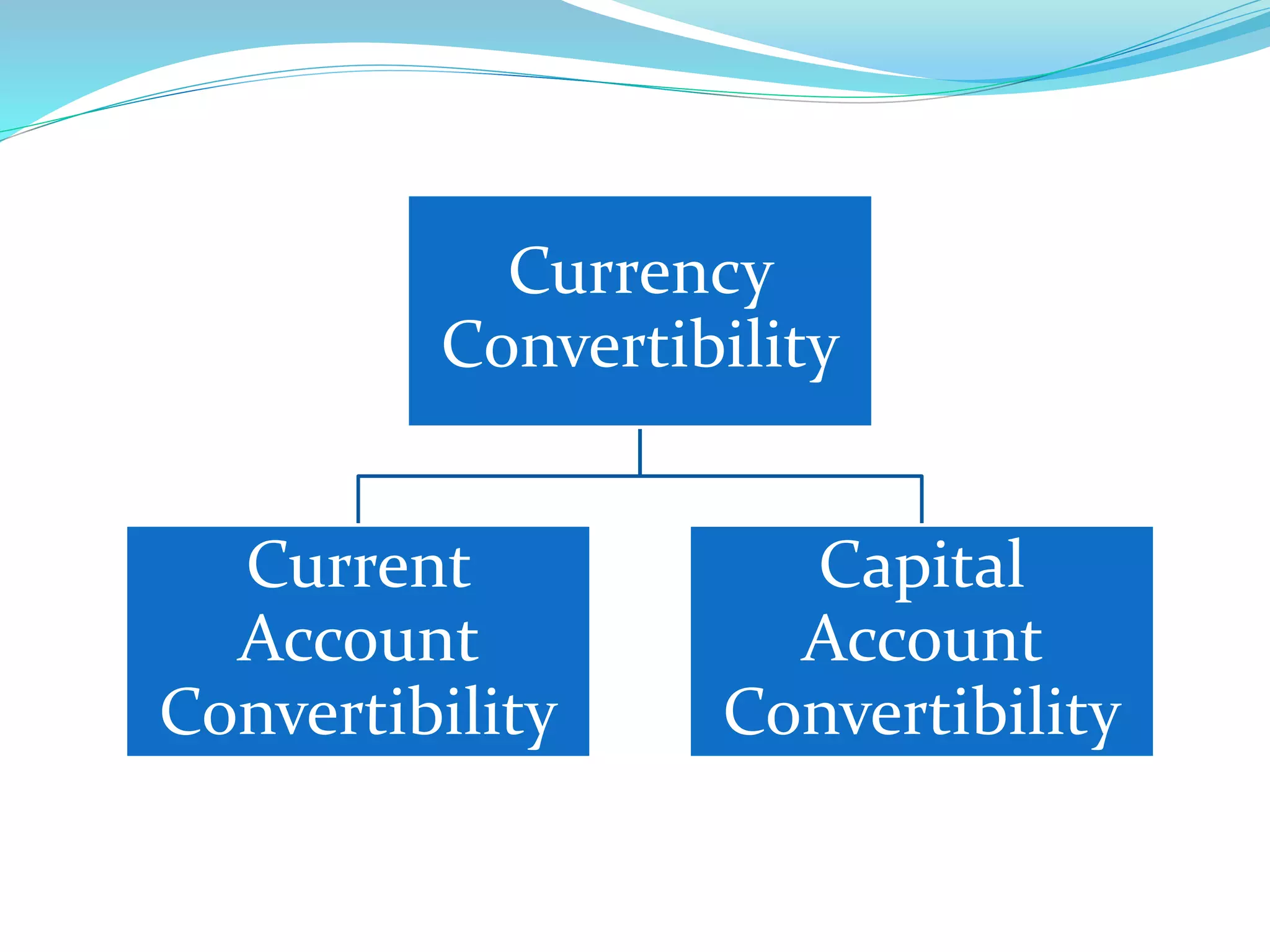
Currency 
Convertibility 
Current 
Account 
Convertibility 
Capital 
Account 
Convertibility
Current Account Convertibility 
Convertibility on current account is defined 
as, “the freedom to buy or sell foreign 
exchange for the following international 
transactions: 
All payments due in connection with foreign 
trade, other current business including 
services and normal short term banking and 
credit facilities. 
Pursuing Higher education abroad. 
Tourism. 
Moderate remittances for family living 
expenses.”
Implications 
Now the authorised dealers are 
empowered to release exchange without 
prior approval of Reserve Bank of India. 
Exporters find it easy to transact the 
business. 
Many bureaucratic hurdles are eliminated 
in the process of obtaining foreign exchange 
for imports. 
More than 100 countries in the world 
allowed full convertibility of their 
currencies on capital account.
Capital Account Convertibility 
Capital Account 
Convertibility (CAC) is the 
freedom to convert local 
financial assets into foreign 
financial assets at market 
determined exchange rates.
Non-Convertible capital 
Cuba(peso) and North Korea(won) 
Non participation in FOREX market 
Major challenge for domestic currencies 
there. 
Partial Convertible Capital- 
Indian Rupee 
RBI’s restriction on the inflow and outflow 
of capital 
Full Convertible Capital- 
US dollars 
No restrictions or limitation on the amount to 
be traded 
Thus, this is one of the major currency traded 
in FOREX market
Upto 1991, there was rigid control on 
both Capital and Current account. 
Capital account convertibility was 
introduced in India in August 1994. 
In 1997 the government had set up a 
committee (Tarapore committee) to spell 
out a road map for the full convertibility 
of the rupee.
Tarapore Committee 
Committee on capital account 
convertibility, set up by RBI(Reserve Bank 
of India) under the chairmanship of former 
RBI deputy governor S.S. Tarapore. 
Economists Surjit S Bhalla, M G Bhide, R 
H Patil, A V Rajwade and Ajit Ranade were 
the members of the Committee. 
The report submitted by this Committee 
in the year 1997 proposed a three-year time 
period (1999-2000) for total conversion of 
Rupee
The Second Tarapore Committee on 
Capital Account Convertibility 
Reserve Bank of India appointed the second 
Tarapore committee to set out the framework 
for fuller Capital Account Convertibility. 
The report of this committee was made public 
by RBI on 1st September 2006. In this report, 
the committee suggested 3 phases of adopting 
the full convertibility of rupee in capital 
account. 
 First Phase in 2006-7 
 Second phase in 2007-09 
 Third Phase by 2011.
The government is adopting a 
cautious approach, taking into 
consideration all aspects and 
the risks involved in opening up 
the economy by allowing 
convertibility of the currency.
References 
International trade & financial 
Environment. 
M.K.Bhat – Ane Books Pvt. Ltd.- New 
Delhi-2009 
International Business, Text and 
Cases, P.Subba Rao 
Himalaya Publishing House, Mumbai.
Deemed Export and Rupee Convertibility

Deemed Export and Rupee Convertibility

  • 1.
  • 2.
    Deemed Export "DeemedExports" refers to those transactions in which the goods supplied do not leave the country. Deemed export means that the goods are considered to have been exported even if they have not moved out of the country. Under deemed export, the goods can be sold within India to a anybody who holds a licence for import of these very goods. The seller selling the said goods against an import licence is the deemed exporter and the buyer is the deemed importer.
  • 3.
    The following categoriesof supply of goods by the main/ sub-contractors shall be regarded as "Deemed Exports" under this Policy, provided the goods are manufactured in India: Supply of goods to Export Oriented Units (EOUs) or Software Technology Parks (STPs) or Electronic Hardware Technology Parks (EHTPs) or Bio Technology Parks (BTP); supply of capital goods to holders of licences under the Export Promotion Capital Goods (EPCG) scheme;
  • 4.
    Supply of goodsto nuclear power projects through competitive bidding as opposed to International Competitive Bidding. supply to projects funded by UN agencies.
  • 5.
    Rupee Convertibility Theterm convertibility of a currency means that it can be freely converted into any other currency. It helps in the removal of quantitative restrictions on the trade. After the announcement of economic liberalisation in July 1991, Govt. of India announced partial convertibility of Rupee from March 1, 1992. Under this partial convertibility 40% of the current account transactions were convertible in rupee at officially determined exchange rate and remaining 60% at market determined exchange rate.
  • 6.
    The Govt. ofIndia, in March 1993, introduced a fully unified market determined exchange rate system. Thus the unification of exchange rate and floating rupee was started in 1993-94. The final step is the announcement of full convertibility of the rupee on current account in August 1994 by accepting the obligation under article VII of the IMF.
  • 7.
    Currency Convertibility Current Account Convertibility Capital Account Convertibility
  • 8.
    Current Account Convertibility Convertibility on current account is defined as, “the freedom to buy or sell foreign exchange for the following international transactions: All payments due in connection with foreign trade, other current business including services and normal short term banking and credit facilities. Pursuing Higher education abroad. Tourism. Moderate remittances for family living expenses.”
  • 9.
    Implications Now theauthorised dealers are empowered to release exchange without prior approval of Reserve Bank of India. Exporters find it easy to transact the business. Many bureaucratic hurdles are eliminated in the process of obtaining foreign exchange for imports. More than 100 countries in the world allowed full convertibility of their currencies on capital account.
  • 10.
    Capital Account Convertibility Capital Account Convertibility (CAC) is the freedom to convert local financial assets into foreign financial assets at market determined exchange rates.
  • 11.
    Non-Convertible capital Cuba(peso)and North Korea(won) Non participation in FOREX market Major challenge for domestic currencies there. Partial Convertible Capital- Indian Rupee RBI’s restriction on the inflow and outflow of capital Full Convertible Capital- US dollars No restrictions or limitation on the amount to be traded Thus, this is one of the major currency traded in FOREX market
  • 12.
    Upto 1991, therewas rigid control on both Capital and Current account. Capital account convertibility was introduced in India in August 1994. In 1997 the government had set up a committee (Tarapore committee) to spell out a road map for the full convertibility of the rupee.
  • 13.
    Tarapore Committee Committeeon capital account convertibility, set up by RBI(Reserve Bank of India) under the chairmanship of former RBI deputy governor S.S. Tarapore. Economists Surjit S Bhalla, M G Bhide, R H Patil, A V Rajwade and Ajit Ranade were the members of the Committee. The report submitted by this Committee in the year 1997 proposed a three-year time period (1999-2000) for total conversion of Rupee
  • 14.
    The Second TaraporeCommittee on Capital Account Convertibility Reserve Bank of India appointed the second Tarapore committee to set out the framework for fuller Capital Account Convertibility. The report of this committee was made public by RBI on 1st September 2006. In this report, the committee suggested 3 phases of adopting the full convertibility of rupee in capital account.  First Phase in 2006-7  Second phase in 2007-09  Third Phase by 2011.
  • 15.
    The government isadopting a cautious approach, taking into consideration all aspects and the risks involved in opening up the economy by allowing convertibility of the currency.
  • 16.
    References International trade& financial Environment. M.K.Bhat – Ane Books Pvt. Ltd.- New Delhi-2009 International Business, Text and Cases, P.Subba Rao Himalaya Publishing House, Mumbai.