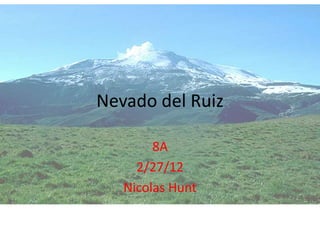
Nevado del Ruiz
8A
2/27/12
Nicolas Hunt
Location
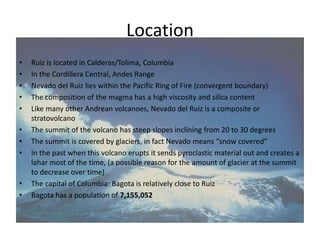
• Ruiz is located in Calderas/Tolima, Columbia
• In the Cordillera Central, Andes Range
• Nevado del Ruiz lies within the Pacific Ring of Fire (convergent boundary)
• The composition of the magma has a high viscosity and silica content
• Like many other Andrean volcanoes, Nevado del Ruiz is a composite or
stratovolcano
• The summit of the volcano has steep slopes inclining from 20 to 30 degrees
• The summit is covered by glaciers, in fact Nevado means “snow covered”
• In the past when this volcano erupts it sends pyroclastic material out and creates a
lahar most of the time, (a possible reason for the amount of glacier at the summit
to decrease over time)
• The capital of Columbia: Bagota is relatively close to Ruiz
• Bagota has a population of 7,155,052
Location Diagrams
On the left
is all the
volcanoes
in Cloumbia
Type of Volcano
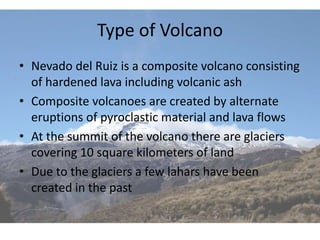
• Nevado del Ruiz is a composite volcano consisting
of hardened lava including volcanic ash
• Composite volcanoes are created by alternate
eruptions of pyroclastic material and lava flows
• At the summit of the volcano there are glaciers
covering 10 square kilometers of land
• Due to the glaciers a few lahars have been
created in the past
Self Created Image of Volcano
• Diagram of Nevado Diagram of
Nevado del Ruiz,
composite
volcano
(Scanned)
By Nic
Impact
• The benefits of the volcano include tourist
destination, provides a beautiful aspect to the
land, and it is home to the mountain tapir and
spectacled, both of which are ‘threatened’
• Some major dangers include another lahar,
pyroclastic material causing physical damage
to buildings, and the possibility of lowering
temperatures in a violent eruption
Impact Pictures
1985 lahar
New land forming from magma
Monitoring the Volcano
• What is being used to monitor the volcano
cannot be found
• However a few methods that could be used to
monitor Ruiz would be a tiltmeter: to measure
the slope of the cone, or a seismograph
measuring the earthquakes created by volcanoes
• The steeper the measure of the slope the more
likely there is to be an eruption
• The more intense and the higher number of
earthquakes the more likely there is to be an
eruption
Monitoring Method Pictures
Experts taking gas samples
(above)
Illustration of tilt and GPS
methods (below)
Eruptive History
• The first eruptions of Nevado del Ruiz occurred about 1.8 million years ago. Three
primary eruption periods in the history of the volcano have been identified:
ancestral, older and present. During the ancestral period between one million to
two million years ago, a complex of large stratovolcanoes was created. Between
1.0 million and 0.8 million years ago, they partially collapsed, forming large (5–
10 km wide) calderas. During the older period, which lasted from 0.8 million to 0.2
million years ago, a new complex of large stratovolcanoes developed (including
Older Ruiz, Tolima, Quindio, and Santa Isabel). Once again explosive summit
calderas formed from 0.2 million to 0.15 million years ago.
• On the morning of March 12, 1595, Nevado del Ruiz erupted. The volcano erupted
pyroclastic material including lapilli and pumice bombs. Additionally, the eruption
created a lahar was created killing more than 600 people
• The worst recorded quake as far as casualties was at Amero on November 13, 1985
killing 23,000 civilians and more than 10,000 animals
• The most recent eruption was in 2008, it was a minor one
Nevado del Ruiz Eruption Pictures
Bibliography
Pics:
• http://www.google.com/search?client=safari&rls=en&q=ruiz+volca
no&oe=UTF-8&um=1&ie=UTF-
8&hl=en&tbm=isch&source=og&sa=N&tab=wi&ei=FTJMT634LMW
RiQLEqcCTDw&biw=1353&bih=967&sei=FzJMT43TDcibiAL1o_nJDw
• http://www.google.com/search?client=safari&rls=en&q=nevado+d
el+ruiz&ie=UTF-8&oe=UTF-8
Info:
• http://en.wikipedia.org/wiki/Nevado_del_Ruiz
• http://www.geology.sdsu.edu/how_volcanoes_work/Nevado.html
• http://vulcan.wr.usgs.gov/Volcanoes/Colombia/Ruiz/description_er
uption_lahar_1985.html
• http://www.ngdc.noaa.gov/hazard/stratoguide/nevadofact.html

Ruiz volcano

  • 1.
  • 2.
    Location • Ruiz islocated in Calderas/Tolima, Columbia • In the Cordillera Central, Andes Range • Nevado del Ruiz lies within the Pacific Ring of Fire (convergent boundary) • The composition of the magma has a high viscosity and silica content • Like many other Andrean volcanoes, Nevado del Ruiz is a composite or stratovolcano • The summit of the volcano has steep slopes inclining from 20 to 30 degrees • The summit is covered by glaciers, in fact Nevado means “snow covered” • In the past when this volcano erupts it sends pyroclastic material out and creates a lahar most of the time, (a possible reason for the amount of glacier at the summit to decrease over time) • The capital of Columbia: Bagota is relatively close to Ruiz • Bagota has a population of 7,155,052
  • 3.
    Location Diagrams On theleft is all the volcanoes in Cloumbia
  • 4.
    Type of Volcano •Nevado del Ruiz is a composite volcano consisting of hardened lava including volcanic ash • Composite volcanoes are created by alternate eruptions of pyroclastic material and lava flows • At the summit of the volcano there are glaciers covering 10 square kilometers of land • Due to the glaciers a few lahars have been created in the past
  • 5.
    Self Created Imageof Volcano • Diagram of Nevado Diagram of Nevado del Ruiz, composite volcano (Scanned) By Nic
  • 6.
    Impact • The benefitsof the volcano include tourist destination, provides a beautiful aspect to the land, and it is home to the mountain tapir and spectacled, both of which are ‘threatened’ • Some major dangers include another lahar, pyroclastic material causing physical damage to buildings, and the possibility of lowering temperatures in a violent eruption
  • 7.
    Impact Pictures 1985 lahar Newland forming from magma
  • 8.
    Monitoring the Volcano •What is being used to monitor the volcano cannot be found • However a few methods that could be used to monitor Ruiz would be a tiltmeter: to measure the slope of the cone, or a seismograph measuring the earthquakes created by volcanoes • The steeper the measure of the slope the more likely there is to be an eruption • The more intense and the higher number of earthquakes the more likely there is to be an eruption
  • 9.
    Monitoring Method Pictures Expertstaking gas samples (above) Illustration of tilt and GPS methods (below)
  • 10.
    Eruptive History • Thefirst eruptions of Nevado del Ruiz occurred about 1.8 million years ago. Three primary eruption periods in the history of the volcano have been identified: ancestral, older and present. During the ancestral period between one million to two million years ago, a complex of large stratovolcanoes was created. Between 1.0 million and 0.8 million years ago, they partially collapsed, forming large (5– 10 km wide) calderas. During the older period, which lasted from 0.8 million to 0.2 million years ago, a new complex of large stratovolcanoes developed (including Older Ruiz, Tolima, Quindio, and Santa Isabel). Once again explosive summit calderas formed from 0.2 million to 0.15 million years ago. • On the morning of March 12, 1595, Nevado del Ruiz erupted. The volcano erupted pyroclastic material including lapilli and pumice bombs. Additionally, the eruption created a lahar was created killing more than 600 people • The worst recorded quake as far as casualties was at Amero on November 13, 1985 killing 23,000 civilians and more than 10,000 animals • The most recent eruption was in 2008, it was a minor one
  • 11.
    Nevado del RuizEruption Pictures
  • 12.
    Bibliography Pics: • http://www.google.com/search?client=safari&rls=en&q=ruiz+volca no&oe=UTF-8&um=1&ie=UTF- 8&hl=en&tbm=isch&source=og&sa=N&tab=wi&ei=FTJMT634LMW RiQLEqcCTDw&biw=1353&bih=967&sei=FzJMT43TDcibiAL1o_nJDw • http://www.google.com/search?client=safari&rls=en&q=nevado+d el+ruiz&ie=UTF-8&oe=UTF-8 Info: •http://en.wikipedia.org/wiki/Nevado_del_Ruiz • http://www.geology.sdsu.edu/how_volcanoes_work/Nevado.html • http://vulcan.wr.usgs.gov/Volcanoes/Colombia/Ruiz/description_er uption_lahar_1985.html • http://www.ngdc.noaa.gov/hazard/stratoguide/nevadofact.html