Organizing The YearlyTraining PlanChris RufDirector of Athletic Performance - Football
Organizing the Yearly Plan1. Why?2. How?
Annual Planning: Why?Think of it as the installation plan for your Off-Season TrainingO/D schemes installed in a sequenceTraining should build upon prior foundationShould have logical sequenceCan aid in technical & physical progressionAble to plan for key times of the year
Annual Planning: Why?2 Ends of the planning spectrum1. 4 year detailed plan for your high school athleteNot realistic unless we can control most of the variablesIf we do this – needs to be pretty general2. Flying by the seat of your pants on a daily basisHaphazard, eliminates the ability to maximize long term progressSolution for most lies somewhere in between
Annual Planning: Why?Off-season program is like a tripWe know where we’re starting fromWe know where we need to goOur Annual Plan outlines the path(s) to get to our destination
Annual Planning: Why?Must be willing to be flexibleAthletes will progress when their bodies are ready, not always when we think they areSometimes we need to take a detour
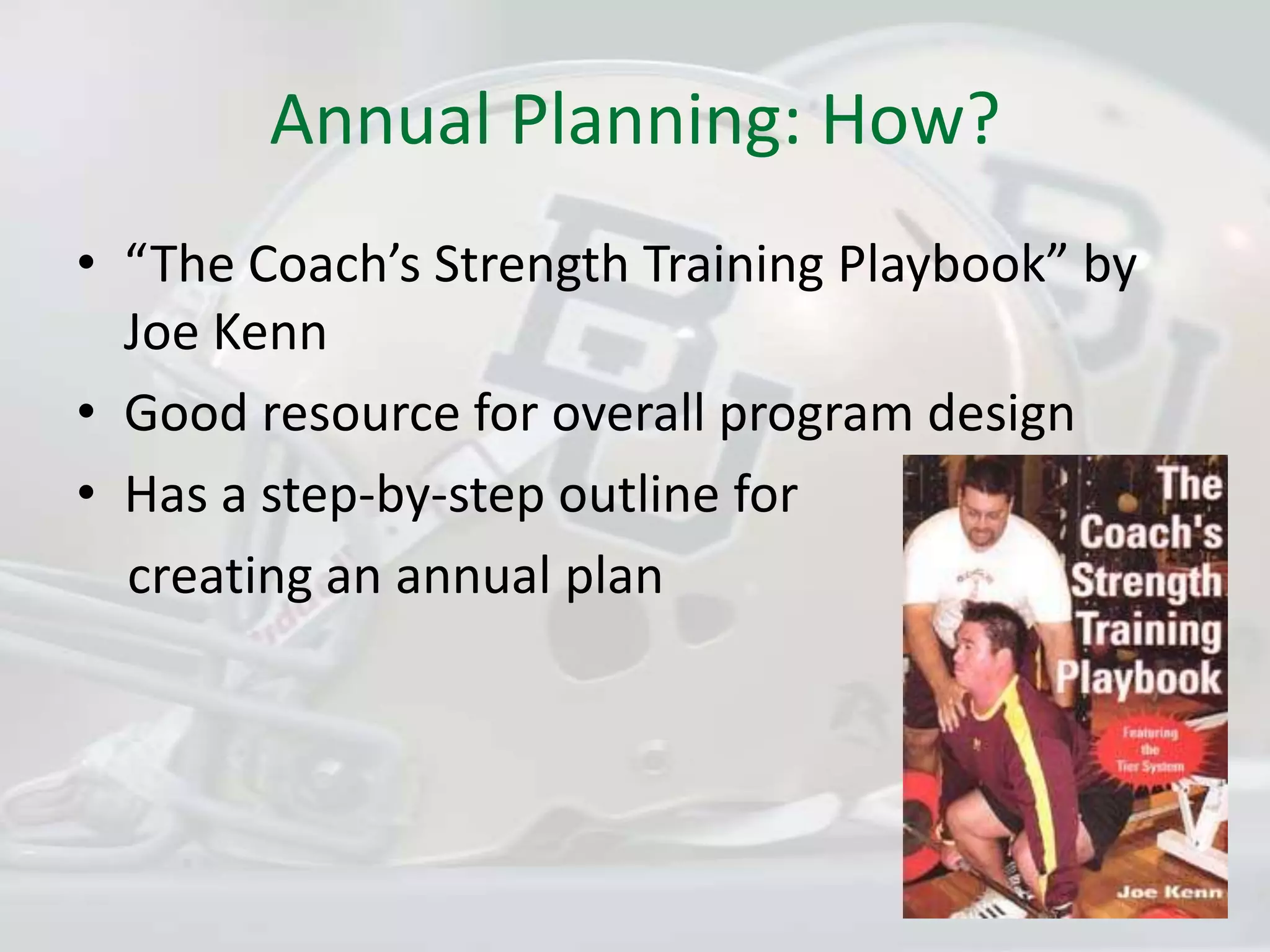
Annual Planning: How?“The Coach’s Strength Training Playbook” by Joe KennGood resource for overall program designHas a step-by-step outline for     creating an annual plan
Annual Planning: How?1. Design an excel template2. Chart out your weeks 1-52Training year will start after the previous year’s last competition3. Enter in your competitions and any “uncontrollable factors”
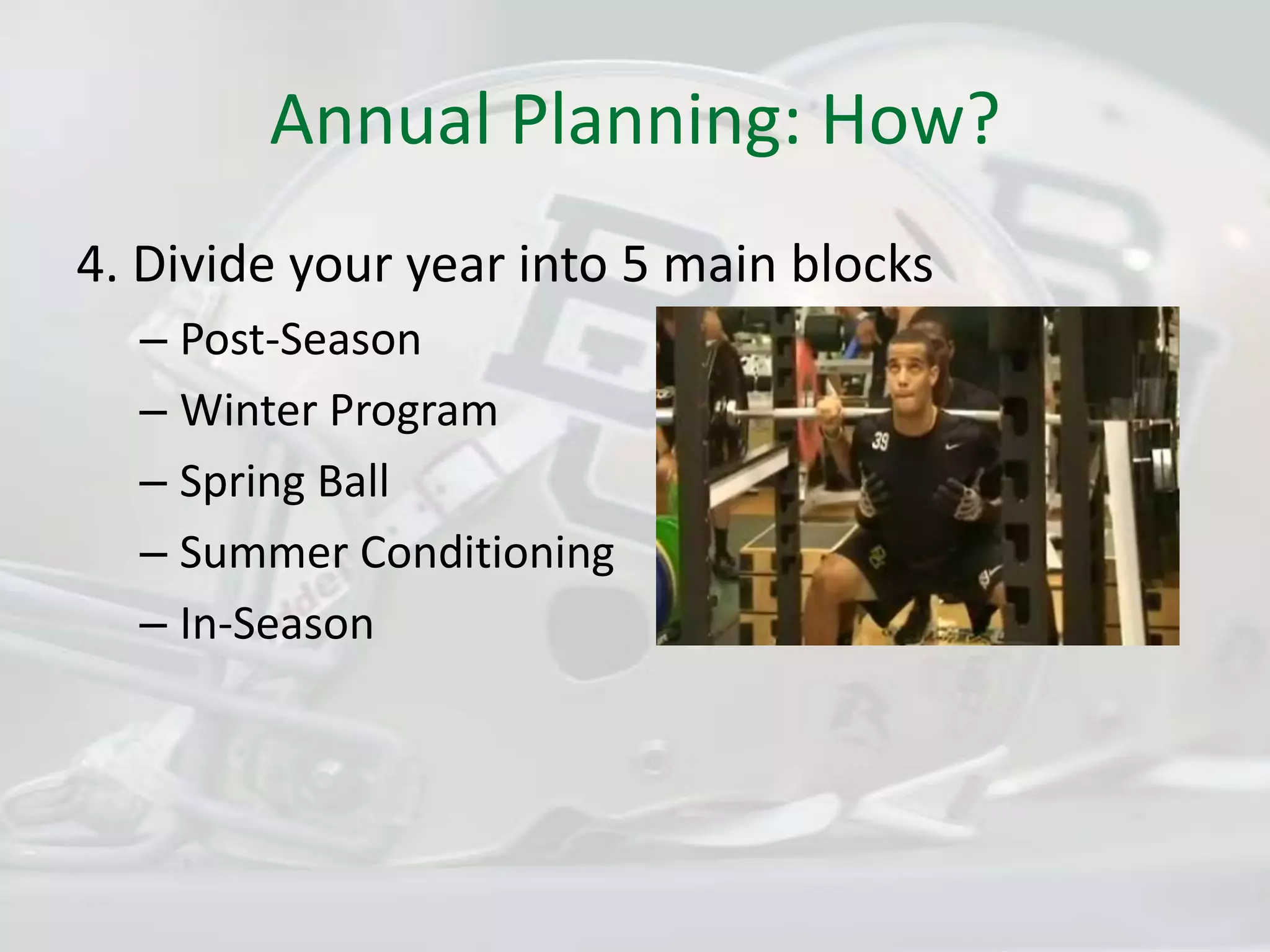
Annual Planning: How?4. Divide your year into 5 main blocksPost-SeasonWinter ProgramSpring BallSummer ConditioningIn-Season
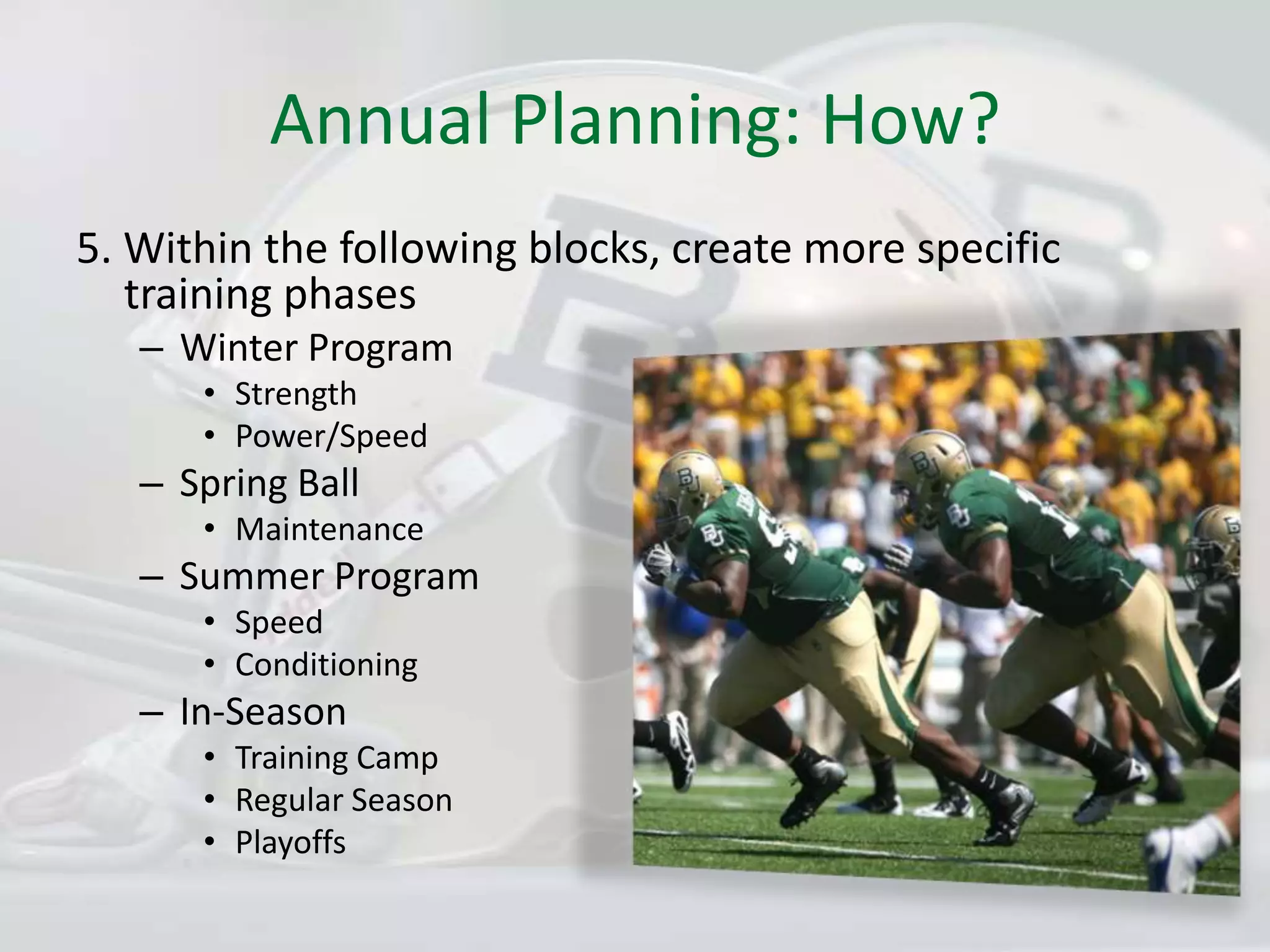
Annual Planning: How?5. Within the following blocks, create more specific training phasesWinter ProgramStrengthPower/SpeedSpring BallMaintenanceSummer ProgramSpeedConditioningIn-SeasonTraining CampRegular SeasonPlayoffs
Annual Planning: How?6. Develop a running plan for each block7. Develop a lifting plan for each blockDon’t have to be specific at this pointSet a focus for lifting/running during each blockHave a general guideline for intensity and volume to develop the desired qualities
Annual Planning: How?
Post-SeasonHave been playing football for 4-5 months straightStrength is likely lowerInjury Concerns/Imbalances1-2 weeks of active rest2-3 weeks of lower intensity trainingGet in shape to train
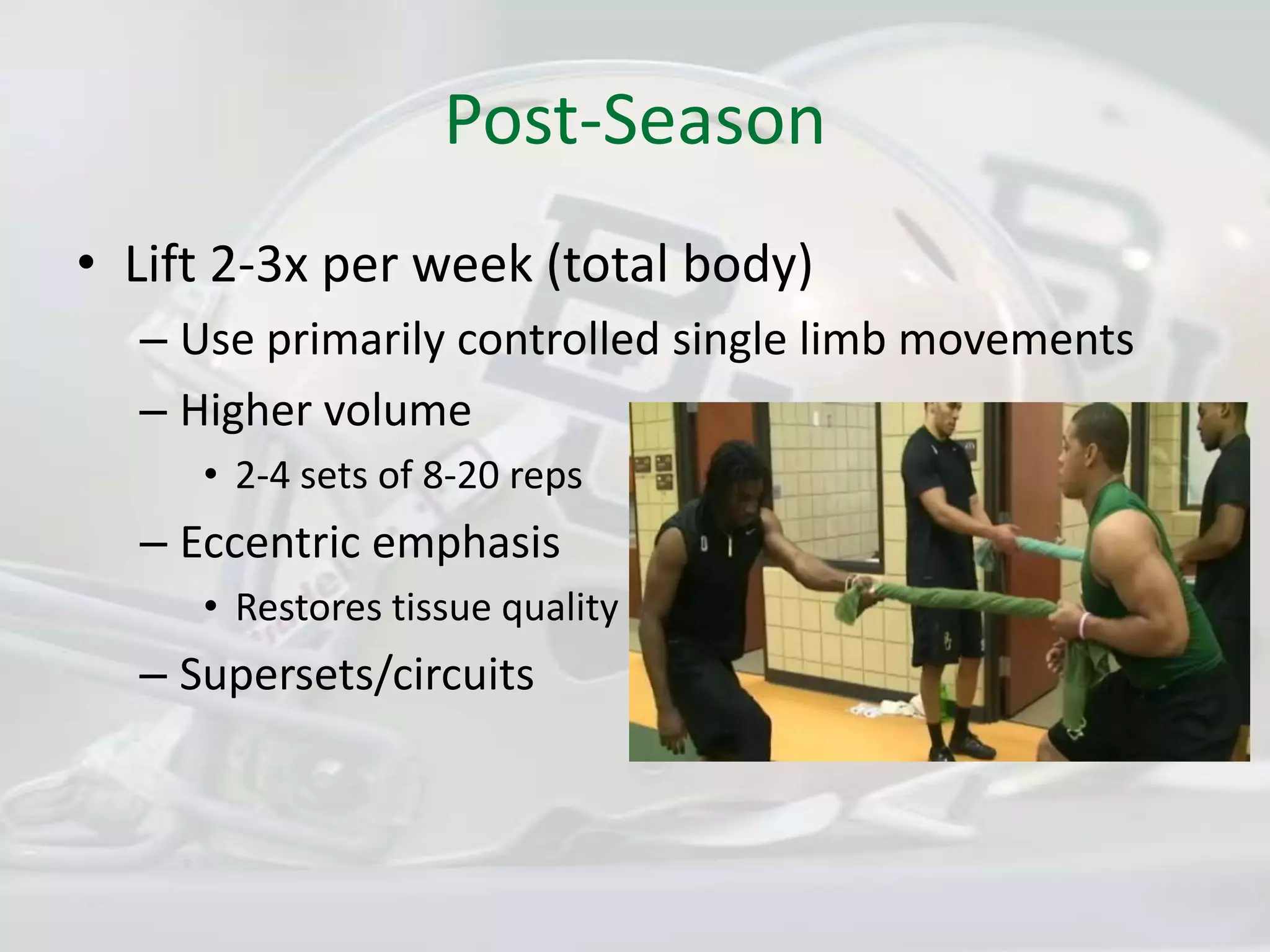
Post-SeasonLift 2-3x per week (total body)Use primarily controlled single limb movementsHigher volume2-4 sets of 8-20 repsEccentric emphasisRestores tissue qualitySupersets/circuits
Post-SeasonLittle to no high intensity runningPrimarily tempo running or circuits aimed at improving aerobic qualities
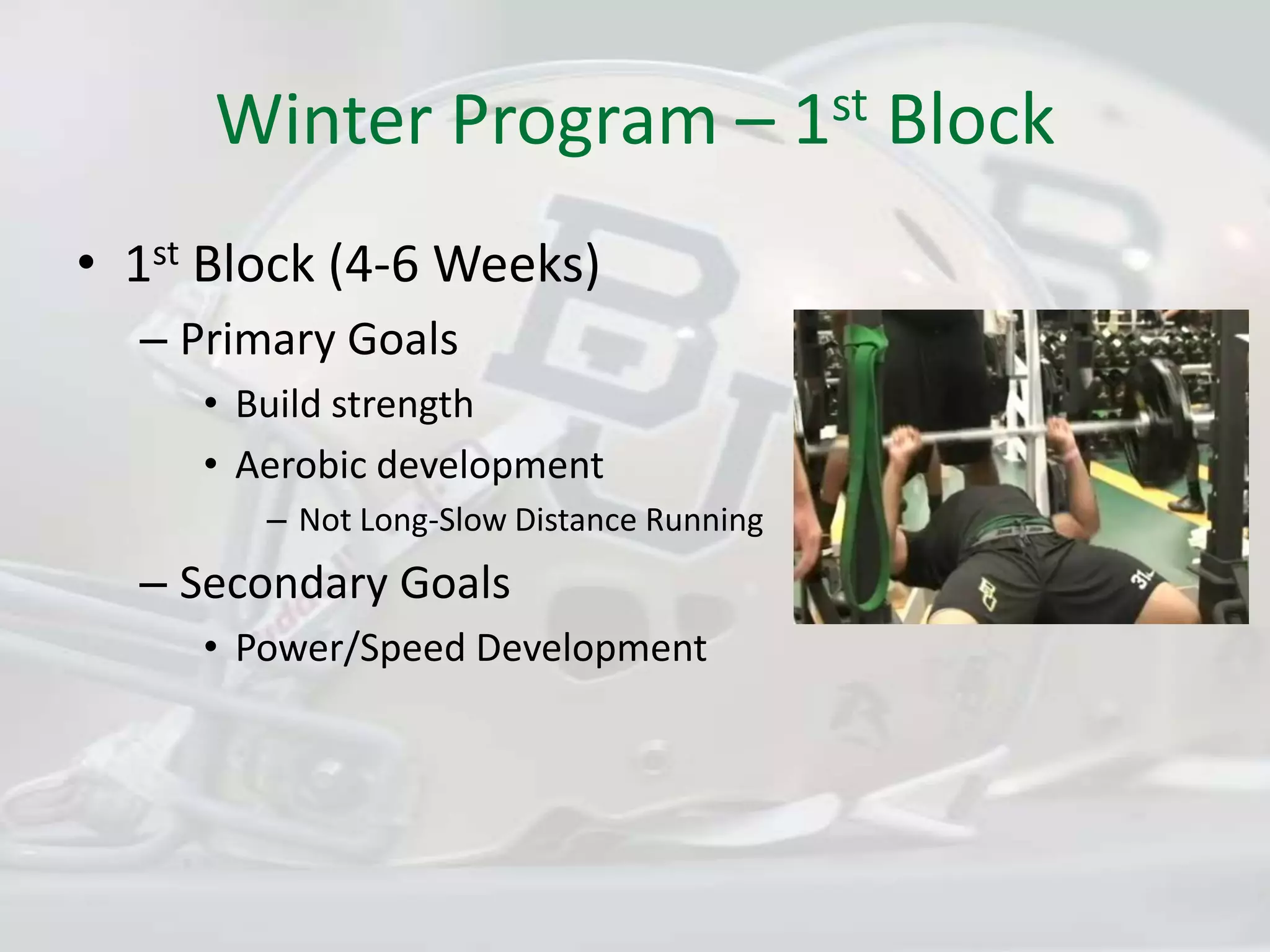
Winter Program – 1st Block1st Block (4-6 Weeks)Primary GoalsBuild strengthAerobic developmentNot Long-Slow Distance RunningSecondary GoalsPower/Speed Development
Winter Program – 1st BlockLift 3-4x per weekOlympic or explosive movements trained for 3-4 sets of 2-5 reps @ 60-75% (Pick 1 per day)Our Choices: Clean variations, Power Jerk, DE Squat & Bench w/accommodating resistance, various jumps or throwsCore strength lifts trained for 3-8 sets of 3-8 reps @ 70-85% (Pick 1 per day)Our Choices: Squat & Bench and their variationsAccessory movements trained for 3-6 sets of 6-12 repsOur Choices: Various pulls, posterior chain movements, single leg movements, various single joint movements
Winter Program – 1st BlockRun 2-3x per weekAcceleration workVarious start positionsGenerally up to 20-30 yards depending on skill and positionBuild up to approx. 100-200 yards of total volume per dayAgility workProgrammedTechnique and deceleration work
Winter Program – 2nd Block2nd Block (4-6 Weeks)Primary GoalsSpeed DevelopmentPower DevelopmentSecondary GoalsStrength DevelopmentAlactic Capacity
Winter Program – 2nd BlockLift 3-4x per weekOlympic or explosive movements trained for 4-8 sets of 2-4 reps @ 65-80% (Pick 1 per day)Core strength lifts trained for 3-6 sets of 2-6 reps @ 70-85% (Pick 1 per day)Accessory movements trained for 3-6 sets of 6-12 reps
Winter Program – 2nd BlockRun 2-3x per weekAcceleration and Max Speed WorkGenerally up to 40-60 yards depending on skill and positionBuild up to approx. 100-200 yards of total volume per dayAgility workProgrammed and reactiveTransition to drills that are more technically demandingSome skill work introducedPosition Drills7 on 7
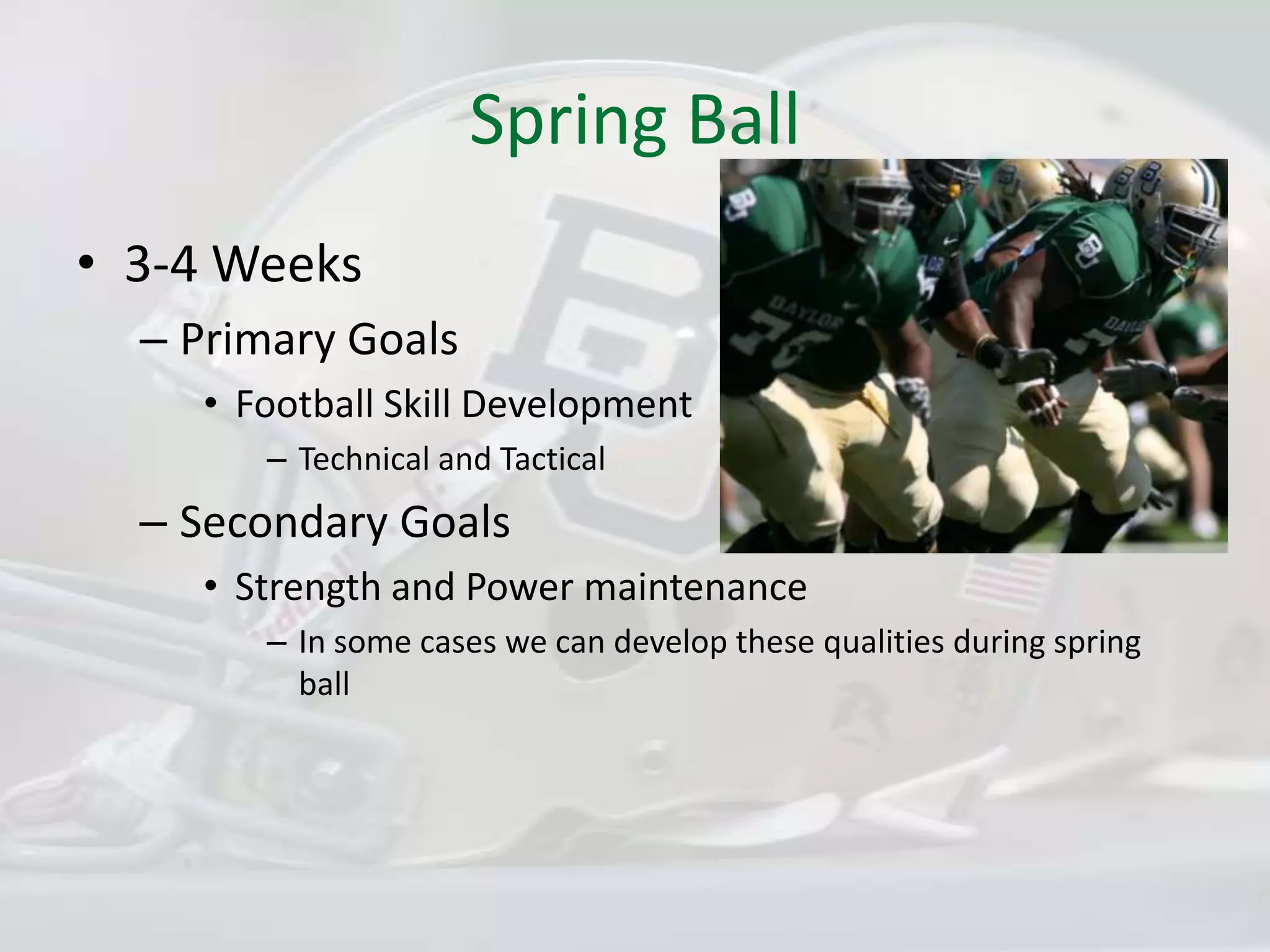
Spring Ball3-4 WeeksPrimary GoalsFootball Skill DevelopmentTechnical and TacticalSecondary GoalsStrength and Power maintenanceIn some cases we can develop these qualities during spring ball
Spring BallLift 2-3x per weekOlympic or explosive movements trained for 3-4 sets of 2-3 reps @ 60-70% (Pick 1 per day)Core strength lifts trained for 3-5 sets of 2-5 reps @ 65-80% (Pick 1 per day)Accessory movements trained for 2-4 sets of 6-10 reps
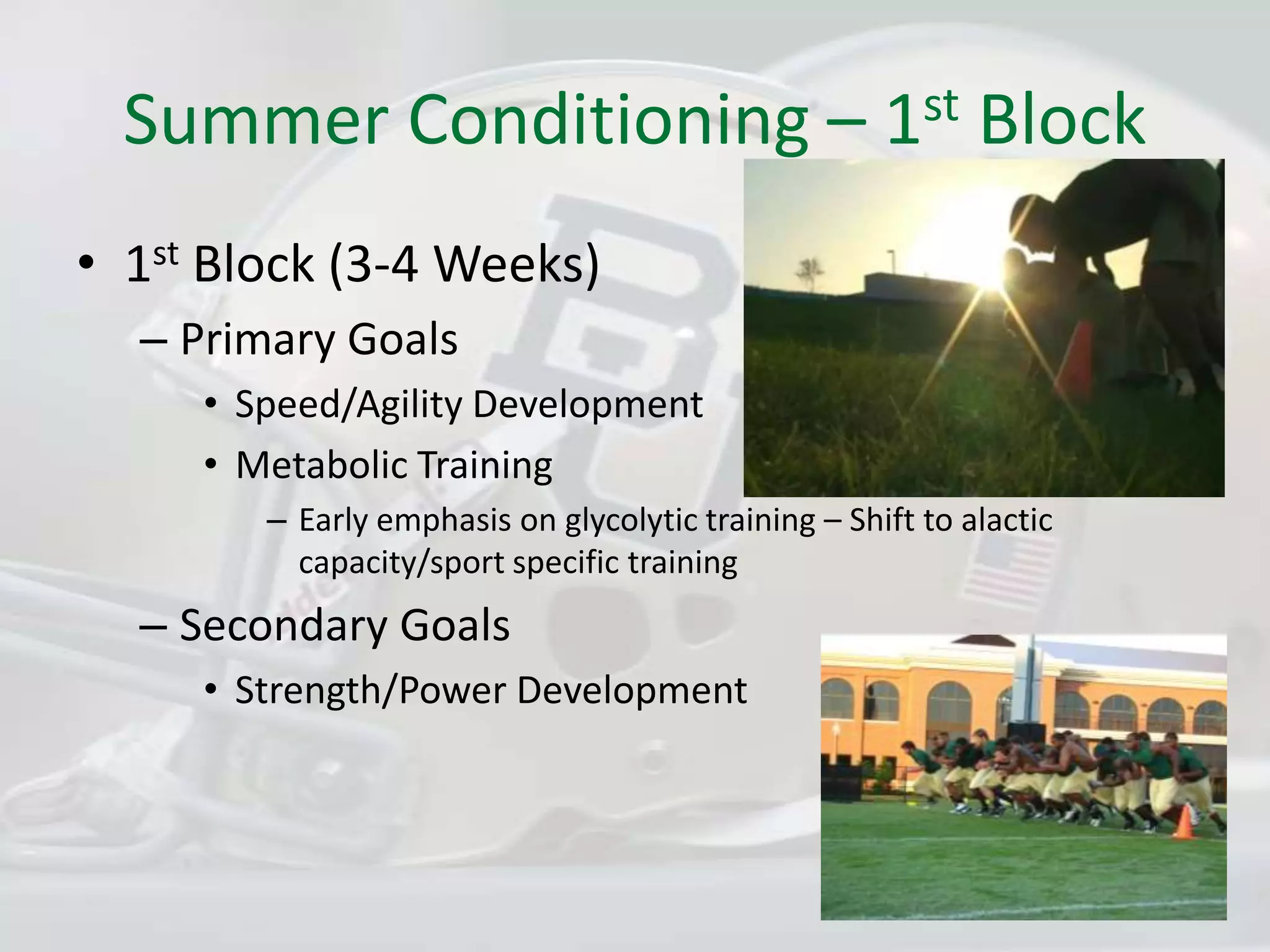
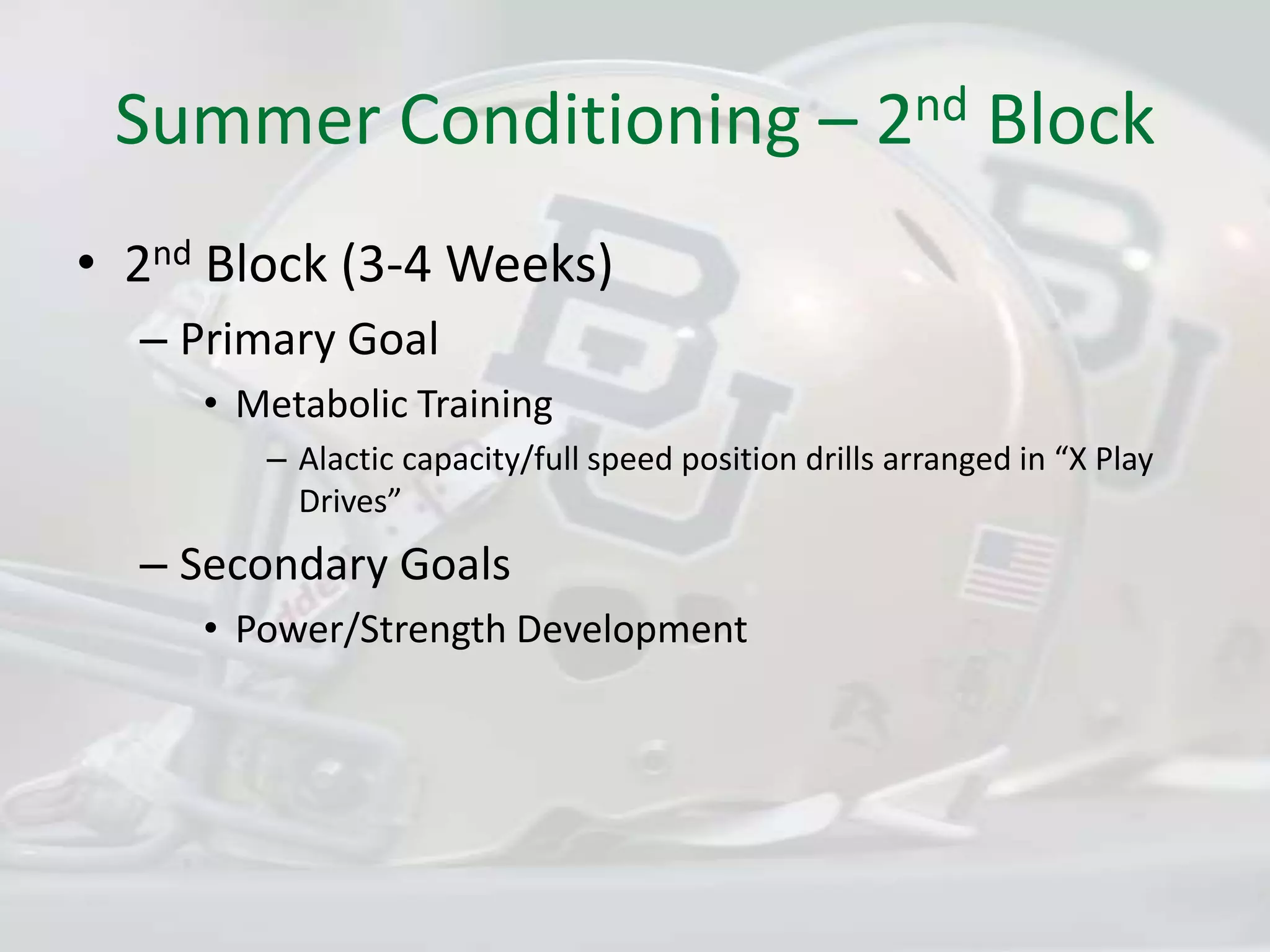
Summer Conditioning – 1st Block1st Block (3-4 Weeks)Primary GoalsSpeed/Agility DevelopmentMetabolic TrainingEarly emphasis on glycolytic training – Shift to alactic capacity/sport specific trainingSecondary GoalsStrength/Power Development
Summer Conditioning – 1st BlockLift 3-4x per weekOlympic or explosive movements trained for 4-8 sets of 2-4 reps @ 65-80% (Pick 1 per day)Core strength lifts trained for 3-6 sets of 2-6 reps @ 70-85% (Pick 1 per day)Accessory movements trained for 3-5 sets of 6-12 reps
Summer Conditioning – 1st BlockRun 3-4x per weekAcceleration workVarious start positionsGenerally up to 20-30 yards depending on skill and positionBuild up to 100-200 yards of total volume per dayAgility workMore time on drills that are more “position-specific”Conditioning for 1st 1-2 weeks lactic in natureProvided good aerobic development is in place
Summer Conditioning – 2nd Block2nd Block (3-4 Weeks)Primary GoalMetabolic TrainingAlactic capacity/full speed position drills arranged in “X Play Drives”Secondary GoalsPower/Strength Development
Summer Conditioning – 2nd BlockLift 3-4x per weekOlympic or explosive movements trained for 4-8 sets of 1-3 reps @ 70-85% (Pick 1 per day)Core strength lifts trained for 3-5 sets of 2-5 reps @ 70-85% (Pick 1 per day)Accessory movements trained for 3-4 sets of 6-10 reps
Summer Conditioning – 2nd BlockRun 3-4x per weekConditioning 2x/WeekAlactic capacity/full speed position drillsDrills come as close to football drills/movements/speeds as possibleAgility workIncreased use of reactionary drillsForce quick decision makingMake drills as “open” as possibleAcceleration work
Training CampKeep it SimpleLift 2-3x per weekLooking to maintain strength while not taking away from demands of practicePractice volume and intensity should dictate the structure of what you do in the weight room Not everyone’s situation is the sameGet In and Get OutTry to keep at least 1 day in between lifts
Training CampKeep it SimplePick 3 things you NEED to doExample: a squat, a press, and an upper body pullVolume very low on the structurally demanding movements (3-4 sets of 2-3 reps) and intensity moderate (65-75%)1 higher rep upper body press or pull as an accessory each day If the press is heavy, the pull will be higher volume and vice versa
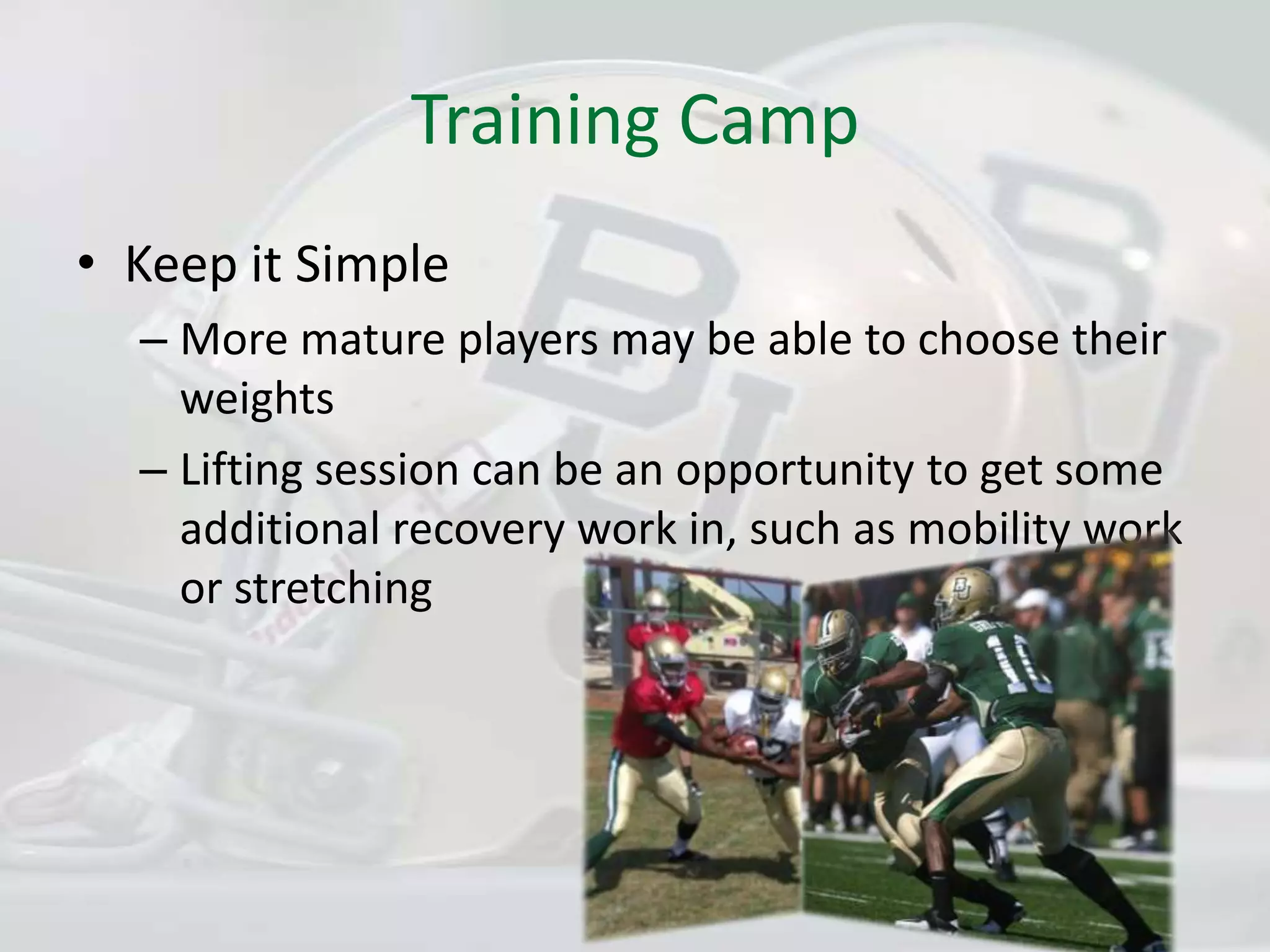
Training CampKeep it SimpleMore mature players may be able to choose their weightsLifting session can be an opportunity to get some additional recovery work in, such as mobility work or stretching
In-Season10 - 16 WeeksPrimary GoalsFootball Skill DevelopmentTechnical and TacticalSecondary GoalsStrength and Power maintenanceIn some cases we can develop these qualities during the season
In-SeasonLift 2-3x per weekDifferent lifting groups/levelsGuys getting the most snaps at the varsity level will benefit from lesser volumes and intensitiesYoung & Low Snap Guys – Technique development and increased volume/intensityCan follow general guidelines from Spring Ball, but reduce volume as the season progresses
In-SeasonScheduleSaturdayTempo Run (500-800 yards total) + Mobility/Bodyweight/Med Ball CircuitPrimary lower body strength dayUpper & Lower body assistance work - single arm and single leg movementsAlways ready to make adjustments
In-SeasonScheduleMondaySecondary lower body strength dayUtilize a different movement than Sunday and at lower intensityUpper body assistance workLight Posterior Chain MovementAlways ready to make adjustments
In-SeasonScheduleWednesdayExplosive MovementKeep it fast and the volume lowPrimary upper body strength dayTypically use Bench variations for thisAlways ready to make adjustments
Additional ItemsThe “Deload”Reduction in volume, intensity, or both to allow body to recuperate and adapt to new level of performancePlanned vs. UnplannedOff-Season – once every 3-4 weeksIn-Season – once every 2-3 weeks
Additional ItemsPrilepin’s ChartGuideline for assigning volume/intensity for well-trained athletes
   Olympic movements can work in upper end of range
   Strength movements generally need to stay in lower endSummary
References/Recommended Readings“The Coach’s Strength Training Playbook” – Joe Kenn“Vermeil’s Sports and Fitness Training System for Enhancing Athletic Performance” – Al Vermeil, Erik Helland & Mike Gattone“The Charlie Francis Training System” – Charlie FrancisCoaches I have had the privilege to work under and learn fromKaz KazadiMatt McGettiganRon McKeeferyRich Lansky

Ruf -Organizing Yearly plan

  • 1.
    Organizing The YearlyTrainingPlanChris RufDirector of Athletic Performance - Football
  • 2.
    Organizing the YearlyPlan1. Why?2. How?
  • 3.
    Annual Planning: Why?Thinkof it as the installation plan for your Off-Season TrainingO/D schemes installed in a sequenceTraining should build upon prior foundationShould have logical sequenceCan aid in technical & physical progressionAble to plan for key times of the year
  • 4.
    Annual Planning: Why?2Ends of the planning spectrum1. 4 year detailed plan for your high school athleteNot realistic unless we can control most of the variablesIf we do this – needs to be pretty general2. Flying by the seat of your pants on a daily basisHaphazard, eliminates the ability to maximize long term progressSolution for most lies somewhere in between
  • 5.
    Annual Planning: Why?Off-seasonprogram is like a tripWe know where we’re starting fromWe know where we need to goOur Annual Plan outlines the path(s) to get to our destination
  • 6.
    Annual Planning: Why?Mustbe willing to be flexibleAthletes will progress when their bodies are ready, not always when we think they areSometimes we need to take a detour
  • 7.
    Annual Planning: How?“TheCoach’s Strength Training Playbook” by Joe KennGood resource for overall program designHas a step-by-step outline for creating an annual plan
  • 8.
    Annual Planning: How?1.Design an excel template2. Chart out your weeks 1-52Training year will start after the previous year’s last competition3. Enter in your competitions and any “uncontrollable factors”
  • 9.
    Annual Planning: How?4.Divide your year into 5 main blocksPost-SeasonWinter ProgramSpring BallSummer ConditioningIn-Season
  • 10.
    Annual Planning: How?5.Within the following blocks, create more specific training phasesWinter ProgramStrengthPower/SpeedSpring BallMaintenanceSummer ProgramSpeedConditioningIn-SeasonTraining CampRegular SeasonPlayoffs
  • 11.
    Annual Planning: How?6.Develop a running plan for each block7. Develop a lifting plan for each blockDon’t have to be specific at this pointSet a focus for lifting/running during each blockHave a general guideline for intensity and volume to develop the desired qualities
  • 12.
  • 13.
    Post-SeasonHave been playingfootball for 4-5 months straightStrength is likely lowerInjury Concerns/Imbalances1-2 weeks of active rest2-3 weeks of lower intensity trainingGet in shape to train
  • 14.
    Post-SeasonLift 2-3x perweek (total body)Use primarily controlled single limb movementsHigher volume2-4 sets of 8-20 repsEccentric emphasisRestores tissue qualitySupersets/circuits
  • 15.
    Post-SeasonLittle to nohigh intensity runningPrimarily tempo running or circuits aimed at improving aerobic qualities
  • 16.
    Winter Program –1st Block1st Block (4-6 Weeks)Primary GoalsBuild strengthAerobic developmentNot Long-Slow Distance RunningSecondary GoalsPower/Speed Development
  • 17.
    Winter Program –1st BlockLift 3-4x per weekOlympic or explosive movements trained for 3-4 sets of 2-5 reps @ 60-75% (Pick 1 per day)Our Choices: Clean variations, Power Jerk, DE Squat & Bench w/accommodating resistance, various jumps or throwsCore strength lifts trained for 3-8 sets of 3-8 reps @ 70-85% (Pick 1 per day)Our Choices: Squat & Bench and their variationsAccessory movements trained for 3-6 sets of 6-12 repsOur Choices: Various pulls, posterior chain movements, single leg movements, various single joint movements
  • 18.
    Winter Program –1st BlockRun 2-3x per weekAcceleration workVarious start positionsGenerally up to 20-30 yards depending on skill and positionBuild up to approx. 100-200 yards of total volume per dayAgility workProgrammedTechnique and deceleration work
  • 19.
    Winter Program –2nd Block2nd Block (4-6 Weeks)Primary GoalsSpeed DevelopmentPower DevelopmentSecondary GoalsStrength DevelopmentAlactic Capacity
  • 20.
    Winter Program –2nd BlockLift 3-4x per weekOlympic or explosive movements trained for 4-8 sets of 2-4 reps @ 65-80% (Pick 1 per day)Core strength lifts trained for 3-6 sets of 2-6 reps @ 70-85% (Pick 1 per day)Accessory movements trained for 3-6 sets of 6-12 reps
  • 21.
    Winter Program –2nd BlockRun 2-3x per weekAcceleration and Max Speed WorkGenerally up to 40-60 yards depending on skill and positionBuild up to approx. 100-200 yards of total volume per dayAgility workProgrammed and reactiveTransition to drills that are more technically demandingSome skill work introducedPosition Drills7 on 7
  • 22.
    Spring Ball3-4 WeeksPrimaryGoalsFootball Skill DevelopmentTechnical and TacticalSecondary GoalsStrength and Power maintenanceIn some cases we can develop these qualities during spring ball
  • 23.
    Spring BallLift 2-3xper weekOlympic or explosive movements trained for 3-4 sets of 2-3 reps @ 60-70% (Pick 1 per day)Core strength lifts trained for 3-5 sets of 2-5 reps @ 65-80% (Pick 1 per day)Accessory movements trained for 2-4 sets of 6-10 reps
  • 24.
    Summer Conditioning –1st Block1st Block (3-4 Weeks)Primary GoalsSpeed/Agility DevelopmentMetabolic TrainingEarly emphasis on glycolytic training – Shift to alactic capacity/sport specific trainingSecondary GoalsStrength/Power Development
  • 25.
    Summer Conditioning –1st BlockLift 3-4x per weekOlympic or explosive movements trained for 4-8 sets of 2-4 reps @ 65-80% (Pick 1 per day)Core strength lifts trained for 3-6 sets of 2-6 reps @ 70-85% (Pick 1 per day)Accessory movements trained for 3-5 sets of 6-12 reps
  • 26.
    Summer Conditioning –1st BlockRun 3-4x per weekAcceleration workVarious start positionsGenerally up to 20-30 yards depending on skill and positionBuild up to 100-200 yards of total volume per dayAgility workMore time on drills that are more “position-specific”Conditioning for 1st 1-2 weeks lactic in natureProvided good aerobic development is in place
  • 27.
    Summer Conditioning –2nd Block2nd Block (3-4 Weeks)Primary GoalMetabolic TrainingAlactic capacity/full speed position drills arranged in “X Play Drives”Secondary GoalsPower/Strength Development
  • 28.
    Summer Conditioning –2nd BlockLift 3-4x per weekOlympic or explosive movements trained for 4-8 sets of 1-3 reps @ 70-85% (Pick 1 per day)Core strength lifts trained for 3-5 sets of 2-5 reps @ 70-85% (Pick 1 per day)Accessory movements trained for 3-4 sets of 6-10 reps
  • 29.
    Summer Conditioning –2nd BlockRun 3-4x per weekConditioning 2x/WeekAlactic capacity/full speed position drillsDrills come as close to football drills/movements/speeds as possibleAgility workIncreased use of reactionary drillsForce quick decision makingMake drills as “open” as possibleAcceleration work
  • 30.
    Training CampKeep itSimpleLift 2-3x per weekLooking to maintain strength while not taking away from demands of practicePractice volume and intensity should dictate the structure of what you do in the weight room Not everyone’s situation is the sameGet In and Get OutTry to keep at least 1 day in between lifts
  • 31.
    Training CampKeep itSimplePick 3 things you NEED to doExample: a squat, a press, and an upper body pullVolume very low on the structurally demanding movements (3-4 sets of 2-3 reps) and intensity moderate (65-75%)1 higher rep upper body press or pull as an accessory each day If the press is heavy, the pull will be higher volume and vice versa
  • 32.
    Training CampKeep itSimpleMore mature players may be able to choose their weightsLifting session can be an opportunity to get some additional recovery work in, such as mobility work or stretching
  • 33.
    In-Season10 - 16WeeksPrimary GoalsFootball Skill DevelopmentTechnical and TacticalSecondary GoalsStrength and Power maintenanceIn some cases we can develop these qualities during the season
  • 34.
    In-SeasonLift 2-3x perweekDifferent lifting groups/levelsGuys getting the most snaps at the varsity level will benefit from lesser volumes and intensitiesYoung & Low Snap Guys – Technique development and increased volume/intensityCan follow general guidelines from Spring Ball, but reduce volume as the season progresses
  • 35.
    In-SeasonScheduleSaturdayTempo Run (500-800yards total) + Mobility/Bodyweight/Med Ball CircuitPrimary lower body strength dayUpper & Lower body assistance work - single arm and single leg movementsAlways ready to make adjustments
  • 36.
    In-SeasonScheduleMondaySecondary lower bodystrength dayUtilize a different movement than Sunday and at lower intensityUpper body assistance workLight Posterior Chain MovementAlways ready to make adjustments
  • 37.
    In-SeasonScheduleWednesdayExplosive MovementKeep itfast and the volume lowPrimary upper body strength dayTypically use Bench variations for thisAlways ready to make adjustments
  • 38.
    Additional ItemsThe “Deload”Reductionin volume, intensity, or both to allow body to recuperate and adapt to new level of performancePlanned vs. UnplannedOff-Season – once every 3-4 weeksIn-Season – once every 2-3 weeks
  • 39.
    Additional ItemsPrilepin’s ChartGuidelinefor assigning volume/intensity for well-trained athletes
  • 40.
    Olympic movements can work in upper end of range
  • 41.
    Strength movements generally need to stay in lower endSummary
  • 42.
    References/Recommended Readings“The Coach’sStrength Training Playbook” – Joe Kenn“Vermeil’s Sports and Fitness Training System for Enhancing Athletic Performance” – Al Vermeil, Erik Helland & Mike Gattone“The Charlie Francis Training System” – Charlie FrancisCoaches I have had the privilege to work under and learn fromKaz KazadiMatt McGettiganRon McKeeferyRich Lansky
  • 43.
    Thank YouThanks toall of you who are making a difference in the lives of young peopleCoach Art Briles and the Baylor University Football ProgramBaylor Athletic Performance Staff - Kaz Kazadi - Anne Tamporello - Adam Davis - Andrew Althoff - Jeremy Weeks - Keith Belton - Ryder Weischedel - Bryce LinnPower Systems – Jeff Bales, Andrew Hunt & Jason EasonCoach Sam Gillespie and the Nike COY Clinic StaffChris Ruf254-710-3395chris_ruf@baylor.edu