Folk Style Wrestling
Wrestler
Coach Matt Waldron
Sport Introduction
 Folk Style wrestling is one of three common forms of wrestling
 The others are Free Style and Greco Roman
 Folk Style is the form used in all school related wrestling programs.
 Folk Style consist on three one to two minute rounds with up to three over
time rounds.
 In Folk Style wrestling points are scored as follows. Take Down (2 points),
Escape (1 point), Reversal (2 points), Three Count Near Fall (2 points), Five
Count Near Fall (3 points).
 Wrestlers may either win by points or a pin.
 If time runs out and no pin occurs wrestlers with the most points wins.
 If a pin (fall) occurs wrestler who pins their opponent wins regardless of
points.
Sport Demands
 Wrestling is unique in its physical requirements of it competitors
 Wrestling matches are majorly affect by the strength and or endurance of
participants.
 The ability to either out last or over power ones opponent can greatly affect
the out come of matches especially if competitors and equally skilled.
 Wrestling demands that participants and essentially at the peak of fitness and
performance.
 Wrestling at all levels of competition require wrestlers to focus on power,
strength, agility, and endurance.
 Along with sport related skills those who wish to be the best most also be
among the quickest, the strongest, and the most powerful competitors.
Sport Goals and Objectives
 For training wrestlers there must be a balance of sport training and general
condition training.
 Wrestling is a combative sport and like all combative sports finely tuned skills
is imperative.
 This program mostly on the non sport specific conditioning.
 The goal of this program is to build power, strength, and agility, endurance.
 Strength will be tested via 1RM barbell bench press, and back squats.
 Power will be tested via vertical leap, and 1RM power clean.
 Agility will be tested via latter run, and T-test.
 Endurance will be tested via one mile run, 1-min push up test.
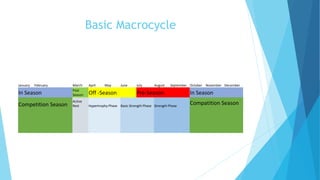
Basic Macrocycle
January February March April May June July August September October November December
In Season Post
Season Off -Season Pre-Season In Season
Competition Season
Active
Rest Hypertrophy Phase Basic Strength Phase Strength Phase
Compatition Season
Off Season; Hypertrophy Phase
 5 day a week program.
 All workout periods will begin with a 10 to 15 min warm up of jogging and
dynamic stretching.
 Monday, Wednesday, Friday. These days will focus entirely on core
muscles/lifts.
 Workouts will be volumous but not overly intense. This is why core lifts will be
preformed three times a week.
 Tuesday, and Thursday will focus on synergetic, and stabilizer muscles.
 Goal: increase muscle Mass
 The workouts provided are to build the greatest amount of lean muscle mass
in all of the core areas of the body. While still strengthening the
complementary muscles.
 Since the competitive season has just ended the focus will be on strength and
conditioning.
 All workout periods will end with 5 min cool down jog and static stretch.
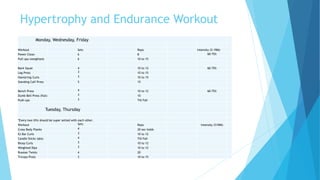
Hypertrophy and Endurance Workout
Monday, Wednesday, Friday
Workout Sets Reps Intensity (% 1RM)
Power Clean 6 8 60-75%
Pull-ups (weighted) 6 10 to 15
Back Squat 4 10 to 12 60-75%
Leg Press 3 10 to 15
Hamstring Curls 3 10 to 15
Standing Calf Press 5 15
Bench Press 4 10 to 12 60-75%
Dumb Bell Press (flat) 3 10
Push-ups 3 Till Fail
Tuesday, Thursday
*Every two lifts should be super setted with each other.
Workout Sets Reps Intensity (%1RM)
Cross Body Planks 4 20 sec holds
Ez Bar Curls 3 10 to 12
Candle Sticks (abs) 4 Till Fail
Bicep Curls 3 10 to 12
Weighted Dips 3 10 to 12
Russian Twists 4 20
Triceps Press 3 10 to 15
Pre-Season, Strength Phase
 All workout periods will begin with a 10 to 15 min warm up of jogging and
dynamic stretching.
 Program will continue on a three day a week program.
 Now that the competitive season is about to start again more emphasis is
going to be put on sport specific training.
 Therefore workouts are going to be more intense but much less volumous so
that athlete will not be fatigued during sport specific training.
 Now that workouts are becoming more intense lean muscle mass will need
more time to recover so workouts will move to a muscle group specific day.
 Goal: To maximize muscular strength just as season is about to begin.
 All workout periods will end with 5 min cool down jog and static stretch.
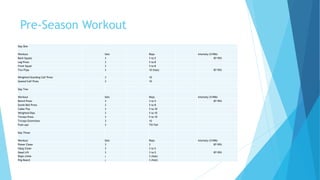
Pre-Season Workout
Day One
Workout Sets Reps Intensity (%1RM)
Back Squats 3 3 to 5 87-95%
Leg Press 3 5 to 8
Front Squat 3 5 to 8
Tire Flips 3 10 (fast) 87-95%
Weighted Standing Calf Press 3 10
Seated Calf Press 3 10
Day Two
Workout Sets Reps Intensity (%1RM)
Bench Press 3 3 to 5 87-95%
Dumb Bell Press 3 5 to 8
Cable Flys 3 5 to 10
Weighted Dips 3 5 to 10
Triceps Press 3 5 to 10
Triceps Extentions 3 10
Push-ups 3 Till Fail
Day Three
Workout Sets Reps Intensity (%1RM)
Power Clean 3 3 87-95%
Hang Clean 3 3 to 5
Dead Lift 3 3 to 5 87-95%
Rope climb 3 3 (fast)
Peg Board 3 3 (fast)
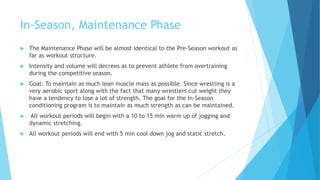
In-Season, Maintenance Phase
 The Maintenance Phase will be almost identical to the Pre-Season workout as
far as workout structure.
 Intensity and volume will decrees as to prevent athlete from overtraining
during the competitive season.
 Goal: To maintain as much lean muscle mass as possible. Since wrestling is a
very aerobic sport along with the fact that many wrestlers cut weight they
have a tendency to lose a lot of strength. The goal for the In-Season
conditioning program is to maintain as much strength as can be maintained.
 All workout periods will begin with a 10 to 15 min warm up of jogging and
dynamic stretching.
 All workout periods will end with 5 min cool down jog and static stretch.
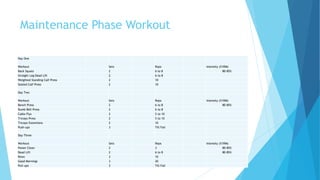
Maintenance Phase Workout
Day One
Workout Sets Reps Intensity (%1RM)
Back Squats 2 6 to 8 80-85%
Straight Leg Dead Lift 2 6 to 8
Weighted Standing Calf Press 2 10
Seated Calf Press 2 10
Day Two
Workout Sets Reps Intensity (%1RM)
Bench Press 2 6 to 8 80-85%
Dumb Bell Press 2 6 to 8
Cable Flys 2 5 to 10
Triceps Press 2 5 to 10
Triceps Extentions 2 10
Push-ups 3 Till Fail
Day Three
Workout Sets Reps Intensity (%1RM)
Power Clean 2 3 80-85%
Dead Lift 2 6 to 8 80-85%
Rows 3 10
Good Mornings 3 20
Pull-ups 3 Till Fail
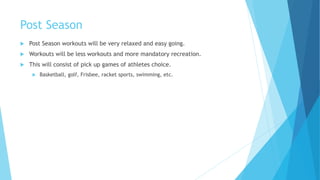
Post Season
 Post Season workouts will be very relaxed and easy going.
 Workouts will be less workouts and more mandatory recreation.
 This will consist of pick up games of athletes choice.
 Basketball, golf, Frisbee, racket sports, swimming, etc.
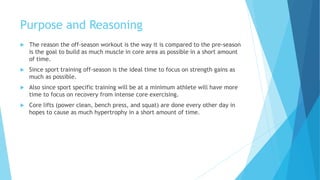
Purpose and Reasoning
 The reason the off-season workout is the way it is compared to the pre-season
is the goal to build as much muscle in core area as possible in a short amount
of time.
 Since sport training off-season is the ideal time to focus on strength gains as
much as possible.
 Also since sport specific training will be at a minimum athlete will have more
time to focus on recovery from intense core exercising.
 Core lifts (power clean, bench press, and squat) are done every other day in
hopes to cause as much hypertrophy in a short amount of time.
Purpose and Reasoning
 In the pre-season sport specific training begins and becomes more of a focus,
so energy and effort will be split.
 That being the case recovery time must be taken into consideration.
 With less recovery time core exercises have been broken up into three
separate days so that those muscles have ample time to recover between
more intense lifting sessions.
 In-season training will have less total exercises but will maintain a sub-
maximal level of intensity to maintain as much gains as possible throughout
competitive season.
 Post-season training will be almost total recovery. Athlete will only engage in
light recreational sports.
 This is to prevent detraining and keep the body semi-active as to be ready
when the next season comes around.
Purpose and Reasoning
 In regards to particular lifts wrestling is a full body event. There is no room
for weakness in any part of the body. That being the case all core lifts are
emphasized to be at optimum physical capacity.
 Since wrestling requires all the muscles of the body subsequent lifts are
provided to more specifically target muscles that support core lifts, but that
core lifts don’t target specifically.
 Exercises like rope climbs, peg board, power/hang cleans are perfect
transitional exercises. Grip strength and power are vital in wrestling and are
greatly impacted by these lifts. Your ability to more or control your opponent
is directly related on how hard you can hold on to your opponent. Your power
than comes in to play when it becomes necessary to throw or lift your
opponent. However to move, throw, or lift your opponent especially when
sweating profusely grip strength is imperative.
Testing
 An initial testing to asses athlete current abilities will be done at the very
begin of the Hypertrophy phase.
 Re-Testing will occur at the end of every progressing Microcycle to asses
athletes progress.
 Testing may be done in multiple days. Testing a few things at the beginning of
a workout, or all may be done at once in replacement of a workout. At
coaches discretion.
 Testing Protocols
 Strength will be tested via 1RM barbell bench press, and back squats.
 Power will be tested via vertical leap, and 1RM power clean.
 Agility will be tested via latter run, and T-test.
 Endurance will be tested via one mile run, 1-min push up test.
Conclusion
 At the end of this training program athletes will have improved strength,
power, and ability.
 Athletes will be able to preform at maximal levels throughout the season
without worried about detraining, or overtraining.
 After appropriate rest in the post season athletes should be fully recovered
from the macrocycle both mentally and physically.
 Once post season is complete athlete will be read to start training regiment
once again.

Training Program

  • 1.
  • 2.
    Sport Introduction  FolkStyle wrestling is one of three common forms of wrestling  The others are Free Style and Greco Roman  Folk Style is the form used in all school related wrestling programs.  Folk Style consist on three one to two minute rounds with up to three over time rounds.  In Folk Style wrestling points are scored as follows. Take Down (2 points), Escape (1 point), Reversal (2 points), Three Count Near Fall (2 points), Five Count Near Fall (3 points).  Wrestlers may either win by points or a pin.  If time runs out and no pin occurs wrestlers with the most points wins.  If a pin (fall) occurs wrestler who pins their opponent wins regardless of points.
  • 3.
    Sport Demands  Wrestlingis unique in its physical requirements of it competitors  Wrestling matches are majorly affect by the strength and or endurance of participants.  The ability to either out last or over power ones opponent can greatly affect the out come of matches especially if competitors and equally skilled.  Wrestling demands that participants and essentially at the peak of fitness and performance.  Wrestling at all levels of competition require wrestlers to focus on power, strength, agility, and endurance.  Along with sport related skills those who wish to be the best most also be among the quickest, the strongest, and the most powerful competitors.
  • 4.
    Sport Goals andObjectives  For training wrestlers there must be a balance of sport training and general condition training.  Wrestling is a combative sport and like all combative sports finely tuned skills is imperative.  This program mostly on the non sport specific conditioning.  The goal of this program is to build power, strength, and agility, endurance.  Strength will be tested via 1RM barbell bench press, and back squats.  Power will be tested via vertical leap, and 1RM power clean.  Agility will be tested via latter run, and T-test.  Endurance will be tested via one mile run, 1-min push up test.
  • 5.
    Basic Macrocycle January FebruaryMarch April May June July August September October November December In Season Post Season Off -Season Pre-Season In Season Competition Season Active Rest Hypertrophy Phase Basic Strength Phase Strength Phase Compatition Season
  • 6.
    Off Season; HypertrophyPhase  5 day a week program.  All workout periods will begin with a 10 to 15 min warm up of jogging and dynamic stretching.  Monday, Wednesday, Friday. These days will focus entirely on core muscles/lifts.  Workouts will be volumous but not overly intense. This is why core lifts will be preformed three times a week.  Tuesday, and Thursday will focus on synergetic, and stabilizer muscles.  Goal: increase muscle Mass  The workouts provided are to build the greatest amount of lean muscle mass in all of the core areas of the body. While still strengthening the complementary muscles.  Since the competitive season has just ended the focus will be on strength and conditioning.  All workout periods will end with 5 min cool down jog and static stretch.
  • 7.
    Hypertrophy and EnduranceWorkout Monday, Wednesday, Friday Workout Sets Reps Intensity (% 1RM) Power Clean 6 8 60-75% Pull-ups (weighted) 6 10 to 15 Back Squat 4 10 to 12 60-75% Leg Press 3 10 to 15 Hamstring Curls 3 10 to 15 Standing Calf Press 5 15 Bench Press 4 10 to 12 60-75% Dumb Bell Press (flat) 3 10 Push-ups 3 Till Fail Tuesday, Thursday *Every two lifts should be super setted with each other. Workout Sets Reps Intensity (%1RM) Cross Body Planks 4 20 sec holds Ez Bar Curls 3 10 to 12 Candle Sticks (abs) 4 Till Fail Bicep Curls 3 10 to 12 Weighted Dips 3 10 to 12 Russian Twists 4 20 Triceps Press 3 10 to 15
  • 8.
    Pre-Season, Strength Phase All workout periods will begin with a 10 to 15 min warm up of jogging and dynamic stretching.  Program will continue on a three day a week program.  Now that the competitive season is about to start again more emphasis is going to be put on sport specific training.  Therefore workouts are going to be more intense but much less volumous so that athlete will not be fatigued during sport specific training.  Now that workouts are becoming more intense lean muscle mass will need more time to recover so workouts will move to a muscle group specific day.  Goal: To maximize muscular strength just as season is about to begin.  All workout periods will end with 5 min cool down jog and static stretch.
  • 9.
    Pre-Season Workout Day One WorkoutSets Reps Intensity (%1RM) Back Squats 3 3 to 5 87-95% Leg Press 3 5 to 8 Front Squat 3 5 to 8 Tire Flips 3 10 (fast) 87-95% Weighted Standing Calf Press 3 10 Seated Calf Press 3 10 Day Two Workout Sets Reps Intensity (%1RM) Bench Press 3 3 to 5 87-95% Dumb Bell Press 3 5 to 8 Cable Flys 3 5 to 10 Weighted Dips 3 5 to 10 Triceps Press 3 5 to 10 Triceps Extentions 3 10 Push-ups 3 Till Fail Day Three Workout Sets Reps Intensity (%1RM) Power Clean 3 3 87-95% Hang Clean 3 3 to 5 Dead Lift 3 3 to 5 87-95% Rope climb 3 3 (fast) Peg Board 3 3 (fast)
  • 10.
    In-Season, Maintenance Phase The Maintenance Phase will be almost identical to the Pre-Season workout as far as workout structure.  Intensity and volume will decrees as to prevent athlete from overtraining during the competitive season.  Goal: To maintain as much lean muscle mass as possible. Since wrestling is a very aerobic sport along with the fact that many wrestlers cut weight they have a tendency to lose a lot of strength. The goal for the In-Season conditioning program is to maintain as much strength as can be maintained.  All workout periods will begin with a 10 to 15 min warm up of jogging and dynamic stretching.  All workout periods will end with 5 min cool down jog and static stretch.
  • 11.
    Maintenance Phase Workout DayOne Workout Sets Reps Intensity (%1RM) Back Squats 2 6 to 8 80-85% Straight Leg Dead Lift 2 6 to 8 Weighted Standing Calf Press 2 10 Seated Calf Press 2 10 Day Two Workout Sets Reps Intensity (%1RM) Bench Press 2 6 to 8 80-85% Dumb Bell Press 2 6 to 8 Cable Flys 2 5 to 10 Triceps Press 2 5 to 10 Triceps Extentions 2 10 Push-ups 3 Till Fail Day Three Workout Sets Reps Intensity (%1RM) Power Clean 2 3 80-85% Dead Lift 2 6 to 8 80-85% Rows 3 10 Good Mornings 3 20 Pull-ups 3 Till Fail
  • 12.
    Post Season  PostSeason workouts will be very relaxed and easy going.  Workouts will be less workouts and more mandatory recreation.  This will consist of pick up games of athletes choice.  Basketball, golf, Frisbee, racket sports, swimming, etc.
  • 13.
    Purpose and Reasoning The reason the off-season workout is the way it is compared to the pre-season is the goal to build as much muscle in core area as possible in a short amount of time.  Since sport training off-season is the ideal time to focus on strength gains as much as possible.  Also since sport specific training will be at a minimum athlete will have more time to focus on recovery from intense core exercising.  Core lifts (power clean, bench press, and squat) are done every other day in hopes to cause as much hypertrophy in a short amount of time.
  • 14.
    Purpose and Reasoning In the pre-season sport specific training begins and becomes more of a focus, so energy and effort will be split.  That being the case recovery time must be taken into consideration.  With less recovery time core exercises have been broken up into three separate days so that those muscles have ample time to recover between more intense lifting sessions.  In-season training will have less total exercises but will maintain a sub- maximal level of intensity to maintain as much gains as possible throughout competitive season.  Post-season training will be almost total recovery. Athlete will only engage in light recreational sports.  This is to prevent detraining and keep the body semi-active as to be ready when the next season comes around.
  • 15.
    Purpose and Reasoning In regards to particular lifts wrestling is a full body event. There is no room for weakness in any part of the body. That being the case all core lifts are emphasized to be at optimum physical capacity.  Since wrestling requires all the muscles of the body subsequent lifts are provided to more specifically target muscles that support core lifts, but that core lifts don’t target specifically.  Exercises like rope climbs, peg board, power/hang cleans are perfect transitional exercises. Grip strength and power are vital in wrestling and are greatly impacted by these lifts. Your ability to more or control your opponent is directly related on how hard you can hold on to your opponent. Your power than comes in to play when it becomes necessary to throw or lift your opponent. However to move, throw, or lift your opponent especially when sweating profusely grip strength is imperative.
  • 16.
    Testing  An initialtesting to asses athlete current abilities will be done at the very begin of the Hypertrophy phase.  Re-Testing will occur at the end of every progressing Microcycle to asses athletes progress.  Testing may be done in multiple days. Testing a few things at the beginning of a workout, or all may be done at once in replacement of a workout. At coaches discretion.  Testing Protocols  Strength will be tested via 1RM barbell bench press, and back squats.  Power will be tested via vertical leap, and 1RM power clean.  Agility will be tested via latter run, and T-test.  Endurance will be tested via one mile run, 1-min push up test.
  • 17.
    Conclusion  At theend of this training program athletes will have improved strength, power, and ability.  Athletes will be able to preform at maximal levels throughout the season without worried about detraining, or overtraining.  After appropriate rest in the post season athletes should be fully recovered from the macrocycle both mentally and physically.  Once post season is complete athlete will be read to start training regiment once again.