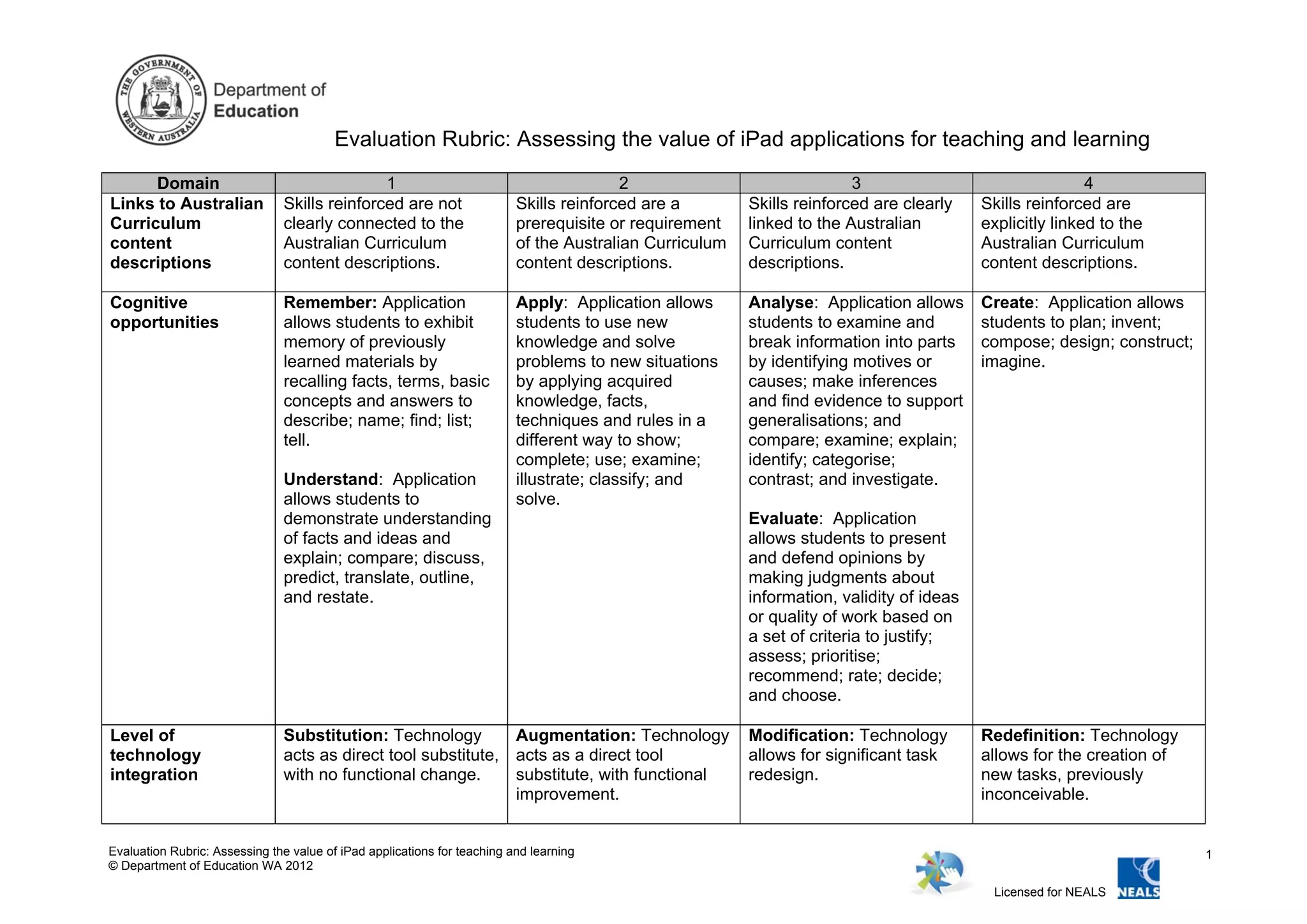
Evaluation Rubric: Assessing the value of iPad applications for teaching and learning
Domain
Links to Australian
Curriculum
content
descriptions

1
Skills reinforced are not
clearly connected to the
Australian Curriculum
content descriptions.

2
Skills reinforced are a
prerequisite or requirement
of the Australian Curriculum
content descriptions.

3
Skills reinforced are clearly
linked to the Australian
Curriculum content
descriptions.

4
Skills reinforced are
explicitly linked to the
Australian Curriculum
content descriptions.

Cognitive
opportunities

Remember: Application
allows students to exhibit
memory of previously
learned materials by
recalling facts, terms, basic
concepts and answers to
describe; name; find; list;
tell.

Apply: Application allows
students to use new
knowledge and solve
problems to new situations
by applying acquired
knowledge, facts,
techniques and rules in a
different way to show;
complete; use; examine;
illustrate; classify; and
solve.

Analyse: Application allows
students to examine and
break information into parts
by identifying motives or
causes; make inferences
and find evidence to support
generalisations; and
compare; examine; explain;
identify; categorise;
contrast; and investigate.

Create: Application allows
students to plan; invent;
compose; design; construct;
imagine.

Understand: Application
allows students to
demonstrate understanding
of facts and ideas and
explain; compare; discuss,
predict, translate, outline,
and restate.

Level of
technology
integration

Substitution: Technology
Augmentation: Technology
acts as direct tool substitute, acts as a direct tool
with no functional change.
substitute, with functional
improvement.

Evaluate: Application
allows students to present
and defend opinions by
making judgments about
information, validity of ideas
or quality of work based on
a set of criteria to justify;
assess; prioritise;
recommend; rate; decide;
and choose.
Modification: Technology
allows for significant task
redesign.

Redefinition: Technology
allows for the creation of
new tasks, previously
inconceivable.

Evaluation Rubric: Assessing the value of iPad applications for teaching and learning
© Department of Education WA 2012

1
Licensed for NEALS
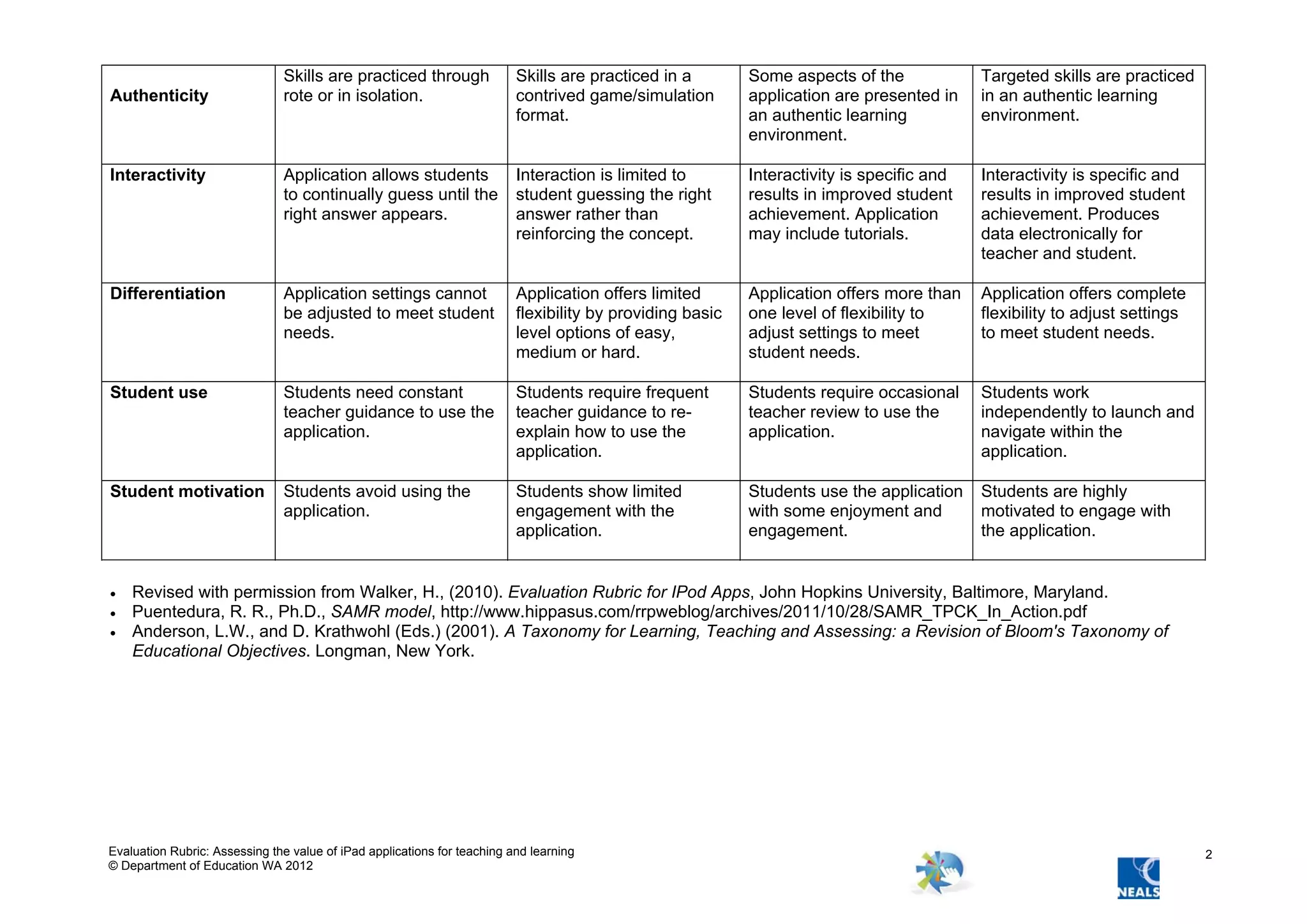
Skills are practiced through
rote or in isolation.

Skills are practiced in a
contrived game/simulation
format.

Some aspects of the
application are presented in
an authentic learning
environment.

Targeted skills are practiced
in an authentic learning
environment.

Interactivity

Application allows students
to continually guess until the
right answer appears.

Interaction is limited to
student guessing the right
answer rather than
reinforcing the concept.

Interactivity is specific and
results in improved student
achievement. Application
may include tutorials.

Interactivity is specific and
results in improved student
achievement. Produces
data electronically for
teacher and student.

Differentiation

Application settings cannot
be adjusted to meet student
needs.

Application offers limited
flexibility by providing basic
level options of easy,
medium or hard.

Application offers more than
one level of flexibility to
adjust settings to meet
student needs.

Application offers complete
flexibility to adjust settings
to meet student needs.

Student use

Students need constant
teacher guidance to use the
application.

Students require frequent
teacher guidance to reexplain how to use the
application.

Students require occasional
teacher review to use the
application.

Students work
independently to launch and
navigate within the
application.

Student motivation

Students avoid using the
application.

Students show limited
engagement with the
application.

Students use the application
with some enjoyment and
engagement.

Students are highly
motivated to engage with
the application.

Authenticity

Revised with permission from Walker, H., (2010). Evaluation Rubric for IPod Apps, John Hopkins University, Baltimore, Maryland.
Puentedura, R. R., Ph.D., SAMR model, http://www.hippasus.com/rrpweblog/archives/2011/10/28/SAMR_TPCK_In_Action.pdf
Anderson, L.W., and D. Krathwohl (Eds.) (2001). A Taxonomy for Learning, Teaching and Assessing: a Revision of Bloom's Taxonomy of
Educational Objectives. Longman, New York.

Evaluation Rubric: Assessing the value of iPad applications for teaching and learning
© Department of Education WA 2012

2

Rubric ipad apps_v0.4

  • 1.
    Evaluation Rubric: Assessingthe value of iPad applications for teaching and learning Domain Links to Australian Curriculum content descriptions 1 Skills reinforced are not clearly connected to the Australian Curriculum content descriptions. 2 Skills reinforced are a prerequisite or requirement of the Australian Curriculum content descriptions. 3 Skills reinforced are clearly linked to the Australian Curriculum content descriptions. 4 Skills reinforced are explicitly linked to the Australian Curriculum content descriptions. Cognitive opportunities Remember: Application allows students to exhibit memory of previously learned materials by recalling facts, terms, basic concepts and answers to describe; name; find; list; tell. Apply: Application allows students to use new knowledge and solve problems to new situations by applying acquired knowledge, facts, techniques and rules in a different way to show; complete; use; examine; illustrate; classify; and solve. Analyse: Application allows students to examine and break information into parts by identifying motives or causes; make inferences and find evidence to support generalisations; and compare; examine; explain; identify; categorise; contrast; and investigate. Create: Application allows students to plan; invent; compose; design; construct; imagine. Understand: Application allows students to demonstrate understanding of facts and ideas and explain; compare; discuss, predict, translate, outline, and restate. Level of technology integration Substitution: Technology Augmentation: Technology acts as direct tool substitute, acts as a direct tool with no functional change. substitute, with functional improvement. Evaluate: Application allows students to present and defend opinions by making judgments about information, validity of ideas or quality of work based on a set of criteria to justify; assess; prioritise; recommend; rate; decide; and choose. Modification: Technology allows for significant task redesign. Redefinition: Technology allows for the creation of new tasks, previously inconceivable. Evaluation Rubric: Assessing the value of iPad applications for teaching and learning © Department of Education WA 2012 1 Licensed for NEALS
  • 2.
    Skills are practicedthrough rote or in isolation. Skills are practiced in a contrived game/simulation format. Some aspects of the application are presented in an authentic learning environment. Targeted skills are practiced in an authentic learning environment. Interactivity Application allows students to continually guess until the right answer appears. Interaction is limited to student guessing the right answer rather than reinforcing the concept. Interactivity is specific and results in improved student achievement. Application may include tutorials. Interactivity is specific and results in improved student achievement. Produces data electronically for teacher and student. Differentiation Application settings cannot be adjusted to meet student needs. Application offers limited flexibility by providing basic level options of easy, medium or hard. Application offers more than one level of flexibility to adjust settings to meet student needs. Application offers complete flexibility to adjust settings to meet student needs. Student use Students need constant teacher guidance to use the application. Students require frequent teacher guidance to reexplain how to use the application. Students require occasional teacher review to use the application. Students work independently to launch and navigate within the application. Student motivation Students avoid using the application. Students show limited engagement with the application. Students use the application with some enjoyment and engagement. Students are highly motivated to engage with the application. Authenticity Revised with permission from Walker, H., (2010). Evaluation Rubric for IPod Apps, John Hopkins University, Baltimore, Maryland. Puentedura, R. R., Ph.D., SAMR model, http://www.hippasus.com/rrpweblog/archives/2011/10/28/SAMR_TPCK_In_Action.pdf Anderson, L.W., and D. Krathwohl (Eds.) (2001). A Taxonomy for Learning, Teaching and Assessing: a Revision of Bloom's Taxonomy of Educational Objectives. Longman, New York. Evaluation Rubric: Assessing the value of iPad applications for teaching and learning © Department of Education WA 2012 2