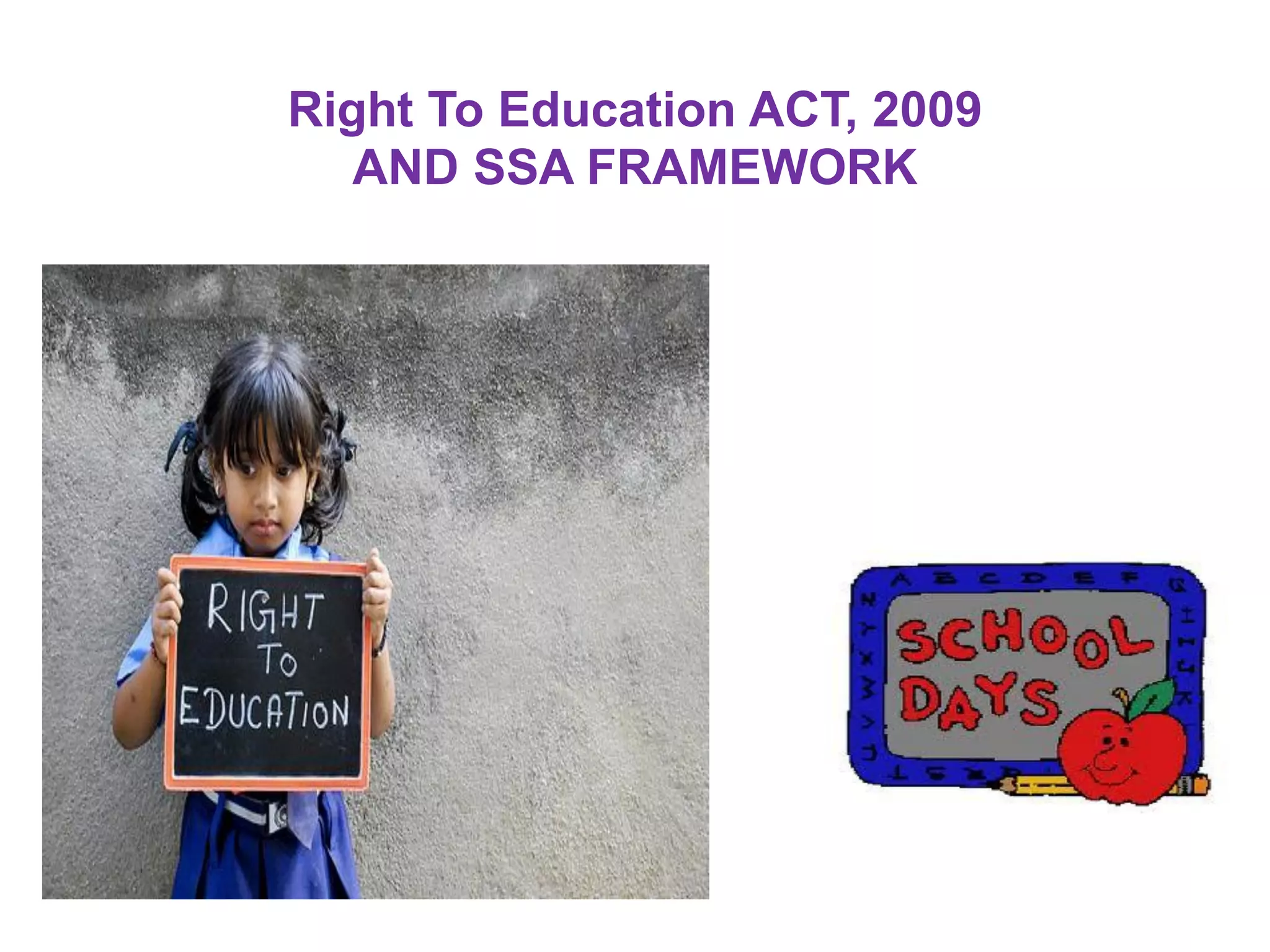
Right To Education ACT, 2009
AND SSA FRAMEWORK
BACKGROUND
 Due to efforts of Dadabhai Naoroji and Jyothiba Phule,
Hunter Commission (1882) : recommended that schools
should be open to all.
 The first law on education introduced by the State of Baroda in 1906,
provided for compulsory education for boys and girls in the age groups
of 7–12 years and 7–10 years respectively.
 The word ‘right’ in the context of elementary education by Tagore
used in his letter to the International League for the Rational
Education of Children in 1908
BACKGROUND…..
• Mahatma Gandhi gave a magnificent call for
universal education in 1937 with concept of
Basic Education
• Education was included in the Directive
Principles of State Policy, in the Constitution of
India in 1950
• Article 45 : Stating for free and compulsory
education for all children until they complete
the age of 14 years (1950)
BACKGROUND……

• Kothari Commission(1964) with concept of
common school system
• NPE (1968 & 1986) recommended for
equalization of educational opportunity and
common school system

• The Supreme Court Judgment (1993) to make
Education as Fundamental Right
• 86th Constitutional Amendment (2002) was
passed by Parliament and Article 21A
BACKGROUND……
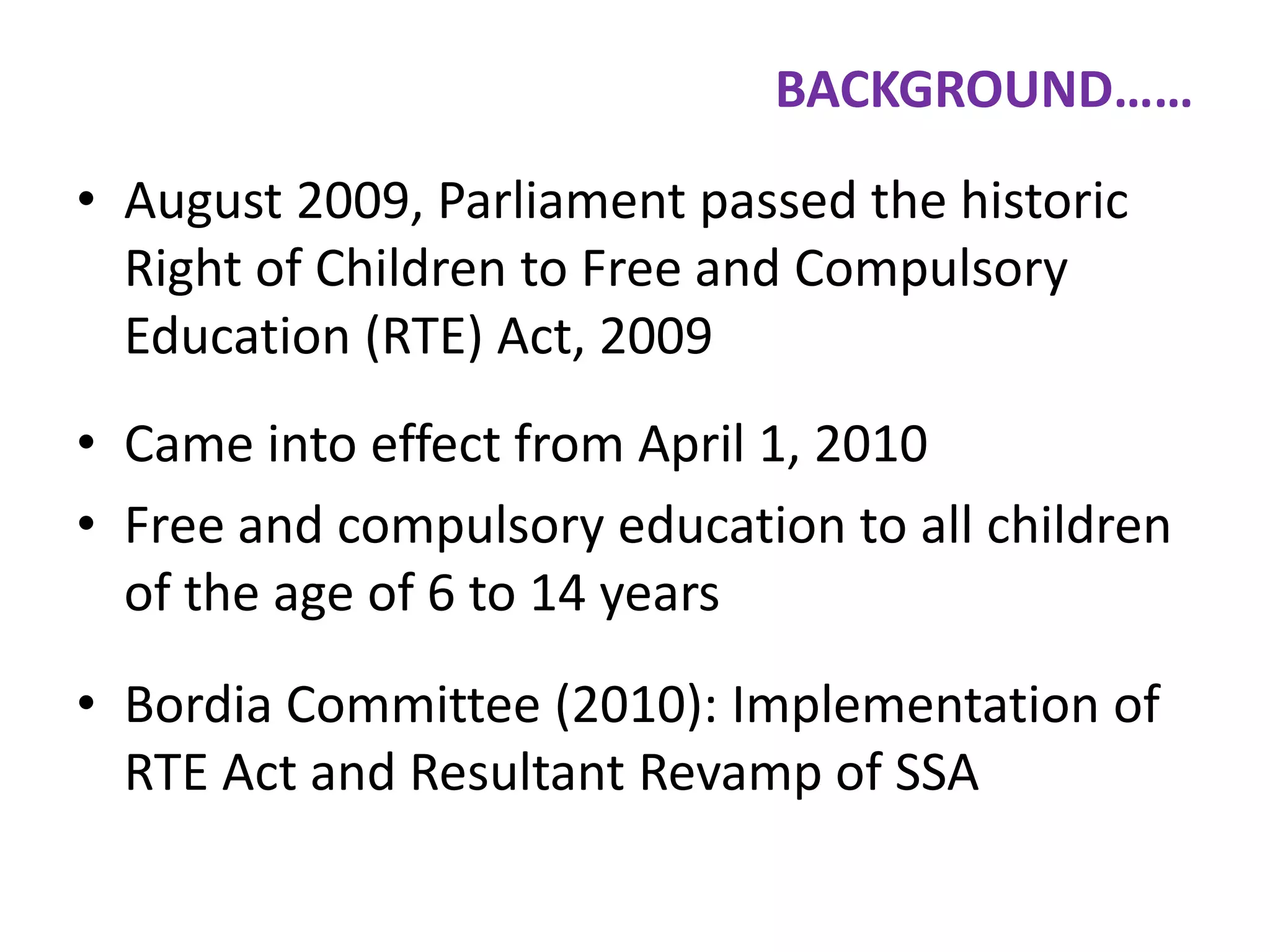
• August 2009, Parliament passed the historic
Right of Children to Free and Compulsory
Education (RTE) Act, 2009

• Came into effect from April 1, 2010
• Free and compulsory education to all children
of the age of 6 to 14 years
• Bordia Committee (2010): Implementation of
RTE Act and Resultant Revamp of SSA
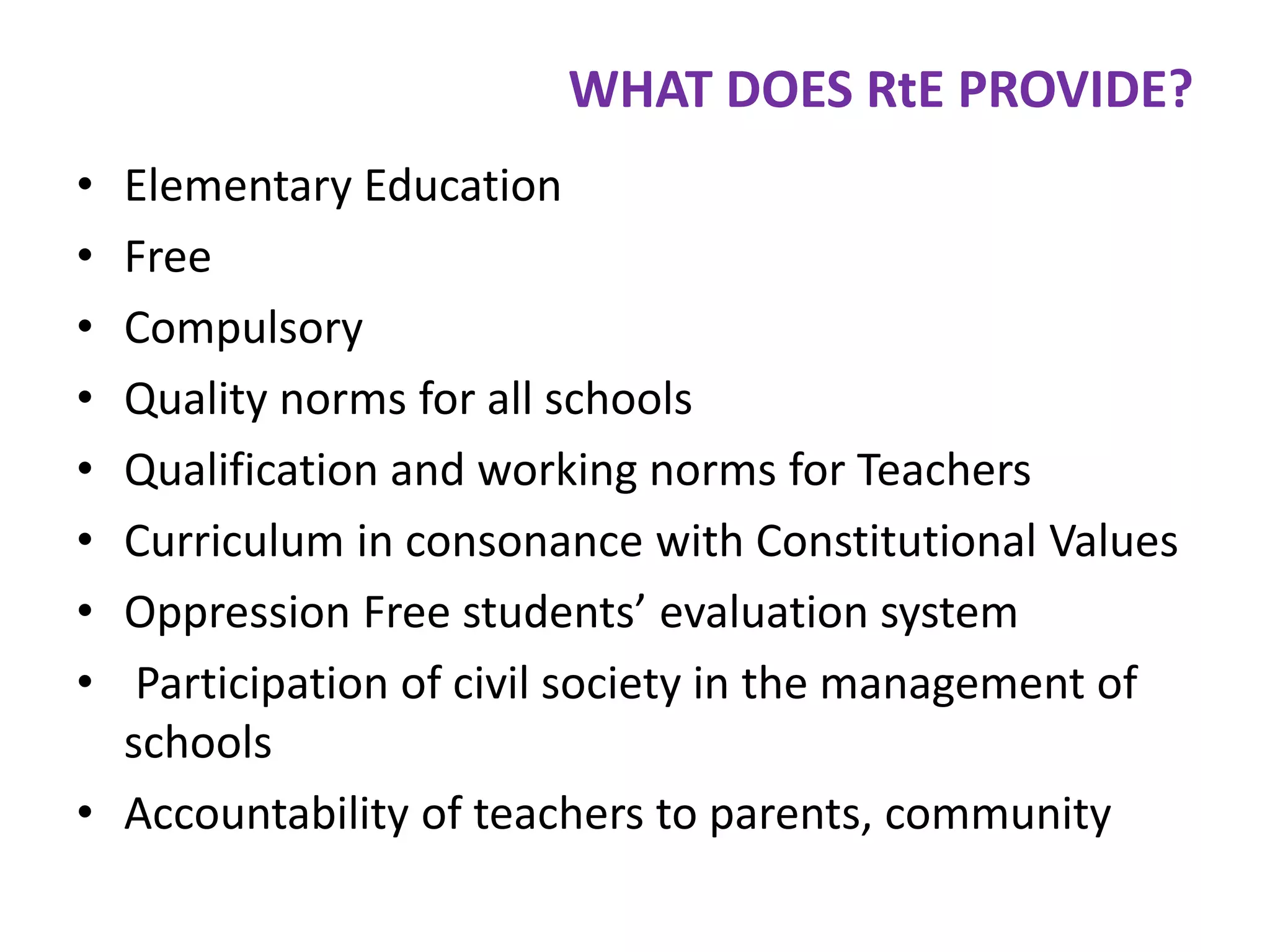
WHAT DOES RtE PROVIDE?
•
•
•
•
•
•
•
•

Elementary Education
Free
Compulsory
Quality norms for all schools
Qualification and working norms for Teachers
Curriculum in consonance with Constitutional Values
Oppression Free students’ evaluation system
Participation of civil society in the management of
schools
• Accountability of teachers to parents, community
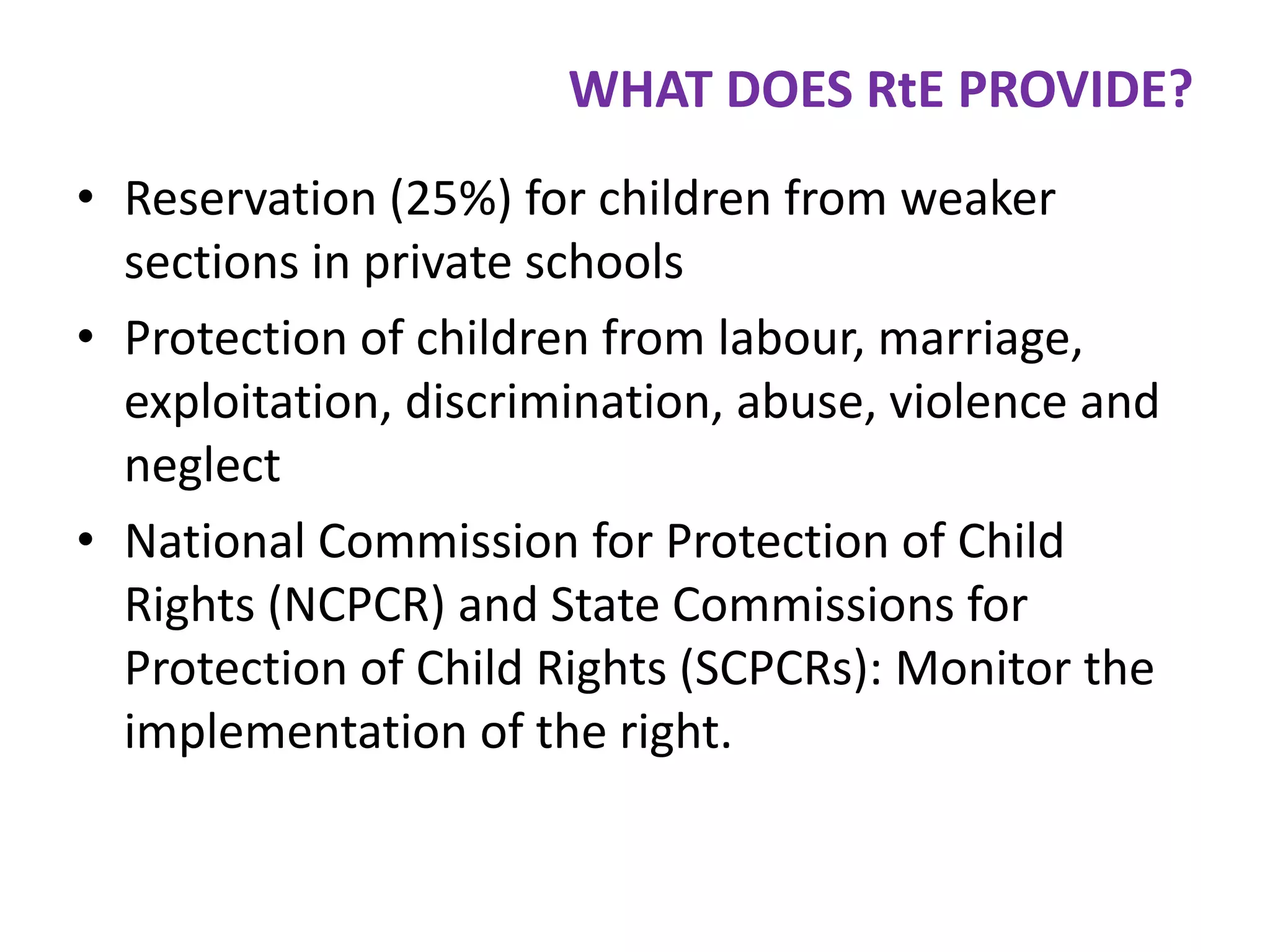
WHAT DOES RtE PROVIDE?
• Reservation (25%) for children from weaker
sections in private schools
• Protection of children from labour, marriage,
exploitation, discrimination, abuse, violence and
neglect
• National Commission for Protection of Child
Rights (NCPCR) and State Commissions for
Protection of Child Rights (SCPCRs): Monitor the
implementation of the right.
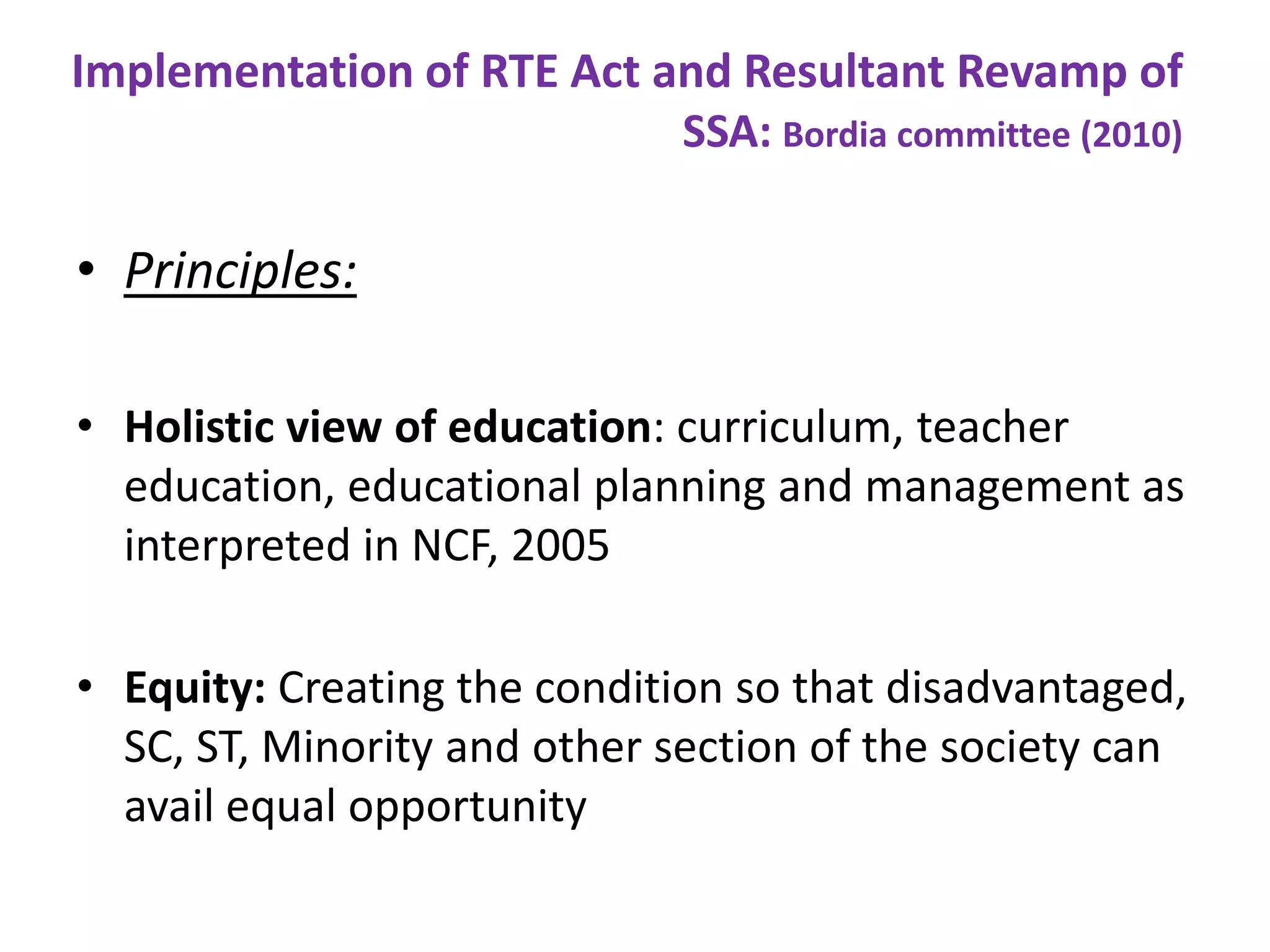
Implementation of RTE Act and Resultant Revamp of
SSA: Bordia committee (2010)

• Principles:
• Holistic view of education: curriculum, teacher
education, educational planning and management as
interpreted in NCF, 2005
• Equity: Creating the condition so that disadvantaged,
SC, ST, Minority and other section of the society can
avail equal opportunity
Implementation of RTE Act and Resultant Revamp of
SSA: Bordia committee (2010)
• Access: ensuring schools in specified distance,
understanding educational needs and predicaments of
the excluded sections viz; Sc, ST, Minority, Girls etc.
• Moral compulsion: imposed on parents, teachers,
educational administrators and other stakeholders
• Gender concern: Not only enabling girls to keep pace
with boys but also to bring about a basic change in the
status of women
IMPLEMENTING RTE ACT IN ODISHA
• Odisha-2nd state after Sikkim to notify the RCFCE
Rules, 2010
• Prohibition of corporal punishment in Schools-Sept
23, 2010
• Prohibition of screening procedures on 4thy Nov, 2010
• Guidelines for Composition and functions of SMCs in
Elementary Schools on 11th Jan, 2011
• RtE Cell has been functioning from OPEPA office and
works in close association with all the Directorates of
the School and Mass Education Department
IMPLEMENTING RTE ACT IN ODISHA
• Quality School package: across 30 districts ; to emerge
as quality schools -infrastructure, curricular and cocurricular components etc.
• Sanitation and Safe Drinking Water: 93% rural schools
have safe drinking water and 84 % of rural schools
have common toilets

• Government-Civil Societies partnership: consultation
with civil society was held on 20th Dec, 2010. Guidance
note issued to all districts on taking support from civil
society organization in implementing RTE at the
district level.
IMPLEMENTING RTE ACT IN ODISHA
• Teachers’ Training: in-service training programme
(Samarthya), both content & theme- based modules
(NCF; RtE; and CCE);
1,37,836 teachers received training for 20 days out of
the targeted 1, 72,892
• Grievance Redressal Cell and School Students’
Helpline: toll-free Helpline no.
GRC - hearing, enquiry, follow-up and redressal of
cases from teachers, officers, parents and children.
IMPLEMENTING RTE ACT IN ODISHA
• Monitoring Mechanism: ‘Samiksha’ w.e.f Nov-2010;
Indicators under Samiksha -Environment, Curricular
Programmes and Co-Curricular Programmes, SchoolCommunity Linkage, School Management.
• Documentation of RtE Initiatives: success stories
under School students’ helpline documented in
booklet ‘sampark’;
all initiatives of S&ME Department in
implementation of RTE Act is documented in booklet
‘Sambhav’.
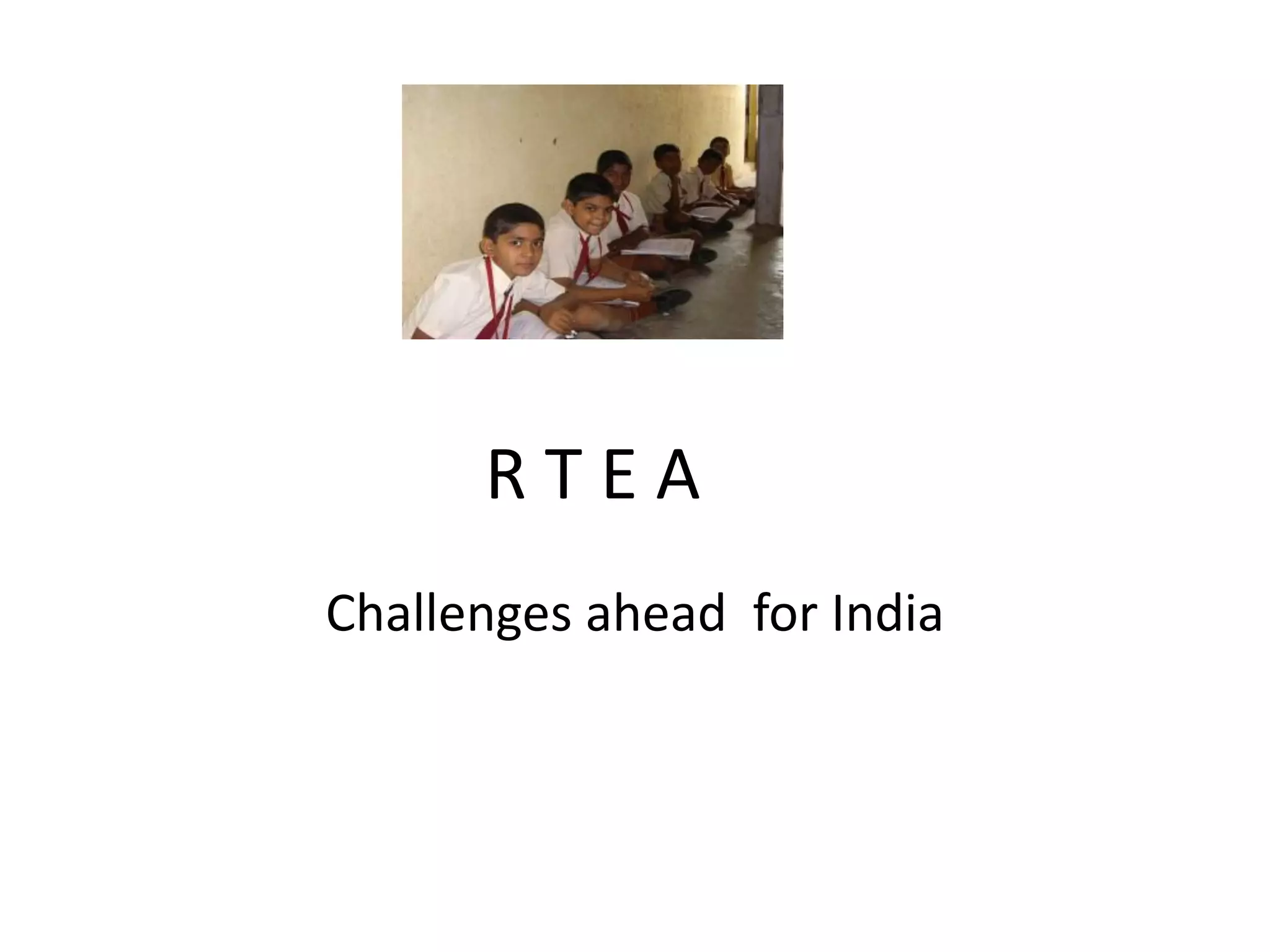
RTEA
Challenges ahead for India
Challenges Ahead :
State Governments' Apathy:
Lack of Promptness / Commitment
Poor economic conditions of the States

Availability of Infrastructure Facilities:
Establishment of Primary Schools within one

kilometer and upper Primary Schools within three
kilometer distance.
Well equipped classrooms, library, laboratory,
play ground, drinking water and toilet facilities.
Availability of Teachers and Required Pupil-Teacher Ratio:

• Five lakhs new teachers are to be recruited and 5 lakhs new
classrooms are to be constructed to meet the required 30 : 1
pupil teacher ratio.
• There are seven lakhs teachers in the recognized 13 lakhs
primary schools. Out of these, three lakhs teachers are either

untrained or under-training.
• In many states large number of teachers are para -teachers and

many of them are untrained.
As per a recent report by NUEPA, Bihar tops amongst
the states having poor pupil-teacher ratio and Uttar
Pradesh comes at second place.
In about 35 percent primary schools in Uttar Pradesh,

pupil teacher ratio is 60:1. Fifty one percent primary
schools in Uttar Pradesh are having three or less

number of teachers. Out of these, 38 percent are parateachers.
In the present circumstances, to maintain pupil-teacher
ratio as per the Act, appears a distant dream.
Quality of Education:
Quality of education depends upon the quality of
teachers. Teachers'

selection and training procedure

and their conditions of work need a substantial
improvement.

Teachers' accountability to the pupils, their parents, the
community and to their own profession needs to be
determined
Twenty Five Percent Reservation of Seats in Private

Schools:
How will be the identification, selection and verification
of economically weaker and disadvantaged children
done ?
Would they be selected from the neighborhood or from
the entire village / town / city?
How will the whole process be monitored by the

government?
Recommendations / Suggestions:
Following suggestions may be helpful to meet the challenges:

The state governments are required to promptly implement the
RTE Act. If a time limit to release funds to the states be imposed
by the Central Government and if any state government still
shows apathy to release notification, then no funds should be
released by the Centre to that state for the establishment of new
schools.
State governments should show full commitment for the
implementation of the Act.
Primary schools with all minimum required infrastructure
facilities should be established in the neglected areas on
priority basis. Central government should release its
share of budget to the states at the earliest. Facilities in
the existing government schools should be expanded.
To avoid the closure of unrecognized private schools for

not fulfilling the prescribed recognition standards within
three years, these schools must be helped to improve
their facilities by resource support and providing
linkages with financial institutions.
To meet budgetary constraints, stress must be given on
cost effectiveness and accountability at every level.
The teachers in required number must be recruited at
the earliest and pupil-teacher ratio be maintained as
required.
As more and more children move into the primary
school age group, it is needful to build more schools
and recruit more teachers for sustained improvement in

the quality of education.
Primary schools need to be made aware of the
provisions made for 25 percent reservation of seats for
the economically and socially weaker and
disadvantaged children and the role of school managing
committees in this regard.
The identification, selection and verification procedure

of such children should be well defined and well
informed. How the whole process will be monitored
should also be notified.
While the Central and State Governments have their full
share of responsibilities, it is community participation and
involvement of NGOs which will make marked difference
in implementing Right to Education Act.

To achieve the goals, it is of upmost importance to
develop curricula that is responsive to changing needs

and facilitates the incorporation and integration of new
content areas related to science, technology, population
and the environment.
To implement Right to Education Act, make all efforts with

dedication and commitment. The governments and the
nation as a whole should take responsibility in this regard.
Community participation and support are needed for
greater coordination amongst different agencies and
functionaries involved in this task. To overcome population
pressures and budgetary constraints, cost effectiveness
and accountability must be ascertained at every level.

Efforts should be focused on qualitative improvement of the
whole programme
With Thanks

Right to Education and Sarva Shiksha Abhiyan

  • 1.
    Right To EducationACT, 2009 AND SSA FRAMEWORK
  • 2.
    BACKGROUND  Due toefforts of Dadabhai Naoroji and Jyothiba Phule, Hunter Commission (1882) : recommended that schools should be open to all.  The first law on education introduced by the State of Baroda in 1906, provided for compulsory education for boys and girls in the age groups of 7–12 years and 7–10 years respectively.  The word ‘right’ in the context of elementary education by Tagore used in his letter to the International League for the Rational Education of Children in 1908
  • 3.
    BACKGROUND….. • Mahatma Gandhigave a magnificent call for universal education in 1937 with concept of Basic Education • Education was included in the Directive Principles of State Policy, in the Constitution of India in 1950 • Article 45 : Stating for free and compulsory education for all children until they complete the age of 14 years (1950)
  • 4.
    BACKGROUND…… • Kothari Commission(1964)with concept of common school system • NPE (1968 & 1986) recommended for equalization of educational opportunity and common school system • The Supreme Court Judgment (1993) to make Education as Fundamental Right • 86th Constitutional Amendment (2002) was passed by Parliament and Article 21A
  • 5.
    BACKGROUND…… • August 2009,Parliament passed the historic Right of Children to Free and Compulsory Education (RTE) Act, 2009 • Came into effect from April 1, 2010 • Free and compulsory education to all children of the age of 6 to 14 years • Bordia Committee (2010): Implementation of RTE Act and Resultant Revamp of SSA
  • 6.
    WHAT DOES RtEPROVIDE? • • • • • • • • Elementary Education Free Compulsory Quality norms for all schools Qualification and working norms for Teachers Curriculum in consonance with Constitutional Values Oppression Free students’ evaluation system Participation of civil society in the management of schools • Accountability of teachers to parents, community
  • 7.
    WHAT DOES RtEPROVIDE? • Reservation (25%) for children from weaker sections in private schools • Protection of children from labour, marriage, exploitation, discrimination, abuse, violence and neglect • National Commission for Protection of Child Rights (NCPCR) and State Commissions for Protection of Child Rights (SCPCRs): Monitor the implementation of the right.
  • 8.
    Implementation of RTEAct and Resultant Revamp of SSA: Bordia committee (2010) • Principles: • Holistic view of education: curriculum, teacher education, educational planning and management as interpreted in NCF, 2005 • Equity: Creating the condition so that disadvantaged, SC, ST, Minority and other section of the society can avail equal opportunity
  • 9.
    Implementation of RTEAct and Resultant Revamp of SSA: Bordia committee (2010) • Access: ensuring schools in specified distance, understanding educational needs and predicaments of the excluded sections viz; Sc, ST, Minority, Girls etc. • Moral compulsion: imposed on parents, teachers, educational administrators and other stakeholders • Gender concern: Not only enabling girls to keep pace with boys but also to bring about a basic change in the status of women
  • 10.
    IMPLEMENTING RTE ACTIN ODISHA • Odisha-2nd state after Sikkim to notify the RCFCE Rules, 2010 • Prohibition of corporal punishment in Schools-Sept 23, 2010 • Prohibition of screening procedures on 4thy Nov, 2010 • Guidelines for Composition and functions of SMCs in Elementary Schools on 11th Jan, 2011 • RtE Cell has been functioning from OPEPA office and works in close association with all the Directorates of the School and Mass Education Department
  • 11.
    IMPLEMENTING RTE ACTIN ODISHA • Quality School package: across 30 districts ; to emerge as quality schools -infrastructure, curricular and cocurricular components etc. • Sanitation and Safe Drinking Water: 93% rural schools have safe drinking water and 84 % of rural schools have common toilets • Government-Civil Societies partnership: consultation with civil society was held on 20th Dec, 2010. Guidance note issued to all districts on taking support from civil society organization in implementing RTE at the district level.
  • 12.
    IMPLEMENTING RTE ACTIN ODISHA • Teachers’ Training: in-service training programme (Samarthya), both content & theme- based modules (NCF; RtE; and CCE); 1,37,836 teachers received training for 20 days out of the targeted 1, 72,892 • Grievance Redressal Cell and School Students’ Helpline: toll-free Helpline no. GRC - hearing, enquiry, follow-up and redressal of cases from teachers, officers, parents and children.
  • 13.
    IMPLEMENTING RTE ACTIN ODISHA • Monitoring Mechanism: ‘Samiksha’ w.e.f Nov-2010; Indicators under Samiksha -Environment, Curricular Programmes and Co-Curricular Programmes, SchoolCommunity Linkage, School Management. • Documentation of RtE Initiatives: success stories under School students’ helpline documented in booklet ‘sampark’; all initiatives of S&ME Department in implementation of RTE Act is documented in booklet ‘Sambhav’.
  • 14.
  • 15.
    Challenges Ahead : StateGovernments' Apathy: Lack of Promptness / Commitment Poor economic conditions of the States Availability of Infrastructure Facilities: Establishment of Primary Schools within one kilometer and upper Primary Schools within three kilometer distance. Well equipped classrooms, library, laboratory, play ground, drinking water and toilet facilities.
  • 16.
    Availability of Teachersand Required Pupil-Teacher Ratio: • Five lakhs new teachers are to be recruited and 5 lakhs new classrooms are to be constructed to meet the required 30 : 1 pupil teacher ratio. • There are seven lakhs teachers in the recognized 13 lakhs primary schools. Out of these, three lakhs teachers are either untrained or under-training. • In many states large number of teachers are para -teachers and many of them are untrained.
  • 17.
    As per arecent report by NUEPA, Bihar tops amongst the states having poor pupil-teacher ratio and Uttar Pradesh comes at second place. In about 35 percent primary schools in Uttar Pradesh, pupil teacher ratio is 60:1. Fifty one percent primary schools in Uttar Pradesh are having three or less number of teachers. Out of these, 38 percent are parateachers. In the present circumstances, to maintain pupil-teacher ratio as per the Act, appears a distant dream.
  • 18.
    Quality of Education: Qualityof education depends upon the quality of teachers. Teachers' selection and training procedure and their conditions of work need a substantial improvement. Teachers' accountability to the pupils, their parents, the community and to their own profession needs to be determined
  • 19.
    Twenty Five PercentReservation of Seats in Private Schools: How will be the identification, selection and verification of economically weaker and disadvantaged children done ? Would they be selected from the neighborhood or from the entire village / town / city? How will the whole process be monitored by the government?
  • 20.
    Recommendations / Suggestions: Followingsuggestions may be helpful to meet the challenges: The state governments are required to promptly implement the RTE Act. If a time limit to release funds to the states be imposed by the Central Government and if any state government still shows apathy to release notification, then no funds should be released by the Centre to that state for the establishment of new schools. State governments should show full commitment for the implementation of the Act.
  • 21.
    Primary schools withall minimum required infrastructure facilities should be established in the neglected areas on priority basis. Central government should release its share of budget to the states at the earliest. Facilities in the existing government schools should be expanded. To avoid the closure of unrecognized private schools for not fulfilling the prescribed recognition standards within three years, these schools must be helped to improve their facilities by resource support and providing linkages with financial institutions.
  • 22.
    To meet budgetaryconstraints, stress must be given on cost effectiveness and accountability at every level. The teachers in required number must be recruited at the earliest and pupil-teacher ratio be maintained as required. As more and more children move into the primary school age group, it is needful to build more schools and recruit more teachers for sustained improvement in the quality of education.
  • 23.
    Primary schools needto be made aware of the provisions made for 25 percent reservation of seats for the economically and socially weaker and disadvantaged children and the role of school managing committees in this regard. The identification, selection and verification procedure of such children should be well defined and well informed. How the whole process will be monitored should also be notified.
  • 25.
    While the Centraland State Governments have their full share of responsibilities, it is community participation and involvement of NGOs which will make marked difference in implementing Right to Education Act. To achieve the goals, it is of upmost importance to develop curricula that is responsive to changing needs and facilitates the incorporation and integration of new content areas related to science, technology, population and the environment.
  • 26.
    To implement Rightto Education Act, make all efforts with dedication and commitment. The governments and the nation as a whole should take responsibility in this regard. Community participation and support are needed for greater coordination amongst different agencies and functionaries involved in this task. To overcome population pressures and budgetary constraints, cost effectiveness and accountability must be ascertained at every level. Efforts should be focused on qualitative improvement of the whole programme
  • 27.