Rashtriya Uchchatar Shiksha AbhiyanRashtriya Uchchatar Shiksha Abhiyan
RUSARUSA
Transformation of Higher EducationTransformation of Higher Education
Concerns in Higher EducationConcerns in Higher Education
• Access, Equity, Quality and Funding
• State Universities: Poor Reforms in areas like:
– Academic and Affiliation
– Governance
– Autonomy
• Role of StateRole of State in Higher Education
• Funding not linked with performance
• Lack of MonitoringMonitoring and Evaluation of Schemes of
Higher Education
• PlanningPlanning by State Governments and Institutions
• Poor AccountabilityAccountability of Institutions and States
• No partnership of stakeholdersstakeholders
Rashtriya Madhyamik Shiksha Abhiyan
(RMSA)
• It was launched in March, 2009
• the objective to enhance access to secondary
education and to improve its quality. The
implementation of the scheme started from
2009-10. It is envisaged to achieve an
enrolment rate of 75% from 52.26% in 2005-
06 at secondary stage of implementation of
the scheme by providing a secondary school
within a reasonable distance of any
habitation.
• The other objectives include improving
quality of education imparted at
secondary level through making all
secondary schools conform to prescribed
norms, removing gender, socio-economic
and disability barriers, providing
universal access to secondary level
education by 2017, i.e., by the end of
12th Five Year Plan and achieving
universal retention by 2020.
• Important Physical Facilities Provided Under
The Scheme Are:
• (i) Additional class rooms, (ii) Laboratories, (iii)
Libraries, (iv) Art and crafts room, (v) Toilet
blocks, (vi) Drinking water provisions and (vii)
Residential Hostels for Teachers in remote
areas.
• Important Quality Interventions Provided
Under The Scheme Are:
• (i) appointment of additional teachers to
reduce PTR to 30:1, (ii) focus on Science, Math
and English education, (iii) In-service training
of teachers, (iv) science laboratories, (v) ICT
enabled education, (vi) curriculum reforms;
and (vii) teaching learning reforms.
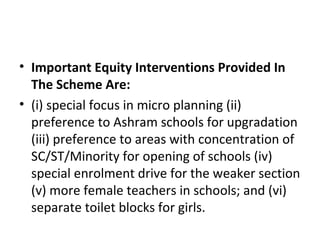
• Important Equity Interventions Provided In
The Scheme Are:
• (i) special focus in micro planning (ii)
preference to Ashram schools for upgradation
(iii) preference to areas with concentration of
SC/ST/Minority for opening of schools (iv)
special enrolment drive for the weaker section
(v) more female teachers in schools; and (vi)
separate toilet blocks for girls.
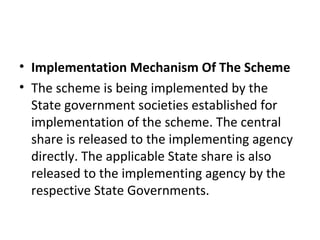
• Implementation Mechanism Of The Scheme
• The scheme is being implemented by the
State government societies established for
implementation of the scheme. The central
share is released to the implementing agency
directly. The applicable State share is also
released to the implementing agency by the
respective State Governments.
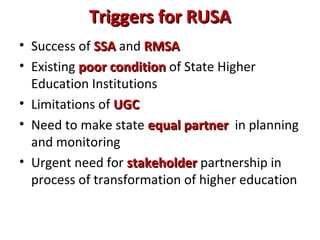
Triggers for RUSATriggers for RUSA
• Success of SSASSA and RMSARMSA
• Existing poor conditionpoor condition of State Higher
Education Institutions
• Limitations of UGCUGC
• Need to make state equal partnerequal partner in planning
and monitoring
• Urgent need for stakeholderstakeholder partnership in
process of transformation of higher education
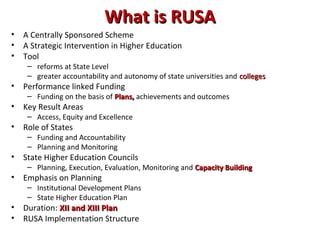
What is RUSAWhat is RUSA
• A Centrally Sponsored Scheme
• A Strategic Intervention in Higher Education
• Tool
– reforms at State Level
– greater accountability and autonomy of state universities and collegescolleges
• Performance linked Funding
– Funding on the basis of Plans,Plans, achievements and outcomes
• Key Result Areas
– Access, Equity and Excellence
• Role of States
– Funding and Accountability
– Planning and Monitoring
• State Higher Education Councils
– Planning, Execution, Evaluation, Monitoring and Capacity BuildingCapacity Building
• Emphasis on Planning
– Institutional Development Plans
– State Higher Education Plan
• Duration: XII and XIII PlanXII and XIII Plan
• RUSA Implementation Structure
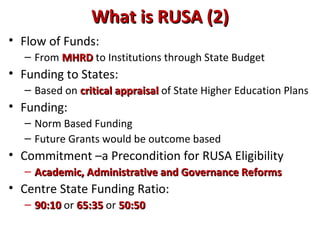
What is RUSA (2)What is RUSA (2)
• Flow of Funds:
– From MHRDMHRD to Institutions through State Budget
• Funding to States:
– Based on critical appraisalcritical appraisal of State Higher Education Plans
• Funding:
– Norm Based Funding
– Future Grants would be outcome based
• Commitment –a Precondition for RUSA Eligibility
– Academic, Administrative and Governance ReformsAcademic, Administrative and Governance Reforms
• Centre State Funding Ratio:
– 90:1090:10 or 65:3565:35 or 50:5050:50
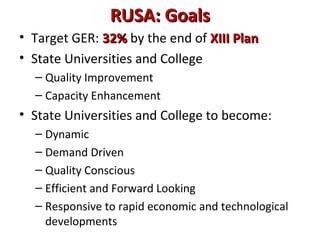
RUSA: GoalsRUSA: Goals
• Target GER: 32%32% by the end of XIII PlanXIII Plan
• State Universities and College
– Quality Improvement
– Capacity Enhancement
• State Universities and College to become:
– Dynamic
– Demand Driven
– Quality Conscious
– Efficient and Forward Looking
– Responsive to rapid economic and technological
developments
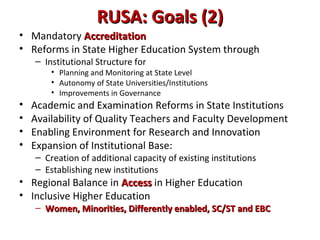
RUSA: Goals (2)RUSA: Goals (2)
• Mandatory AccreditationAccreditation
• Reforms in State Higher Education System through
– Institutional Structure for
• Planning and Monitoring at State Level
• Autonomy of State Universities/Institutions
• Improvements in Governance
• Academic and Examination Reforms in State Institutions
• Availability of Quality Teachers and Faculty Development
• Enabling Environment for Research and Innovation
• Expansion of Institutional Base:
– Creation of additional capacity of existing institutions
– Establishing new institutions
• Regional Balance in AccessAccess in Higher Education
• Inclusive Higher Education
– Women, Minorities, Differently enabled, SC/ST and EBCWomen, Minorities, Differently enabled, SC/ST and EBC
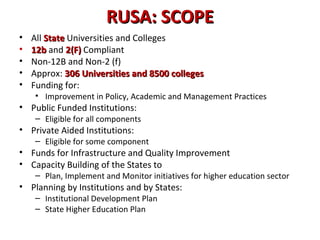
RUSA: SCOPERUSA: SCOPE
• All StateState Universities and Colleges
• 12b12b and 2(F)2(F) Compliant
• Non-12B and Non-2 (f)
• Approx: 306 Universities and 8500 colleges306 Universities and 8500 colleges
• Funding for:
• Improvement in Policy, Academic and Management Practices
• Public Funded Institutions:
– Eligible for all components
• Private Aided Institutions:
– Eligible for some component
• Funds for Infrastructure and Quality Improvement
• Capacity Building of the States to
– Plan, Implement and Monitor initiatives for higher education sector
• Planning by Institutions and by States:
– Institutional Development Plan
– State Higher Education Plan
Why RUSA
• Key Objectives:
– To improve accessaccess, equityequity and qualityquality in higher
education
– Through Planned Development at State Level
• Planning at State level for:
– Creating newnew institutions
– Expanding and upgradingupgrading existing ones
– StrengtheningStrengthening self reliant institutions
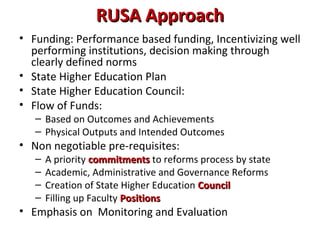
RUSA ApproachRUSA Approach
• Funding: Performance based funding, Incentivizing well
performing institutions, decision making through
clearly defined norms
• State Higher Education Plan
• State Higher Education Council:
• Flow of Funds:
– Based on Outcomes and Achievements
– Physical Outputs and Intended Outcomes
• Non negotiable pre-requisites:
– A priority commitmentscommitments to reforms process by state
– Academic, Administrative and Governance Reforms
– Creation of State Higher Education CouncilCouncil
– Filling up Faculty PositionsPositions
• Emphasis on Monitoring and Evaluation
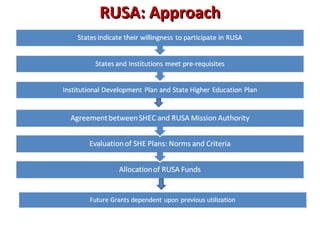
RUSA: ApproachRUSA: Approach
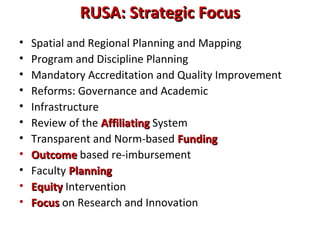
RUSA: Strategic FocusRUSA: Strategic Focus
• Spatial and Regional Planning and Mapping
• Program and Discipline Planning
• Mandatory Accreditation and Quality Improvement
• Reforms: Governance and Academic
• Infrastructure
• Review of the AffiliatingAffiliating System
• Transparent and Norm-based FundingFunding
• OutcomeOutcome based re-imbursement
• Faculty PlanningPlanning
• EquityEquity Intervention
• FocusFocus on Research and Innovation
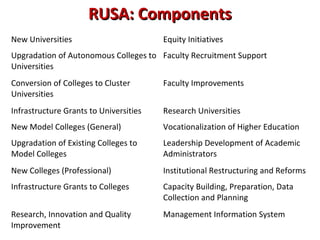
RUSA: ComponentsRUSA: Components
New Universities Equity Initiatives
Upgradation of Autonomous Colleges to
Universities
Faculty Recruitment Support
Conversion of Colleges to Cluster
Universities
Faculty Improvements
Infrastructure Grants to Universities Research Universities
New Model Colleges (General) Vocationalization of Higher Education
Upgradation of Existing Colleges to
Model Colleges
Leadership Development of Academic
Administrators
New Colleges (Professional) Institutional Restructuring and Reforms
Infrastructure Grants to Colleges Capacity Building, Preparation, Data
Collection and Planning
Research, Innovation and Quality
Improvement
Management Information System
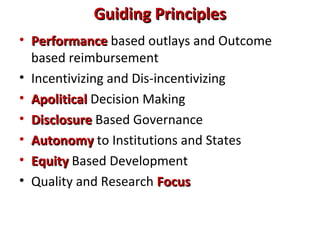
Guiding PrinciplesGuiding Principles
• PerformancePerformance based outlays and Outcome
based reimbursement
• Incentivizing and Dis-incentivizing
• ApoliticalApolitical Decision Making
• DisclosureDisclosure Based Governance
• AutonomyAutonomy to Institutions and States
• EquityEquity Based Development
• Quality and Research FocusFocus
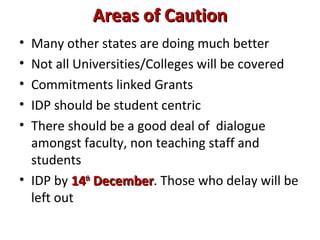
Areas of CautionAreas of Caution
• Many other states are doing much better
• Not all Universities/Colleges will be covered
• Commitments linked Grants
• IDP should be student centric
• There should be a good deal of dialogue
amongst faculty, non teaching staff and
students
• IDP by 1414thth
DecemberDecember. Those who delay will be
left out
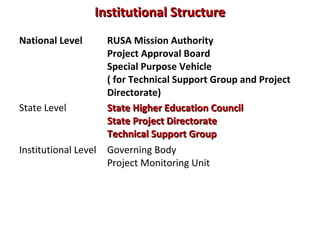
Institutional StructureInstitutional Structure
National Level RUSA Mission Authority
Project Approval Board
Special Purpose Vehicle
( for Technical Support Group and Project
Directorate)
State Level State Higher Education CouncilState Higher Education Council
State Project DirectorateState Project Directorate
Technical Support GroupTechnical Support Group
Institutional Level Governing Body
Project Monitoring Unit
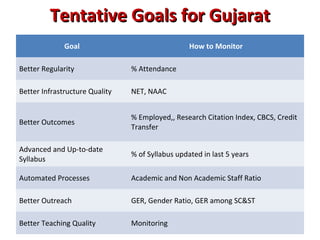
Tentative Goals for GujaratTentative Goals for Gujarat
Goal How to Monitor
Better Regularity % Attendance
Better Infrastructure Quality NET, NAAC
Better Outcomes
% Employed,, Research Citation Index, CBCS, Credit
Transfer
Advanced and Up-to-date
Syllabus
% of Syllabus updated in last 5 years
Automated Processes Academic and Non Academic Staff Ratio
Better Outreach GER, Gender Ratio, GER among SC&ST
Better Teaching Quality Monitoring