THE RIGHT OF CHILDREN
TO FREE AND
TO FREE AND
COMPULSORY EDUCATION
ACT – 2009
ACT – 2009
It is one of the 3 flagship programs of UPA govt.
1.
1. MGNREGA
MGNREGA
2.
2. RIGHT TO INFORMATION ACT
RIGHT TO INFORMATION ACT
(These 2 were enacted during it its first term
(2004 – 09))
(2004 – 09))
3.
3. RIGHT OF CHILDREN TO FREE &
RIGHT OF CHILDREN TO FREE &
COMPULSORY EDUCATION ACT (2009-10)
 PART 1 –
PART 1 – Right to Education as a Human Right
Right to Education as a Human Right
 PART 11 – Right to Education as a
PART 11 – Right to Education as a
Fundamental Right
Fundamental Right
 PART 111 – Right of Children for Free &
PART 111 – Right of Children for Free &
Compulsory Education Act
 PART 1V – RTE Model rules
PART 1V – RTE Model rules
 PART V –
PART V – Comments / Consequences /Implications
Comments / Consequences /Implications
of the Act for Minorities
Preamble
Preamble
 The Right of Children to Free & compulsory Education Act (RTE) is
a welfare legislation.
 It is meant to benefit about 1 crore non school going children.
 Cost envisaged is enormous: Centre & States will share the financial
burden in the ratio 55:45
 It will bring the pupil – teacher ratio to 30:1
 5.1 lakh teachers are required. So good scope for trained teachers/
B. Ed students.
 Every one seems to have jumped at the idea of RTE Act without
realizing its implications.
 India has joined a group of few countries in the world with making
education a fundamental right of every child. In that sense it is
historic.
 The act is meant to help children from economically weaker section
as well as children with disabilities.
 The hope was that the act would help improve government schools
and would not do any harm to the private schools. But it has turned
out to be the other way.
Right to Education as a Human Right
PART - I
PART - I
Right to Education
Right to Education
As a
As a
Human Right
Human Right
PART - II
PART - II
Education
Education
is a
is a
Fundamental Right
Fundamental Right
What are Fundamental Rights ?
 Fundamental Rights are rights which are inherent in a
Fundamental Rights are rights which are inherent in a
human being. They are natural rights. These rights are
regarded fundamental because they are most essential
for the attainment of the full growth, development and
potential of a human being.
 The framers of the Indian Constitution, drawing
The framers of the Indian Constitution, drawing
inspiration from the “Bill of Rights” of America,
incorporated a full chapter of these rights in Part III of
the Constitution. These Fundamental Rights listed in our
constitution represent the basic values cherished by the
people of this country.
Education As A Fundamental Right
8
Article 46
Article 46 –
–
The State shall promote with special care the educational
and economic interests of the weaker sections of the
people and, in particular, of the SCs and STs and shall
protect them from social injustice and all forms of
exploitation.
exploitation.
Article 29
Article 29 –
–
No citizen shall be denied admission into any educational
institution maintained by the State or receiving aid out of
State funds on grounds only of religion, race, caste,
language or any of them.
Equality of opportunity is a basic feature of the
Constitution and has been interpreted to include equality
of education which means equality of access to education
and equality of educational facilities.
All these factors contributed and finally
gave birth to this new act –
Right of Children to Free and Compulsory
Education Act, 2009.
PART – III
PART – III
Right to Education
Right to Education
Act – 2009
Act – 2009
Right to Education Act – 2009
Objectives:
Objectives:
 To provide for free and compulsory
To provide for free and compulsory
education to all children of the age 6 to 14
years.
years.
 Emphasis is on children belonging to
Emphasis is on children belonging to
disadvantaged group.
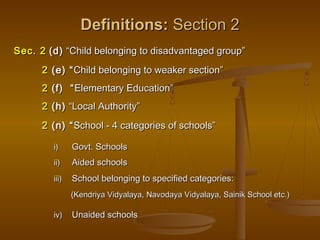
Definitions:
Definitions: Section 2
Section 2
i)
i) Govt. Schools
Govt. Schools
ii)
ii) Aided schools
Aided schools
iii)
iii) School belonging to specified categories:
School belonging to specified categories:
(Kendriya Vidyalaya, Navodaya Vidyalaya, Sainik School etc.)
iv)
iv) Unaided schools
Unaided schools
Sec. 2
Sec. 2 (d)
(d) “Child belonging to disadvantaged group”
“Child belonging to disadvantaged group”
2
2 (e) “
(e) “Child belonging to weaker section”
Child belonging to weaker section”
2
2 (f) “
(f) “Elementary Education”
Elementary Education”
2
2 (h)
(h) “Local Authority”
“Local Authority”
2
2 (n) “
(n) “School - 4 categories of schools”
School - 4 categories of schools”
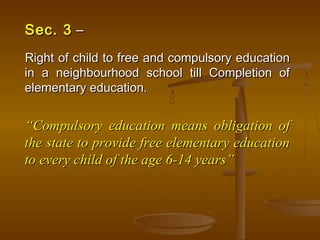
Sec. 3
Sec. 3 –
–
Right of child to free and compulsory education
in a neighbourhood school till Completion of
elementary education.
“
“Compulsory education means obligation of
Compulsory education means obligation of
the state to provide free elementary education
to every child of the age 6-14 years”
Sec. 4
Sec. 4 –
–
Special provisions for children not admitted to, or
who have not completed, elementary education.
Such children are to be directly admitted in a class
appropriate to his or her age and in order to be at
par with others, have a right to receive special
training and shall be entitled to free education till
completion of elementary education even after 14
years.
years.
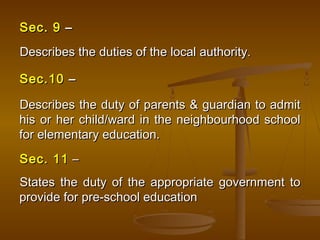
Sec. 9
Sec. 9 –
–
Describes the duties of the local authority.
Sec.10
Sec.10 –
–
Describes the duty of parents & guardian to admit
his or her child/ward in the neighbourhood school
for elementary education.
Sec. 11
Sec. 11 –
–
States the duty of the appropriate government to
provide for pre-school education
Sec. 12
Sec. 12 –
–
Extent of school’s responsibility:
(1) to admit children belonging to weaker sections and
disadvantaged group in the ‘neighbourhood’ in Class I
at least upto 25% of the strength of the class.
(2) an unaided school will be reimbursed expenditure
incurred by it to the extent of per child expenditure
incurred by the State or the actual amount charged
from the child, whichever is less. Reimbursement shall
not exceed per child expenditure incurred by a govt.
school.
school.
(3) every school shall provide such information as may be
required by the govt. or local authority.
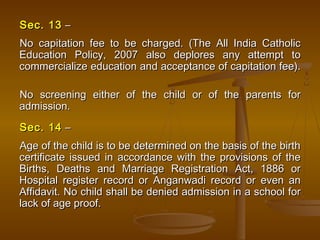
Sec. 13
Sec. 13 –
–
No capitation fee to be charged. (The All India Catholic
Education Policy, 2007 also deplores any attempt to
commercialize education and acceptance of capitation fee).
No screening either of the child or of the parents for
admission.
admission.
Sec. 14
Sec. 14 –
–
Age of the child is to be determined on the basis of the birth
certificate issued in accordance with the provisions of the
Births, Deaths and Marriage Registration Act, 1886 or
Hospital register record or Anganwadi record or even an
Affidavit. No child shall be denied admission in a school for
lack of age proof.
lack of age proof.
Sec. 15
Sec. 15 –
–
No denial of admission even if the child does not
turn up at the commencement of the academic
year.
year.
Sec. 16
Sec. 16 –
–
No child once admitted, can be held back or
expelled till the completion of elementary
education.
education.
Sec. 17
Sec. 17 –
–
No child shall be subjected to physical punishment
or mental harassment.
Sec. 18
Sec. 18 –
–
No school to be established without obtaining
certificate of recognition.
Sec. 19
Sec. 19 –
–
Schools to fulfill all the norms and standards
specified in the schedule.
Sec. 20
Sec. 20 –
–
Power of the Govt. to amend the schedule
a)
a) The elected representatives of the local authority,
The elected representatives of the local authority,
parents/guardians and teachers,
b)
b) At least ¾ of members shall be parents/guardians,
At least ¾ of members shall be parents/guardians,
c)
c) Proportionate representation should be given to the
Proportionate representation should be given to the
parents/guardians of children belonging to disadvantaged group
and weaker section,
and weaker section,
d)
d) 50% members shall be women.
50% members shall be women.
Sec. 21
Sec. 21 –
–
Every school should constitute a School Management Committee
(SMC) consisting of:
a)
a) Monitor the working of the school,
Monitor the working of the school,
b)
b) Prepare and recommend school development plan,
Prepare and recommend school development plan,
c)
c) Monitor the utilization of the grants received from the govt.,
Monitor the utilization of the grants received from the govt.,
d)
d) Perform other functions as may be prescribed.
Perform other functions as may be prescribed.
Functions of the SMC. The SMC shall
Sec. 22
Sec. 22 –
–
Preparation of School Development Plan by the SMC.
Sec. 23
Sec. 23 –
–
States that the qualification for appointment and terms and
conditions of service of teachers shall be as laid down by
the academic authority authorized by the Govt.
Sec. 24
Sec. 24 –
–
Duties of teachers. Teachers shall maintain regularity &
punctuality, complete the curriculum, hold regular meetings
with parents/guardians, etc.
Sec. 25
Sec. 25 –
–
Pupil-Teacher Ratio as specified in the schedule is to be
maintained, i.e., Classes I-V 30:1. Above 200 children
P-T ratio shall not exceed 40. Classes V-VIII 1:35, but at
least one teacher per class.
Sec. 26
Sec. 26 –
–
Filling up of vacancies of teachers.
Sec. 27
Sec. 27 –
–
Prohibition of deployment of teachers for non-educational
purposes other than decennial population census,
disaster relief duties and for election duties.
Sec. 28
Sec. 28 –
–
No private tuition by teachers.
Sec. 29
Sec. 29 –
–
(1) Curriculum and evaluation procedure for elementary education shall
be laid down by academic authority to be specified by the
appropriate government,
(2) (f) medium of instruction shall, as far as practicable, be in child’s
mother tongue,
mother tongue,
(2) (h) comprehensive and continuous evaluation of child’s
understanding etc.
understanding etc.
Sec. 30
Sec. 30 –
–
1)
1) No child shall be required to pass any board exam till completion
No child shall be required to pass any board exam till completion
of elementary education,
2)
2) Every child completing elementary education shall be awarded a
Every child completing elementary education shall be awarded a
certificate.
certificate.
Sec. 31
Sec. 31 –
–
The National Commission or the State Commission for
Protection of Child Rights constituted under the
Commission of Protection of Child Rights Act, 2005, shall
in addition to the functions assigned to it, monitor, enquire
into complaints relating to child’s right to free and
compulsory education and/or function as Appellate
Authority above the local authority
Authority above the local authority (Sec. 32)
(Sec. 32) .
.
Sec. 33
Sec. 33 –
–
Speaks of a National Advisory Council.
Sec. 34
Sec. 34 –
–
Speaks of the State Advisory council and their functions.
Sec. 35
Sec. 35 –
–
The appropriate government may issue guidelines and give
directions to the local authority or to the School Managing
Committee.
Committee.
Sec. 36
Sec. 36 –
–
No prosecution for offences without previous sanction of the
appropriate authority.
Sec. 37
Sec. 37 –
–
No suit or legal proceeding shall lie against action taken in
good faith.
good faith.
Sec. 38
Sec. 38 –
–
Appropriate government may make rules for carrying out the
provisions of this Act.
Schedule
Schedule
1.
1. Teacher-Pupil Ratio:
Teacher-Pupil Ratio:
I-V –
I-V –
upto 120 students – 1:30
upto 120-200 students – 1:40 (+ H.M.)
more than 200 students – 1:40 (+ H.M.)
VI-VIII – 1:35
VI-VIII – 1:35
Full Time – Science and Mathematics, Social
Studies, Language
Studies, Language
Part Time – Art Education, Health & Physical
Education, Work Education
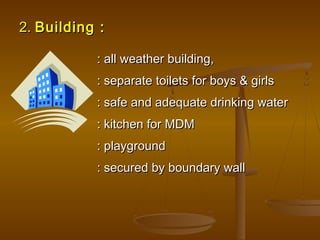
2.
2. Building :
Building :
: all weather building,
: separate toilets for boys & girls
: safe and adequate drinking water
: kitchen for MDM
: kitchen for MDM
: playground
: playground
: secured by boundary wall
3.
3. Minimum working Days
Minimum working Days –
–
I-V = 200
I-V = 200
VI-VIII = 220
VI-VIII = 220
Instructional Hours
Instructional Hours –
–
I-V = 800
I-V = 800
I-VIII = 1000
I-VIII = 1000
4. Minimum Working Hours per week for
teachers
teachers –
–
45 (including preparation hours).
5. Provide
5. Provide –
–
- Teaching-Learning Equipment
- Library
- Library
- Games & Sports and other play materials.
PART IV
PART IV
Model Rules
Model Rules
under the Right of Children
to
to
Free & Compulsory Education
Act 2009
Act 2009
Key Points:
Key Points:
1) The area or limits of neighborhood :
Classes I – V – within walking distance of 1 km.
Classes VI – VIII – within walking distance of 3 kms.
2) Where no school exists within the area or limits
specified, government has to make provision for free
transportation, residential facilities and other facilities.
3) In areas with high population density, the State may
establish more than one neighbourhood school.
4) The State has to make appropriate and safe
transportation arrangements for children with
disabilities.
disabilities.
5) The State to ensure that access of children to the
school is not hindered on account of social and
cultural factors.
cultural factors.
6) The responsibility of providing free entitlement (text
books, writing materials and uniforms, special
support materials for children with disabilities, etc)
shall be of the school in case of school belonging
to specified category and unaided schools.
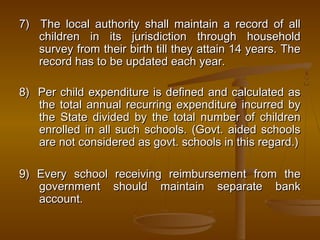
7) The local authority shall maintain a record of all
children in its jurisdiction through household
survey from their birth till they attain 14 years. The
record has to be updated each year.
8) Per child expenditure is defined and calculated as
the total annual recurring expenditure incurred by
the State divided by the total number of children
enrolled in all such schools. (Govt. aided schools
are not considered as govt. schools in this regard.)
9) Every school receiving reimbursement from the
government should maintain separate bank
account.
account.
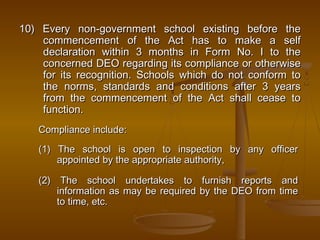
10) Every non-government school existing before the
commencement of the Act has to make a self
declaration within 3 months in Form No. I to the
concerned DEO regarding its compliance or otherwise
for its recognition. Schools which do not conform to
the norms, standards and conditions after 3 years
from the commencement of the Act shall cease to
function.
function.
Compliance include:
Compliance include:
(1) The school is open to inspection by any officer
appointed by the appropriate authority,
(2) The school undertakes to furnish reports and
information as may be required by the DEO from time
to time, etc.
to time, etc.
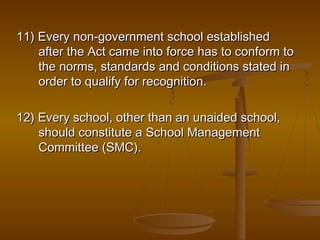
11) Every non-government school established
after the Act came into force has to conform to
the norms, standards and conditions stated in
order to qualify for recognition.
12) Every school, other than an unaided school,
should constitute a School Management
Committee (SMC).
Committee (SMC).
 75% from parents/guardians
75% from parents/guardians
 Of the remaining 25%:
Of the remaining 25%:
 1/3 members from amongst elected members of the local authority
1/3 members from amongst elected members of the local authority
 1/3members from the teachers of the school to be decided by the
1/3members from the teachers of the school to be decided by the
teachers
teachers
 Remaining 1/3 from amongst local educationists/children in the
Remaining 1/3 from amongst local educationists/children in the
school to be decided by the parents in the committee
 The SMC shall elect a Chairperson and Vice-Chairperson from
The SMC shall elect a Chairperson and Vice-Chairperson from
among the parent members.
 The Head Teacher/Senior most teacher of the school shall be the
The Head Teacher/Senior most teacher of the school shall be the
ex-officio member – convener.
 The SMC is to meet at least once a month and maintain minutes
The SMC is to meet at least once a month and maintain minutes
and decisions of the meetings.
 Prepare a 3 year school development plan.
Prepare a 3 year school development plan.
Composition of School Management Committee (SMC) :
13)
13) An Academic Authority (the SCERT) to lay down
An Academic Authority (the SCERT) to lay down
minimum academic qualifications for persons eligible
for appointment as a teacher.
14)
14) The SMC shall be the first level of grievance redressal
The SMC shall be the first level of grievance redressal
of teachers.
of teachers.
15)
15) The State government should constitute Schools
The State government should constitute Schools
Tribunals at the State, District and Block levels for
grievance redressal.
16)
16) Where the State Commission for Protection of Child
Where the State Commission for Protection of Child
Rights does not exist, the State government shall
appoint an interim authority - Right to Education
Protection Authority (REPA).
PART V
PART V
Comments/Consequences/Implications
of the Act for Minorities
Comments / Consequences /Implications
of the Act for Minorities
 Enforcement of the Fundamental Rights is the duty of the state.
Enforcement of the Fundamental Rights is the duty of the state.
Now the state is enforcing it on others including the minorities.
 RTE Act threatens to take away the rights granted and
RTE Act threatens to take away the rights granted and
guaranteed to the minorities under the constitution
 RTE Act does not mention the word ‘minority’ at all anywhere in
RTE Act does not mention the word ‘minority’ at all anywhere in
the act.
the act.
 Will RTEA negate/black out the Art.30? Writs are already filed
Will RTEA negate/black out the Art.30? Writs are already filed
and pending in the S.C.
 25% seats to be reserved for disadvantaged groups. How do you
25% seats to be reserved for disadvantaged groups. How do you
identify “children belonging to disadvantaged group”? What
happens if more than 25% come for admission?
Comments / Consequence / Implications of the Act for Mino
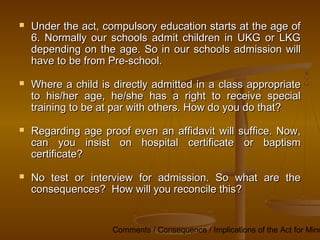
 Under the act, compulsory education starts at the age of
Under the act, compulsory education starts at the age of
6. Normally our schools admit children in UKG or LKG
depending on the age. So in our schools admission will
have to be from Pre-school.
 Where a child is directly admitted in a class appropriate
Where a child is directly admitted in a class appropriate
to his/her age, he/she has a right to receive special
training to be at par with others. How do you do that?
 Regarding age proof even an affidavit will suffice. Now,
Regarding age proof even an affidavit will suffice. Now,
can you insist on hospital certificate or baptism
certificate?
certificate?
 No test or interview for admission. So what are the
No test or interview for admission. So what are the
consequences? How will you reconcile this?
Comments / Consequence / Implications of the Act for Mino
 Government will prescribe a common syllabus. What
Government will prescribe a common syllabus. What
happens to your school syllabus?
 The school has to provide entitlements (books, uniforms
The school has to provide entitlements (books, uniforms
even transportation) to the 25% disadvantaged students.
 The government is supposed to provide books for them
The government is supposed to provide books for them
but will not match with the text books you are using?
Moreover, the books from govt. quota hardly come in
time. So what’s the solution? National curriculum?
 There is provision for MDM for the disadvantaged
There is provision for MDM for the disadvantaged
children. How are you going to handle that?
 Government will reimburse all the expenses as per its
Government will reimburse all the expenses as per its
norms. The school has to maintain a separate bank
account for the amount received.
Comments / Consequence / Implications of the Act for Mino
 No child is to be detained up to class 8. On
No child is to be detained up to class 8. On
completion of class 8 a child is to be given a
certificate stating that s/he has completed the
course.
course.
 No physical punishment or mental harassment of
No physical punishment or mental harassment of
the child while in school
the child while in school. (“Spare the rod and spoil
. (“Spare the rod and spoil
the child” ??)
the child” ??)
 No disciplinary action ; no expulsion of students is
No disciplinary action ; no expulsion of students is
possible.
possible.
 School buildings cannot be used for non-educational
School buildings cannot be used for non-educational
purpose. What does it mean?
Comments / Consequence / Implications of the Act for Mino
 Every school,
Every school, other than an unaided school
other than an unaided school (exempted under
(exempted under
Model Rule 13), must have a School Managing Committee
(SMC).
(SMC).
 75% of the members must be parents/guardians of the
75% of the members must be parents/guardians of the
children. Remaining from local representatives of the people,
teachers representatives etc. 50 % are to be women.
 Prima facie it appears that only one person, namely the
Prima facie it appears that only one person, namely the
School Head can represent the management. Doesn’t it
violate the minority right under Art. 30?
 What happens to the existing Governing Board? With this the
What happens to the existing Governing Board? With this the
virtual control of the school will be with the SMC.
 Are they qualified, competent to carry out these
Are they qualified, competent to carry out these
responsibilities including financial affairs such as school
development plan, annual accounts of receipts and payments
etc.?
etc.?
 Isn’t it a simple conversion of the existing VEC (Village
Isn’t it a simple conversion of the existing VEC (Village
Education Committee) concept in villages under SSA to all
schools?
schools?
Comments / Consequence / Implications of the Act for Mino
 No school can be established without obtaining
No school can be established without obtaining
certificate of registration.
 Existing schools, too, have to obtain registration.
Existing schools, too, have to obtain registration.
 Recognition once granted can also be withdrawn
Recognition once granted can also be withdrawn
on condition of non fulfillment of norms,
standards, conditions etc. Hence there will
always loom large the fear and threat of de-
recognition under some pretext or other.
 No tuitions are allowed. Can our schools tighten
No tuitions are allowed. Can our schools tighten
the noose on our teachers in this regard?
Comments / Consequence / Implications of the Act for Mino
 Doesn’t the idea of admitting children to the
Doesn’t the idea of admitting children to the
‘neighborhood school’ take away the freedom of
parents/guardians to choose the school of their choice?.
Will the govt. servants, politicians etc. do the same?
 No prosecution of any offence under the act without
No prosecution of any offence under the act without
previous sanction of an authorized officer. That seems to
give a ray of hope.
give a ray of hope.
 The school has to furnish such reports and information
The school has to furnish such reports and information
as may be required by the DEO including copy of the
audited report. The school is also open to inspection by
any officer appointed by the govt. or local authority. This
can be used as a sword of Damocles. It’s a clear and
blatant violation of Fundamental Right of Minorities.
The End
The End
Thank You !
Thank You !

righttoeducation-101117231912-phpapp01 (2).pdf

  • 1.
    THE RIGHT OFCHILDREN THE RIGHT OF CHILDREN TO FREE AND TO FREE AND COMPULSORY EDUCATION COMPULSORY EDUCATION ACT – 2009 ACT – 2009
  • 2.
    It is oneof the 3 flagship programs of UPA govt. It is one of the 3 flagship programs of UPA govt. 1. 1. MGNREGA MGNREGA 2. 2. RIGHT TO INFORMATION ACT RIGHT TO INFORMATION ACT (These 2 were enacted during it its first term (These 2 were enacted during it its first term (2004 – 09)) (2004 – 09)) 3. 3. RIGHT OF CHILDREN TO FREE & RIGHT OF CHILDREN TO FREE & COMPULSORY EDUCATION ACT (2009-10) COMPULSORY EDUCATION ACT (2009-10)
  • 3.
     PART 1– PART 1 – Right to Education as a Human Right Right to Education as a Human Right  PART 11 – Right to Education as a PART 11 – Right to Education as a Fundamental Right Fundamental Right  PART 111 – Right of Children for Free & PART 111 – Right of Children for Free & Compulsory Education Act Compulsory Education Act  PART 1V – RTE Model rules PART 1V – RTE Model rules  PART V – PART V – Comments / Consequences /Implications Comments / Consequences /Implications of the Act for Minorities of the Act for Minorities
  • 4.
    Preamble Preamble  The Rightof Children to Free & compulsory Education Act (RTE) is a welfare legislation.  It is meant to benefit about 1 crore non school going children.  Cost envisaged is enormous: Centre & States will share the financial burden in the ratio 55:45  It will bring the pupil – teacher ratio to 30:1  5.1 lakh teachers are required. So good scope for trained teachers/ B. Ed students.  Every one seems to have jumped at the idea of RTE Act without realizing its implications.  India has joined a group of few countries in the world with making education a fundamental right of every child. In that sense it is historic.  The act is meant to help children from economically weaker section as well as children with disabilities.  The hope was that the act would help improve government schools and would not do any harm to the private schools. But it has turned out to be the other way.
  • 5.
    Right to Educationas a Human Right PART - I PART - I Right to Education Right to Education As a As a Human Right Human Right
  • 6.
    PART - II PART- II Education Education is a is a Fundamental Right Fundamental Right
  • 7.
    What are FundamentalRights ? What are Fundamental Rights ?  Fundamental Rights are rights which are inherent in a Fundamental Rights are rights which are inherent in a human being. They are natural rights. These rights are human being. They are natural rights. These rights are regarded fundamental because they are most essential regarded fundamental because they are most essential for the attainment of the full growth, development and for the attainment of the full growth, development and potential of a human being. potential of a human being.  The framers of the Indian Constitution, drawing The framers of the Indian Constitution, drawing inspiration from the “Bill of Rights” of America, inspiration from the “Bill of Rights” of America, incorporated a full chapter of these rights in Part III of incorporated a full chapter of these rights in Part III of the Constitution. These Fundamental Rights listed in our the Constitution. These Fundamental Rights listed in our constitution represent the basic values cherished by the constitution represent the basic values cherished by the people of this country. people of this country.
  • 8.
    Education As AFundamental Right 8 Article 46 Article 46 – – The State shall promote with special care the educational The State shall promote with special care the educational and economic interests of the weaker sections of the and economic interests of the weaker sections of the people and, in particular, of the SCs and STs and shall people and, in particular, of the SCs and STs and shall protect them from social injustice and all forms of protect them from social injustice and all forms of exploitation. exploitation. Article 29 Article 29 – – No citizen shall be denied admission into any educational No citizen shall be denied admission into any educational institution maintained by the State or receiving aid out of institution maintained by the State or receiving aid out of State funds on grounds only of religion, race, caste, State funds on grounds only of religion, race, caste, language or any of them. language or any of them. Equality of opportunity is a basic feature of the Equality of opportunity is a basic feature of the Constitution and has been interpreted to include equality Constitution and has been interpreted to include equality of education which means equality of access to education of education which means equality of access to education and equality of educational facilities. and equality of educational facilities.
  • 9.
    All these factorscontributed and finally All these factors contributed and finally gave birth to this new act – gave birth to this new act – Right of Children to Free and Compulsory Right of Children to Free and Compulsory Education Act, 2009. Education Act, 2009.
  • 10.
    PART – III PART– III Right to Education Right to Education Act – 2009 Act – 2009
  • 11.
    Right to EducationAct – 2009 Right to Education Act – 2009 Objectives: Objectives:  To provide for free and compulsory To provide for free and compulsory education to all children of the age 6 to 14 education to all children of the age 6 to 14 years. years.  Emphasis is on children belonging to Emphasis is on children belonging to disadvantaged group. disadvantaged group.
  • 12.
    Definitions: Definitions: Section 2 Section2 i) i) Govt. Schools Govt. Schools ii) ii) Aided schools Aided schools iii) iii) School belonging to specified categories: School belonging to specified categories: (Kendriya Vidyalaya, Navodaya Vidyalaya, Sainik School etc.) (Kendriya Vidyalaya, Navodaya Vidyalaya, Sainik School etc.) iv) iv) Unaided schools Unaided schools Sec. 2 Sec. 2 (d) (d) “Child belonging to disadvantaged group” “Child belonging to disadvantaged group” 2 2 (e) “ (e) “Child belonging to weaker section” Child belonging to weaker section” 2 2 (f) “ (f) “Elementary Education” Elementary Education” 2 2 (h) (h) “Local Authority” “Local Authority” 2 2 (n) “ (n) “School - 4 categories of schools” School - 4 categories of schools”
  • 13.
    Sec. 3 Sec. 3– – Right of child to free and compulsory education Right of child to free and compulsory education in a neighbourhood school till Completion of in a neighbourhood school till Completion of elementary education. elementary education. “ “Compulsory education means obligation of Compulsory education means obligation of the state to provide free elementary education the state to provide free elementary education to every child of the age 6-14 years” to every child of the age 6-14 years”
  • 14.
    Sec. 4 Sec. 4– – Special provisions for children not admitted to, or Special provisions for children not admitted to, or who have not completed, elementary education. who have not completed, elementary education. Such children are to be directly admitted in a class Such children are to be directly admitted in a class appropriate to his or her age and in order to be at appropriate to his or her age and in order to be at par with others, have a right to receive special par with others, have a right to receive special training and shall be entitled to free education till training and shall be entitled to free education till completion of elementary education even after 14 completion of elementary education even after 14 years. years.
  • 15.
    Sec. 9 Sec. 9– – Describes the duties of the local authority. Describes the duties of the local authority. Sec.10 Sec.10 – – Describes the duty of parents & guardian to admit Describes the duty of parents & guardian to admit his or her child/ward in the neighbourhood school his or her child/ward in the neighbourhood school for elementary education. for elementary education. Sec. 11 Sec. 11 – – States the duty of the appropriate government to States the duty of the appropriate government to provide for pre-school education provide for pre-school education
  • 16.
    Sec. 12 Sec. 12– – Extent of school’s responsibility: Extent of school’s responsibility: (1) to admit children belonging to weaker sections and (1) to admit children belonging to weaker sections and disadvantaged group in the ‘neighbourhood’ in Class I disadvantaged group in the ‘neighbourhood’ in Class I at least upto 25% of the strength of the class. at least upto 25% of the strength of the class. (2) an unaided school will be reimbursed expenditure (2) an unaided school will be reimbursed expenditure incurred by it to the extent of per child expenditure incurred by it to the extent of per child expenditure incurred by the State or the actual amount charged incurred by the State or the actual amount charged from the child, whichever is less. Reimbursement shall from the child, whichever is less. Reimbursement shall not exceed per child expenditure incurred by a govt. not exceed per child expenditure incurred by a govt. school. school. (3) every school shall provide such information as may be (3) every school shall provide such information as may be required by the govt. or local authority. required by the govt. or local authority.
  • 17.
    Sec. 13 Sec. 13– – No capitation fee to be charged. (The All India Catholic No capitation fee to be charged. (The All India Catholic Education Policy, 2007 also deplores any attempt to Education Policy, 2007 also deplores any attempt to commercialize education and acceptance of capitation fee). commercialize education and acceptance of capitation fee). No screening either of the child or of the parents for No screening either of the child or of the parents for admission. admission. Sec. 14 Sec. 14 – – Age of the child is to be determined on the basis of the birth Age of the child is to be determined on the basis of the birth certificate issued in accordance with the provisions of the certificate issued in accordance with the provisions of the Births, Deaths and Marriage Registration Act, 1886 or Births, Deaths and Marriage Registration Act, 1886 or Hospital register record or Anganwadi record or even an Hospital register record or Anganwadi record or even an Affidavit. No child shall be denied admission in a school for Affidavit. No child shall be denied admission in a school for lack of age proof. lack of age proof.
  • 18.
    Sec. 15 Sec. 15– – No denial of admission even if the child does not No denial of admission even if the child does not turn up at the commencement of the academic turn up at the commencement of the academic year. year. Sec. 16 Sec. 16 – – No child once admitted, can be held back or No child once admitted, can be held back or expelled till the completion of elementary expelled till the completion of elementary education. education. Sec. 17 Sec. 17 – – No child shall be subjected to physical punishment No child shall be subjected to physical punishment or mental harassment. or mental harassment.
  • 19.
    Sec. 18 Sec. 18– – No school to be established without obtaining No school to be established without obtaining certificate of recognition. certificate of recognition. Sec. 19 Sec. 19 – – Schools to fulfill all the norms and standards Schools to fulfill all the norms and standards specified in the schedule. specified in the schedule. Sec. 20 Sec. 20 – – Power of the Govt. to amend the schedule Power of the Govt. to amend the schedule
  • 20.
    a) a) The electedrepresentatives of the local authority, The elected representatives of the local authority, parents/guardians and teachers, parents/guardians and teachers, b) b) At least ¾ of members shall be parents/guardians, At least ¾ of members shall be parents/guardians, c) c) Proportionate representation should be given to the Proportionate representation should be given to the parents/guardians of children belonging to disadvantaged group parents/guardians of children belonging to disadvantaged group and weaker section, and weaker section, d) d) 50% members shall be women. 50% members shall be women. Sec. 21 Sec. 21 – – Every school should constitute a School Management Committee Every school should constitute a School Management Committee (SMC) consisting of: (SMC) consisting of: a) a) Monitor the working of the school, Monitor the working of the school, b) b) Prepare and recommend school development plan, Prepare and recommend school development plan, c) c) Monitor the utilization of the grants received from the govt., Monitor the utilization of the grants received from the govt., d) d) Perform other functions as may be prescribed. Perform other functions as may be prescribed. Functions of the SMC. The SMC shall Functions of the SMC. The SMC shall
  • 21.
    Sec. 22 Sec. 22– – Preparation of School Development Plan by the SMC. Preparation of School Development Plan by the SMC. Sec. 23 Sec. 23 – – States that the qualification for appointment and terms and States that the qualification for appointment and terms and conditions of service of teachers shall be as laid down by conditions of service of teachers shall be as laid down by the academic authority authorized by the Govt. the academic authority authorized by the Govt. Sec. 24 Sec. 24 – – Duties of teachers. Teachers shall maintain regularity & Duties of teachers. Teachers shall maintain regularity & punctuality, complete the curriculum, hold regular meetings punctuality, complete the curriculum, hold regular meetings with parents/guardians, etc. with parents/guardians, etc.
  • 22.
    Sec. 25 Sec. 25– – Pupil-Teacher Ratio as specified in the schedule is to be Pupil-Teacher Ratio as specified in the schedule is to be maintained, i.e., Classes I-V 30:1. Above 200 children maintained, i.e., Classes I-V 30:1. Above 200 children P-T ratio shall not exceed 40. Classes V-VIII 1:35, but at P-T ratio shall not exceed 40. Classes V-VIII 1:35, but at least one teacher per class. least one teacher per class. Sec. 26 Sec. 26 – – Filling up of vacancies of teachers. Filling up of vacancies of teachers. Sec. 27 Sec. 27 – – Prohibition of deployment of teachers for non-educational Prohibition of deployment of teachers for non-educational purposes other than decennial population census, purposes other than decennial population census, disaster relief duties and for election duties. disaster relief duties and for election duties. Sec. 28 Sec. 28 – – No private tuition by teachers. No private tuition by teachers.
  • 23.
    Sec. 29 Sec. 29– – (1) Curriculum and evaluation procedure for elementary education shall (1) Curriculum and evaluation procedure for elementary education shall be laid down by academic authority to be specified by the be laid down by academic authority to be specified by the appropriate government, appropriate government, (2) (f) medium of instruction shall, as far as practicable, be in child’s (2) (f) medium of instruction shall, as far as practicable, be in child’s mother tongue, mother tongue, (2) (h) comprehensive and continuous evaluation of child’s (2) (h) comprehensive and continuous evaluation of child’s understanding etc. understanding etc. Sec. 30 Sec. 30 – – 1) 1) No child shall be required to pass any board exam till completion No child shall be required to pass any board exam till completion of elementary education, of elementary education, 2) 2) Every child completing elementary education shall be awarded a Every child completing elementary education shall be awarded a certificate. certificate.
  • 24.
    Sec. 31 Sec. 31– – The National Commission or the State Commission for The National Commission or the State Commission for Protection of Child Rights constituted under the Protection of Child Rights constituted under the Commission of Protection of Child Rights Act, 2005, shall Commission of Protection of Child Rights Act, 2005, shall in addition to the functions assigned to it, monitor, enquire in addition to the functions assigned to it, monitor, enquire into complaints relating to child’s right to free and into complaints relating to child’s right to free and compulsory education and/or function as Appellate compulsory education and/or function as Appellate Authority above the local authority Authority above the local authority (Sec. 32) (Sec. 32) . . Sec. 33 Sec. 33 – – Speaks of a National Advisory Council. Speaks of a National Advisory Council. Sec. 34 Sec. 34 – – Speaks of the State Advisory council and their functions. Speaks of the State Advisory council and their functions.
  • 25.
    Sec. 35 Sec. 35– – The appropriate government may issue guidelines and give The appropriate government may issue guidelines and give directions to the local authority or to the School Managing directions to the local authority or to the School Managing Committee. Committee. Sec. 36 Sec. 36 – – No prosecution for offences without previous sanction of the No prosecution for offences without previous sanction of the appropriate authority. appropriate authority. Sec. 37 Sec. 37 – – No suit or legal proceeding shall lie against action taken in No suit or legal proceeding shall lie against action taken in good faith. good faith. Sec. 38 Sec. 38 – – Appropriate government may make rules for carrying out the Appropriate government may make rules for carrying out the provisions of this Act. provisions of this Act.
  • 26.
    Schedule Schedule 1. 1. Teacher-Pupil Ratio: Teacher-PupilRatio: I-V – I-V – upto 120 students – 1:30 upto 120 students – 1:30 upto 120-200 students – 1:40 (+ H.M.) upto 120-200 students – 1:40 (+ H.M.) more than 200 students – 1:40 (+ H.M.) more than 200 students – 1:40 (+ H.M.) VI-VIII – 1:35 VI-VIII – 1:35 Full Time – Science and Mathematics, Social Full Time – Science and Mathematics, Social Studies, Language Studies, Language Part Time – Art Education, Health & Physical Part Time – Art Education, Health & Physical Education, Work Education Education, Work Education
  • 27.
    2. 2. Building : Building: : all weather building, : all weather building, : separate toilets for boys & girls : separate toilets for boys & girls : safe and adequate drinking water : safe and adequate drinking water : kitchen for MDM : kitchen for MDM : playground : playground : secured by boundary wall : secured by boundary wall
  • 28.
    3. 3. Minimum workingDays Minimum working Days – – I-V = 200 I-V = 200 VI-VIII = 220 VI-VIII = 220 Instructional Hours Instructional Hours – – I-V = 800 I-V = 800 I-VIII = 1000 I-VIII = 1000
  • 29.
    4. Minimum WorkingHours per week for 4. Minimum Working Hours per week for teachers teachers – – 45 (including preparation hours). 45 (including preparation hours). 5. Provide 5. Provide – – - Teaching-Learning Equipment - Teaching-Learning Equipment - Library - Library - Games & Sports and other play materials. - Games & Sports and other play materials.
  • 30.
    PART IV PART IV ModelRules Model Rules under the Right of Children under the Right of Children to to Free & Compulsory Education Free & Compulsory Education Act 2009 Act 2009
  • 31.
    Key Points: Key Points: 1)The area or limits of neighborhood : 1) The area or limits of neighborhood : Classes I – V – within walking distance of 1 km. Classes I – V – within walking distance of 1 km. Classes VI – VIII – within walking distance of 3 kms. Classes VI – VIII – within walking distance of 3 kms. 2) Where no school exists within the area or limits 2) Where no school exists within the area or limits specified, government has to make provision for free specified, government has to make provision for free transportation, residential facilities and other facilities. transportation, residential facilities and other facilities. 3) In areas with high population density, the State may 3) In areas with high population density, the State may establish more than one neighbourhood school. establish more than one neighbourhood school.
  • 32.
    4) The Statehas to make appropriate and safe 4) The State has to make appropriate and safe transportation arrangements for children with transportation arrangements for children with disabilities. disabilities. 5) The State to ensure that access of children to the 5) The State to ensure that access of children to the school is not hindered on account of social and school is not hindered on account of social and cultural factors. cultural factors. 6) The responsibility of providing free entitlement (text 6) The responsibility of providing free entitlement (text books, writing materials and uniforms, special books, writing materials and uniforms, special support materials for children with disabilities, etc) support materials for children with disabilities, etc) shall be of the school in case of school belonging shall be of the school in case of school belonging to specified category and unaided schools. to specified category and unaided schools.
  • 33.
    7) The localauthority shall maintain a record of all 7) The local authority shall maintain a record of all children in its jurisdiction through household children in its jurisdiction through household survey from their birth till they attain 14 years. The survey from their birth till they attain 14 years. The record has to be updated each year. record has to be updated each year. 8) Per child expenditure is defined and calculated as 8) Per child expenditure is defined and calculated as the total annual recurring expenditure incurred by the total annual recurring expenditure incurred by the State divided by the total number of children the State divided by the total number of children enrolled in all such schools. (Govt. aided schools enrolled in all such schools. (Govt. aided schools are not considered as govt. schools in this regard.) are not considered as govt. schools in this regard.) 9) Every school receiving reimbursement from the 9) Every school receiving reimbursement from the government should maintain separate bank government should maintain separate bank account. account.
  • 34.
    10) Every non-governmentschool existing before the 10) Every non-government school existing before the commencement of the Act has to make a self commencement of the Act has to make a self declaration within 3 months in Form No. I to the declaration within 3 months in Form No. I to the concerned DEO regarding its compliance or otherwise concerned DEO regarding its compliance or otherwise for its recognition. Schools which do not conform to for its recognition. Schools which do not conform to the norms, standards and conditions after 3 years the norms, standards and conditions after 3 years from the commencement of the Act shall cease to from the commencement of the Act shall cease to function. function. Compliance include: Compliance include: (1) The school is open to inspection by any officer (1) The school is open to inspection by any officer appointed by the appropriate authority, appointed by the appropriate authority, (2) The school undertakes to furnish reports and (2) The school undertakes to furnish reports and information as may be required by the DEO from time information as may be required by the DEO from time to time, etc. to time, etc.
  • 35.
    11) Every non-governmentschool established 11) Every non-government school established after the Act came into force has to conform to after the Act came into force has to conform to the norms, standards and conditions stated in the norms, standards and conditions stated in order to qualify for recognition. order to qualify for recognition. 12) Every school, other than an unaided school, 12) Every school, other than an unaided school, should constitute a School Management should constitute a School Management Committee (SMC). Committee (SMC).
  • 36.
     75% fromparents/guardians 75% from parents/guardians  Of the remaining 25%: Of the remaining 25%:  1/3 members from amongst elected members of the local authority 1/3 members from amongst elected members of the local authority  1/3members from the teachers of the school to be decided by the 1/3members from the teachers of the school to be decided by the teachers teachers  Remaining 1/3 from amongst local educationists/children in the Remaining 1/3 from amongst local educationists/children in the school to be decided by the parents in the committee school to be decided by the parents in the committee  The SMC shall elect a Chairperson and Vice-Chairperson from The SMC shall elect a Chairperson and Vice-Chairperson from among the parent members. among the parent members.  The Head Teacher/Senior most teacher of the school shall be the The Head Teacher/Senior most teacher of the school shall be the ex-officio member – convener. ex-officio member – convener.  The SMC is to meet at least once a month and maintain minutes The SMC is to meet at least once a month and maintain minutes and decisions of the meetings. and decisions of the meetings.  Prepare a 3 year school development plan. Prepare a 3 year school development plan. Composition of School Management Committee (SMC) : Composition of School Management Committee (SMC) :
  • 37.
    13) 13) An AcademicAuthority (the SCERT) to lay down An Academic Authority (the SCERT) to lay down minimum academic qualifications for persons eligible minimum academic qualifications for persons eligible for appointment as a teacher. for appointment as a teacher. 14) 14) The SMC shall be the first level of grievance redressal The SMC shall be the first level of grievance redressal of teachers. of teachers. 15) 15) The State government should constitute Schools The State government should constitute Schools Tribunals at the State, District and Block levels for Tribunals at the State, District and Block levels for grievance redressal. grievance redressal. 16) 16) Where the State Commission for Protection of Child Where the State Commission for Protection of Child Rights does not exist, the State government shall Rights does not exist, the State government shall appoint an interim authority - Right to Education appoint an interim authority - Right to Education Protection Authority (REPA). Protection Authority (REPA).
  • 38.
  • 39.
    Comments / Consequences/Implications Comments / Consequences /Implications of the Act for Minorities of the Act for Minorities  Enforcement of the Fundamental Rights is the duty of the state. Enforcement of the Fundamental Rights is the duty of the state. Now the state is enforcing it on others including the minorities. Now the state is enforcing it on others including the minorities.  RTE Act threatens to take away the rights granted and RTE Act threatens to take away the rights granted and guaranteed to the minorities under the constitution guaranteed to the minorities under the constitution  RTE Act does not mention the word ‘minority’ at all anywhere in RTE Act does not mention the word ‘minority’ at all anywhere in the act. the act.  Will RTEA negate/black out the Art.30? Writs are already filed Will RTEA negate/black out the Art.30? Writs are already filed and pending in the S.C. and pending in the S.C.  25% seats to be reserved for disadvantaged groups. How do you 25% seats to be reserved for disadvantaged groups. How do you identify “children belonging to disadvantaged group”? What identify “children belonging to disadvantaged group”? What happens if more than 25% come for admission? happens if more than 25% come for admission?
  • 40.
    Comments / Consequence/ Implications of the Act for Mino  Under the act, compulsory education starts at the age of Under the act, compulsory education starts at the age of 6. Normally our schools admit children in UKG or LKG 6. Normally our schools admit children in UKG or LKG depending on the age. So in our schools admission will depending on the age. So in our schools admission will have to be from Pre-school. have to be from Pre-school.  Where a child is directly admitted in a class appropriate Where a child is directly admitted in a class appropriate to his/her age, he/she has a right to receive special to his/her age, he/she has a right to receive special training to be at par with others. How do you do that? training to be at par with others. How do you do that?  Regarding age proof even an affidavit will suffice. Now, Regarding age proof even an affidavit will suffice. Now, can you insist on hospital certificate or baptism can you insist on hospital certificate or baptism certificate? certificate?  No test or interview for admission. So what are the No test or interview for admission. So what are the consequences? How will you reconcile this? consequences? How will you reconcile this?
  • 41.
    Comments / Consequence/ Implications of the Act for Mino  Government will prescribe a common syllabus. What Government will prescribe a common syllabus. What happens to your school syllabus? happens to your school syllabus?  The school has to provide entitlements (books, uniforms The school has to provide entitlements (books, uniforms even transportation) to the 25% disadvantaged students. even transportation) to the 25% disadvantaged students.  The government is supposed to provide books for them The government is supposed to provide books for them but will not match with the text books you are using? but will not match with the text books you are using? Moreover, the books from govt. quota hardly come in Moreover, the books from govt. quota hardly come in time. So what’s the solution? National curriculum? time. So what’s the solution? National curriculum?  There is provision for MDM for the disadvantaged There is provision for MDM for the disadvantaged children. How are you going to handle that? children. How are you going to handle that?  Government will reimburse all the expenses as per its Government will reimburse all the expenses as per its norms. The school has to maintain a separate bank norms. The school has to maintain a separate bank account for the amount received. account for the amount received.
  • 42.
    Comments / Consequence/ Implications of the Act for Mino  No child is to be detained up to class 8. On No child is to be detained up to class 8. On completion of class 8 a child is to be given a completion of class 8 a child is to be given a certificate stating that s/he has completed the certificate stating that s/he has completed the course. course.  No physical punishment or mental harassment of No physical punishment or mental harassment of the child while in school the child while in school. (“Spare the rod and spoil . (“Spare the rod and spoil the child” ??) the child” ??)  No disciplinary action ; no expulsion of students is No disciplinary action ; no expulsion of students is possible. possible.  School buildings cannot be used for non-educational School buildings cannot be used for non-educational purpose. What does it mean? purpose. What does it mean?
  • 43.
    Comments / Consequence/ Implications of the Act for Mino  Every school, Every school, other than an unaided school other than an unaided school (exempted under (exempted under Model Rule 13), must have a School Managing Committee Model Rule 13), must have a School Managing Committee (SMC). (SMC).  75% of the members must be parents/guardians of the 75% of the members must be parents/guardians of the children. Remaining from local representatives of the people, children. Remaining from local representatives of the people, teachers representatives etc. 50 % are to be women. teachers representatives etc. 50 % are to be women.  Prima facie it appears that only one person, namely the Prima facie it appears that only one person, namely the School Head can represent the management. Doesn’t it School Head can represent the management. Doesn’t it violate the minority right under Art. 30? violate the minority right under Art. 30?  What happens to the existing Governing Board? With this the What happens to the existing Governing Board? With this the virtual control of the school will be with the SMC. virtual control of the school will be with the SMC.  Are they qualified, competent to carry out these Are they qualified, competent to carry out these responsibilities including financial affairs such as school responsibilities including financial affairs such as school development plan, annual accounts of receipts and payments development plan, annual accounts of receipts and payments etc.? etc.?  Isn’t it a simple conversion of the existing VEC (Village Isn’t it a simple conversion of the existing VEC (Village Education Committee) concept in villages under SSA to all Education Committee) concept in villages under SSA to all schools? schools?
  • 44.
    Comments / Consequence/ Implications of the Act for Mino  No school can be established without obtaining No school can be established without obtaining certificate of registration. certificate of registration.  Existing schools, too, have to obtain registration. Existing schools, too, have to obtain registration.  Recognition once granted can also be withdrawn Recognition once granted can also be withdrawn on condition of non fulfillment of norms, on condition of non fulfillment of norms, standards, conditions etc. Hence there will standards, conditions etc. Hence there will always loom large the fear and threat of de- always loom large the fear and threat of de- recognition under some pretext or other. recognition under some pretext or other.  No tuitions are allowed. Can our schools tighten No tuitions are allowed. Can our schools tighten the noose on our teachers in this regard? the noose on our teachers in this regard?
  • 45.
    Comments / Consequence/ Implications of the Act for Mino  Doesn’t the idea of admitting children to the Doesn’t the idea of admitting children to the ‘neighborhood school’ take away the freedom of ‘neighborhood school’ take away the freedom of parents/guardians to choose the school of their choice?. parents/guardians to choose the school of their choice?. Will the govt. servants, politicians etc. do the same? Will the govt. servants, politicians etc. do the same?  No prosecution of any offence under the act without No prosecution of any offence under the act without previous sanction of an authorized officer. That seems to previous sanction of an authorized officer. That seems to give a ray of hope. give a ray of hope.  The school has to furnish such reports and information The school has to furnish such reports and information as may be required by the DEO including copy of the as may be required by the DEO including copy of the audited report. The school is also open to inspection by audited report. The school is also open to inspection by any officer appointed by the govt. or local authority. This any officer appointed by the govt. or local authority. This can be used as a sword of Damocles. It’s a clear and can be used as a sword of Damocles. It’s a clear and blatant violation of Fundamental Right of Minorities. blatant violation of Fundamental Right of Minorities.
  • 46.

    The End The End ThankYou ! Thank You !