RSA Cryptosystem                                                                                                                                                         6/8/2002 2:20 PM


                                                                                                             Outline
                                                                                                                  Euler’s theorem (§10.1.3)
                                                                                                                  RSA cryptosystem (§10.2.3)
            RSA Cryptosystem                                                                                           Definition
                                                                                                                       Example
                                                          Bits           PCs        Memory                             Security
                                                          430             1         128MB                              Correctness
                                                          760          215,000          4GB
                                                                                                                  Algorithms for RSA
                                                         1,020         342×106      170GB
                                                                                                                       Modular power (§10.1.4)
                                                         1,620         1.6×10¹⁵         120TB
                                                                                                                       Modular inverse (§10.1.5)
                                                                                                                       Randomized primality testing (§10.1.6)

        6/8/2002 2:20 PM                    RSA Cryptosystem                                        1        6/8/2002 2:20 PM               RSA Cryptosystem                                     2


        Euler’s Theorem                                                                                      RSA Cryptosystem
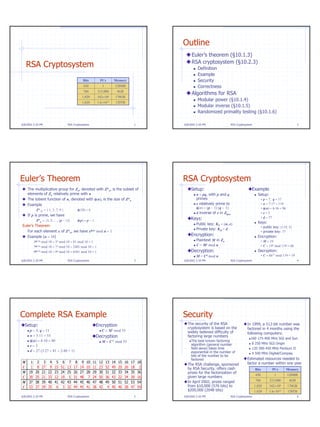
            The multiplicative group for Zn, denoted with Z*n, is the subset of                                   Setup:                                   Example
            elements of Zn relatively prime with n                                                                    n = pq, with p and q                       Setup:
            The totient function of n, denoted with φ(n), is the size of Z*n                                          primes                                           p = 7, q = 17
            Example                                                                                                   e relatively prime to                            n = 7⋅17 = 119
                                                                                                                      φ(n) = (p − 1) (q − 1)                           φ(n) = 6⋅16 = 96
                   Z*10 = { 1, 3, 7, 9 }              φ(10) = 4
                                                                                                                      d inverse of e in Zφ(n)                          e=5
            If p is prime, we have
                                                                                                                  Keys:                                                d = 77
                   Z*p = {1, 2, …, (p − 1)}           φ(p) = p − 1
                                                                                                                      Public key: KE = (n, e)                    Keys:
        Euler’s Theorem                                                                                                                                                public key: (119, 5)
                                                                                                                      Private key: KD = d
           For each element x of Z*n, we have xφ(n) mod n = 1                                                                                                          private key: 77
           Example (n = 10)                                                                                       Encryption:                                    Encryption:
                  3φ(10) mod 10 = 34 mod 10 = 81 mod 10 = 1                                                           Plaintext M in Zn                                M = 19
                  7φ(10) mod 10 = 74 mod 10 = 2401 mod 10 = 1                                                         C = Me mod n                                     C = 195 mod 119 = 66
                  9φ(10) mod 10 = 94 mod 10 = 6561 mod 10 = 1                                                     Decryption:                                    Decryption:
                                                                                                                      M = Cd mod n                                     C = 6677 mod 119 = 19
        6/8/2002 2:20 PM                    RSA Cryptosystem                                        3        6/8/2002 2:20 PM               RSA Cryptosystem                                     4


        Complete RSA Example                                                                                 Security
          Setup:                                                     Encryption                                The security of the RSA                  In 1999, a 512-bit number was
                                                                                                               cryptosystem is based on the             factored in 4 months using the
              p = 5, q = 11                                               C = M3 mod 55                        widely believed difficulty of            following computers:
              n = 5⋅11 = 55                                          Decryption                                factoring large numbers
                                                                                                                                                          160 175-400 MHz SGI and Sun
              φ(n) = 4⋅10 = 40                                            M = C27 mod 55                          The best known factoring
                                                                                                                  algorithm (general number                8 250 MHz SGI Origin
              e=3
                                                                                                                  field sieve) takes time                  120 300-450 MHz Pentium II
              d = 27 (3⋅27 = 81 = 2⋅40 + 1)                                                                       exponential in the number of             4 500 MHz Digital/Compaq
                                                                                                                  bits of the number to be
                                                                                                                  factored                              Estimated resources needed to
        M     1     2    3    4    5    6    7    8     9   10    11    12    13   14    15   16   17   18                                              factor a number within one year
                                                                                                               The RSA challenge, sponsored
        C     1     8   27    9   15   51   13   17    14   10    11    23    52   49    20   26   18    2     by RSA Security, offers cash                    Bits          PCs          Memory
        M    19    20   21   22   23   24   25   26    27   28    29    30    31   32    33   34   35   36     prizes for the factorization of
                                                                                                                                                               430            1           128MB
        C    39    25   21   33   12   19    5   31    48    7    24    50    36   43    22   34   30   16     given large numbers
                                                                                                               In April 2002, prizes ranged                    760         215,000         4GB
        M    37    38   39   40   41   42   43   44    45   46    47    48    49   50    51   52   53   54
        C    53    37   29   35    6    3   32   44    45   41    38    42     4   40    46   28   47   54     from $10,000 (576 bits) to                      1,020       342×106        170GB
                                                                                                               $200,000 (2048 bits)                            1,620       1.6×10¹⁵       120TB
        6/8/2002 2:20 PM                    RSA Cryptosystem                                        5        6/8/2002 2:20 PM               RSA Cryptosystem                                     6


                                                                                                                                                                                                     1
RSA Cryptosystem                                                                                                                                             6/8/2002 2:20 PM


        Correctness                                                                               Algorithmic Issues
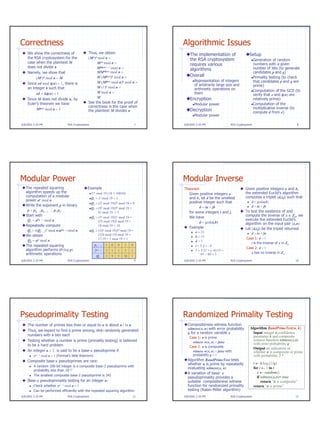
            We show the correctness of                 Thus, we obtain                                The implementation of                     Setup
            the RSA cryptosystem for the               (Me)d mod n =                                  the RSA cryptosystem                           Generation of random
            case when the plaintext M                       Med mod n =                               requires various                               numbers with a given
            does not divide n                               Mkφ(n) + 1 mod n =                                                                       number of bits (to generate
                                                                                                      algorithms
            Namely, we show that                            MMkφ(n) mod n =                                                                          candidates p and q)
                                                            M (Mφ(n))k mod n =                        Overall                                        Primality testing (to check
                 (Me)d mod n = M
                                                            M (Mφ(n) mod n)k mod n =                     Representation of integers                  that candidates p and q are
            Since ed mod φ(n) = 1, there is                                                              of arbitrarily large size and
                                                            M (1)k mod n =                                                                           prime)
            an integer k such that                                                                       arithmetic operations on
                                                            M mod n =                                                                                Computation of the GCD (to
                 ed = kφ(n) + 1                                                                          them                                        verify that e and φ(n) are
            Since M does not divide n, by                   M                                         Encryption                                     relatively prime)
            Euler’s theorem we have                    See the book for the proof of                     Modular power                               Computation of the
                                                       correctness in the case when                                                                  multiplicative inverse (to
                 Mφ(n) mod n = 1                       the plaintext M divides n                      Decryption                                     compute d from e)
                                                                                                         Modular power

        6/8/2002 2:20 PM                RSA Cryptosystem                                      7   6/8/2002 2:20 PM                RSA Cryptosystem                              8


        Modular Power                                                                             Modular Inverse
           The repeated squaring                       Example                                    Theorem                                    Given positive integers a and b,
           algorithm speeds up the                         318 mod 19 (18 = 10010)                  Given positive integers a                the extended Euclid’s algorithm
           computation of a modular                                                                 and b, let d be the smallest             computes a triplet (d,i,j) such that
                                                           Q1 = 31 mod 19 = 3
           power ap mod n                                                                                                                        d = gcd(a,b)
                                                           Q2 = (32 mod 19)30 mod 19 = 9            positive integer such that
           Write the exponent p in binary                                                                                                        d = ia + jb
                                                           Q3 = (92 mod 19)30 mod 19 =                    d = ia + jb
            p = pb − 1 pb − 2 … p1 p0                                                                                                        To test the existence of and
                                                                81 mod 19 = 5                       for some integers i and j.
           Start with                                      Q4 = (52 mod 19)31 mod 19 =              We have                                  compute the inverse of x ∈ Zn, we
            Q1 = apb − 1 mod n                                  (25 mod 19)3 mod 19 =
                                                                                                                                             execute the extended Euclid’s
                                                                                                          d = gcd(a,b)                       algorithm on the input pair (x,n)
           Repeatedly compute                                   18 mod 19 = 18
                                                                                                    Example                                  Let (d,i,j) be the triplet returned
            Qi = ((Qi − 1)2 mod n)apb − i mod n            Q5 = (182 mod 19)30 mod 19 =                   a = 21
                                                                (324 mod 19) mod 19 =                                                           d = ix + jn
           We obtain                                                                                      b = 15
                                                                17⋅19 + 1 mod 19 = 1                                                         Case 1: d = 1
            Qb = ap mod n                                                                                 d=3
                                                                                                                                                i is the inverse of x in Zn
           The repeated squaring                              p5 − 1     1   0   0   1    0               i = 3, j = −4
                                                                                                                                             Case 2: d > 1
           algorithm performs O (log p)                       2 p5 − i   3   1   1   3    1               3 = 3⋅21 + (−4)⋅15 =
           arithmetic operations                                                                              63 − 60 = 3                       x has no inverse in Zn
                                                                Qi       3   9   5   18   1
        6/8/2002 2:20 PM                RSA Cryptosystem                                      9   6/8/2002 2:20 PM                RSA Cryptosystem                             10


        Pseudoprimality Testing                                                                   Randomized Primality Testing
            The number of primes less than or equal to n is about n / ln n                          Compositeness witness function
                                                                                                    witness(x, n) with error probability        Algorithm RandPrimeTest(n, k)
            Thus, we expect to find a prime among, O(b) randomly generated
                                                                                                    q for a random variable x                     Input integer n,confidence
            numbers with b bits each                                                                                                              parameter k and composite
                                                                                                     Case 1: n is prime
            Testing whether a number is prime (primality testing) is believed                                                                     witness function witness(x,n)
                                                                                                       witness w(x, n) = false                    with error probability q
            to be a hard problem                                                                     Case 2: n is composite                       Output an indication of
            An integer n ≥ 2 is said to be a base-x pseudoprime if                                     witness w(x, n) = false with               whether n is composite or prime
                 xn − 1 mod n = 1 (Fermat’s little theorem)                                            probability q < 1                          with probability 2−k
            Composite base-x pseudoprimes are rare:                                                 Algorithm RandPrimeTest tests
                                                                                                    whether n is prime by repeatedly                 t ← k/log2(1/q)
                 A random 100-bit integer is a composite base-2 pseudoprime with                                                                     for i ← 1 to t
                                                                                                    evaluating witness(x, n)
                 probability less than 10-13
                                                                                                    A variation of base- x                             x ← random()
                 The smallest composite base-2 pseudoprime is 341
                                                                                                    pseudoprimality provides a                         if witness(x,n)= true
            Base-x pseudoprimality testing for an integer n:                                        suitable compositeness witness                        return “n is composite”
                 Check whether xn − 1 mod n = 1                                                     function for randomized primality                return “n is prime”
                 Can be performed efficiently with the repeated squaring algorithm                  testing (Rabin-Miller algorithm)
        6/8/2002 2:20 PM                RSA Cryptosystem                                  11      6/8/2002 2:20 PM                RSA Cryptosystem                             12


                                                                                                                                                                                    2

RSA

  • 1.
    RSA Cryptosystem 6/8/2002 2:20 PM Outline Euler’s theorem (§10.1.3) RSA cryptosystem (§10.2.3) RSA Cryptosystem Definition Example Bits PCs Memory Security 430 1 128MB Correctness 760 215,000 4GB Algorithms for RSA 1,020 342×106 170GB Modular power (§10.1.4) 1,620 1.6×10¹⁵ 120TB Modular inverse (§10.1.5) Randomized primality testing (§10.1.6) 6/8/2002 2:20 PM RSA Cryptosystem 1 6/8/2002 2:20 PM RSA Cryptosystem 2 Euler’s Theorem RSA Cryptosystem The multiplicative group for Zn, denoted with Z*n, is the subset of Setup: Example elements of Zn relatively prime with n n = pq, with p and q Setup: The totient function of n, denoted with φ(n), is the size of Z*n primes p = 7, q = 17 Example e relatively prime to n = 7⋅17 = 119 φ(n) = (p − 1) (q − 1) φ(n) = 6⋅16 = 96 Z*10 = { 1, 3, 7, 9 } φ(10) = 4 d inverse of e in Zφ(n) e=5 If p is prime, we have Keys: d = 77 Z*p = {1, 2, …, (p − 1)} φ(p) = p − 1 Public key: KE = (n, e) Keys: Euler’s Theorem public key: (119, 5) Private key: KD = d For each element x of Z*n, we have xφ(n) mod n = 1 private key: 77 Example (n = 10) Encryption: Encryption: 3φ(10) mod 10 = 34 mod 10 = 81 mod 10 = 1 Plaintext M in Zn M = 19 7φ(10) mod 10 = 74 mod 10 = 2401 mod 10 = 1 C = Me mod n C = 195 mod 119 = 66 9φ(10) mod 10 = 94 mod 10 = 6561 mod 10 = 1 Decryption: Decryption: M = Cd mod n C = 6677 mod 119 = 19 6/8/2002 2:20 PM RSA Cryptosystem 3 6/8/2002 2:20 PM RSA Cryptosystem 4 Complete RSA Example Security Setup: Encryption The security of the RSA In 1999, a 512-bit number was cryptosystem is based on the factored in 4 months using the p = 5, q = 11 C = M3 mod 55 widely believed difficulty of following computers: n = 5⋅11 = 55 Decryption factoring large numbers 160 175-400 MHz SGI and Sun φ(n) = 4⋅10 = 40 M = C27 mod 55 The best known factoring algorithm (general number 8 250 MHz SGI Origin e=3 field sieve) takes time 120 300-450 MHz Pentium II d = 27 (3⋅27 = 81 = 2⋅40 + 1) exponential in the number of 4 500 MHz Digital/Compaq bits of the number to be factored Estimated resources needed to M 1 2 3 4 5 6 7 8 9 10 11 12 13 14 15 16 17 18 factor a number within one year The RSA challenge, sponsored C 1 8 27 9 15 51 13 17 14 10 11 23 52 49 20 26 18 2 by RSA Security, offers cash Bits PCs Memory M 19 20 21 22 23 24 25 26 27 28 29 30 31 32 33 34 35 36 prizes for the factorization of 430 1 128MB C 39 25 21 33 12 19 5 31 48 7 24 50 36 43 22 34 30 16 given large numbers In April 2002, prizes ranged 760 215,000 4GB M 37 38 39 40 41 42 43 44 45 46 47 48 49 50 51 52 53 54 C 53 37 29 35 6 3 32 44 45 41 38 42 4 40 46 28 47 54 from $10,000 (576 bits) to 1,020 342×106 170GB $200,000 (2048 bits) 1,620 1.6×10¹⁵ 120TB 6/8/2002 2:20 PM RSA Cryptosystem 5 6/8/2002 2:20 PM RSA Cryptosystem 6 1
  • 2.
    RSA Cryptosystem 6/8/2002 2:20 PM Correctness Algorithmic Issues We show the correctness of Thus, we obtain The implementation of Setup the RSA cryptosystem for the (Me)d mod n = the RSA cryptosystem Generation of random case when the plaintext M Med mod n = requires various numbers with a given does not divide n Mkφ(n) + 1 mod n = number of bits (to generate algorithms Namely, we show that MMkφ(n) mod n = candidates p and q) M (Mφ(n))k mod n = Overall Primality testing (to check (Me)d mod n = M M (Mφ(n) mod n)k mod n = Representation of integers that candidates p and q are Since ed mod φ(n) = 1, there is of arbitrarily large size and M (1)k mod n = prime) an integer k such that arithmetic operations on M mod n = Computation of the GCD (to ed = kφ(n) + 1 them verify that e and φ(n) are Since M does not divide n, by M Encryption relatively prime) Euler’s theorem we have See the book for the proof of Modular power Computation of the correctness in the case when multiplicative inverse (to Mφ(n) mod n = 1 the plaintext M divides n Decryption compute d from e) Modular power 6/8/2002 2:20 PM RSA Cryptosystem 7 6/8/2002 2:20 PM RSA Cryptosystem 8 Modular Power Modular Inverse The repeated squaring Example Theorem Given positive integers a and b, algorithm speeds up the 318 mod 19 (18 = 10010) Given positive integers a the extended Euclid’s algorithm computation of a modular and b, let d be the smallest computes a triplet (d,i,j) such that Q1 = 31 mod 19 = 3 power ap mod n d = gcd(a,b) Q2 = (32 mod 19)30 mod 19 = 9 positive integer such that Write the exponent p in binary d = ia + jb Q3 = (92 mod 19)30 mod 19 = d = ia + jb p = pb − 1 pb − 2 … p1 p0 To test the existence of and 81 mod 19 = 5 for some integers i and j. Start with Q4 = (52 mod 19)31 mod 19 = We have compute the inverse of x ∈ Zn, we Q1 = apb − 1 mod n (25 mod 19)3 mod 19 = execute the extended Euclid’s d = gcd(a,b) algorithm on the input pair (x,n) Repeatedly compute 18 mod 19 = 18 Example Let (d,i,j) be the triplet returned Qi = ((Qi − 1)2 mod n)apb − i mod n Q5 = (182 mod 19)30 mod 19 = a = 21 (324 mod 19) mod 19 = d = ix + jn We obtain b = 15 17⋅19 + 1 mod 19 = 1 Case 1: d = 1 Qb = ap mod n d=3 i is the inverse of x in Zn The repeated squaring p5 − 1 1 0 0 1 0 i = 3, j = −4 Case 2: d > 1 algorithm performs O (log p) 2 p5 − i 3 1 1 3 1 3 = 3⋅21 + (−4)⋅15 = arithmetic operations 63 − 60 = 3 x has no inverse in Zn Qi 3 9 5 18 1 6/8/2002 2:20 PM RSA Cryptosystem 9 6/8/2002 2:20 PM RSA Cryptosystem 10 Pseudoprimality Testing Randomized Primality Testing The number of primes less than or equal to n is about n / ln n Compositeness witness function witness(x, n) with error probability Algorithm RandPrimeTest(n, k) Thus, we expect to find a prime among, O(b) randomly generated q for a random variable x Input integer n,confidence numbers with b bits each parameter k and composite Case 1: n is prime Testing whether a number is prime (primality testing) is believed witness function witness(x,n) witness w(x, n) = false with error probability q to be a hard problem Case 2: n is composite Output an indication of An integer n ≥ 2 is said to be a base-x pseudoprime if witness w(x, n) = false with whether n is composite or prime xn − 1 mod n = 1 (Fermat’s little theorem) probability q < 1 with probability 2−k Composite base-x pseudoprimes are rare: Algorithm RandPrimeTest tests whether n is prime by repeatedly t ← k/log2(1/q) A random 100-bit integer is a composite base-2 pseudoprime with for i ← 1 to t evaluating witness(x, n) probability less than 10-13 A variation of base- x x ← random() The smallest composite base-2 pseudoprime is 341 pseudoprimality provides a if witness(x,n)= true Base-x pseudoprimality testing for an integer n: suitable compositeness witness return “n is composite” Check whether xn − 1 mod n = 1 function for randomized primality return “n is prime” Can be performed efficiently with the repeated squaring algorithm testing (Rabin-Miller algorithm) 6/8/2002 2:20 PM RSA Cryptosystem 11 6/8/2002 2:20 PM RSA Cryptosystem 12 2