Downloaded 15 times
![Reed-Solomon Codes
by
Bernard Sklar
Introduction
In 1960, Irving Reed and Gus Solomon published a paper in the Journal of the
Society for Industrial and Applied Mathematics [1]. This paper described a new
class of error-correcting codes that are now called Reed-Solomon (R-S) codes.
These codes have great power and utility, and are today found in many
applications from compact disc players to deep-space applications. This article is
an attempt to describe the paramount features of R-S codes and the fundamentals
of how they work.
Reed-Solomon codes are nonbinary cyclic codes with symbols made up of m-bit
sequences, where m is any positive integer having a value greater than 2. R-S (n, k)
codes on m-bit symbols exist for all n and k for which
0 < k < n < 2m + 2 (1)
where k is the number of data symbols being encoded, and n is the total number of
code symbols in the encoded block. For the most conventional R-S (n, k) code,
(n, k) = (2m - 1, 2m - 1 - 2t) (2)
where t is the symbol-error correcting capability of the code, and n - k = 2t is the
number of parity symbols. An extended R-S code can be made up with n = 2m or
n = 2m + 1, but not any further.
Reed-Solomon codes achieve the largest possible code minimum distance for any
linear code with the same encoder input and output block lengths. For nonbinary
codes, the distance between two codewords is defined (analogous to Hamming
distance) as the number of symbols in which the sequences differ. For Reed-
Solomon codes, the code minimum distance is given by [2]
dmin = n - k + 1 (3)](https://image.slidesharecdn.com/13643304-120715034839-phpapp01/85/art_sklar7_reed-solomon-1-320.jpg)
![The code is capable of correcting any combination of t or fewer errors, where t can
be expressed as [3]
- 1 n - k
t = d min = 2 (4)
2
where x means the largest integer not to exceed x. Equation (4) illustrates that
for the case of R-S codes, correcting t symbol errors requires no more than 2t parity
symbols. Equation (4) lends itself to the following intuitive reasoning. One can say
that the decoder has n - k redundant symbols to “spend,” which is twice the amount
of correctable errors. For each error, one redundant symbol is used to locate the error,
and another redundant symbol is used to find its correct value.
The erasure-correcting capability, ρ, of the code is
ρ = dmin - 1 = n - k (5)
Simultaneous error-correction and erasure-correction capability can be expressed
as follows:
2α + γ < dmin < n - k (6)
where α is the number of symbol-error patterns that can be corrected and γ is the
number of symbol erasure patterns that can be corrected. An advantage of
nonbinary codes such as a Reed-Solomon code can be seen by the following
comparison. Consider a binary (n, k) = (7, 3) code. The entire n-tuple space
contains 2n = 27 = 128 n-tuples, of which 2k = 23 = 8 (or 1/16 of the n-tuples) are
codewords. Next, consider a nonbinary (n, k) = (7, 3) code where each symbol is
composed of m = 3 bits. The n-tuple space amounts to 2nm = 221 = 2,097,152
n-tuples, of which 2km = 29 = 512 (or 1/4096 of the n-tuples) are codewords. When
dealing with nonbinary symbols, each made up of m bits, only a small fraction (i.e.,
2km of the large number 2nm) of possible n-tuples are codewords. This fraction
decreases with increasing values of m. The important point here is that when a
small fraction of the n-tuple space is used for codewords, a large dmin can be
created.
Any linear code is capable of correcting n - k symbol erasure patterns if the n - k
erased symbols all happen to lie on the parity symbols. However, R-S codes have
the remarkable property that they are able to correct any set of n - k symbol
erasures within the block. R-S codes can be designed to have any redundancy.
However, the complexity of a high-speed implementation increases with
2 Reed-Solomon Codes](https://image.slidesharecdn.com/13643304-120715034839-phpapp01/85/art_sklar7_reed-solomon-2-320.jpg)
![redundancy. Thus, the most attractive R-S codes have high code rates (low
redundancy).
Reed-Solomon Error Probability
The Reed-Solomon (R-S) codes are particularly useful for burst-error correction;
that is, they are effective for channels that have memory. Also, they can be used
efficiently on channels where the set of input symbols is large. An interesting
feature of the R-S code is that as many as two information symbols can be added to
an R-S code of length n without reducing its minimum distance. This extended R-S
code has length n + 2 and the same number of parity check symbols as the original
code. The R-S decoded symbol-error probability, PE, in terms of the channel
symbol-error probability, p, can be written as follows [4]:
m
1 2 −1 2m − 1 j 2m −1− j
PE ≈ m ∑1 j j p (1 − p )
2 − 1 j =t +
(7)
where t is the symbol-error correcting capability of the code, and the symbols are
made up of m bits each.
The bit-error probability can be upper bounded by the symbol-error probability for
specific modulation types. For MFSK modulation with M = 2m, the relationship
between PB and PE is as follows [3]:
PB 2m−1
= (8)
PE 2m − 1
Figure 1 shows PB versus the channel symbol-error probability p, plotted from
Equations (7) and (8) for various (t-error-correcting 32-ary orthogonal Reed-
Solomon codes with n = 31 (thirty-one 5-bit symbols per code block).
Figure 2 shows PB versus Eb/N0 for such a coded system using 32-ary MFSK
modulation and noncoherent demodulation over an AWGN channel [4]. For R-S
codes, error probability is an exponentially decreasing function of block length, n,
and decoding complexity is proportional to a small power of the block length [2].
The R-S codes are sometimes used in a concatenated arrangement. In such a
system, an inner convolutional decoder first provides some error control by
operating on soft-decision demodulator outputs; the convolutional decoder then
presents hard-decision data to the outer Reed-Solomon decoder, which further
reduces the probability of error.
Reed-Solomon Codes 3](https://image.slidesharecdn.com/13643304-120715034839-phpapp01/85/art_sklar7_reed-solomon-3-320.jpg)
![Figure 1
PB versus p for 32-ary orthogonal signaling and n = 31, t-error correcting Reed-Solomon
coding [4].
4 Reed-Solomon Codes](https://image.slidesharecdn.com/13643304-120715034839-phpapp01/85/art_sklar7_reed-solomon-4-320.jpg)
![Figure 2
Bit-error probability versus Eb/N0 performance of several n = 31, t-error correcting Reed-
Solomon coding systems with 32-ary MPSK modulation over an AWGN channel [4].
Reed-Solomon Codes 5](https://image.slidesharecdn.com/13643304-120715034839-phpapp01/85/art_sklar7_reed-solomon-5-320.jpg)
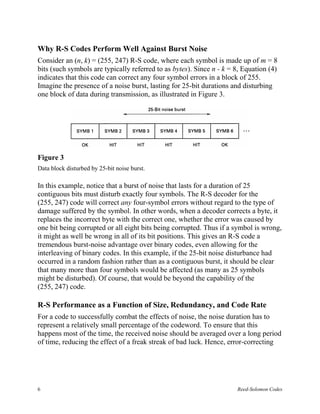
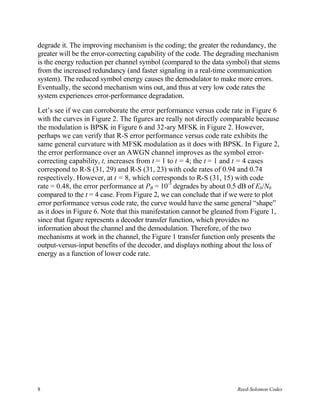
![codes become more efficient (error performance improves) as the code block size
increases, making R-S codes an attractive choice whenever long block lengths are
desired [5]. This is seen by the family of curves in Figure 4, where the rate of the
code is held at a constant 7/8, while its block size increases from n = 32 symbols
(with m = 5 bits per symbol) to n = 256 symbols (with m = 8 bits per symbol).
Thus, the block size increases from 160 bits to 2048 bits.
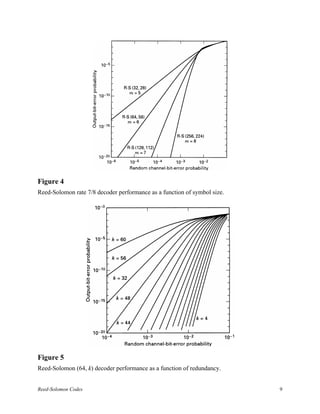
As the redundancy of an R-S code increases (lower code rate), its implementation
grows in complexity (especially for high-speed devices). Also, the bandwidth
expansion must grow for any real-time communications application. However, the
benefit of increased redundancy, just like the benefit of increased symbol size, is
the improvement in bit-error performance, as can be seen in Figure 5, where the
code length n is held at a constant 64, while the number of data symbols decreases
from k = 60 to k = 4 (redundancy increases from 4 symbols to 60 symbols).
Figure 5 represents transfer functions (output bit-error probability versus input
channel symbol-error probability) of hypothetical decoders. Because there is no
system or channel in mind (only an output-versus-input of a decoder), you might
get the idea that the improved error performance versus increased redundancy is a
monotonic function that will continually provide system improvement even as the
code rate approaches zero. However, this is not the case for codes operating in a
real-time communication system. As the rate of a code varies from minimum to
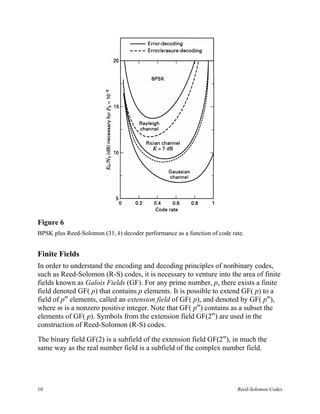
maximum (0 to 1), it is interesting to observe the effects shown in Figure 6. Here,
the performance curves are plotted for BPSK modulation and an R-S (31, k) code
for various channel types. Figure 6 reflects a real-time communication system, where
the price paid for error-correction coding is bandwidth expansion by a factor equal to
the inverse of the code rate. The curves plotted show clear optimum code rates that
minimize the required Eb/N0 [6]. The optimum code rate is about 0.6 to 0.7 for a
Gaussian channel, 0.5 for a Rician-fading channel (with the ratio of direct to reflected
received signal power, K = 7 dB), and 0.3 for a Rayleigh-fading channel. Why is
there an Eb/N0 degradation for very large rates (small redundancy) and very low rates
(large redundancy)? It is easy to explain the degradation at high rates compared to the
optimum rate. Any code generally provides a coding-gain benefit; thus, as the code
rate approaches unity (no coding), the system will suffer worse error performance.
The degradation at low code rates is more subtle because in a real-time
communication system using both modulation and coding, there are two mechanisms
at work. One mechanism works to improve error performance, and the other works to
Reed-Solomon Codes 7](https://image.slidesharecdn.com/13643304-120715034839-phpapp01/85/art_sklar7_reed-solomon-7-320.jpg)
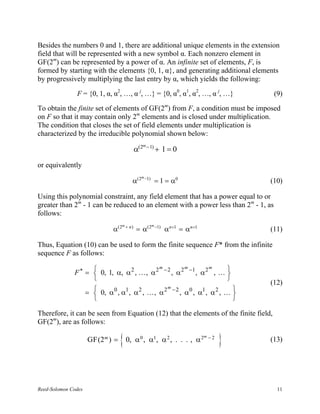
![A Primitive Polynomial Is Used to Define the Finite Field
A class of polynomials called primitive polynomials is of interest because such
functions define the finite fields GF(2m) that in turn are needed to define R-S
codes. The following condition is necessary and sufficient to guarantee that a
polynomial is primitive. An irreducible polynomial f(X ) of degree m is said to be
primitive if the smallest positive integer n for which f(X ) divides X n + 1 is
n = 2m - 1. Note that the statement A divides B means that A divided into B yields a
nonzero quotient and a zero remainder. Polynomials will usually be shown low
order to high order. Sometimes, it is convenient to follow the reverse format (for
example, when performing polynomial division).
Example 1: Recognizing a Primitive Polynomial
Based on the definition of a primitive polynomial given above, determine whether
the following irreducible polynomials are primitive.
a. 1+X+X4
b. 1+X+X2+X3+X4
Solution
a. We can verify whether this degree m = 4 polynomial is primitive by
m
determining whether it divides X n + 1 = X (2 −1) + 1 = X 15 + 1, but does
not divide X n + 1, for values of n in the range of 1 ≤ n < 15. It is easy to
verify that 1 + X + X 4 divides X 15 + 1 [3], and after repeated
computations it can be verified that 1 + X + X 4 will not divide X n + 1 for
any n in the range of 1 ≤ n < 15. Therefore, 1 + X + X 4 is a primitive
polynomial.
b. It is simple to verify that the polynomial 1 + X + X 2 + X 3 + X 4 divides
X 15 + 1. Testing to see whether it will divide X n + 1 for some n that is
less than 15 yields the fact that it also divides X 5 + 1. Thus, although
1 + X + X 2 + X 3 + X 4 is irreducible, it is not primitive.
The Extension Field GF(23)
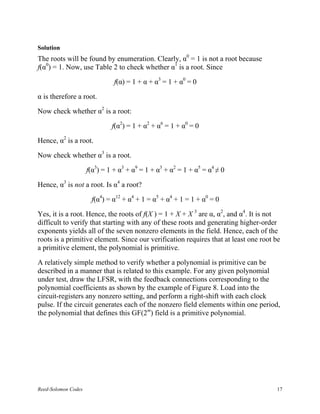
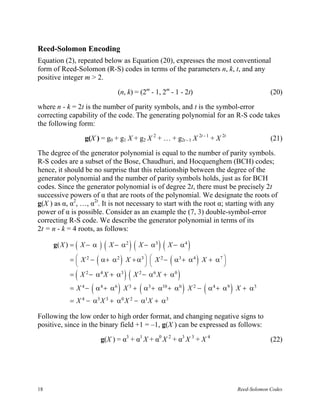
Consider an example involving a primitive polynomial and the finite field that it
defines. Table 1 contains a listing of some primitive polynomials. We choose the
first one shown, f(X) = 1 + X + X 3, which defines a finite field GF(2m), where the
degree of the polynomial is m = 3. Thus, there are 2m = 23 = 8 elements in the field
defined by f(X ). Solving for the roots of f(X ) means that the values of X that
Reed-Solomon Codes 13](https://image.slidesharecdn.com/13643304-120715034839-phpapp01/85/art_sklar7_reed-solomon-13-320.jpg)
![Table 1
Some Primitive Polynomials
m m
3 1+X+X3 14 1 + X + X 6 + X 10 + X 14
4 1+X+X4 15 1 + X + X 15
5 1+X2+X5 16 1 + X + X 3 + X 12 + X 16
6 1+X+X6 17 1 + X 3 + X 17
7 1+X3+X7 18 1 + X 7 + X 18
8 1+X2+X3+X4+X8 19 1 + X + X 2 + X 5 + X 19
9 1+X4+X9 20 1 + X 3 + X 20
10 1 + X 3 + X 10 21 1 + X 2 + X 21
11 1 + X 2 + X 11 22 1 + X + X 22
12 1 + X + X 4 + X 6 + X 12 23 1 + X 5 + X 23
13 1 + X + X 3 + X 4 + X 13 24 1 + X + X 2 + X 7 + X 24
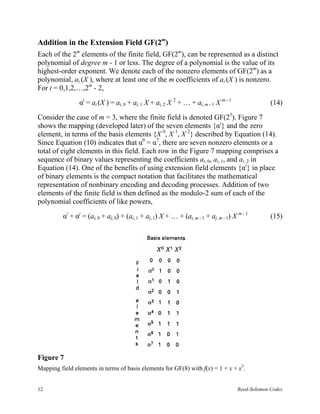
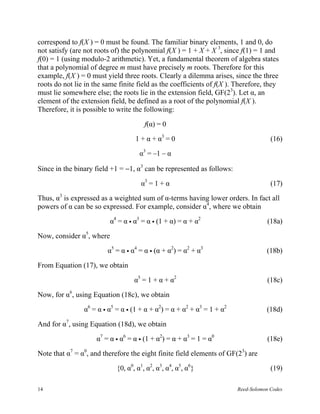
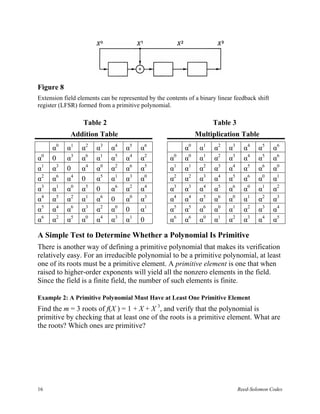
The mapping of field elements in terms of basis elements, described by Equation
(14), can be demonstrated with the linear feedback shift register (LFSR) circuit
shown in Figure 8. The circuit generates (with m = 3) the 2m - 1 nonzero elements
of the field, and thus summarizes the findings of Figure 7 and Equations (17)
through (19). Note that in Figure 8 the circuit feedback connections correspond to
the coefficients of the polynomial f(X ) = 1 + X + X 3, just like for binary cyclic
codes [3]. By starting the circuit in any nonzero state, say 1 0 0, and performing a
right-shift at each clock time, it is possible to verify that each of the field elements
shown in Figure 7 (except the all-zeros element) will cyclically appear in the stages
of the shift register. Two arithmetic operations, addition and multiplication, can be
defined for this GF(23) finite field. Addition is shown in Table 2, and
multiplication is shown in Table 3 for the nonzero elements only. The rules of
addition follow from Equations (17) through (18e), and can be verified by noticing
in Figure 7 that the sum of any field elements can be obtained by adding (modulo-
2) the respective coefficients of their basis elements. The multiplication rules in
Table 3 follow the usual procedure, in which the product of the field elements is
obtained by adding their exponents modulo-(2m - 1), or for this case, modulo-7.
Reed-Solomon Codes 15](https://image.slidesharecdn.com/13643304-120715034839-phpapp01/85/art_sklar7_reed-solomon-15-320.jpg)
![Encoding in Systematic Form
Since R-S codes are cyclic codes, encoding in systematic form is analogous to the
binary encoding procedure [3]. We can think of shifting a message polynomial,
m(X ), into the rightmost k stages of a codeword register and then appending a
parity polynomial, p(X ), by placing it in the leftmost n - k stages. Therefore we
multiply m(X ) by X n - k, thereby manipulating the message polynomial
algebraically so that it is right-shifted n - k positions. Next, we divide X n - k m(X )
by the generator polynomial g(X ), which is written in the following form:
X n - k m(X ) = q(X ) g(X ) + p(X ) (23)
where q(X ) and p(X ) are quotient and remainder polynomials, respectively. As in
the binary case, the remainder is the parity. Equation (23) can also be expressed as
follows:
p(X ) = X n - k m(X ) modulo g(X ) (24)
The resulting codeword polynomial, U(X ) can be written as
U(X ) = p(X ) + X n - k m(X ) (25)
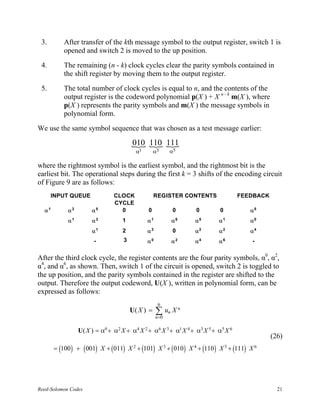
We demonstrate the steps implied by Equations (24) and (25) by encoding the
following three-symbol message:
{ 110 111
010 { {
α1 α3 α5
with the (7, 3) R-S code whose generator polynomial is given in Equation (22). We
first multiply (upshift) the message polynomial α1 + α3 X + α5 X 2 by X n - k = X 4,
yielding α1 X 4 + α3 X 5 + α5 X 6. We next divide this upshifted message polynomial
by the generator polynomial in Equation (22), α3 + α1 X + α0 X 2 + α3 X 3 + X 4.
Polynomial division with nonbinary coefficients is more tedious than its binary
counterpart, because the required operations of addition (subtraction) and
multiplication (division) must follow the rules in Tables 2 and 3, respectively. It is
left as an exercise for the reader to verify that this polynomial division results in
the following remainder (parity) polynomial.
p(X ) = α0 + α2 X + α4 X 2 + α6 X 3
Then, from Equation (25), the codeword polynomial can be written as follows:
U(X ) = α0 + α2 X + α4 X 2 + α6 X 3+ α1 X 4 + α3 X 5 + α5 X 6
Reed-Solomon Codes 19](https://image.slidesharecdn.com/13643304-120715034839-phpapp01/85/art_sklar7_reed-solomon-19-320.jpg)
![Systematic Encoding with an (n - k)–Stage Shift Register
Using circuitry to encode a three-symbol sequence in systematic form with the
(7, 3) R-S code described by g(X ) in Equation (22) requires the implementation of
a linear feedback shift register (LFSR) circuit, as shown in Figure 9. It can easily
be verified that the multiplier terms in Figure 9, taken from left to right, correspond
to the coefficients of the polynomial in Equation (22) (low order to high order).
This encoding process is the nonbinary equivalent of cyclic encoding [3]. Here,
corresponding to Equation (20), the (7, 3) R-S nonzero codewords are made up of
2m - 1 = 7 symbols, and each symbol is made up of m = 3 bits.
Figure 9
LFSR encoder for a (7, 3) R-S code.
Here the example is nonbinary, so that each stage in the shift register of Figure 9
holds a 3-bit symbol. In the case of binary codes, the coefficients labeled g1, g2,
and so on are binary. Therefore, they take on values of 1 or 0, simply dictating the
presence or absence of a connection in the LFSR. However in Figure 9, since each
coefficient is specified by 3-bits, it can take on one of eight values.
The nonbinary operation implemented by the encoder of Figure 9, forming
codewords in a systematic format, proceeds in the same way as the binary one. The
steps can be described as follows:
1. Switch 1 is closed during the first k clock cycles to allow shifting the
message symbols into the (n - k)–stage shift register.
2. Switch 2 is in the down position during the first k clock cycles in order to
allow simultaneous transfer of the message symbols directly to an output
register (not shown in Figure 9).
20 Reed-Solomon Codes](https://image.slidesharecdn.com/13643304-120715034839-phpapp01/85/art_sklar7_reed-solomon-20-320.jpg)
![Reed-Solomon Decoding
Earlier, a test message encoded in systematic form using a (7, 3) R-S code resulted
in a codeword polynomial described by Equation (26). Now, assume that during
transmission this codeword becomes corrupted so that two symbols are received in
error. (This number of errors corresponds to the maximum error-correcting
capability of the code.) For this seven-symbol codeword example, the error pattern,
e(X ), can be described in polynomial form as follows:
6
e(X ) = ∑ en X n
n =0
(28)
For this example, let the double-symbol error be such that
e ( X ) = 0 + 0 X + 0 X 2 + α 2 X 3 + α5 X 4 + 0 X 5 + 0 X 6
(29)
= ( 000 ) + ( 000 ) X + ( 000 ) X 2 + ( 001) X 3 + (111) X 4 + ( 000 ) X 5 + ( 000 ) X 6
In other words, one parity symbol has been corrupted with a 1-bit error (seen as
α2), and one data symbol has been corrupted with a 3-bit error (seen as α5). The
received corrupted-codeword polynomial, r(X ), is then represented by the sum of
the transmitted-codeword polynomial and the error-pattern polynomial as follows:
r( X ) = U( X ) + e( X ) (30)
Following Equation (30), we add U(X ) from Equation (26) to e(X ) from Equation
(29) to yield r(X ), as follows:
r ( X ) = (100) + ( 001) X + ( 011) X 2 + (100) X 3 + (101) X 4 + (110) X 5 + (111) X 6
= α 0 + α 2 X + α 4 X 2 + α 0 X 3 + α 6 X 4 + α3 X 5 + α 5 X 6 (31)
In this example, there are four unknowns—two error locations and two error
values. Notice an important difference between the nonbinary decoding of r(X )
that we are faced with in Equation (31) and binary decoding; in binary decoding,
the decoder only needs to find the error locations [3]. Knowledge that there is an
error at a particular location dictates that the bit must be “flipped” from 1 to 0 or
vice versa. But here, the nonbinary symbols require that we not only learn the error
locations, but also determine the correct symbol values at those locations. Since
there are four unknowns in this example, four equations are required for their
solution.
Reed-Solomon Codes 23](https://image.slidesharecdn.com/13643304-120715034839-phpapp01/85/art_sklar7_reed-solomon-23-320.jpg)
![Syndrome Computation
The syndrome is the result of a parity check performed on r to determine whether r
is a valid member of the codeword set [3]. If in fact r is a member, the syndrome S
has value 0. Any nonzero value of S indicates the presence of errors. Similar to the
binary case, the syndrome S is made up of n - k symbols, {Si} (i = 1, … , n - k).
Thus, for this (7, 3) R-S code, there are four symbols in every syndrome vector;
their values can be computed from the received polynomial, r(X ). Note how the
computation is facilitated by the structure of the code, given by Equation (27) and
rewritten below:
U(X ) = m(X ) g(X )
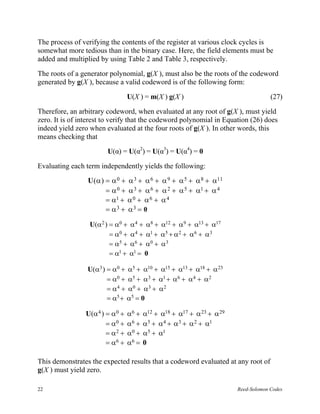
From this structure it can be seen that every valid codeword polynomial U(X ) is a
multiple of the generator polynomial g(X ). Therefore, the roots of g(X ) must also
be the roots of U(X ). Since r(X ) = U(X ) + e(X ), then r(X ) evaluated at each of
the roots of g(X ) should yield zero only when it is a valid codeword. Any errors
will result in one or more of the computations yielding a nonzero result. The
computation of a syndrome symbol can be described as follows:
Si = r( X ) = r(αi ) i = 1,L , n − k (32)
X = αi
where r(X ) contains the postulated two-symbol errors as shown in Equation (29).
If r(X ) were a valid codeword, it would cause each syndrome symbol Si to equal 0.
For this example, the four syndrome symbols are found as follows:
S1 = r(α) = α0 + α3 + α6 + α 3 + α10 + α8 + α11
= α0 + α3 + α6 + α3 + α 2 + α1+ α 4 (33)
= α3
S2 = r(α 2 ) = α0 + α 4 + α8 + α6 + α14 + α13 + α17
= α0 + α 4 + α1+ α6 + α0 + α 6 + α 3 (34)
= α5
S3 = r(α3 ) = α0 + α5 + α10 + α 9 + α18 + α18 + α 23
= α 0 + α5 + α 3 + α 2 + α 4 + α 4 + α 2 (35)
= α6
S4 = r(α 4 ) = α0 + α6 + α12 + α12 + α 22 + α 23 + α 29
= α0 + α6 + α5 + α5 + α1+ α 2 + α1 (36)
=0
24 Reed-Solomon Codes](https://image.slidesharecdn.com/13643304-120715034839-phpapp01/85/art_sklar7_reed-solomon-24-320.jpg)
![The results confirm that the received codeword contains an error (which we
inserted), since S≠0.
Example 3: A Secondary Check on the Syndrome Values
For the (7, 3) R-S code example under consideration, the error pattern is known,
since it was chosen earlier. An important property of codes when describing the
standard array is that each element of a coset (row) in the standard array has the
same syndrome [3]. Show that this property is also true for the R-S code by
evaluating the error polynomial e(X ) at the roots of g(X ) to demonstrate that it
must yield the same syndrome values as when r(X ) is evaluated at the roots of
g(X ). In other words, it must yield the same values obtained in Equations (33)
through (36).
Solution
Si = r ( X ) = r (αi ) i = 1, 2, L , n − k
X = αi
Si =
U( X ) + e( X )
X = αi
= U (αi ) + e (αi )
Si = r (αi ) = U (αi ) + e (αi ) = 0 + e (αi )
From Equation (29),
e(X ) = α2 X 3 + α5 X 4
Therefore,
S 1 = e(α1 ) = α5 + α9
= α5 + α 2
= α3
S2 = e(α2 ) = α8 + α13
= α1+ α6
= α5
continues
Reed-Solomon Codes 25](https://image.slidesharecdn.com/13643304-120715034839-phpapp01/85/art_sklar7_reed-solomon-25-320.jpg)
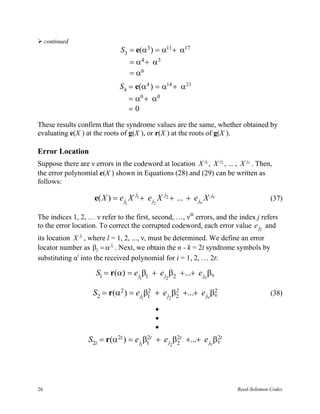
![There are 2t unknowns (t error values and t locations), and 2t simultaneous
equations. However, these 2t simultaneous equations cannot be solved in the usual
way because they are nonlinear (as some of the unknowns have exponents). Any
technique that solves this system of equations is known as a Reed-Solomon
decoding algorithm.
Once a nonzero syndrome vector (one or more of its symbols are nonzero) has
been computed, that signifies that an error has been received. Next, it is necessary
to learn the location of the error or errors. An error-locator polynomial, σ(X ), can
be defined as follows:
σ( X ) = ( 1 + β1 X ) ( 1 + β2 X ) ... ( 1 + βν X )
(39)
= 1 + σ1 X + σ2 X 2 +... + σν X ν
The roots of σ(X ) are 1/β1, 1/β2, … ,1/βν. The reciprocal of the roots of σ(X ) are
the error-location numbers of the error pattern e(X ). Then, using autoregressive
modeling techniques [7], we form a matrix from the syndromes, where the first t
syndromes are used to predict the next syndrome. That is,
S1 S2 S3 ... St – 1 St σt –St + 1
S2 S3 S4 ... St St + 1 σt – 1 –St + 2
• • •
• • = • (40)
• • •
St – 1 St St + 1 ... S2t – 3 S2t – 2 σ2 –S2t – 1
St St + 1 St + 2 ... S2t – 2 S2t – 1 σ1 –S2t
Reed-Solomon Codes 27](https://image.slidesharecdn.com/13643304-120715034839-phpapp01/85/art_sklar7_reed-solomon-27-320.jpg)
![We apply the autoregressive model of Equation (40) by using the largest
dimensioned matrix that has a nonzero determinant. For the (7, 3) double-symbol-
error correcting R-S code, the matrix size is 2 × 2, and the model is written as
follows:
S S2 σ2 S3
1 = (41)
S2
S3 σ1 S4
α3
α5 σ2 α6
= (42)
α5 6 σ
α 1 0
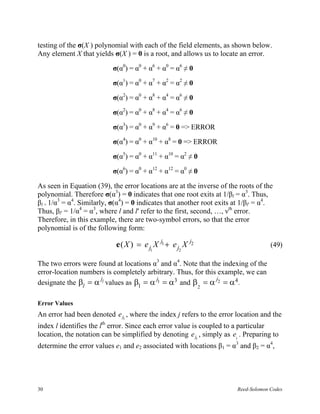
To solve for the coefficients σ1 and σ2 and of the error-locator polynomial, σ(X ),
we first take the inverse of the matrix in Equation (42). The inverse of a matrix [A]
is found as follows:
cofactor A
Inv A
=
det A
Therefore,
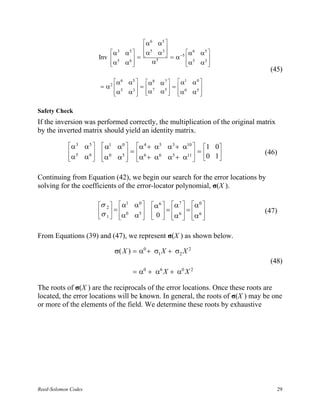
α3 α5
det = α3α6 − α5α5 = α 9 + α10 (43)
α5 6
α
= α 2 + α 3 = α5
α 3 α5 α 6 α
5
cofactor = (44)
α α
5 6 5 3
α α
28 Reed-Solomon Codes](https://image.slidesharecdn.com/13643304-120715034839-phpapp01/85/art_sklar7_reed-solomon-28-320.jpg)
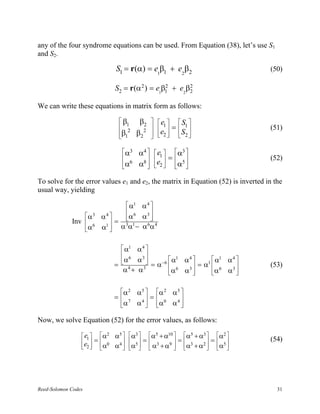
![Correcting the Received Polynomial with Estimates of the Error Polynomial
From Equations (49) and (54), the estimated error polynomial is formed, to yield
the following:
e ( X ) = e1 X j1 + e2 X j2
$
(55)
= α2 X 3 + α5 X 4
The demonstrated algorithm repairs the received polynomial, yielding an estimate
of the transmitted codeword, and ultimately delivers a decoded message. That is,
Û(X ) = r(X ) + ê(X ) = U(X ) + e(X ) + ê(X ) (56)
r(X ) = (100) + (001)X + (011)X 2 + (100)X 3 + (101)X 4 + (110)X 5 + (111)X 6
ê(X ) = (000) + (000)X + (000)X 2 + (001)X 3 + (111)X 4 + (000)X 5 + (000)X 6
Û(X ) = (100) + (001)X + (011)X 2 + (101)X 3 + (010)X 4 + (110)X 5 + (111)X 6
= α0 + α2X + α4X 2 + α6X 3 + α1X 4 + α3X 5 + α5X 6 (57)
Since the message symbols constitute the rightmost k = 3 symbols, the decoded
message is
{ 110 111
010 { {
α1 α3 α5
which is exactly the test message that was chosen earlier for this example. For
further reading on R-S coding, see the collection of papers in reference [8].
Conclusion
In this article, we examined Reed-Solomon (R-S) codes, a powerful class of
nonbinary block codes, particularly useful for correcting burst errors. Because
coding efficiency increases with code length, R-S codes have a special attraction.
They can be configured with long block lengths (in bits) with less decoding time
32 Reed-Solomon Codes](https://image.slidesharecdn.com/13643304-120715034839-phpapp01/85/art_sklar7_reed-solomon-32-320.jpg)
![than other codes of similar lengths. This is because the decoder logic works with
symbol-based rather than bit-based arithmetic. Hence, for 8-bit symbols, the
arithmetic operations would all be at the byte level. This increases the complexity
of the logic, compared with binary codes of the same length, but it also increases
the throughput.
References
[1] Reed, I. S. and Solomon, G., “Polynomial Codes Over Certain Finite
Fields,” SIAM Journal of Applied Math., vol. 8, 1960, pp. 300-304.
[2] Gallager, R. G., Information Theory and Reliable Communication (New
York: John Wiley and Sons, 1968).
[3] Sklar, B., Digital Communications: Fundamentals and Applications, Second
Edition (Upper Saddle River, NJ: Prentice-Hall, 2001).
[4] Odenwalder, J. P., Error Control Coding Handbook, Linkabit Corporation,
San Diego, CA, July 15, 1976.
[5] Berlekamp, E. R., Peile, R. E., and Pope, S. P., “The Application of Error
Control to Communications,” IEEE Communications Magazine, vol. 25, no.
4, April 1987, pp. 44-57.
[6] Hagenauer, J., and Lutz, E., “Forward Error Correction Coding for Fading
Compensation in Mobile Satellite Channels,” IEEE JSAC, vol. SAC-5, no. 2,
February 1987, pp. 215-225.
[7] Blahut, R. E., Theory and Practice of Error Control Codes (Reading, MA:
Addison-Wesley, 1983).
[8] Wicker, S. B. and Bhargava, V. K., ed., Reed-Solomon Codes and Their
Applications (Piscataway, NJ: IEEE Press, 1983).
About the Author
Bernard Sklar is the author of Digital Communications: Fundamentals and
Applications, Second Edition (Prentice-Hall, 2001, ISBN 0-13-084788-7).
Reed-Solomon Codes 33](https://image.slidesharecdn.com/13643304-120715034839-phpapp01/85/art_sklar7_reed-solomon-33-320.jpg)

1) Reed-Solomon codes are a type of error-correcting code invented in 1960 that can detect and correct multiple symbol errors. They work by encoding data into redundant symbols that can be used to detect and locate errors. 2) Reed-Solomon codes are particularly good at correcting burst errors, where a run of symbols are corrupted together, because they can correct a set number of errors regardless of where in the codeword they occur. 3) The error correction capability increases with lower code rates (more redundant symbols) and longer block lengths, as this averages the noise over more symbols and makes it less likely for a noise burst to corrupt too many consecutive symbols.


![5G Explained! A High Level Overview [Introduction]](https://cdn.slidesharecdn.com/ss_thumbnails/5gexplainedahighleveloverview-260119165306-cc137a3e-thumbnail.jpg?width=640&height=640&fit=bounds)


