Routing and Algorithms
By Prateek Tripathi
VLSI Physical Design: From Graph Partitioning to Timing
Closure; Andrew B. Kahng, Jens Lienig
Basic Idea
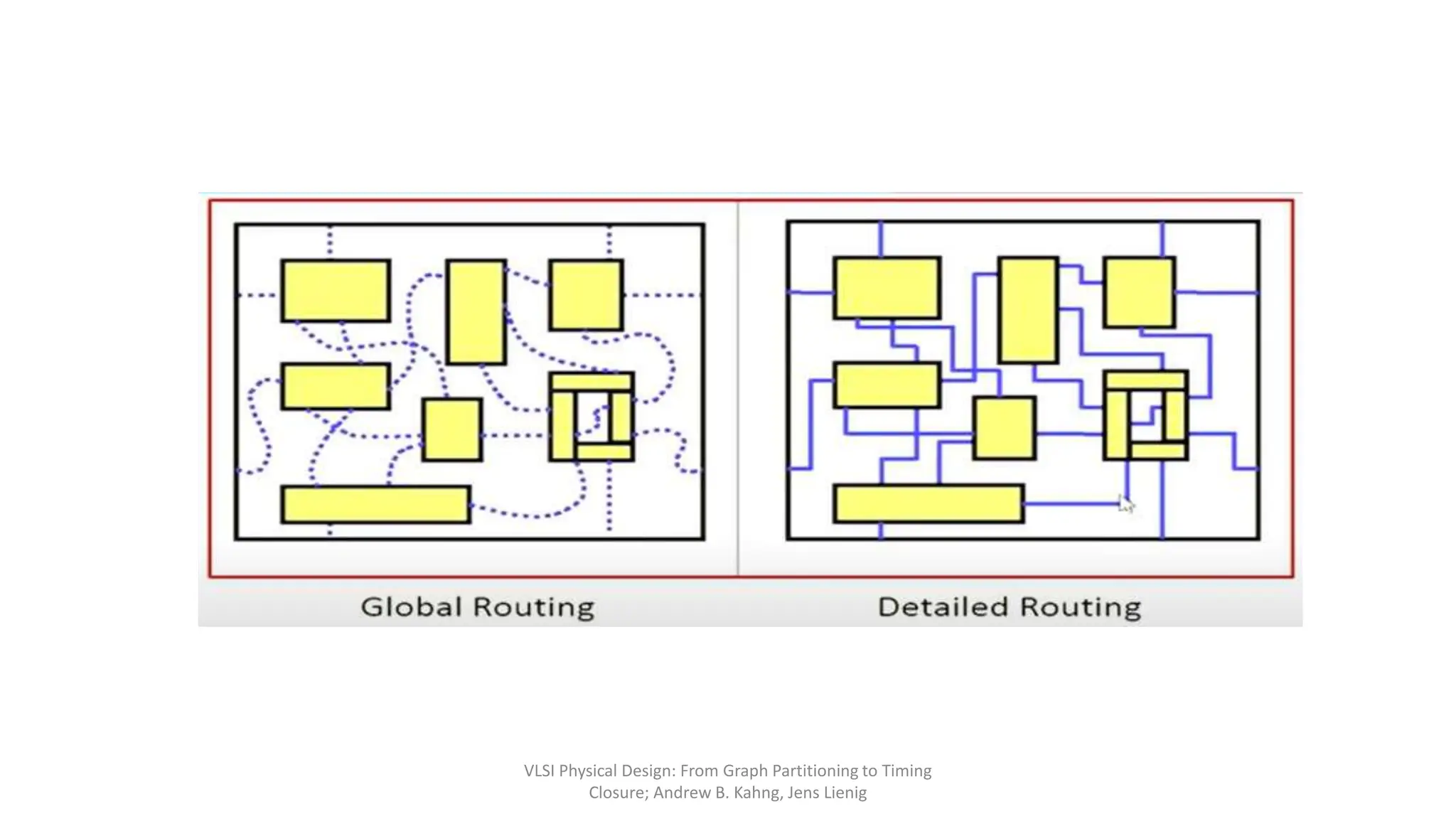
• Global Routing: Global routes assign nets to particular metal
layers and global routing cells.in an approximate manner.
• Detailed Routing: For detailed routing, the router decides the
actual physical interconnections of nets by allocating wires on
each metal layer and vias for switching between metal layers.
VLSI Physical Design: From Graph Partitioning to Timing
Closure; Andrew B. Kahng, Jens Lienig
VLSI Physical Design: From Graph Partitioning to Timing
Closure; Andrew B. Kahng, Jens Lienig
Some points to remember
• Vertical and horizontal tracks are laid out on different layers
• The junctions are connected by a “via”.
• There can be multiple layers of tracks depending upon the complexity
of the routing problem.
• As a conventional routing method we label the two or more pins with
the same name to specify the program that a connection is to be form
between them.
VLSI Physical Design: From Graph Partitioning to Timing
Closure; Andrew B. Kahng, Jens Lienig
Optimization goal of Global Routing
• Seeks to determine whether a given placement is routable
• Seeks to determine a coarse routing for all nets within available
routing regions.
VLSI Physical Design: From Graph Partitioning to Timing
Closure; Andrew B. Kahng, Jens Lienig
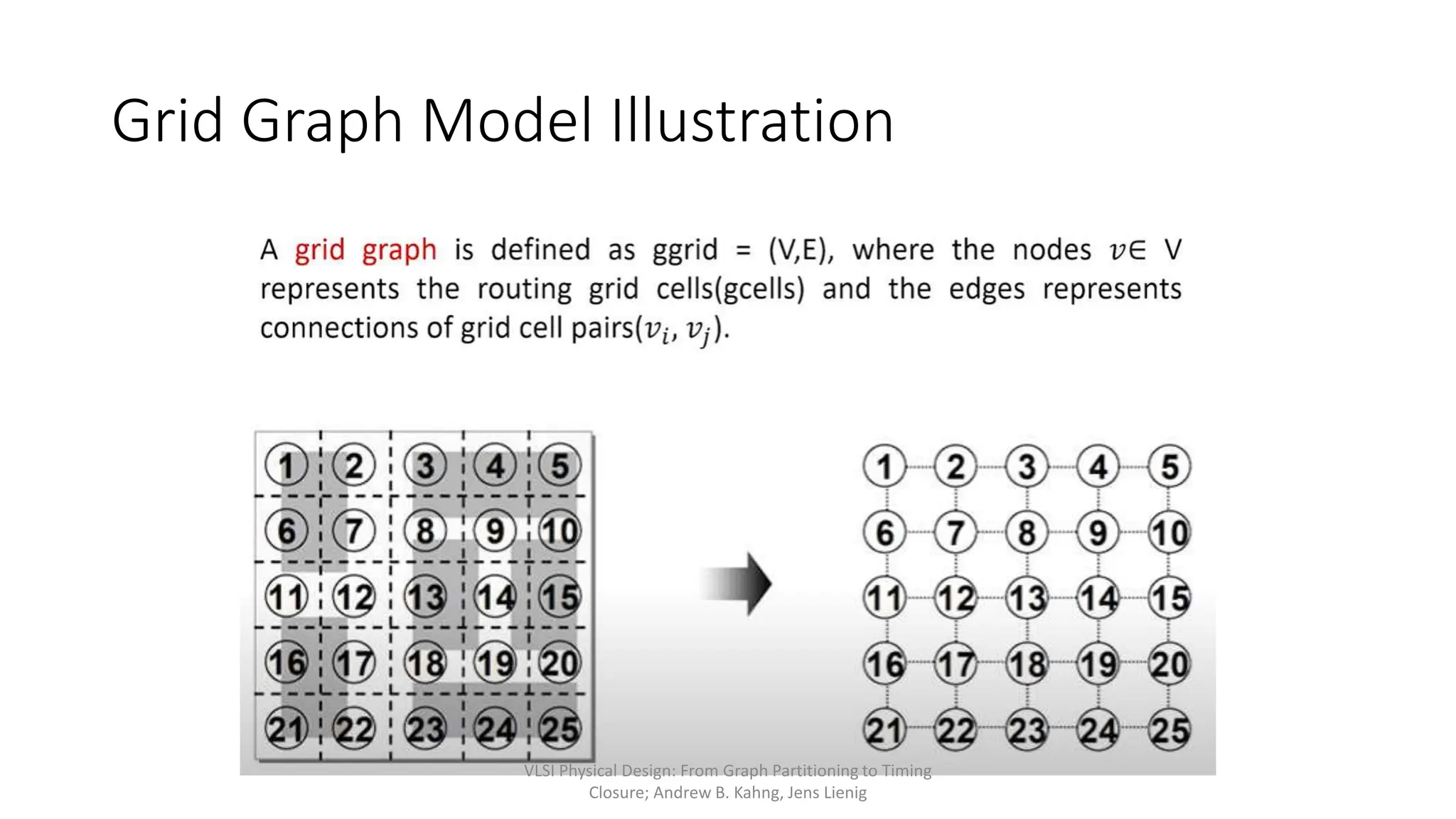
Grid Graph Model Illustration
VLSI Physical Design: From Graph Partitioning to Timing
Closure; Andrew B. Kahng, Jens Lienig
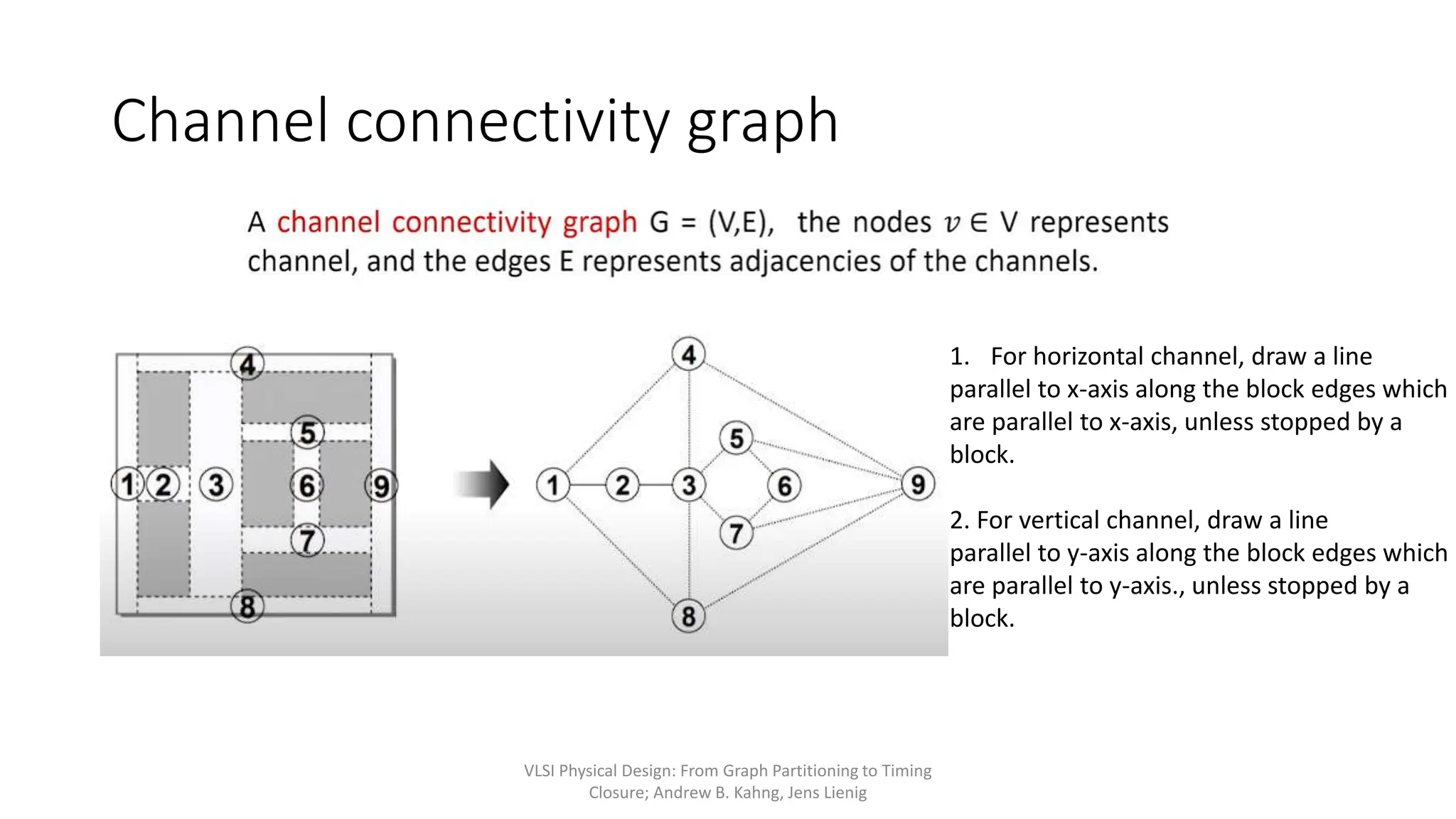
Channel connectivity graph
VLSI Physical Design: From Graph Partitioning to Timing
Closure; Andrew B. Kahng, Jens Lienig
1. For horizontal channel, draw a line
parallel to x-axis along the block edges which
are parallel to x-axis, unless stopped by a
block.
2. For vertical channel, draw a line
parallel to y-axis along the block edges which
are parallel to y-axis., unless stopped by a
block.
Switch-box
VLSI Physical Design: From Graph Partitioning to Timing
Closure; Andrew B. Kahng, Jens Lienig
Single net routing(rectilinear routing)
then the tree is a rectilinear minimum spanning
tree(RMST)
VLSI Physical Design: From Graph Partitioning to Timing
Closure; Andrew B. Kahng, Jens Lienig
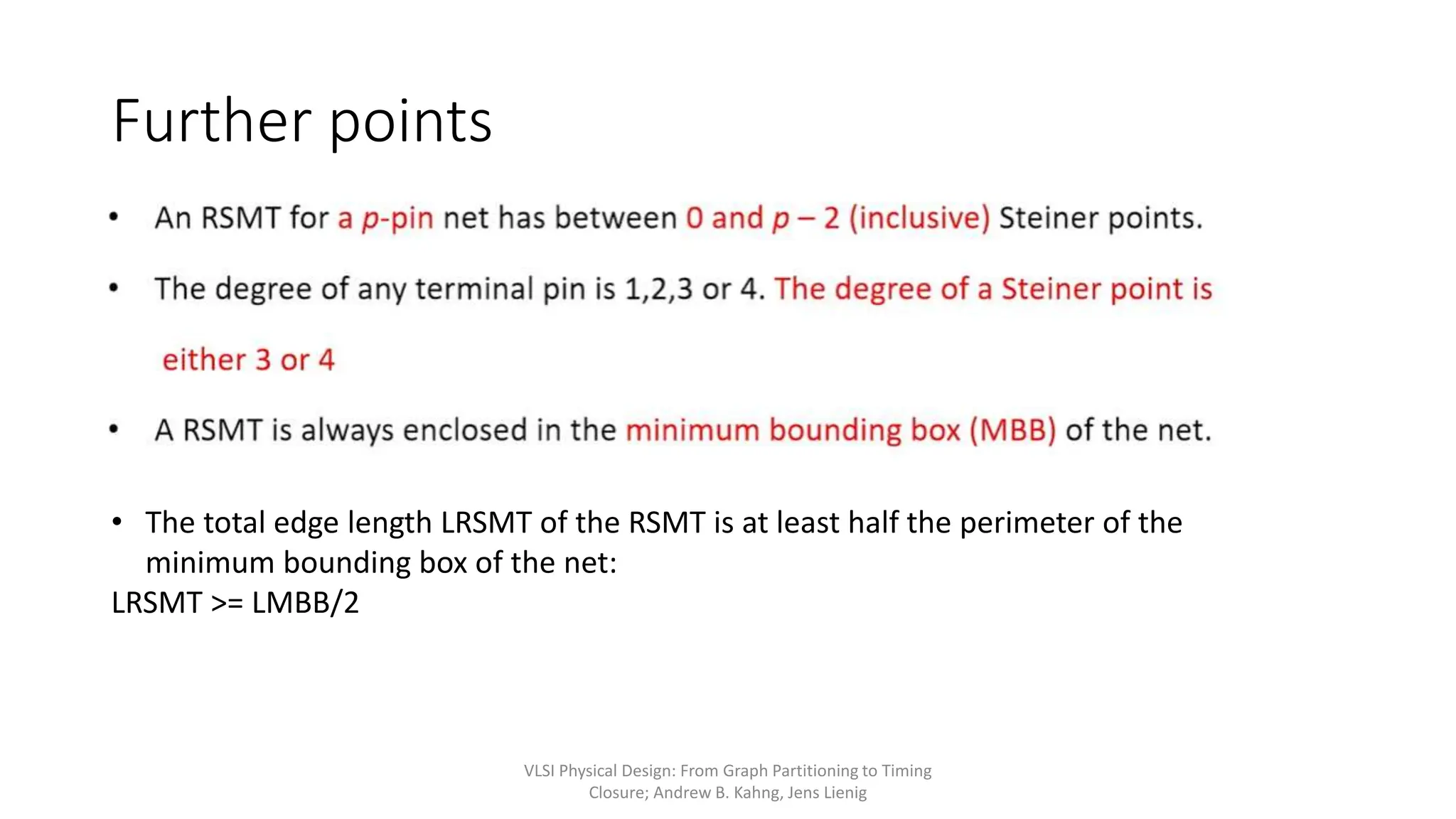
Further points
• The total edge length LRSMT of the RSMT is at least half the perimeter of the
minimum bounding box of the net:
LRSMT >= LMBB/2
VLSI Physical Design: From Graph Partitioning to Timing
Closure; Andrew B. Kahng, Jens Lienig
VLSI Physical Design: From Graph Partitioning to Timing
Closure; Andrew B. Kahng, Jens Lienig
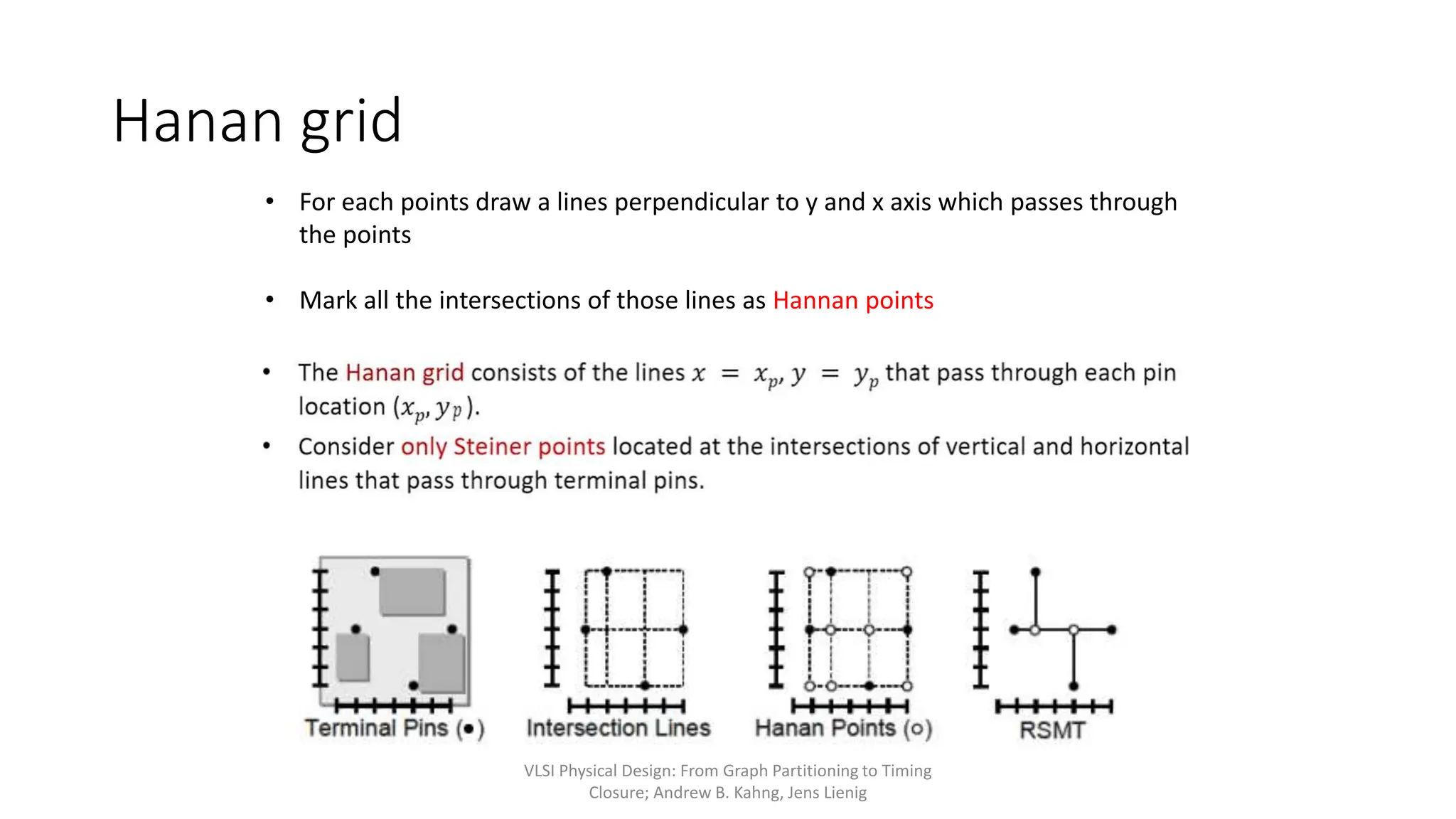
Hanan grid
VLSI Physical Design: From Graph Partitioning to Timing
Closure; Andrew B. Kahng, Jens Lienig
• For each points draw a lines perpendicular to y and x axis which passes through
the points
• Mark all the intersections of those lines as Hannan points
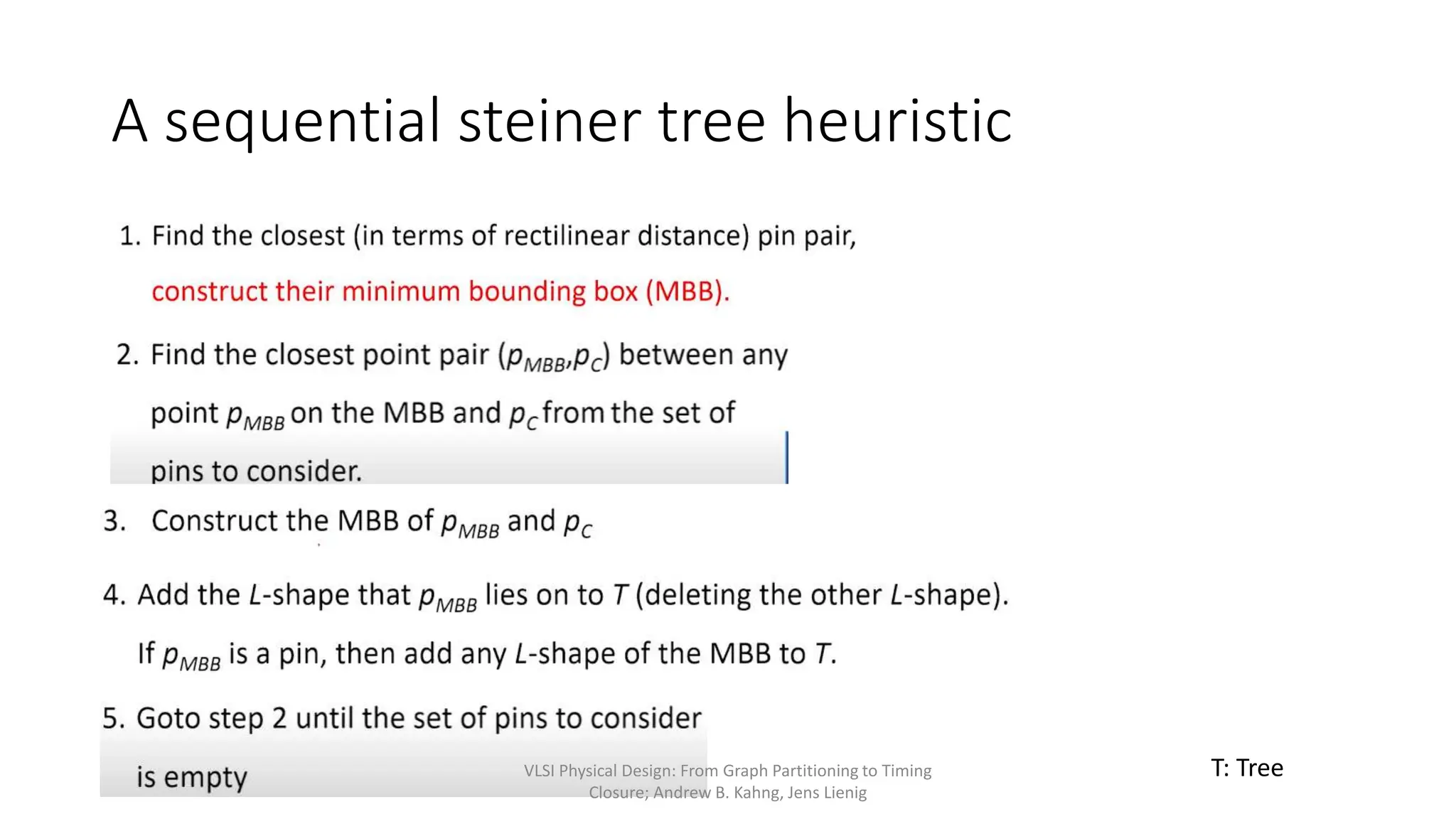
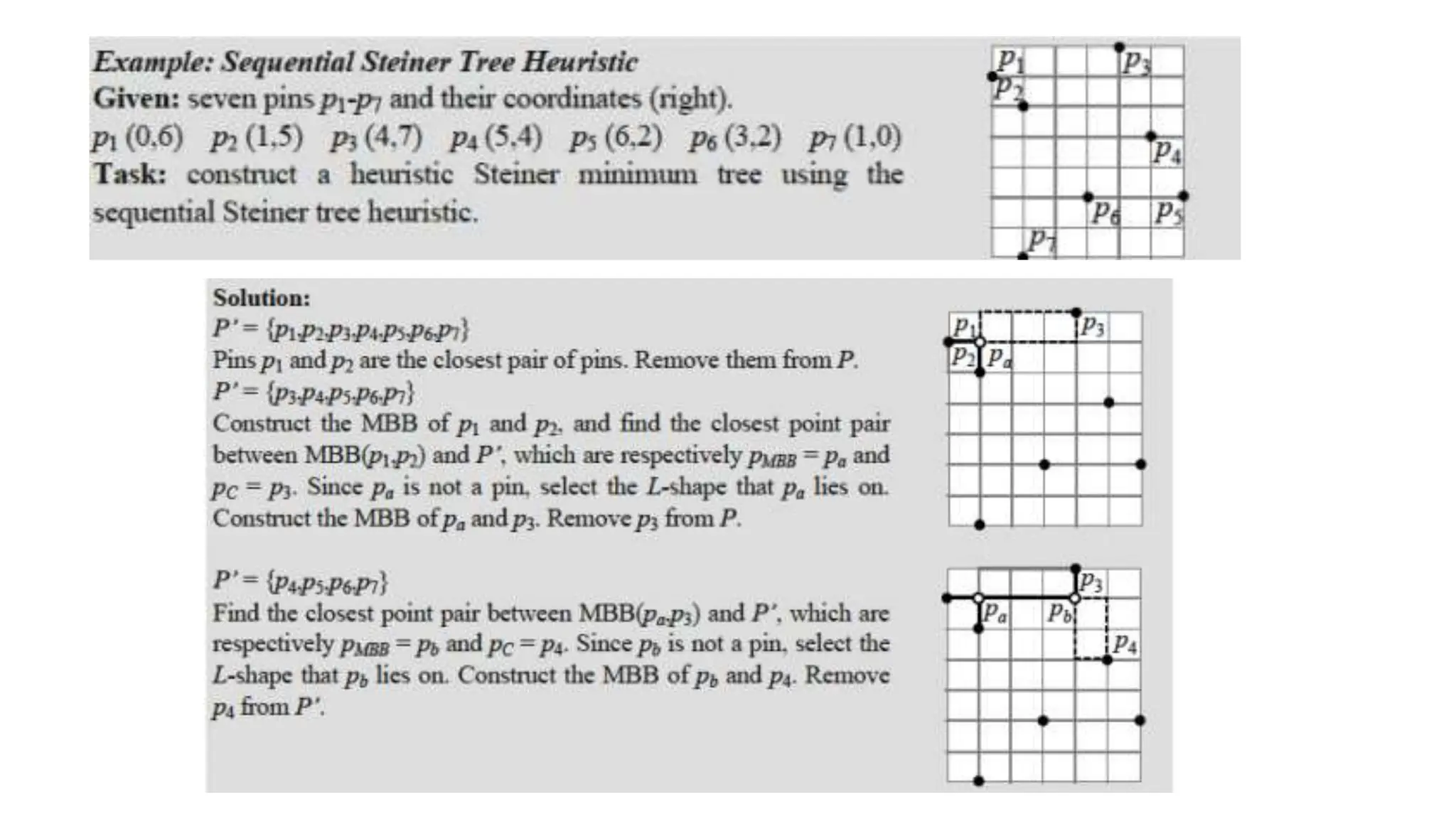
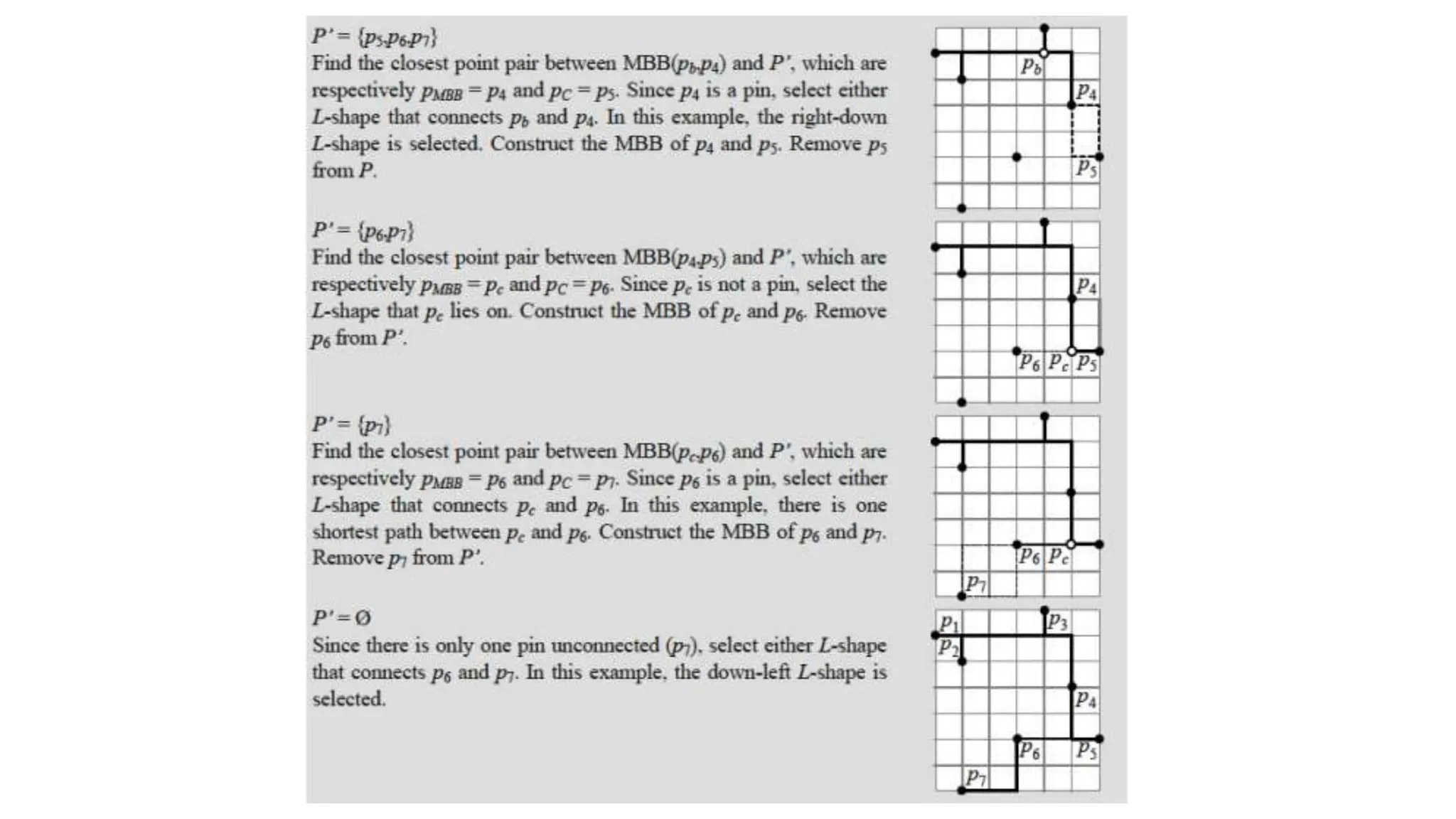
A sequential steiner tree heuristic
VLSI Physical Design: From Graph Partitioning to Timing
Closure; Andrew B. Kahng, Jens Lienig
T: Tree
VLSI Physical Design: From Graph Partitioning to Timing
Closure; Andrew B. Kahng, Jens Lienig
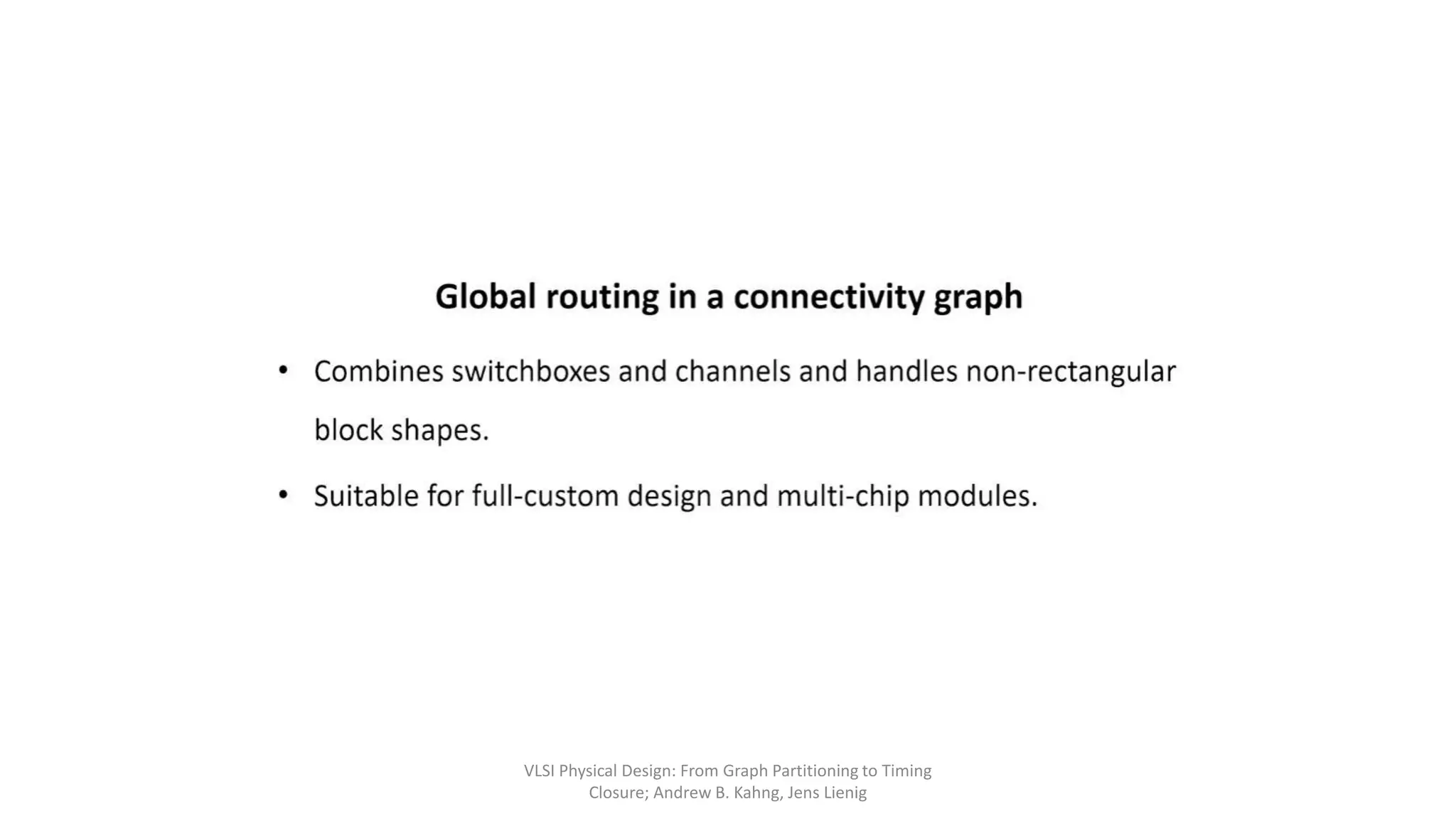
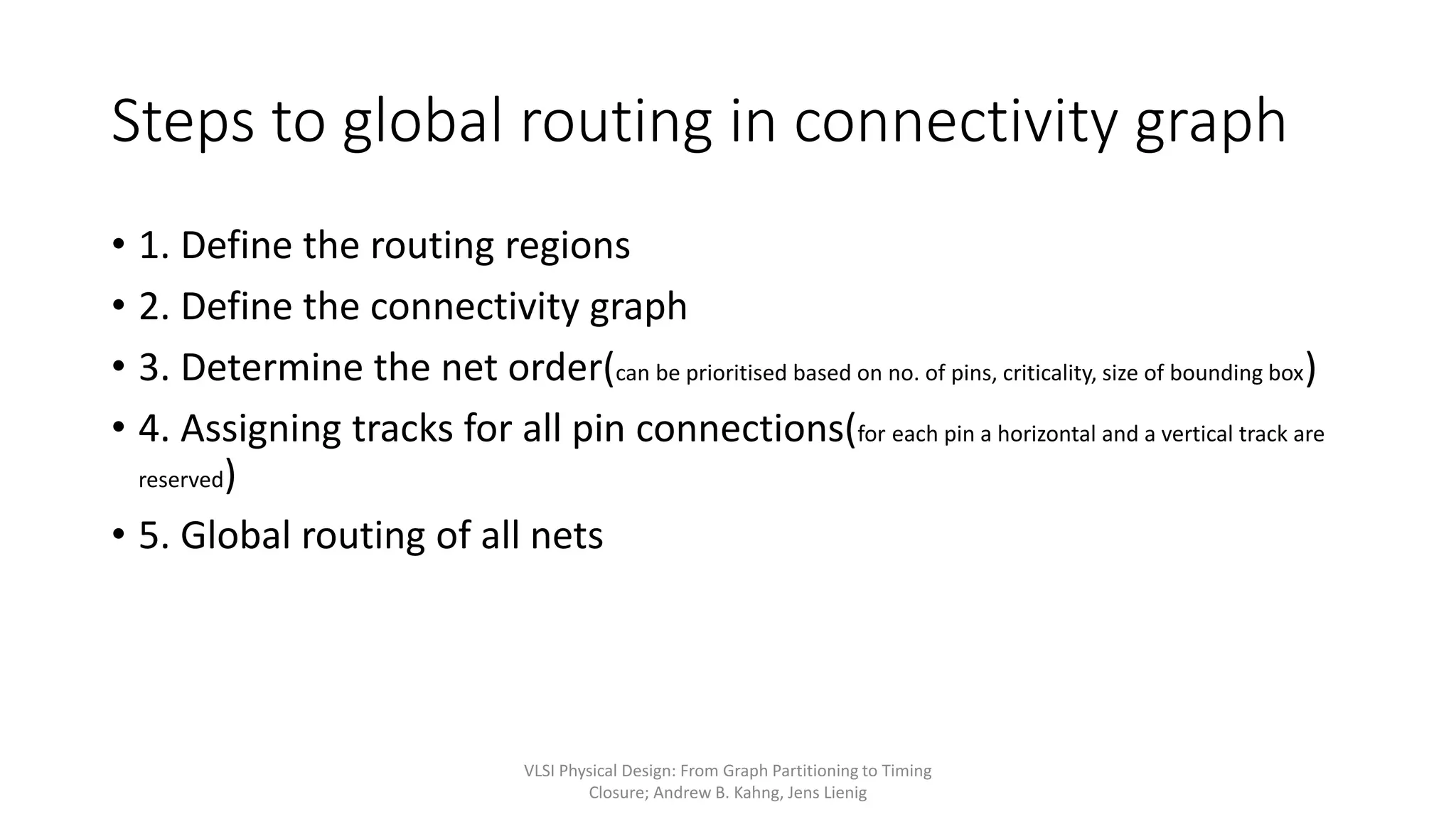
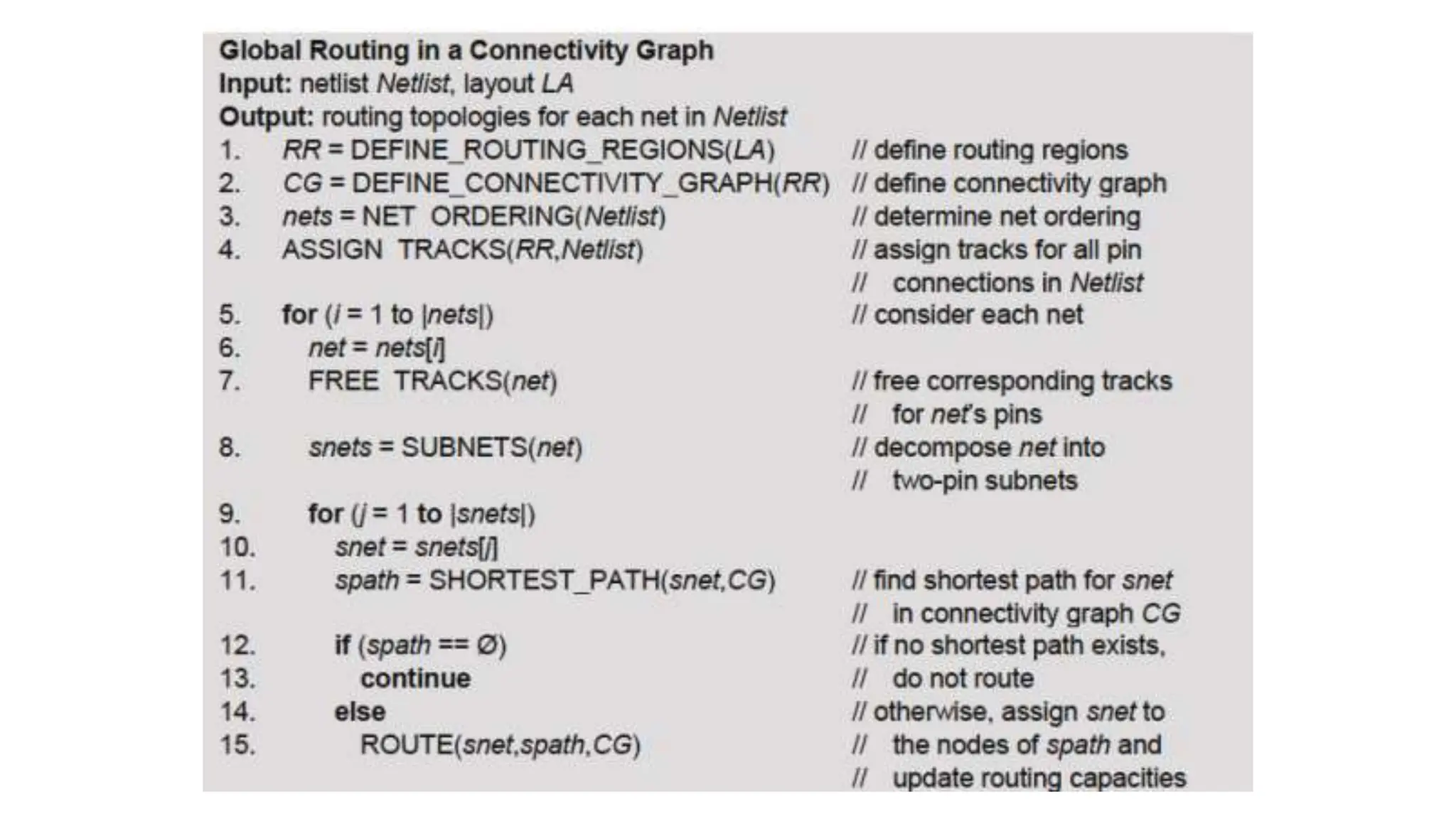
Steps to global routing in connectivity graph
• 1. Define the routing regions
• 2. Define the connectivity graph
• 3. Determine the net order(can be prioritised based on no. of pins, criticality, size of bounding box)
• 4. Assigning tracks for all pin connections(for each pin a horizontal and a vertical track are
reserved)
• 5. Global routing of all nets
VLSI Physical Design: From Graph Partitioning to Timing
Closure; Andrew B. Kahng, Jens Lienig
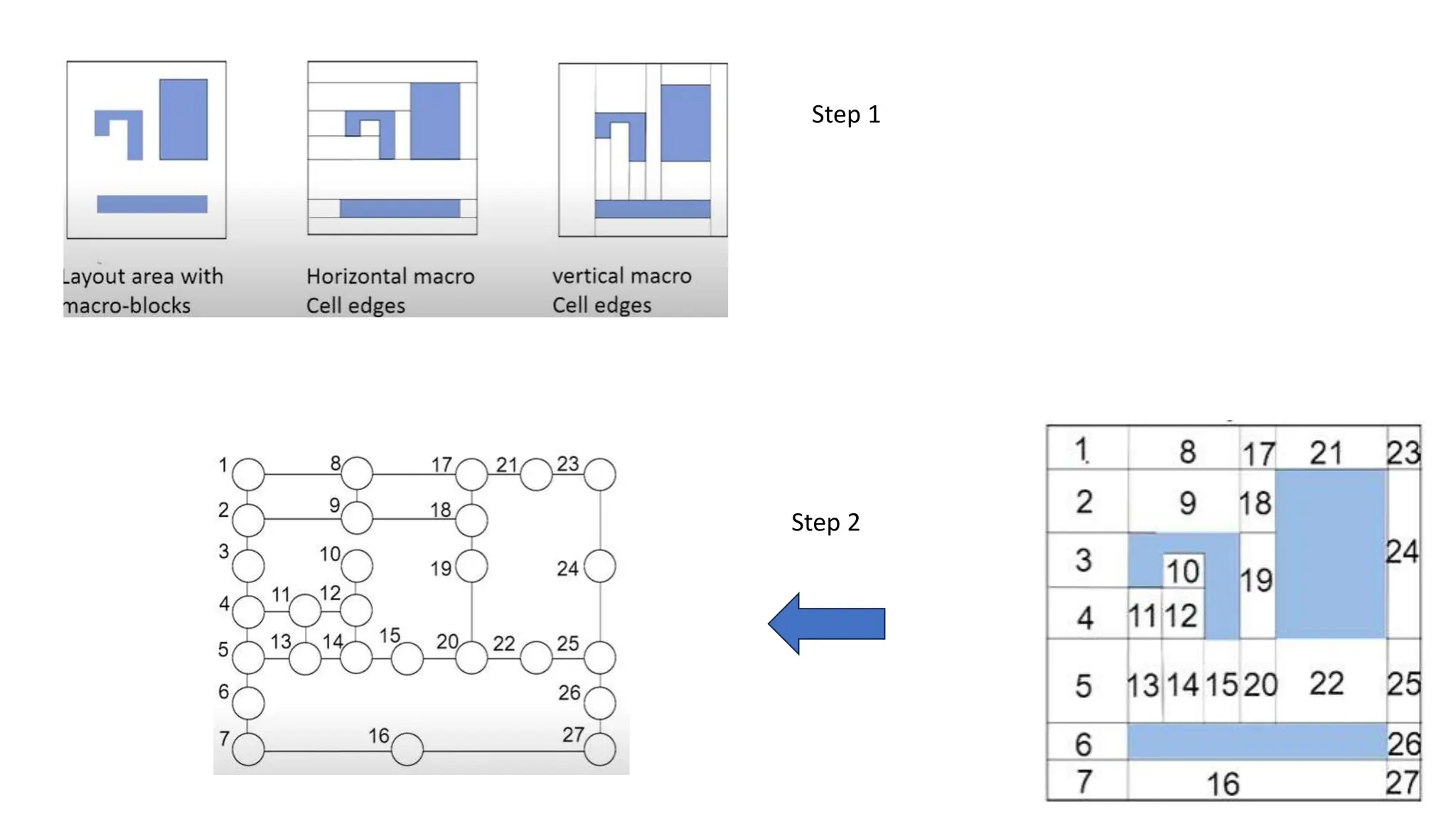
Step 1
Step 2
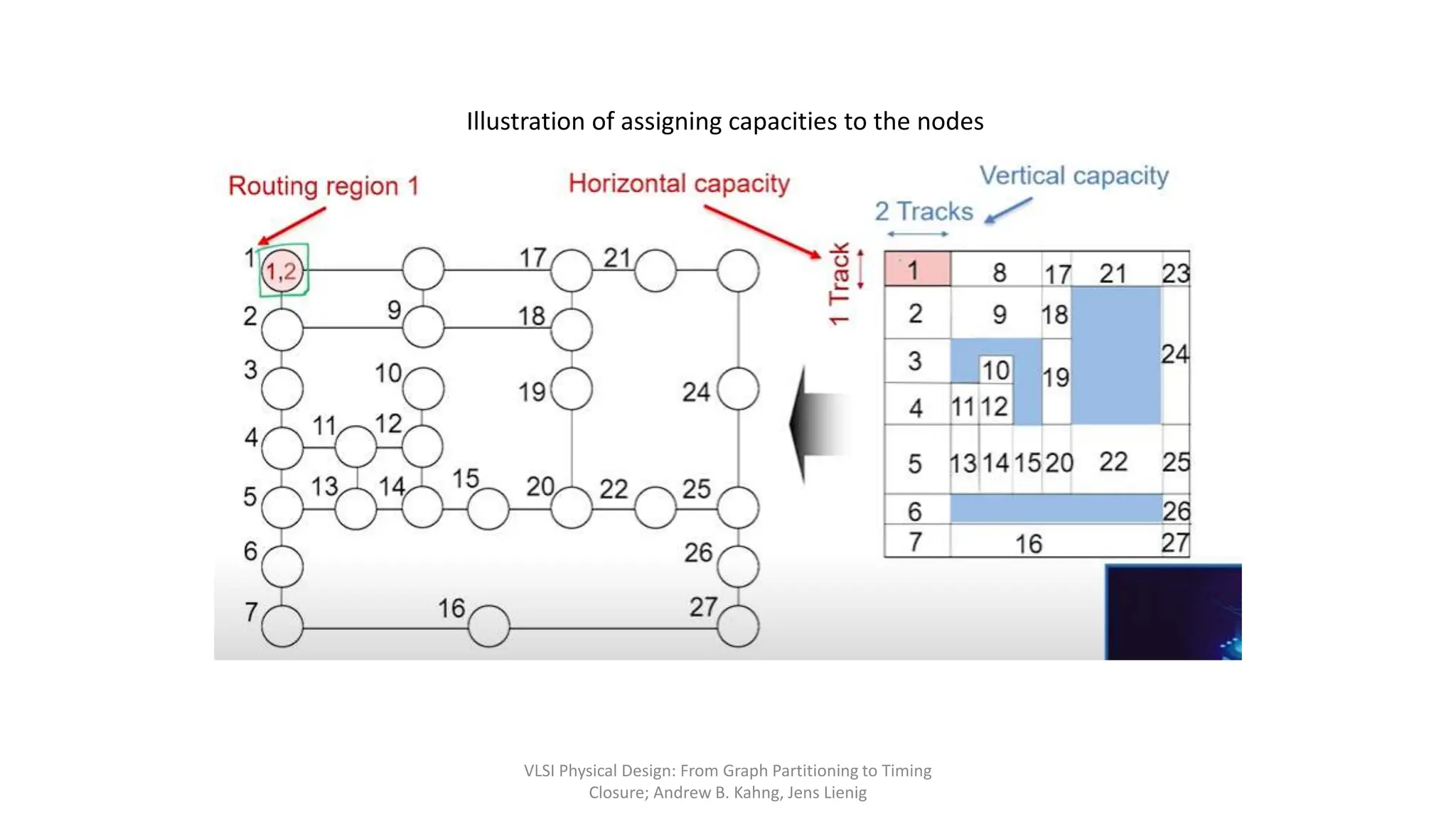
Illustration of assigning capacities to the nodes
VLSI Physical Design: From Graph Partitioning to Timing
Closure; Andrew B. Kahng, Jens Lienig
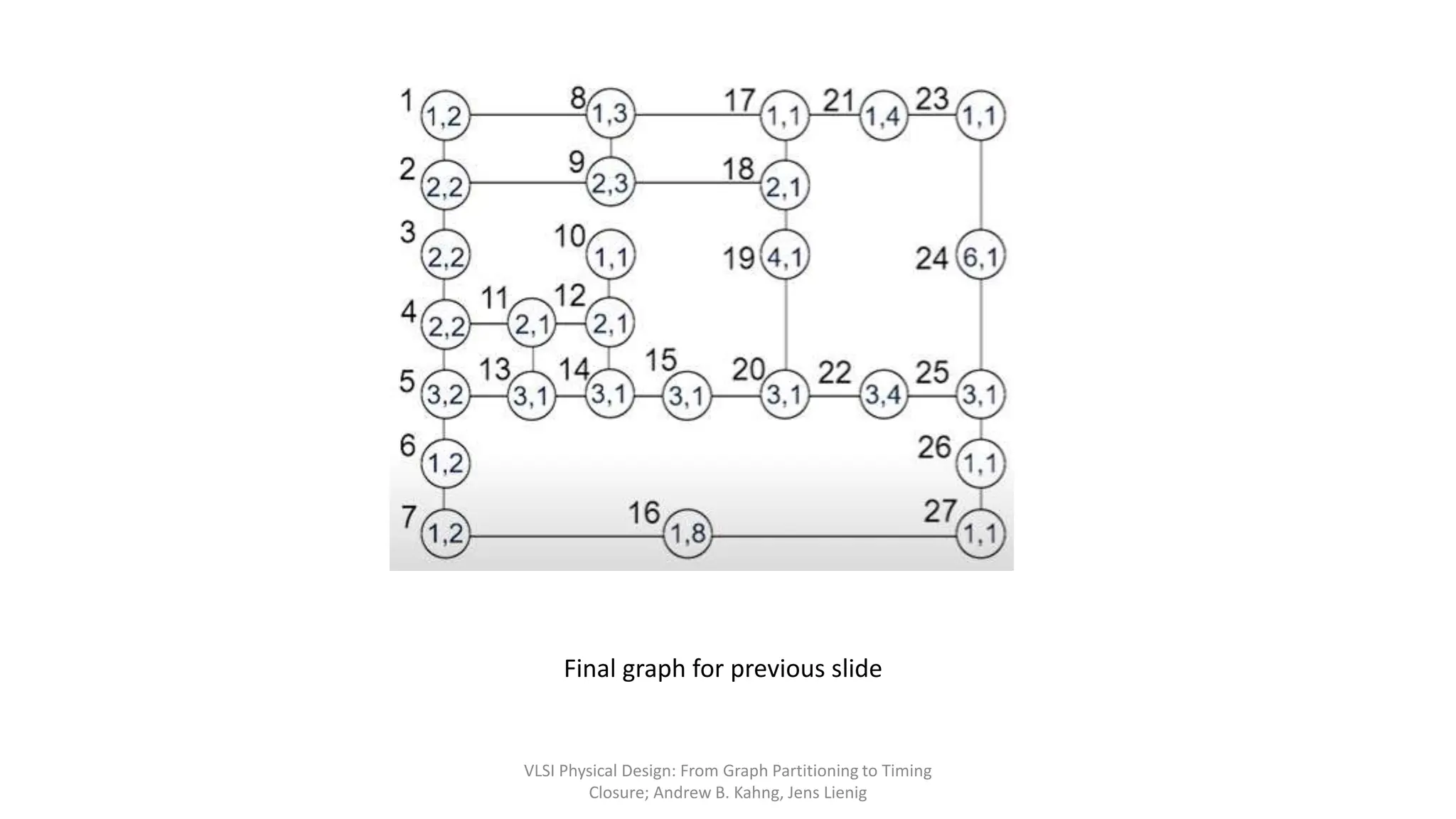
Final graph for previous slide
VLSI Physical Design: From Graph Partitioning to Timing
Closure; Andrew B. Kahng, Jens Lienig
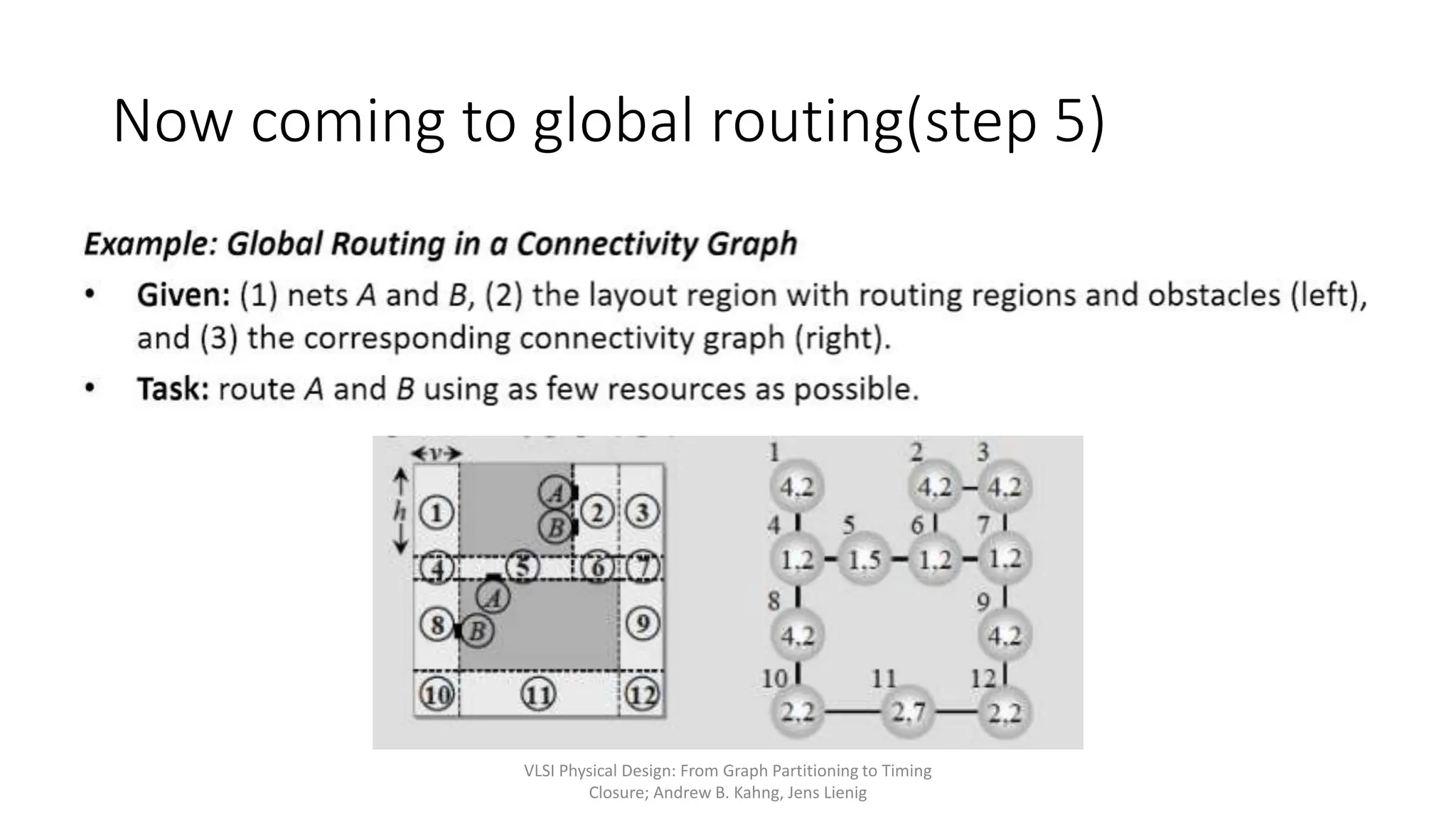
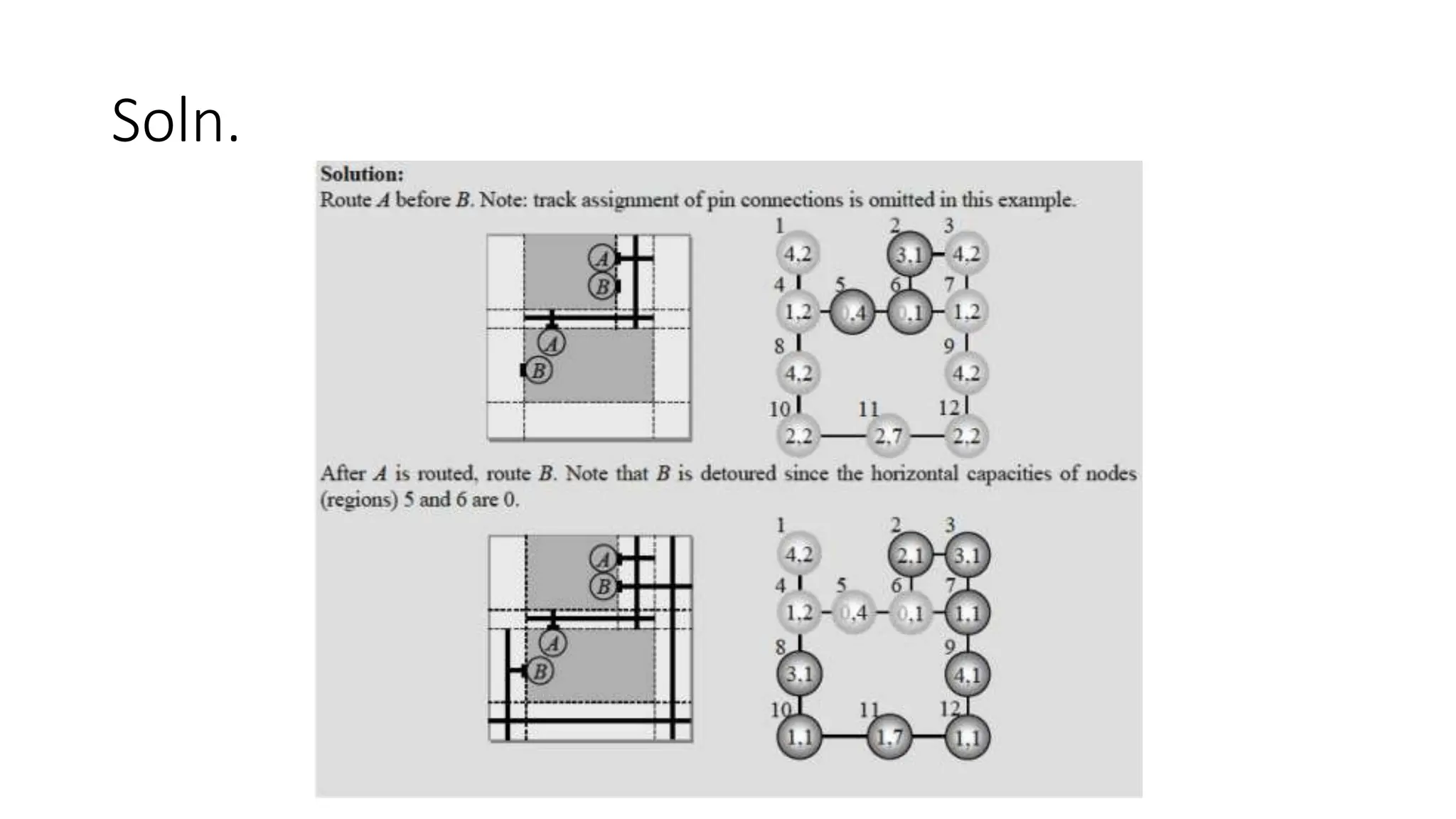
Now coming to global routing(step 5)
VLSI Physical Design: From Graph Partitioning to Timing
Closure; Andrew B. Kahng, Jens Lienig
Soln.
Try yourself
Routing by Integer Linear Programming
• A linear program of a set of constraints and an optional objective
function.
• Objective function is maximised or minimised
• Constraints and objective must be linear.
• Constraints form a system of linear equation and inequalities
• An ILP is a linear program where every variable assume integer value.
VLSI Physical Design: From Graph Partitioning to Timing
Closure; Andrew B. Kahng, Jens Lienig
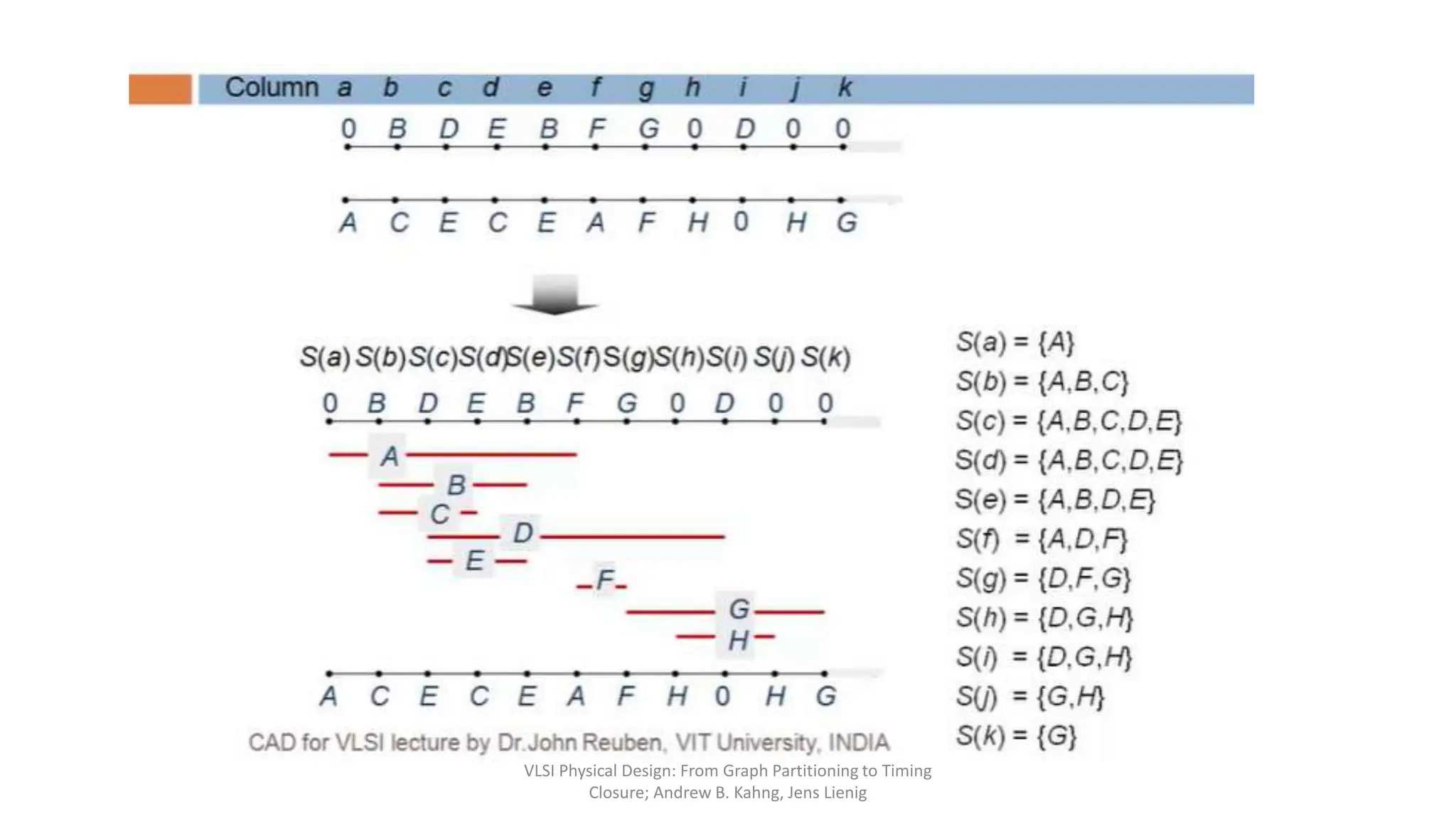
Routing by Integer Linear Programming
VLSI Physical Design: From Graph Partitioning to Timing
Closure; Andrew B. Kahng, Jens Lienig
VLSI Physical Design: From Graph Partitioning to Timing
Closure; Andrew B. Kahng, Jens Lienig
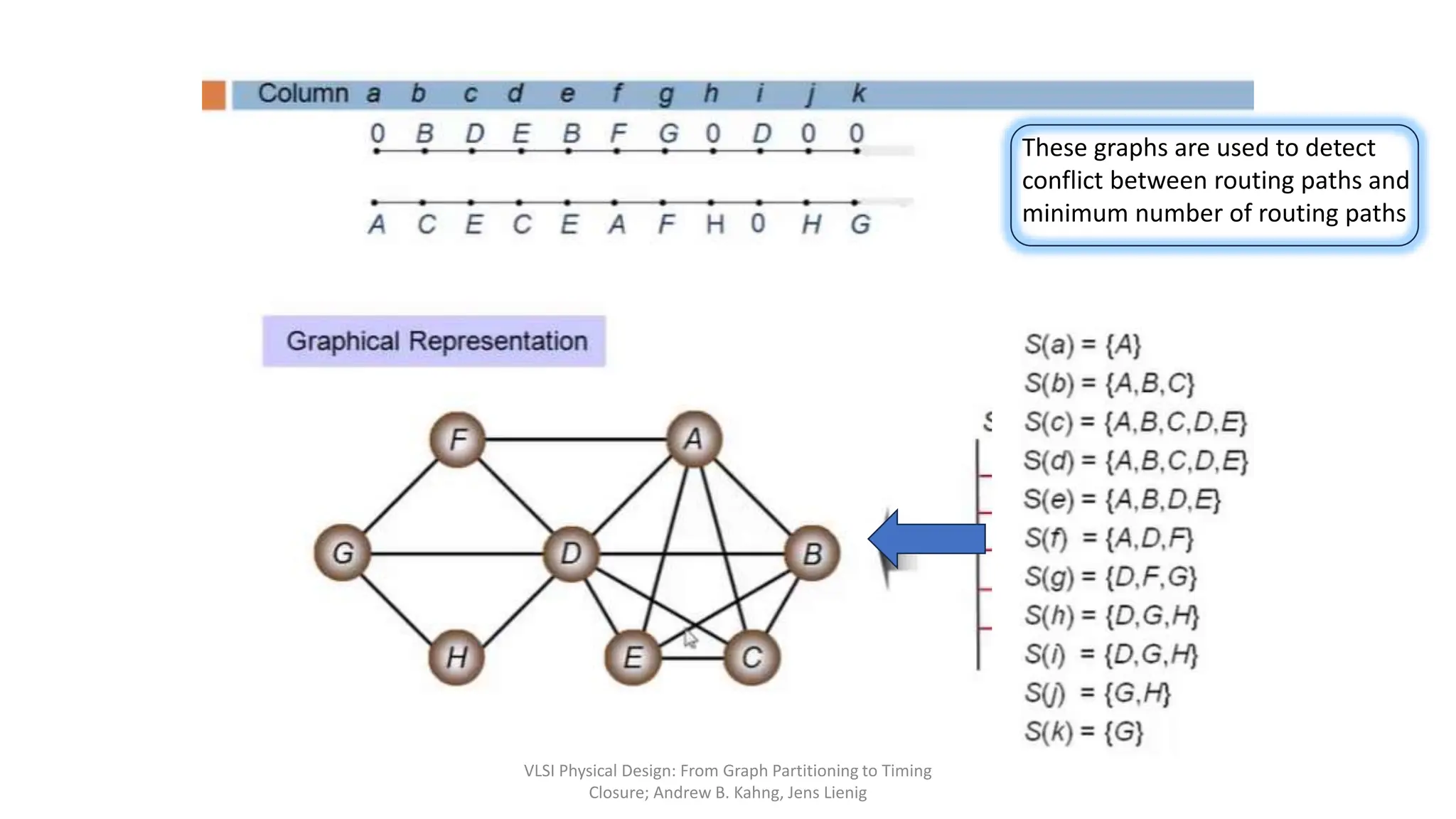
Horizontal Constraint Graph
Draw all the horizontal
Connections, each on a
Single line
VLSI Physical Design: From Graph Partitioning to Timing
Closure; Andrew B. Kahng, Jens Lienig
These graphs are used to detect
conflict between routing paths and
minimum number of routing paths
VLSI Physical Design: From Graph Partitioning to Timing
Closure; Andrew B. Kahng, Jens Lienig
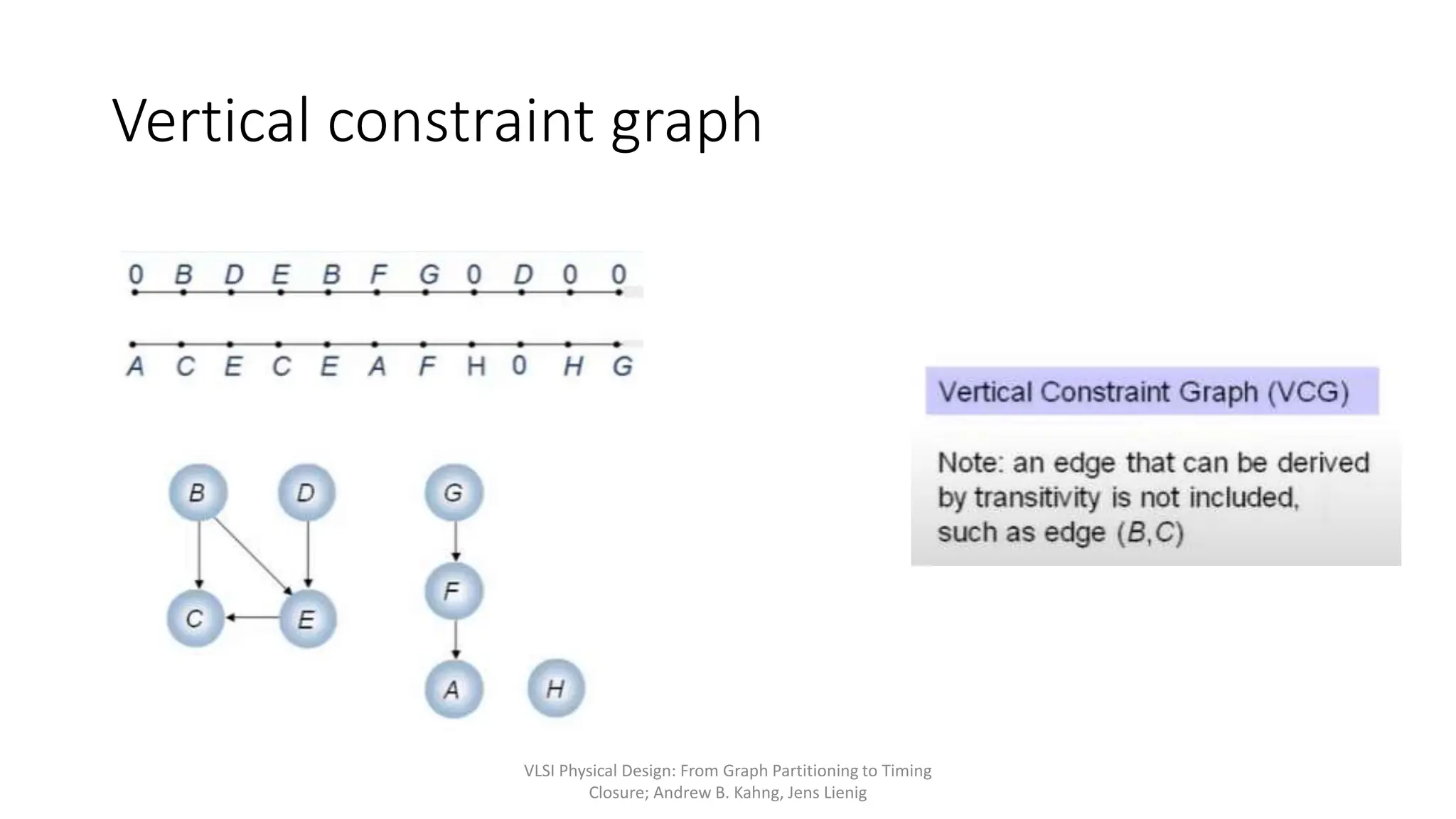
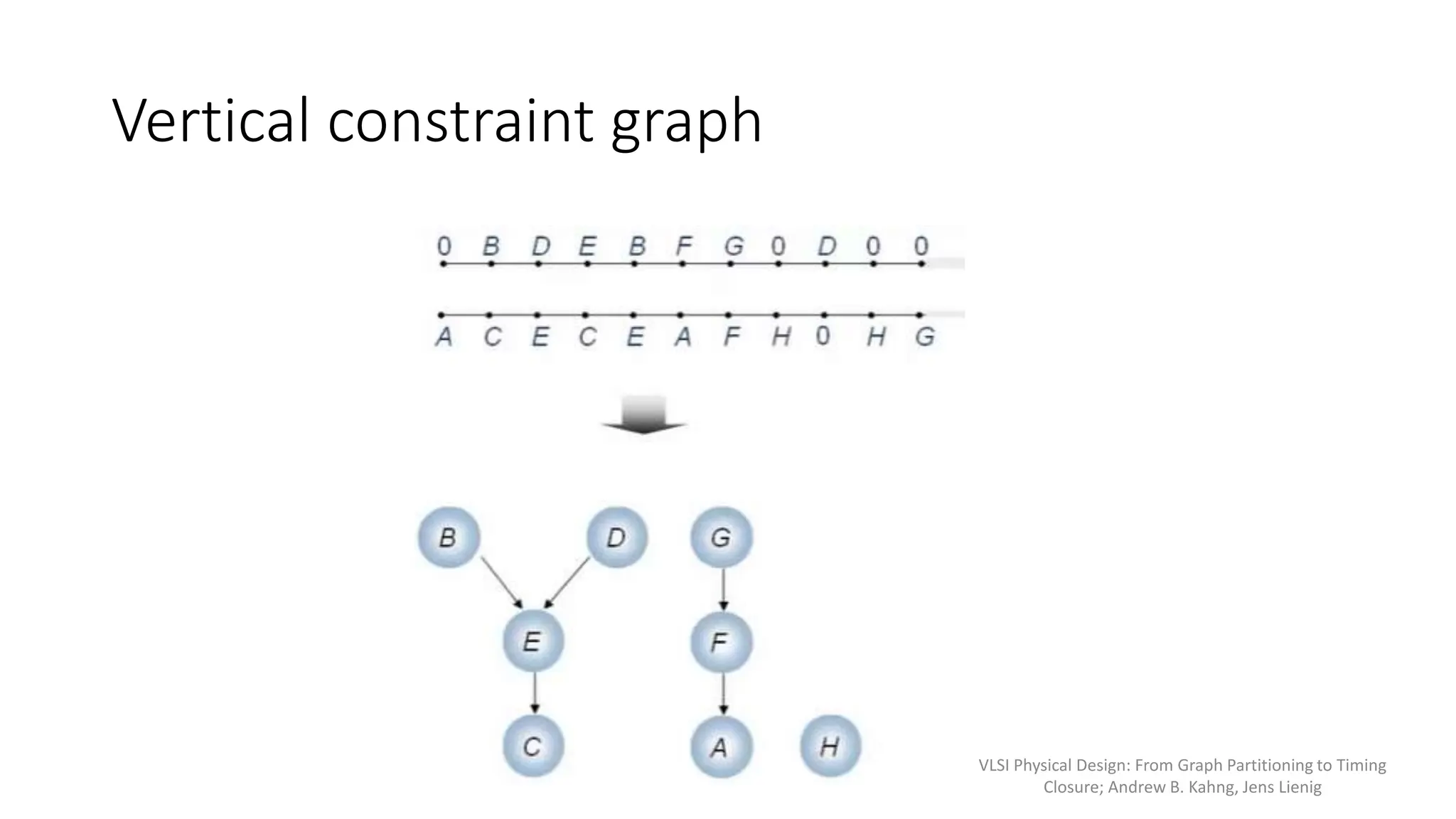
Vertical constraint graph
VLSI Physical Design: From Graph Partitioning to Timing
Closure; Andrew B. Kahng, Jens Lienig
Vertical constraint graph
VLSI Physical Design: From Graph Partitioning to Timing
Closure; Andrew B. Kahng, Jens Lienig
Vertical constraint graph
VLSI Physical Design: From Graph Partitioning to Timing
Closure; Andrew B. Kahng, Jens Lienig
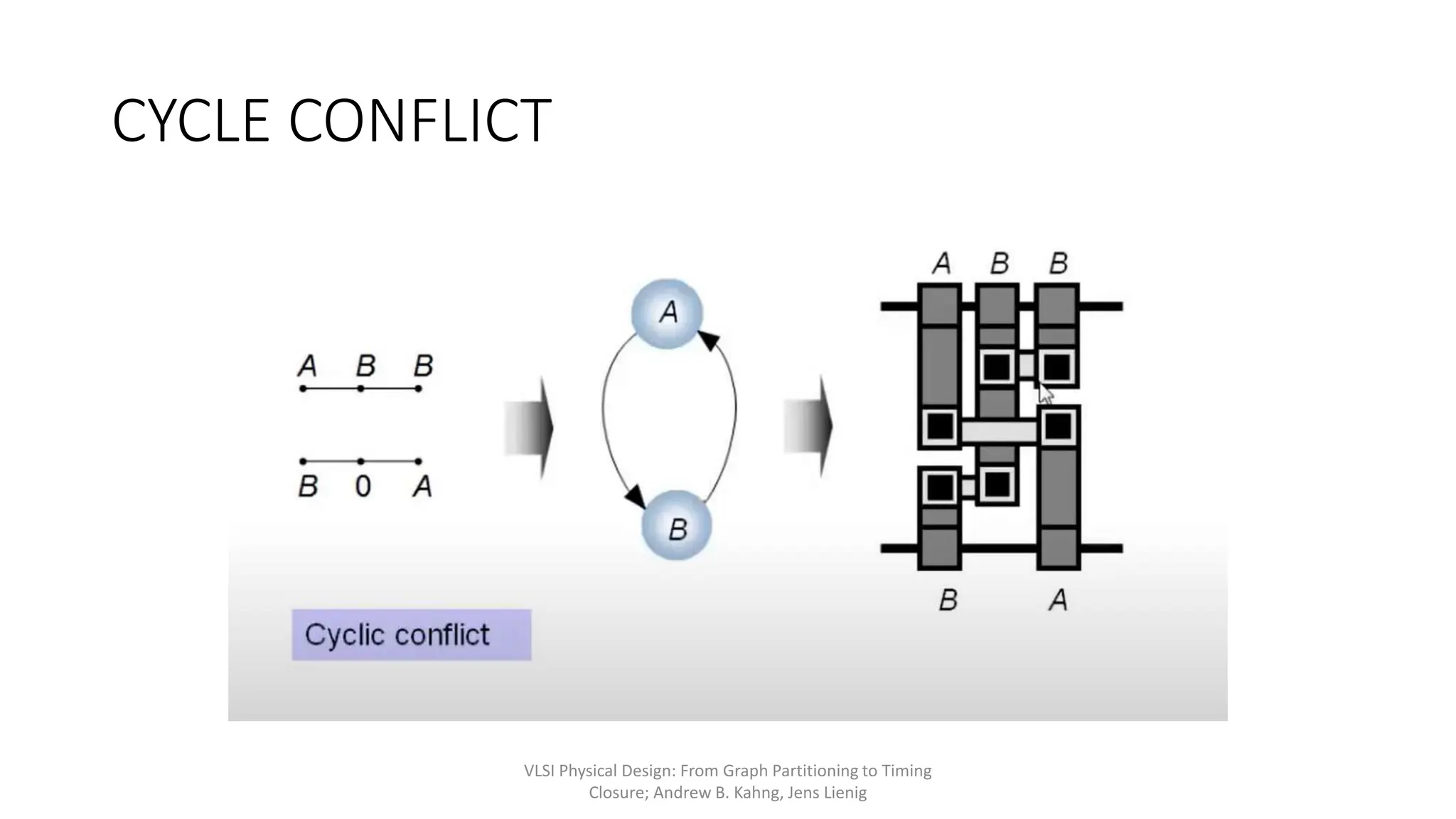
CYCLE CONFLICT
VLSI Physical Design: From Graph Partitioning to Timing
Closure; Andrew B. Kahng, Jens Lienig
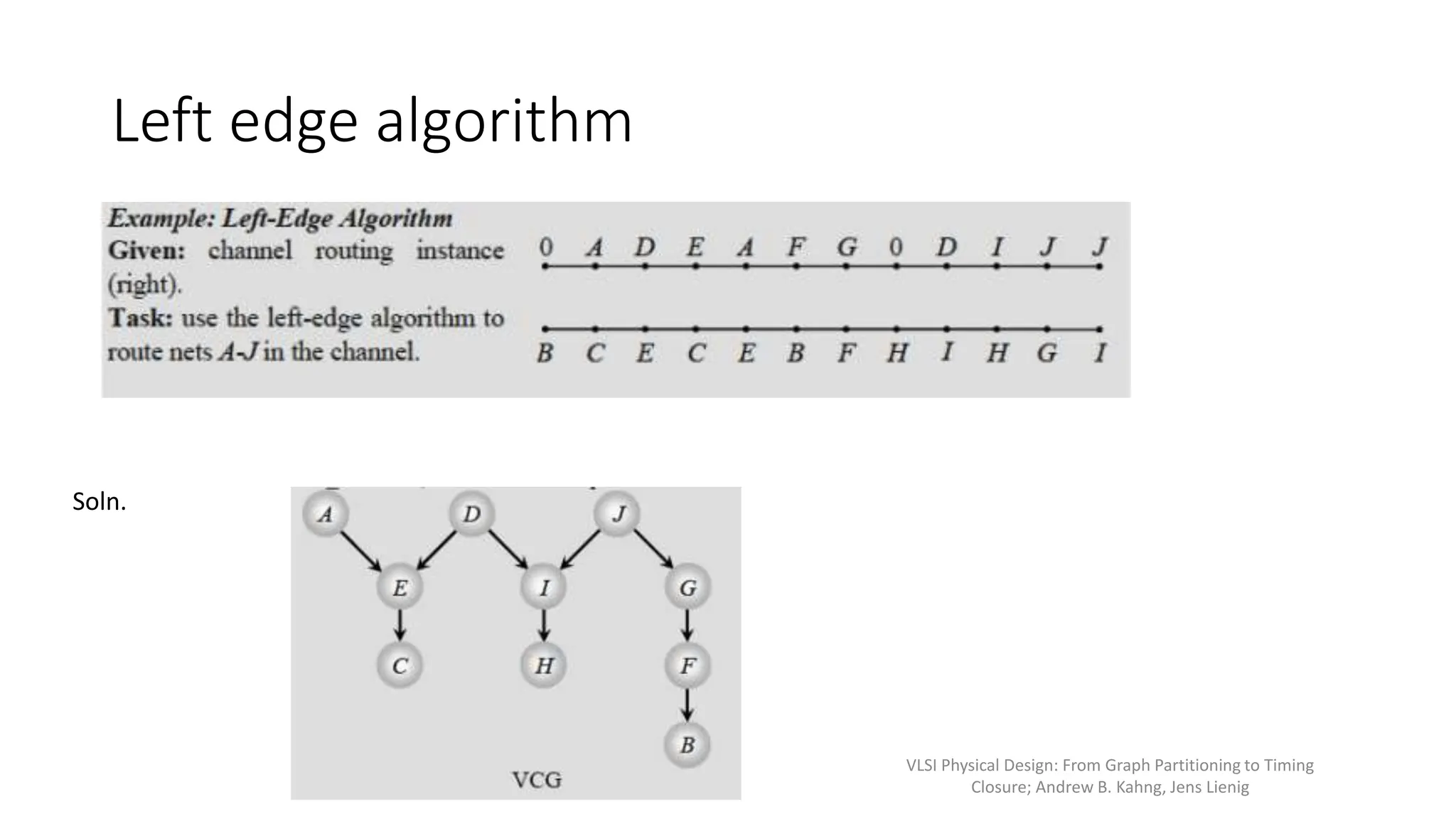
Left edge algorithm
VLSI Physical Design: From Graph Partitioning to Timing
Closure; Andrew B. Kahng, Jens Lienig
Left edge algorithm
Soln.
VLSI Physical Design: From Graph Partitioning to Timing
Closure; Andrew B. Kahng, Jens Lienig
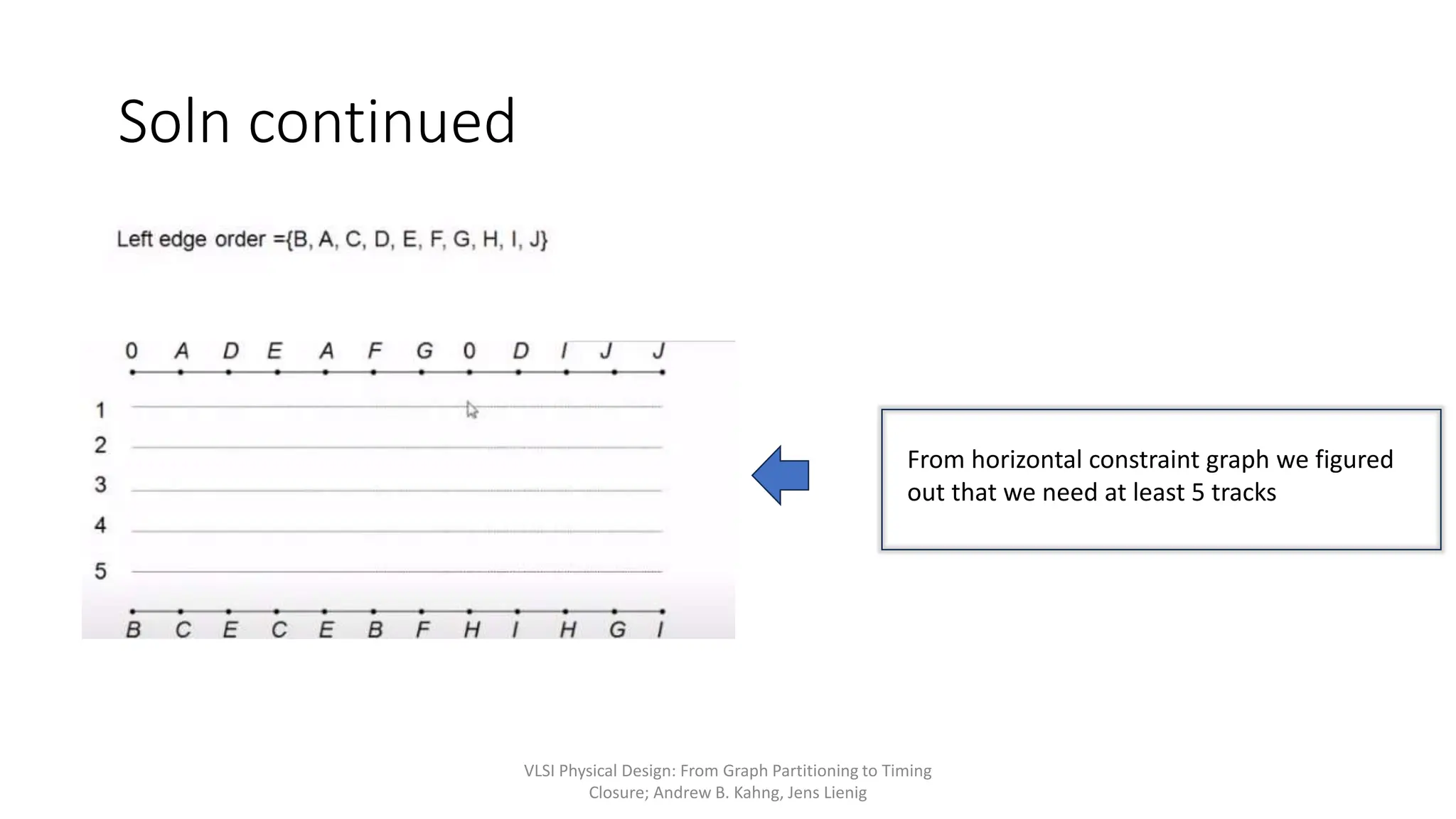
Soln continued
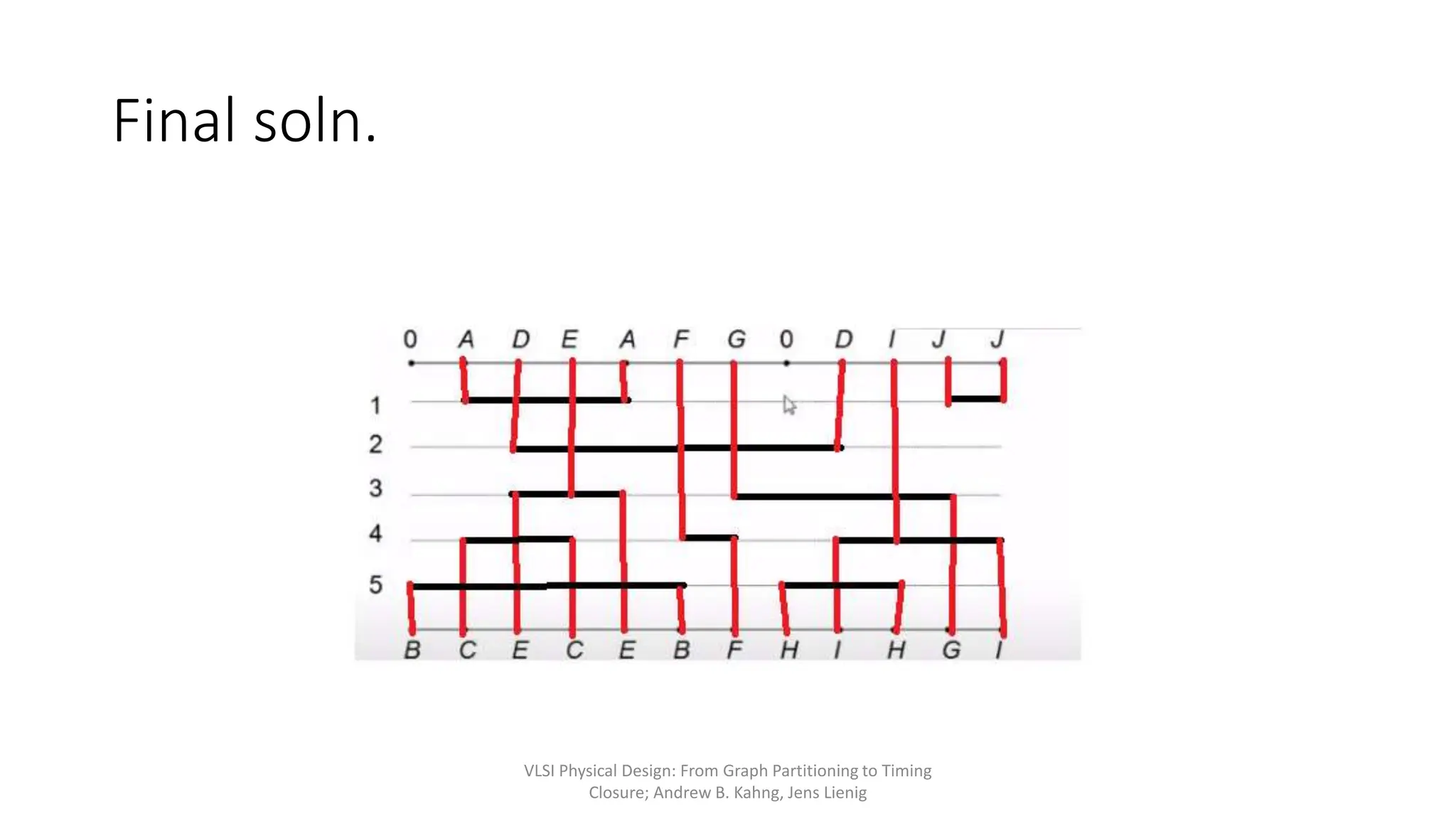
From horizontal constraint graph we figured
out that we need at least 5 tracks
VLSI Physical Design: From Graph Partitioning to Timing
Closure; Andrew B. Kahng, Jens Lienig
Final soln.
VLSI Physical Design: From Graph Partitioning to Timing
Closure; Andrew B. Kahng, Jens Lienig
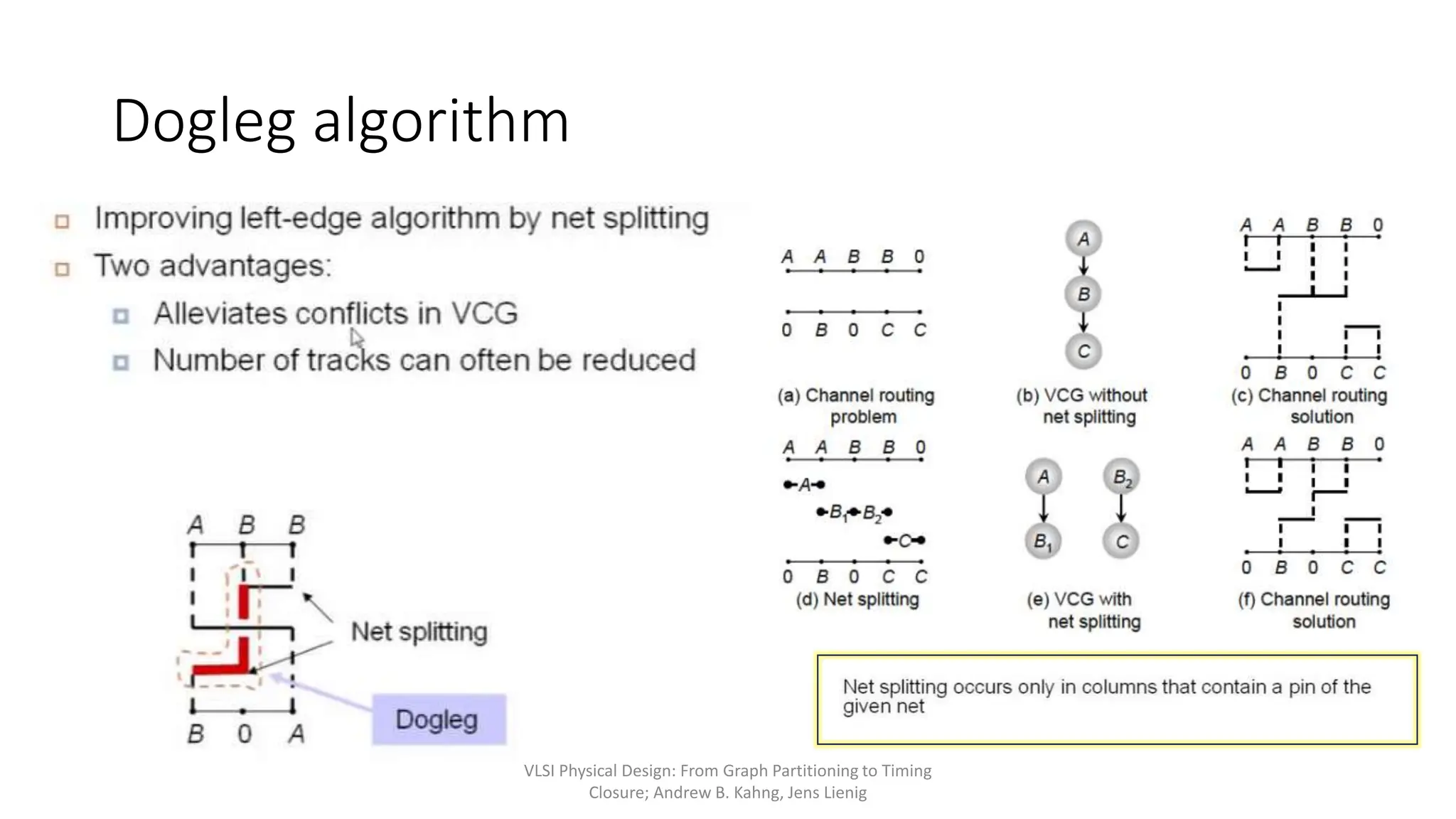
Dogleg algorithm
VLSI Physical Design: From Graph Partitioning to Timing
Closure; Andrew B. Kahng, Jens Lienig
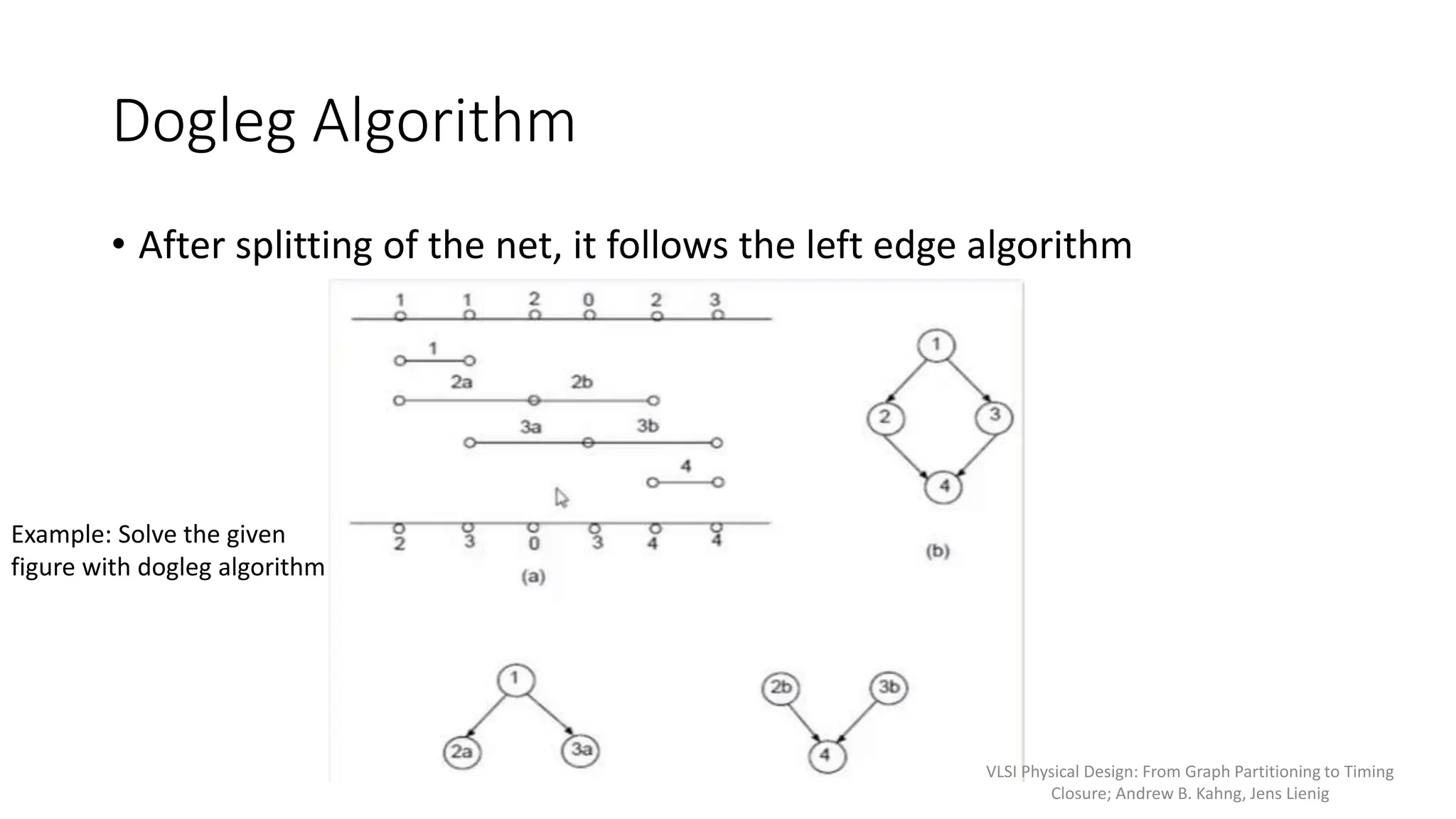
Dogleg Algorithm
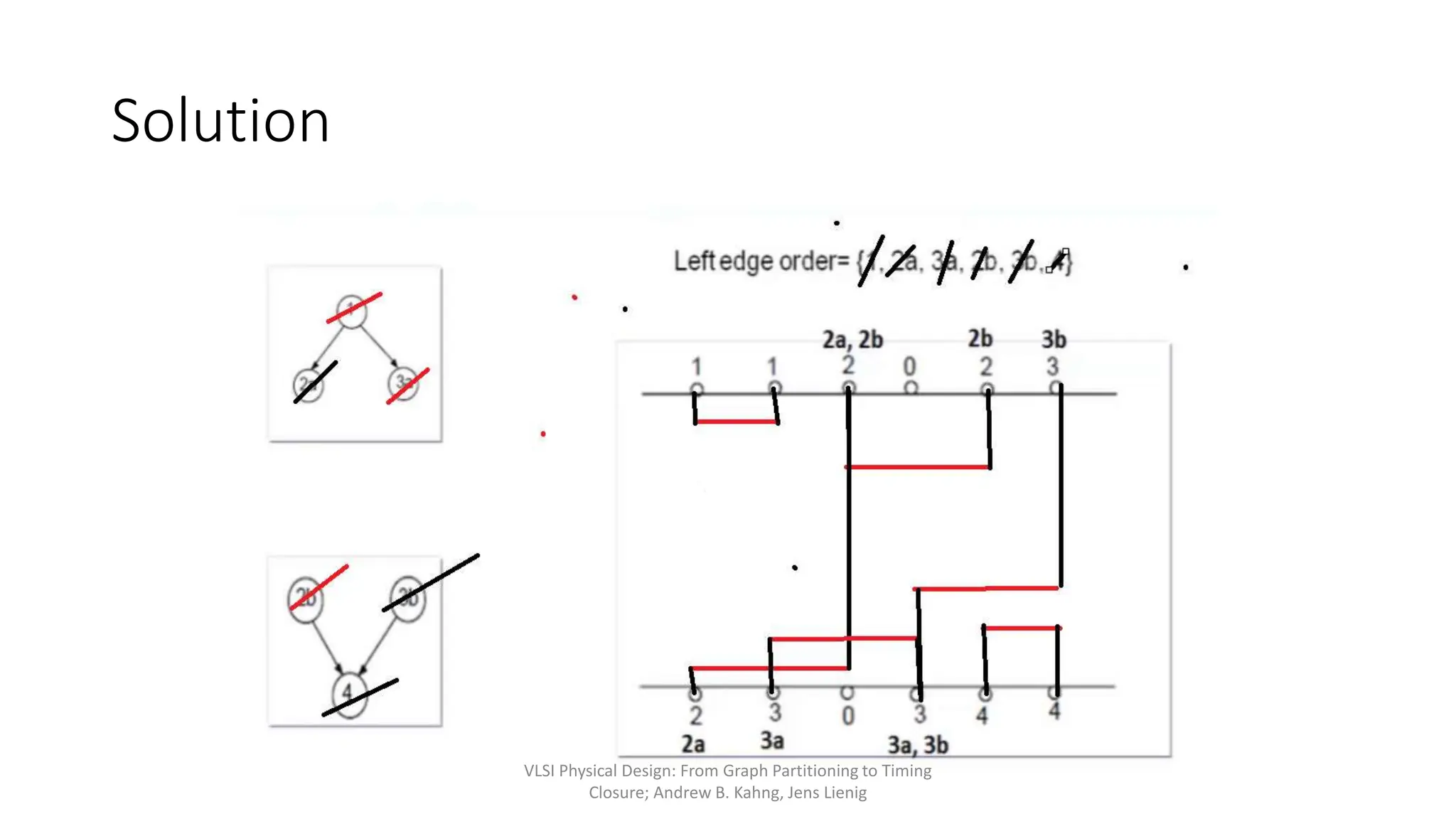
• After splitting of the net, it follows the left edge algorithm
Example: Solve the given
figure with dogleg algorithm
VLSI Physical Design: From Graph Partitioning to Timing
Closure; Andrew B. Kahng, Jens Lienig
Solution
VLSI Physical Design: From Graph Partitioning to Timing
Closure; Andrew B. Kahng, Jens Lienig
END

Routing and Algorithms For VLSI design.pptx

  • 1.
    Routing and Algorithms ByPrateek Tripathi VLSI Physical Design: From Graph Partitioning to Timing Closure; Andrew B. Kahng, Jens Lienig
  • 2.
    Basic Idea • GlobalRouting: Global routes assign nets to particular metal layers and global routing cells.in an approximate manner. • Detailed Routing: For detailed routing, the router decides the actual physical interconnections of nets by allocating wires on each metal layer and vias for switching between metal layers. VLSI Physical Design: From Graph Partitioning to Timing Closure; Andrew B. Kahng, Jens Lienig
  • 3.
    VLSI Physical Design:From Graph Partitioning to Timing Closure; Andrew B. Kahng, Jens Lienig
  • 4.
    Some points toremember • Vertical and horizontal tracks are laid out on different layers • The junctions are connected by a “via”. • There can be multiple layers of tracks depending upon the complexity of the routing problem. • As a conventional routing method we label the two or more pins with the same name to specify the program that a connection is to be form between them. VLSI Physical Design: From Graph Partitioning to Timing Closure; Andrew B. Kahng, Jens Lienig
  • 5.
    Optimization goal ofGlobal Routing • Seeks to determine whether a given placement is routable • Seeks to determine a coarse routing for all nets within available routing regions. VLSI Physical Design: From Graph Partitioning to Timing Closure; Andrew B. Kahng, Jens Lienig
  • 6.
    Grid Graph ModelIllustration VLSI Physical Design: From Graph Partitioning to Timing Closure; Andrew B. Kahng, Jens Lienig
  • 7.
    Channel connectivity graph VLSIPhysical Design: From Graph Partitioning to Timing Closure; Andrew B. Kahng, Jens Lienig 1. For horizontal channel, draw a line parallel to x-axis along the block edges which are parallel to x-axis, unless stopped by a block. 2. For vertical channel, draw a line parallel to y-axis along the block edges which are parallel to y-axis., unless stopped by a block.
  • 8.
    Switch-box VLSI Physical Design:From Graph Partitioning to Timing Closure; Andrew B. Kahng, Jens Lienig
  • 9.
    Single net routing(rectilinearrouting) then the tree is a rectilinear minimum spanning tree(RMST) VLSI Physical Design: From Graph Partitioning to Timing Closure; Andrew B. Kahng, Jens Lienig
  • 10.
    Further points • Thetotal edge length LRSMT of the RSMT is at least half the perimeter of the minimum bounding box of the net: LRSMT >= LMBB/2 VLSI Physical Design: From Graph Partitioning to Timing Closure; Andrew B. Kahng, Jens Lienig
  • 11.
    VLSI Physical Design:From Graph Partitioning to Timing Closure; Andrew B. Kahng, Jens Lienig
  • 12.
    Hanan grid VLSI PhysicalDesign: From Graph Partitioning to Timing Closure; Andrew B. Kahng, Jens Lienig • For each points draw a lines perpendicular to y and x axis which passes through the points • Mark all the intersections of those lines as Hannan points
  • 13.
    A sequential steinertree heuristic VLSI Physical Design: From Graph Partitioning to Timing Closure; Andrew B. Kahng, Jens Lienig T: Tree
  • 16.
    VLSI Physical Design:From Graph Partitioning to Timing Closure; Andrew B. Kahng, Jens Lienig
  • 17.
    Steps to globalrouting in connectivity graph • 1. Define the routing regions • 2. Define the connectivity graph • 3. Determine the net order(can be prioritised based on no. of pins, criticality, size of bounding box) • 4. Assigning tracks for all pin connections(for each pin a horizontal and a vertical track are reserved) • 5. Global routing of all nets VLSI Physical Design: From Graph Partitioning to Timing Closure; Andrew B. Kahng, Jens Lienig
  • 19.
  • 20.
    Illustration of assigningcapacities to the nodes VLSI Physical Design: From Graph Partitioning to Timing Closure; Andrew B. Kahng, Jens Lienig
  • 22.
    Final graph forprevious slide VLSI Physical Design: From Graph Partitioning to Timing Closure; Andrew B. Kahng, Jens Lienig
  • 23.
    Now coming toglobal routing(step 5) VLSI Physical Design: From Graph Partitioning to Timing Closure; Andrew B. Kahng, Jens Lienig
  • 24.
  • 25.
  • 26.
    Routing by IntegerLinear Programming • A linear program of a set of constraints and an optional objective function. • Objective function is maximised or minimised • Constraints and objective must be linear. • Constraints form a system of linear equation and inequalities • An ILP is a linear program where every variable assume integer value. VLSI Physical Design: From Graph Partitioning to Timing Closure; Andrew B. Kahng, Jens Lienig
  • 27.
    Routing by IntegerLinear Programming VLSI Physical Design: From Graph Partitioning to Timing Closure; Andrew B. Kahng, Jens Lienig
  • 28.
    VLSI Physical Design:From Graph Partitioning to Timing Closure; Andrew B. Kahng, Jens Lienig
  • 29.
    Horizontal Constraint Graph Drawall the horizontal Connections, each on a Single line
  • 30.
    VLSI Physical Design:From Graph Partitioning to Timing Closure; Andrew B. Kahng, Jens Lienig
  • 31.
    These graphs areused to detect conflict between routing paths and minimum number of routing paths VLSI Physical Design: From Graph Partitioning to Timing Closure; Andrew B. Kahng, Jens Lienig
  • 32.
    Vertical constraint graph VLSIPhysical Design: From Graph Partitioning to Timing Closure; Andrew B. Kahng, Jens Lienig
  • 33.
    Vertical constraint graph VLSIPhysical Design: From Graph Partitioning to Timing Closure; Andrew B. Kahng, Jens Lienig
  • 34.
    Vertical constraint graph VLSIPhysical Design: From Graph Partitioning to Timing Closure; Andrew B. Kahng, Jens Lienig
  • 35.
    CYCLE CONFLICT VLSI PhysicalDesign: From Graph Partitioning to Timing Closure; Andrew B. Kahng, Jens Lienig
  • 36.
    Left edge algorithm VLSIPhysical Design: From Graph Partitioning to Timing Closure; Andrew B. Kahng, Jens Lienig
  • 37.
    Left edge algorithm Soln. VLSIPhysical Design: From Graph Partitioning to Timing Closure; Andrew B. Kahng, Jens Lienig
  • 38.
    Soln continued From horizontalconstraint graph we figured out that we need at least 5 tracks VLSI Physical Design: From Graph Partitioning to Timing Closure; Andrew B. Kahng, Jens Lienig
  • 39.
    Final soln. VLSI PhysicalDesign: From Graph Partitioning to Timing Closure; Andrew B. Kahng, Jens Lienig
  • 40.
    Dogleg algorithm VLSI PhysicalDesign: From Graph Partitioning to Timing Closure; Andrew B. Kahng, Jens Lienig
  • 41.
    Dogleg Algorithm • Aftersplitting of the net, it follows the left edge algorithm Example: Solve the given figure with dogleg algorithm VLSI Physical Design: From Graph Partitioning to Timing Closure; Andrew B. Kahng, Jens Lienig
  • 42.
    Solution VLSI Physical Design:From Graph Partitioning to Timing Closure; Andrew B. Kahng, Jens Lienig
  • 43.

Editor's Notes

  • #4 Global routing: rough path are shown Detailed routing: Done after the global routing step, the horizontal routing is done in one layer and vertical in another layer. Via connection is connection between two metal layers(wires with corners) Enclosed region with pins on all four sides is called switch box
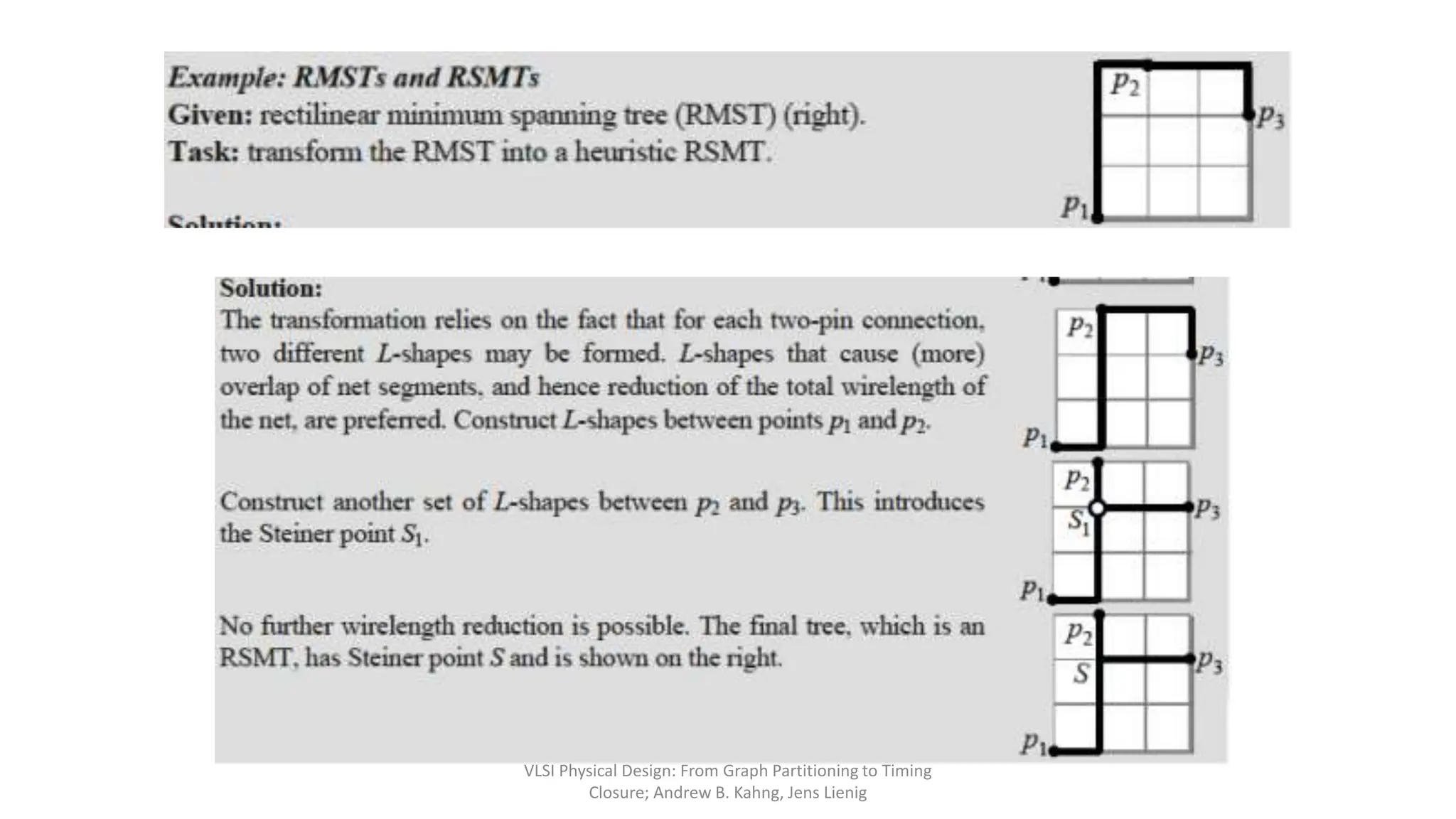
  • #12 S1 is the steiner point here Aim is to minimize data transfer between two points
  • #20 Edge contains the vertical and horizontal capacities of the routing region
  • #25 (hor,ver) whenever a hor line passes (hor-1,ver) and vice versa
  • #27 Objective function: The real-valued function whose value is to be either minimized or maximized subject to the constraints. Linear means degree is 1 When wirelength is minimized the optimization problem becomes minimization problem When speed is to be maximized then it becomes maximization problem
  • #28 Widthxheight of the routing grid
  • #31 S(d) : maximum 5 horizontal constraints. We will need at least 5 tracks to route this.
  • #33 Has directions
  • #36 WE WON’T BE SPLITTING HORIZONTAL GRAPH IN LEFT EDGE ALGO BUT IN DOG-LEG ALGO