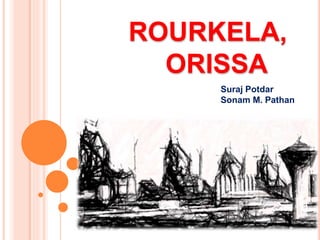
ROURKELA,
ORISSA
Suraj Potdar
Sonam M. Pathan
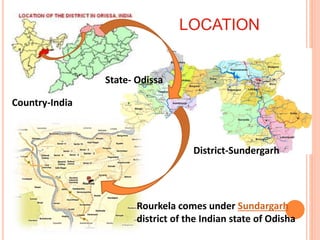
District-Sundergarh
Country-India
State- Odissa
Rourkela comes under Sundargarh
district of the Indian state of Odisha
LOCATION
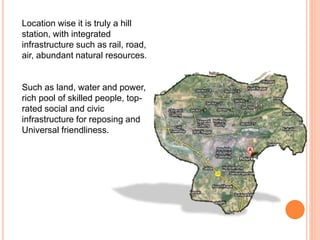
Location wise it is truly a hill
station, with integrated
infrastructure such as rail, road,
air, abundant natural resources.
Such as land, water and power,
rich pool of skilled people, top-
rated social and civic
infrastructure for reposing and
Universal friendliness.
These factors have attracted many industrialists outside the state to
choose Rourkela as their destination.
The geographical location is another blessing.
In history it has never faced any sort of natural calamity whatsoever,
except some heavy rainfall.
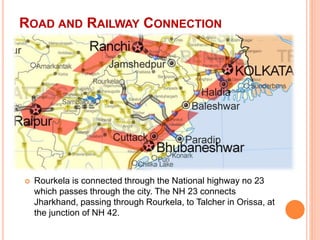
ROAD AND RAILWAY CONNECTION
 Rourkela is connected through the National highway no 23
which passes through the city. The NH 23 connects
Jharkhand, passing through Rourkela, to Talcher in Orissa, at
the junction of NH 42.
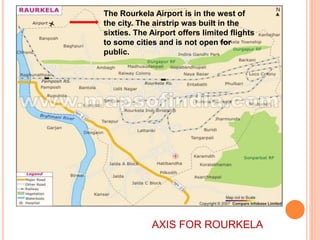
The Rourkela Airport is in the west of
the city. The airstrip was built in the
sixties. The Airport offers limited flights
to some cities and is not open for
public.
AXIS FOR ROURKELA
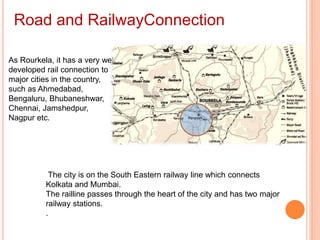
As Rourkela, it has a very well
developed rail connection to
major cities in the country,
such as Ahmedabad,
Bengaluru, Bhubaneshwar,
Chennai, Jamshedpur,
Nagpur etc.
Road and RailwayConnection
The city is on the South Eastern railway line which connects
Kolkata and Mumbai.
The railline passes through the heart of the city and has two major
railway stations.
.
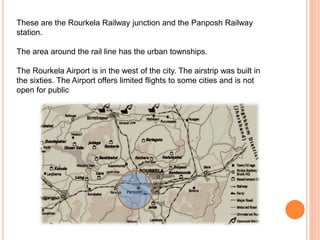
These are the Rourkela Railway junction and the Panposh Railway
station.
The area around the rail line has the urban townships.
The Rourkela Airport is in the west of the city. The airstrip was built in
the sixties. The Airport offers limited flights to some cities and is not
open for public
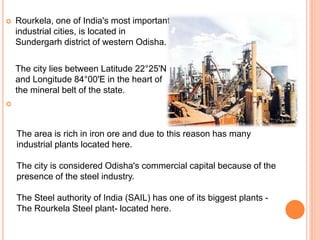
 Rourkela, one of India's most important
industrial cities, is located in
Sundergarh district of western Odisha.
The city lies between Latitude 22°25'N
and Longitude 84°00'E in the heart of
the mineral belt of the state.

The area is rich in iron ore and due to this reason has many
industrial plants located here.
The city is considered Odisha's commercial capital because of the
presence of the steel industry.
The Steel authority of India (SAIL) has one of its biggest plants -
The Rourkela Steel plant- located here.
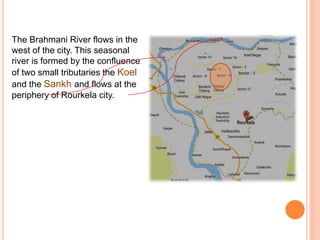
The Brahmani River flows in the
west of the city. This seasonal
river is formed by the confluence
of two small tributaries the Koel
and the Sankh and flows at the
periphery of Rourkela city.
Parts of the Rourkela city developed after the setting up of the Rourkela
steel plant here.
The old Rourkela area or Purana Rourkela including Entabatti and
Phulbari is the older part of the city .
The new parts of the city are Pamposh, Rourkela Township, and Ambagh.
The inhabited urban areas are Udit Nagar, Pamposh, Aam Bagh, Railway
Colony, and the Industrial Estate or strip.
South Rourkela is predominantly rural in areas such as Jalda ,
Lathikanta, Pikodih, Tangarpali, Tarapur.
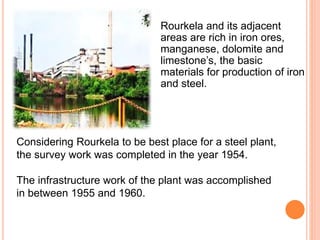
Rourkela and its adjacent
areas are rich in iron ores,
manganese, dolomite and
limestone’s, the basic
materials for production of iron
and steel.
Considering Rourkela to be best place for a steel plant,
the survey work was completed in the year 1954.
The infrastructure work of the plant was accomplished
in between 1955 and 1960.
 Besides, there are many units producing sponge
iron, cement, Refractories etc.
 Rourkela Steel Plant, a unit of SAIL is a one of the
largest steel manufacturing facilities in India.
 The town has population of all communities and
can be called a cosmopolitan town.
 it has large population of people from all religion
including Hindu, Muslim, Sikhs, Christians.
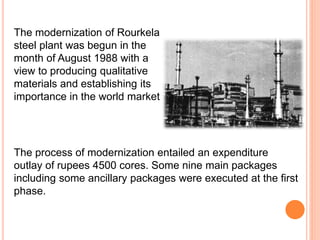
The process of modernization entailed an expenditure
outlay of rupees 4500 cores. Some nine main packages
including some ancillary packages were executed at the first
phase.
The modernization of Rourkela
steel plant was begun in the
month of August 1988 with a
view to producing qualitative
materials and establishing its
importance in the world market
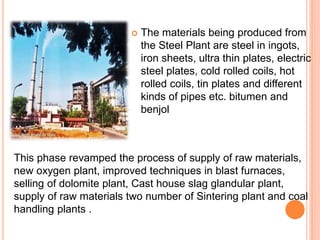
 The materials being produced from
the Steel Plant are steel in ingots,
iron sheets, ultra thin plates, electric
steel plates, cold rolled coils, hot
rolled coils, tin plates and different
kinds of pipes etc. bitumen and
benjol
This phase revamped the process of supply of raw materials,
new oxygen plant, improved techniques in blast furnaces,
selling of dolomite plant, Cast house slag glandular plant,
supply of raw materials two number of Sintering plant and coal
handling plants .
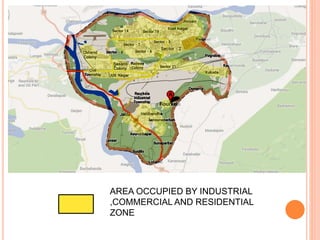
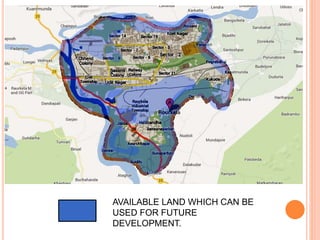
AREA OCCUPIED BY INDUSTRIAL
,COMMERCIAL AND RESIDENTIAL
ZONE
AVAILABLE LAND WHICH CAN BE
USED FOR FUTURE
DEVELOPMENT.
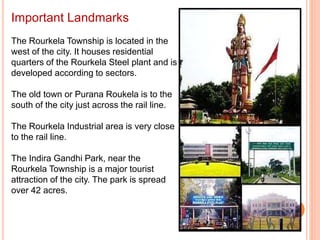
Important Landmarks
The Rourkela Township is located in the
west of the city. It houses residential
quarters of the Rourkela Steel plant and is
developed according to sectors.
The old town or Purana Roukela is to the
south of the city just across the rail line.
The Rourkela Industrial area is very close
to the rail line.
The Indira Gandhi Park, near the
Rourkela Township is a major tourist
attraction of the city. The park is spread
over 42 acres.
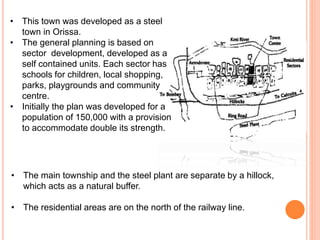
• This town was developed as a steel
town in Orissa.
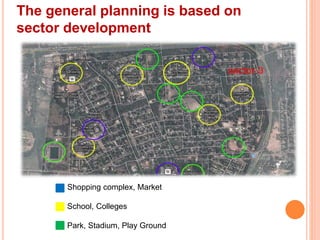
• The general planning is based on
sector development, developed as a
self contained units. Each sector has
schools for children, local shopping,
parks, playgrounds and community
centre.
• Initially the plan was developed for a
population of 150,000 with a provision
to accommodate double its strength.
• The main township and the steel plant are separate by a hillock,
which acts as a natural buffer.
• The residential areas are on the north of the railway line.
 The Rourkela Township is divided into two separate townships
under Census of India as Steel Township and Civil Township.
The Residential quarters colony of Rourkela Steel Plant having
21 sectors on record (while in reality the Sector – 10, 11 and 12
do not exist, though the area for the same is earmarked) is called
Steel Township and the other part is called Civil Township. One
smaller township Fertilizer was renamed sector-22, as this
township is within the purview of SAIL.
 The 23 kilometers long Ring Road, connecting 19 sectors and
some other parts of the steel city including old Rourkela.
 Other layouts include Civil Township, Station Road (Bus &
Railway), Koel Nagar, Panposh, Udit Nagar, Fertiliser Township,
IGH Road, Vedvyas.
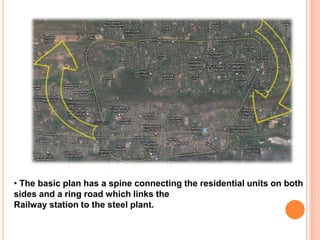
• The basic plan has a spine connecting the residential units on both
sides and a ring road which links the
Railway station to the steel plant.
Shopping complex, Market
School, Colleges
Park, Stadium, Play Ground
The general planning is based on
sector development
CONCLUSIONS
There is a difference between forced rapid change
and gradual change through an evolutionary process.
Evolutionary changes - that enable a society
to perceive the incoming change, to understand
its consequences, to accept and to welcome it -
are desirable. The imposed and rapid changes
which mostly are caused by industrialisation and
a rapid modernisation process, throw the society
into chaos: The Adivasis are not ready for that
and also are not welcome in this process.
This destroys the society, breaks its social fabric, its
economic strength, its moral strength, the spiritual as well
as the political life, and ultimately the overall ethnic
characteristics.
For these reasons, the Adivasi societies all overthe world
have been opposing such processes.
It is, therefore, necessary that the indigenous communities
are to be completely associated in the decision making
process, so that they are aware.

Rourkela architecture case study town planning

  • 1.
  • 2.
    District-Sundergarh Country-India State- Odissa Rourkela comesunder Sundargarh district of the Indian state of Odisha LOCATION
  • 3.
    Location wise itis truly a hill station, with integrated infrastructure such as rail, road, air, abundant natural resources. Such as land, water and power, rich pool of skilled people, top- rated social and civic infrastructure for reposing and Universal friendliness.
  • 4.
    These factors haveattracted many industrialists outside the state to choose Rourkela as their destination. The geographical location is another blessing. In history it has never faced any sort of natural calamity whatsoever, except some heavy rainfall.
  • 5.
    ROAD AND RAILWAYCONNECTION  Rourkela is connected through the National highway no 23 which passes through the city. The NH 23 connects Jharkhand, passing through Rourkela, to Talcher in Orissa, at the junction of NH 42.
  • 6.
    The Rourkela Airportis in the west of the city. The airstrip was built in the sixties. The Airport offers limited flights to some cities and is not open for public. AXIS FOR ROURKELA
  • 7.
    As Rourkela, ithas a very well developed rail connection to major cities in the country, such as Ahmedabad, Bengaluru, Bhubaneshwar, Chennai, Jamshedpur, Nagpur etc. Road and RailwayConnection The city is on the South Eastern railway line which connects Kolkata and Mumbai. The railline passes through the heart of the city and has two major railway stations. .
  • 8.
    These are theRourkela Railway junction and the Panposh Railway station. The area around the rail line has the urban townships. The Rourkela Airport is in the west of the city. The airstrip was built in the sixties. The Airport offers limited flights to some cities and is not open for public
  • 9.
     Rourkela, oneof India's most important industrial cities, is located in Sundergarh district of western Odisha. The city lies between Latitude 22°25'N and Longitude 84°00'E in the heart of the mineral belt of the state.  The area is rich in iron ore and due to this reason has many industrial plants located here. The city is considered Odisha's commercial capital because of the presence of the steel industry. The Steel authority of India (SAIL) has one of its biggest plants - The Rourkela Steel plant- located here.
  • 10.
    The Brahmani Riverflows in the west of the city. This seasonal river is formed by the confluence of two small tributaries the Koel and the Sankh and flows at the periphery of Rourkela city.
  • 11.
    Parts of theRourkela city developed after the setting up of the Rourkela steel plant here. The old Rourkela area or Purana Rourkela including Entabatti and Phulbari is the older part of the city . The new parts of the city are Pamposh, Rourkela Township, and Ambagh. The inhabited urban areas are Udit Nagar, Pamposh, Aam Bagh, Railway Colony, and the Industrial Estate or strip. South Rourkela is predominantly rural in areas such as Jalda , Lathikanta, Pikodih, Tangarpali, Tarapur.
  • 12.
    Rourkela and itsadjacent areas are rich in iron ores, manganese, dolomite and limestone’s, the basic materials for production of iron and steel. Considering Rourkela to be best place for a steel plant, the survey work was completed in the year 1954. The infrastructure work of the plant was accomplished in between 1955 and 1960.
  • 13.
     Besides, thereare many units producing sponge iron, cement, Refractories etc.  Rourkela Steel Plant, a unit of SAIL is a one of the largest steel manufacturing facilities in India.  The town has population of all communities and can be called a cosmopolitan town.  it has large population of people from all religion including Hindu, Muslim, Sikhs, Christians.
  • 14.
    The process ofmodernization entailed an expenditure outlay of rupees 4500 cores. Some nine main packages including some ancillary packages were executed at the first phase. The modernization of Rourkela steel plant was begun in the month of August 1988 with a view to producing qualitative materials and establishing its importance in the world market
  • 15.
     The materialsbeing produced from the Steel Plant are steel in ingots, iron sheets, ultra thin plates, electric steel plates, cold rolled coils, hot rolled coils, tin plates and different kinds of pipes etc. bitumen and benjol This phase revamped the process of supply of raw materials, new oxygen plant, improved techniques in blast furnaces, selling of dolomite plant, Cast house slag glandular plant, supply of raw materials two number of Sintering plant and coal handling plants .
  • 16.
    AREA OCCUPIED BYINDUSTRIAL ,COMMERCIAL AND RESIDENTIAL ZONE
  • 17.
    AVAILABLE LAND WHICHCAN BE USED FOR FUTURE DEVELOPMENT.
  • 18.
    Important Landmarks The RourkelaTownship is located in the west of the city. It houses residential quarters of the Rourkela Steel plant and is developed according to sectors. The old town or Purana Roukela is to the south of the city just across the rail line. The Rourkela Industrial area is very close to the rail line. The Indira Gandhi Park, near the Rourkela Township is a major tourist attraction of the city. The park is spread over 42 acres.
  • 19.
    • This townwas developed as a steel town in Orissa. • The general planning is based on sector development, developed as a self contained units. Each sector has schools for children, local shopping, parks, playgrounds and community centre. • Initially the plan was developed for a population of 150,000 with a provision to accommodate double its strength. • The main township and the steel plant are separate by a hillock, which acts as a natural buffer. • The residential areas are on the north of the railway line.
  • 20.
     The RourkelaTownship is divided into two separate townships under Census of India as Steel Township and Civil Township. The Residential quarters colony of Rourkela Steel Plant having 21 sectors on record (while in reality the Sector – 10, 11 and 12 do not exist, though the area for the same is earmarked) is called Steel Township and the other part is called Civil Township. One smaller township Fertilizer was renamed sector-22, as this township is within the purview of SAIL.  The 23 kilometers long Ring Road, connecting 19 sectors and some other parts of the steel city including old Rourkela.  Other layouts include Civil Township, Station Road (Bus & Railway), Koel Nagar, Panposh, Udit Nagar, Fertiliser Township, IGH Road, Vedvyas.
  • 21.
    • The basicplan has a spine connecting the residential units on both sides and a ring road which links the Railway station to the steel plant.
  • 22.
    Shopping complex, Market School,Colleges Park, Stadium, Play Ground The general planning is based on sector development
  • 23.
    CONCLUSIONS There is adifference between forced rapid change and gradual change through an evolutionary process. Evolutionary changes - that enable a society to perceive the incoming change, to understand its consequences, to accept and to welcome it - are desirable. The imposed and rapid changes which mostly are caused by industrialisation and a rapid modernisation process, throw the society into chaos: The Adivasis are not ready for that and also are not welcome in this process.
  • 24.
    This destroys thesociety, breaks its social fabric, its economic strength, its moral strength, the spiritual as well as the political life, and ultimately the overall ethnic characteristics. For these reasons, the Adivasi societies all overthe world have been opposing such processes. It is, therefore, necessary that the indigenous communities are to be completely associated in the decision making process, so that they are aware.