1 | P a g e
Chapter 1: Introduction
1.1 Backgroundof the study
The Bhairab, which is considered to be of older origin its parent river the Jalangi, takes off
from that river at a point, a few miles north of Karimpur (in West Bengal). After a tortuous
course towards the south it turns to the east forming the boundary line
between Meherpur P.S. (Bangladesh) and Karimpur (India) for a short distance and then
turning south enters Meherpur P.S. and flows past Meherpur town to the south and loses itself
in the Mathabhanga close to the east of Kapashdanga. Its intake from the Jalangi having silted
up, this river has been practically dead since long. The poor climate of Meherpur, which lies
upon its bank, is in great measure attributed to the stagnancy of its water. The settlement
alongside river are not urbanized yet, moreover maximum commercial and industrial
infrastructures are not technologically developed. The drainage systems are not provided until
development of the settlement. So, the study area is occupied with different types of arising
problems on the basis of the needs of the locality.
To find out the solution of this rising problems this study is needed.
2 | P a g e
1.2 Study area
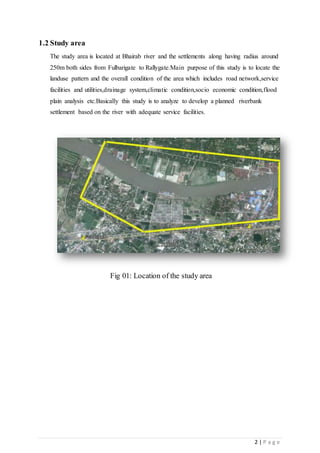
The study area is located at Bhairab river and the settlements along having radius around
250m both sides from Fulbarigate to Rallygate.Main purpose of this study is to locate the
landuse pattern and the overall condition of the area which includes road network,service
facilities and utilities,drainage system,climatic condition,socio economic condition,flood
plain analysis etc.Basically this study is to analyze to develop a planned riverbank
settlement based on the river with adequate service facilities.
Fig 01: Location of the study area
3 | P a g e
Chapter 2: Methodology
A methodology is the set of methods or steps of a process by which the study will be done.
This study is done by a well arranged methodology by which the goals can be achieved. The
study was done in a certain order.
2.1 Site Selection:
The site was selected at Ralligate by our course teachers. This site is selected as it was one of
the significant sites having both commercial, residential and also industrial uses. The
riverbank sides are mostly using as commercial purposes. Moreover, there are some residents
nearby industries locating around river.
2.2 Preparationof Questionnaire:
A questionnaire was made to collect the data. For this at first a primary survey was done in
which information were gathered from few number of local people belonging with the
locality. Based upon the assumption of the situation the questionnaire was made.
2.3 Questionnaire Survey
 A questionnaire survey was carried out in order to investigate the current condition of
the riverbank settlements.
 10 people were asked the questions about demographic measures –the availability of
utility and services, water supply, electric supply, waste management system, health
and sanitation services etc.
 The answers are used to analyze the current problems and their solutions.
2.4 Analysis
From the gathered data an analysis was carried out. From this analysis the problems were
found out.
4 | P a g e
2.5 Alternatives
On basis of the analysis and findings some alternatives were developed.
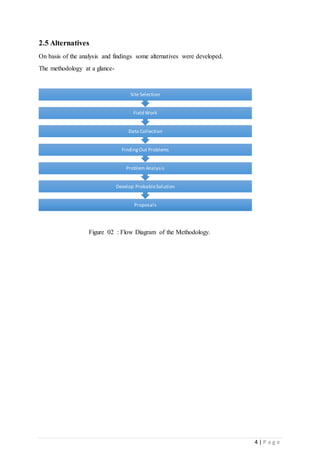
The methodology at a glance-
Figure 02 : Flow Diagram of the Methodology.
Proposals
Develop ProbableSolution
Problem Analysis
FindingOut Problems
Data Collection
Field Work
Site Selection
5 | P a g e
Chapter 3: Data Analysis
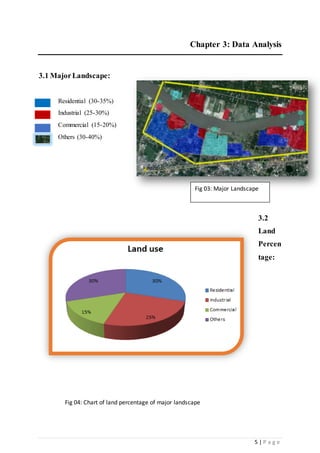
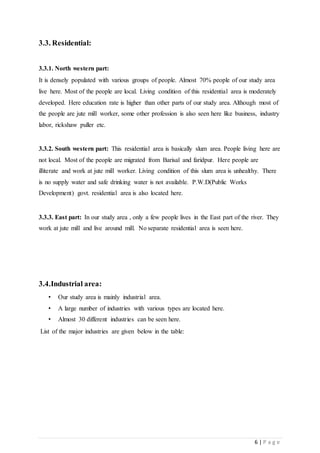
3.1 MajorLandscape:
Residential (30-35%)
Industrial (25-30%)
Commercial (15-20%)
Others (30-40%)
3.2
Land
Percen
tage:
Fig 03: Major Landscape
Fig 04: Chart of land percentage of major landscape
6 | P a g e
3.3. Residential:
3.3.1. North western part:
It is densely populated with various groups of people. Almost 70% people of our study area
live here. Most of the people are local. Living condition of this residential area is moderately
developed. Here education rate is higher than other parts of our study area. Although most of
the people are jute mill worker, some other profession is also seen here like business, industry
labor, rickshaw puller etc.
3.3.2. South western part: This residential area is basically slum area. People living here are
not local. Most of the people are migrated from Barisal and faridpur. Here people are
illiterate and work at jute mill worker. Living condition of this slum area is unhealthy. There
is no supply water and safe drinking water is not available. P.W.D(Public Works
Development) govt. residential area is also located here.
3.3.3. East part: In our study area , only a few people lives in the East part of the river. They
work at jute mill and live around mill. No separate residential area is seen here.
3.4.Industrial area:
• Our study area is mainly industrial area.
• A large number of industries with various types are located here.
• Almost 30 different industries can be seen here.
List of the major industries are given below in the table:
7 | P a g e
Table 01:List of Major industries
Type Name
1. Jute mill  Sha nawaj jute mill
 Sagor jute mill
 Mondol jute mill
 Star jute mill
 M/s co Amzad hossain jute mill etc.
2. Jute press  Dhaka trading house Ltd.
 Faridpur jute press
 Hazrat sha candropuri jute press
 Reza jute traders
 Salam jute traders etc.
3. Brick industry  New S.R brick industry
4. Fish processing  Digholia mothsow hachary Ltd.
5. Saw mill  Vi-Vi saw mill
6. Others  Nordic wood Limited
 Anser flour mill
3.5. Image of some important industries:
3.5.1. Jute mil:
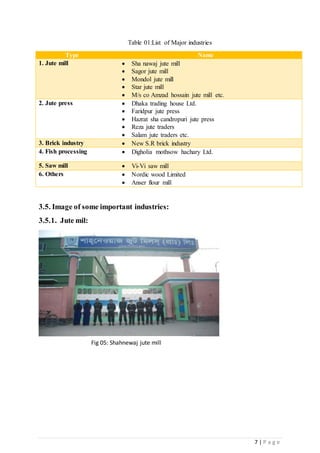
Fig 05: Shahnewaj jute mill
8 | P a g e
3.5.2. Jute press:
3.5.3. Brick industry:
3.5.4. Fishprocessing:
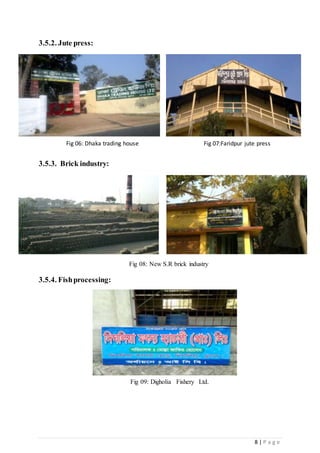
Fig 06: Dhaka trading house
Ltd.
Fig 07:Faridpur jute press
Fig 08: New S.R brick industry
Fig 09: Digholia Fishery Ltd.
9 | P a g e
3.5.5. Saw mill :
3.5.6. Others:
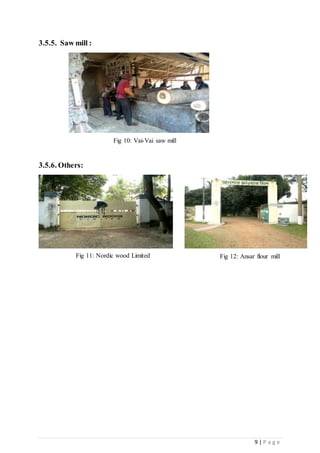
Fig 10: Vai-Vai saw mill
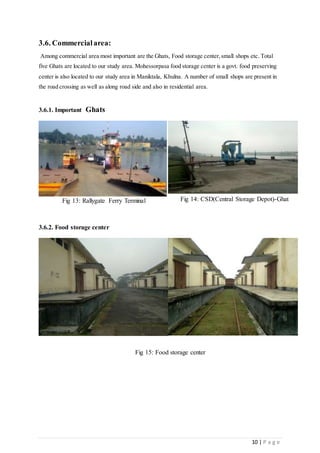
Fig 11: Nordic wood Limited Fig 12: Ansar flour mill
10 | P a g e
3.6. Commercialarea:
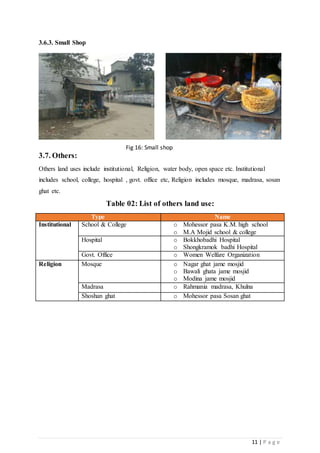
Among commercial area most important are the Ghats, Food storage center,small shops etc. Total
five Ghats are located to our study area. Mohessorpasa food storage center is a govt. food preserving
center is also located to our study area in Maniktala, Khulna. A number of small shops are present in
the road crossing as well as along road side and also in residential area.
3.6.1. Important Ghats
3.6.2. Food storage center
Fig 13: Rallygate Ferry Terminal Fig 14: CSD(Central Storage Depot)-Ghat
Fig 15: Food storage center
11 | P a g e
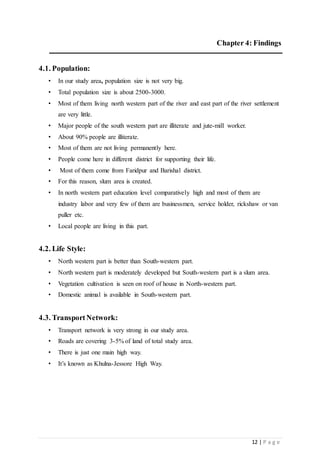
3.6.3. Small Shop
3.7. Others:
Others land uses include institutional, Religion, water body, open space etc. Institutional
includes school, college, hospital , govt. office etc, Religion includes mosque, madrasa, sosan
ghat etc.
Table 02: List of others land use:
Type Name
Institutional School & College o Mohessor pasa K.M. high school
o M.A Mojid school & college
Hospital o Bokkhobadhi Hospital
o Shongkramok badhi Hospital
Govt. Office o Women Welfare Organization
Religion Mosque o Nagar ghat jame mosjid
o Bawali ghata jame mosjid
o Modina jame mosjid
Madrasa o Rahmania madrasa, Khulna
Shoshan ghat o Mohessor pasa Sosan ghat
Fig 16: Small shop
12 | P a g e
Chapter 4: Findings
4.1. Population:
• In our study area, population size is not very big.
• Total population size is about 2500-3000.
• Most of them living north western part of the river and east part of the river settlement
are very little.
• Major people of the south western part are illiterate and jute-mill worker.
• About 90% people are illiterate.
• Most of them are not living permanently here.
• People come here in different district for supporting their life.
• Most of them come from Faridpur and Barishal district.
• For this reason, slum area is created.
• In north western part education level comparatively high and most of them are
industry labor and very few of them are businessmen, service holder, rickshaw or van
puller etc.
• Local people are living in this part.
4.2. Life Style:
• North western part is better than South-western part.
• North western part is moderately developed but South-western part is a slum area.
• Vegetation cultivation is seen on roof of house in North-western part.
• Domestic animal is available in South-western part.
4.3. Transport Network:
• Transport network is very strong in our study area.
• Roads are covering 3-5% of land of total study area.
• There is just one main high way.
• It’s known as Khulna-Jessore High Way.
13 | P a g e
4.4. RoadClassification:
Three types of road are seen there. There are:-
1. Primary Road
2. Secondary Road
3. Tertiary Road
Besides residential areas and industry, we can see footpath.
4.5. RoadCondition:
• Primary road condition is moderately better & smooth.
• Secondary and Tertiary roads are linked by Primary road.
• But people face various troubles because of poor condition of secondary and tertiary
road.
• Primary road width is minimum 6-7 m.
• Secondary road width is 3.5 m but standard width is about 5 m.
• Tertiary road width is minimum 1.8 m.
• So, almost all roads are very narrow.
4.6. Traffic:
• Our study area is industry based. So, high loaded trucks are seen here every time.
• Without truck, we can see some other vehicles like van, bi-cycle, rickshaw, motor-
cycle etc.
4.7. River Condition :
• Decreases flow of water
• Pollutes river water
• Increases river bank erosion
• Decreases fishes and other.
14 | P a g e
4.8. FloodPlain :
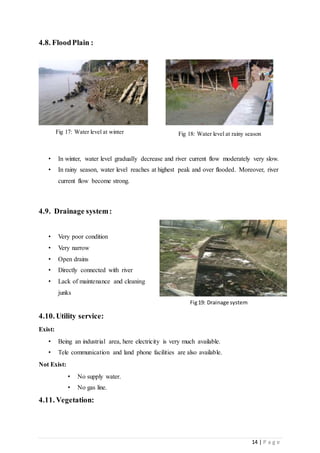
• In winter, water level gradually decrease and river current flow moderately very slow.
• In rainy season, water level reaches at highest peak and over flooded. Moreover, river
current flow become strong.
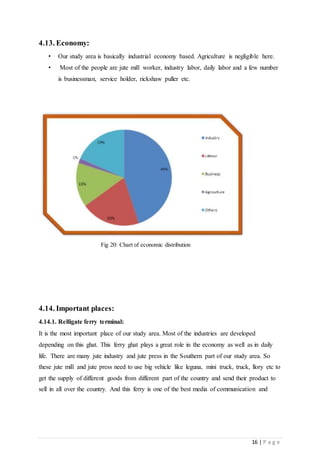
4.9. Drainage system:
• Very poor condition
• Very narrow
• Open drains
• Directly connected with river
• Lack of maintenance and cleaning
junks
4.10. Utility service:
Exist:
• Being an industrial area, here electricity is very much available.
• Tele communication and land phone facilities are also available.
Not Exist:
• No supply water.
• No gas line.
4.11. Vegetation:
Fig 17: Water level at winter Fig 18: Water level at rainy season
Fig19: Drainage system
15 | P a g e
• Our study area is rich with vegetation.
• Covers about 30% land of our study area.
• Different types and sizes of trees can be seen here.
Table 03: List of different types and sizes of trees
Type of tree Examples
Wood • Mehegoni
• Shirish
• Banyan tree etc.
Fruits • Mango
• Coconut
• Plam
• Kul
• Tamarind etc.
Others • Sajni
• Mandar
• Debdaru
• Grass etc.
4.12. Buffering:
• No planned buffering.
• Natural buffering can be seen at both side of the river.
• Somewhere density of trees is very high and somewhere very low.
16 | P a g e
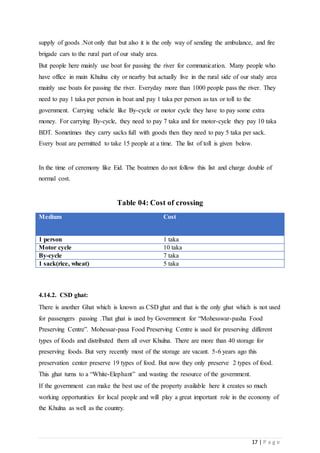
4.13. Economy:
• Our study area is basically industrial economy based. Agriculture is negligible here.
• Most of the people are jute mill worker, industry labor, daily labor and a few number
is businessman, service holder, rickshaw puller etc.
4.14. Important places:
4.14.1. Relligate ferry terminal:
It is the most important place of our study area. Most of the industries are developed
depending on this ghat. This ferry ghat plays a great role in the economy as well as in daily
life. There are many jute industry and jute press in the Southern part of our study area. So
these jute mill and jute press need to use big vehicle like leguna, mini truck, truck, llory etc to
get the supply of different goods from different part of the country and send their product to
sell in all over the country. And this ferry is one of the best media of communication and
Fig 20: Chart of economic distribution
17 | P a g e
supply of goods .Not only that but also it is the only way of sending the ambulance, and fire
brigade cars to the rural part of our study area.
But people here mainly use boat for passing the river for communication. Many people who
have office in main Khulna city or nearby but actually live in the rural side of our study area
mainly use boats for passing the river. Everyday more than 1000 people pass the river. They
need to pay 1 taka per person in boat and pay 1 taka per person as tax or toll to the
government. Carrying vehicle like By-cycle or motor cycle they have to pay some extra
money. For carrying By-cycle, they need to pay 7 taka and for motor-cycle they pay 10 taka
BDT. Sometimes they carry sacks full with goods then they need to pay 5 taka per sack.
Every boat are permitted to take 15 people at a time. The list of toll is given below.
In the time of ceremony like Eid. The boatmen do not follow this list and charge double of
normal cost.
Table 04: Cost of crossing
Medium Cost
1 person 1 taka
Motor cycle 10 taka
By-cycle 7 taka
1 sack(rice, wheat) 5 taka
4.14.2. CSD ghat:
There is another Ghat which is known as CSD ghat and that is the only ghat which is not used
for passengers passing .That ghat is used by Government for “Mohesswar-pasha Food
Preserving Centre”. Mohessar-pasa Food Preserving Centre is used for preserving different
types of foods and distributed them all over Khulna. There are more than 40 storage for
preserving foods. But very recently most of the storage are vacant. 5-6 years ago this
preservation center preserve 19 types of food. But now they only preserve 2 types of food.
This ghat turns to a “White-Elephant” and wasting the resource of the government.
If the government can make the best use of the property available here it creates so much
working opportunities for local people and will play a great important role in the economy of
the Khulna as well as the country.
18 | P a g e
4.14.3. Jute mills and Jute press:
There are also some jute mills and jute press around our study area. Jute is a natural fiber
popularly known as the golden fiber. It is one of the cheapest and the strongest of all natural
fibers and considered as fiber of the future. Jute is called the “Golden fiber” of Bangladesh.
Our country earn a huge amount of foreign currency by selling raw processed jute or jute
made products. The product of these mills goes to different part around the world. The
countries like Vietnam, Combodia, Scotland, Germany, Mexico, USA, Ireland are the buyer
of the product of these jute mills. The products are transported by different sizes of ship and
all the mills have separate terminal in river attached to the mills. Ships or large boats wait
near the terminal and then they load with the products and then go to the port and pass the
products to the larger ship.
At present raw jute and jute products account for around 10% of total foreign earnings and
4% of GDP.
We failed to enter inside the jute mills but we talked with the managers and workers on the
mills. There we got an idea of whole process of jute processing. At first, the jute fibers
remove from the sticks and dry them under sun for a few days. Then, the dried fiber goes to
the jute press mill and here they make bundle of jute. These bundle exported to different
countries. Different things like ropes, bags, mats, wall-mats, different types of show peace are
made with jute fiber.
19 | P a g e
Chapter 5: Recommendation
5.1. Convenience alternatives
• Road should be developed and wider.
• Adequate measures should be taken to solve drainage problem.
• Drains should be cleaned properly.
• Industry should develop their waste management system.
• Adequate dustbins should be provided.
• Supply water should make available.
5.2 . Economic alternatives
• Sufficient funding is required to recover and make secondary and tertiary roads more
wider by public authorities.
• Government should build some specific waste disposal points as early as possible.
• Deep tube wells should be imposed to make the water supply available.
• A health care center is much needed to the southern part to minimize health hazards.
20 | P a g e
Chapter 6: Proposals
 Some deep tube-wells are to be provided for safe drinking water at the north western
part.
 A health care center is to be established at the north western part.
 Planned buffering is to be established at both side of the river.
 Proper steps have to be taken in Government food preserving area at Maniktola to run
again in full swing.
 River barrier is need to stop river bank land degradation at north western part.
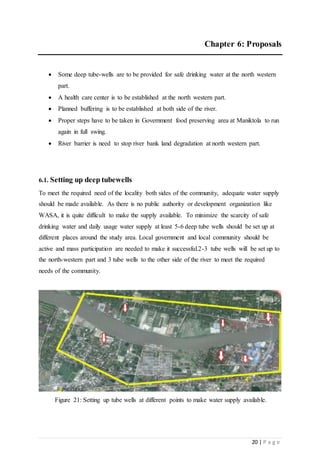
6.1. Setting up deep tubewells
To meet the required need of the locality both sides of the community, adequate water supply
should be made available. As there is no public authority or development organization like
WASA, it is quite difficult to make the supply available. To minimize the scarcity of safe
drinking water and daily usage water supply at least 5-6 deep tube wells should be set up at
different places around the study area. Local government and local community should be
active and mass participation are needed to make it successful.2-3 tube wells will be set up to
the north-western part and 3 tube wells to the other side of the river to meet the required
needs of the community.
Figure 21: Setting up tube wells at different points to make water supply available.
21 | P a g e
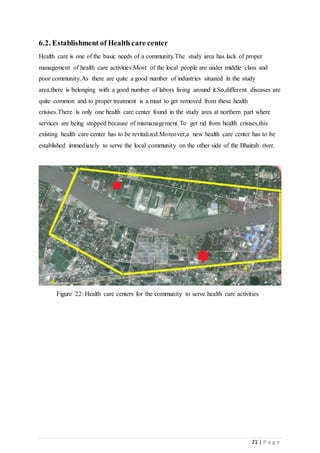
6.2. Establishment of Health care center
Health care is one of the basic needs of a community.The study area has lack of proper
management of health care activities.Most of the local people are under middle class and
poor community.As there are quite a good number of industries situated in the study
area,there is belonging with a good number of labors living around it.So,different diseases are
quite common and to proper treatment is a must to get removed from these health
crisises.There is only one health care center found in the study area at northern part where
services are being stopped because of mismanagement.To get rid from health crisises,this
existing health care center has to be revitalized.Moreover,a new health care center has to be
established immediately to serve the local community on the other side of the Bhairab river.
Figure 22: Health care centers for the community to serve health care activities
22 | P a g e
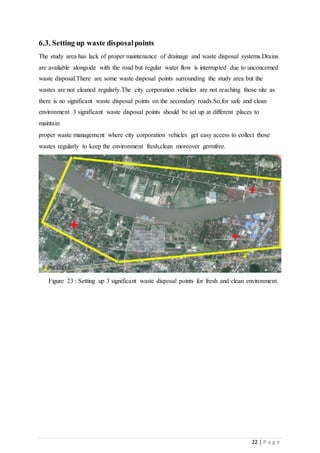
6.3. Setting up waste disposalpoints
The study area has lack of proper maintenance of drainage and waste disposal systems.Drains
are available alongside with the road but regular water flow is interrupted due to unconcerned
waste disposal.There are some waste disposal points surrounding the study area but the
wastes are not cleaned regularly.The city corporation vehicles are not reaching those site as
there is no significant waste disposal points on the secondary roads.So,for safe and clean
environment 3 significant waste disposal points should be set up at different places to
maintain
proper waste management where city corporation vehicles get easy access to collect those
wastes regularly to keep the environment fresh,clean moreover germfree.
Figure 23 : Setting up 3 significant waste disposal points for fresh and clean environment.
23 | P a g e
Chapter 7: SWOT analysis
7.1 Strength:
In terms of SWOT analysis of the study area,the whole area is basically multipurpose zone
where commercial,residential and industrial areas are located.As there are good percentages
of commercial zones and industries available,these are the strength of the site which are used
for day to day living purposes.The main earning source of the community is highly dependent
on these.
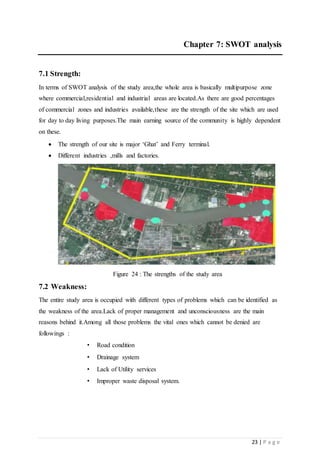
 The strength of our site is major ‘Ghat’ and Ferry terminal.
 Different industries ,mills and factories.
Figure 24 : The strengths of the study area
7.2 Weakness:
The entire study area is occupied with different types of problems which can be identified as
the weakness of the area.Lack of proper management and unconsciousness are the main
reasons behind it.Among all those problems the vital ones which cannot be denied are
followings :
• Road condition
• Drainage system
• Lack of Utility services
• Improper waste disposal system.
24 | P a g e
7.3 Opportunity:
If the proposals which are introduced earlier are implemented as early as possible, there is
a high possibility to make it as a business center with adequate services and facilities.
When road condition, transporting system, gas, water supply etc are developed and
available then,
• New industries will be attracted.
• Income of the local people will increase
7.4 Threat:
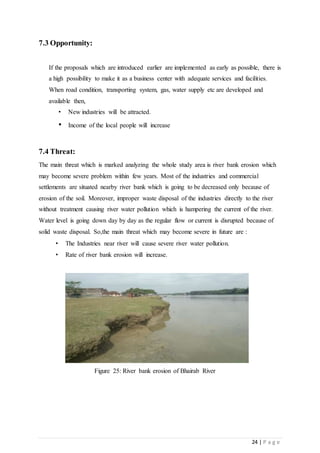
The main threat which is marked analyzing the whole study area is river bank erosion which
may become severe problem within few years. Most of the industries and commercial
settlements are situated nearby river bank which is going to be decreased only because of
erosion of the soil. Moreover, improper waste disposal of the industries directly to the river
without treatment causing river water pollution which is hampering the current of the river.
Water level is going down day by day as the regular flow or current is disrupted because of
solid waste disposal. So,the main threat which may become severe in future are :
• The Industries near river will cause severe river water pollution.
• Rate of river bank erosion will increase.
Figure 25: River bank erosion of Bhairab River
25 | P a g e
Chapter 8: Conclusion
Basically, the study area is mostly commercial and industrial area including residential area.
The area is occupied with various types of problems. Lack of utility and service facilities
mainly responsible for irregular development. The whole analysis worked out on the basis of
field survey and some statistical data collected from the people of the locality. The area will
become futuristic if using of the resources are maximized and raising consciousness of the
government and community people. If the proposals are imposed within a short period then it
will be able to play a vital role in economy.
.
26 | P a g e
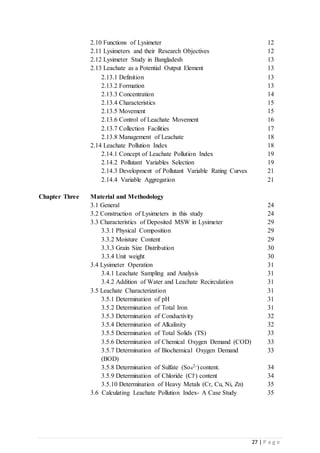
Contents
Page
No.
Acknowledgement i
Abstract ii
Content iii
List of Tables vi
List of Figures vii
Chapter One Introduction
1.1 General 1
1.2 Objective of this study 1
1.3 Background of this Study 1
1.4 Organization of this Thesis 2
Chapter Two Literature Review
2.1 General 3
2.2 General Aspects of Municipal Solid Waste(MSW) 3
2.2.1 Definition 3
2.2.2 Source 3
2.2.3 Physical Composition 4
2.2.3.1 Identification of the Individual Components 5
2.2.3.2 Analysis of Particle Size 5
2.2.4 Physical Properties 6
2.2.5 Chemical properties 6
2.2.6 Biological properties 6
2.2.7 Characterization 7
2.2.8 Solid Waste Management 8
2.2.9 Effects of Solid Waste Management 8
2.2.10 Elements of Solid Waste Management System 8
2.3 Ultimate Disposal of Solid Waste 9
2.3.1 Dumping Facilities of MSW 9
2.3.1.1 Open Dumping Facilities 9
2.3.1.2 Sanitary Landfill 10
2.4 Evaluation of Sanitary Landfill 10
2.5 Factors in Evaluating the Potential Site 10
2.6 Ultimate Disposal Site of MSW in Bangladesh 11
2.7 Definition of Lysimeter 11
2.8 Sanitary Landfill Lysimeter 12
2.9 Types of landfill Lysimeter 12
27 | P a g e
2.10 Functions of Lysimeter 12
2.11 Lysimeters and their Research Objectives 12
2.12 Lysimeter Study in Bangladesh 13
2.13 Leachate as a Potential Output Element 13
2.13.1 Definition 13
2.13.2 Formation 13
2.13.3 Concentration 14
2.13.4 Characteristics 15
2.13.5 Movement 15
2.13.6 Control of Leachate Movement 16
2.13.7 Collection Facilities 17
2.13.8 Management of Leachate 18
2.14 Leachate Pollution Index 18
2.14.1 Concept of Leachate Pollution Index 19
2.14.2 Pollutant Variables Selection 19
2.14.3 Development of Pollutant Variable Rating Curves 21
2.14.4 Variable Aggregation 21
Chapter Three Material and Methodology
3.1 General 24
3.2 Construction of Lysimeters in this study 24
3.3 Characteristics of Deposited MSW in Lysimeter 29
3.3.1 Physical Composition 29
3.3.2 Moisture Content 29
3.3.3 Grain Size Distribution 30
3.3.4 Unit weight 30
3.4 Lysimeter Operation 31
3.4.1 Leachate Sampling and Analysis 31
3.4.2 Addition of Water and Leachate Recirculation 31
3.5 Leachate Characterization 31
3.5.1 Determination of pH 31
3.5.2 Determination of Total Iron 31
3.5.3 Determination of Conductivity 32
3.5.4 Determination of Alkalinity 32
3.5.5 Determination of Total Solids (TS) 33
3.5.6 Determination of Chemical Oxygen Demand (COD) 33
3.5.7 Determination of Biochemical Oxygen Demand
(BOD)
33
3.5.8 Determination of Sulfate (So4
2-) content. 34
3.5.9 Determination of Chloride (Cl-) content 34
3.5.10 Determination of Heavy Metals (Cr, Cu, Ni, Zn) 35
3.6 Calculating Leachate Pollution Index- A Case Study 35
28 | P a g e
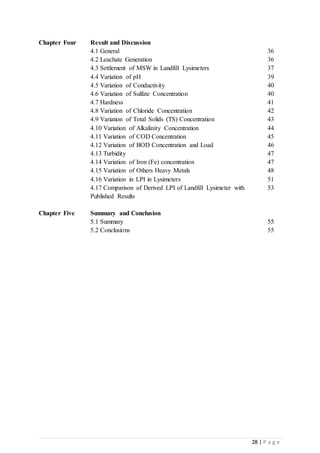
Chapter Four Result and Discussion
4.1 General 36
4.2 Leachate Generation 36
4.3 Settlement of MSW in Landfill Lysimeters 37
4.4 Variation of pH 39
4.5 Variation of Conductivity 40
4.6 Variation of Sulfate Concentration 40
4.7 Hardness 41
4.8 Variation of Chloride Concentration 42
4.9 Variation of Total Solids (TS) Concentration 43
4.10 Variation of Alkalinity Concentration 44
4.11 Variation of COD Concentration 45
4.12 Variation of BOD Concentration and Load 46
4.13 Turbidity 47
4.14 Variation of Iron (Fe) concentration 47
4.15 Variation of Others Heavy Metals 48
4.16 Variation in LPI in Lysimeters 51
4.17 Comparison of Derived LPI of Landfill Lysimeter with
Published Results
53
Chapter Five Summary and Conclusion
5.1 Summary 55
5.2 Conclusions 55
29 | P a g e

Report on Bhairab Rupsha Riverfront Development

  • 1.
    1 | Pa g e Chapter 1: Introduction 1.1 Backgroundof the study The Bhairab, which is considered to be of older origin its parent river the Jalangi, takes off from that river at a point, a few miles north of Karimpur (in West Bengal). After a tortuous course towards the south it turns to the east forming the boundary line between Meherpur P.S. (Bangladesh) and Karimpur (India) for a short distance and then turning south enters Meherpur P.S. and flows past Meherpur town to the south and loses itself in the Mathabhanga close to the east of Kapashdanga. Its intake from the Jalangi having silted up, this river has been practically dead since long. The poor climate of Meherpur, which lies upon its bank, is in great measure attributed to the stagnancy of its water. The settlement alongside river are not urbanized yet, moreover maximum commercial and industrial infrastructures are not technologically developed. The drainage systems are not provided until development of the settlement. So, the study area is occupied with different types of arising problems on the basis of the needs of the locality. To find out the solution of this rising problems this study is needed.
  • 2.
    2 | Pa g e 1.2 Study area The study area is located at Bhairab river and the settlements along having radius around 250m both sides from Fulbarigate to Rallygate.Main purpose of this study is to locate the landuse pattern and the overall condition of the area which includes road network,service facilities and utilities,drainage system,climatic condition,socio economic condition,flood plain analysis etc.Basically this study is to analyze to develop a planned riverbank settlement based on the river with adequate service facilities. Fig 01: Location of the study area
  • 3.
    3 | Pa g e Chapter 2: Methodology A methodology is the set of methods or steps of a process by which the study will be done. This study is done by a well arranged methodology by which the goals can be achieved. The study was done in a certain order. 2.1 Site Selection: The site was selected at Ralligate by our course teachers. This site is selected as it was one of the significant sites having both commercial, residential and also industrial uses. The riverbank sides are mostly using as commercial purposes. Moreover, there are some residents nearby industries locating around river. 2.2 Preparationof Questionnaire: A questionnaire was made to collect the data. For this at first a primary survey was done in which information were gathered from few number of local people belonging with the locality. Based upon the assumption of the situation the questionnaire was made. 2.3 Questionnaire Survey  A questionnaire survey was carried out in order to investigate the current condition of the riverbank settlements.  10 people were asked the questions about demographic measures –the availability of utility and services, water supply, electric supply, waste management system, health and sanitation services etc.  The answers are used to analyze the current problems and their solutions. 2.4 Analysis From the gathered data an analysis was carried out. From this analysis the problems were found out.
  • 4.
    4 | Pa g e 2.5 Alternatives On basis of the analysis and findings some alternatives were developed. The methodology at a glance- Figure 02 : Flow Diagram of the Methodology. Proposals Develop ProbableSolution Problem Analysis FindingOut Problems Data Collection Field Work Site Selection
  • 5.
    5 | Pa g e Chapter 3: Data Analysis 3.1 MajorLandscape: Residential (30-35%) Industrial (25-30%) Commercial (15-20%) Others (30-40%) 3.2 Land Percen tage: Fig 03: Major Landscape Fig 04: Chart of land percentage of major landscape
  • 6.
    6 | Pa g e 3.3. Residential: 3.3.1. North western part: It is densely populated with various groups of people. Almost 70% people of our study area live here. Most of the people are local. Living condition of this residential area is moderately developed. Here education rate is higher than other parts of our study area. Although most of the people are jute mill worker, some other profession is also seen here like business, industry labor, rickshaw puller etc. 3.3.2. South western part: This residential area is basically slum area. People living here are not local. Most of the people are migrated from Barisal and faridpur. Here people are illiterate and work at jute mill worker. Living condition of this slum area is unhealthy. There is no supply water and safe drinking water is not available. P.W.D(Public Works Development) govt. residential area is also located here. 3.3.3. East part: In our study area , only a few people lives in the East part of the river. They work at jute mill and live around mill. No separate residential area is seen here. 3.4.Industrial area: • Our study area is mainly industrial area. • A large number of industries with various types are located here. • Almost 30 different industries can be seen here. List of the major industries are given below in the table:
  • 7.
    7 | Pa g e Table 01:List of Major industries Type Name 1. Jute mill  Sha nawaj jute mill  Sagor jute mill  Mondol jute mill  Star jute mill  M/s co Amzad hossain jute mill etc. 2. Jute press  Dhaka trading house Ltd.  Faridpur jute press  Hazrat sha candropuri jute press  Reza jute traders  Salam jute traders etc. 3. Brick industry  New S.R brick industry 4. Fish processing  Digholia mothsow hachary Ltd. 5. Saw mill  Vi-Vi saw mill 6. Others  Nordic wood Limited  Anser flour mill 3.5. Image of some important industries: 3.5.1. Jute mil: Fig 05: Shahnewaj jute mill
  • 8.
    8 | Pa g e 3.5.2. Jute press: 3.5.3. Brick industry: 3.5.4. Fishprocessing: Fig 06: Dhaka trading house Ltd. Fig 07:Faridpur jute press Fig 08: New S.R brick industry Fig 09: Digholia Fishery Ltd.
  • 9.
    9 | Pa g e 3.5.5. Saw mill : 3.5.6. Others: Fig 10: Vai-Vai saw mill Fig 11: Nordic wood Limited Fig 12: Ansar flour mill
  • 10.
    10 | Pa g e 3.6. Commercialarea: Among commercial area most important are the Ghats, Food storage center,small shops etc. Total five Ghats are located to our study area. Mohessorpasa food storage center is a govt. food preserving center is also located to our study area in Maniktala, Khulna. A number of small shops are present in the road crossing as well as along road side and also in residential area. 3.6.1. Important Ghats 3.6.2. Food storage center Fig 13: Rallygate Ferry Terminal Fig 14: CSD(Central Storage Depot)-Ghat Fig 15: Food storage center
  • 11.
    11 | Pa g e 3.6.3. Small Shop 3.7. Others: Others land uses include institutional, Religion, water body, open space etc. Institutional includes school, college, hospital , govt. office etc, Religion includes mosque, madrasa, sosan ghat etc. Table 02: List of others land use: Type Name Institutional School & College o Mohessor pasa K.M. high school o M.A Mojid school & college Hospital o Bokkhobadhi Hospital o Shongkramok badhi Hospital Govt. Office o Women Welfare Organization Religion Mosque o Nagar ghat jame mosjid o Bawali ghata jame mosjid o Modina jame mosjid Madrasa o Rahmania madrasa, Khulna Shoshan ghat o Mohessor pasa Sosan ghat Fig 16: Small shop
  • 12.
    12 | Pa g e Chapter 4: Findings 4.1. Population: • In our study area, population size is not very big. • Total population size is about 2500-3000. • Most of them living north western part of the river and east part of the river settlement are very little. • Major people of the south western part are illiterate and jute-mill worker. • About 90% people are illiterate. • Most of them are not living permanently here. • People come here in different district for supporting their life. • Most of them come from Faridpur and Barishal district. • For this reason, slum area is created. • In north western part education level comparatively high and most of them are industry labor and very few of them are businessmen, service holder, rickshaw or van puller etc. • Local people are living in this part. 4.2. Life Style: • North western part is better than South-western part. • North western part is moderately developed but South-western part is a slum area. • Vegetation cultivation is seen on roof of house in North-western part. • Domestic animal is available in South-western part. 4.3. Transport Network: • Transport network is very strong in our study area. • Roads are covering 3-5% of land of total study area. • There is just one main high way. • It’s known as Khulna-Jessore High Way.
  • 13.
    13 | Pa g e 4.4. RoadClassification: Three types of road are seen there. There are:- 1. Primary Road 2. Secondary Road 3. Tertiary Road Besides residential areas and industry, we can see footpath. 4.5. RoadCondition: • Primary road condition is moderately better & smooth. • Secondary and Tertiary roads are linked by Primary road. • But people face various troubles because of poor condition of secondary and tertiary road. • Primary road width is minimum 6-7 m. • Secondary road width is 3.5 m but standard width is about 5 m. • Tertiary road width is minimum 1.8 m. • So, almost all roads are very narrow. 4.6. Traffic: • Our study area is industry based. So, high loaded trucks are seen here every time. • Without truck, we can see some other vehicles like van, bi-cycle, rickshaw, motor- cycle etc. 4.7. River Condition : • Decreases flow of water • Pollutes river water • Increases river bank erosion • Decreases fishes and other.
  • 14.
    14 | Pa g e 4.8. FloodPlain : • In winter, water level gradually decrease and river current flow moderately very slow. • In rainy season, water level reaches at highest peak and over flooded. Moreover, river current flow become strong. 4.9. Drainage system: • Very poor condition • Very narrow • Open drains • Directly connected with river • Lack of maintenance and cleaning junks 4.10. Utility service: Exist: • Being an industrial area, here electricity is very much available. • Tele communication and land phone facilities are also available. Not Exist: • No supply water. • No gas line. 4.11. Vegetation: Fig 17: Water level at winter Fig 18: Water level at rainy season Fig19: Drainage system
  • 15.
    15 | Pa g e • Our study area is rich with vegetation. • Covers about 30% land of our study area. • Different types and sizes of trees can be seen here. Table 03: List of different types and sizes of trees Type of tree Examples Wood • Mehegoni • Shirish • Banyan tree etc. Fruits • Mango • Coconut • Plam • Kul • Tamarind etc. Others • Sajni • Mandar • Debdaru • Grass etc. 4.12. Buffering: • No planned buffering. • Natural buffering can be seen at both side of the river. • Somewhere density of trees is very high and somewhere very low.
  • 16.
    16 | Pa g e 4.13. Economy: • Our study area is basically industrial economy based. Agriculture is negligible here. • Most of the people are jute mill worker, industry labor, daily labor and a few number is businessman, service holder, rickshaw puller etc. 4.14. Important places: 4.14.1. Relligate ferry terminal: It is the most important place of our study area. Most of the industries are developed depending on this ghat. This ferry ghat plays a great role in the economy as well as in daily life. There are many jute industry and jute press in the Southern part of our study area. So these jute mill and jute press need to use big vehicle like leguna, mini truck, truck, llory etc to get the supply of different goods from different part of the country and send their product to sell in all over the country. And this ferry is one of the best media of communication and Fig 20: Chart of economic distribution
  • 17.
    17 | Pa g e supply of goods .Not only that but also it is the only way of sending the ambulance, and fire brigade cars to the rural part of our study area. But people here mainly use boat for passing the river for communication. Many people who have office in main Khulna city or nearby but actually live in the rural side of our study area mainly use boats for passing the river. Everyday more than 1000 people pass the river. They need to pay 1 taka per person in boat and pay 1 taka per person as tax or toll to the government. Carrying vehicle like By-cycle or motor cycle they have to pay some extra money. For carrying By-cycle, they need to pay 7 taka and for motor-cycle they pay 10 taka BDT. Sometimes they carry sacks full with goods then they need to pay 5 taka per sack. Every boat are permitted to take 15 people at a time. The list of toll is given below. In the time of ceremony like Eid. The boatmen do not follow this list and charge double of normal cost. Table 04: Cost of crossing Medium Cost 1 person 1 taka Motor cycle 10 taka By-cycle 7 taka 1 sack(rice, wheat) 5 taka 4.14.2. CSD ghat: There is another Ghat which is known as CSD ghat and that is the only ghat which is not used for passengers passing .That ghat is used by Government for “Mohesswar-pasha Food Preserving Centre”. Mohessar-pasa Food Preserving Centre is used for preserving different types of foods and distributed them all over Khulna. There are more than 40 storage for preserving foods. But very recently most of the storage are vacant. 5-6 years ago this preservation center preserve 19 types of food. But now they only preserve 2 types of food. This ghat turns to a “White-Elephant” and wasting the resource of the government. If the government can make the best use of the property available here it creates so much working opportunities for local people and will play a great important role in the economy of the Khulna as well as the country.
  • 18.
    18 | Pa g e 4.14.3. Jute mills and Jute press: There are also some jute mills and jute press around our study area. Jute is a natural fiber popularly known as the golden fiber. It is one of the cheapest and the strongest of all natural fibers and considered as fiber of the future. Jute is called the “Golden fiber” of Bangladesh. Our country earn a huge amount of foreign currency by selling raw processed jute or jute made products. The product of these mills goes to different part around the world. The countries like Vietnam, Combodia, Scotland, Germany, Mexico, USA, Ireland are the buyer of the product of these jute mills. The products are transported by different sizes of ship and all the mills have separate terminal in river attached to the mills. Ships or large boats wait near the terminal and then they load with the products and then go to the port and pass the products to the larger ship. At present raw jute and jute products account for around 10% of total foreign earnings and 4% of GDP. We failed to enter inside the jute mills but we talked with the managers and workers on the mills. There we got an idea of whole process of jute processing. At first, the jute fibers remove from the sticks and dry them under sun for a few days. Then, the dried fiber goes to the jute press mill and here they make bundle of jute. These bundle exported to different countries. Different things like ropes, bags, mats, wall-mats, different types of show peace are made with jute fiber.
  • 19.
    19 | Pa g e Chapter 5: Recommendation 5.1. Convenience alternatives • Road should be developed and wider. • Adequate measures should be taken to solve drainage problem. • Drains should be cleaned properly. • Industry should develop their waste management system. • Adequate dustbins should be provided. • Supply water should make available. 5.2 . Economic alternatives • Sufficient funding is required to recover and make secondary and tertiary roads more wider by public authorities. • Government should build some specific waste disposal points as early as possible. • Deep tube wells should be imposed to make the water supply available. • A health care center is much needed to the southern part to minimize health hazards.
  • 20.
    20 | Pa g e Chapter 6: Proposals  Some deep tube-wells are to be provided for safe drinking water at the north western part.  A health care center is to be established at the north western part.  Planned buffering is to be established at both side of the river.  Proper steps have to be taken in Government food preserving area at Maniktola to run again in full swing.  River barrier is need to stop river bank land degradation at north western part. 6.1. Setting up deep tubewells To meet the required need of the locality both sides of the community, adequate water supply should be made available. As there is no public authority or development organization like WASA, it is quite difficult to make the supply available. To minimize the scarcity of safe drinking water and daily usage water supply at least 5-6 deep tube wells should be set up at different places around the study area. Local government and local community should be active and mass participation are needed to make it successful.2-3 tube wells will be set up to the north-western part and 3 tube wells to the other side of the river to meet the required needs of the community. Figure 21: Setting up tube wells at different points to make water supply available.
  • 21.
    21 | Pa g e 6.2. Establishment of Health care center Health care is one of the basic needs of a community.The study area has lack of proper management of health care activities.Most of the local people are under middle class and poor community.As there are quite a good number of industries situated in the study area,there is belonging with a good number of labors living around it.So,different diseases are quite common and to proper treatment is a must to get removed from these health crisises.There is only one health care center found in the study area at northern part where services are being stopped because of mismanagement.To get rid from health crisises,this existing health care center has to be revitalized.Moreover,a new health care center has to be established immediately to serve the local community on the other side of the Bhairab river. Figure 22: Health care centers for the community to serve health care activities
  • 22.
    22 | Pa g e 6.3. Setting up waste disposalpoints The study area has lack of proper maintenance of drainage and waste disposal systems.Drains are available alongside with the road but regular water flow is interrupted due to unconcerned waste disposal.There are some waste disposal points surrounding the study area but the wastes are not cleaned regularly.The city corporation vehicles are not reaching those site as there is no significant waste disposal points on the secondary roads.So,for safe and clean environment 3 significant waste disposal points should be set up at different places to maintain proper waste management where city corporation vehicles get easy access to collect those wastes regularly to keep the environment fresh,clean moreover germfree. Figure 23 : Setting up 3 significant waste disposal points for fresh and clean environment.
  • 23.
    23 | Pa g e Chapter 7: SWOT analysis 7.1 Strength: In terms of SWOT analysis of the study area,the whole area is basically multipurpose zone where commercial,residential and industrial areas are located.As there are good percentages of commercial zones and industries available,these are the strength of the site which are used for day to day living purposes.The main earning source of the community is highly dependent on these.  The strength of our site is major ‘Ghat’ and Ferry terminal.  Different industries ,mills and factories. Figure 24 : The strengths of the study area 7.2 Weakness: The entire study area is occupied with different types of problems which can be identified as the weakness of the area.Lack of proper management and unconsciousness are the main reasons behind it.Among all those problems the vital ones which cannot be denied are followings : • Road condition • Drainage system • Lack of Utility services • Improper waste disposal system.
  • 24.
    24 | Pa g e 7.3 Opportunity: If the proposals which are introduced earlier are implemented as early as possible, there is a high possibility to make it as a business center with adequate services and facilities. When road condition, transporting system, gas, water supply etc are developed and available then, • New industries will be attracted. • Income of the local people will increase 7.4 Threat: The main threat which is marked analyzing the whole study area is river bank erosion which may become severe problem within few years. Most of the industries and commercial settlements are situated nearby river bank which is going to be decreased only because of erosion of the soil. Moreover, improper waste disposal of the industries directly to the river without treatment causing river water pollution which is hampering the current of the river. Water level is going down day by day as the regular flow or current is disrupted because of solid waste disposal. So,the main threat which may become severe in future are : • The Industries near river will cause severe river water pollution. • Rate of river bank erosion will increase. Figure 25: River bank erosion of Bhairab River
  • 25.
    25 | Pa g e Chapter 8: Conclusion Basically, the study area is mostly commercial and industrial area including residential area. The area is occupied with various types of problems. Lack of utility and service facilities mainly responsible for irregular development. The whole analysis worked out on the basis of field survey and some statistical data collected from the people of the locality. The area will become futuristic if using of the resources are maximized and raising consciousness of the government and community people. If the proposals are imposed within a short period then it will be able to play a vital role in economy. .
  • 26.
    26 | Pa g e Contents Page No. Acknowledgement i Abstract ii Content iii List of Tables vi List of Figures vii Chapter One Introduction 1.1 General 1 1.2 Objective of this study 1 1.3 Background of this Study 1 1.4 Organization of this Thesis 2 Chapter Two Literature Review 2.1 General 3 2.2 General Aspects of Municipal Solid Waste(MSW) 3 2.2.1 Definition 3 2.2.2 Source 3 2.2.3 Physical Composition 4 2.2.3.1 Identification of the Individual Components 5 2.2.3.2 Analysis of Particle Size 5 2.2.4 Physical Properties 6 2.2.5 Chemical properties 6 2.2.6 Biological properties 6 2.2.7 Characterization 7 2.2.8 Solid Waste Management 8 2.2.9 Effects of Solid Waste Management 8 2.2.10 Elements of Solid Waste Management System 8 2.3 Ultimate Disposal of Solid Waste 9 2.3.1 Dumping Facilities of MSW 9 2.3.1.1 Open Dumping Facilities 9 2.3.1.2 Sanitary Landfill 10 2.4 Evaluation of Sanitary Landfill 10 2.5 Factors in Evaluating the Potential Site 10 2.6 Ultimate Disposal Site of MSW in Bangladesh 11 2.7 Definition of Lysimeter 11 2.8 Sanitary Landfill Lysimeter 12 2.9 Types of landfill Lysimeter 12
  • 27.
    27 | Pa g e 2.10 Functions of Lysimeter 12 2.11 Lysimeters and their Research Objectives 12 2.12 Lysimeter Study in Bangladesh 13 2.13 Leachate as a Potential Output Element 13 2.13.1 Definition 13 2.13.2 Formation 13 2.13.3 Concentration 14 2.13.4 Characteristics 15 2.13.5 Movement 15 2.13.6 Control of Leachate Movement 16 2.13.7 Collection Facilities 17 2.13.8 Management of Leachate 18 2.14 Leachate Pollution Index 18 2.14.1 Concept of Leachate Pollution Index 19 2.14.2 Pollutant Variables Selection 19 2.14.3 Development of Pollutant Variable Rating Curves 21 2.14.4 Variable Aggregation 21 Chapter Three Material and Methodology 3.1 General 24 3.2 Construction of Lysimeters in this study 24 3.3 Characteristics of Deposited MSW in Lysimeter 29 3.3.1 Physical Composition 29 3.3.2 Moisture Content 29 3.3.3 Grain Size Distribution 30 3.3.4 Unit weight 30 3.4 Lysimeter Operation 31 3.4.1 Leachate Sampling and Analysis 31 3.4.2 Addition of Water and Leachate Recirculation 31 3.5 Leachate Characterization 31 3.5.1 Determination of pH 31 3.5.2 Determination of Total Iron 31 3.5.3 Determination of Conductivity 32 3.5.4 Determination of Alkalinity 32 3.5.5 Determination of Total Solids (TS) 33 3.5.6 Determination of Chemical Oxygen Demand (COD) 33 3.5.7 Determination of Biochemical Oxygen Demand (BOD) 33 3.5.8 Determination of Sulfate (So4 2-) content. 34 3.5.9 Determination of Chloride (Cl-) content 34 3.5.10 Determination of Heavy Metals (Cr, Cu, Ni, Zn) 35 3.6 Calculating Leachate Pollution Index- A Case Study 35
  • 28.
    28 | Pa g e Chapter Four Result and Discussion 4.1 General 36 4.2 Leachate Generation 36 4.3 Settlement of MSW in Landfill Lysimeters 37 4.4 Variation of pH 39 4.5 Variation of Conductivity 40 4.6 Variation of Sulfate Concentration 40 4.7 Hardness 41 4.8 Variation of Chloride Concentration 42 4.9 Variation of Total Solids (TS) Concentration 43 4.10 Variation of Alkalinity Concentration 44 4.11 Variation of COD Concentration 45 4.12 Variation of BOD Concentration and Load 46 4.13 Turbidity 47 4.14 Variation of Iron (Fe) concentration 47 4.15 Variation of Others Heavy Metals 48 4.16 Variation in LPI in Lysimeters 51 4.17 Comparison of Derived LPI of Landfill Lysimeter with Published Results 53 Chapter Five Summary and Conclusion 5.1 Summary 55 5.2 Conclusions 55
  • 29.
    29 | Pa g e