Hosted by:
                          Office of Senator Richard Burr
                           Office of Senator Kay Hagan
                      North Carolina Military Business Center

Sponsored by:
           Presenting Sponsor                              Gold Sponsor


                                  Silver Sponsor
Net Zero Energy
                            Installations and Facilities
This roundtable will address:
•Benchmarking, conservation and efficiency in energy consumption
• High performance, sustainable building
• Utilizing and re-purposing waste energy
• Generation of energy from renewable sources
• Reducing petroleum consumption and GHG emissions
Net Zero Energy
                                Fort Bragg Initiatives
Current Initiatives (Installation/Agency: Fort Bragg)
1. Retro Commissioning to reduce energy usage
3.Small scale PV systems up to 300 kw
3. Ground Source Heat Pump systems
4. Energy awareness and Conservation programs
5. Thermal Energy Storage (Chill water)
Net Zero Energy
                              Fort Bragg Future Needs
Future Needs (Installation/Agency: Fort Bragg)
1. Retro Commissioning

2. Large scale PV (1-10 MW)

3. Base load energy security generation (i.e. bio-mass)

4. More GSHP projects
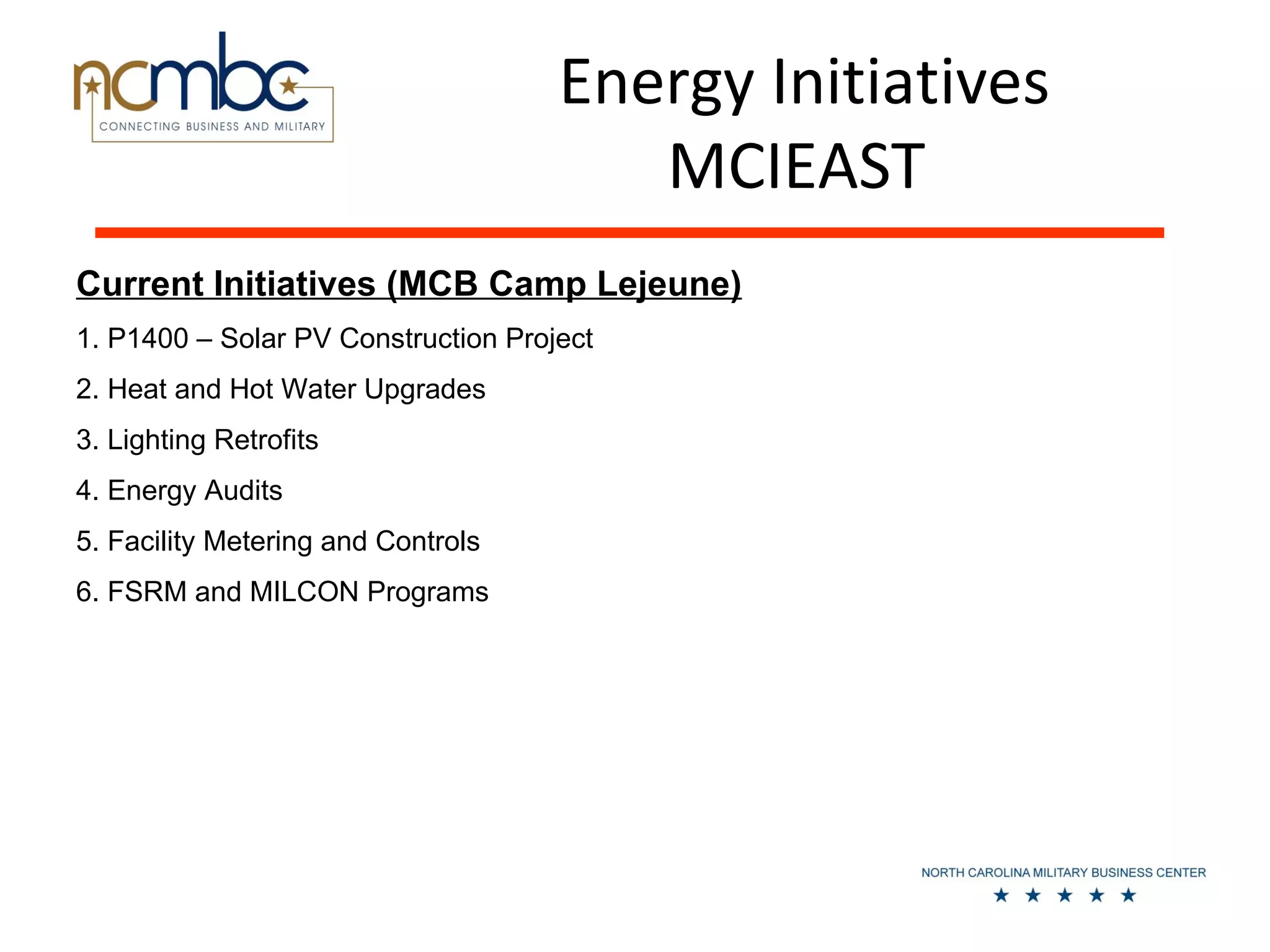
Energy Initiatives
                                        MCIEAST
Current Initiatives (MCB Camp Lejeune)
1. P1400 – Solar PV Construction Project
2. Heat and Hot Water Upgrades
3. Lighting Retrofits
4. Energy Audits
5. Facility Metering and Controls
6. FSRM and MILCON Programs
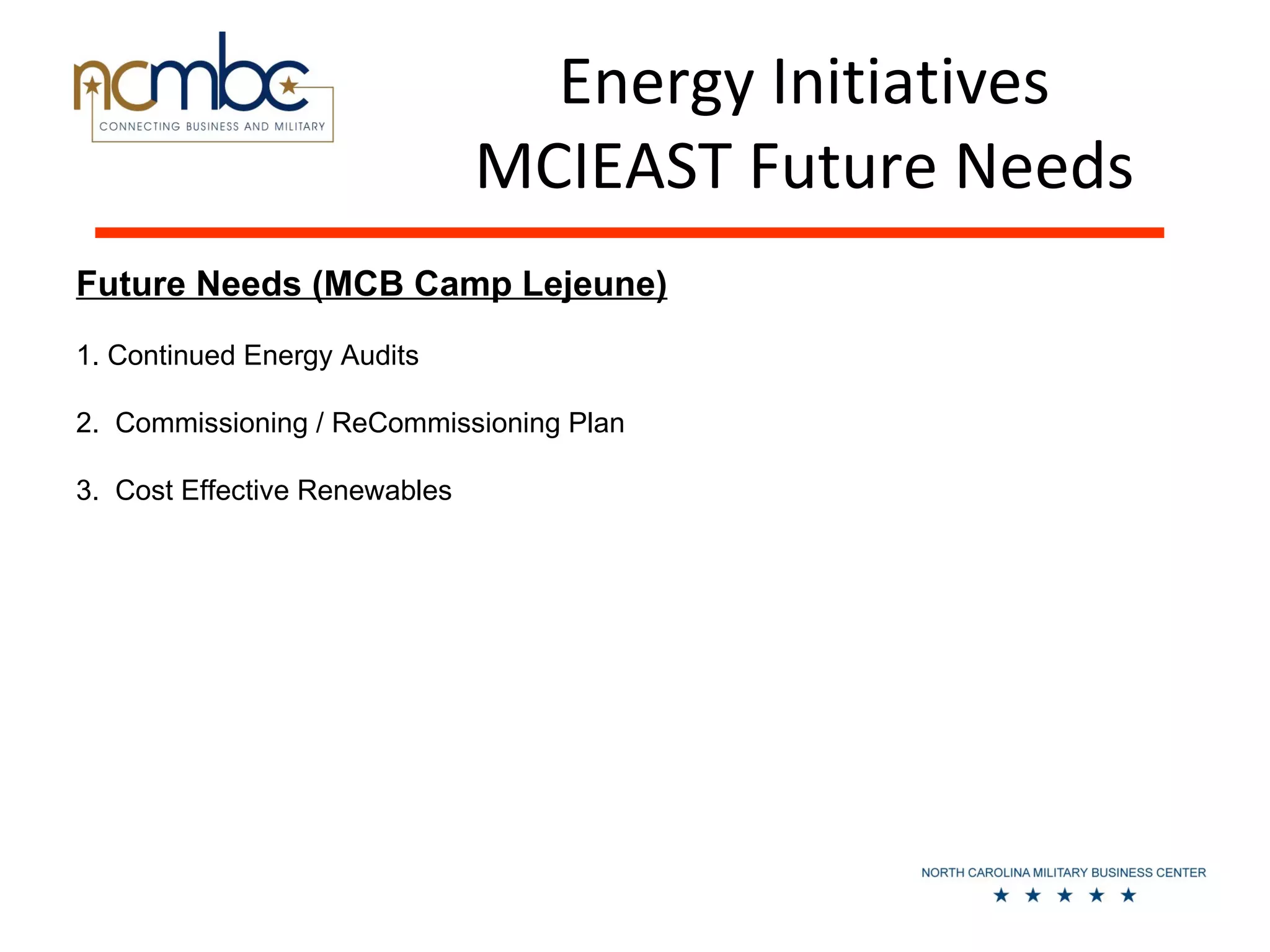
Energy Initiatives
                               MCIEAST Future Needs
Future Needs (MCB Camp Lejeune)
1. Continued Energy Audits

2. Commissioning / ReCommissioning Plan

3. Cost Effective Renewables
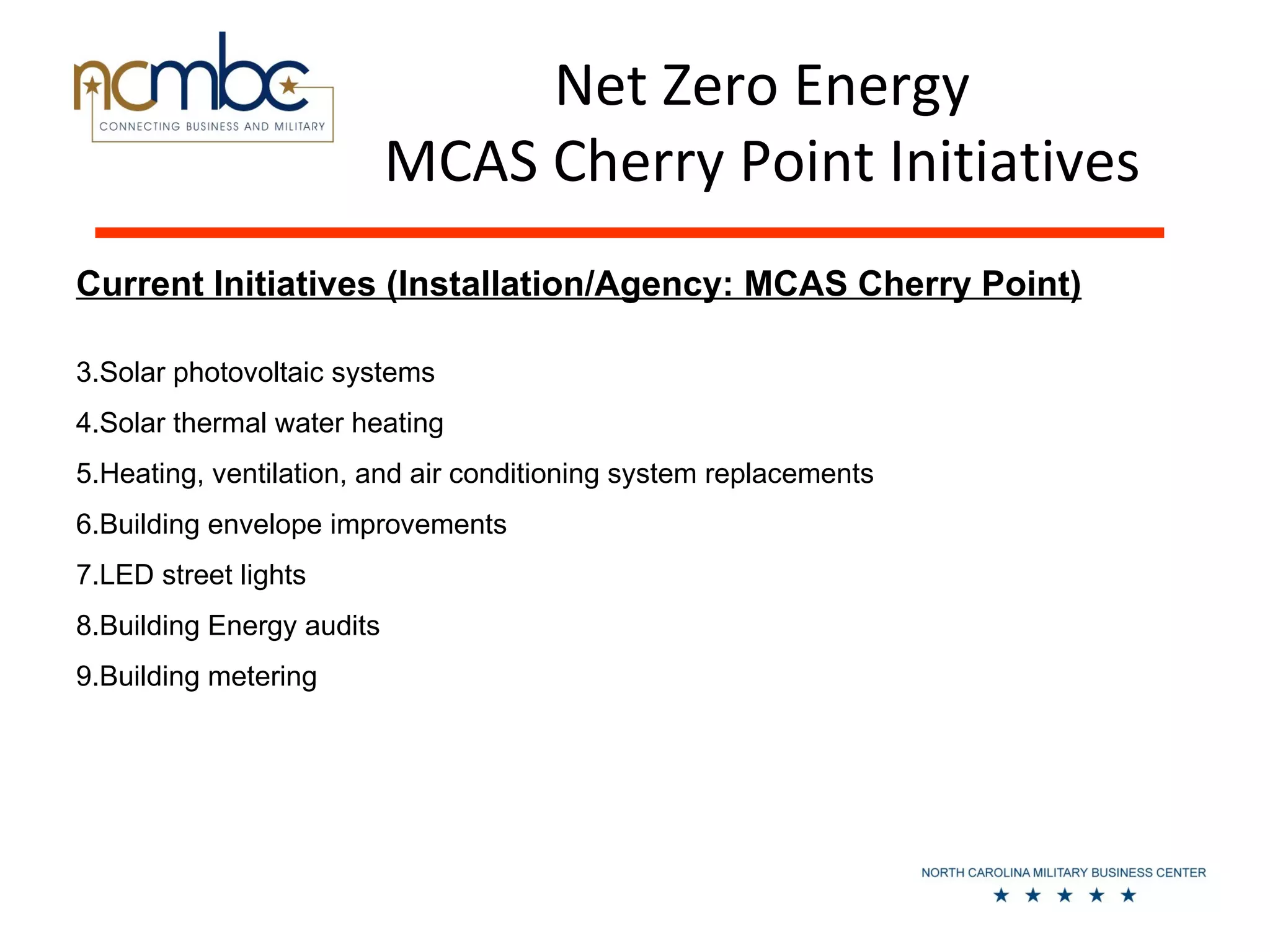
Net Zero Energy
                           MCAS Cherry Point Initiatives
Current Initiatives (Installation/Agency: MCAS Cherry Point)

3.Solar photovoltaic systems
4.Solar thermal water heating
5.Heating, ventilation, and air conditioning system replacements
6.Building envelope improvements
7.LED street lights
8.Building Energy audits
9.Building metering
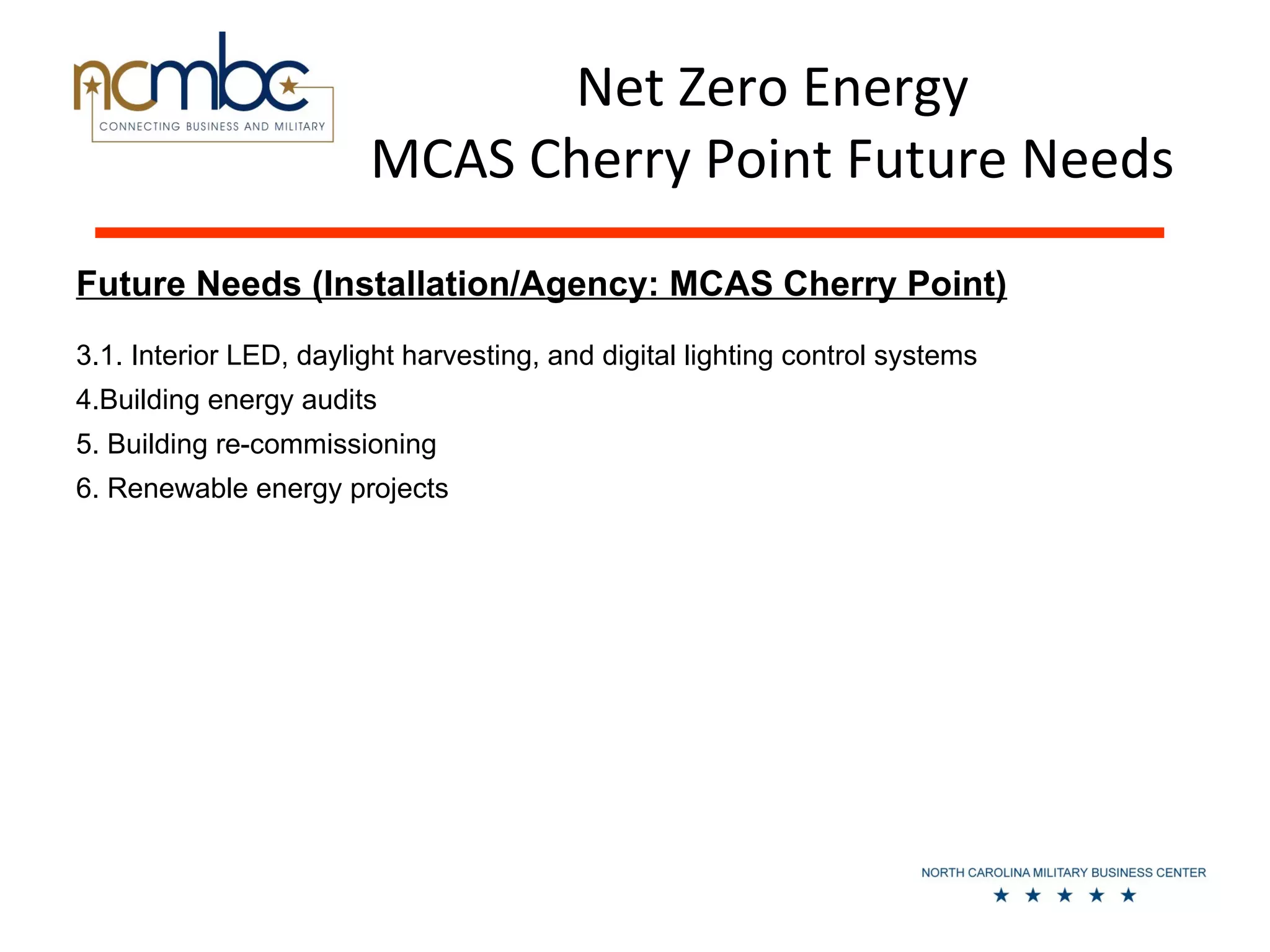
Net Zero Energy
                        MCAS Cherry Point Future Needs
Future Needs (Installation/Agency: MCAS Cherry Point)
3.1. Interior LED, daylight harvesting, and digital lighting control systems
4.Building energy audits
5. Building re-commissioning
6. Renewable energy projects
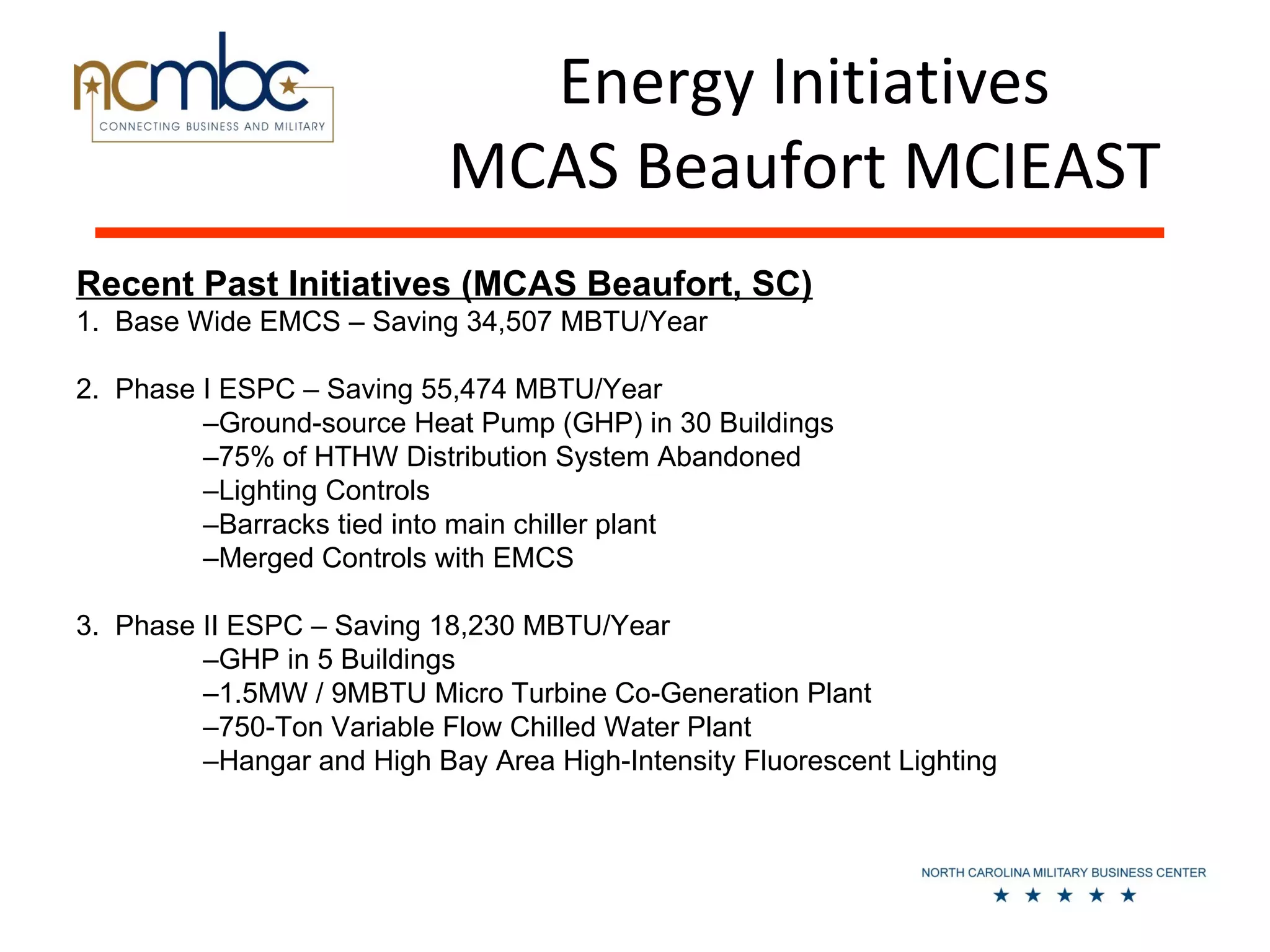
Energy Initiatives
                            MCAS Beaufort MCIEAST
Recent Past Initiatives (MCAS Beaufort, SC)
1. Base Wide EMCS – Saving 34,507 MBTU/Year

2. Phase I ESPC – Saving 55,474 MBTU/Year
         –Ground-source Heat Pump (GHP) in 30 Buildings
         –75% of HTHW Distribution System Abandoned
         –Lighting Controls
         –Barracks tied into main chiller plant
         –Merged Controls with EMCS

3. Phase II ESPC – Saving 18,230 MBTU/Year
         –GHP in 5 Buildings
         –1.5MW / 9MBTU Micro Turbine Co-Generation Plant
         –750-Ton Variable Flow Chilled Water Plant
         –Hangar and High Bay Area High-Intensity Fluorescent Lighting
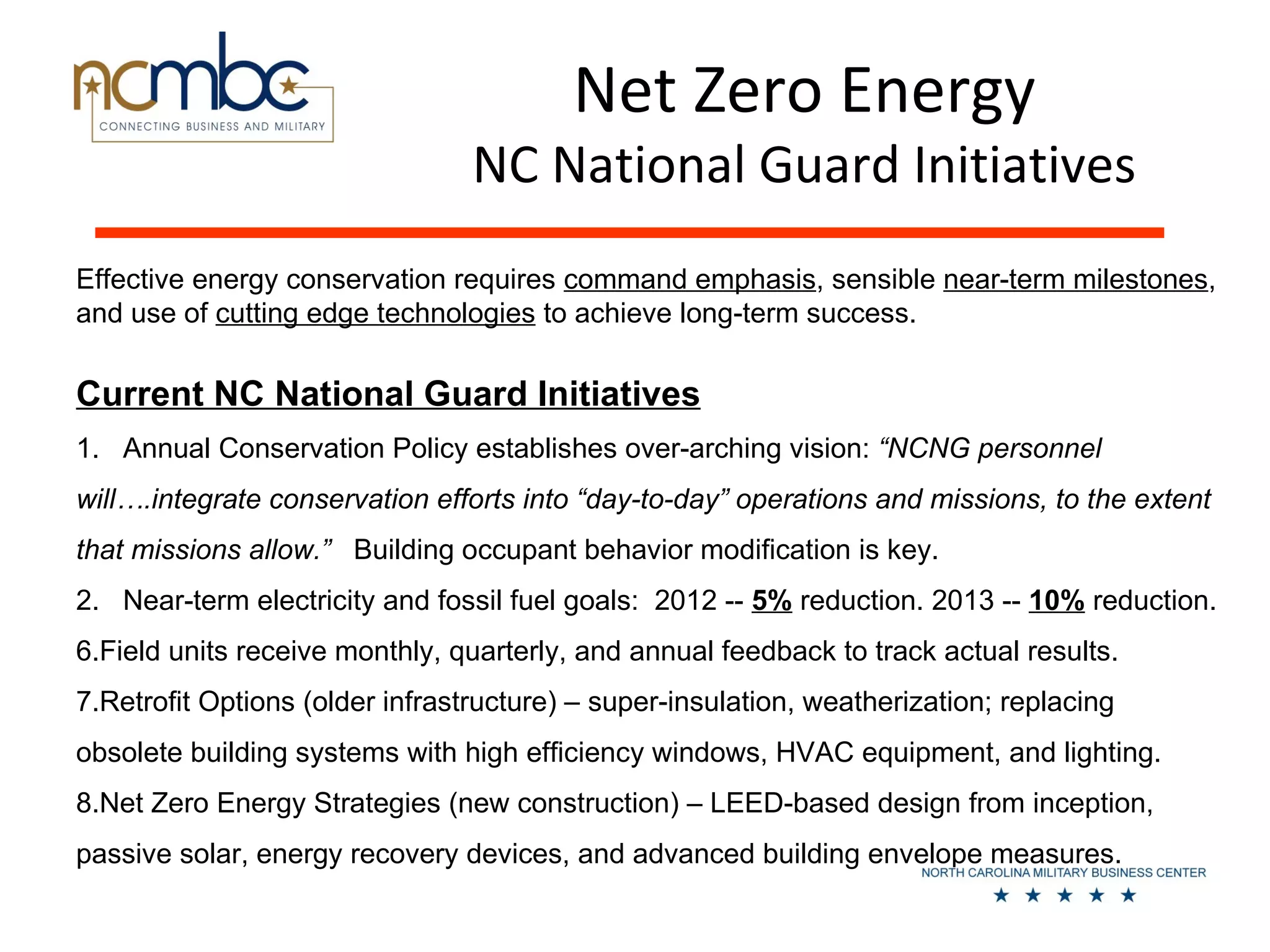
Net Zero Energy
                                 NC National Guard Initiatives
Effective energy conservation requires command emphasis, sensible near-term milestones,
and use of cutting edge technologies to achieve long-term success.

Current NC National Guard Initiatives
1. Annual Conservation Policy establishes over-arching vision: “NCNG personnel
will….integrate conservation efforts into “day-to-day” operations and missions, to the extent
that missions allow.” Building occupant behavior modification is key.
2. Near-term electricity and fossil fuel goals: 2012 -- 5% reduction. 2013 -- 10% reduction.
6.Field units receive monthly, quarterly, and annual feedback to track actual results.
7.Retrofit Options (older infrastructure) – super-insulation, weatherization; replacing
obsolete building systems with high efficiency windows, HVAC equipment, and lighting.
8.Net Zero Energy Strategies (new construction) – LEED-based design from inception,
passive solar, energy recovery devices, and advanced building envelope measures.
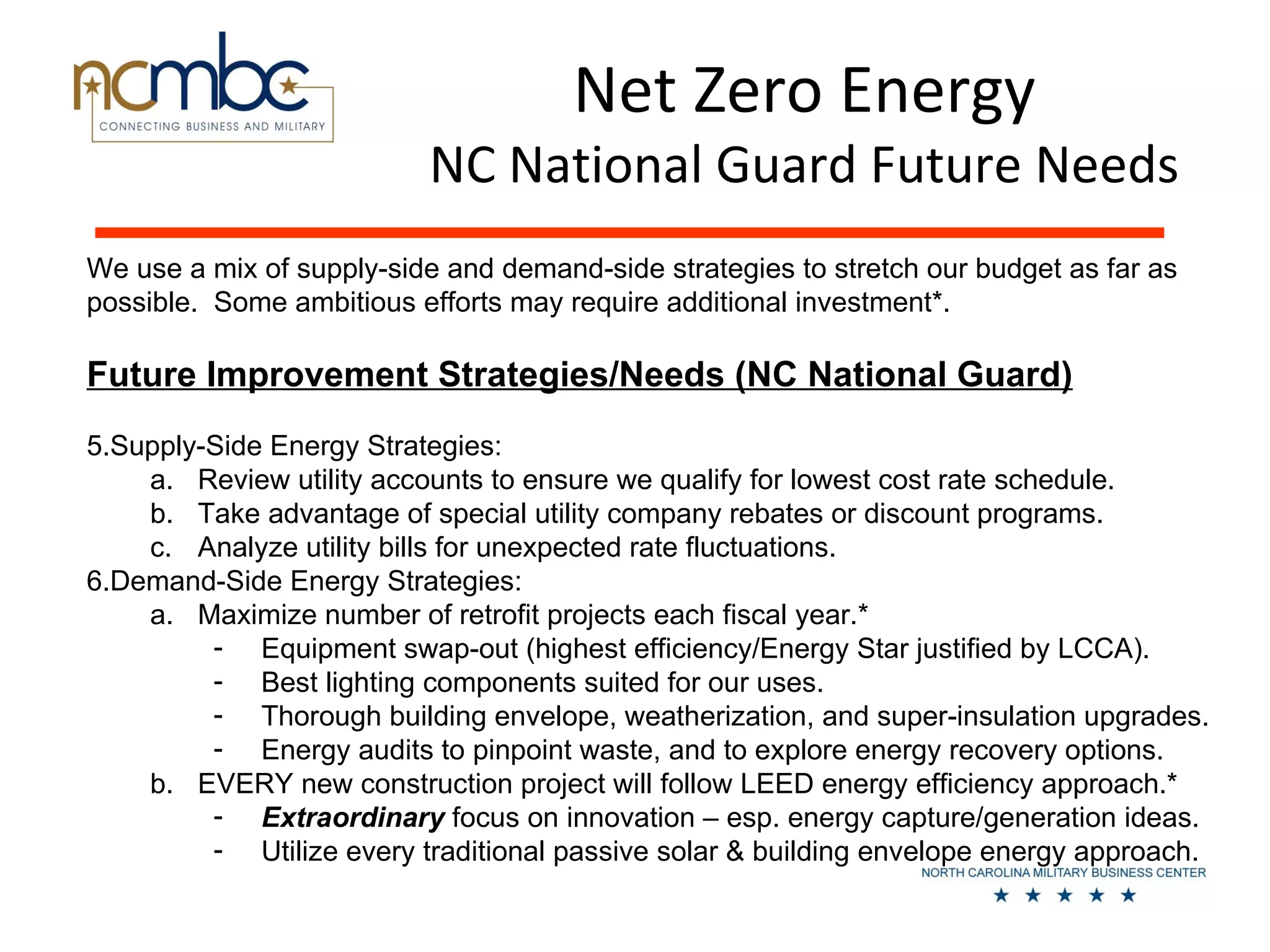
Net Zero Energy
                           NC National Guard Future Needs
We use a mix of supply-side and demand-side strategies to stretch our budget as far as
possible. Some ambitious efforts may require additional investment*.

Future Improvement Strategies/Needs (NC National Guard)
5.Supply-Side Energy Strategies:
    a. Review utility accounts to ensure we qualify for lowest cost rate schedule.
    b. Take advantage of special utility company rebates or discount programs.
    c. Analyze utility bills for unexpected rate fluctuations.
6.Demand-Side Energy Strategies:
    a. Maximize number of retrofit projects each fiscal year.*
         - Equipment swap-out (highest efficiency/Energy Star justified by LCCA).
         - Best lighting components suited for our uses.
         - Thorough building envelope, weatherization, and super-insulation upgrades.
         - Energy audits to pinpoint waste, and to explore energy recovery options.
    b. EVERY new construction project will follow LEED energy efficiency approach.*
         - Extraordinary focus on innovation – esp. energy capture/generation ideas.
         - Utilize every traditional passive solar & building envelope energy approach.
Net Zero Energy
                                   Seymour Johnson AFB
                                        Initiatives
Current Initiatives (Seymour Johnson AFB:)

3.Facility Audits [1.9M SF of Class II/III audits]
4.Direct Digital Controls & Energy Management Control System Upgrades [100+ facilities
upgraded]
5.Retro-commissioning [20 facilities @ 400K+ SF]
6.Education/outreach [ Airman e-BEAST, videos, articles]
7.Lighting upgrades [LED / Occupancy sensors / T5]
8.Area Development Plans & associated Campus Parking/Transportation Plans [walking
campuses and “one-stop shopping” type admin facilities]
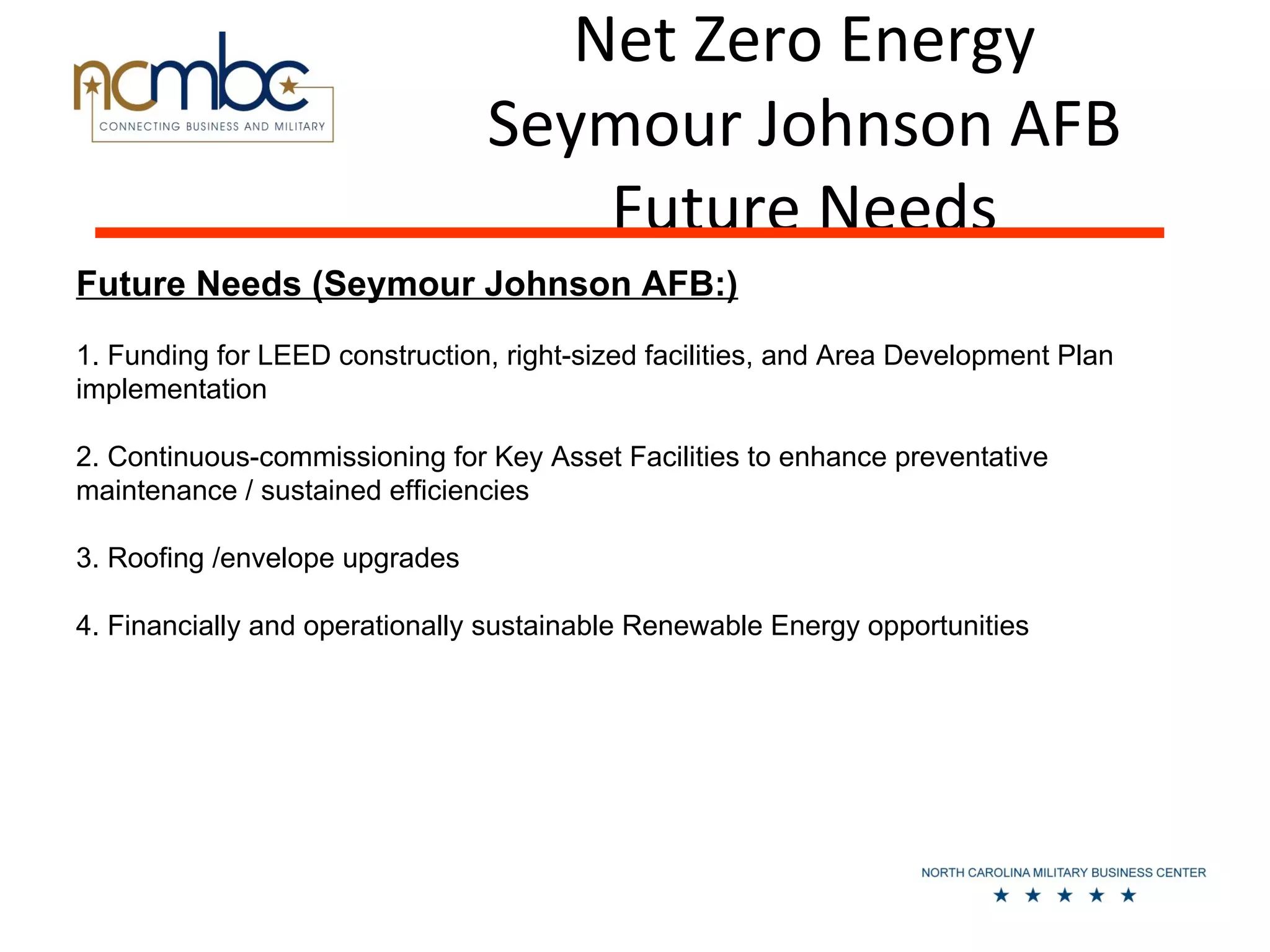
Net Zero Energy
                                Seymour Johnson AFB
                                    Future Needs
Future Needs (Seymour Johnson AFB:)
1. Funding for LEED construction, right-sized facilities, and Area Development Plan
implementation

2. Continuous-commissioning for Key Asset Facilities to enhance preventative
maintenance / sustained efficiencies

3. Roofing /envelope upgrades

4. Financially and operationally sustainable Renewable Energy opportunities

Roundtable 3: NetZero Energy Installations and Facilities

  • 1.
    Hosted by: Office of Senator Richard Burr Office of Senator Kay Hagan North Carolina Military Business Center Sponsored by: Presenting Sponsor Gold Sponsor Silver Sponsor
  • 2.
    Net Zero Energy Installations and Facilities This roundtable will address: •Benchmarking, conservation and efficiency in energy consumption • High performance, sustainable building • Utilizing and re-purposing waste energy • Generation of energy from renewable sources • Reducing petroleum consumption and GHG emissions
  • 3.
    Net Zero Energy Fort Bragg Initiatives Current Initiatives (Installation/Agency: Fort Bragg) 1. Retro Commissioning to reduce energy usage 3.Small scale PV systems up to 300 kw 3. Ground Source Heat Pump systems 4. Energy awareness and Conservation programs 5. Thermal Energy Storage (Chill water)
  • 4.
    Net Zero Energy Fort Bragg Future Needs Future Needs (Installation/Agency: Fort Bragg) 1. Retro Commissioning 2. Large scale PV (1-10 MW) 3. Base load energy security generation (i.e. bio-mass) 4. More GSHP projects
  • 5.
    Energy Initiatives MCIEAST Current Initiatives (MCB Camp Lejeune) 1. P1400 – Solar PV Construction Project 2. Heat and Hot Water Upgrades 3. Lighting Retrofits 4. Energy Audits 5. Facility Metering and Controls 6. FSRM and MILCON Programs
  • 6.
    Energy Initiatives MCIEAST Future Needs Future Needs (MCB Camp Lejeune) 1. Continued Energy Audits 2. Commissioning / ReCommissioning Plan 3. Cost Effective Renewables
  • 7.
    Net Zero Energy MCAS Cherry Point Initiatives Current Initiatives (Installation/Agency: MCAS Cherry Point) 3.Solar photovoltaic systems 4.Solar thermal water heating 5.Heating, ventilation, and air conditioning system replacements 6.Building envelope improvements 7.LED street lights 8.Building Energy audits 9.Building metering
  • 8.
    Net Zero Energy MCAS Cherry Point Future Needs Future Needs (Installation/Agency: MCAS Cherry Point) 3.1. Interior LED, daylight harvesting, and digital lighting control systems 4.Building energy audits 5. Building re-commissioning 6. Renewable energy projects
  • 9.
    Energy Initiatives MCAS Beaufort MCIEAST Recent Past Initiatives (MCAS Beaufort, SC) 1. Base Wide EMCS – Saving 34,507 MBTU/Year 2. Phase I ESPC – Saving 55,474 MBTU/Year –Ground-source Heat Pump (GHP) in 30 Buildings –75% of HTHW Distribution System Abandoned –Lighting Controls –Barracks tied into main chiller plant –Merged Controls with EMCS 3. Phase II ESPC – Saving 18,230 MBTU/Year –GHP in 5 Buildings –1.5MW / 9MBTU Micro Turbine Co-Generation Plant –750-Ton Variable Flow Chilled Water Plant –Hangar and High Bay Area High-Intensity Fluorescent Lighting
  • 10.
    Net Zero Energy NC National Guard Initiatives Effective energy conservation requires command emphasis, sensible near-term milestones, and use of cutting edge technologies to achieve long-term success. Current NC National Guard Initiatives 1. Annual Conservation Policy establishes over-arching vision: “NCNG personnel will….integrate conservation efforts into “day-to-day” operations and missions, to the extent that missions allow.” Building occupant behavior modification is key. 2. Near-term electricity and fossil fuel goals: 2012 -- 5% reduction. 2013 -- 10% reduction. 6.Field units receive monthly, quarterly, and annual feedback to track actual results. 7.Retrofit Options (older infrastructure) – super-insulation, weatherization; replacing obsolete building systems with high efficiency windows, HVAC equipment, and lighting. 8.Net Zero Energy Strategies (new construction) – LEED-based design from inception, passive solar, energy recovery devices, and advanced building envelope measures.
  • 11.
    Net Zero Energy NC National Guard Future Needs We use a mix of supply-side and demand-side strategies to stretch our budget as far as possible. Some ambitious efforts may require additional investment*. Future Improvement Strategies/Needs (NC National Guard) 5.Supply-Side Energy Strategies: a. Review utility accounts to ensure we qualify for lowest cost rate schedule. b. Take advantage of special utility company rebates or discount programs. c. Analyze utility bills for unexpected rate fluctuations. 6.Demand-Side Energy Strategies: a. Maximize number of retrofit projects each fiscal year.* - Equipment swap-out (highest efficiency/Energy Star justified by LCCA). - Best lighting components suited for our uses. - Thorough building envelope, weatherization, and super-insulation upgrades. - Energy audits to pinpoint waste, and to explore energy recovery options. b. EVERY new construction project will follow LEED energy efficiency approach.* - Extraordinary focus on innovation – esp. energy capture/generation ideas. - Utilize every traditional passive solar & building envelope energy approach.
  • 12.
    Net Zero Energy Seymour Johnson AFB Initiatives Current Initiatives (Seymour Johnson AFB:) 3.Facility Audits [1.9M SF of Class II/III audits] 4.Direct Digital Controls & Energy Management Control System Upgrades [100+ facilities upgraded] 5.Retro-commissioning [20 facilities @ 400K+ SF] 6.Education/outreach [ Airman e-BEAST, videos, articles] 7.Lighting upgrades [LED / Occupancy sensors / T5] 8.Area Development Plans & associated Campus Parking/Transportation Plans [walking campuses and “one-stop shopping” type admin facilities]
  • 13.
    Net Zero Energy Seymour Johnson AFB Future Needs Future Needs (Seymour Johnson AFB:) 1. Funding for LEED construction, right-sized facilities, and Area Development Plan implementation 2. Continuous-commissioning for Key Asset Facilities to enhance preventative maintenance / sustained efficiencies 3. Roofing /envelope upgrades 4. Financially and operationally sustainable Renewable Energy opportunities