John Dolan
BEng (Hons) M.Sc. Fire Eng
H.Dip CEng MIEI
Chartered Engineer
Planning & Building Unit
Tullamore
www.energyineducation.ie.
energy in schools
Workshop on Public Sector NZEB
Interim Specification Jan 2017
energy in schools
• our energy policy & design approach
• research projects informing approach to
achieving new energy regulation targets
• NZEB design priorities
• proposed implementation of NZEB interim
• proposed next steps
energy in schools
• our energy policy & design approach
• research projects informing approach to
achieving new energy regulation targets
• NZEB design priorities
• proposed implementation of NZEB interim
• proposed next steps
energy in school design
• evolved from energy programme DART
(Design, Awareness, Research & Technology)
• informed by building unit professional &
technical staff & external partnerships
• driven by technical guidance documents
• updated by continued energy research & development
• disseminated by internal / external publications,
conferences & annual report
• specific project support from SEAI
• acknowledged by national &
international energy awards
maximising
nature
• passive solar design
• daylighting
• quality ventilation
utilising
technologies
• enhanced insulation
• air tightness
• lighting & controls
• heating & controls
• water efficiency
• I.T. & web based
technologies
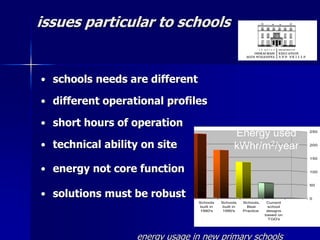
issues particular to schools
• schools needs are different
• different operational profiles
• short hours of operation
• technical ability on site
• energy not core function
• solutions must be robust
energy usage in new primary schools
0
50
100
150
200
250
Schools
built in
1980's
Schools
built in
1990's
Schools,
Best
Practice
Current
school
designs
based on
TGD's
Energy used
kWhr/m2/year
renewables in schools
• thermal solar
• photovoltaic For more information visit energyineducation.ie
• wind
• biomass
energy in schools
• our energy policy & design approach
• research projects informing approach to
achieving new energy regulation targets
• NZEB design priorities
• proposed implementation of NZEB interim
• proposed next steps
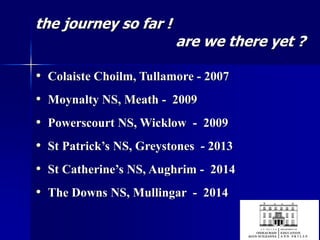
the journey so far !
are we there yet ?
• Colaiste Choilm, Tullamore - 2007
• Moynalty NS, Meath - 2009
• Powerscourt NS, Wicklow - 2009
• St Patrick’s NS, Greystones - 2013
• St Catherine’s NS, Aughrim - 2014
• The Downs NS, Mullingar - 2014
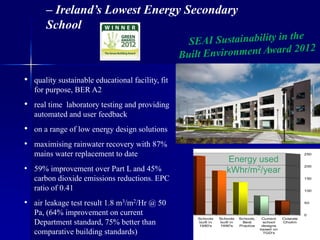
– Ireland’s Lowest Energy Secondary
School
• quality sustainable educational facility, fit
for purpose, BER A2
• real time laboratory testing and providing
automated and user feedback
• on a range of low energy design solutions
• maximising rainwater recovery with 87%
mains water replacement to date
• 59% improvement over Part L and 45%
carbon dioxide emissions reductions. EPC
ratio of 0.41
• air leakage test result 1.8 m3/m2/Hr @ 50
Pa, (64% improvement on current
Department standard, 75% better than
comparative building standards)
0
50
100
150
200
250
Schools
built in
1980's
Schools
built in
1990's
Schools,
Best
Practice
Current
school
designs
based on
TGD's
Colaiste
Choilm
Energy used
kWhr/m2/year
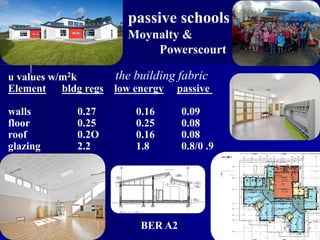
u values w/m2k
Element bldg regs low energy passive
walls 0.27 0.16 0.09
floor 0.25 0.25 0.08
roof 0.2O 0.16 0.08
glazing 2.2 1.8 0.8/0 .9
• passive schools
• Moynalty &
Powerscourt
the building fabric
BER A2
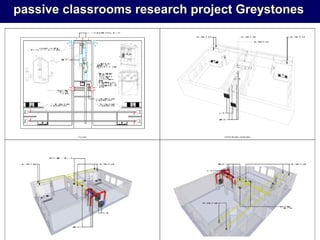
passive classrooms research project Greystones

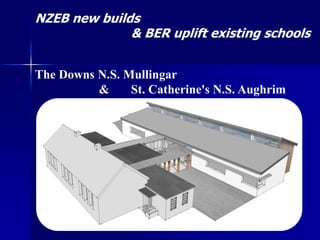
NZEB new builds
& BER uplift existing schools
The Downs N.S. Mullingar
& St. Catherine's N.S. Aughrim
energy in schools
• our energy policy & design approach
• research projects informing approach to
achieving new energy regulation targets
• NZEB design priorities
• proposed implementation of NZEB interim
• proposed next steps
NZEB design priorities
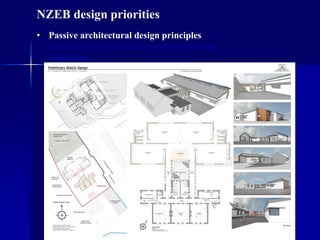
• Passive architectural design principles
• Energy efficient envelope and technologies
• Modelling
NZEB design priorities
• Passive architectural design principles
• Energy efficient envelope and technologies
• Modelling
NZEB design priorities
Passive architectural design principles
Energy efficient envelope and technologies
Modelling
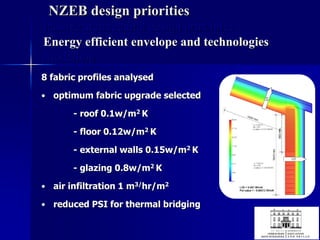
8 fabric profiles analysed
• optimum fabric upgrade selected
- roof 0.1w/m2 K
- floor 0.12w/m2 K
- external walls 0.15w/m2 K
- glazing 0.8w/m2 K
• air infiltration 1 m3/hr/m2
• reduced PSI for thermal bridging
NZEB design priorities
Passive architectural design principles
Energy efficient envelope and technologies
Modelling
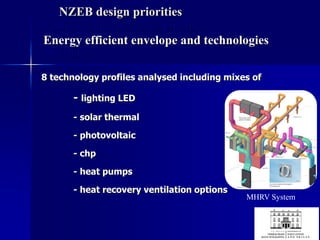
8 technology profiles analysed including mixes of
- lighting LED
- solar thermal
- photovoltaic
- chp
- heat pumps
- heat recovery ventilation options
MHRV System
NZEB design priorities
Passive architectural design principles
Energy efficient envelope and technologies
Modelling
selected targets * model parameters
A 55 kWh/m2 &
10 % renewables
B 50 kWh/m2 with
no renewables
C 40 kWh/m2 &
20 % renewables
• dry resultant temp does not exceed 25 0C for
5% of occupied year
• occupied period 1st Sept to 21 June (183 days)
• occupancy 9am to 3pm
• daylight Factor 4.5 %
• 16 different energy profiles developed
modelling – Sustainable Engineering Solutions Ltd
NZEB design priorities
Passive architectural design principles
Energy efficient envelope and technologies
Modelling
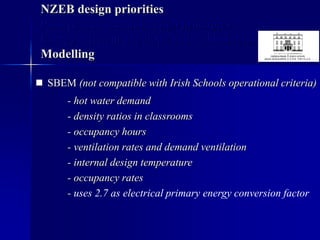
 SBEM (not compatible with Irish Schools operational criteria)
- hot water demand
- density ratios in classrooms
- occupancy hours
- ventilation rates and demand ventilation
- internal design temperature
- occupancy rates
- uses 2.7 as electrical primary energy conversion factor
NZEB design priorities
Passive architectural design principles
Energy efficient envelope and technologies
Modelling
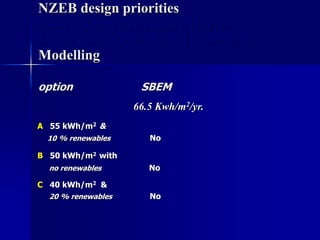
option SBEM
66.5 Kwh/m2/yr.
A 55 kWh/m2 &
10 % renewables No
B 50 kWh/m2 with
no renewables No
C 40 kWh/m2 &
20 % renewables No
NZEB design priorities
Passive architectural design principles
Energy efficient envelope and technologies
Modelling
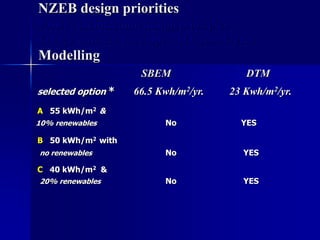
SBEM DTM
selected option * 66.5 Kwh/m2/yr. 23 Kwh/m2/yr.
A 55 kWh/m2 &
10% renewables No YES
B 50 kWh/m2 with
no renewables No YES
C 40 kWh/m2 &
20% renewables No YES
NZEB design priorities
Passive architectural design principles
Energy efficient envelope and technologies
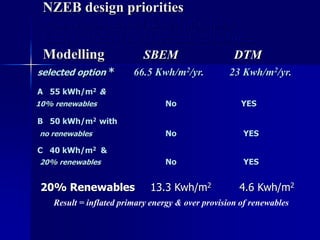
Modelling SBEM DTM
selected option * 66.5 Kwh/m2/yr. 23 Kwh/m2/yr.
A 55 kWh/m2 &
10% renewables No YES
B 50 kWh/m2 with
no renewables No YES
C 40 kWh/m2 &
20% renewables No YES
20% Renewables 13.3 Kwh/m2 4.6 Kwh/m2
Result = inflated primary energy & over provision of renewables
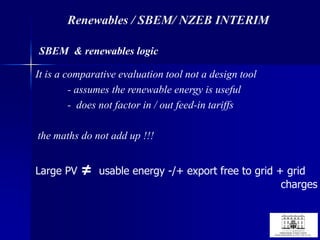
Renewables / SBEM/ NZEB INTERIM
It is a comparative evaluation tool not a design tool
- assumes the renewable energy is useful
- does not factor in / out feed-in tariffs
the maths do not add up !!!
Large PV ≠ usable energy -/+ export free to grid + grid
charges
SBEM & renewables logic
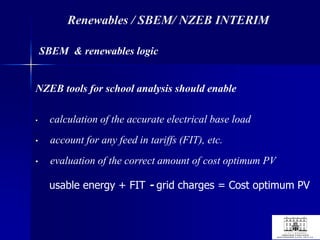
Renewables / SBEM/ NZEB INTERIM
NZEB tools for school analysis should enable
• calculation of the accurate electrical base load
• account for any feed in tariffs (FIT), etc.
• evaluation of the correct amount of cost optimum PV
usable energy + FIT - grid charges = Cost optimum PV
SBEM & renewables logic
energy in schools
• our energy policy & design approach
• research projects informing approach to
achieving new energy regulation targets
• NZEB design priorities
• proposed implementation of NZEB interim
• proposed next steps
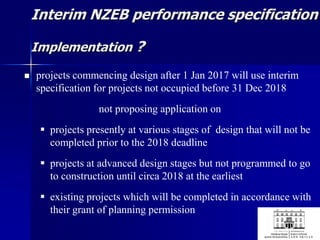
Interim NZEB performance specification
Implementation ?
 projects commencing design after 1 Jan 2017 will use interim
specification for projects not occupied before 31 Dec 2018
not proposing application on
 projects presently at various stages of design that will not be
completed prior to the 2018 deadline
 projects at advanced design stages but not programmed to go
to construction until circa 2018 at the earliest
 existing projects which will be completed in accordance with
their grant of planning permission
deliverables to apply NZEB interim
specification for schools
 the Simplified Building Energy Model (SBEM) requires
upgrading to reflect the Irish Schools criteria
 additional capital funding
 provisions to make the maths add up on renewables in
schools
energy in schools
• our energy policy & design approach
• research projects informing approach to
achieving new energy regulation targets
• NZEB design priorities
• proposed implementation of NZEB interim
• proposed next steps
Next steps
 deliverables to support NZEB interim Specification for
schools are required
 the Down’s NS detail design is underway based on interim
specification requirements, prequal Q1, tendering Q2,
opening 2018
maximising
nature
• passive solar
design
• daylighting
• quality ventilation
technologies
• > enhanced insulation
• > air tightness
• > enhanced glazing
• lighting & controls
• heating & controls
• water efficiency
• I.T. & web based
technologies
• renewable energy on site
• thermal bridging
applying NZEB interim specification to
schools
Next steps (continued)
 in accordance with DHPCLG direction, public sector
interim specification to be used by all design teams
appointed/ commencing design from 1 January 2017 where
the schools will be occupied after 31 Dec 2018
 the exact cost implications need to be established
 the funding implications will need to be addressed
Thank you for listening
www.energyineducation.ie.
energy in schools
Workshop on Public Sector NZEB
Interim Specification Jan 2017

Energy in Schools by John Dolan

  • 1.
    John Dolan BEng (Hons)M.Sc. Fire Eng H.Dip CEng MIEI Chartered Engineer Planning & Building Unit Tullamore www.energyineducation.ie. energy in schools Workshop on Public Sector NZEB Interim Specification Jan 2017
  • 2.
    energy in schools •our energy policy & design approach • research projects informing approach to achieving new energy regulation targets • NZEB design priorities • proposed implementation of NZEB interim • proposed next steps
  • 3.
    energy in schools •our energy policy & design approach • research projects informing approach to achieving new energy regulation targets • NZEB design priorities • proposed implementation of NZEB interim • proposed next steps
  • 4.
    energy in schooldesign • evolved from energy programme DART (Design, Awareness, Research & Technology) • informed by building unit professional & technical staff & external partnerships • driven by technical guidance documents • updated by continued energy research & development • disseminated by internal / external publications, conferences & annual report • specific project support from SEAI • acknowledged by national & international energy awards
  • 5.
    maximising nature • passive solardesign • daylighting • quality ventilation utilising technologies • enhanced insulation • air tightness • lighting & controls • heating & controls • water efficiency • I.T. & web based technologies
  • 6.
    issues particular toschools • schools needs are different • different operational profiles • short hours of operation • technical ability on site • energy not core function • solutions must be robust energy usage in new primary schools 0 50 100 150 200 250 Schools built in 1980's Schools built in 1990's Schools, Best Practice Current school designs based on TGD's Energy used kWhr/m2/year
  • 7.
    renewables in schools •thermal solar • photovoltaic For more information visit energyineducation.ie • wind • biomass
  • 8.
    energy in schools •our energy policy & design approach • research projects informing approach to achieving new energy regulation targets • NZEB design priorities • proposed implementation of NZEB interim • proposed next steps
  • 9.
    the journey sofar ! are we there yet ? • Colaiste Choilm, Tullamore - 2007 • Moynalty NS, Meath - 2009 • Powerscourt NS, Wicklow - 2009 • St Patrick’s NS, Greystones - 2013 • St Catherine’s NS, Aughrim - 2014 • The Downs NS, Mullingar - 2014
  • 10.
    – Ireland’s LowestEnergy Secondary School • quality sustainable educational facility, fit for purpose, BER A2 • real time laboratory testing and providing automated and user feedback • on a range of low energy design solutions • maximising rainwater recovery with 87% mains water replacement to date • 59% improvement over Part L and 45% carbon dioxide emissions reductions. EPC ratio of 0.41 • air leakage test result 1.8 m3/m2/Hr @ 50 Pa, (64% improvement on current Department standard, 75% better than comparative building standards) 0 50 100 150 200 250 Schools built in 1980's Schools built in 1990's Schools, Best Practice Current school designs based on TGD's Colaiste Choilm Energy used kWhr/m2/year
  • 11.
    u values w/m2k Elementbldg regs low energy passive walls 0.27 0.16 0.09 floor 0.25 0.25 0.08 roof 0.2O 0.16 0.08 glazing 2.2 1.8 0.8/0 .9 • passive schools • Moynalty & Powerscourt the building fabric BER A2
  • 12.
    passive classrooms researchproject Greystones 
  • 13.
    NZEB new builds &BER uplift existing schools The Downs N.S. Mullingar & St. Catherine's N.S. Aughrim
  • 14.
    energy in schools •our energy policy & design approach • research projects informing approach to achieving new energy regulation targets • NZEB design priorities • proposed implementation of NZEB interim • proposed next steps
  • 15.
    NZEB design priorities •Passive architectural design principles • Energy efficient envelope and technologies • Modelling
  • 16.
    NZEB design priorities •Passive architectural design principles • Energy efficient envelope and technologies • Modelling
  • 17.
    NZEB design priorities Passivearchitectural design principles Energy efficient envelope and technologies Modelling 8 fabric profiles analysed • optimum fabric upgrade selected - roof 0.1w/m2 K - floor 0.12w/m2 K - external walls 0.15w/m2 K - glazing 0.8w/m2 K • air infiltration 1 m3/hr/m2 • reduced PSI for thermal bridging
  • 18.
    NZEB design priorities Passivearchitectural design principles Energy efficient envelope and technologies Modelling 8 technology profiles analysed including mixes of - lighting LED - solar thermal - photovoltaic - chp - heat pumps - heat recovery ventilation options MHRV System
  • 19.
    NZEB design priorities Passivearchitectural design principles Energy efficient envelope and technologies Modelling selected targets * model parameters A 55 kWh/m2 & 10 % renewables B 50 kWh/m2 with no renewables C 40 kWh/m2 & 20 % renewables • dry resultant temp does not exceed 25 0C for 5% of occupied year • occupied period 1st Sept to 21 June (183 days) • occupancy 9am to 3pm • daylight Factor 4.5 % • 16 different energy profiles developed modelling – Sustainable Engineering Solutions Ltd
  • 20.
    NZEB design priorities Passivearchitectural design principles Energy efficient envelope and technologies Modelling  SBEM (not compatible with Irish Schools operational criteria) - hot water demand - density ratios in classrooms - occupancy hours - ventilation rates and demand ventilation - internal design temperature - occupancy rates - uses 2.7 as electrical primary energy conversion factor
  • 21.
    NZEB design priorities Passivearchitectural design principles Energy efficient envelope and technologies Modelling option SBEM 66.5 Kwh/m2/yr. A 55 kWh/m2 & 10 % renewables No B 50 kWh/m2 with no renewables No C 40 kWh/m2 & 20 % renewables No
  • 22.
    NZEB design priorities Passivearchitectural design principles Energy efficient envelope and technologies Modelling SBEM DTM selected option * 66.5 Kwh/m2/yr. 23 Kwh/m2/yr. A 55 kWh/m2 & 10% renewables No YES B 50 kWh/m2 with no renewables No YES C 40 kWh/m2 & 20% renewables No YES
  • 23.
    NZEB design priorities Passivearchitectural design principles Energy efficient envelope and technologies Modelling SBEM DTM selected option * 66.5 Kwh/m2/yr. 23 Kwh/m2/yr. A 55 kWh/m2 & 10% renewables No YES B 50 kWh/m2 with no renewables No YES C 40 kWh/m2 & 20% renewables No YES 20% Renewables 13.3 Kwh/m2 4.6 Kwh/m2 Result = inflated primary energy & over provision of renewables
  • 24.
    Renewables / SBEM/NZEB INTERIM It is a comparative evaluation tool not a design tool - assumes the renewable energy is useful - does not factor in / out feed-in tariffs the maths do not add up !!! Large PV ≠ usable energy -/+ export free to grid + grid charges SBEM & renewables logic
  • 25.
    Renewables / SBEM/NZEB INTERIM NZEB tools for school analysis should enable • calculation of the accurate electrical base load • account for any feed in tariffs (FIT), etc. • evaluation of the correct amount of cost optimum PV usable energy + FIT - grid charges = Cost optimum PV SBEM & renewables logic
  • 26.
    energy in schools •our energy policy & design approach • research projects informing approach to achieving new energy regulation targets • NZEB design priorities • proposed implementation of NZEB interim • proposed next steps
  • 27.
    Interim NZEB performancespecification Implementation ?  projects commencing design after 1 Jan 2017 will use interim specification for projects not occupied before 31 Dec 2018 not proposing application on  projects presently at various stages of design that will not be completed prior to the 2018 deadline  projects at advanced design stages but not programmed to go to construction until circa 2018 at the earliest  existing projects which will be completed in accordance with their grant of planning permission
  • 28.
    deliverables to applyNZEB interim specification for schools  the Simplified Building Energy Model (SBEM) requires upgrading to reflect the Irish Schools criteria  additional capital funding  provisions to make the maths add up on renewables in schools
  • 29.
    energy in schools •our energy policy & design approach • research projects informing approach to achieving new energy regulation targets • NZEB design priorities • proposed implementation of NZEB interim • proposed next steps
  • 30.
    Next steps  deliverablesto support NZEB interim Specification for schools are required  the Down’s NS detail design is underway based on interim specification requirements, prequal Q1, tendering Q2, opening 2018
  • 31.
    maximising nature • passive solar design •daylighting • quality ventilation technologies • > enhanced insulation • > air tightness • > enhanced glazing • lighting & controls • heating & controls • water efficiency • I.T. & web based technologies • renewable energy on site • thermal bridging applying NZEB interim specification to schools
  • 32.
    Next steps (continued) in accordance with DHPCLG direction, public sector interim specification to be used by all design teams appointed/ commencing design from 1 January 2017 where the schools will be occupied after 31 Dec 2018  the exact cost implications need to be established  the funding implications will need to be addressed
  • 33.
    Thank you forlistening www.energyineducation.ie. energy in schools Workshop on Public Sector NZEB Interim Specification Jan 2017