
Roth IRA Conversions


          By Ward J. Wilsey, JD, LLM
           3655 Nobel Dr. Suite 345
             San Diego, CA 92122
                (858) 764-2672
          wardwilsey@wilseylaw.com
Ward J. Wilsey, JD, LLM
 BA in Economics from UCSD
 JD from University of San Diego
 LLM in Taxation from Washington University in St. Louis
 Estate Planning Attorney with the Wilsey Law Firm
 Frequent lecturer with several providers of continuing legal
  education for attorneys, including the National Business
  Institute
Roth IRA Overview
 Roth IRAs are treated exactly like regular IRAs
   Except for where the Internal Revenue Code specifies
 Three main advantages
   Distributions are Tax Free
   No Required Minimum Distributions (“RMDs”)
   No Maximum Age for Making Contributions
 Disadvantage
   Cannot Deduct Contributions
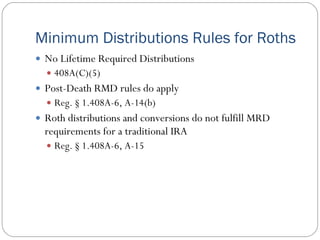
Minimum Distributions Rules for Roths
 No Lifetime Required Distributions
   408A(C)(5)
 Post-Death RMD rules do apply
   Reg. § 1.408A-6, A-14(b)
 Roth distributions and conversions do not fulfill MRD
  requirements for a traditional IRA
   Reg. § 1.408A-6, A-15
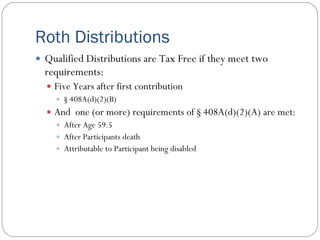
Roth Distributions
 Qualified Distributions are Tax Free if they meet two
  requirements:
   Five Years after first contribution
     § 408A(d)(2)(B)
   And one (or more) requirements of § 408A(d)(2)(A) are met:
     After Age 59.5
     After Participants death
     Attributable to Participant being disabled
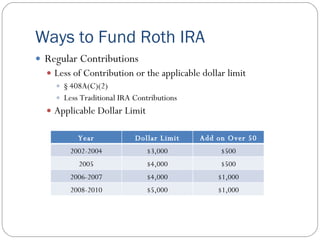
Ways to Fund Roth IRA
 Regular Contributions
   Less of Contribution or the applicable dollar limit
     § 408A(C)(2)
     Less Traditional IRA Contributions
   Applicable Dollar Limit

          Year           Dollar Limit     Add on Over 50
        2002-2004           $3,000              $500
          2005              $4,000              $500
        2006-2007           $4,000             $1,000
        2008-2010           $5,000             $1,000
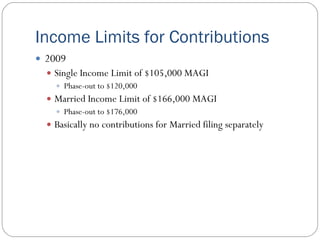
Income Limits for Contributions
 2009
   Single Income Limit of $105,000 MAGI
     Phase-out to $120,000
   Married Income Limit of $166,000 MAGI
     Phase-out to $176,000
   Basically no contributions for Married filing separately
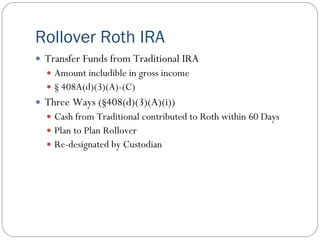
Rollover Roth IRA
 Transfer Funds from Traditional IRA
   Amount includible in gross income
   § 408A(d)(3)(A)-(C)
 Three Ways (§408(d)(3)(A)(i))
   Cash from Traditional contributed to Roth within 60 Days
   Plan to Plan Rollover
   Re-designated by Custodian
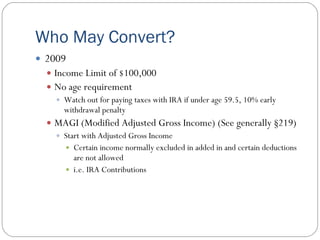
Who May Convert?
 2009
   Income Limit of $100,000
   No age requirement
     Watch out for paying taxes with IRA if under age 59.5, 10% early
      withdrawal penalty
   MAGI (Modified Adjusted Gross Income) (See generally §219)
     Start with Adjusted Gross Income
       Certain income normally excluded in added in and certain deductions
         are not allowed
       i.e. IRA Contributions
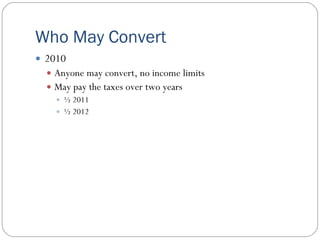
Who May Convert
 2010
   Anyone may convert, no income limits
   May pay the taxes over two years
     ½ 2011
     ½ 2012
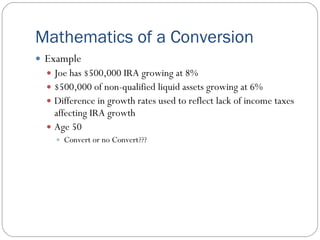
Mathematics of a Conversion
 Example
   Joe has $500,000 IRA growing at 8%
   $500,000 of non-qualified liquid assets growing at 6%
   Difference in growth rates used to reflect lack of income taxes
    affecting IRA growth
   Age 50
     Convert or no Convert???
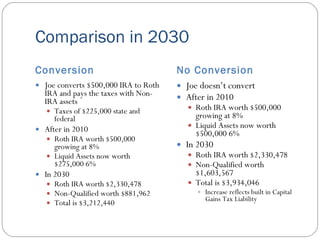
Comparison in 2030
Conversion                            No Conversion
 Joe converts $500,000 IRA to Roth    Joe doesn’t convert
  IRA and pays the taxes with Non-     After in 2010
  IRA assets
    Taxes of $225,000 state and         Roth IRA worth $500,000
     federal                              growing at 8%
                                         Liquid Assets now worth
 After in 2010
                                          $500,000 6%
    Roth IRA worth $500,000
     growing at 8%                     In 2030
    Liquid Assets now worth             Roth IRA worth $2,330,478
     $275,000 6%                         Non-Qualified worth
 In 2030                                 $1,603,567
    Roth IRA worth $2,330,478           Total is $3,934,046
    Non-Qualified worth $881,962           Increase reflects built in Capital
                                              Gains Tax Liability
    Total is $3,212,440
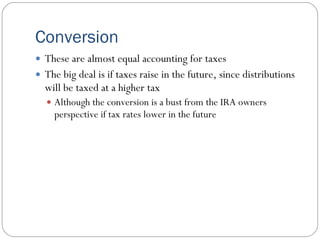
Conversion
 These are almost equal accounting for taxes
 The big deal is if taxes raise in the future, since distributions
  will be taxed at a higher tax
   Although the conversion is a bust from the IRA owners
    perspective if tax rates lower in the future
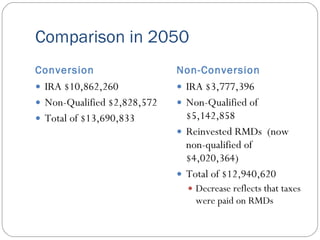
Comparison in 2050
Conversion                   Non-Conversion
 IRA $10,862,260             IRA $3,777,396
 Non-Qualified $2,828,572    Non-Qualified of
 Total of $13,690,833         $5,142,858
                              Reinvested RMDs (now
                               non-qualified of
                               $4,020,364)
                              Total of $12,940,620
                                Decrease reflects that taxes
                                 were paid on RMDs
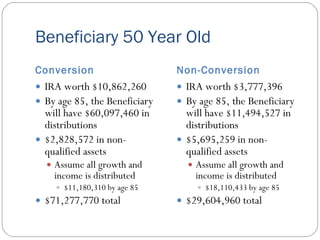
Beneficiary 50 Year Old
Conversion                     Non-Conversion
 IRA worth $10,862,260         IRA worth $3,777,396
 By age 85, the Beneficiary    By age 85, the Beneficiary
  will have $60,097,460 in       will have $11,494,527 in
  distributions                  distributions
 $2,828,572 in non-            $5,695,259 in non-
  qualified assets               qualified assets
   Assume all growth and         Assume all growth and
    income is distributed          income is distributed
     $11,180,310 by age 85         $18,110,433 by age 85
 $71,277,770 total             $29,604,960 total
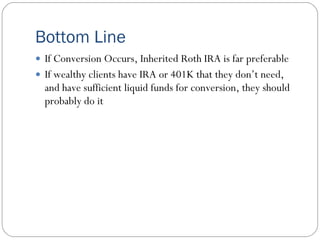
Bottom Line
 If Conversion Occurs, Inherited Roth IRA is far preferable
 If wealthy clients have IRA or 401K that they don’t need,
  and have sufficient liquid funds for conversion, they should
  probably do it
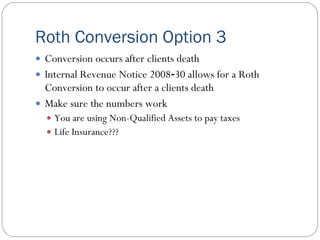
Roth Conversion Option 3
 Conversion occurs after clients death
 Internal Revenue Notice 2008‐30 allows for a Roth
  Conversion to occur after a clients death
 Make sure the numbers work
   You are using Non-Qualified Assets to pay taxes
   Life Insurance???
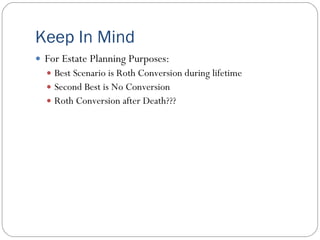
Keep In Mind
 For Estate Planning Purposes:
   Best Scenario is Roth Conversion during lifetime
   Second Best is No Conversion
   Roth Conversion after Death???

Roth Ira Conversions

  • 1.
    Roth IRA Conversions By Ward J. Wilsey, JD, LLM 3655 Nobel Dr. Suite 345 San Diego, CA 92122 (858) 764-2672 wardwilsey@wilseylaw.com
  • 2.
    Ward J. Wilsey,JD, LLM  BA in Economics from UCSD  JD from University of San Diego  LLM in Taxation from Washington University in St. Louis  Estate Planning Attorney with the Wilsey Law Firm  Frequent lecturer with several providers of continuing legal education for attorneys, including the National Business Institute
  • 3.
    Roth IRA Overview Roth IRAs are treated exactly like regular IRAs  Except for where the Internal Revenue Code specifies  Three main advantages  Distributions are Tax Free  No Required Minimum Distributions (“RMDs”)  No Maximum Age for Making Contributions  Disadvantage  Cannot Deduct Contributions
  • 4.
    Minimum Distributions Rulesfor Roths  No Lifetime Required Distributions  408A(C)(5)  Post-Death RMD rules do apply  Reg. § 1.408A-6, A-14(b)  Roth distributions and conversions do not fulfill MRD requirements for a traditional IRA  Reg. § 1.408A-6, A-15
  • 5.
    Roth Distributions  QualifiedDistributions are Tax Free if they meet two requirements:  Five Years after first contribution  § 408A(d)(2)(B)  And one (or more) requirements of § 408A(d)(2)(A) are met:  After Age 59.5  After Participants death  Attributable to Participant being disabled
  • 6.
    Ways to FundRoth IRA  Regular Contributions  Less of Contribution or the applicable dollar limit  § 408A(C)(2)  Less Traditional IRA Contributions  Applicable Dollar Limit Year Dollar Limit Add on Over 50 2002-2004 $3,000 $500 2005 $4,000 $500 2006-2007 $4,000 $1,000 2008-2010 $5,000 $1,000
  • 7.
    Income Limits forContributions  2009  Single Income Limit of $105,000 MAGI  Phase-out to $120,000  Married Income Limit of $166,000 MAGI  Phase-out to $176,000  Basically no contributions for Married filing separately
  • 8.
    Rollover Roth IRA Transfer Funds from Traditional IRA  Amount includible in gross income  § 408A(d)(3)(A)-(C)  Three Ways (§408(d)(3)(A)(i))  Cash from Traditional contributed to Roth within 60 Days  Plan to Plan Rollover  Re-designated by Custodian
  • 9.
    Who May Convert? 2009  Income Limit of $100,000  No age requirement  Watch out for paying taxes with IRA if under age 59.5, 10% early withdrawal penalty  MAGI (Modified Adjusted Gross Income) (See generally §219)  Start with Adjusted Gross Income  Certain income normally excluded in added in and certain deductions are not allowed  i.e. IRA Contributions
  • 10.
    Who May Convert 2010  Anyone may convert, no income limits  May pay the taxes over two years  ½ 2011  ½ 2012
  • 11.
    Mathematics of aConversion  Example  Joe has $500,000 IRA growing at 8%  $500,000 of non-qualified liquid assets growing at 6%  Difference in growth rates used to reflect lack of income taxes affecting IRA growth  Age 50  Convert or no Convert???
  • 12.
    Comparison in 2030 Conversion No Conversion  Joe converts $500,000 IRA to Roth  Joe doesn’t convert IRA and pays the taxes with Non-  After in 2010 IRA assets  Taxes of $225,000 state and  Roth IRA worth $500,000 federal growing at 8%  Liquid Assets now worth  After in 2010 $500,000 6%  Roth IRA worth $500,000 growing at 8%  In 2030  Liquid Assets now worth  Roth IRA worth $2,330,478 $275,000 6%  Non-Qualified worth  In 2030 $1,603,567  Roth IRA worth $2,330,478  Total is $3,934,046  Non-Qualified worth $881,962  Increase reflects built in Capital Gains Tax Liability  Total is $3,212,440
  • 13.
    Conversion  These arealmost equal accounting for taxes  The big deal is if taxes raise in the future, since distributions will be taxed at a higher tax  Although the conversion is a bust from the IRA owners perspective if tax rates lower in the future
  • 14.
    Comparison in 2050 Conversion Non-Conversion  IRA $10,862,260  IRA $3,777,396  Non-Qualified $2,828,572  Non-Qualified of  Total of $13,690,833 $5,142,858  Reinvested RMDs (now non-qualified of $4,020,364)  Total of $12,940,620  Decrease reflects that taxes were paid on RMDs
  • 15.
    Beneficiary 50 YearOld Conversion Non-Conversion  IRA worth $10,862,260  IRA worth $3,777,396  By age 85, the Beneficiary  By age 85, the Beneficiary will have $60,097,460 in will have $11,494,527 in distributions distributions  $2,828,572 in non-  $5,695,259 in non- qualified assets qualified assets  Assume all growth and  Assume all growth and income is distributed income is distributed  $11,180,310 by age 85  $18,110,433 by age 85  $71,277,770 total  $29,604,960 total
  • 16.
    Bottom Line  IfConversion Occurs, Inherited Roth IRA is far preferable  If wealthy clients have IRA or 401K that they don’t need, and have sufficient liquid funds for conversion, they should probably do it
  • 17.
    Roth Conversion Option3  Conversion occurs after clients death  Internal Revenue Notice 2008‐30 allows for a Roth Conversion to occur after a clients death  Make sure the numbers work  You are using Non-Qualified Assets to pay taxes  Life Insurance???
  • 18.
    Keep In Mind For Estate Planning Purposes:  Best Scenario is Roth Conversion during lifetime  Second Best is No Conversion  Roth Conversion after Death???