







What Every Attorney, Accountant and Financial Advisor Must Know About IRAs and 401ks
What We Will Cover Minimum Distribution Rules Disclaimers Roth IRA Conversions Beneficiary Designations IRA Triple-Tax Trap Use of Life Insurance with IRAs Stretch IRAs Stretch IRA Trusts
Minimum Distribution Rules Mandatory withdrawals upon reaching 70 ½ Plans grow on tax deferred basis Keeps funds from growing tax deferred forever Distributions made according to Uniform Life Table  Divide Account Balance on Dec. 31 of previous year by Divisor Recalculation v. Fixed Method
Determining MRD During Participant’s Lifetime At age 70 ½ Except Roth’s By December 31 st  of each year MRD determined by Life Expectancy Divisor Assuming MRDs only taken out Account Balance will not start fall until participant is well into 90’s Account Balance will not be reduced to pre-70 ½ size until 110+
Determining MRD’s after death Ask Four Questions Did the participant die before or after his RBD? Are there Multiple Beneficiaries? Do the benefits pass to a Designated Beneficiary?  What distribution option does the plan permit?
If Death Before RBD Surviving Spouse Surviving Spouse’s Life Expectancy  Uniform Table Individual Non-Spouse Beneficiary Individual Beneficiaries Life Expectancy Single Life Table Estate, non-Stretch IRA Trust, or other non-DB 5-Year Rule BAD,BAD, BAD
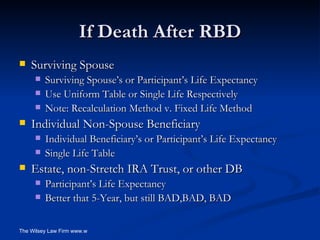
If Death After RBD Surviving Spouse Surviving Spouse’s or Participant’s Life Expectancy Use Uniform Table or Single Life Respectively Note: Recalculation Method v. Fixed Life Method Individual Non-Spouse Beneficiary Individual Beneficiary’s or Participant’s Life Expectancy Single Life Table Estate, non-Stretch IRA Trust, or other DB Participant’s Life Expectancy  Better that 5-Year, but still BAD,BAD, BAD
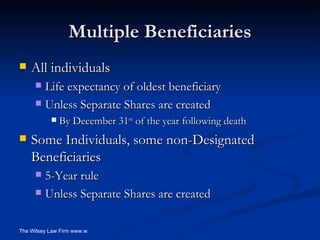
Multiple Beneficiaries All individuals Life expectancy of oldest beneficiary Unless Separate Shares are created By December 31 st  of the year following death Some Individuals, some non-Designated Beneficiaries 5-Year rule Unless Separate Shares are created
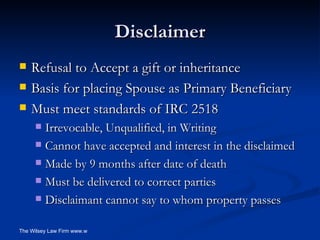
Disclaimer Refusal to Accept a gift or inheritance Basis for placing Spouse as Primary Beneficiary Must meet standards of IRC 2518 Irrevocable, Unqualified, in Writing Cannot have accepted and interest in the disclaimed Made by 9 months after date of death Must be delivered to correct parties Disclaimant cannot say to whom property passes
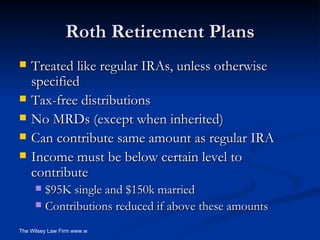
Roth Retirement Plans Treated like regular IRAs, unless otherwise specified Tax-free distributions No MRDs (except when inherited) Can contribute same amount as regular IRA Income must be below certain level to contribute $95K single and $150k married Contributions reduced if above these amounts
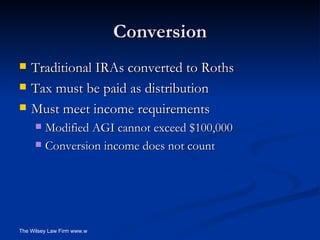
Conversion Traditional IRAs converted to Roths Tax must be paid as distribution Must meet income requirements Modified AGI cannot exceed $100,000 Conversion income does not count
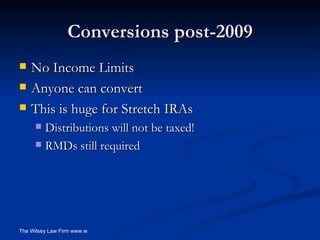
Conversions post-2009 No Income Limits Anyone can convert This is huge for Stretch IRAs Distributions will not be taxed! RMDs still required
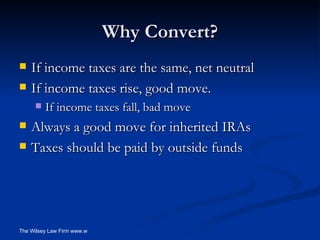
Why Convert? If income taxes are the same, net neutral If income taxes rise, good move. If income taxes fall, bad move Always a good move for inherited IRAs Taxes should be paid by outside funds
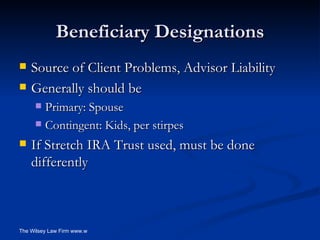
Beneficiary Designations Source of Client Problems, Advisor Liability Generally should be Primary: Spouse Contingent: Kids, per stirpes If Stretch IRA Trust used, must be done differently
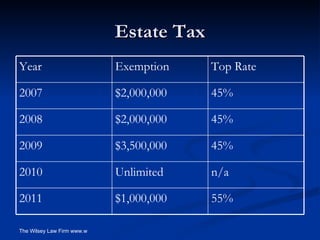
Triple Taxes Three Types of Taxes  Estate-55% after 2011 Federal Income-35% State Income-9.3%
Estate Tax 55% $1,000,000 2011 n/a Unlimited 2010 45% $3,500,000 2009 45% $2,000,000 2008 45% $2,000,000 2007 Top Rate Exemption Year
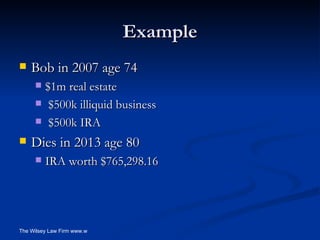
Example Bob in 2007 age 74 $1m real estate $500k illiquid business $500k IRA Dies in 2013 age 80 IRA worth $765,298.16
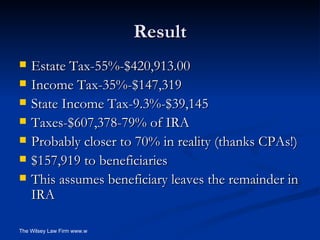
Result Estate Tax-55%-$420,913.00 Income Tax-35%-$147,319 State Income Tax-9.3%-$39,145 Taxes-$607,378-79% of IRA Probably closer to 70% in reality (thanks CPAs!) $157,919 to beneficiaries This assumes beneficiary leaves the remainder in IRA
 
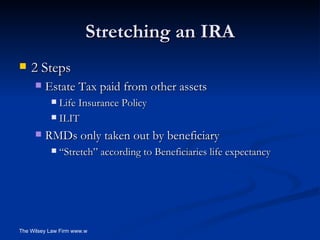
Stretching an IRA 2 Steps Estate Tax paid from other assets Life Insurance Policy ILIT RMDs only taken out by beneficiary “Stretch” according to Beneficiaries life expectancy
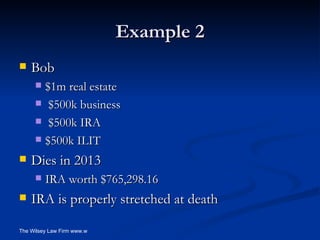
Example 2 Bob $1m real estate $500k business $500k IRA $500k ILIT Dies in 2013 IRA worth $765,298.16 IRA is properly stretched at death
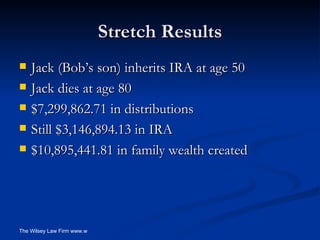
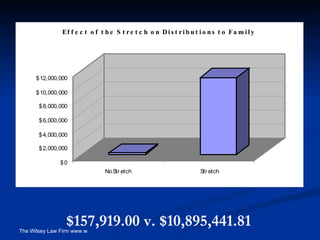
Stretch Results Jack (Bob’s son) inherits IRA at age 50 Jack dies at age 80 $7,299,862.71 in distributions Still $3,146,894.13 in IRA $10,895,441.81 in family wealth created
$157,919.00 v. $10,895,441.81
NO BRAINER!!!
Stretch is NOT Automatic Blow-Outs are the norm, not the exception Why Not understanding rules and choices Asking advice of Custodian Corporate Plan requires withdrawal Beneficiary Rollover Poor Money Management Spending
Problems for Prudent Beneficiaries Creditors Divorce Lawsuits
Living Trust Will Not Work Limited Creditor Protection Mandatory Distributions Non-Designated Beneficiaries Oldest Beneficiary is Spouse No Stretch (Conduit) Language
Solution STAND ALONE  STRETCH IRA TRUST
Stretch IRA Trust Forces Stretch Provides Creditor Protection Stand Alone Revocable Beneficiary of IRA upon death  Surviving Spouse still receives Benefit Independent Trustee
Spouse Spouse should receive trust outright Beneficiaries Primary: Spouse Contingent: Each child’s share of the Stretch IRA Trust Spouse can disclaim if sufficient other assets ILIT paying spouse income?
Example Bob’s son Jack receives Bob’s IRA in a Stretch IRA Trust Jack gets sued, $2million judgment Jack’s IRA is protected, not lost Stretch is preserved If no Stretch IRA trust, IRA is probably lost
Accumulation v. Conduit Accumulation Amounts held in trust Conduit RMDs distributed every year Trust Protector can switch to Accumulation (1 time)
Conclusion MRD Requirements Problem: Triple Tax Solution: Stretch Roadblock: Stretch is not Automatic Solution: Stretch IRA Trust

IRA Seminar for Advisors

  • 1.
    What Every Attorney,Accountant and Financial Advisor Must Know About IRAs and 401ks
  • 2.
    What We WillCover Minimum Distribution Rules Disclaimers Roth IRA Conversions Beneficiary Designations IRA Triple-Tax Trap Use of Life Insurance with IRAs Stretch IRAs Stretch IRA Trusts
  • 3.
    Minimum Distribution RulesMandatory withdrawals upon reaching 70 ½ Plans grow on tax deferred basis Keeps funds from growing tax deferred forever Distributions made according to Uniform Life Table Divide Account Balance on Dec. 31 of previous year by Divisor Recalculation v. Fixed Method
  • 4.
    Determining MRD DuringParticipant’s Lifetime At age 70 ½ Except Roth’s By December 31 st of each year MRD determined by Life Expectancy Divisor Assuming MRDs only taken out Account Balance will not start fall until participant is well into 90’s Account Balance will not be reduced to pre-70 ½ size until 110+
  • 5.
    Determining MRD’s afterdeath Ask Four Questions Did the participant die before or after his RBD? Are there Multiple Beneficiaries? Do the benefits pass to a Designated Beneficiary? What distribution option does the plan permit?
  • 6.
    If Death BeforeRBD Surviving Spouse Surviving Spouse’s Life Expectancy Uniform Table Individual Non-Spouse Beneficiary Individual Beneficiaries Life Expectancy Single Life Table Estate, non-Stretch IRA Trust, or other non-DB 5-Year Rule BAD,BAD, BAD
  • 7.
    If Death AfterRBD Surviving Spouse Surviving Spouse’s or Participant’s Life Expectancy Use Uniform Table or Single Life Respectively Note: Recalculation Method v. Fixed Life Method Individual Non-Spouse Beneficiary Individual Beneficiary’s or Participant’s Life Expectancy Single Life Table Estate, non-Stretch IRA Trust, or other DB Participant’s Life Expectancy Better that 5-Year, but still BAD,BAD, BAD
  • 8.
    Multiple Beneficiaries Allindividuals Life expectancy of oldest beneficiary Unless Separate Shares are created By December 31 st of the year following death Some Individuals, some non-Designated Beneficiaries 5-Year rule Unless Separate Shares are created
  • 9.
    Disclaimer Refusal toAccept a gift or inheritance Basis for placing Spouse as Primary Beneficiary Must meet standards of IRC 2518 Irrevocable, Unqualified, in Writing Cannot have accepted and interest in the disclaimed Made by 9 months after date of death Must be delivered to correct parties Disclaimant cannot say to whom property passes
  • 10.
    Roth Retirement PlansTreated like regular IRAs, unless otherwise specified Tax-free distributions No MRDs (except when inherited) Can contribute same amount as regular IRA Income must be below certain level to contribute $95K single and $150k married Contributions reduced if above these amounts
  • 11.
    Conversion Traditional IRAsconverted to Roths Tax must be paid as distribution Must meet income requirements Modified AGI cannot exceed $100,000 Conversion income does not count
  • 12.
    Conversions post-2009 NoIncome Limits Anyone can convert This is huge for Stretch IRAs Distributions will not be taxed! RMDs still required
  • 13.
    Why Convert? Ifincome taxes are the same, net neutral If income taxes rise, good move. If income taxes fall, bad move Always a good move for inherited IRAs Taxes should be paid by outside funds
  • 14.
    Beneficiary Designations Sourceof Client Problems, Advisor Liability Generally should be Primary: Spouse Contingent: Kids, per stirpes If Stretch IRA Trust used, must be done differently
  • 15.
    Triple Taxes ThreeTypes of Taxes Estate-55% after 2011 Federal Income-35% State Income-9.3%
  • 16.
    Estate Tax 55%$1,000,000 2011 n/a Unlimited 2010 45% $3,500,000 2009 45% $2,000,000 2008 45% $2,000,000 2007 Top Rate Exemption Year
  • 17.
    Example Bob in2007 age 74 $1m real estate $500k illiquid business $500k IRA Dies in 2013 age 80 IRA worth $765,298.16
  • 18.
    Result Estate Tax-55%-$420,913.00Income Tax-35%-$147,319 State Income Tax-9.3%-$39,145 Taxes-$607,378-79% of IRA Probably closer to 70% in reality (thanks CPAs!) $157,919 to beneficiaries This assumes beneficiary leaves the remainder in IRA
  • 19.
  • 20.
    Stretching an IRA2 Steps Estate Tax paid from other assets Life Insurance Policy ILIT RMDs only taken out by beneficiary “Stretch” according to Beneficiaries life expectancy
  • 21.
    Example 2 Bob$1m real estate $500k business $500k IRA $500k ILIT Dies in 2013 IRA worth $765,298.16 IRA is properly stretched at death
  • 22.
    Stretch Results Jack(Bob’s son) inherits IRA at age 50 Jack dies at age 80 $7,299,862.71 in distributions Still $3,146,894.13 in IRA $10,895,441.81 in family wealth created
  • 23.
  • 24.
  • 25.
    Stretch is NOTAutomatic Blow-Outs are the norm, not the exception Why Not understanding rules and choices Asking advice of Custodian Corporate Plan requires withdrawal Beneficiary Rollover Poor Money Management Spending
  • 26.
    Problems for PrudentBeneficiaries Creditors Divorce Lawsuits
  • 27.
    Living Trust WillNot Work Limited Creditor Protection Mandatory Distributions Non-Designated Beneficiaries Oldest Beneficiary is Spouse No Stretch (Conduit) Language
  • 28.
    Solution STAND ALONE STRETCH IRA TRUST
  • 29.
    Stretch IRA TrustForces Stretch Provides Creditor Protection Stand Alone Revocable Beneficiary of IRA upon death Surviving Spouse still receives Benefit Independent Trustee
  • 30.
    Spouse Spouse shouldreceive trust outright Beneficiaries Primary: Spouse Contingent: Each child’s share of the Stretch IRA Trust Spouse can disclaim if sufficient other assets ILIT paying spouse income?
  • 31.
    Example Bob’s sonJack receives Bob’s IRA in a Stretch IRA Trust Jack gets sued, $2million judgment Jack’s IRA is protected, not lost Stretch is preserved If no Stretch IRA trust, IRA is probably lost
  • 32.
    Accumulation v. ConduitAccumulation Amounts held in trust Conduit RMDs distributed every year Trust Protector can switch to Accumulation (1 time)
  • 33.
    Conclusion MRD RequirementsProblem: Triple Tax Solution: Stretch Roadblock: Stretch is not Automatic Solution: Stretch IRA Trust