Protecting Inheritances  from Creditors By Ward J. Wilsey, JD, LLM 3655 Nobel Dr. Suite 345 San Diego, CA 92122 (858) 764-2672 [email_address]
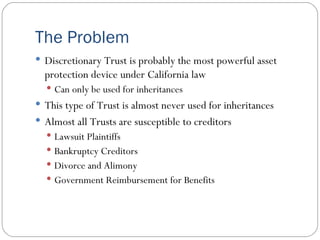
The Problem Discretionary Trust is probably the most powerful asset protection device under California law Can only be used for inheritances This type of Trust is almost never used for inheritances Almost all Trusts are susceptible to creditors Lawsuit Plaintiffs Bankruptcy Creditors Divorce and Alimony Government Reimbursement for Benefits
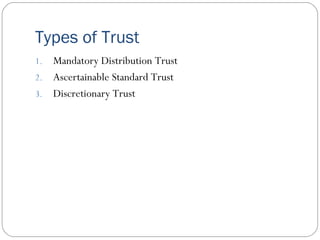
Types of Trust Mandatory Distribution Trust Ascertainable Standard Trust Discretionary Trust
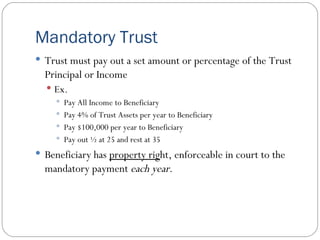
Mandatory Trust Trust must pay out a set amount or percentage of the Trust Principal or Income Ex. Pay All Income to Beneficiary Pay 4% of Trust Assets per year to Beneficiary Pay $100,000 per year to Beneficiary Pay out ½ at 25 and rest at 35 Beneficiary has  property rig ht, enforceable in court to the mandatory payment  each year .
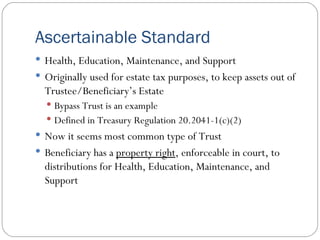
Ascertainable Standard Health, Education, Maintenance, and Support Originally used for estate tax purposes, to keep assets out of Trustee/Beneficiary’s Estate Bypass Trust is an example Defined in Treasury Regulation 20.2041-1(c)(2) Now it seems most common type of Trust Beneficiary has a  property right , enforceable in court, to distributions for Health, Education, Maintenance, and Support
Effect of a Property Right If the Beneficiary has a Property Right, enforceable in court, then their creditor has a right to ask the court to make a distribution to satisfy the creditor claim Mandatory Distribution and Ascertainable Standard Trusts Both allow Beneficiary to have Property Right Neither protects against creditors
Discretionary Dynasty Trust This type of Trust is the only type that provides creditor protection for beneficiaries 3 Types Beneficiary Controlled Beneficiary Controlled with Distribution Trustee Full Discretion of Independent Trustee
Beneficiary Controlled Trust In California, a Beneficiary who is the sole trustee of a trust must abide by the health, education, maintenance, and support standard. Cal. Probate Code 16081(c) Creates a Property Right Therefore, this type of trust does not offer much asset protection However, we can allow the Trust Protector to have the right to remove the Trustee, and replace them with an Independent Trustee having full discretion, which  may  solve this problem
Beneficiary Controlled with Distribution Trustee Beneficiary is managing trustee and appoints a co-trustee responsible for making distributions Beneficiary retains right to remove and replace all trustees This probably eliminates the application of Cal. Probate Code 16081(c). Co-Trustee may use Discretionary Distribution standard This should not create a Property Right in the Trust
Fully Discretionary Trust with Independent Trustee Independent Trustee Sole, Absolute and Unreviewable Discretion to make distributions as they see fit. Still must be made “reasonably” under California law Most powerful asset protection There is no real possibility of a “Property Right” Creditor attack is really not possible, according to case  law.
Controlling the Trustee How do you make sure the Trustee makes prudent decisions? Method 1 Leave a Letter of Wishes Allow Trust Protector to Remove and Replace if Letter of Wishes is Not Followed Method 2 Allow Beneficiary to Remove and Replace the Trustee Almost like the beneficiary is in control, no real risk of being labeled a “Property Right”
Summary Most Trusts are Mandatory Distribution Trusts or Ascertainable Standards Trusts These Trusts create a Property Right in the Trust Assets This Property Right makes the trust susceptible to creditors The only way to avoid creditor issues is through Discretionary Trust

Protecting Inheritances

  • 1.
    Protecting Inheritances from Creditors By Ward J. Wilsey, JD, LLM 3655 Nobel Dr. Suite 345 San Diego, CA 92122 (858) 764-2672 [email_address]
  • 2.
    The Problem DiscretionaryTrust is probably the most powerful asset protection device under California law Can only be used for inheritances This type of Trust is almost never used for inheritances Almost all Trusts are susceptible to creditors Lawsuit Plaintiffs Bankruptcy Creditors Divorce and Alimony Government Reimbursement for Benefits
  • 3.
    Types of TrustMandatory Distribution Trust Ascertainable Standard Trust Discretionary Trust
  • 4.
    Mandatory Trust Trustmust pay out a set amount or percentage of the Trust Principal or Income Ex. Pay All Income to Beneficiary Pay 4% of Trust Assets per year to Beneficiary Pay $100,000 per year to Beneficiary Pay out ½ at 25 and rest at 35 Beneficiary has property rig ht, enforceable in court to the mandatory payment each year .
  • 5.
    Ascertainable Standard Health,Education, Maintenance, and Support Originally used for estate tax purposes, to keep assets out of Trustee/Beneficiary’s Estate Bypass Trust is an example Defined in Treasury Regulation 20.2041-1(c)(2) Now it seems most common type of Trust Beneficiary has a property right , enforceable in court, to distributions for Health, Education, Maintenance, and Support
  • 6.
    Effect of aProperty Right If the Beneficiary has a Property Right, enforceable in court, then their creditor has a right to ask the court to make a distribution to satisfy the creditor claim Mandatory Distribution and Ascertainable Standard Trusts Both allow Beneficiary to have Property Right Neither protects against creditors
  • 7.
    Discretionary Dynasty TrustThis type of Trust is the only type that provides creditor protection for beneficiaries 3 Types Beneficiary Controlled Beneficiary Controlled with Distribution Trustee Full Discretion of Independent Trustee
  • 8.
    Beneficiary Controlled TrustIn California, a Beneficiary who is the sole trustee of a trust must abide by the health, education, maintenance, and support standard. Cal. Probate Code 16081(c) Creates a Property Right Therefore, this type of trust does not offer much asset protection However, we can allow the Trust Protector to have the right to remove the Trustee, and replace them with an Independent Trustee having full discretion, which may solve this problem
  • 9.
    Beneficiary Controlled withDistribution Trustee Beneficiary is managing trustee and appoints a co-trustee responsible for making distributions Beneficiary retains right to remove and replace all trustees This probably eliminates the application of Cal. Probate Code 16081(c). Co-Trustee may use Discretionary Distribution standard This should not create a Property Right in the Trust
  • 10.
    Fully Discretionary Trustwith Independent Trustee Independent Trustee Sole, Absolute and Unreviewable Discretion to make distributions as they see fit. Still must be made “reasonably” under California law Most powerful asset protection There is no real possibility of a “Property Right” Creditor attack is really not possible, according to case law.
  • 11.
    Controlling the TrusteeHow do you make sure the Trustee makes prudent decisions? Method 1 Leave a Letter of Wishes Allow Trust Protector to Remove and Replace if Letter of Wishes is Not Followed Method 2 Allow Beneficiary to Remove and Replace the Trustee Almost like the beneficiary is in control, no real risk of being labeled a “Property Right”
  • 12.
    Summary Most Trustsare Mandatory Distribution Trusts or Ascertainable Standards Trusts These Trusts create a Property Right in the Trust Assets This Property Right makes the trust susceptible to creditors The only way to avoid creditor issues is through Discretionary Trust