SAP Parts Pvt.Ltd. – Add: 85 B.U Bhandari Indl.Estate, Sanaswadi, Pune -412208, INDIA. www.sapparts.com.
Metal Face Seal
Failures
  
Seal failure can lead to a potential
consequences in a mechanical
system, mainly that of Rock
Breaking Machines, and cutter
rollers of TBM in an underground
environment.
During the Failed Cutter Roller
assembly analysis, it is seen that
the most commonly needed first
part to be removed is Failed
Mechanical Seal. The severity of
failure in some cases shows the
Torric Rings burn outs and smoke
thereto. However quite often the
mode of failure isn’t so obvious.
Complicating things ahead, it is
not always easy to determine the
cause of failure once the failure
mode is isolated.
Modes of Seal Failure:
 Damaged O -Rings.
 Fused Faces.
 Abrasive Wear
Causes of Seal Failure
 Assembly Error
 Too much Drag
 Too Low face Pressure
 Rust after pronged not in
use time.
 Mud Packing due to clay
entered in cutters
Cutter Rollers
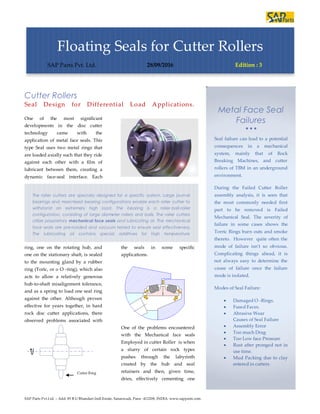
Seal Design for Differential Load Applications.
One of the most significant
developments in the disc cutter
technology came with the
application of metal face seals. This
type Seal uses two metal rings that
are loaded axially such that they ride
against each other with a film of
lubricant between them, creating a
dynamic face-seal interface. Each
ring, one on the rotating hub, and
one on the stationary shaft, is sealed
to the mounting gland by a rubber
ring (Toric, or o O -ring), which also
acts to allow a relatively generous
hub-to-shaft misalignment tolerance,
and as a spring to load one seal ring
against the other. Although proven
effective for years together, in hard
rock disc cutter applications, there
observed problems associated with
the seals in some specific
applications.
One of the problems encountered
with the Mechanical face seals
Employed in cutter Roller is when
a slurry of certain rock types
pushes through the labyrinth
created by the hub and seal
retainers and then, given time,
dries, effectively cementing one
Floating Seals for Cutter Rollers
SAP Parts Pvt. Ltd. 28/09/2016 Edition : 3
The roller cutters are specially designed for a specific system. Large journal
bearings and maximized bearing configurations enable each roller cutter to
withstand an extremely high load. The bearing is a roller-ball-roller
configuration, consisting of large diameter rollers and balls. The roller cutters
utilize proprietary mechanical face seals and lubricating oil. The mechanical
face seals are pre-loaded and vacuum tested to ensure seal effectiveness.
The lubricating oil contains special additives for high temperature
Cutter Ring
SAP Parts Pvt.Ltd. – Add: 85 B.U Bhandari Indl.Estate, Sanaswadi, Pune -412208, INDIA. www.sapparts.com.
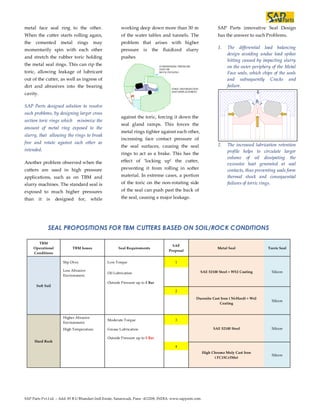
SEAL PROPOSITIONS FOR TBM CUTTERS BASED ON SOIL/ROCK CONDITIONS
TBM
Operational
Conditions
TBM Issues Seal Requirements
SAP
Proposal
Metal Seal Torric Seal
Soft Soil
Slip Over. Low Torque 1
SAE 52100 Steel + WS2 Coating SiliconLess Abrasive
Environment.
Oil Lubrication
Outside Pressure up to 3 Bar
2
Durenite Cast Iron ( Ni-Hard) + Ws2
Coating
Silicon
Hard Rock
Higher Abrasive
Environment.
Moderate Torque 3
SAE 52100 Steel SiliconHigh Temperature. Grease Lubrication
Outside Pressure up to 5 Bar
4
High Chrome Moly Cast Iron
( FC15Cr3Mo)
Silicon
metal face seal ring to the other.
When the cutter starts rolling again,
the cemented metal rings may
momentarily spin with each other
and stretch the rubber toric holding
the metal seal rings. This can rip the
toric, allowing leakage of lubricant
out of the cutter, as well as ingress of
dirt and abrasives into the bearing
cavity.
SAP Parts designed solution to resolve
such problems, by designing larger cross
section toric rings which minimize the
amount of metal ring exposed to the
slurry, that allowing the rings to break
free and rotate against each other as
intended.
Another problem observed when the
cutters are used in high pressure
applications, such as on TBM and
slurry machines. The standard seal is
exposed to much higher pressures
than it is designed for, while
working deep down more than 30 m
of the water tables and tunnels. The
problem that arises with higher
pressure is the fluidized slurry
pushes
against the toric, forcing it down the
seal gland ramps. This forces the
metal rings tighter against each other,
increasing face contact pressure of
the seal surfaces, causing the seal
rings to act as a brake. This has the
effect of ‘locking up’ the cutter,
preventing it from rolling in softer
material. In extreme cases, a portion
of the toric on the non-rotating side
of the seal can push past the back of
the seal, causing a major leakage.
SAP Parts innovative Seal Design
has the answer to such Problems.
1. The differential load balancing
design avoiding undue load spikes
hitting caused by impacting slurry
on the outer periphery of the Metal
Face seals, which chips of the seals
and subsequently Cracks and
failure.
2. The increased lubrication retention
profile helps to circulate larger
volume of oil dissipating the
excessive heat generated at seal
contacts, thus preventing seals form
thermal shock and consequential
failures of torric rings.

Floating seals for cutter rollers

  • 1.
    SAP Parts Pvt.Ltd.– Add: 85 B.U Bhandari Indl.Estate, Sanaswadi, Pune -412208, INDIA. www.sapparts.com. Metal Face Seal Failures    Seal failure can lead to a potential consequences in a mechanical system, mainly that of Rock Breaking Machines, and cutter rollers of TBM in an underground environment. During the Failed Cutter Roller assembly analysis, it is seen that the most commonly needed first part to be removed is Failed Mechanical Seal. The severity of failure in some cases shows the Torric Rings burn outs and smoke thereto. However quite often the mode of failure isn’t so obvious. Complicating things ahead, it is not always easy to determine the cause of failure once the failure mode is isolated. Modes of Seal Failure:  Damaged O -Rings.  Fused Faces.  Abrasive Wear Causes of Seal Failure  Assembly Error  Too much Drag  Too Low face Pressure  Rust after pronged not in use time.  Mud Packing due to clay entered in cutters Cutter Rollers Seal Design for Differential Load Applications. One of the most significant developments in the disc cutter technology came with the application of metal face seals. This type Seal uses two metal rings that are loaded axially such that they ride against each other with a film of lubricant between them, creating a dynamic face-seal interface. Each ring, one on the rotating hub, and one on the stationary shaft, is sealed to the mounting gland by a rubber ring (Toric, or o O -ring), which also acts to allow a relatively generous hub-to-shaft misalignment tolerance, and as a spring to load one seal ring against the other. Although proven effective for years together, in hard rock disc cutter applications, there observed problems associated with the seals in some specific applications. One of the problems encountered with the Mechanical face seals Employed in cutter Roller is when a slurry of certain rock types pushes through the labyrinth created by the hub and seal retainers and then, given time, dries, effectively cementing one Floating Seals for Cutter Rollers SAP Parts Pvt. Ltd. 28/09/2016 Edition : 3 The roller cutters are specially designed for a specific system. Large journal bearings and maximized bearing configurations enable each roller cutter to withstand an extremely high load. The bearing is a roller-ball-roller configuration, consisting of large diameter rollers and balls. The roller cutters utilize proprietary mechanical face seals and lubricating oil. The mechanical face seals are pre-loaded and vacuum tested to ensure seal effectiveness. The lubricating oil contains special additives for high temperature Cutter Ring
  • 2.
    SAP Parts Pvt.Ltd.– Add: 85 B.U Bhandari Indl.Estate, Sanaswadi, Pune -412208, INDIA. www.sapparts.com. SEAL PROPOSITIONS FOR TBM CUTTERS BASED ON SOIL/ROCK CONDITIONS TBM Operational Conditions TBM Issues Seal Requirements SAP Proposal Metal Seal Torric Seal Soft Soil Slip Over. Low Torque 1 SAE 52100 Steel + WS2 Coating SiliconLess Abrasive Environment. Oil Lubrication Outside Pressure up to 3 Bar 2 Durenite Cast Iron ( Ni-Hard) + Ws2 Coating Silicon Hard Rock Higher Abrasive Environment. Moderate Torque 3 SAE 52100 Steel SiliconHigh Temperature. Grease Lubrication Outside Pressure up to 5 Bar 4 High Chrome Moly Cast Iron ( FC15Cr3Mo) Silicon metal face seal ring to the other. When the cutter starts rolling again, the cemented metal rings may momentarily spin with each other and stretch the rubber toric holding the metal seal rings. This can rip the toric, allowing leakage of lubricant out of the cutter, as well as ingress of dirt and abrasives into the bearing cavity. SAP Parts designed solution to resolve such problems, by designing larger cross section toric rings which minimize the amount of metal ring exposed to the slurry, that allowing the rings to break free and rotate against each other as intended. Another problem observed when the cutters are used in high pressure applications, such as on TBM and slurry machines. The standard seal is exposed to much higher pressures than it is designed for, while working deep down more than 30 m of the water tables and tunnels. The problem that arises with higher pressure is the fluidized slurry pushes against the toric, forcing it down the seal gland ramps. This forces the metal rings tighter against each other, increasing face contact pressure of the seal surfaces, causing the seal rings to act as a brake. This has the effect of ‘locking up’ the cutter, preventing it from rolling in softer material. In extreme cases, a portion of the toric on the non-rotating side of the seal can push past the back of the seal, causing a major leakage. SAP Parts innovative Seal Design has the answer to such Problems. 1. The differential load balancing design avoiding undue load spikes hitting caused by impacting slurry on the outer periphery of the Metal Face seals, which chips of the seals and subsequently Cracks and failure. 2. The increased lubrication retention profile helps to circulate larger volume of oil dissipating the excessive heat generated at seal contacts, thus preventing seals form thermal shock and consequential failures of torric rings.