Sharing Curriculum Models: Chinese Curriculum Project K-1 Chengbin Yin, Ph.D.  Chinese K-5 Curriculum Project Coordinator Center for Applied Linguistics Washington , D.C.  Marcia Harmon Rosenbusch, Ph.D.  Director National K-12 Foreign Language  Resource Center Iowa State University, Ames, Iowa
Chinese Curriculum Project Collaborative Partners   National K-12 Foreign Language Resource Center at Iowa State University and Center for Applied Linguistics, Washington, DC Two Midwestern School Districts Funding Source   U.S. Department of Education, Language Resource Centers: 2006-2010
Chinese Curriculum Project Purpose of Project Develop Chinese K-5 conceptual curriculum documents Draft proficiency-focused and standards-based K-3 Chinese curriculum and materials using Backward Design; Mentor pilot teachers in classroom best practices; Train teachers in use of the SOPA assessment; Collaborate with two districts in the implementation of their Chinese non-intensive programs
Curriculum Design Group Marcia Rosenbusch, NFLRC Director Nancy Rhodes, Project Director Chengbin Yin, Project Coordinator Shuhan Wang, Project Advisor Wei-ling Wu, Project Advisor Eileen Lorenz, Project Contributor Project Chinese Teachers
Defining the Framework Backward Design Principles “ If you don’t know where you are going how will you know when you get there?”
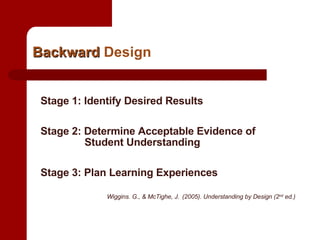
Backward  Design Stage 1: Identify Desired Results  Stage 2: Determine Acceptable Evidence   of  Student Understanding   Stage 3: Plan Learning Experiences   Wiggins. G., & McTighe, J.   (2005). Understanding by Design (2 nd  ed.)
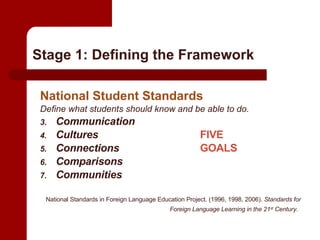
Stage 1: Defining the Framework National Student Standards Define what students should know and be able to do. Communication Cultures  FIVE Connections   GOALS Comparisons   Communities National Standards in Foreign Language Education Project. (1996, 1998, 2006).  Standards for Foreign Language Learning in the 21 st  Century.
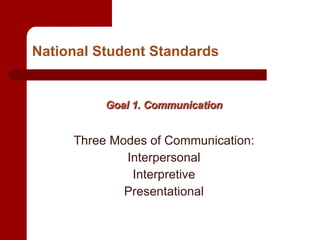
National Student Standards   Goal 1. Communication Three Modes of Communication: Interpersonal Interpretive Presentational
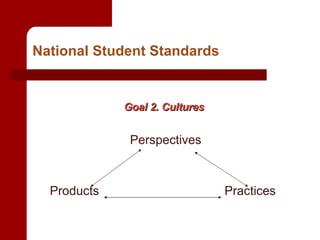
National Student Standards   Goal 2. Cultures Perspectives Products Practices
National Student Standards 3. Connections   4. Comparisons   5. Communities
Conceptual Framework Documents Conceptual Overview K-5 Chinese Grade Level Expectations: Learner Linguistic and Cultural Profiles
Learner Linguistic and Cultural Profiles Based on Proficiency Assessments: Early Language Learning Assessment (ELLOPA) Student Oral Proficiency Assessment (SOPA) National Online Early Language Learning Assessment (NOELLA) Define expectations by grade level for student proficiency in listening, reading, writing, and culture
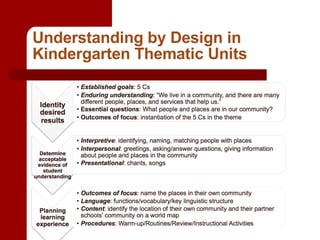
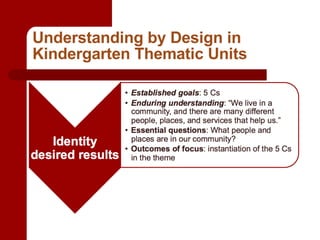
Backward  Design: Stage 1 Established Goals:  As a result of this unit students will make progress toward the following goals… Enduring Understanding:  Students will understand that… Essential Questions:  Students will answer the following questions… Outcomes of Focus:  Students will gain the following knowledge and skills … (Language, Culture, Content, Connections, Comparisons, Communities)
Conceptual Framework Documents Comprehensive Curriculum Framework Chinese Curriculum Scope and Sequence: Kindergarten and 1 st  Grade
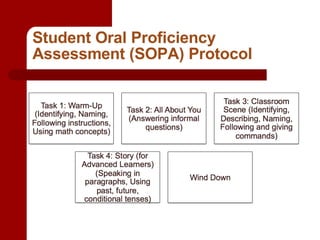
Stage 2: Accountability, Achievement, and Assessment How will we know when we get there? Define classroom performance tasks for language assessment (interpersonal, interpretive, presentational). Administer the Student Oral Proficiency Assessment (SOPA)
Backward  Design: Stage 2 Students will demonstrate that they understand by: Unit Performance Assessment Tasks:  As a result of this unit students will be able to … Lesson Performance Assessment Tasks:  As a result of this lesson   students will be able to …
Student Oral Proficiency Assessment (SOPA) Protocol
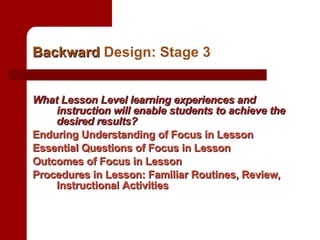
Backward  Design: Stage 3 What Lesson Level learning experiences and instruction will enable students to achieve the desired results? Enduring Understanding of Focus in Lesson Essential Questions of Focus in Lesson Outcomes of Focus in Lesson Procedures in Lesson: Familiar Routines, Review, Instructional Activities
Thematic Planning Carol Ann Dahlberg  •  [email_address] Theme Enduring Understanding / Essential Question Standards  Outcomes Final Assessment A Curriculum Development Framework for Language Learning
Defining Thematic Teaching What is thematic teaching? Links concepts (content), language and culture; Grounded in developmentally appropriate learning; Provides a meaningful framework for  teaching/learning; Addresses the National Student Standards.
Designing the Curriculum Essential Strategies of the Curriculum: School Partnerships Voices and Perspectives Awareness of the World Spiraling Themes Comparison of Languages and Cultures Transfer Task
Designing the Curriculum The Process: Drafting Field-testing Fine-tuning  Finalizing the Curriculum
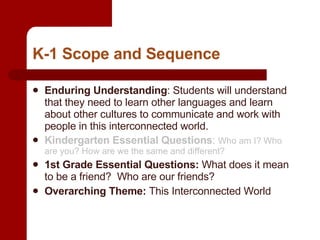
K-1 Scope and Sequence Enduring Understanding : Students will understand that they need to learn other languages and learn about other cultures to communicate and work with people in this interconnected world.  Kindergarten   Essential Questions :  Who am I? Who are you? How are we the same and different? 1st Grade Essential Questions:  What does it mean to be a friend?  Who are our friends?   Overarching Theme:  This Interconnected World
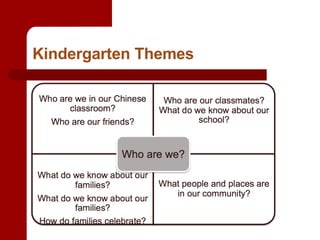
Kindergarten Themes
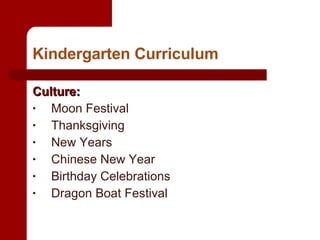
Kindergarten Curriculum Culture: Moon Festival Thanksgiving New Years  Chinese New Year Birthday Celebrations Dragon Boat Festival
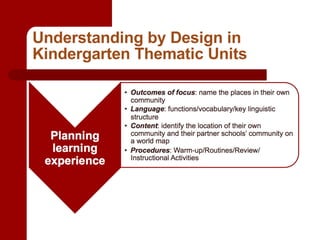
Understanding by Design in Kindergarten Thematic Units
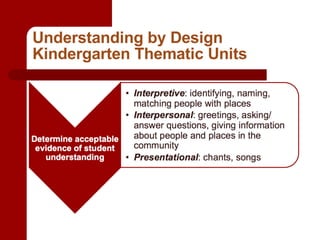
Understanding by Design Kindergarten Thematic Units
Understanding by Design in Kindergarten Thematic Units
K-1 Scope and Sequence Enduring Understanding : Students will understand that they need to learn other languages and learn about other cultures to communicate and work with people in this interconnected world.  Kindergarten   Essential Questions :  Who am I? Who are you? How are we the same and different? 1st Grade Essential Questions:  What does it mean to be a friend?  Who are our friends?   Overarching Theme:  This Interconnected World
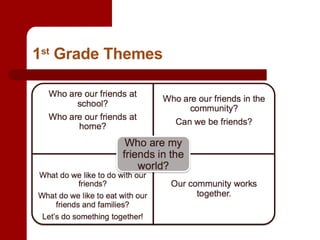
1 st  Grade Themes
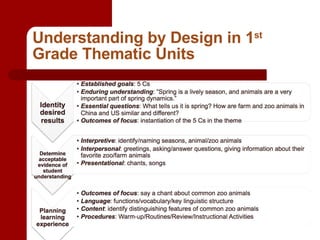
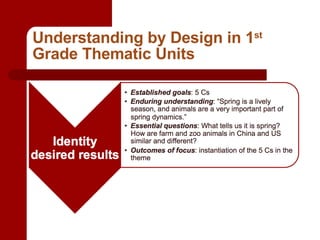
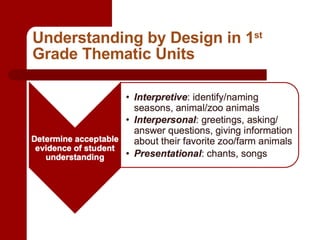
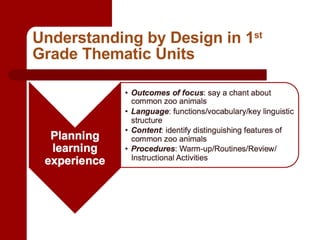
Understanding by Design in 1 st  Grade Thematic Units
Challenges Implementing backward design in drafting kindergarten thematic units Defining performance tasks in defining 1 st  grade thematic units
Rewards Powerful experience of the partner school Teacher initiatives to communicate with parents and stakeholders  Positive responses from the students, parents, and teachers Creative initiatives the teachers have taken in creating the websites and wiki-space
Sharing Curriculum Models: Chinese Curriculum Project K-1 Chengbin Yin, Ph.D.  Chinese K-5 Curriculum Project Coordinator Center for Applied Linguistics Washington , D.C.  Marcia Harmon Rosenbusch, Ph.D.  Director National K-12 Foreign Language  Resource Center Iowa State University, Ames, Iowa

Rosenbusch Yin Sharing Curriculum Models

  • 1.
    Sharing Curriculum Models:Chinese Curriculum Project K-1 Chengbin Yin, Ph.D. Chinese K-5 Curriculum Project Coordinator Center for Applied Linguistics Washington , D.C. Marcia Harmon Rosenbusch, Ph.D. Director National K-12 Foreign Language Resource Center Iowa State University, Ames, Iowa
  • 2.
    Chinese Curriculum ProjectCollaborative Partners National K-12 Foreign Language Resource Center at Iowa State University and Center for Applied Linguistics, Washington, DC Two Midwestern School Districts Funding Source U.S. Department of Education, Language Resource Centers: 2006-2010
  • 3.
    Chinese Curriculum ProjectPurpose of Project Develop Chinese K-5 conceptual curriculum documents Draft proficiency-focused and standards-based K-3 Chinese curriculum and materials using Backward Design; Mentor pilot teachers in classroom best practices; Train teachers in use of the SOPA assessment; Collaborate with two districts in the implementation of their Chinese non-intensive programs
  • 4.
    Curriculum Design GroupMarcia Rosenbusch, NFLRC Director Nancy Rhodes, Project Director Chengbin Yin, Project Coordinator Shuhan Wang, Project Advisor Wei-ling Wu, Project Advisor Eileen Lorenz, Project Contributor Project Chinese Teachers
  • 5.
    Defining the FrameworkBackward Design Principles “ If you don’t know where you are going how will you know when you get there?”
  • 6.
    Backward DesignStage 1: Identify Desired Results Stage 2: Determine Acceptable Evidence of Student Understanding Stage 3: Plan Learning Experiences Wiggins. G., & McTighe, J. (2005). Understanding by Design (2 nd ed.)
  • 7.
    Stage 1: Definingthe Framework National Student Standards Define what students should know and be able to do. Communication Cultures FIVE Connections GOALS Comparisons Communities National Standards in Foreign Language Education Project. (1996, 1998, 2006). Standards for Foreign Language Learning in the 21 st Century.
  • 8.
    National Student Standards Goal 1. Communication Three Modes of Communication: Interpersonal Interpretive Presentational
  • 9.
    National Student Standards Goal 2. Cultures Perspectives Products Practices
  • 10.
    National Student Standards3. Connections 4. Comparisons 5. Communities
  • 11.
    Conceptual Framework DocumentsConceptual Overview K-5 Chinese Grade Level Expectations: Learner Linguistic and Cultural Profiles
  • 12.
    Learner Linguistic andCultural Profiles Based on Proficiency Assessments: Early Language Learning Assessment (ELLOPA) Student Oral Proficiency Assessment (SOPA) National Online Early Language Learning Assessment (NOELLA) Define expectations by grade level for student proficiency in listening, reading, writing, and culture
  • 13.
    Backward Design:Stage 1 Established Goals: As a result of this unit students will make progress toward the following goals… Enduring Understanding: Students will understand that… Essential Questions: Students will answer the following questions… Outcomes of Focus: Students will gain the following knowledge and skills … (Language, Culture, Content, Connections, Comparisons, Communities)
  • 14.
    Conceptual Framework DocumentsComprehensive Curriculum Framework Chinese Curriculum Scope and Sequence: Kindergarten and 1 st Grade
  • 15.
    Stage 2: Accountability,Achievement, and Assessment How will we know when we get there? Define classroom performance tasks for language assessment (interpersonal, interpretive, presentational). Administer the Student Oral Proficiency Assessment (SOPA)
  • 16.
    Backward Design:Stage 2 Students will demonstrate that they understand by: Unit Performance Assessment Tasks: As a result of this unit students will be able to … Lesson Performance Assessment Tasks: As a result of this lesson students will be able to …
  • 17.
    Student Oral ProficiencyAssessment (SOPA) Protocol
  • 18.
    Backward Design:Stage 3 What Lesson Level learning experiences and instruction will enable students to achieve the desired results? Enduring Understanding of Focus in Lesson Essential Questions of Focus in Lesson Outcomes of Focus in Lesson Procedures in Lesson: Familiar Routines, Review, Instructional Activities
  • 19.
    Thematic Planning CarolAnn Dahlberg • [email_address] Theme Enduring Understanding / Essential Question Standards Outcomes Final Assessment A Curriculum Development Framework for Language Learning
  • 20.
    Defining Thematic TeachingWhat is thematic teaching? Links concepts (content), language and culture; Grounded in developmentally appropriate learning; Provides a meaningful framework for teaching/learning; Addresses the National Student Standards.
  • 21.
    Designing the CurriculumEssential Strategies of the Curriculum: School Partnerships Voices and Perspectives Awareness of the World Spiraling Themes Comparison of Languages and Cultures Transfer Task
  • 22.
    Designing the CurriculumThe Process: Drafting Field-testing Fine-tuning Finalizing the Curriculum
  • 23.
    K-1 Scope andSequence Enduring Understanding : Students will understand that they need to learn other languages and learn about other cultures to communicate and work with people in this interconnected world. Kindergarten Essential Questions : Who am I? Who are you? How are we the same and different? 1st Grade Essential Questions: What does it mean to be a friend? Who are our friends? Overarching Theme: This Interconnected World
  • 24.
  • 25.
    Kindergarten Curriculum Culture:Moon Festival Thanksgiving New Years Chinese New Year Birthday Celebrations Dragon Boat Festival
  • 26.
    Understanding by Designin Kindergarten Thematic Units
  • 27.
    Understanding by Designin Kindergarten Thematic Units
  • 28.
    Understanding by DesignKindergarten Thematic Units
  • 29.
    Understanding by Designin Kindergarten Thematic Units
  • 30.
    K-1 Scope andSequence Enduring Understanding : Students will understand that they need to learn other languages and learn about other cultures to communicate and work with people in this interconnected world. Kindergarten Essential Questions : Who am I? Who are you? How are we the same and different? 1st Grade Essential Questions: What does it mean to be a friend? Who are our friends? Overarching Theme: This Interconnected World
  • 31.
    1 st Grade Themes
  • 32.
    Understanding by Designin 1 st Grade Thematic Units
  • 33.
    Understanding by Designin 1 st Grade Thematic Units
  • 34.
    Understanding by Designin 1 st Grade Thematic Units
  • 35.
    Understanding by Designin 1 st Grade Thematic Units
  • 36.
    Challenges Implementing backwarddesign in drafting kindergarten thematic units Defining performance tasks in defining 1 st grade thematic units
  • 37.
    Rewards Powerful experienceof the partner school Teacher initiatives to communicate with parents and stakeholders Positive responses from the students, parents, and teachers Creative initiatives the teachers have taken in creating the websites and wiki-space
  • 38.
    Sharing Curriculum Models:Chinese Curriculum Project K-1 Chengbin Yin, Ph.D. Chinese K-5 Curriculum Project Coordinator Center for Applied Linguistics Washington , D.C. Marcia Harmon Rosenbusch, Ph.D. Director National K-12 Foreign Language Resource Center Iowa State University, Ames, Iowa