
Key Drivers of Educational Performance in Finland International Perspectives on U.S. Education Policy and Practice: What Can We Learn from High Performing Nations? Washington, DC April 27 – 28, 2010 Pasi Sahlberg Director General
Is Finland a high-performing nation? According to international indicators  ‘yes’  because: high graduation and low drop-out rates equitable outcomes and equal opportunities high student achievement moderate overall spending high rankings in other performances as well
Has there been improvement over time? The evidence suggests  ‘yes’  because in the past Finland had: low level of educational attainment deep inequality and elitist structure modest student achievement teachers without proper education big gap to other OECD countries
Most important changes and policies Peruskoulu  (nine-year basic school) in early 1970s Law on Teacher Education in 1979 Reformed upper secondary education in1980s/90s Promotion of trust since early 1990s
The most important factors in the successful implementation of these policies The Finnish Dream:  Good school for all The Finnish Principle:  Less is more The Finnish Privilege:  Teachers The Finnish Way: Only dead fish follow the stream
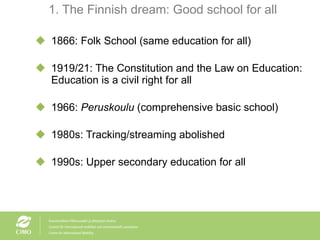
1. The Finnish dream: Good school for all 1866: Folk School (same education for all) 1919/21: The Constitution and the Law on Education: Education is a civil right for all 1966:  Peruskoulu  (comprehensive basic school) 1980s: Tracking/streaming abolished 1990s: Upper secondary education for all
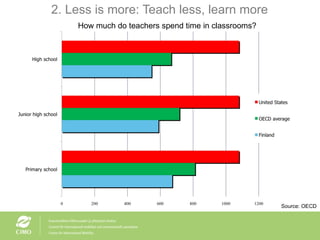
2. Less is more: Teach less, learn more Source: OECD How much do teachers spend time in classrooms?
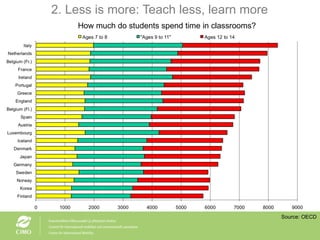
2. Less is more: Teach less, learn more Source: OECD How much do students spend time in classrooms?
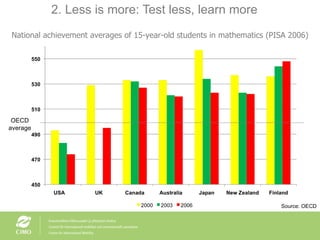
2. Less is more: Test less, learn more OECD average National achievement averages of 15-year-old students in mathematics (PISA 2006) Source: OECD
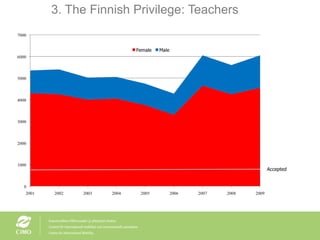
3. The Finnish Privilege: Teachers Accepted
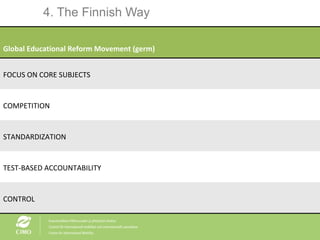
4. The Finnish Way Global Educational Reform Movement (germ) FOCUS ON CORE SUBJECTS COMPETITION STANDARDIZATION TEST-BASED ACCOUNTABILITY CONTROL
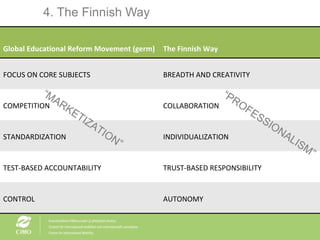
4. The Finnish Way “ MARKETIZATION” “ PROFESSIONALISM” Global Educational Reform Movement (germ) The Finnish Way FOCUS ON CORE SUBJECTS BREADTH AND CREATIVITY  COMPETITION COLLABORATION STANDARDIZATION INDIVIDUALIZATION TEST-BASED ACCOUNTABILITY TRUST-BASED RESPONSIBILITY CONTROL AUTONOMY
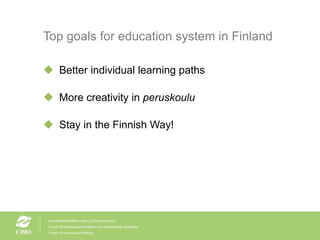
Top goals for education system in Finland  Better individual learning paths More creativity in  peruskoulu Stay in the Finnish Way!
Thank you!

Pasi Sahlberg, Finland

  • 1.
    Key Drivers ofEducational Performance in Finland International Perspectives on U.S. Education Policy and Practice: What Can We Learn from High Performing Nations? Washington, DC April 27 – 28, 2010 Pasi Sahlberg Director General
  • 2.
    Is Finland ahigh-performing nation? According to international indicators ‘yes’ because: high graduation and low drop-out rates equitable outcomes and equal opportunities high student achievement moderate overall spending high rankings in other performances as well
  • 3.
    Has there beenimprovement over time? The evidence suggests ‘yes’ because in the past Finland had: low level of educational attainment deep inequality and elitist structure modest student achievement teachers without proper education big gap to other OECD countries
  • 4.
    Most important changesand policies Peruskoulu (nine-year basic school) in early 1970s Law on Teacher Education in 1979 Reformed upper secondary education in1980s/90s Promotion of trust since early 1990s
  • 5.
    The most importantfactors in the successful implementation of these policies The Finnish Dream: Good school for all The Finnish Principle: Less is more The Finnish Privilege: Teachers The Finnish Way: Only dead fish follow the stream
  • 6.
    1. The Finnishdream: Good school for all 1866: Folk School (same education for all) 1919/21: The Constitution and the Law on Education: Education is a civil right for all 1966: Peruskoulu (comprehensive basic school) 1980s: Tracking/streaming abolished 1990s: Upper secondary education for all
  • 7.
    2. Less ismore: Teach less, learn more Source: OECD How much do teachers spend time in classrooms?
  • 8.
    2. Less ismore: Teach less, learn more Source: OECD How much do students spend time in classrooms?
  • 9.
    2. Less ismore: Test less, learn more OECD average National achievement averages of 15-year-old students in mathematics (PISA 2006) Source: OECD
  • 10.
    3. The FinnishPrivilege: Teachers Accepted
  • 11.
    4. The FinnishWay Global Educational Reform Movement (germ) FOCUS ON CORE SUBJECTS COMPETITION STANDARDIZATION TEST-BASED ACCOUNTABILITY CONTROL
  • 12.
    4. The FinnishWay “ MARKETIZATION” “ PROFESSIONALISM” Global Educational Reform Movement (germ) The Finnish Way FOCUS ON CORE SUBJECTS BREADTH AND CREATIVITY COMPETITION COLLABORATION STANDARDIZATION INDIVIDUALIZATION TEST-BASED ACCOUNTABILITY TRUST-BASED RESPONSIBILITY CONTROL AUTONOMY
  • 13.
    Top goals foreducation system in Finland Better individual learning paths More creativity in peruskoulu Stay in the Finnish Way!
  • 14.