




TEACHING LANGUAGES TO YOUNG LEARNERS.By: The Big Smile.Rita Villaescusa.
 Hamza Mohamed.
- Silvana Sánchez
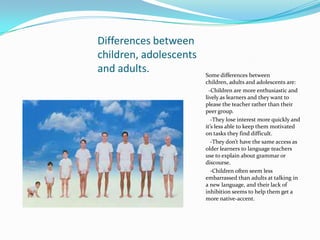
-Rocío MoranoDifferences between children, adolescents and adults.Some differences between children, adults and adolescents are:  -Children are more enthusiastic and lively as learners and they want to please the teacher rather than their peer group.   -They lose interest more quickly and it’s less able to keep them motivated on tasks they find difficult.   -They don’t have the same access as older learners to language teachers use to explain about grammar or discourse.   -Children often seem less embarrassed than adults at talking in a new language, and their lack of inhibition seems to help them get a more native-accent. 
Why should languages be taught to young learners?    -A young child tends to absorb a language.   -Some child learners end up with accents and incomplete second language grammars, and some adult learners become, for all practical purposes, as skilled as native speakers.    -While young learners are more likely than older students to ultimately speak a new language like native speakers.     -While young learners are more likely than older students to ultimately speak a new language like native speakers, adolescents and adults actually learn foreign languages faster.
Growing up with a language…Such programs simulate the environment of growing up with a language by:Integrating the second language with instruction in other subjects.Giving learners ample opportunities to engage in     meaningful discourse with other students and teachers using the foreign language.Exposing learners to a variety of native speakers of the target language.Focusing instruction on attaining the language skills needed for communicating about and understanding   academic subject matter, not on mastering a foreign language for its own sake.
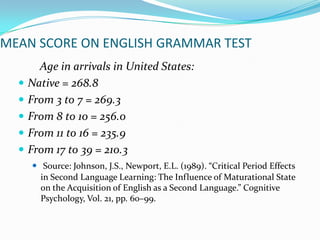
MEAN SCORE ON ENGLISH GRAMMAR TEST        Age in arrivals in United States:Native = 268.8From 3 to 7 = 269.3From 8 to 10 = 256.0From 11 to 16 = 235.9From 17 to 39 = 210.3Source: Johnson, J.S., Newport, E.L. (1989). “Critical Period Effects in Second Language Learning: The Influence of Maturational State on the Acquisition of English as a Second Language.” Cognitive Psychology, Vol. 21, pp. 60–99.

Teaching languages to young learners [autoguardado]

  • 1.
    TEACHING LANGUAGES TOYOUNG LEARNERS.By: The Big Smile.Rita Villaescusa.
  • 2.
  • 3.
  • 4.
    -Rocío MoranoDifferences betweenchildren, adolescents and adults.Some differences between children, adults and adolescents are: -Children are more enthusiastic and lively as learners and they want to please the teacher rather than their peer group. -They lose interest more quickly and it’s less able to keep them motivated on tasks they find difficult. -They don’t have the same access as older learners to language teachers use to explain about grammar or discourse. -Children often seem less embarrassed than adults at talking in a new language, and their lack of inhibition seems to help them get a more native-accent. 
  • 5.
    Why should languagesbe taught to young learners? -A young child tends to absorb a language. -Some child learners end up with accents and incomplete second language grammars, and some adult learners become, for all practical purposes, as skilled as native speakers. -While young learners are more likely than older students to ultimately speak a new language like native speakers. -While young learners are more likely than older students to ultimately speak a new language like native speakers, adolescents and adults actually learn foreign languages faster.
  • 6.
    Growing up witha language…Such programs simulate the environment of growing up with a language by:Integrating the second language with instruction in other subjects.Giving learners ample opportunities to engage in meaningful discourse with other students and teachers using the foreign language.Exposing learners to a variety of native speakers of the target language.Focusing instruction on attaining the language skills needed for communicating about and understanding academic subject matter, not on mastering a foreign language for its own sake.
  • 7.
    MEAN SCORE ONENGLISH GRAMMAR TEST Age in arrivals in United States:Native = 268.8From 3 to 7 = 269.3From 8 to 10 = 256.0From 11 to 16 = 235.9From 17 to 39 = 210.3Source: Johnson, J.S., Newport, E.L. (1989). “Critical Period Effects in Second Language Learning: The Influence of Maturational State on the Acquisition of English as a Second Language.” Cognitive Psychology, Vol. 21, pp. 60–99.