Early Language Learning  World Languages in the Elementary Years Helena Curtain, Ph. D. University of Wisconsin-Milwaukee (Emerita)hcurtain@uwm.edu
Key Concepts for Success withElementary & Middle School Language LearningfromLanguages and Children—Making the Match, Curtain and Dahlberg2010, 4th edition, Pearson / Allyn and Bacon
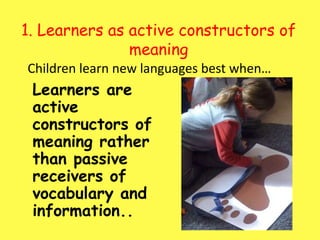
1. Learners as active constructors of meaningChildren learn new languages best when…Learners are active constructors of meaning rather than passive receivers of vocabulary and information..
2. Consistent target language instruction 	Target language || Native language separatedChildren learn new languages best when…	Teachers consistently conduct instruction in 	the target language with minimal use of the native language.  Teachers keep the  target language and the native language distinctly separate.
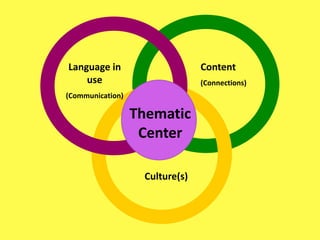
3. Thematic Center for LessonsChildren learn new languages best when…Units and lessons focus on a thematic center aligned with content and performance standards.  There is a balance among the basic goals of culture, subject content, and language in use
ThematicCenterLanguage in use(Communication)Content(Connections)Culture(s)
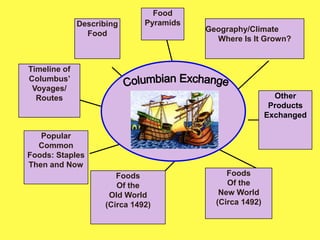
FoodPyramidsDescribingFoodGeography/Climate Where Is It Grown?Timeline of Columbus’ Voyages/RoutesColumbian ExchangeOther Products ExchangedPopular Common Foods: StaplesThen and NowFoods Of the New World(Circa 1492)FoodsOf the Old World(Circa 1492)
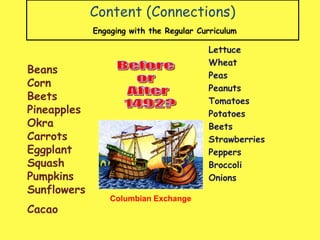
Content (Connections)Engaging with the Regular CurriculumLettuce Wheat Peas Peanuts Tomatoes Potatoes Beets Strawberries Peppers Broccoli OnionsBeans 	Corn Beets PineapplesOkra Carrots Eggplant SquashPumpkins Sunflowers CacaoBefore or After 1492?Columbian Exchange
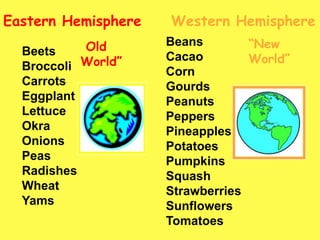
Eastern HemisphereWestern HemisphereBeansCacaoCornGourdsPeanutsPeppersPineapplesPotatoesPumpkinsSquashStrawberriesSunflowersTomatoesBeetsBroccoliCarrotsEggplantLettuceOkraOnionsPeasRadishesWheatYams“New World”“Old World”
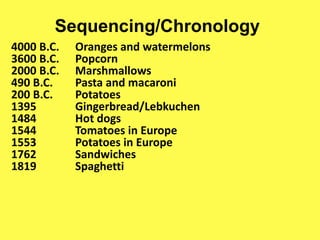
Sequencing/Chronology4000 B.C.	Oranges and watermelons3600 B.C.	Popcorn2000 B.C.	Marshmallows490 B.C.		Pasta and macaroni200 B.C.		Potatoes1395			Gingerbread/Lebkuchen1484			Hot dogs1544			Tomatoes in Europe1553			Potatoes in Europe1762			Sandwiches1819			Spaghetti
No soy un abrigo.
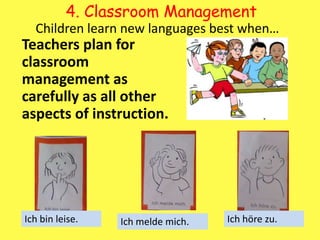
4. Classroom ManagementChildren learn new languages best when…Teachers plan for classroom management as carefully as all other aspects of instruction. Ich bin leise.Ichhörezu.Ichmeldemich.
5. Scaffolding and ModelingChildren learn new languages best when…Teachers scaffold instruction so that learners become increasingly independent in their use of the spoken and written language.
6. Communicative, significant contexts Children learn new languages best when…Learning takes place in communicative contexts that carry significance for the student.
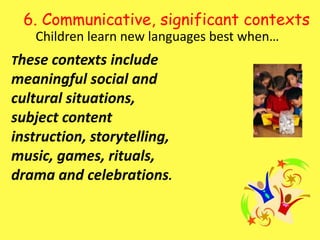
6. Communicative, significant contexts Children learn new languages best when…These contexts include meaningful social and cultural situations, subject content instruction, storytelling, music, games, rituals, drama and celebrations.
6. Communicative, significant contexts Children learn new languages best when…Students learn grammar in context through usage not through analysis.  Grammar for its own sake is not the object of instruction.
6. Communicative, significant contexts Children learn new languages best when…There are meaningful opportunities  to use the new language beyond the classroom.
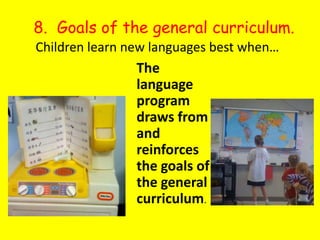
8.  Goals of the general curriculum.Children learn new languages best when…The language program draws from and  reinforces the goals of the general curriculum.
9.   Learners experience activities that:
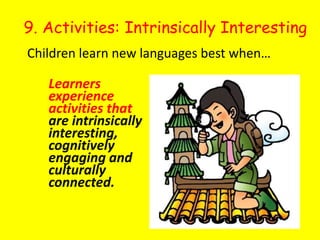
9. Activities: Intrinsically InterestingChildren learn new languages best when…Learners experience activities thatare intrinsically interesting, cognitively engaging and culturally connected.
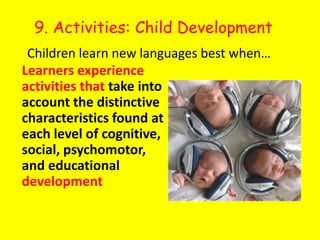
9. Activities: Child DevelopmentChildren learn new languages best when…Learners experience activities that take into account the distinctive characteristics found at each level of cognitive, social, psychomotor, and educational development
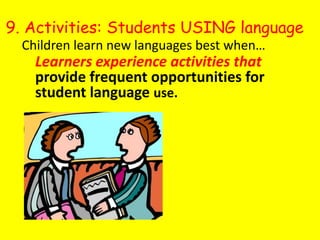
9. Activities: Students USING languageChildren learn new languages best when…Learners experience activities that provide frequent opportunities for student language use.
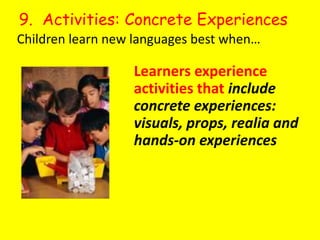
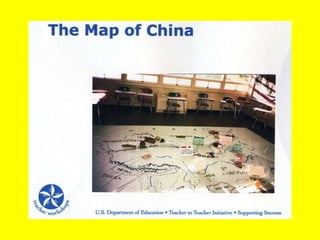
9.  Activities: Concrete ExperiencesChildren learn new languages best when…Learners experience activities that include concrete experiences: visuals, props, realia and hands-on experiences
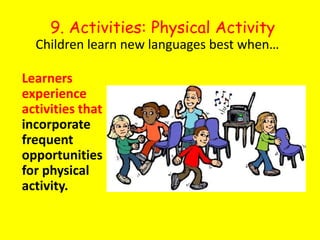
9. Activities: Physical ActivityChildren learn new languages best when…Learners experience activities that incorporate frequent opportunities for physical activity.
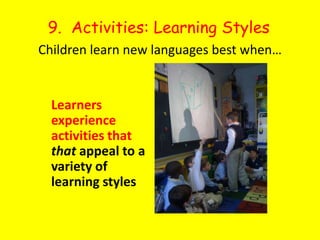
9.  Activities: Learning StylesChildren learn new languages best when…Learners experience activities that that appeal to a variety of learning styles
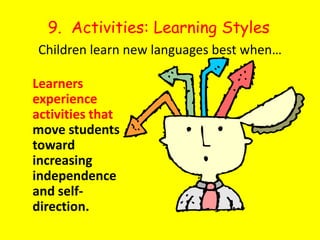
9.  Activities: Learning StylesChildren learn new languages best when…Learners experience activities that move students toward increasing independence and self-direction.
10. Story formChildren learn new languages best when…	Activities, lessons and units are affectively engaging and made meaningful and memorable through the use of story form and contain a clear beginning, middle and end._____________________________________________________________________________________
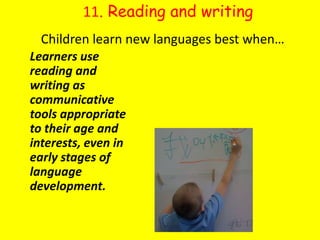
11. Reading and writingChildren learn new languages best when…Learners use reading and writing as communicative tools appropriate to their age and interests, even in early stages of language development.
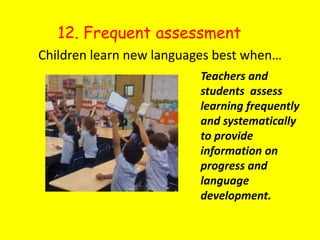
12. Frequent assessment Children learn new languages best when…Teachers and students  assess learning frequently and systematically to provide information on progress and language development.
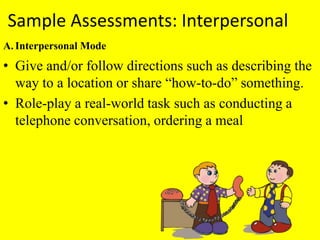
Sample Assessments: InterpersonalA.	Interpersonal ModeGive and/or follow directions such as describing the way to a location or share “how-to-do” something.Role-play a real-world task such as conducting a telephone conversation, ordering a meal
Sample Assessments: Interpretive• Complete a cloze activity to indicate listening and/or reading comprehension.• Sequence sentences or pictures to indicate listening and/or reading comprehension
Sample Assessments: InterpretiveListen to a passage and follow a map or diagram.Draw and/or label an illustration such as a house, clock or a map according to oral or written cues.
Sample Assessments: Culture and Connections• Identify features and products of the target culture.Prepare a culture capsule.Produce crafts and/or artwork that are representative of the target culture(s).
Key Concepts
Program Models
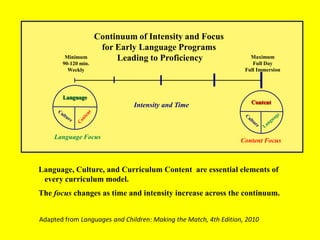
LanguageContentCultureContentLanguageCultureLanguage FocusContent FocusContinuum of Intensity and Focus for Early Language Programs Leading to ProficiencyMaximumFull DayFull ImmersionMinimum90-120 min.WeeklyIntensity and TimeLanguage, Culture, and Curriculum Content  are essential elements of every curriculum model. The focus changes as time and intensity increase across the continuum.  Adapted from Languages and Children: Making the Match, 4th Edition, 2010
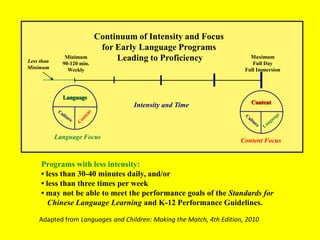
LanguageContentCultureContentLanguageCultureLanguage FocusContent FocusContinuum of Intensity and Focus for Early Language Programs Leading to ProficiencyMaximumFull DayFull ImmersionMinimum90-120 min.WeeklyLess thanMinimumIntensity and TimePrograms with less intensity:• less than 30-40 minutes daily, and/or • less than three times per week • may not be able to meet the performance goals of the Standards for Chinese Language Learning and K-12 Performance Guidelines.Adapted from Languages and Children: Making the Match, 4th Edition, 2010
What about programs with less time and intensity?
Proficiency
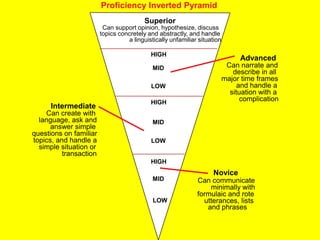
Can support opinion, hypothesize, discuss topics concretely and abstractly, and handlea linguistically unfamiliar situationAdvancedCan narrate and describe in all major time frames and handle a situation with a complicationIntermediateCan create with language, ask and answer simple questions on familiar topics, and handle a simple situation or transactionNoviceCan communicateminimally withformulaic and rote utterances, listsand phrasesProficiency Inverted PyramidSuperiorHIGHMIDLOWHIGHMIDLOWHIGHMIDLOW
Anticipated Performance OutcomesAs Described in theACTFL Performance GuidelinesFor K-12 Learners
Considering the content and the intended K-12 sequence set forth in the Standards for Foreign Language Learning, developers of the performance guidelines for students felt obliged to assume that accomplishment of such content standards required students to be enrolled in
elementary programs that meet from 3-5 days per week for no less than 30-40 minutes per class; middle school programs that meet daily for no less than 40-50 minutes; and high school programs that equal four units of credit.
Through learning about language we learn about culture
Through learning about culture                      We learn respect for others
Through learning respect for others, we can hope forPeace

Early Language Learning: World Languages in the Elementary Years

  • 1.
    Early Language Learning World Languages in the Elementary Years Helena Curtain, Ph. D. University of Wisconsin-Milwaukee (Emerita)hcurtain@uwm.edu
  • 2.
    Key Concepts forSuccess withElementary & Middle School Language LearningfromLanguages and Children—Making the Match, Curtain and Dahlberg2010, 4th edition, Pearson / Allyn and Bacon
  • 3.
    1. Learners asactive constructors of meaningChildren learn new languages best when…Learners are active constructors of meaning rather than passive receivers of vocabulary and information..
  • 4.
    2. Consistent targetlanguage instruction Target language || Native language separatedChildren learn new languages best when… Teachers consistently conduct instruction in the target language with minimal use of the native language. Teachers keep the target language and the native language distinctly separate.
  • 5.
    3. Thematic Centerfor LessonsChildren learn new languages best when…Units and lessons focus on a thematic center aligned with content and performance standards. There is a balance among the basic goals of culture, subject content, and language in use
  • 6.
  • 8.
    FoodPyramidsDescribingFoodGeography/Climate Where IsIt Grown?Timeline of Columbus’ Voyages/RoutesColumbian ExchangeOther Products ExchangedPopular Common Foods: StaplesThen and NowFoods Of the New World(Circa 1492)FoodsOf the Old World(Circa 1492)
  • 9.
    Content (Connections)Engaging withthe Regular CurriculumLettuce Wheat Peas Peanuts Tomatoes Potatoes Beets Strawberries Peppers Broccoli OnionsBeans Corn Beets PineapplesOkra Carrots Eggplant SquashPumpkins Sunflowers CacaoBefore or After 1492?Columbian Exchange
  • 10.
  • 11.
    Sequencing/Chronology4000 B.C. Oranges andwatermelons3600 B.C. Popcorn2000 B.C. Marshmallows490 B.C. Pasta and macaroni200 B.C. Potatoes1395 Gingerbread/Lebkuchen1484 Hot dogs1544 Tomatoes in Europe1553 Potatoes in Europe1762 Sandwiches1819 Spaghetti
  • 12.
    No soy unabrigo.
  • 13.
    4. Classroom ManagementChildrenlearn new languages best when…Teachers plan for classroom management as carefully as all other aspects of instruction. Ich bin leise.Ichhörezu.Ichmeldemich.
  • 14.
    5. Scaffolding andModelingChildren learn new languages best when…Teachers scaffold instruction so that learners become increasingly independent in their use of the spoken and written language.
  • 15.
    6. Communicative, significantcontexts Children learn new languages best when…Learning takes place in communicative contexts that carry significance for the student.
  • 16.
    6. Communicative, significantcontexts Children learn new languages best when…These contexts include meaningful social and cultural situations, subject content instruction, storytelling, music, games, rituals, drama and celebrations.
  • 17.
    6. Communicative, significantcontexts Children learn new languages best when…Students learn grammar in context through usage not through analysis. Grammar for its own sake is not the object of instruction.
  • 18.
    6. Communicative, significantcontexts Children learn new languages best when…There are meaningful opportunities to use the new language beyond the classroom.
  • 19.
    8. Goalsof the general curriculum.Children learn new languages best when…The language program draws from and reinforces the goals of the general curriculum.
  • 20.
    9. Learners experience activities that:
  • 21.
    9. Activities: IntrinsicallyInterestingChildren learn new languages best when…Learners experience activities thatare intrinsically interesting, cognitively engaging and culturally connected.
  • 22.
    9. Activities: ChildDevelopmentChildren learn new languages best when…Learners experience activities that take into account the distinctive characteristics found at each level of cognitive, social, psychomotor, and educational development
  • 23.
    9. Activities: StudentsUSING languageChildren learn new languages best when…Learners experience activities that provide frequent opportunities for student language use.
  • 24.
    9. Activities:Concrete ExperiencesChildren learn new languages best when…Learners experience activities that include concrete experiences: visuals, props, realia and hands-on experiences
  • 26.
    9. Activities: PhysicalActivityChildren learn new languages best when…Learners experience activities that incorporate frequent opportunities for physical activity.
  • 27.
    9. Activities:Learning StylesChildren learn new languages best when…Learners experience activities that that appeal to a variety of learning styles
  • 28.
    9. Activities:Learning StylesChildren learn new languages best when…Learners experience activities that move students toward increasing independence and self-direction.
  • 29.
    10. Story formChildrenlearn new languages best when… Activities, lessons and units are affectively engaging and made meaningful and memorable through the use of story form and contain a clear beginning, middle and end._____________________________________________________________________________________
  • 30.
    11. Reading andwritingChildren learn new languages best when…Learners use reading and writing as communicative tools appropriate to their age and interests, even in early stages of language development.
  • 31.
    12. Frequent assessmentChildren learn new languages best when…Teachers and students assess learning frequently and systematically to provide information on progress and language development.
  • 32.
    Sample Assessments: InterpersonalA. InterpersonalModeGive and/or follow directions such as describing the way to a location or share “how-to-do” something.Role-play a real-world task such as conducting a telephone conversation, ordering a meal
  • 33.
    Sample Assessments: Interpretive•Complete a cloze activity to indicate listening and/or reading comprehension.• Sequence sentences or pictures to indicate listening and/or reading comprehension
  • 34.
    Sample Assessments: InterpretiveListento a passage and follow a map or diagram.Draw and/or label an illustration such as a house, clock or a map according to oral or written cues.
  • 35.
    Sample Assessments: Cultureand Connections• Identify features and products of the target culture.Prepare a culture capsule.Produce crafts and/or artwork that are representative of the target culture(s).
  • 36.
  • 37.
  • 38.
    LanguageContentCultureContentLanguageCultureLanguage FocusContent FocusContinuumof Intensity and Focus for Early Language Programs Leading to ProficiencyMaximumFull DayFull ImmersionMinimum90-120 min.WeeklyIntensity and TimeLanguage, Culture, and Curriculum Content are essential elements of every curriculum model. The focus changes as time and intensity increase across the continuum. Adapted from Languages and Children: Making the Match, 4th Edition, 2010
  • 39.
    LanguageContentCultureContentLanguageCultureLanguage FocusContent FocusContinuumof Intensity and Focus for Early Language Programs Leading to ProficiencyMaximumFull DayFull ImmersionMinimum90-120 min.WeeklyLess thanMinimumIntensity and TimePrograms with less intensity:• less than 30-40 minutes daily, and/or • less than three times per week • may not be able to meet the performance goals of the Standards for Chinese Language Learning and K-12 Performance Guidelines.Adapted from Languages and Children: Making the Match, 4th Edition, 2010
  • 40.
    What about programswith less time and intensity?
  • 41.
  • 42.
    Can support opinion,hypothesize, discuss topics concretely and abstractly, and handlea linguistically unfamiliar situationAdvancedCan narrate and describe in all major time frames and handle a situation with a complicationIntermediateCan create with language, ask and answer simple questions on familiar topics, and handle a simple situation or transactionNoviceCan communicateminimally withformulaic and rote utterances, listsand phrasesProficiency Inverted PyramidSuperiorHIGHMIDLOWHIGHMIDLOWHIGHMIDLOW

  • 43.
    Anticipated Performance OutcomesAsDescribed in theACTFL Performance GuidelinesFor K-12 Learners
  • 45.
    Considering the contentand the intended K-12 sequence set forth in the Standards for Foreign Language Learning, developers of the performance guidelines for students felt obliged to assume that accomplishment of such content standards required students to be enrolled in
  • 46.
    elementary programs thatmeet from 3-5 days per week for no less than 30-40 minutes per class; middle school programs that meet daily for no less than 40-50 minutes; and high school programs that equal four units of credit.
  • 47.
    Through learning aboutlanguage we learn about culture
  • 48.
    Through learning aboutculture We learn respect for others
  • 49.
    Through learning respectfor others, we can hope forPeace