A
Pragma(c
Web
Workshop

                             Ronald
Stamper

                           stamper.measur@gmail.com

         Pragma(cs
in
a
Semio(c
Framework

         built
on
a
Seman(c
Theory

         based
on
a
Presen(st
Ontology
of
Actualism

         leading
to
the
concept
of
Ontological
Dependency

         and
a
Seman(c
Normal
Form
with
Seman(c
Temporal
DB

         ¿
able
to
support
an
Open
Common
“Ontology”
?

         with
pragma(c
tools
for
web
discourse


finally
a


SMALL
CASE
STUDY


©
Ronald
K
Stamper
2009
                               I‐SEMANTICS
'09
GRAZ


SEMIOTIC
FRAMEWORK 
                     
   
seman:cs
of
“informa:on”

    Human
Informa:on
Func:ons
(neglected)


SOCIAL
WORLD:
norms,
law,
culture,


aWtudes,
values,
beliefs
commitments,
              
norms

    EFFECTIVENESS 
PRAGMATICS:

inten(ons,
communica(ons,


conversa(ons,
nego(a(ons 


sign‐tokens


SEMANTICS:
meaning,
significa(on,
denota(on,


connota(on,
validity,
truth‐falsehood 


sign‐types


Technical
PlaLorm
(dominant)


SYNTACTICS:
formal
structure,
logic, 
         
       
sign‐types

    EFFICIENCY 
       
language
syntax,
so[ware,
data,
files 


EMPIRICS:
paern,
variety,
noise,
entropy, 
        
       
populaDons
of


channel
capacity,
redundancy,
efficiency
codes        
       
sign‐tokens


PHYSICAL
WORLD:
signals,
traces,
hardware,
speed,        


energy
and
material
consump(on,
info
economics           
       
sign‐tokens


Semio(c
Framework
                                             ©
Ronald
K
Stamper
2009

AN
EMPIRICAL
APPROACH
TO
IS
AS
A
HUMAN
SYSTEM

–
LAW
TO
‘PROGRAM’
PEOPLE


                                 A 1m shelf of legal norms gives
                                 rise to the huge DSS bureaucracy


Via 400, 5cm books of
clerical codes (info flow)
for 20% of the norms


of which 10% can be                          +
automated – requiring
programs and piles of
documentation
                                           Why not formalise 2% of those legal
                                           norms and generate the systems directly?

      ©
Ronald
K
Stamper
2009

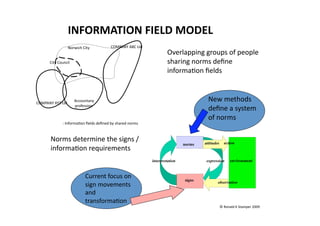
INFORMATION
FIELD
MODEL

                  Norwich
City         COMPANY
ABC
Ltd
                                                                  Overlapping
groups
of
people

      City
Council                                                sharing
norms
define

                                                                  informa(on
fields


COMPANY
XYZ
Ltd
                     Accountany                                                     New
methods

                     profession
                                                                                    define
a
system

                                                                                    of
norms

             :
Informa(on
fields
defined
by
shared
norms


      Norms
determine
the
signs
/
                                                attitudes     action
                                                                          norms
      informa(on
requirements

                                                         interpretation            expression       environment


                           Current
focus
on
                              signs
                                                                                          observation
                           sign
movements

                           and

                           transforma(on


                                                                                              ©
Ronald
K
Stamper
2009

KEY
PROBLEMS
IN
THE
HUMAN
INFORMATION
SYSTEM


role
of
signs
in
rela:on
with
norms

          
meaning
of
“meaning”
and
hence

          
nature
of
reality


responsibility
for
linking
data
and
reality

          
history
and
Dme
when
things
exist


The
law
points
the
way

          
it
requires
evidence,
both
material
and
verbal
from
witnesses


especially
evidence
of
inten:ons


THESE
CONCEPTS
ARE
NOT
OPTIONAL
EXTRAS

          
BUT
OBLIGATORY
FOR
SEMANTIC
AND
PRAGMATIC
ANALYSES


Between
                                                              ©
Ronald
K
Stamper
2009

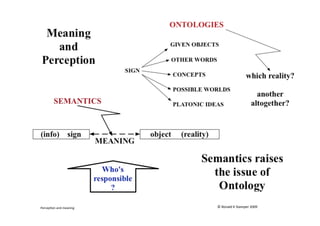
Percep(on
and
meaning
   ©
Ronald
K
Stamper
2009

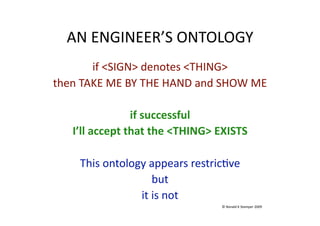
AN
ENGINEER’S
ONTOLOGY

       if
<SIGN>
denotes
<THING>

then
TAKE
ME
BY
THE
HAND
and
SHOW
ME


                if
successful

   I’ll
accept
that
the
<THING>
EXISTS


    This
ontology
appears
restric(ve

                   but

                it
is
not

                                 ©
Ronald
K
Stamper
2009

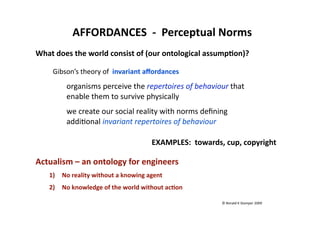
AFFORDANCES

‐

Perceptual
Norms

What
does
the
world
consist
of
(our
ontological
assump:on)?


    Gibson’s
theory
of

invariant
affordances


organisms
perceive
the
repertoires
of
behaviour
that


enable
them
to
survive
physically


we
create
our
social
reality
with
norms
defining

         
addi(onal
invariant
repertoires
of
behaviour


EXAMPLES:

towards,
cup,
copyright


Actualism
–
an
ontology
for
engineers

   1)    No
reality
without
a
knowing
agent

   2)    No
knowledge
of
the
world
without
ac:on


                                                           ©
Ronald
K
Stamper
2009

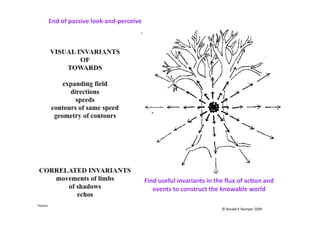
End
of
passive
look‐and‐perceive


                                              Find
useful
invariants
in
the
flux
of
ac:on
and

                                                 events
to
construct
the
knowable
world


Towards
                                                                         ©
Ronald
K
Stamper
2009

Ontological
Dependency


                                                                                                        Syntax
of
Norma


of
each
affordance
upon
its
antecedents


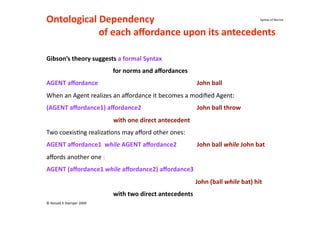
Gibson’s
theory
suggests
a
formal
Syntax


for
norms
and
affordances

AGENT
affordance 


John
ball

When
an
Agent
realizes
an
affordance
it
becomes
a
modified
Agent:

(AGENT
affordance1)
affordance2                              


John
ball
throw


with
one
direct
antecedent

Two
coexis(ng
realiza(ons
may
afford
other
ones:

AGENT
affordance1

while
AGENT
affordance2 
                                     
John
ball
while
John
bat

affords
another
one
:

AGENT
(affordance1
while
affordance2)
affordance3


John
(ball
while
bat)
hit


with
two
direct
antecedents

©
Ronald
K
Stamper
2009

©
Ronald
K
Stamper
2009

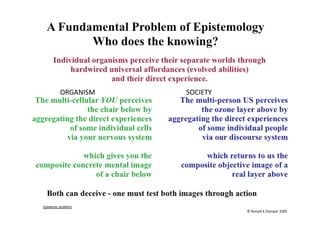
ORGANISM


SOCIETY


Epistemic
problem

                                                                                  ©
Ronald
K
Stamper
2009

Seman:c
Normal
Form                               
(vs.
OO,
ER,
Rela:onal
.
.
.
Models)


 GEOMETRY

                                                                     SURROGATE


                                                                                STRUCTURE

                                    COLLATERAL                          $
Surrogate
number

                                     BRANCHES                           s
Universal
affordance

                                                                        1
Antecedent‐1

      Root                                                              2
[Antecedent‐2]

                             STEM    affordance       BRANCH
      agent
                                                                        +
Start    


                                    COLLATERAL                          ‐

Finish 


                                     BRANCHES                           @
Authority
for
start

                                                                        &

Authority
for
finish

 THE
RULES


       affordance
=
invariant
repertoire
of
behaviour
(NOT
data
item)

       affordance
only
exists
during

co‐existence
of
all
those
in
its
stem

       maximum
of
two
direct
antecedents
per
affordance

       represents
the
here‐and‐now,
the
only
(me
we
can
know
directly


       past
and
future
(mes
constructed
using
signs
(informa(on)


PRESENTISM

  ©
Ronald
K
Stamper
2009

PRESENTISM’s
CHALLENCE
EVADED


Berkeley's ontology: God perceives all
          Satirised in the limerick:
There was a young man who said "God
Must think it exceedingly odd
If he finds that this tree
Continues to be
When there's no one about in the Quad."

         Ronald Knox replied:

"Dear Sir, your astonishment's odd;
I am always about in the Quad
And that's why this tree
Will continue to be
Since observed by
Yours faithfully, God."


                                          ©
Ronald
K
Stamper
2009

©
Ronald
K
Stamper
2009

Gibson:

Direct
Percep:on
of
Material
World

Isolated
Agents
Build
Separate
Reali:es

Human
Society
enables
us
to
share
experiences

 and
build
a
shared
reality

This
largely
indirectly
perceived
world
exists

  through
shared
perceptual
norms,

the
social
invariants
equivalent
to
Gibson’s

  affordances
for
the
material
world,

for
which
Society
at
large
is
the
perceiving

  Agent

                                           ©
Ronald
K
Stamper
2009

INTRINSIC
SURROGATE
ATTRIBUTES

                        (not
op:onal
extras)


•     $
Surrogate
number

•     s
Universal
affordance

•     1
Antecedent‐1

•     2
[Antecedent‐2]

•     +
Start 


•     ‐

Finish 


•     @
Authority
for
start
 
 
KEY
TO
PRAGMATIC

•     &

Authority
for
finish 


STATUS


@
&
=

comm.
act
(document),
norm,
agent
.
.
.

©
Ronald
K
Stamper
2009

Thank
you!


Your
ques(ons
and
comments,

           please


    (Case
Study
Follows)


                            ©
Ronald
K
Stamper
2009

CASE
STUDY
ON
PRAGMATICS

     A
bureaucra(c
story
with
a
dash
of

                 romance

•    some
dra[
schemas

•    how
implemented

•    problems
raised

•    value
of
canonical
schema

•    ¿
open
source
schema
possible
?

•    ¿
what
issues
should
we
inves(gate
?

•    ¿
are
these
tools
suitable
?

                                             ©
Ronald
K
Stamper
2009

acceptance

                           Seman:c
Temporal
Data
Base


Escape
from
here‐and‐now                           ©
Ronald
K
Stamper
2009

First
dram
schema
for
a
birth
cer:ficate


                                What
is

                                missing?


                                  ©
Ronald
K
Stamper
2009

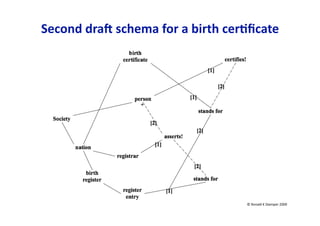
Second
dram
schema
for
a
birth
cer:ficate


                                   ©
Ronald
K
Stamper
2009

First
Order
Predicate
Logic
/
Norma


x acquires British citizenship by section 1.1 on date y             =   A(x,y)
x is born in the U.K.                                               =   B(x)
x was born on date y                                                =   D(x,y)
y is after or on commencement                                       =   C(y)

B(x) & D(x,y) & C(y) then A(x,y)
UK 1981-Ch28.S1.1: start of (citizenship (x, Britain)) =
                        start of (x) while in (x, UK) while in force (UK 1981-Ch28)
start authority of x = UK 1981-Ch28.S1.1
              Britain         UK 1981-28              Section 1.1
                                        in force                              Normbase

               nation        statute           section
                                                                                 SURROGATE


                                        calendar                         $
Surrogate
number

Society        territory
                                                                         s
Universal
affordance

            time zone             day                                    1
Antecedent‐1

            country                                #date
                                                                         2
[Antecedent‐2]

                             UK
                                                                         +
Start    


                        in
                                                                         ‐

Finish 


                                        citizenship                      @
Authority
for
start

                                                                         &

Authority
for
finish

          person
                                        ©
Ronald
K
Stamper
2009


Ronald Stamper Workshop Organizational Semiotics

  • 1.
    A
Pragma(c
Web
Workshop
 Ronald
Stamper
 stamper.measur@gmail.com
 Pragma(cs
in
a
Semio(c
Framework
 built
on
a
Seman(c
Theory
 based
on
a
Presen(st
Ontology
of
Actualism
 leading
to
the
concept
of
Ontological
Dependency
 and
a
Seman(c
Normal
Form
with
Seman(c
Temporal
DB
 ¿
able
to
support
an
Open
Common
“Ontology”
?
 with
pragma(c
tools
for
web
discourse


finally
a


SMALL
CASE
STUDY

 ©
Ronald
K
Stamper
2009
 I‐SEMANTICS
'09
GRAZ


  • 2.
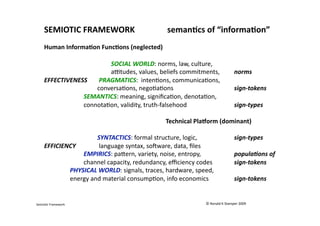
    SEMIOTIC
FRAMEWORK 
 
 
seman:cs
of
“informa:on”
 Human
Informa:on
Func:ons
(neglected)


SOCIAL
WORLD:
norms,
law,
culture,


aWtudes,
values,
beliefs
commitments,
 
norms
 EFFECTIVENESS 
PRAGMATICS:

inten(ons,
communica(ons,


conversa(ons,
nego(a(ons 


sign‐tokens


SEMANTICS:
meaning,
significa(on,
denota(on,


connota(on,
validity,
truth‐falsehood 


sign‐types


Technical
PlaLorm
(dominant)


SYNTACTICS:
formal
structure,
logic, 
 
 
sign‐types
 EFFICIENCY 
 
language
syntax,
so[ware,
data,
files 


EMPIRICS:
paern,
variety,
noise,
entropy, 
 
 
populaDons
of


channel
capacity,
redundancy,
efficiency
codes 
 
sign‐tokens
 
 
PHYSICAL
WORLD:
signals,
traces,
hardware,
speed, 


energy
and
material
consump(on,
info
economics 
 
sign‐tokens
 Semio(c
Framework
 ©
Ronald
K
Stamper
2009

  • 3.
    AN
EMPIRICAL
APPROACH
TO
IS
AS
A
HUMAN
SYSTEM

–
LAW
TO
‘PROGRAM’
PEOPLE
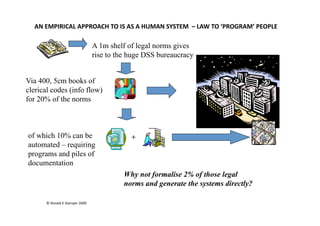
 A 1m shelf of legal norms gives rise to the huge DSS bureaucracy Via 400, 5cm books of clerical codes (info flow) for 20% of the norms of which 10% can be + automated – requiring programs and piles of documentation Why not formalise 2% of those legal norms and generate the systems directly? ©
Ronald
K
Stamper
2009

  • 4.
    INFORMATION
FIELD
MODEL
 Norwich
City COMPANY
ABC
Ltd Overlapping
groups
of
people
 City
Council sharing
norms
define
 informa(on
fields
 COMPANY
XYZ
Ltd Accountany New
methods
 profession define
a
system
 of
norms
 :
Informa(on
fields
defined
by
shared
norms Norms
determine
the
signs
/
 attitudes action norms informa(on
requirements
 interpretation expression environment Current
focus
on
 signs observation sign
movements
 and
 transforma(on

 ©
Ronald
K
Stamper
2009

  • 5.
    KEY
PROBLEMS
IN
THE
HUMAN
INFORMATION
SYSTEM
 
role
of
signs
in
rela:on
with
norms
 
meaning
of
“meaning”
and
hence
 
nature
of
reality

 
responsibility
for
linking
data
and
reality
 
history
and
Dme
when
things
exist
 
The
law
points
the
way
 
it
requires
evidence,
both
material
and
verbal
from
witnesses


especially
evidence
of
inten:ons


THESE
CONCEPTS
ARE
NOT
OPTIONAL
EXTRAS
 
BUT
OBLIGATORY
FOR
SEMANTIC
AND
PRAGMATIC
ANALYSES
 
 Between ©
Ronald
K
Stamper
2009

  • 6.
    Percep(on
and
meaning
 ©
Ronald
K
Stamper
2009

  • 7.
    AN
ENGINEER’S
ONTOLOGY
 if
<SIGN>
denotes
<THING>
 then
TAKE
ME
BY
THE
HAND
and
SHOW
ME
 if
successful
 I’ll
accept
that
the
<THING>
EXISTS
 This
ontology
appears
restric(ve
 but
 it
is
not
 ©
Ronald
K
Stamper
2009

  • 8.
    AFFORDANCES

‐

Perceptual
Norms
 What
does
the
world
consist
of
(our
ontological
assump:on)?
 Gibson’s
theory
of

invariant
affordances

 
organisms
perceive
the
repertoires
of
behaviour
that

 
enable
them
to
survive
physically

 
we
create
our
social
reality
with
norms
defining
 
addi(onal
invariant
repertoires
of
behaviour


EXAMPLES:

towards,
cup,
copyright
 Actualism
–
an
ontology
for
engineers
 1)  No
reality
without
a
knowing
agent
 2)  No
knowledge
of
the
world
without
ac:on
 ©
Ronald
K
Stamper
2009

  • 9.
    End
of
passive
look‐and‐perceive
 Find
useful
invariants
in
the
flux
of
ac:on
and
 events
to
construct
the
knowable
world
 
 Towards ©
Ronald
K
Stamper
2009

  • 10.
    Ontological
Dependency


 Syntax
of
Norma 


of
each
affordance
upon
its
antecedents
 Gibson’s
theory
suggests
a
formal
Syntax


for
norms
and
affordances
 AGENT
affordance 


John
ball
 When
an
Agent
realizes
an
affordance
it
becomes
a
modified
Agent:
 (AGENT
affordance1)
affordance2 


John
ball
throw


with
one
direct
antecedent
 Two
coexis(ng
realiza(ons
may
afford
other
ones:
 AGENT
affordance1

while
AGENT
affordance2 
 
John
ball
while
John
bat
 affords
another
one
:
 AGENT
(affordance1
while
affordance2)
affordance3


John
(ball
while
bat)
hit


with
two
direct
antecedents
 ©
Ronald
K
Stamper
2009

  • 11.
  • 12.
  • 13.
    Seman:c
Normal
Form 
(vs.
OO,
ER,
Rela:onal
.
.
.
Models)
 GEOMETRY

 SURROGATE


 STRUCTURE
 COLLATERAL $
Surrogate
number
 BRANCHES s
Universal
affordance
 1
Antecedent‐1
 Root 2
[Antecedent‐2]
 STEM affordance BRANCH agent +
Start 

 COLLATERAL ‐

Finish 

 BRANCHES @
Authority
for
start
 &

Authority
for
finish
 THE
RULES
 affordance
=
invariant
repertoire
of
behaviour
(NOT
data
item)
 affordance
only
exists
during

co‐existence
of
all
those
in
its
stem
 maximum
of
two
direct
antecedents
per
affordance
 represents
the
here‐and‐now,
the
only
(me
we
can
know
directly

 past
and
future
(mes
constructed
using
signs
(informa(on)


PRESENTISM
 ©
Ronald
K
Stamper
2009

  • 14.
    PRESENTISM’s
CHALLENCE
EVADED
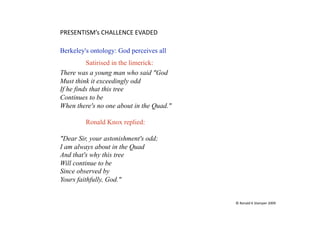
 Berkeley's ontology: Godperceives all Satirised in the limerick: There was a young man who said "God Must think it exceedingly odd If he finds that this tree Continues to be When there's no one about in the Quad." Ronald Knox replied: "Dear Sir, your astonishment's odd; I am always about in the Quad And that's why this tree Will continue to be Since observed by Yours faithfully, God." ©
Ronald
K
Stamper
2009

  • 15.
  • 16.
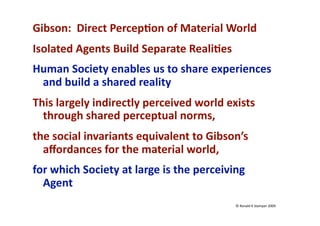
    Gibson:

Direct
Percep:on
of
Material
World
 Isolated
Agents
Build
Separate
Reali:es
 Human
Society
enables
us
to
share
experiences
 and
build
a
shared
reality
 This
largely
indirectly
perceived
world
exists
 through
shared
perceptual
norms,
 the
social
invariants
equivalent
to
Gibson’s
 affordances
for
the
material
world,
 for
which
Society
at
large
is
the
perceiving
 Agent
 ©
Ronald
K
Stamper
2009

  • 17.
    INTRINSIC
SURROGATE
ATTRIBUTES
 (not
op:onal
extras)

 •  $
Surrogate
number
 •  s
Universal
affordance
 •  1
Antecedent‐1
 •  2
[Antecedent‐2]
 •  +
Start 


 •  ‐

Finish 

 •  @
Authority
for
start
 
 
KEY
TO
PRAGMATIC
 •  &

Authority
for
finish 


STATUS


@
&
=

comm.
act
(document),
norm,
agent
.
.
.
 ©
Ronald
K
Stamper
2009

  • 18.
    Thank
you!


 Your
ques(ons
and
comments,
 please
 (Case
Study
Follows)
 ©
Ronald
K
Stamper
2009

  • 19.
    CASE
STUDY
ON
PRAGMATICS
 A
bureaucra(c
story
with
a
dash
of
 romance
 •  some
dra[
schemas
 •  how
implemented
 •  problems
raised
 •  value
of
canonical
schema
 •  ¿
open
source
schema
possible
?
 •  ¿
what
issues
should
we
inves(gate
?
 •  ¿
are
these
tools
suitable
?
 ©
Ronald
K
Stamper
2009

  • 20.
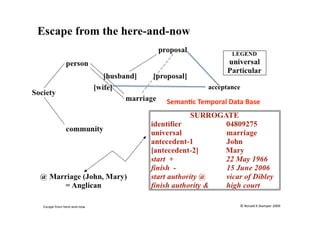
    acceptance Seman:c
Temporal
Data
Base
 
 Escape
from
here‐and‐now ©
Ronald
K
Stamper
2009

  • 21.
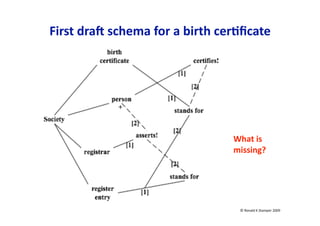
    First
dram
schema
for
a
birth
cer:ficate
 What
is
 missing?
 ©
Ronald
K
Stamper
2009

  • 22.
  • 23.
    First
Order
Predicate
Logic
/
Norma
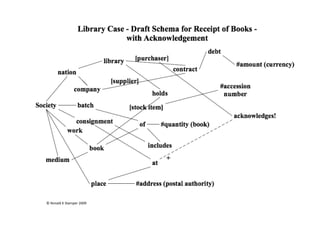
 x acquires Britishcitizenship by section 1.1 on date y = A(x,y) x is born in the U.K. = B(x) x was born on date y = D(x,y) y is after or on commencement = C(y) B(x) & D(x,y) & C(y) then A(x,y) UK 1981-Ch28.S1.1: start of (citizenship (x, Britain)) = start of (x) while in (x, UK) while in force (UK 1981-Ch28) start authority of x = UK 1981-Ch28.S1.1 Britain UK 1981-28 Section 1.1 in force Normbase
 nation statute section SURROGATE


 calendar $
Surrogate
number
 Society territory s
Universal
affordance
 time zone day 1
Antecedent‐1
 country #date 2
[Antecedent‐2]
 UK +
Start 

 in ‐

Finish 

 citizenship @
Authority
for
start
 &

Authority
for
finish
 person ©
Ronald
K
Stamper
2009