KBMS – Text and Image
Frank Nack
ILPS


  ILPS
Outline


        Summary last lecture
        Text – a visual sign system

        Image – a different visual sign system


  ILPS      Frank Nack   nack@uva.nl   KBMS       2
Intro knowledge - summary


           Investigated
               Different types of knowledge, epistemological aspects of

                knowledge, in particular constructivism, and established
                knowledge representation methods


           Findings
               Knowledge, as part of communication, has to be situated, reliable,

                and justifiable
               A knowledge representation is a surrogate that provides a set of

                ontology commitments to be able to state things about a domain.
               There are already a large variety of knowledge representation

                techniques available, of which most follow the epistemological
                understanding of knowledge by focussing on propositional
                representations.


  ILPS   Frank Nack   nack@uva.nl   KBMS                                             3
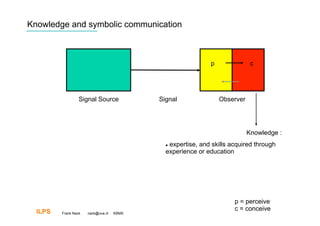
Knowledge and symbolic communication


                                                             p               c


                  Signal Source            Signal                Observer


                                                                            Knowledge :
                                              expertise, and skills acquired through
                                              

                                             experience or education


                                                                     p = perceive
  ILPS                                                               c = conceive
         Frank Nack   nack@uva.nl   KBMS
Knowledge and symbolic communication


                                           Representing knowledge in media-based
                                           systems requires:

                                               Relevant conceptual models
                                               A language to represent the models
                                               Interpretation mechanisms


  ILPS   Frank Nack   nack@uva.nl   KBMS                                             5
Text – a visual sign system


  ILPS   Frank Nack   nack@uva.nl   KBMS   6
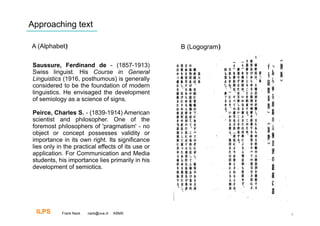
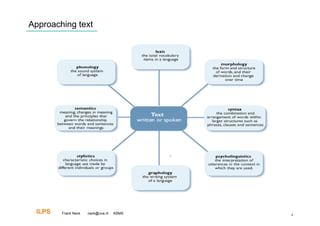
Approaching text

A (Alphabet)‫‏‬                                       B (Logogram)‫‏‬

 Saussure, Ferdinand de - (1857-1913)
 Swiss linguist. His Course in General
 Linguistics (1916, posthumous) is generally
 considered to be the foundation of modern
 linguistics. He envisaged the development
 of semiology as a science of signs.

 Peirce, Charles S. - (1839-1914) American
 scientist and philosopher. One of the
 foremost philosophers of 'pragmatism' - no
 object or concept possesses validity or
 importance in its own right. Its significance
 lies only in the practical effects of its use or
 application. For Communication and Media
 students, his importance lies primarily in his
 development of semiotics.


  ILPS       Frank Nack   nack@uva.nl   KBMS                        7
Approaching text


 ILPS   Frank Nack   nack@uva.nl   KBMS   8
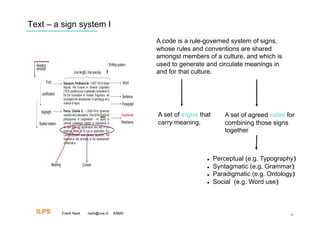
Text – a sign system I
                                           A code is a rule-governed system of signs,
                                           whose rules and conventions are shared
                                           amongst members of a culture, and which is
                                           used to generate and circulate meanings in
                                           and for that culture.


                                           A set of signs that       A set of agreed rules for
                                           carry meaning.            combining those signs
                                                                     together


                                                                Perceptual (e.g. Typography)‫‏‬
                                                                Syntagmatic (e.g. Grammar)‫‏‬
                                                                Paradigmatic (e.g. Ontology)‫‏‬
                                                                Social (e.g. Word use)‫‏‬


  ILPS   Frank Nack   nack@uva.nl   KBMS                                                    9
Text – a sign system II
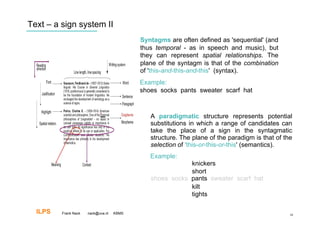
                                           Syntagms are often defined as 'sequential' (and
                                           thus temporal - as in speech and music), but
                                           they can represent spatial relationships. The
                                           plane of the syntagm is that of the combination
                                           of 'this-and-this-and-this' (syntax).
                                           Example:
                                           shoes socks pants sweater scarf hat


                                              A paradigmatic structure represents potential
                                              substitutions in which a range of candidates can
                                              take the place of a sign in the syntagmatic
                                              structure. The plane of the paradigm is that of the
                                              selection of 'this-or-this-or-this' (semantics).
                                              Example:
                                                          knickers
                                                          short
                                              shoes socks pants sweater scarf hat
                                                          kilt
                                                          tights

  ILPS   Frank Nack   nack@uva.nl   KBMS                                                        10
Text – a sign system III
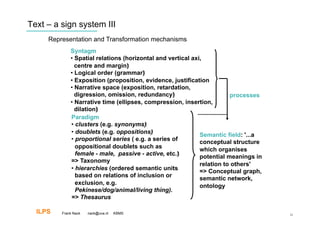
     Representation and Transformation mechanisms
             Syntagm
             •  Spatial relations (horizontal and vertical axi,
               centre and margin)‫‏‬
             •  Logical order (grammar)‫‏‬
             •  Exposition (proposition, evidence, justification
             •  Narrative space (exposition, retardation,
               digression, omission, redundancy)‫‏‬                        processes
             •  Narrative time (ellipses, compression, insertion,
               dilation)‫‏‬
             Paradigm
             •  clusters (e.g. synonyms)‫‏‬
             •  doublets (e.g. oppositions)‫‏‬                  Semantic field: '...a
             •  proportional series ( e.g. a series of        conceptual structure
                oppositional doublets such as                 which organises
                female - male, passive - active, etc.)‫‏‬       potential meanings in
             => Taxonomy
                                                              relation to others'
             •  hierarchies (ordered semantic units           => Conceptual graph,
                based on relations of inclusion or            semantic network,
                exclusion, e.g.                               ontology
                Pekinese/dog/animal/living thing).
             => Thesaurus

  ILPS   Frank Nack   nack@uva.nl   KBMS                                              11
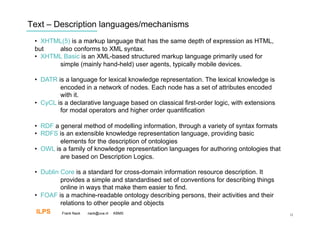
Text – Description languages/mechanisms
 •  XHTML(5) is a markup language that has the same depth of expression as HTML,
 but    also conforms to XML syntax.
 •  XHTML Basic is an XML-based structured markup language primarily used for
        simple (mainly hand-held) user agents, typically mobile devices.

 •  DATR is a language for lexical knowledge representation. The lexical knowledge is
          encoded in a network of nodes. Each node has a set of attributes encoded
          with it.
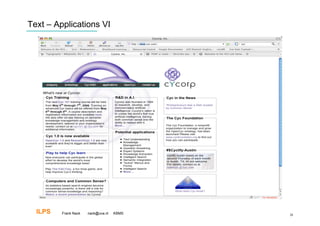
 •  CyCL is a declarative language based on classical first-order logic, with extensions
          for modal operators and higher order quantification

 •  RDF a general method of modelling information, through a variety of syntax formats
 •  RDFS is an extensible knowledge representation language, providing basic
          elements for the description of ontologies
 •  OWL is a family of knowledge representation languages for authoring ontologies that
          are based on Description Logics.

 •  Dublin Core is a standard for cross-domain information resource description. It
           provides a simple and standardised set of conventions for describing things
           online in ways that make them easier to find.
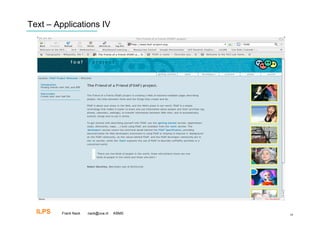
 •  FOAF is a machine-readable ontology describing persons, their activities and their
           relations to other people and objects
  ILPS      Frank Nack nack@uva.nl KBMS                                                    12
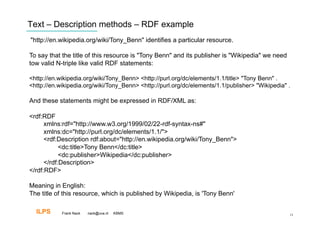
Text – Description methods – RDF example
"http://en.wikipedia.org/wiki/Tony_Benn" identifies a particular resource.

To say that the title of this resource is "Tony Benn" and its publisher is "Wikipedia" we need
tow valid N-triple like valid RDF statements:

<http://en.wikipedia.org/wiki/Tony_Benn> <http://purl.org/dc/elements/1.1/title> "Tony Benn" .
<http://en.wikipedia.org/wiki/Tony_Benn> <http://purl.org/dc/elements/1.1/publisher> "Wikipedia" .

And these statements might be expressed in RDF/XML as:

<rdf:RDF
      xmlns:rdf="http://www.w3.org/1999/02/22-rdf-syntax-ns#"
      xmlns:dc="http://purl.org/dc/elements/1.1/">
      <rdf:Description rdf:about="http://en.wikipedia.org/wiki/Tony_Benn">
            <dc:title>Tony Benn</dc:title>
            <dc:publisher>Wikipedia</dc:publisher>
      </rdf:Description>
</rdf:RDF>

Meaning in English:
The title of this resource, which is published by Wikipedia, is 'Tony Benn'

  ILPS      Frank Nack   nack@uva.nl   KBMS                                                      13
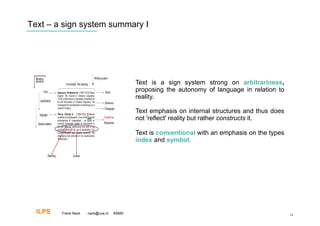
Text – a sign system summary I


                                           Text is a sign system strong on arbitrariness,
                                           proposing the autonomy of language in relation to
                                           reality.

                                           Text emphasis on internal structures and thus does
                                           not 'reflect' reality but rather constructs it.

                                           Text is conventional with an emphasis on the types
                                           index and symbol.


  ILPS   Frank Nack   nack@uva.nl   KBMS                                                        14
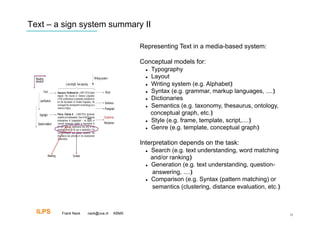
Text – a sign system summary II

                                           Representing Text in a media-based system:

                                           Conceptual models for:
                                                 Typography
                                                 Layout
                                                 Writing system (e.g. Alphabet)‫‏‬
                                                 Syntax (e.g. grammar, markup languages, ....)‫‏‬
                                                 Dictionaries
                                                 Semantics (e.g. taxonomy, thesaurus, ontology,
                                                  conceptual graph, etc.)‫‏‬
                                                 Style (e.g. frame, template, script,....)‫‏‬
                                                 Genre (e.g. template, conceptual graph)‫‏‬

                                           Interpretation depends on the task:
                                                 Search (e.g. text understanding, word matching
                                                  and/or ranking)‫‏‬
                                                 Generation (e.g. text understanding, question-
                                                   answering, ....)‫‏‬
                                                 Comparison (e.g. Syntax (pattern matching) or
                                                   semantics (clustering, distance evaluation, etc.)‫‏‬


  ILPS   Frank Nack   nack@uva.nl   KBMS                                                                15
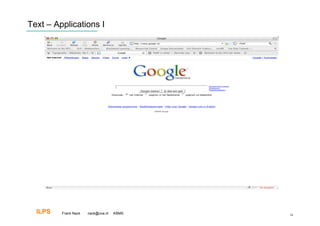
Text – Applications I


  ILPS   Frank Nack   nack@uva.nl   KBMS   16
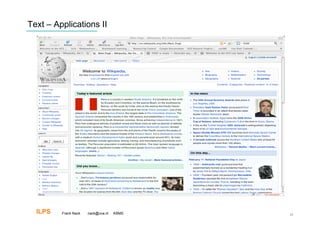
Text – Applications II


  ILPS   Frank Nack   nack@uva.nl   KBMS   17
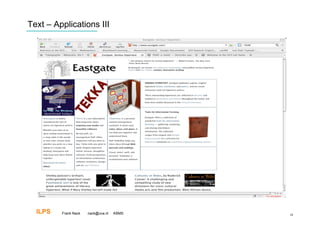
Text – Applications III


  ILPS   Frank Nack   nack@uva.nl   KBMS   18
Text – Applications IV


  ILPS   Frank Nack   nack@uva.nl   KBMS   19
Text – Applications VI


  ILPS   Frank Nack   nack@uva.nl   KBMS   20
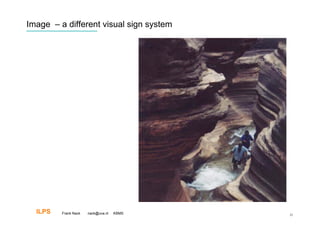
Image – a different visual sign system


  ILPS   Frank Nack   nack@uva.nl   KBMS   21
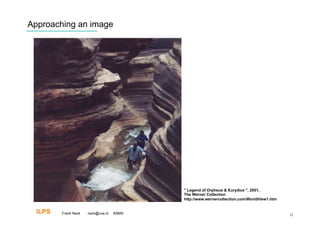
Approaching an image


                                           " Legend of Orpheus & Eurydice ", 2001,
                                           The Werner Collection
                                           http://www.wernercollection.com/WorldView1.htm


  ILPS   Frank Nack   nack@uva.nl   KBMS                                                    22
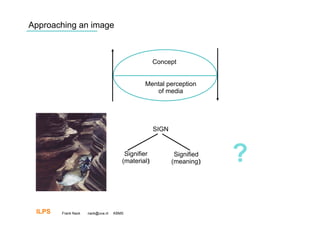
Approaching an image


                                                    Concept


                                               Mental perception
                                                  of media


                                                    SIGN


                                       Signifier
                                      (material)‫‏‬
                                                            Signified
                                                           (meaning)‫‏‬   ?

 ILPS   Frank Nack   nack@uva.nl   KBMS
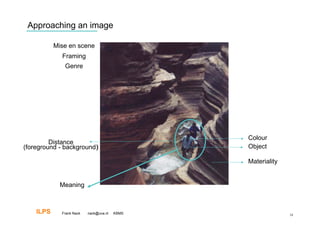
Approaching an image

           Mise en scene
             Framing
              Genre


                                               Colour
         Distance
(foreground - background)‫‏‬                     Object

                                               Materiality


             Meaning


    ILPS     Frank Nack   nack@uva.nl   KBMS                 24
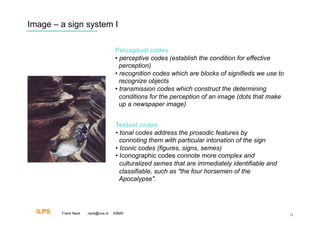
Image – a sign system I

                                    Perceptual codes
                                    •  perceptive codes (establish the condition for effective
                                      perception)
                                    •  recognition codes which are blocks of signifieds we use to
                                      recognize objects
                                    •  transmission codes which construct the determining
                                      conditions for the perception of an image (dots that make
                                      up a newspaper image)


                                    Textual codes
                                    •  tonal codes address the prosodic features by
                                      connoting them with particular intonation of the sign
                                    •  Iconic codes (figures, signs, semes)
                                    •  Iconographic codes connote more complex and
                                      culturalized semes that are immediately identifiable and
                                      classifiable, such as "the four horsemen of the
                                      Apocalypse".


  ILPS   Frank Nack   nack@uva.nl   KBMS                                                            25
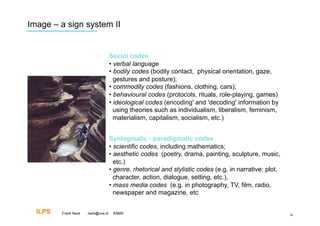
Image – a sign system II


                                    Social codes
                                    •  verbal language
                                    •  bodily codes (bodily contact, physical orientation, gaze,
                                      gestures and posture);
                                    •  commodity codes (fashions, clothing, cars);
                                    •  behavioural codes (protocols, rituals, role-playing, games)
                                    •  ideological codes (encoding' and 'decoding' information by
                                      using theories such as individualism, liberalism, feminism,
                                      materialism, capitalism, socialism, etc.)


                                    Syntagmatic - paradigmatic codes
                                    •  scientific codes, including mathematics;
                                    •  aesthetic codes (poetry, drama, painting, sculpture, music,
                                      etc.)
                                    •  genre, rhetorical and stylistic codes (e.g. in narrative: plot,
                                      character, action, dialogue, setting, etc.),
                                    •  mass media codes (e.g. in photography, TV, film, radio,
                                      newspaper and magazine, etc.)

  ILPS   Frank Nack   nack@uva.nl    KBMS                                                                26
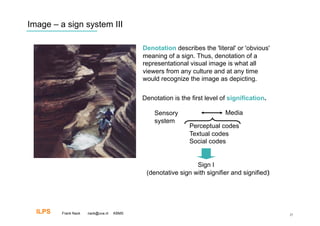
Image – a sign system III

                                           Denotation describes the 'literal' or 'obvious'
                                           meaning of a sign. Thus, denotation of a
                                           representational visual image is what all
                                           viewers from any culture and at any time
                                           would recognize the image as depicting.

                                           Denotation is the first level of signification.

                                               Sensory                    Media
                                               system
                                                            Perceptual codes
                                                            Textual codes
                                                            Social codes


                                                              Sign I
                                            (denotative sign with signifier and signified)‫‏‬


  ILPS   Frank Nack   nack@uva.nl   KBMS                                                      27
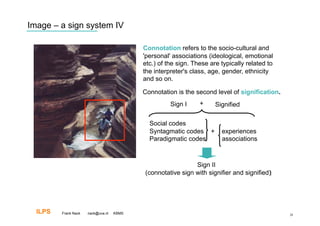
Image – a sign system IV

                                           Connotation refers to the socio-cultural and
                                           'personal' associations (ideological, emotional
                                           etc.) of the sign. These are typically related to
                                           the interpreter's class, age, gender, ethnicity
                                           and so on.

                                           Connotation is the second level of signification.
                                                     Sign I     +     Signified

                                             Social codes
                                             Syntagmatic codes +        experiences
                                             Paradigmatic codes         associations


                                                             Sign II
                                           (connotative sign with signifier and signified)‫‏‬


  ILPS   Frank Nack   nack@uva.nl   KBMS                                                       28
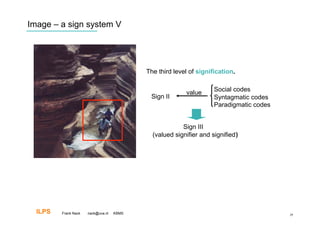
Image – a sign system V


                                           The third level of signification.

                                                                    Social codes
                                                          value
                                            Sign II                 Syntagmatic codes
                                                                    Paradigmatic codes


                                                        Sign III
                                             (valued signifier and signified)‫‏‬


  ILPS   Frank Nack   nack@uva.nl   KBMS                                                 29
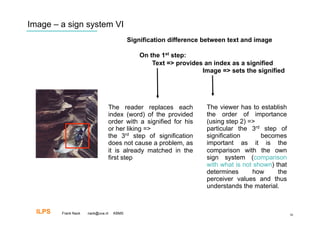
Image – a sign system VI
                                           Signification difference between text and image

                                               On the 1st step:
                                                   Text => provides an index as a signified
                                                                   Image => sets the signified


                                The reader replaces each            The viewer has to establish
                                index (word) of the provided        the order of importance
                                order with a signified for his      (using step 2) =>
                                or her liking =>                    particular the 3rd step of
                                the 3rd step of signification       signification      becomes
                                does not cause a problem, as        important as it is the
                                it is already matched in the        comparison with the own
                                first step                          sign system (comparison
                                                                    with what is not shown) that
                                                                    determines      how      the
                                                                    perceiver values and thus
                                                                    understands the material.


  ILPS   Frank Nack   nack@uva.nl   KBMS                                                           30
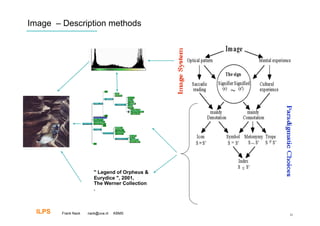
Image – Description methods


                         " Legend of Orpheus &
                         Eurydice ", 2001,
                         The Werner Collection
                         .


  ILPS   Frank Nack   nack@uva.nl   KBMS         31
Image – Description methods


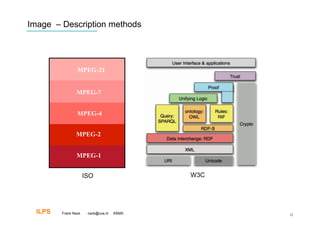
                 MPEG-21


                MPEG-7


                 MPEG-4


                MPEG-2


                 MPEG-1


                      ISO                   W3C


  ILPS   Frank Nack    nack@uva.nl   KBMS         32
Image – Description methods

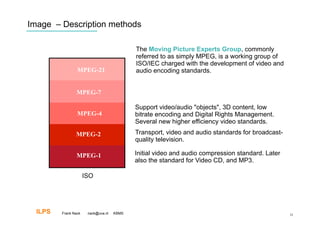
                                            The Moving Picture Experts Group, commonly
                                            referred to as simply MPEG, is a working group of
                                            ISO/IEC charged with the development of video and
                 MPEG-21                    audio encoding standards.


                MPEG-7

                                            Support video/audio "objects", 3D content, low
                 MPEG-4                     bitrate encoding and Digital Rights Management.
                                            Several new higher efficiency video standards.
                MPEG-2                      Transport, video and audio standards for broadcast-
                                            quality television.

                 MPEG-1                     Initial video and audio compression standard. Later
                                            also the standard for Video CD, and MP3.

                      ISO


  ILPS   Frank Nack    nack@uva.nl   KBMS                                                         33
Image – Description methods


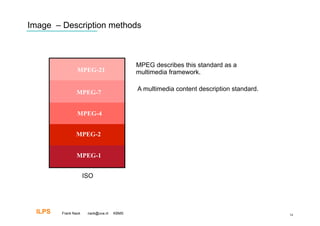
                                            MPEG describes this standard as a
                 MPEG-21                    multimedia framework.

                                            A multimedia content description standard.
                MPEG-7


                 MPEG-4


                MPEG-2


                 MPEG-1


                      ISO


  ILPS   Frank Nack    nack@uva.nl   KBMS                                                34
Image – Description methods


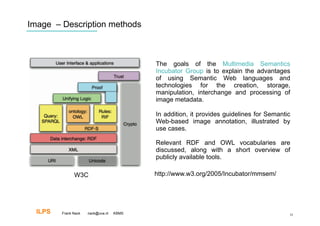
                                           The goals of the Multimedia Semantics
                                           Incubator Group is to explain the advantages
                                           of using Semantic Web languages and
                                           technologies for the creation, storage,
                                           manipulation, interchange and processing of
                                           image metadata.

                                           In addition, it provides guidelines for Semantic
                                           Web-based image annotation, illustrated by
                                           use cases.

                                           Relevant RDF and OWL vocabularies are
                                           discussed, along with a short overview of
                                           publicly available tools.

               W3C                         http://www.w3.org/2005/Incubator/mmsem/


  ILPS   Frank Nack   nack@uva.nl   KBMS                                                  35
Image – a sign system summary


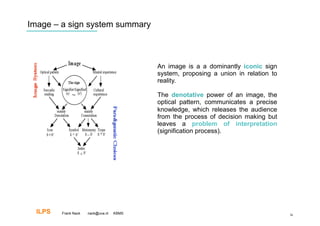
                                           An image is a a dominantly iconic sign
                                           system, proposing a union in relation to
                                           reality.

                                           The denotative power of an image, the
                                           optical pattern, communicates a precise
                                           knowledge, which releases the audience
                                           from the process of decision making but
                                           leaves a problem of interpretation
                                           (signification process).


  ILPS   Frank Nack   nack@uva.nl   KBMS                                              36
Image – a sign system summary II

                                           Representing an Image in a media-based system:

                                           Conceptual models for:
                                                 quantitative or qualitative characterization of optical
                                                  pattern (feature extraction (colour, texture, light,
                                                  angle, etc.), pattern recognition (line, shape region,
                                                  etc.), multi-scale signal analysis, ...)‫‏‬
                                                 Spatial dimensions
                                             => textual metadata
                                               Semantics (e.g. taxonomy, thesaurus, ontology, etc.)‫‏‬
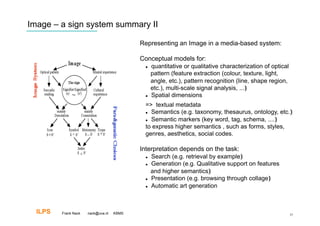
                                               Semantic markers (key word, tag, schema, ....)‫‏‬

                                             to express higher semantics , such as forms, styles,
                                             genres, aesthetics, social codes.
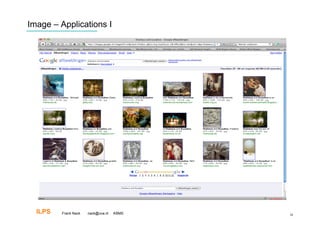
                                           Interpretation depends on the task:
                                                 Search (e.g. retrieval by example)‫‏‬
                                                 Generation (e.g. Qualitative support on features
                                                  and higher semantics)‫‏‬
                                                 Presentation (e.g. browsing through collage)‫‏‬
                                                 Automatic art generation


  ILPS   Frank Nack   nack@uva.nl   KBMS                                                                    37
Image – Applications I


  ILPS   Frank Nack   nack@uva.nl   KBMS   38
Image – Applications II


  ILPS   Frank Nack   nack@uva.nl   KBMS   39
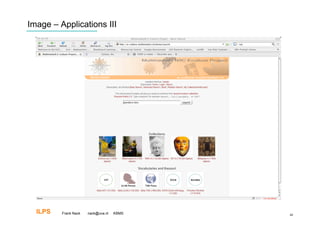
Image – Applications III


  ILPS   Frank Nack   nack@uva.nl   KBMS   40
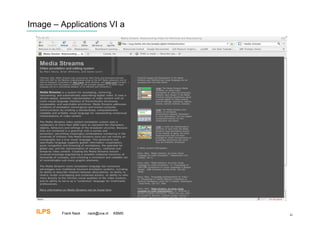
Image – Applications VI a


  ILPS   Frank Nack   nack@uva.nl   KBMS   41
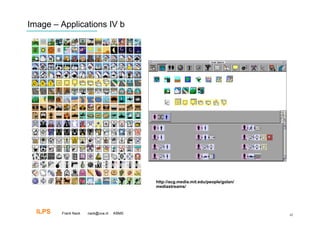
Image – Applications IV b


                                           http://acg.media.mit.edu/people/golan/
                                           mediastreams/


  ILPS   Frank Nack   nack@uva.nl   KBMS                                            42
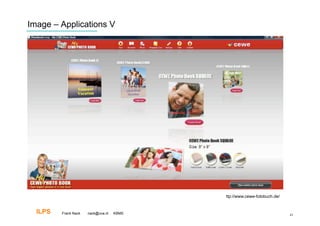
Image – Applications V


                                           http://www.cewe-fotobuch.de/

  ILPS   Frank Nack   nack@uva.nl   KBMS                                  43
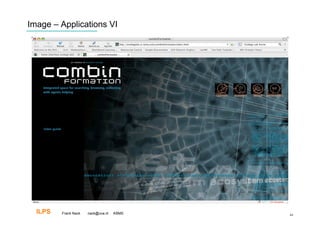
Image – Applications VI


  ILPS   Frank Nack   nack@uva.nl   KBMS   44
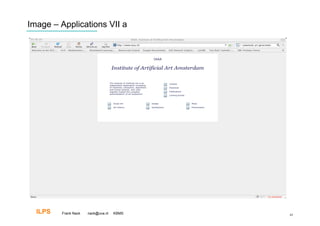
Image – Applications VII a


  ILPS   Frank Nack   nack@uva.nl   KBMS   45
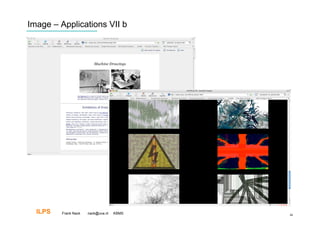
Image – Applications VII b


  ILPS   Frank Nack   nack@uva.nl   KBMS   46
Text and Image – summary


                                           Both text and images refer to the same modality and
                                           domain knowledge but they establish different sign
                                           systems.

                                           Both differ on the denotative level of signification.

                                           Both differ on their paradicmatic processes.

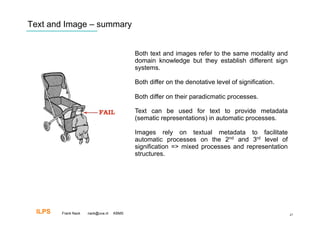
                                           Text can be used for text to provide metadata
                                           (sematic representations) in automatic processes.

                                           Images rely on textual metadata to facilitate
                                           automatic processes on the 2nd and 3rd level of
                                           signification => mixed processes and representation
                                           structures.


  ILPS   Frank Nack   nack@uva.nl   KBMS                                                           47

Kbms text-image

  • 1.
    KBMS – Textand Image Frank Nack ILPS ILPS
  • 2.
    Outline   Summary last lecture   Text – a visual sign system   Image – a different visual sign system ILPS Frank Nack nack@uva.nl KBMS 2
  • 3.
    Intro knowledge -summary Investigated   Different types of knowledge, epistemological aspects of knowledge, in particular constructivism, and established knowledge representation methods Findings   Knowledge, as part of communication, has to be situated, reliable, and justifiable   A knowledge representation is a surrogate that provides a set of ontology commitments to be able to state things about a domain.   There are already a large variety of knowledge representation techniques available, of which most follow the epistemological understanding of knowledge by focussing on propositional representations. ILPS Frank Nack nack@uva.nl KBMS 3
  • 4.
    Knowledge and symboliccommunication p c Signal Source Signal Observer Knowledge : expertise, and skills acquired through   experience or education p = perceive ILPS c = conceive Frank Nack nack@uva.nl KBMS
  • 5.
    Knowledge and symboliccommunication Representing knowledge in media-based systems requires:   Relevant conceptual models   A language to represent the models   Interpretation mechanisms ILPS Frank Nack nack@uva.nl KBMS 5
  • 6.
    Text – avisual sign system ILPS Frank Nack nack@uva.nl KBMS 6
  • 7.
    Approaching text A (Alphabet)‫‏‬ B (Logogram)‫‏‬ Saussure, Ferdinand de - (1857-1913) Swiss linguist. His Course in General Linguistics (1916, posthumous) is generally considered to be the foundation of modern linguistics. He envisaged the development of semiology as a science of signs. Peirce, Charles S. - (1839-1914) American scientist and philosopher. One of the foremost philosophers of 'pragmatism' - no object or concept possesses validity or importance in its own right. Its significance lies only in the practical effects of its use or application. For Communication and Media students, his importance lies primarily in his development of semiotics. ILPS Frank Nack nack@uva.nl KBMS 7
  • 8.
    Approaching text ILPS Frank Nack nack@uva.nl KBMS 8
  • 9.
    Text – asign system I A code is a rule-governed system of signs, whose rules and conventions are shared amongst members of a culture, and which is used to generate and circulate meanings in and for that culture. A set of signs that A set of agreed rules for carry meaning. combining those signs together   Perceptual (e.g. Typography)‫‏‬   Syntagmatic (e.g. Grammar)‫‏‬   Paradigmatic (e.g. Ontology)‫‏‬   Social (e.g. Word use)‫‏‬ ILPS Frank Nack nack@uva.nl KBMS 9
  • 10.
    Text – asign system II Syntagms are often defined as 'sequential' (and thus temporal - as in speech and music), but they can represent spatial relationships. The plane of the syntagm is that of the combination of 'this-and-this-and-this' (syntax). Example: shoes socks pants sweater scarf hat A paradigmatic structure represents potential substitutions in which a range of candidates can take the place of a sign in the syntagmatic structure. The plane of the paradigm is that of the selection of 'this-or-this-or-this' (semantics). Example: knickers short shoes socks pants sweater scarf hat kilt tights ILPS Frank Nack nack@uva.nl KBMS 10
  • 11.
    Text – asign system III Representation and Transformation mechanisms Syntagm •  Spatial relations (horizontal and vertical axi, centre and margin)‫‏‬ •  Logical order (grammar)‫‏‬ •  Exposition (proposition, evidence, justification •  Narrative space (exposition, retardation, digression, omission, redundancy)‫‏‬ processes •  Narrative time (ellipses, compression, insertion, dilation)‫‏‬ Paradigm •  clusters (e.g. synonyms)‫‏‬ •  doublets (e.g. oppositions)‫‏‬ Semantic field: '...a •  proportional series ( e.g. a series of conceptual structure oppositional doublets such as which organises female - male, passive - active, etc.)‫‏‬ potential meanings in => Taxonomy relation to others' •  hierarchies (ordered semantic units => Conceptual graph, based on relations of inclusion or semantic network, exclusion, e.g. ontology Pekinese/dog/animal/living thing). => Thesaurus ILPS Frank Nack nack@uva.nl KBMS 11
  • 12.
    Text – Descriptionlanguages/mechanisms •  XHTML(5) is a markup language that has the same depth of expression as HTML, but also conforms to XML syntax. •  XHTML Basic is an XML-based structured markup language primarily used for simple (mainly hand-held) user agents, typically mobile devices. •  DATR is a language for lexical knowledge representation. The lexical knowledge is encoded in a network of nodes. Each node has a set of attributes encoded with it. •  CyCL is a declarative language based on classical first-order logic, with extensions for modal operators and higher order quantification •  RDF a general method of modelling information, through a variety of syntax formats •  RDFS is an extensible knowledge representation language, providing basic elements for the description of ontologies •  OWL is a family of knowledge representation languages for authoring ontologies that are based on Description Logics. •  Dublin Core is a standard for cross-domain information resource description. It provides a simple and standardised set of conventions for describing things online in ways that make them easier to find. •  FOAF is a machine-readable ontology describing persons, their activities and their relations to other people and objects ILPS Frank Nack nack@uva.nl KBMS 12
  • 13.
    Text – Descriptionmethods – RDF example "http://en.wikipedia.org/wiki/Tony_Benn" identifies a particular resource. To say that the title of this resource is "Tony Benn" and its publisher is "Wikipedia" we need tow valid N-triple like valid RDF statements: <http://en.wikipedia.org/wiki/Tony_Benn> <http://purl.org/dc/elements/1.1/title> "Tony Benn" . <http://en.wikipedia.org/wiki/Tony_Benn> <http://purl.org/dc/elements/1.1/publisher> "Wikipedia" . And these statements might be expressed in RDF/XML as: <rdf:RDF xmlns:rdf="http://www.w3.org/1999/02/22-rdf-syntax-ns#" xmlns:dc="http://purl.org/dc/elements/1.1/"> <rdf:Description rdf:about="http://en.wikipedia.org/wiki/Tony_Benn"> <dc:title>Tony Benn</dc:title> <dc:publisher>Wikipedia</dc:publisher> </rdf:Description> </rdf:RDF> Meaning in English: The title of this resource, which is published by Wikipedia, is 'Tony Benn' ILPS Frank Nack nack@uva.nl KBMS 13
  • 14.
    Text – asign system summary I Text is a sign system strong on arbitrariness, proposing the autonomy of language in relation to reality. Text emphasis on internal structures and thus does not 'reflect' reality but rather constructs it. Text is conventional with an emphasis on the types index and symbol. ILPS Frank Nack nack@uva.nl KBMS 14
  • 15.
    Text – asign system summary II Representing Text in a media-based system: Conceptual models for:   Typography   Layout   Writing system (e.g. Alphabet)‫‏‬   Syntax (e.g. grammar, markup languages, ....)‫‏‬   Dictionaries   Semantics (e.g. taxonomy, thesaurus, ontology, conceptual graph, etc.)‫‏‬   Style (e.g. frame, template, script,....)‫‏‬   Genre (e.g. template, conceptual graph)‫‏‬ Interpretation depends on the task:   Search (e.g. text understanding, word matching and/or ranking)‫‏‬   Generation (e.g. text understanding, question- answering, ....)‫‏‬   Comparison (e.g. Syntax (pattern matching) or semantics (clustering, distance evaluation, etc.)‫‏‬ ILPS Frank Nack nack@uva.nl KBMS 15
  • 16.
    Text – ApplicationsI ILPS Frank Nack nack@uva.nl KBMS 16
  • 17.
    Text – ApplicationsII ILPS Frank Nack nack@uva.nl KBMS 17
  • 18.
    Text – ApplicationsIII ILPS Frank Nack nack@uva.nl KBMS 18
  • 19.
    Text – ApplicationsIV ILPS Frank Nack nack@uva.nl KBMS 19
  • 20.
    Text – ApplicationsVI ILPS Frank Nack nack@uva.nl KBMS 20
  • 21.
    Image – adifferent visual sign system ILPS Frank Nack nack@uva.nl KBMS 21
  • 22.
    Approaching an image " Legend of Orpheus & Eurydice ", 2001, The Werner Collection http://www.wernercollection.com/WorldView1.htm ILPS Frank Nack nack@uva.nl KBMS 22
  • 23.
    Approaching an image Concept Mental perception of media SIGN Signifier (material)‫‏‬ Signified (meaning)‫‏‬ ? ILPS Frank Nack nack@uva.nl KBMS
  • 24.
    Approaching an image Mise en scene Framing Genre Colour Distance (foreground - background)‫‏‬ Object Materiality Meaning ILPS Frank Nack nack@uva.nl KBMS 24
  • 25.
    Image – asign system I Perceptual codes •  perceptive codes (establish the condition for effective perception) •  recognition codes which are blocks of signifieds we use to recognize objects •  transmission codes which construct the determining conditions for the perception of an image (dots that make up a newspaper image) Textual codes •  tonal codes address the prosodic features by connoting them with particular intonation of the sign •  Iconic codes (figures, signs, semes) •  Iconographic codes connote more complex and culturalized semes that are immediately identifiable and classifiable, such as "the four horsemen of the Apocalypse". ILPS Frank Nack nack@uva.nl KBMS 25
  • 26.
    Image – asign system II Social codes •  verbal language •  bodily codes (bodily contact, physical orientation, gaze, gestures and posture); •  commodity codes (fashions, clothing, cars); •  behavioural codes (protocols, rituals, role-playing, games) •  ideological codes (encoding' and 'decoding' information by using theories such as individualism, liberalism, feminism, materialism, capitalism, socialism, etc.) Syntagmatic - paradigmatic codes •  scientific codes, including mathematics; •  aesthetic codes (poetry, drama, painting, sculpture, music, etc.) •  genre, rhetorical and stylistic codes (e.g. in narrative: plot, character, action, dialogue, setting, etc.), •  mass media codes (e.g. in photography, TV, film, radio, newspaper and magazine, etc.) ILPS Frank Nack nack@uva.nl KBMS 26
  • 27.
    Image – asign system III Denotation describes the 'literal' or 'obvious' meaning of a sign. Thus, denotation of a representational visual image is what all viewers from any culture and at any time would recognize the image as depicting. Denotation is the first level of signification. Sensory Media system Perceptual codes Textual codes Social codes Sign I (denotative sign with signifier and signified)‫‏‬ ILPS Frank Nack nack@uva.nl KBMS 27
  • 28.
    Image – asign system IV Connotation refers to the socio-cultural and 'personal' associations (ideological, emotional etc.) of the sign. These are typically related to the interpreter's class, age, gender, ethnicity and so on. Connotation is the second level of signification. Sign I + Signified Social codes Syntagmatic codes + experiences Paradigmatic codes associations Sign II (connotative sign with signifier and signified)‫‏‬ ILPS Frank Nack nack@uva.nl KBMS 28
  • 29.
    Image – asign system V The third level of signification. Social codes value Sign II Syntagmatic codes Paradigmatic codes Sign III (valued signifier and signified)‫‏‬ ILPS Frank Nack nack@uva.nl KBMS 29
  • 30.
    Image – asign system VI Signification difference between text and image On the 1st step: Text => provides an index as a signified Image => sets the signified The reader replaces each The viewer has to establish index (word) of the provided the order of importance order with a signified for his (using step 2) => or her liking => particular the 3rd step of the 3rd step of signification signification becomes does not cause a problem, as important as it is the it is already matched in the comparison with the own first step sign system (comparison with what is not shown) that determines how the perceiver values and thus understands the material. ILPS Frank Nack nack@uva.nl KBMS 30
  • 31.
    Image – Descriptionmethods " Legend of Orpheus & Eurydice ", 2001, The Werner Collection . ILPS Frank Nack nack@uva.nl KBMS 31
  • 32.
    Image – Descriptionmethods MPEG-21 MPEG-7 MPEG-4 MPEG-2 MPEG-1 ISO W3C ILPS Frank Nack nack@uva.nl KBMS 32
  • 33.
    Image – Descriptionmethods The Moving Picture Experts Group, commonly referred to as simply MPEG, is a working group of ISO/IEC charged with the development of video and MPEG-21 audio encoding standards. MPEG-7 Support video/audio "objects", 3D content, low MPEG-4 bitrate encoding and Digital Rights Management. Several new higher efficiency video standards. MPEG-2 Transport, video and audio standards for broadcast- quality television. MPEG-1 Initial video and audio compression standard. Later also the standard for Video CD, and MP3. ISO ILPS Frank Nack nack@uva.nl KBMS 33
  • 34.
    Image – Descriptionmethods MPEG describes this standard as a MPEG-21 multimedia framework. A multimedia content description standard. MPEG-7 MPEG-4 MPEG-2 MPEG-1 ISO ILPS Frank Nack nack@uva.nl KBMS 34
  • 35.
    Image – Descriptionmethods The goals of the Multimedia Semantics Incubator Group is to explain the advantages of using Semantic Web languages and technologies for the creation, storage, manipulation, interchange and processing of image metadata. In addition, it provides guidelines for Semantic Web-based image annotation, illustrated by use cases. Relevant RDF and OWL vocabularies are discussed, along with a short overview of publicly available tools. W3C http://www.w3.org/2005/Incubator/mmsem/ ILPS Frank Nack nack@uva.nl KBMS 35
  • 36.
    Image – asign system summary An image is a a dominantly iconic sign system, proposing a union in relation to reality. The denotative power of an image, the optical pattern, communicates a precise knowledge, which releases the audience from the process of decision making but leaves a problem of interpretation (signification process). ILPS Frank Nack nack@uva.nl KBMS 36
  • 37.
    Image – asign system summary II Representing an Image in a media-based system: Conceptual models for:   quantitative or qualitative characterization of optical pattern (feature extraction (colour, texture, light, angle, etc.), pattern recognition (line, shape region, etc.), multi-scale signal analysis, ...)‫‏‬   Spatial dimensions => textual metadata   Semantics (e.g. taxonomy, thesaurus, ontology, etc.)‫‏‬   Semantic markers (key word, tag, schema, ....)‫‏‬ to express higher semantics , such as forms, styles, genres, aesthetics, social codes. Interpretation depends on the task:   Search (e.g. retrieval by example)‫‏‬   Generation (e.g. Qualitative support on features and higher semantics)‫‏‬   Presentation (e.g. browsing through collage)‫‏‬   Automatic art generation ILPS Frank Nack nack@uva.nl KBMS 37
  • 38.
    Image – ApplicationsI ILPS Frank Nack nack@uva.nl KBMS 38
  • 39.
    Image – ApplicationsII ILPS Frank Nack nack@uva.nl KBMS 39
  • 40.
    Image – ApplicationsIII ILPS Frank Nack nack@uva.nl KBMS 40
  • 41.
    Image – ApplicationsVI a ILPS Frank Nack nack@uva.nl KBMS 41
  • 42.
    Image – ApplicationsIV b http://acg.media.mit.edu/people/golan/ mediastreams/ ILPS Frank Nack nack@uva.nl KBMS 42
  • 43.
    Image – ApplicationsV http://www.cewe-fotobuch.de/ ILPS Frank Nack nack@uva.nl KBMS 43
  • 44.
    Image – ApplicationsVI ILPS Frank Nack nack@uva.nl KBMS 44
  • 45.
    Image – ApplicationsVII a ILPS Frank Nack nack@uva.nl KBMS 45
  • 46.
    Image – ApplicationsVII b ILPS Frank Nack nack@uva.nl KBMS 46
  • 47.
    Text and Image– summary Both text and images refer to the same modality and domain knowledge but they establish different sign systems. Both differ on the denotative level of signification. Both differ on their paradicmatic processes. Text can be used for text to provide metadata (sematic representations) in automatic processes. Images rely on textual metadata to facilitate automatic processes on the 2nd and 3rd level of signification => mixed processes and representation structures. ILPS Frank Nack nack@uva.nl KBMS 47