Andreas Blumauer
CEO & Managing Partner
Semantic Web Company /
PoolParty Semantic Suite
Semantics as the
Basis of Advanced
Cognitive
Computing
(with a focus on
Cognitive Search &
Analytics)
1
Introduction
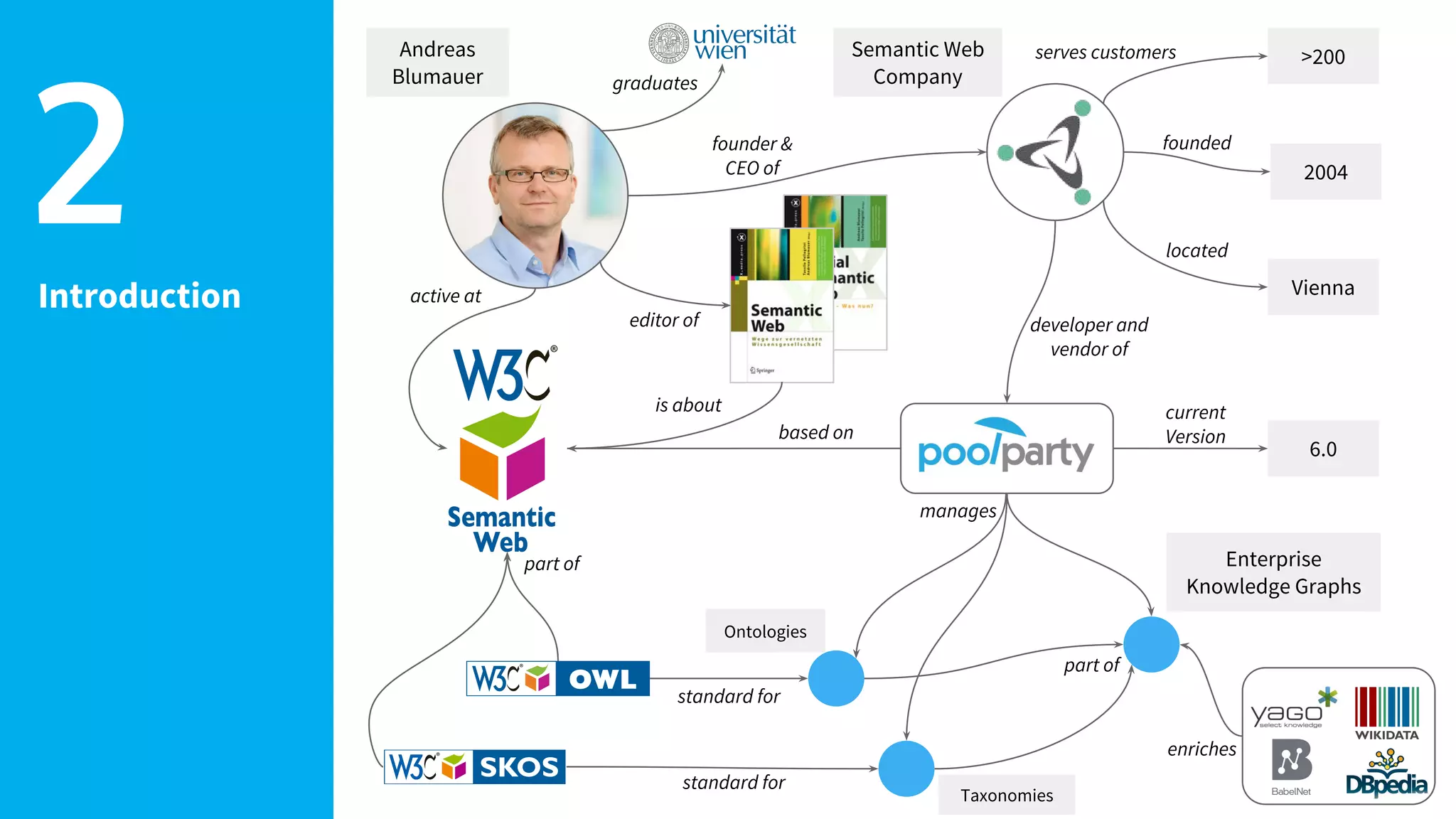
2
Semantic Web
Company
founder &
CEO of
Andreas
Blumauer
developer and
vendor of
2004
founded
6.0
current
Version
active at
based on
Vienna
located
part of Enterprise
Knowledge Graphs
manages
standard for
part of
enriches
>200serves customers
editor of
Taxonomies
is about
Ontologies
standard for
graduates
A quick
question at the
beginning
Will Artificial
Intelligence
make
Subject Matter
Experts
obsolete?
3 Imagine you want to
build an application
that helps to identify
wine and cheese
pairings.
Which performs best?
Applications solely based on machine learning, those ones which
are based on experts' knowledge only, or a combination of both?
Another
question at the
beginning
Will Artificial
Intelligence
make
Subject Matter
Experts
obsolete?
4 Imagine you want to
build an application
that helps to identify
patients and
treatments pairings.
Which will you prefer?
Applications solely based on machine learning, those ones which
are based on doctors' knowledge only, or a combination of both?
A key
assumption of
this talk
Effectiveness of
cognitive
systems is
limited by the
machines’
current
inability to
explain their
decisions and
actions to
human users.
5
From: David Gunning
https://www.darpa.mil/
Explainable Artificial
Intelligence (XAI)
Another key
assumption
of this talk
People do not search
for documents only,
they seek facts about
things and smaller
chunks of information.
Machines shall help to
create links across
data silos to give
answers to questions.
6
Converging AI
Technologies
What makes a
system a
cognitive system?
▸ Adaptive. Cognitive systems learn through their
interactions with data and humans. They may
resolve ambiguity and tolerate unpredictability.
▸ Contextual. Cognitive systems are capable of
extracting relevant information from big and
diverse data sets for users in their (work) context.
▸ Iterative. Systems may interact easily with users so
they can define their needs comfortably, even if a
problem statement is ambiguous or incomplete.
They may also interact with other processors,
devices, and cloud services, as well as with people.
See also: https://cognitivecomputingconsortium.com/
7
How Semantic
Computing
and Machine
Learning
complement
each other
8
Structured Data
Machine
Learning
Cognitive
Applications
How Semantic
Computing
and Machine
Learning
complement
each other
9 Unstructured Data
Structured Data
Machine
Learning
Cognitive
Applications
How Semantic
Computing
and Machine
Learning
complement
each other
10 Unstructured Data
Structured Data
Knowledge Graphs
Machine
Learning
Cognitive
Applications
Four-layered
Information
Architecture
11
Towards a
Digital Twin
Proposal for a
Cognitive
Computing
Platform
Architecture
12 Unstructured Data
Structured Data
Knowledge Graphs
Machine
Learning
Semantic
Layer
IoT & Cognitive
Applications
Digital Twin
A digital twin continuously learns and updates
itself from multiple sources to represent their
near real-time status, working condition or
position. This learning system learns
▸ from itself using sensor data that conveys various aspects of
its operating condition
▸ from human experts, such as engineers with deep and
relevant industry domain knowledge
▸ from other similar machines, and
▸ from the larger systems and environment in which it may be a
part of.
From: Wikipedia
13
Use Case #1
The Wine & Cheese Recommender
14
How to
overcome the
knowledge
acquisition
bottleneck?
15
Knowledge Domain
Knowledge
Modellers
Knowledge Model
semantic gap
Domain
Experts
The idea
Build a
Graph-based
Recommender
Systems and use
Semantic Web
Standards
16 Dry
Medium-bodied
High acidity
Weingut
Weinrieder
Grüner
Veltliner
Alte Reben
is characterized by
Nutmeg
Full-bodied
Warm finish
Tobacco
is characterized by
Nagelkaas
Cumin
Clove
Hard cheese
Higher fat
?
is characterized by
matches
matches
does not match
The result
A scalable and
configurable
application based
on an enterprise
semantic platform:
PoolParty
GraphSearch
17
Use Case #2
Make use of Shadow Concepts
18
Bionics
How does nature
go around similar
learning
bottlenecks?
19 Bla bla
bla bla.
Bla bla
bla bla
The stove is on.
The stove is hot!
Ontological model → reasoningTaxonomical model → is-a abstractions
Bla stove
bla bla.
Bla bla
bla hot
Switched on
devices are
dangerous
devices.
Switched on devices are
dangerous, only if the
operating temperature
is above 100 degrees
and the automatic
shutdown mechanism is
broken.
The stove is on.
The stove is hot!
Statistical model/cooccurences → is related
The stove is on.
The stove is hot!
Bla bla bla bla
Bla bla bla bla.
Graphs +
Machine Learning
PoolParty as a
supervised
learning system
20 Content Manager
Integrator
Taxonomist/
Ontologist
Thesaurus
Server
Extractor
PowerTagging
uses API
is user of
is user of
is basis of
is basis of
Index
annotates
enriches
Corpus Learning/
Semantic Analysis
CMS
extends
is basis of
analyzes
uses API
proposes
extensions
Co-occurence
model
21
Reference
Corpus
- Websites
- PDF, Word, …
- Abstracts from
DBpedia
- RSS Feeds
Term 8
Term 3
Term 7
Term 8
Term 6
Term 9
Term 5
Term 10
- Relevant terms and phrases
- Relevancy of terms
- co-occurence between terms and terms
Term 1
Term 4
Term 2
Shadow Concepts
Use co-occurences
between concepts
and terms to
extract ‘shadow
concepts’
22 This site is a
15th-century Inca
site located 2,430
metres above sea
level. It is located
in Cusco, Peru.
It is situated on a mountain ridge above
the Sacred Valley through which the
Urubamba River flows. Most
archaeologists believe that it was built as
an estate for the Inca emperor Pachacuti.
Often mistakenly referred to as the "Lost
City of the Incas", it is the most familiar
icon of Inca civilization. The Incas built
the estate around 1450, but abandoned it
a century later at the time of the
Spanish Conquest.
Inca
site
Machu
Picchu
Cusco
Inca
empire
Inca
emperor
Peru
Spanish
Conquest
Sacred
Valley
Chankas
Lost
City
Pachacuti
In addition to explicitly used concepts and terms, Machu Picchu is
extracted from the article as a Shadow Concept. As a prerequisite,
one has to provide and analyze a representative text corpus first.
Example:
Use Shadow
Concepts to
improve
Recommender
Systems
23
Mini Countryman
And it’s probably more of a
crossover than ever, with the design
to match, Being a Mini, the
Countryman is clearly meant to be
the driver’s car among small
crossovers. The suspension is
sophisticated, and there are lots of
chassis options (a stiffer sports
setup, variable damping, the
electronically controlled ALL4
all-wheel-drive).
But it’s also the crossover for people who’ve bags of cash to blow on
personalisation and luxury.
There’s been a lot of effort on ramping up the cabin quality, but then the
outgoing Countryman was a sad let-down in that department.
On the outside, plastic wheel-arch extensions, with eyebrow creases in the
metalwork above, as well as roof bars and sill protectors all add to the visual
crossover-ness. This remains the only Mini with angular rather than oval
headlamps, and there’s a load of visual posturing going on in the lower face.
There are eight versions at launch, and they’re exactly what you’d expect. It’s
Cooper or Cooper S, each fuelled by petrol or diesel, each of them with front
drive or ALL4. Oh and an eight-speed auto, too, if you count that as a
separate choice. The Cooper petrol is a three-cylinder, the rest fours.
You get extra kit as standard versus the old car, including navigation,
Bluetooth, emergency call and park sensors. Upgrades include a bigger
touch-screen nav with high-definition traffic, various posher seats, a HUD,
and driver aids. Oh and a cushion thingy that folds out from the boot so you
can sit on the rear bumper without getting your clothes mucky.
In June 2017 a Cooper E will launch, which has the Cooper three-cylinder
petrol driving the front wheels, and an electric motor for the rears, with a
capacity to do a claimed 25 miles of gentle all-electric running. So it has the
performance of a Cooper S ALL4 with the tax-busting advantages of a plug-in
hybrid. And you wouldn’t use any fuel if you commuted a short distance.
The platform is BMW’s contemporary transverse-engined hardware, in the
bigger of its two sizes. That means it shares a lot with the BMW X1. The
4WD system is more sophisticated than the previous Countryman’s. The
proportion of drive to the rear is computed by a controller that takes into
account parameters including grip, steering angle and throttle position, as
well as whether you’ve got the sports mode and sports traction systems
selected.
Use Case #3
Improving Classification Algorithms
24
Use Semantic
Knowledge
Models to
improve
Document
Classifiers
25 Prof. Farhad
Ameri
Engineering
Informatics
works at
researches
We observed
10-20% improvement in
precision of the
classification process as
a result of using a
semantic thesaurus.
Classification
Algorithms
improves
uses
Supplier classification
framework
develops
A Thesaurus-guided
Text Analytics Technique
for Capability-based
Classification of
Manufacturing Suppliers
CIE/SEIKM
Best Paper
2017
publishes
Infoneer’s
Manufacturer
Classification
Framework
(MCF)
26
Use Case #4
A Perfect Wedding based on AI
27
How knowledge
acquisition
methods play
together?
28 Natural languages
Taxonomies
Schemas/Ontologies
Statisticalmodels
Computational Linguists
Taxonomists
DataScientists
Ontologists
Why ‘The Knot’
uses Machine
Learning
29
▸ Vendor similarity
▸ Vendor matching
▸ Image similarity
▸ Reverse image search
▸ Image tag generator (auto-classification)
▸ Recommendations
▸ Card sort user response analysis
▸ Style predictor
▸ XO Group runs ‘The Knot’ since 1996
▸ NYSE: XOXO (S&P 600 Component)
▸ 1.5 million active members
▸ The Knot has helped marry 25 million couples
▸ Partnering with 250,000 wedding vendors
▸ Millions of vendor reviews
The Learning
Curve
30
▸ To understand
▹ Content aboutness in a defined framework
▹ Data relationships and context within a
unified organizational model
▹ Connections across disparate datasets
▸ To increase precision
▹ Hierarchical or other mapped relationships allow for
recommending similar content when exact matches not found
▹ Granularity allows for more specific recommendations
▹ Consistency across structure results more precise analysis and
predictions
Source: Suzanne Carroll, Data Science Product Director at XO Group
Why Data
Scientists need
Semantic
Models
31
Thank you for
your interest!
Andreas Blumauer
CEO, Semantic Web Company
▸ Mail andreas.blumauer@semantic-web.com
▸ Company https://www.semantic-web.com
▸ LinkedIn https://www.linkedin.com/in/andreasblumauer
▸ Twitter https://twitter.com/semwebcompany
▸ Blog https://www.linkedin.com/today/
author/andreasblumauer
32
© Semantic Web Company - http://www.semantic-web.com and http://www.poolparty.biz/

Semantics as the Basis of Advanced Cognitive Computing

  • 1.
    Andreas Blumauer CEO &Managing Partner Semantic Web Company / PoolParty Semantic Suite Semantics as the Basis of Advanced Cognitive Computing (with a focus on Cognitive Search & Analytics) 1
  • 2.
    Introduction 2 Semantic Web Company founder & CEOof Andreas Blumauer developer and vendor of 2004 founded 6.0 current Version active at based on Vienna located part of Enterprise Knowledge Graphs manages standard for part of enriches >200serves customers editor of Taxonomies is about Ontologies standard for graduates
  • 3.
    A quick question atthe beginning Will Artificial Intelligence make Subject Matter Experts obsolete? 3 Imagine you want to build an application that helps to identify wine and cheese pairings. Which performs best? Applications solely based on machine learning, those ones which are based on experts' knowledge only, or a combination of both?
  • 4.
    Another question at the beginning WillArtificial Intelligence make Subject Matter Experts obsolete? 4 Imagine you want to build an application that helps to identify patients and treatments pairings. Which will you prefer? Applications solely based on machine learning, those ones which are based on doctors' knowledge only, or a combination of both?
  • 5.
    A key assumption of thistalk Effectiveness of cognitive systems is limited by the machines’ current inability to explain their decisions and actions to human users. 5 From: David Gunning https://www.darpa.mil/ Explainable Artificial Intelligence (XAI)
  • 6.
    Another key assumption of thistalk People do not search for documents only, they seek facts about things and smaller chunks of information. Machines shall help to create links across data silos to give answers to questions. 6 Converging AI Technologies
  • 7.
    What makes a systema cognitive system? ▸ Adaptive. Cognitive systems learn through their interactions with data and humans. They may resolve ambiguity and tolerate unpredictability. ▸ Contextual. Cognitive systems are capable of extracting relevant information from big and diverse data sets for users in their (work) context. ▸ Iterative. Systems may interact easily with users so they can define their needs comfortably, even if a problem statement is ambiguous or incomplete. They may also interact with other processors, devices, and cloud services, as well as with people. See also: https://cognitivecomputingconsortium.com/ 7
  • 8.
    How Semantic Computing and Machine Learning complement eachother 8 Structured Data Machine Learning Cognitive Applications
  • 9.
    How Semantic Computing and Machine Learning complement eachother 9 Unstructured Data Structured Data Machine Learning Cognitive Applications
  • 10.
    How Semantic Computing and Machine Learning complement eachother 10 Unstructured Data Structured Data Knowledge Graphs Machine Learning Cognitive Applications
  • 11.
  • 12.
    Towards a Digital Twin Proposalfor a Cognitive Computing Platform Architecture 12 Unstructured Data Structured Data Knowledge Graphs Machine Learning Semantic Layer IoT & Cognitive Applications
  • 13.
    Digital Twin A digitaltwin continuously learns and updates itself from multiple sources to represent their near real-time status, working condition or position. This learning system learns ▸ from itself using sensor data that conveys various aspects of its operating condition ▸ from human experts, such as engineers with deep and relevant industry domain knowledge ▸ from other similar machines, and ▸ from the larger systems and environment in which it may be a part of. From: Wikipedia 13
  • 14.
    Use Case #1 TheWine & Cheese Recommender 14
  • 15.
    How to overcome the knowledge acquisition bottleneck? 15 KnowledgeDomain Knowledge Modellers Knowledge Model semantic gap Domain Experts
  • 16.
    The idea Build a Graph-based Recommender Systemsand use Semantic Web Standards 16 Dry Medium-bodied High acidity Weingut Weinrieder Grüner Veltliner Alte Reben is characterized by Nutmeg Full-bodied Warm finish Tobacco is characterized by Nagelkaas Cumin Clove Hard cheese Higher fat ? is characterized by matches matches does not match
  • 17.
    The result A scalableand configurable application based on an enterprise semantic platform: PoolParty GraphSearch 17
  • 18.
    Use Case #2 Makeuse of Shadow Concepts 18
  • 19.
    Bionics How does nature goaround similar learning bottlenecks? 19 Bla bla bla bla. Bla bla bla bla The stove is on. The stove is hot! Ontological model → reasoningTaxonomical model → is-a abstractions Bla stove bla bla. Bla bla bla hot Switched on devices are dangerous devices. Switched on devices are dangerous, only if the operating temperature is above 100 degrees and the automatic shutdown mechanism is broken. The stove is on. The stove is hot! Statistical model/cooccurences → is related The stove is on. The stove is hot! Bla bla bla bla Bla bla bla bla.
  • 20.
    Graphs + Machine Learning PoolPartyas a supervised learning system 20 Content Manager Integrator Taxonomist/ Ontologist Thesaurus Server Extractor PowerTagging uses API is user of is user of is basis of is basis of Index annotates enriches Corpus Learning/ Semantic Analysis CMS extends is basis of analyzes uses API proposes extensions
  • 21.
    Co-occurence model 21 Reference Corpus - Websites - PDF,Word, … - Abstracts from DBpedia - RSS Feeds Term 8 Term 3 Term 7 Term 8 Term 6 Term 9 Term 5 Term 10 - Relevant terms and phrases - Relevancy of terms - co-occurence between terms and terms Term 1 Term 4 Term 2
  • 22.
    Shadow Concepts Use co-occurences betweenconcepts and terms to extract ‘shadow concepts’ 22 This site is a 15th-century Inca site located 2,430 metres above sea level. It is located in Cusco, Peru. It is situated on a mountain ridge above the Sacred Valley through which the Urubamba River flows. Most archaeologists believe that it was built as an estate for the Inca emperor Pachacuti. Often mistakenly referred to as the "Lost City of the Incas", it is the most familiar icon of Inca civilization. The Incas built the estate around 1450, but abandoned it a century later at the time of the Spanish Conquest. Inca site Machu Picchu Cusco Inca empire Inca emperor Peru Spanish Conquest Sacred Valley Chankas Lost City Pachacuti In addition to explicitly used concepts and terms, Machu Picchu is extracted from the article as a Shadow Concept. As a prerequisite, one has to provide and analyze a representative text corpus first. Example:
  • 23.
    Use Shadow Concepts to improve Recommender Systems 23 MiniCountryman And it’s probably more of a crossover than ever, with the design to match, Being a Mini, the Countryman is clearly meant to be the driver’s car among small crossovers. The suspension is sophisticated, and there are lots of chassis options (a stiffer sports setup, variable damping, the electronically controlled ALL4 all-wheel-drive). But it’s also the crossover for people who’ve bags of cash to blow on personalisation and luxury. There’s been a lot of effort on ramping up the cabin quality, but then the outgoing Countryman was a sad let-down in that department. On the outside, plastic wheel-arch extensions, with eyebrow creases in the metalwork above, as well as roof bars and sill protectors all add to the visual crossover-ness. This remains the only Mini with angular rather than oval headlamps, and there’s a load of visual posturing going on in the lower face. There are eight versions at launch, and they’re exactly what you’d expect. It’s Cooper or Cooper S, each fuelled by petrol or diesel, each of them with front drive or ALL4. Oh and an eight-speed auto, too, if you count that as a separate choice. The Cooper petrol is a three-cylinder, the rest fours. You get extra kit as standard versus the old car, including navigation, Bluetooth, emergency call and park sensors. Upgrades include a bigger touch-screen nav with high-definition traffic, various posher seats, a HUD, and driver aids. Oh and a cushion thingy that folds out from the boot so you can sit on the rear bumper without getting your clothes mucky. In June 2017 a Cooper E will launch, which has the Cooper three-cylinder petrol driving the front wheels, and an electric motor for the rears, with a capacity to do a claimed 25 miles of gentle all-electric running. So it has the performance of a Cooper S ALL4 with the tax-busting advantages of a plug-in hybrid. And you wouldn’t use any fuel if you commuted a short distance. The platform is BMW’s contemporary transverse-engined hardware, in the bigger of its two sizes. That means it shares a lot with the BMW X1. The 4WD system is more sophisticated than the previous Countryman’s. The proportion of drive to the rear is computed by a controller that takes into account parameters including grip, steering angle and throttle position, as well as whether you’ve got the sports mode and sports traction systems selected.
  • 24.
    Use Case #3 ImprovingClassification Algorithms 24
  • 25.
    Use Semantic Knowledge Models to improve Document Classifiers 25Prof. Farhad Ameri Engineering Informatics works at researches We observed 10-20% improvement in precision of the classification process as a result of using a semantic thesaurus. Classification Algorithms improves uses Supplier classification framework develops A Thesaurus-guided Text Analytics Technique for Capability-based Classification of Manufacturing Suppliers CIE/SEIKM Best Paper 2017 publishes
  • 26.
  • 27.
    Use Case #4 APerfect Wedding based on AI 27
  • 28.
    How knowledge acquisition methods play together? 28Natural languages Taxonomies Schemas/Ontologies Statisticalmodels Computational Linguists Taxonomists DataScientists Ontologists
  • 29.
    Why ‘The Knot’ usesMachine Learning 29 ▸ Vendor similarity ▸ Vendor matching ▸ Image similarity ▸ Reverse image search ▸ Image tag generator (auto-classification) ▸ Recommendations ▸ Card sort user response analysis ▸ Style predictor ▸ XO Group runs ‘The Knot’ since 1996 ▸ NYSE: XOXO (S&P 600 Component) ▸ 1.5 million active members ▸ The Knot has helped marry 25 million couples ▸ Partnering with 250,000 wedding vendors ▸ Millions of vendor reviews
  • 30.
  • 31.
    ▸ To understand ▹Content aboutness in a defined framework ▹ Data relationships and context within a unified organizational model ▹ Connections across disparate datasets ▸ To increase precision ▹ Hierarchical or other mapped relationships allow for recommending similar content when exact matches not found ▹ Granularity allows for more specific recommendations ▹ Consistency across structure results more precise analysis and predictions Source: Suzanne Carroll, Data Science Product Director at XO Group Why Data Scientists need Semantic Models 31
  • 32.
    Thank you for yourinterest! Andreas Blumauer CEO, Semantic Web Company ▸ Mail andreas.blumauer@semantic-web.com ▸ Company https://www.semantic-web.com ▸ LinkedIn https://www.linkedin.com/in/andreasblumauer ▸ Twitter https://twitter.com/semwebcompany ▸ Blog https://www.linkedin.com/today/ author/andreasblumauer 32 © Semantic Web Company - http://www.semantic-web.com and http://www.poolparty.biz/