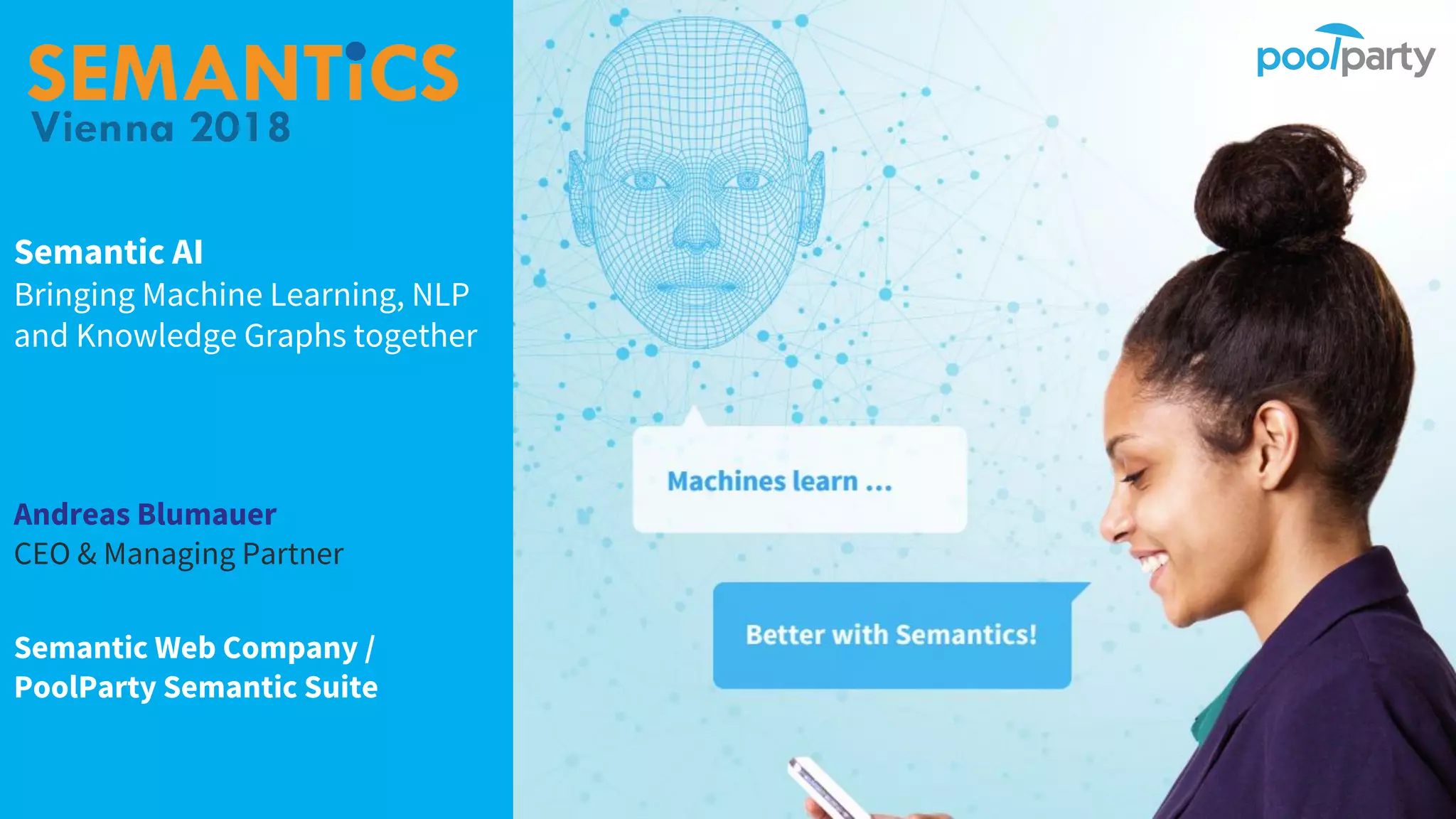
Andreas Blumauer
CEO & Managing Partner
Semantic Web Company /
PoolParty Semantic Suite
Semantic AI
Bringing Machine Learning, NLP
and Knowledge Graphs together
Introduction
Semantic Web Company (SWC)
▸ Founded in 2004, based in Vienna
▸ Privately held
▸ 50 FTE
▸ Software Engineers & Consultants for
NLP, Semantics and Machine learning
▸ Developer & Vendor of
PoolParty Semantic Suite
▸ Participating in projects with €2.5
million funding for R&D
▸ ~30% revenue growth/year
▸ SWC named to KMWorld’s
‘100 Companies That Matter in
Knowledge Management’ in 2016,
2017 and 2018
▸ www.semantic-web.com
2 PoolParty Semantic Suite
▸ Most complete Semantic Middleware
on the Global Market
▸ Semantic AI: Fusion of Knowledge
Graphs, NLP, and Machine Learning
▸ W3C standards compliant
▸ First release in 2009
▸ Current version 7.0
▸ On-premises or cloud-based
▸ Over 200 installations world-wide
▸ Named as Sample Vendor in
Gartner’s Hype Cycle for AI 2018
▸ KMWorld listed PoolParty as
Trend-Setting Product 2015, 2016,
2017, and 2018
▸ www.poolparty.biz
Agenda
3
Semantic
AI
▸ Introduction to Semantic AI
▹ Current status of Artificial
Intelligence
▹ Machine Learning, NLP and
Knowledge Graphs coming
together
▹ Six core aspects of Semantic AI
▸ Use Cases
SEMANTIC
ARTIFICIAL INTELLIGENCE
#SemanticAI: Bringing Machine Learning,
NLP and Knowledge Graphs together
4
Predictions and
ground truths
about AI
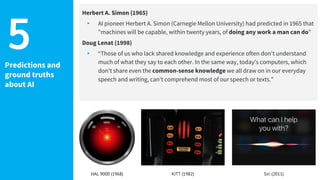
Herbert A. Simon (1965)
▸ AI pioneer Herbert A. Simon (Carnegie Mellon University) had predicted in 1965 that
"machines will be capable, within twenty years, of doing any work a man can do"
Doug Lenat (1998)
▸ “Those of us who lack shared knowledge and experience often don't understand
much of what they say to each other. In the same way, today's computers, which
don't share even the common-sense knowledge we all draw on in our everyday
speech and writing, can't comprehend most of our speech or texts.”
5
HAL 9000 (1968) KITT (1982) Siri (2011)
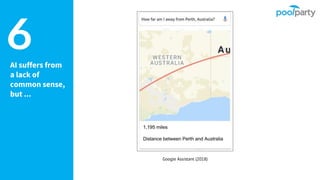
AI suffers from
a lack of
common sense,
but ...
6
Google Assistant (2018)
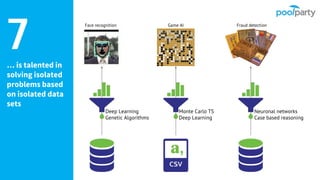
… is talented in
solving isolated
problems based
on isolated data
sets
7
Monte Carlo TS
Deep Learning
Deep Learning
Genetic Algorithms
Neuronal networks
Case based reasoning
Face recognition Game AI Fraud detection
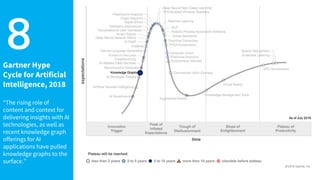
Gartner Hype
Cycle for Artificial
Intelligence, 2018
“The rising role of
content and context for
delivering insights with AI
technologies, as well as
recent knowledge graph
offerings for AI
applications have pulled
knowledge graphs to the
surface.”
8
What makes
someone an
intelligent
being?
Assessment of
the current status
of Artificial
Intelligence
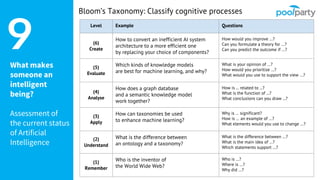
Level Example Questions
(6)
Create
How to convert an inefficient AI system
architecture to a more efficient one
by replacing your choice of components?
How would you improve …?
Can you formulate a theory for …?
Can you predict the outcome if …?
(5)
Evaluate
Which kinds of knowledge models
are best for machine learning, and why?
What is your opinion of …?
How would you prioritize …?
What would you use to support the view …?
(4)
Analyse
How does a graph database
and a semantic knowledge model
work together?
How is ... related to ...?
What is the function of ...?
What conclusions can you draw ...?
(3)
Apply
How can taxonomies be used
to enhance machine learning?
Why is … significant?
How is … an example of …?
What elements would you use to change …?
(2)
Understand
What is the difference between
an ontology and a taxonomy?
What is the difference between …?
What is the main idea of …?
Which statements support …?
(1)
Remember
Who is the inventor of
the World Wide Web?
Who is …?
Where is …?
Why did …?
9
Bloom’s Taxonomy: Classify cognitive processes
Remember
10
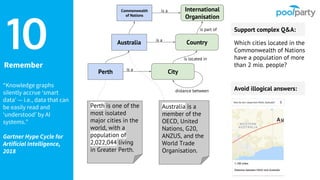
Perth
Australia
Perth is one of the
most isolated
major cities in the
world, with a
population of
2,022,044 living
in Greater Perth.
Australia is a
member of the
OECD, United
Nations, G20,
ANZUS, and the
World Trade
Organisation.
Country
City
is a
is a
is located in
Avoid illogical answers:distance between
Commonwealth
of Nations
International
Organisation
is part of
is a
Support complex Q&A:
Which cities located in the
Commonwealth of Nations
have a population of more
than 2 mio. people?
“Knowledge graphs
silently accrue ‘smart
data’ — i.e., data that can
be easily read and
‘understood’ by AI
systems.”
Gartner Hype Cycle for
Artificial Intelligence,
2018
Remember
Knowledge Graphs
& Knowledge
Extraction
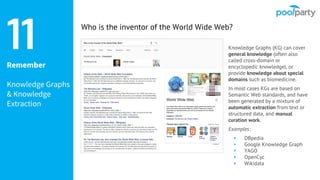
Knowledge Graphs (KG) can cover
general knowledge (often also
called cross-domain or
encyclopedic knowledge), or
provide knowledge about special
domains such as biomedicine.
In most cases KGs are based on
Semantic Web standards, and have
been generated by a mixture of
automatic extraction from text or
structured data, and manual
curation work.
Examples:
▸ DBpedia
▸ Google Knowledge Graph
▸ YAGO
▸ OpenCyc
▸ Wikidata
11 Who is the inventor of the World Wide Web?
“Understand”
Google Featured
Snippets based on
Sentence
Compression
Algorithms
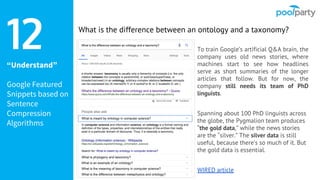
To train Google’s artificial Q&A brain, the
company uses old news stories, where
machines start to see how headlines
serve as short summaries of the longer
articles that follow. But for now, the
company still needs its team of PhD
linguists.
Spanning about 100 PhD linguists across
the globe, the Pygmalion team produces
“the gold data,” while the news stories
are the “silver.” The silver data is still
useful, because there’s so much of it. But
the gold data is essential.
WIRED article
12 What is the difference between an ontology and a taxonomy?
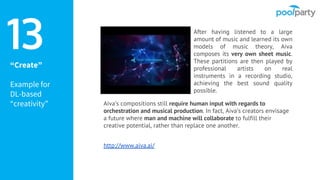
“Create”
Example for
DL-based
“creativity” Aiva’s compositions still require human input with regards to
orchestration and musical production. In fact, Aiva’s creators envisage
a future where man and machine will collaborate to fulfill their
creative potential, rather than replace one another.
http://www.aiva.ai/
13 After having listened to a large
amount of music and learned its own
models of music theory, Aiva
composes its very own sheet music.
These partitions are then played by
professional artists on real
instruments in a recording studio,
achieving the best sound quality
possible.
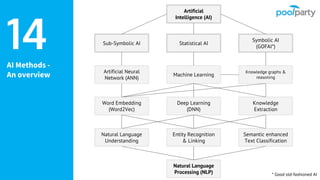
AI Methods -
An overview
14
Artificial
Intelligence (AI)
Artificial Neural
Network (ANN)
Symbolic AI
(GOFAI*)
Sub-Symbolic AI Statistical AI
Knowledge graphs &
reasoning
Natural Language
Processing (NLP)
Machine Learning
* Good old-fashioned AI
Word Embedding
(Word2Vec)
Deep Learning
(DNN)
Natural Language
Understanding
Entity Recognition
& Linking
Knowledge
Extraction
Semantic enhanced
Text Classification
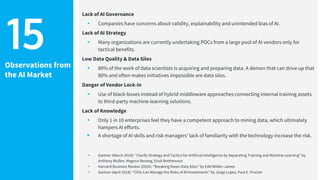
Observations from
the AI Market
Lack of AI Governance
▸ Companies have concerns about validity, explainability and unintended bias of AI.
Lack of AI Strategy
▸ Many organizations are currently undertaking POCs from a large pool of AI vendors only for
tactical benefits.
Low Data Quality & Data Silos
▸ 80% of the work of data scientists is acquiring and preparing data. A demon that can drive up that
80% and often makes initiatives impossible are data silos.
Danger of Vendor Lock-in
▸ Use of black-boxes instead of hybrid middleware approaches connecting internal training assets
to third-party machine-learning solutions.
Lack of Knowledge
▸ Only 1 in 10 enterprises feel they have a competent approach to mining data, which ultimately
hampers AI efforts.
▸ A shortage of AI skills and risk managers' lack of familiarity with the technology increase the risk.
▸ Gartner (March 2018): “Clarify Strategy and Tactics for Artificial Intelligence by Separating Training and Machine Learning” by
Anthony Mullen, Magnus Revang, Erick Brethenoux
▸ Harvard Business Review (2016): “Breaking Down Data Silos” by Edd Wilder-James
▸ Gartner (April 2018): “CIOs Can Manage the Risks of AI Investments” by Jorge Lopez, Paul E. Proctor
15
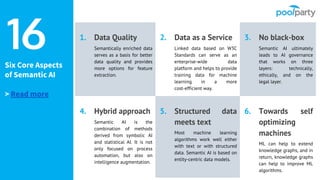
Six Core Aspects
of Semantic AI
> Read more
16 1. Data Quality
Semantically enriched data
serves as a basis for better
data quality and provides
more options for feature
extraction.
2. Data as a Service
Linked data based on W3C
Standards can serve as an
enterprise-wide data
platform and helps to provide
training data for machine
learning in a more
cost-efficient way.
3. No black-box
Semantic AI ultimately
leads to AI governance
that works on three
layers: technically,
ethically, and on the
legal layer.
4. Hybrid approach
Semantic AI is the
combination of methods
derived from symbolic AI
and statistical AI. It is not
only focused on process
automation, but also on
intelligence augmentation.
5. Structured data
meets text
Most machine learning
algorithms work well either
with text or with structured
data. Semantic AI is based on
entity-centric data models.
6. Towards self
optimizing
machines
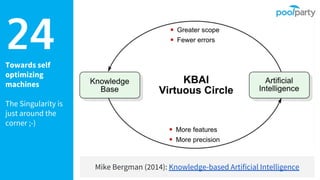
ML can help to extend
knowledge graphs, and in
return, knowledge graphs
can help to improve ML
algorithms.
Data Quality
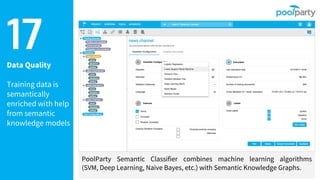
Training data is
semantically
enriched with help
from semantic
knowledge models
17
PoolParty Semantic Classifier combines machine learning algorithms
(SVM, Deep Learning, Naive Bayes, etc.) with Semantic Knowledge Graphs.
Benchmarking
the PoolParty
Semantic
Classifier
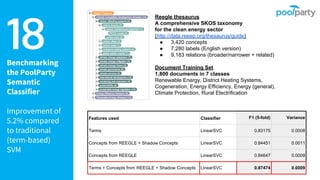
Improvement of
5.2% compared
to traditional
(term-based)
SVM
18
Features used Classifier F1 (5-fold) Variance
Terms LinearSVC 0.83175 0.0008
Concepts from REEGLE + Shadow Concepts LinearSVC 0.84451 0.0011
Concepts from REEGLE LinearSVC 0.84647 0.0009
Terms + Concepts from REEGLE + Shadow Concepts LinearSVC 0.87474 0.0009
Reegle thesaurus
A comprehensive SKOS taxonomy
for the clean energy sector
(http://data.reeep.org/thesaurus/guide)
● 3,420 concepts
● 7,280 labels (English version)
● 9,183 relations (broader/narrower + related)
Document Training Set
1,800 documents in 7 classes
Renewable Energy, District Heating Systems,
Cogeneration, Energy Efficiency, Energy (general),
Climate Protection, Rural Electrification
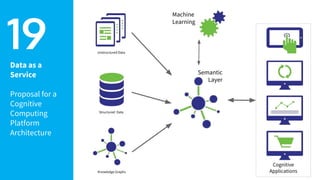
Data as a
Service
Proposal for a
Cognitive
Computing
Platform
Architecture
19 Unstructured Data
Structured Data
Knowledge Graphs
Machine
Learning
Semantic
Layer
Cognitive
Applications
No black-box
Explainable AI
(XAI)
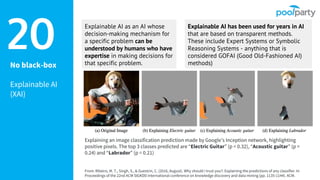
Explaining an image classification prediction made by Google’s Inception network, highlighting
positive pixels. The top 3 classes predicted are “Electric Guitar” (p = 0.32), “Acoustic guitar” (p =
0.24) and “Labrador” (p = 0.21)
From: Ribeiro, M. T., Singh, S., & Guestrin, C. (2016, August). Why should i trust you?: Explaining the predictions of any classifier. In
Proceedings of the 22nd ACM SIGKDD international conference on knowledge discovery and data mining (pp. 1135-1144). ACM.
20 Explainable AI as an AI whose
decision-making mechanism for
a specific problem can be
understood by humans who have
expertise in making decisions for
that specific problem.
Explainable AI has been used for years in AI
that are based on transparent methods.
These include Expert Systems or Symbolic
Reasoning Systems - anything that is
considered GOFAI (Good Old-Fashioned AI)
methods)
No black-box
Explainable AI
(XAI)
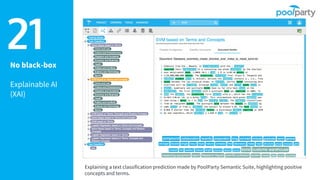
Explaining a text classification prediction made by PoolParty Semantic Suite, highlighting positive
concepts and terms.
21
Hybrid Approach
22
Artificial Intelligence
ANN
Symbolic AISub-Symbolic AI Statistical AI
KR & reasoning
NLP
Machine Learning
Word Embedding Deep Learning
Natural Language
Understanding
Entity Recognition &
Linking
Knowledge Extraction
Semantic enhanced
Text Classification
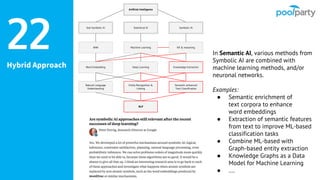
In Semantic AI, various methods from
Symbolic AI are combined with
machine learning methods, and/or
neuronal networks.
Examples:
● Semantic enrichment of
text corpora to enhance
word embeddings
● Extraction of semantic features
from text to improve ML-based
classification tasks
● Combine ML-based with
Graph-based entity extraction
● Knowledge Graphs as a Data
Model for Machine Learning
● ….
Structured data
meets text
Knowledge Graphs
as a Data Model for
Machine Learning
These transformations can result in loss of information and introduce bias. To solve this problem, we
require machine learning methods to consume knowledge in a data model more suited to represent
this heterogeneous knowledge. We argue that knowledge graphs are that data model.
Three examples for the benefits of using knowledge graphs:
▸ they allow for true end-to-end-learning,
▸ they simplify the integration of heterogeneous data sources and data harmonization,
▸ they provide a natural way to seamlessly integrate different forms of background knowledge.
Wilcke X, Bloem P, De Boer V. The Knowledge Graph as the Default Data Model for Machine Learning. Data Science. 2017 Oct 17;1-19.
Available from, DOI: 10.3233/DS-170007
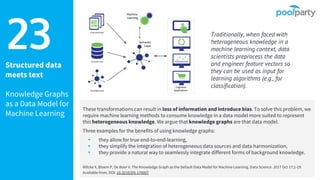
23 Traditionally, when faced with
heterogeneous knowledge in a
machine learning context, data
scientists preprocess the data
and engineer feature vectors so
they can be used as input for
learning algorithms (e.g., for
classification).
Towards self
optimizing
machines
The Singularity is
just around the
corner ;-)
Mike Bergman (2014): Knowledge-based Artificial Intelligence
24
USE CASES
Bringing Machine Learning, NLP and
Knowledge Graphs together
25
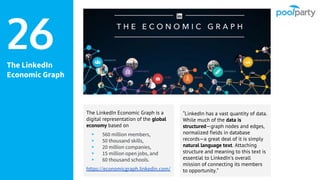
The LinkedIn
Economic Graph
26
The LinkedIn Economic Graph is a
digital representation of the global
economy based on
▸ 560 million members,
▸ 50 thousand skills,
▸ 20 million companies,
▸ 15 million open jobs, and
▸ 60 thousand schools.
https://economicgraph.linkedin.com/
“LinkedIn has a vast quantity of data.
While much of the data is
structured—graph nodes and edges,
normalized fields in database
records—a great deal of it is simply
natural language text. Attaching
structure and meaning to this text is
essential to LinkedIn’s overall
mission of connecting its members
to opportunity.”
27
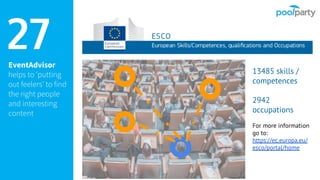
13485 skills /
competences
2942
occupations
For more information
go to:
https://ec.europa.eu/
esco/portal/home
EventAdvisor
helps to 'putting
out feelers' to find
the right people
and interesting
content
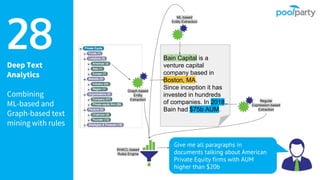
Deep Text
Analytics
Combining
ML-based and
Graph-based text
mining with rules
Bain Capital is a
venture capital
company based in
Boston, MA.
Since inception it has
invested in hundreds
of companies. In 2018,
Bain had $75b AUM.
Graph-based
Entity
Extraction
ML-based
Entity Extraction
Regular
Expression-based
Extraction
SHACL-based
Rules Engine
Give me all paragraphs in
documents talking about American
Private Equity firms with AUM
higher than $20b
28
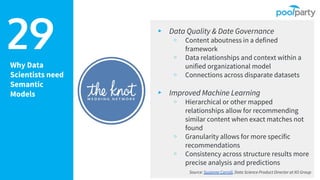
▸ Data Quality & Date Governance
▹ Content aboutness in a defined
framework
▹ Data relationships and context within a
unified organizational model
▹ Connections across disparate datasets
▸ Improved Machine Learning
▹ Hierarchical or other mapped
relationships allow for recommending
similar content when exact matches not
found
▹ Granularity allows for more specific
recommendations
▹ Consistency across structure results more
precise analysis and predictions
Source: Suzanne Carroll, Data Science Product Director at XO Group
Why Data
Scientists need
Semantic
Models
29
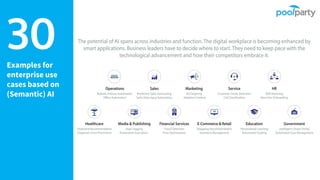
Examples for
enterprise use
cases based on
(Semantic) AI
30
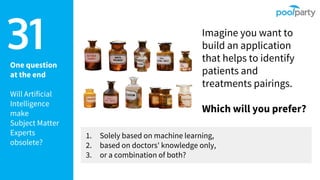
One question
at the end
Will Artificial
Intelligence
make
Subject Matter
Experts
obsolete?
31 Imagine you want to
build an application
that helps to identify
patients and
treatments pairings.
Which will you prefer?
1. Solely based on machine learning,
2. based on doctors' knowledge only,
3. or a combination of both?
Thank you for
your interest!
Andreas Blumauer
CEO, Semantic Web Company
▸ Mail andreas.blumauer@semantic-web.com
▸ Company https://www.semantic-web.com
▸ LinkedIn https://www.linkedin.com/in/andreasblumauer
▸ Twitter https://twitter.com/semwebcompany
32
© Semantic Web Company - http://www.semantic-web.com and http://www.poolparty.biz/

Semantic AI

  • 1.
    Andreas Blumauer CEO &Managing Partner Semantic Web Company / PoolParty Semantic Suite Semantic AI Bringing Machine Learning, NLP and Knowledge Graphs together
  • 2.
    Introduction Semantic Web Company(SWC) ▸ Founded in 2004, based in Vienna ▸ Privately held ▸ 50 FTE ▸ Software Engineers & Consultants for NLP, Semantics and Machine learning ▸ Developer & Vendor of PoolParty Semantic Suite ▸ Participating in projects with €2.5 million funding for R&D ▸ ~30% revenue growth/year ▸ SWC named to KMWorld’s ‘100 Companies That Matter in Knowledge Management’ in 2016, 2017 and 2018 ▸ www.semantic-web.com 2 PoolParty Semantic Suite ▸ Most complete Semantic Middleware on the Global Market ▸ Semantic AI: Fusion of Knowledge Graphs, NLP, and Machine Learning ▸ W3C standards compliant ▸ First release in 2009 ▸ Current version 7.0 ▸ On-premises or cloud-based ▸ Over 200 installations world-wide ▸ Named as Sample Vendor in Gartner’s Hype Cycle for AI 2018 ▸ KMWorld listed PoolParty as Trend-Setting Product 2015, 2016, 2017, and 2018 ▸ www.poolparty.biz
  • 3.
    Agenda 3 Semantic AI ▸ Introduction toSemantic AI ▹ Current status of Artificial Intelligence ▹ Machine Learning, NLP and Knowledge Graphs coming together ▹ Six core aspects of Semantic AI ▸ Use Cases
  • 4.
    SEMANTIC ARTIFICIAL INTELLIGENCE #SemanticAI: BringingMachine Learning, NLP and Knowledge Graphs together 4
  • 5.
    Predictions and ground truths aboutAI Herbert A. Simon (1965) ▸ AI pioneer Herbert A. Simon (Carnegie Mellon University) had predicted in 1965 that "machines will be capable, within twenty years, of doing any work a man can do" Doug Lenat (1998) ▸ “Those of us who lack shared knowledge and experience often don't understand much of what they say to each other. In the same way, today's computers, which don't share even the common-sense knowledge we all draw on in our everyday speech and writing, can't comprehend most of our speech or texts.” 5 HAL 9000 (1968) KITT (1982) Siri (2011)
  • 6.
    AI suffers from alack of common sense, but ... 6 Google Assistant (2018)
  • 7.
    … is talentedin solving isolated problems based on isolated data sets 7 Monte Carlo TS Deep Learning Deep Learning Genetic Algorithms Neuronal networks Case based reasoning Face recognition Game AI Fraud detection
  • 8.
    Gartner Hype Cycle forArtificial Intelligence, 2018 “The rising role of content and context for delivering insights with AI technologies, as well as recent knowledge graph offerings for AI applications have pulled knowledge graphs to the surface.” 8
  • 9.
    What makes someone an intelligent being? Assessmentof the current status of Artificial Intelligence Level Example Questions (6) Create How to convert an inefficient AI system architecture to a more efficient one by replacing your choice of components? How would you improve …? Can you formulate a theory for …? Can you predict the outcome if …? (5) Evaluate Which kinds of knowledge models are best for machine learning, and why? What is your opinion of …? How would you prioritize …? What would you use to support the view …? (4) Analyse How does a graph database and a semantic knowledge model work together? How is ... related to ...? What is the function of ...? What conclusions can you draw ...? (3) Apply How can taxonomies be used to enhance machine learning? Why is … significant? How is … an example of …? What elements would you use to change …? (2) Understand What is the difference between an ontology and a taxonomy? What is the difference between …? What is the main idea of …? Which statements support …? (1) Remember Who is the inventor of the World Wide Web? Who is …? Where is …? Why did …? 9 Bloom’s Taxonomy: Classify cognitive processes
  • 10.
    Remember 10 Perth Australia Perth is oneof the most isolated major cities in the world, with a population of 2,022,044 living in Greater Perth. Australia is a member of the OECD, United Nations, G20, ANZUS, and the World Trade Organisation. Country City is a is a is located in Avoid illogical answers:distance between Commonwealth of Nations International Organisation is part of is a Support complex Q&A: Which cities located in the Commonwealth of Nations have a population of more than 2 mio. people? “Knowledge graphs silently accrue ‘smart data’ — i.e., data that can be easily read and ‘understood’ by AI systems.” Gartner Hype Cycle for Artificial Intelligence, 2018
  • 11.
    Remember Knowledge Graphs & Knowledge Extraction KnowledgeGraphs (KG) can cover general knowledge (often also called cross-domain or encyclopedic knowledge), or provide knowledge about special domains such as biomedicine. In most cases KGs are based on Semantic Web standards, and have been generated by a mixture of automatic extraction from text or structured data, and manual curation work. Examples: ▸ DBpedia ▸ Google Knowledge Graph ▸ YAGO ▸ OpenCyc ▸ Wikidata 11 Who is the inventor of the World Wide Web?
  • 12.
    “Understand” Google Featured Snippets basedon Sentence Compression Algorithms To train Google’s artificial Q&A brain, the company uses old news stories, where machines start to see how headlines serve as short summaries of the longer articles that follow. But for now, the company still needs its team of PhD linguists. Spanning about 100 PhD linguists across the globe, the Pygmalion team produces “the gold data,” while the news stories are the “silver.” The silver data is still useful, because there’s so much of it. But the gold data is essential. WIRED article 12 What is the difference between an ontology and a taxonomy?
  • 13.
    “Create” Example for DL-based “creativity” Aiva’scompositions still require human input with regards to orchestration and musical production. In fact, Aiva’s creators envisage a future where man and machine will collaborate to fulfill their creative potential, rather than replace one another. http://www.aiva.ai/ 13 After having listened to a large amount of music and learned its own models of music theory, Aiva composes its very own sheet music. These partitions are then played by professional artists on real instruments in a recording studio, achieving the best sound quality possible.
  • 14.
    AI Methods - Anoverview 14 Artificial Intelligence (AI) Artificial Neural Network (ANN) Symbolic AI (GOFAI*) Sub-Symbolic AI Statistical AI Knowledge graphs & reasoning Natural Language Processing (NLP) Machine Learning * Good old-fashioned AI Word Embedding (Word2Vec) Deep Learning (DNN) Natural Language Understanding Entity Recognition & Linking Knowledge Extraction Semantic enhanced Text Classification
  • 15.
    Observations from the AIMarket Lack of AI Governance ▸ Companies have concerns about validity, explainability and unintended bias of AI. Lack of AI Strategy ▸ Many organizations are currently undertaking POCs from a large pool of AI vendors only for tactical benefits. Low Data Quality & Data Silos ▸ 80% of the work of data scientists is acquiring and preparing data. A demon that can drive up that 80% and often makes initiatives impossible are data silos. Danger of Vendor Lock-in ▸ Use of black-boxes instead of hybrid middleware approaches connecting internal training assets to third-party machine-learning solutions. Lack of Knowledge ▸ Only 1 in 10 enterprises feel they have a competent approach to mining data, which ultimately hampers AI efforts. ▸ A shortage of AI skills and risk managers' lack of familiarity with the technology increase the risk. ▸ Gartner (March 2018): “Clarify Strategy and Tactics for Artificial Intelligence by Separating Training and Machine Learning” by Anthony Mullen, Magnus Revang, Erick Brethenoux ▸ Harvard Business Review (2016): “Breaking Down Data Silos” by Edd Wilder-James ▸ Gartner (April 2018): “CIOs Can Manage the Risks of AI Investments” by Jorge Lopez, Paul E. Proctor 15
  • 16.
    Six Core Aspects ofSemantic AI > Read more 16 1. Data Quality Semantically enriched data serves as a basis for better data quality and provides more options for feature extraction. 2. Data as a Service Linked data based on W3C Standards can serve as an enterprise-wide data platform and helps to provide training data for machine learning in a more cost-efficient way. 3. No black-box Semantic AI ultimately leads to AI governance that works on three layers: technically, ethically, and on the legal layer. 4. Hybrid approach Semantic AI is the combination of methods derived from symbolic AI and statistical AI. It is not only focused on process automation, but also on intelligence augmentation. 5. Structured data meets text Most machine learning algorithms work well either with text or with structured data. Semantic AI is based on entity-centric data models. 6. Towards self optimizing machines ML can help to extend knowledge graphs, and in return, knowledge graphs can help to improve ML algorithms.
  • 17.
    Data Quality Training datais semantically enriched with help from semantic knowledge models 17 PoolParty Semantic Classifier combines machine learning algorithms (SVM, Deep Learning, Naive Bayes, etc.) with Semantic Knowledge Graphs.
  • 18.
    Benchmarking the PoolParty Semantic Classifier Improvement of 5.2%compared to traditional (term-based) SVM 18 Features used Classifier F1 (5-fold) Variance Terms LinearSVC 0.83175 0.0008 Concepts from REEGLE + Shadow Concepts LinearSVC 0.84451 0.0011 Concepts from REEGLE LinearSVC 0.84647 0.0009 Terms + Concepts from REEGLE + Shadow Concepts LinearSVC 0.87474 0.0009 Reegle thesaurus A comprehensive SKOS taxonomy for the clean energy sector (http://data.reeep.org/thesaurus/guide) ● 3,420 concepts ● 7,280 labels (English version) ● 9,183 relations (broader/narrower + related) Document Training Set 1,800 documents in 7 classes Renewable Energy, District Heating Systems, Cogeneration, Energy Efficiency, Energy (general), Climate Protection, Rural Electrification
  • 19.
    Data as a Service Proposalfor a Cognitive Computing Platform Architecture 19 Unstructured Data Structured Data Knowledge Graphs Machine Learning Semantic Layer Cognitive Applications
  • 20.
    No black-box Explainable AI (XAI) Explainingan image classification prediction made by Google’s Inception network, highlighting positive pixels. The top 3 classes predicted are “Electric Guitar” (p = 0.32), “Acoustic guitar” (p = 0.24) and “Labrador” (p = 0.21) From: Ribeiro, M. T., Singh, S., & Guestrin, C. (2016, August). Why should i trust you?: Explaining the predictions of any classifier. In Proceedings of the 22nd ACM SIGKDD international conference on knowledge discovery and data mining (pp. 1135-1144). ACM. 20 Explainable AI as an AI whose decision-making mechanism for a specific problem can be understood by humans who have expertise in making decisions for that specific problem. Explainable AI has been used for years in AI that are based on transparent methods. These include Expert Systems or Symbolic Reasoning Systems - anything that is considered GOFAI (Good Old-Fashioned AI) methods)
  • 21.
    No black-box Explainable AI (XAI) Explaininga text classification prediction made by PoolParty Semantic Suite, highlighting positive concepts and terms. 21
  • 22.
    Hybrid Approach 22 Artificial Intelligence ANN SymbolicAISub-Symbolic AI Statistical AI KR & reasoning NLP Machine Learning Word Embedding Deep Learning Natural Language Understanding Entity Recognition & Linking Knowledge Extraction Semantic enhanced Text Classification In Semantic AI, various methods from Symbolic AI are combined with machine learning methods, and/or neuronal networks. Examples: ● Semantic enrichment of text corpora to enhance word embeddings ● Extraction of semantic features from text to improve ML-based classification tasks ● Combine ML-based with Graph-based entity extraction ● Knowledge Graphs as a Data Model for Machine Learning ● ….
  • 23.
    Structured data meets text KnowledgeGraphs as a Data Model for Machine Learning These transformations can result in loss of information and introduce bias. To solve this problem, we require machine learning methods to consume knowledge in a data model more suited to represent this heterogeneous knowledge. We argue that knowledge graphs are that data model. Three examples for the benefits of using knowledge graphs: ▸ they allow for true end-to-end-learning, ▸ they simplify the integration of heterogeneous data sources and data harmonization, ▸ they provide a natural way to seamlessly integrate different forms of background knowledge. Wilcke X, Bloem P, De Boer V. The Knowledge Graph as the Default Data Model for Machine Learning. Data Science. 2017 Oct 17;1-19. Available from, DOI: 10.3233/DS-170007 23 Traditionally, when faced with heterogeneous knowledge in a machine learning context, data scientists preprocess the data and engineer feature vectors so they can be used as input for learning algorithms (e.g., for classification).
  • 24.
    Towards self optimizing machines The Singularityis just around the corner ;-) Mike Bergman (2014): Knowledge-based Artificial Intelligence 24
  • 25.
    USE CASES Bringing MachineLearning, NLP and Knowledge Graphs together 25
  • 26.
    The LinkedIn Economic Graph 26 TheLinkedIn Economic Graph is a digital representation of the global economy based on ▸ 560 million members, ▸ 50 thousand skills, ▸ 20 million companies, ▸ 15 million open jobs, and ▸ 60 thousand schools. https://economicgraph.linkedin.com/ “LinkedIn has a vast quantity of data. While much of the data is structured—graph nodes and edges, normalized fields in database records—a great deal of it is simply natural language text. Attaching structure and meaning to this text is essential to LinkedIn’s overall mission of connecting its members to opportunity.”
  • 27.
    27 13485 skills / competences 2942 occupations Formore information go to: https://ec.europa.eu/ esco/portal/home EventAdvisor helps to 'putting out feelers' to find the right people and interesting content
  • 28.
    Deep Text Analytics Combining ML-based and Graph-basedtext mining with rules Bain Capital is a venture capital company based in Boston, MA. Since inception it has invested in hundreds of companies. In 2018, Bain had $75b AUM. Graph-based Entity Extraction ML-based Entity Extraction Regular Expression-based Extraction SHACL-based Rules Engine Give me all paragraphs in documents talking about American Private Equity firms with AUM higher than $20b 28
  • 29.
    ▸ Data Quality& Date Governance ▹ Content aboutness in a defined framework ▹ Data relationships and context within a unified organizational model ▹ Connections across disparate datasets ▸ Improved Machine Learning ▹ Hierarchical or other mapped relationships allow for recommending similar content when exact matches not found ▹ Granularity allows for more specific recommendations ▹ Consistency across structure results more precise analysis and predictions Source: Suzanne Carroll, Data Science Product Director at XO Group Why Data Scientists need Semantic Models 29
  • 30.
    Examples for enterprise use casesbased on (Semantic) AI 30
  • 31.
    One question at theend Will Artificial Intelligence make Subject Matter Experts obsolete? 31 Imagine you want to build an application that helps to identify patients and treatments pairings. Which will you prefer? 1. Solely based on machine learning, 2. based on doctors' knowledge only, 3. or a combination of both?
  • 32.
    Thank you for yourinterest! Andreas Blumauer CEO, Semantic Web Company ▸ Mail andreas.blumauer@semantic-web.com ▸ Company https://www.semantic-web.com ▸ LinkedIn https://www.linkedin.com/in/andreasblumauer ▸ Twitter https://twitter.com/semwebcompany 32 © Semantic Web Company - http://www.semantic-web.com and http://www.poolparty.biz/