Cover Page 


             The Evolution of 
               Abstractions 
 

Author: Jeffrey G. Long (jefflong@aol.com) 

Date: September 11, 1997 

Forum: Talk presented at a luncheon meeting of the Washington Evolutionary 
Systems Society. 
 

                                 Contents 
Page 1: Proposal 

Pages 2‐22: Slides (but no text) for presentation 


                                  License 
This work is licensed under the Creative Commons Attribution‐NonCommercial 
3.0 Unported License. To view a copy of this license, visit 
http://creativecommons.org/licenses/by‐nc/3.0/ or send a letter to Creative 
Commons, 444 Castro Street, Suite 900, Mountain View, California, 94041, USA. 


                                Uploaded June 22, 2011 
Title: The Evolution of Abstractions
Speaker: Jeff Long, Director, GWU Notational Engineering Laboratory
Date: September 11, 1997 at Noon
Location: Faculty Club, The George Washington University (call ahead for
lunch reservations please!)

What is it that gives notational systems their power? Are they merely
convenient collections of arbitrary tokens and rules that just happen to
have a useful application in the real world? Or might there be a deeper
connection between notational systems and reality?

This talk will explore this question, and answer in the affirmative. We
will discuss the conventional definitions of "abstraction" and their
inadequacies, and seek a new definition. To do this we will sketch a
theoretical framework -- a metaphysical system that attempts to account
for the the law-abiding nature of physical objects, the nature of laws,
and, ultimately, the nature of abstractions.

The talk will discuss the notion of an "abstraction space" such as the
field of numbers, and how three such spaces historically have been
explored and tokenized ("settled"). The talk will end with a brief
outline of a plan for improving the abstraction space settlement process.
This plan is essentially an agenda for the proposed new field of
"notational engineering".
The Evolution of Abstractions


      Jeffrey G. Long
 GWU Notational Engineering Laboratory


     Copyright 1997 © Jeffrey G. Long
My Work in Notational Engineering
 y                      g       g
   Involves Four Main Areas
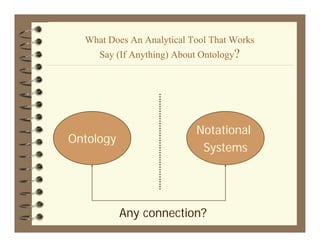
What Does An Analytical Tool That Works
     Say (If Anything) About Ontology?


                           Notational
Ontology
                            Systems


           Any connection?
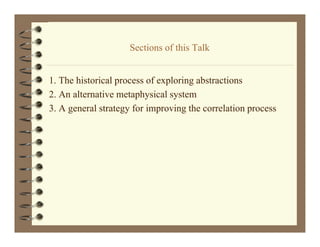
Sections of this Talk
                    S ti      f thi T lk


1. The hi i l process of exploring abstractions
    h historical          f    l i    b      i
2. An alternative metaphysical system
3.
3 A general strategy for improving the correlation process
Part One
The Historical Process of Exploring Abstractions
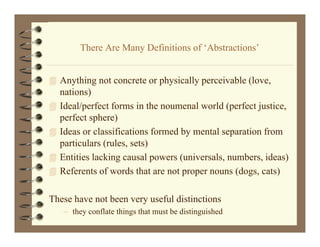
There A M
         Th Are Many Definitions of ‘Abstractions’
                     D fi iti     f ‘Ab t ti ’


 Anything not concrete or physically perceivable (love,
      hi                    h i ll         i bl (l
    nations)
   Ideal/perfect forms in the noumenal world (perfect justice,
                                                        justice
    perfect sphere)
   Ideas or classifications formed by mental separation from
    particulars (rules, sets)
   Entities lacking causal powers (universals, numbers, ideas)
   Referents of words that are not proper nouns (dogs, cats)
                                                  (dogs

These have not been very useful distinctions
    – they conflate things that must be distinguished
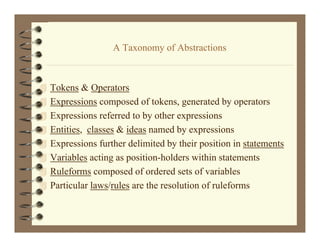
AT
                    Taxonomy of Ab t ti
                              f Abstractions


 Tokens & Operators
 Expressions composed of tokens, generated by operators
 Expressions referred to by other expressions
 Entities, classes & ideas named by expressions
 Expressions further delimited by their position in statements
 Variables acting as position-holders within statements
 Ruleforms composed of ordered sets of variables
 Particular laws/rules are the resolution of ruleforms
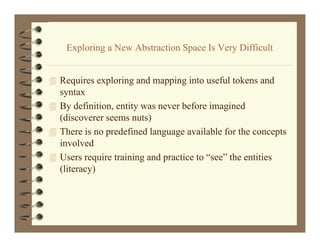
Exploring N Ab t ti S
    E l i a New Abstraction Space Is Very Diffi lt
                                  I V     Difficult


 Requires exploring and mapping into useful tokens and
      i       l i      d     i i         f l k        d
  syntax
 By definition entity was never before imagined
       definition,
  (discoverer seems nuts)
 There is no predefined language available for the concepts
  involved
 Users require training and practice to “see” the entities
  (literacy)
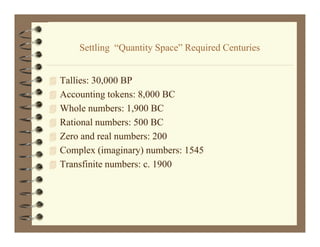
Settling “Q tit S
       S ttli “Quantity Space” Required Centuries
                             ”R i dC t i


 Tallies: 30,000 BP
    lli
 Accounting tokens: 8,000 BC
 Whole numbers: 1,900 BC
                 1 900
 Rational numbers: 500 BC
 Zero and real numbers: 200
 Complex (imaginary) numbers: 1545
 Transfinite numbers: c. 1900
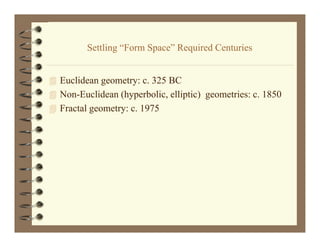
Settling “F
         S ttli “Form Space” Required Centuries
                      S    ”R i dC t i


 Euclidean geometry: c. 325 BC
     lid
 Non-Euclidean (hyperbolic, elliptic) geometries: c. 1850
 Fractal geometry: c. 1975
                    c
Settling “Id tit S
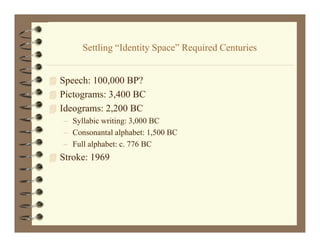
        S ttli “Identity Space” Required Centuries
                              ”R i dC t i


 Speech: 100,000 BP?
       h
 Pictograms: 3,400 BC
 Ideograms: 2,200 BC
             2 200
   – Syllabic writing: 3,000 BC
   – Consonantal alphabet: 1,500 BC
   – Full alphabet: c. 776 BC
 Stroke: 1969
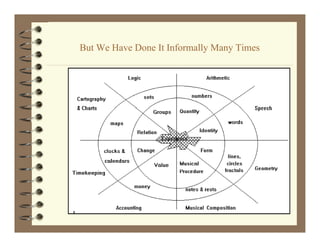
But W H
B t We Have Done It Informally Many Times
            D       I f    ll M     Ti
Part Two
An Alternative Metaphysical System
   for Exploring the Basic Issues
The P
               Th Prevailing (Materialist) Paradigm
                       ili (M t i li t) P di


 Universe consists solely of matter/energy (physicalism)
 This substance follows certain laws, sought by science
 The universe is becoming more uniform over time (2nd Law)
 These laws and all such abstractions are useful fictions
  (nominalism)
  (   i li )
 Metaphysical questions are pseudo-questions (positivism)


But this paradigm leaves unanswered many questions viewed as
  non-scientific
   – why is the universe lawful?
   – what are laws/rules, really? Do they have component parts?
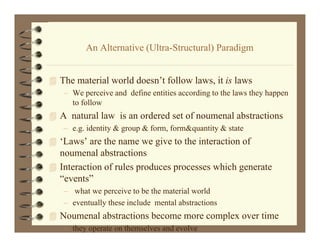
An Alternative (Ultra-Structural) Paradigm
         A Alt     ti (Ult St t l) P di


 The material world doesn’t follow laws, it is l
   h       i l    ld d       f ll l       i laws
   – We perceive and define entities according to the laws they happen
     to follow
 A natural law is an ordered set of noumenal abstractions
   – e.g. identity & group & form, form&quantity & state
 ‘L
  ‘Laws’ are the name we give to the interaction of
       ’     th           i t th i t        ti    f
  noumenal abstractions
 Interaction of rules produces processes which generate
                       p        p               g
  “events”
   – what we perceive to be the material world
   – eventually these include mental abstractions
         t ll th      i l d      t l b t ti
 Noumenal abstractions become more complex over time
   – they operate on themselves and evolve
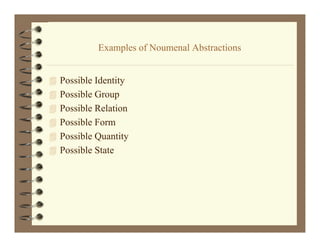
Examples of Noumenal Abstractions
            E    l    fN       l Ab t ti


 Possible Identity
      ibl d i
 Possible Group
 Possible Relation
 Possible Form
 Possible Quantity
 Possible State
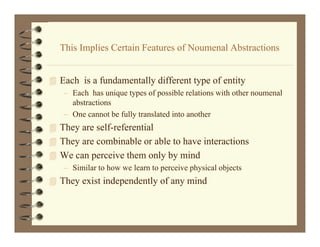
This I li C t i F t
  Thi Implies Certain Features of Noumenal Abstractions
                                fN       l Ab t ti


 Each i a fundamentally different type of entity
     h is f d        ll diff             f i
   – Each has unique types of possible relations with other noumenal
     abstractions
   – One cannot be fully translated into another
 They are self-referential
 Th are combinable or able to have interactions
  They      bi bl       bl t h      i t    ti
 We can perceive them only by mind
   – Similar to how we learn to perceive physical objects
 They exist independently of any mind
Part Three
                 h
     A General Strategy for
Improving the Correlation Process
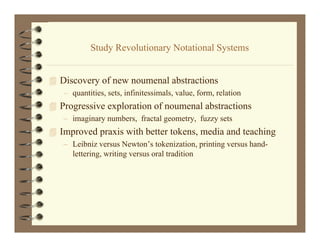
Study R l ti
           St d Revolutionary Notational Systems
                              N t ti l S t


 Discovery of new noumenal abstractions
   i         f            l b       i
   – quantities, sets, infinitessimals, value, form, relation
 Progressive exploration of noumenal abstractions
   – imaginary numbers, fractal geometry, fuzzy sets
 Improved praxis with better tokens, media and teaching
   – Leibniz versus Newton’s tokenization, printing versus hand-
     lettering, writing versus oral tradition
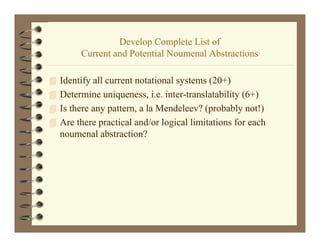
Develop Complete List of
                        p      p
        Current and Potential Noumenal Abstractions

 Identify all current notational systems (20+)
   d if ll                  i l           (   )
 Determine uniqueness, i.e. inter-translatability (6+)
 Is there any pattern, a la Mendeleev? (probably not!)
               pattern
 Are there practical and/or logical limitations for each
  noumenal abstraction?
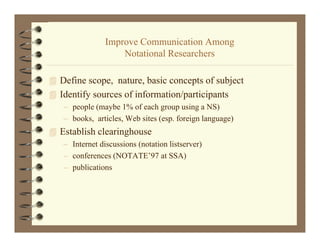
Improve Communication Among
                  p                        g
                    Notational Researchers

 Define scope, nature, basic concepts of subject
    fi                  b i             f bj
 Identify sources of information/participants
   – people (maybe 1% of each group using a NS)
   – books, articles, Web sites (esp. foreign language)
 Establish clearinghouse
   – Internet discussions (notation listserver)
   – conferences (NOTATE’97 at SSA)
   – publications
     p
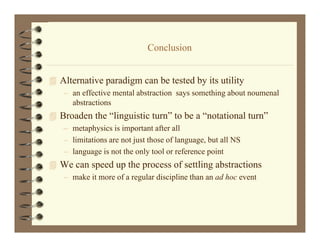
Conclusion
                             C l i


 Alternative paradigm can be tested by its utility
   l      i       di       b       db i       ili
   – an effective mental abstraction says something about noumenal
     abstractions
 Broaden the “linguistic turn” to be a “notational turn”
   – metaphysics is important after all
   – limitations are not just those of language, but all NS
                                       language
   – language is not the only tool or reference point
 We can speed up the process of settling abstractions
   – make it more of a regular discipline than an ad hoc event

The evolution of abstractions

  • 1.
    Cover Page    The Evolution of  Abstractions    Author: Jeffrey G. Long (jefflong@aol.com)  Date: September 11, 1997  Forum: Talk presented at a luncheon meeting of the Washington Evolutionary  Systems Society.    Contents  Page 1: Proposal  Pages 2‐22: Slides (but no text) for presentation    License  This work is licensed under the Creative Commons Attribution‐NonCommercial  3.0 Unported License. To view a copy of this license, visit  http://creativecommons.org/licenses/by‐nc/3.0/ or send a letter to Creative  Commons, 444 Castro Street, Suite 900, Mountain View, California, 94041, USA.  Uploaded June 22, 2011 
  • 2.
    Title: The Evolutionof Abstractions Speaker: Jeff Long, Director, GWU Notational Engineering Laboratory Date: September 11, 1997 at Noon Location: Faculty Club, The George Washington University (call ahead for lunch reservations please!) What is it that gives notational systems their power? Are they merely convenient collections of arbitrary tokens and rules that just happen to have a useful application in the real world? Or might there be a deeper connection between notational systems and reality? This talk will explore this question, and answer in the affirmative. We will discuss the conventional definitions of "abstraction" and their inadequacies, and seek a new definition. To do this we will sketch a theoretical framework -- a metaphysical system that attempts to account for the the law-abiding nature of physical objects, the nature of laws, and, ultimately, the nature of abstractions. The talk will discuss the notion of an "abstraction space" such as the field of numbers, and how three such spaces historically have been explored and tokenized ("settled"). The talk will end with a brief outline of a plan for improving the abstraction space settlement process. This plan is essentially an agenda for the proposed new field of "notational engineering".
  • 3.
    The Evolution ofAbstractions Jeffrey G. Long GWU Notational Engineering Laboratory Copyright 1997 © Jeffrey G. Long
  • 4.
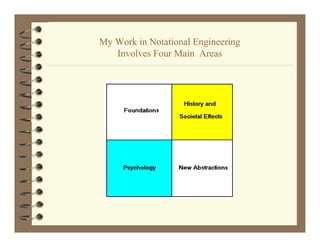
    My Work inNotational Engineering y g g Involves Four Main Areas
  • 5.
    What Does AnAnalytical Tool That Works Say (If Anything) About Ontology? Notational Ontology Systems Any connection?
  • 6.
    Sections of thisTalk S ti f thi T lk 1. The hi i l process of exploring abstractions h historical f l i b i 2. An alternative metaphysical system 3. 3 A general strategy for improving the correlation process
  • 7.
    Part One The HistoricalProcess of Exploring Abstractions
  • 8.
    There A M Th Are Many Definitions of ‘Abstractions’ D fi iti f ‘Ab t ti ’  Anything not concrete or physically perceivable (love, hi h i ll i bl (l nations)  Ideal/perfect forms in the noumenal world (perfect justice, justice perfect sphere)  Ideas or classifications formed by mental separation from particulars (rules, sets)  Entities lacking causal powers (universals, numbers, ideas)  Referents of words that are not proper nouns (dogs, cats) (dogs These have not been very useful distinctions – they conflate things that must be distinguished
  • 9.
    AT Taxonomy of Ab t ti f Abstractions  Tokens & Operators  Expressions composed of tokens, generated by operators  Expressions referred to by other expressions  Entities, classes & ideas named by expressions  Expressions further delimited by their position in statements  Variables acting as position-holders within statements  Ruleforms composed of ordered sets of variables  Particular laws/rules are the resolution of ruleforms
  • 10.
    Exploring N Abt ti S E l i a New Abstraction Space Is Very Diffi lt I V Difficult  Requires exploring and mapping into useful tokens and i l i d i i f l k d syntax  By definition entity was never before imagined definition, (discoverer seems nuts)  There is no predefined language available for the concepts involved  Users require training and practice to “see” the entities (literacy)
  • 11.
    Settling “Q titS S ttli “Quantity Space” Required Centuries ”R i dC t i  Tallies: 30,000 BP lli  Accounting tokens: 8,000 BC  Whole numbers: 1,900 BC 1 900  Rational numbers: 500 BC  Zero and real numbers: 200  Complex (imaginary) numbers: 1545  Transfinite numbers: c. 1900
  • 12.
    Settling “F S ttli “Form Space” Required Centuries S ”R i dC t i  Euclidean geometry: c. 325 BC lid  Non-Euclidean (hyperbolic, elliptic) geometries: c. 1850  Fractal geometry: c. 1975 c
  • 13.
    Settling “Id titS S ttli “Identity Space” Required Centuries ”R i dC t i  Speech: 100,000 BP? h  Pictograms: 3,400 BC  Ideograms: 2,200 BC 2 200 – Syllabic writing: 3,000 BC – Consonantal alphabet: 1,500 BC – Full alphabet: c. 776 BC  Stroke: 1969
  • 14.
    But W H Bt We Have Done It Informally Many Times D I f ll M Ti
  • 15.
    Part Two An AlternativeMetaphysical System for Exploring the Basic Issues
  • 16.
    The P Th Prevailing (Materialist) Paradigm ili (M t i li t) P di  Universe consists solely of matter/energy (physicalism)  This substance follows certain laws, sought by science  The universe is becoming more uniform over time (2nd Law)  These laws and all such abstractions are useful fictions (nominalism) ( i li )  Metaphysical questions are pseudo-questions (positivism) But this paradigm leaves unanswered many questions viewed as non-scientific – why is the universe lawful? – what are laws/rules, really? Do they have component parts?
  • 17.
    An Alternative (Ultra-Structural)Paradigm A Alt ti (Ult St t l) P di  The material world doesn’t follow laws, it is l h i l ld d f ll l i laws – We perceive and define entities according to the laws they happen to follow  A natural law is an ordered set of noumenal abstractions – e.g. identity & group & form, form&quantity & state  ‘L ‘Laws’ are the name we give to the interaction of ’ th i t th i t ti f noumenal abstractions  Interaction of rules produces processes which generate p p g “events” – what we perceive to be the material world – eventually these include mental abstractions t ll th i l d t l b t ti  Noumenal abstractions become more complex over time – they operate on themselves and evolve
  • 18.
    Examples of NoumenalAbstractions E l fN l Ab t ti  Possible Identity ibl d i  Possible Group  Possible Relation  Possible Form  Possible Quantity  Possible State
  • 19.
    This I liC t i F t Thi Implies Certain Features of Noumenal Abstractions fN l Ab t ti  Each i a fundamentally different type of entity h is f d ll diff f i – Each has unique types of possible relations with other noumenal abstractions – One cannot be fully translated into another  They are self-referential  Th are combinable or able to have interactions They bi bl bl t h i t ti  We can perceive them only by mind – Similar to how we learn to perceive physical objects  They exist independently of any mind
  • 20.
    Part Three h A General Strategy for Improving the Correlation Process
  • 21.
    Study R lti St d Revolutionary Notational Systems N t ti l S t  Discovery of new noumenal abstractions i f l b i – quantities, sets, infinitessimals, value, form, relation  Progressive exploration of noumenal abstractions – imaginary numbers, fractal geometry, fuzzy sets  Improved praxis with better tokens, media and teaching – Leibniz versus Newton’s tokenization, printing versus hand- lettering, writing versus oral tradition
  • 22.
    Develop Complete Listof p p Current and Potential Noumenal Abstractions  Identify all current notational systems (20+) d if ll i l ( )  Determine uniqueness, i.e. inter-translatability (6+)  Is there any pattern, a la Mendeleev? (probably not!) pattern  Are there practical and/or logical limitations for each noumenal abstraction?
  • 23.
    Improve Communication Among p g Notational Researchers  Define scope, nature, basic concepts of subject fi b i f bj  Identify sources of information/participants – people (maybe 1% of each group using a NS) – books, articles, Web sites (esp. foreign language)  Establish clearinghouse – Internet discussions (notation listserver) – conferences (NOTATE’97 at SSA) – publications p
  • 24.
    Conclusion C l i  Alternative paradigm can be tested by its utility l i di b db i ili – an effective mental abstraction says something about noumenal abstractions  Broaden the “linguistic turn” to be a “notational turn” – metaphysics is important after all – limitations are not just those of language, but all NS language – language is not the only tool or reference point  We can speed up the process of settling abstractions – make it more of a regular discipline than an ad hoc event