Basics of Information ModelingModels, LanguagesandMethods
AgendaLanguagesModelsTechniques and Method(ologie)s
LanguageLanguagesLanguages are human communication instruments for the understanding of items (linguistic definition)Languages are the basis of any scientific discourseLanguages are systems of signs (semiotic definition)Linguistic signs are arbitrary and conventionalArbitrarity:The choice and construction of signs is arbitrary, i.e. there is no direct connection between the sign and the singified item (i.e., e.g. a „customer“ is not necessarily represented as a picture of a customer)Conventionality:The semantics of the signs is result of a convention – a consensus of the speech community (e.g. scientists, modelers)
Classification of LanguagesNatural Languagessystems of signs that have originated in an evolutionary wayno complete definition of syntax and semanticsnatural languages evolve naturally (e.g. slang, dialects etc.)extremely expressiveextremely redundant, potentially fuzzy and inconsistentStatements of natural languages can be interpreted in different waysCommunication in natural language is not only dependent on the signs (gestures, intonation)
Natural LanguagesUniversal LanguagesAre able to express „almost everything“ (Morris)Are not assigned to specific domainsNo dedicated application areaHuge speech communityDynamic vocabular that is not defined clearlyExamples: English, Russian, German, …Do not distinguish between language and meta language
Natural LanguagesTerminologySubset of universal languageIs assigned to a particular domainScientific disciplinesIndustry sectorBusiness classCompany…Application-driven, serving task fulfillmentAre the basis of organizational actionComprise a finite set of terms and application rulese.g.: legal texts (juristic language), „officialese“
Terms as Sings of Natural LanguagesThe Term „Term“A termis a linguisticsignthatconsistsofthefollowingcomponentsWord (name): sequenceoflettersas medium ofthesignIntension: „idea“ oftheterm, itssemanticsandcharacteristicsExtension:setofobjectsthatarenamedbytheterm
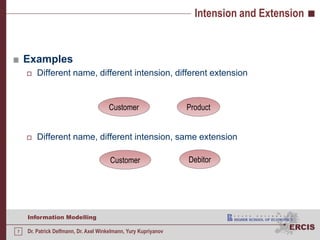
Intension and ExtensionExamplesDifferent name, different intension, different extensionDifferent name, different intension, same extensionCustomerProductDebitorCustomer
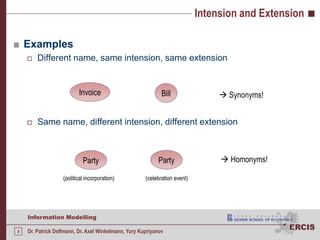
Intension and ExtensionExamplesDifferent name, same intension, same extensionSame name, different intension, different extensionInvoiceBill Synonyms!PartyParty Homonyms!(politicalincorporation)(celebrationevent)
Classification of LanguagesFormal LanguageA system of signs that is based on a calculuscalculus: Methodology that is used to construct figures out of a set of basic signs (alphabet) following particular rulesformal definition of syntax and semanticsSemantics are classified as „defined formally“ if the definition of the sementics is based on mathematical rules (Sommerville 2001)AdvantagesClarityConsistencyRedundancy-free
Classification of LanguagesSemi-formal LanguagesVisual, diagram-based languages that contain textual elements (Remme 1997)Syntax is defined formally, definition of semantics is missingSigns of semi-formal languages consist of graphical elements and textual signifier (i.e. a node in a graph-based process modelling language „check invoice“)Semi-formal languages encounter some probolems that result from the application of natural languagesRedundancyFuzzinessInconsistencyResolution approaches: Standards, ontology
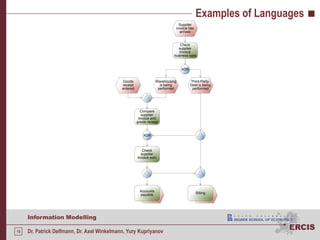
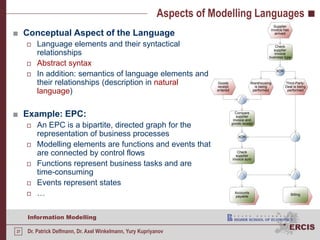
Formal andnaturallanguageaspectsof semi-formal languagesExample: EPCNatural language aspectsA document is relevant for a business transaction„Process“ is a task that transforms an object (the document)A document has to arrive prior to ist processing…Formal languages aspectsDefined symbolsGraph is directedFunctions are followed by eventsEvents do not follow events…DocumenthasarrivedProcessdocumentDocumentprocessed
Specification of LanguagesPossibilities to avoid problems of natural languagesTechnical term modelsGlossariesTerm relationship modelsOntologiesLanguage standardisationFormal definition of the natural language‘s syntax and semantics	Language application conventionsDomain-specific languages (e.g. PICTURE)
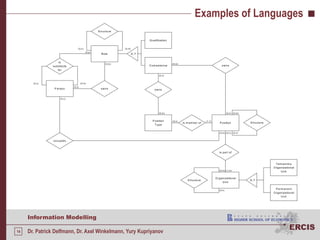
Examples of Languages
AgendaLanguagesModelsTechniquesandMethod(ologie)s
Model TheroyCharacteristics of Models (Stachowiak 1973):Mapping: a model is always related to an original that is being mappedThe original consists either of a natural object or a mental constructReduction:a model does not describe the orininal in totalNon-relevant aspects are left outImportant aspects are emphasizedThe model may contain additional aspects that do not exist in the originalPragmatics: a model has a particular purpose that is valid for a certain time and for a set of users
Model TheroyRelationship between model and originalOriginalModelMappingAdditonalAspectsReductionCf. Stachowiak(1973)
Mappingmapping-orienteddefinitionofmodels (Kosiol 1968)Structuralandbehaviouralequivalenceof original and modelStructuralequivalence (isomorphism)Structuralequivalenceisrestrictedtothe model apsectsthatare relevant forthe model purpose structuralsimilarity (homomorphism)CriticismItisassumedthatthemodellerisabletorecognisethe original completely (i.e. in total andobjectively)But: everymodellerissubjective constructionorienteddefinitionofmodels
ConstructionModelling is a process A person…constructs a representation of a (real or mental) issue…On the basis of her/his perceptionModelling is purpose-drivenThe purpose is defined by the modellerModel components have to be considered relevant by the modellerModels are represented with artificial, (semi-)formal languages
ConstructionConsequences that arise from the construction-oriented model definitionModels are not objectively true or falseModels are more or less purposeful at mostThe choice of a particular model out of a set of possible models is exclusively dependent on decisions of a modellerIn order to guarantee usefulness of a model: consensus of modellers and users
Construction of Information Models
Definition of the Term Model in Information SystemsA model is an abstract representation of a business issue (the original) for subjective purposesIt is the result of the construction of a person that defines a representation of an original at a certain time for a certain group of recipients using a particular artificial language.
Definition of the Term Information ModelAn information model is an abstractrepresentationof a businessissue (the original) forthepurposeofapplicationsystemsand organisational designItistheresultoftheconstructionof a personthatdefines a representationof an original at a certaintime forapplicationsystemsand organisational designersusing a modellinglanguage.
AgendaLanguagesModelsTechniquesandMethod(ologie)s
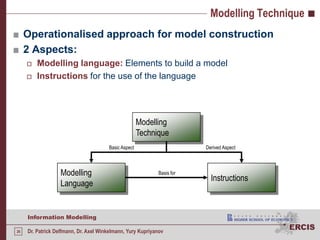
Modelling TechniqueOperationalised approach for model construction2 Aspects:Modelling language: Elements to build a modelInstructions for the use of the languageModellingTechniqueBasic AspectDerivedAspectInstructionsModellingLanguageBasis for
Aspectsof Modelling LanguagesConceptualAspectofthe LanguageLanguage elementsandtheirsyntacticalrelationshipsAbstract syntaxIn addition: semanticsoflanguageelementsandtheirrelationships (description in naturallanguage)Example: EPC:An EPC is a bipartite, directedgraphfortherepresentationofbusinessprocessesModelling elementsarefunctionsandeventsthatareconnectedbycontrolflowsFunctionsrepresentbusinesstasksandare time-consumingEvents representstates…
Aspectsof Modelling LanguagesRepresentational AspectRepresentation of language elements and their relationshipsParticular syntaxExample EPC:Functions are represented by rounded, green coloured rectanglesEvents are represented by flattened, red coloured hexagonsControl flows are represented by directed edges. The direction is indicated by an arrow
Aspectsof Modelling LanguagesA modellinglanguagecansupport different representationsA newrepresentationdoes notimply a newlanguage!Example EPC:RepresentationoflanguageelementsthroughiconsFunction: workingemployeeEvent: explosionRepresentationofthecontrolflowthrough „fancy“ Edges
Instructions… describe how to construct a model with a modelling language… are therefore derived from the modelling languageExample EPC:The tasks that are performed in a business process have to be identified and subsumed as functionsTriggering or resulting states have to be identified and subsumed as eventsThe temporal and logic order of functions and events has to be represented as control flowThe model elements and relationships have to be represented with symbols
Modelling Languagesand Modelling TechniquesModellingTechniqueBasic AspectDerivedAspectInstructionsModellingLanguageBasis for1:n1:1ConceptualAspectRepresentationalAspect
Modelling Method(ology)Defines the essential tasks of one or more model development phase(s)Modelling techniques as constitutional elementsModelling views (cf. ARIS)Development layers (cf. ARIS)
Modelling Method(ology)Method(ology)1:nModellingTechniqueBasic AspectDerivedAspectInstructionsModellingLanguageBasis for1:n1:1ConceptualAspectRepresentationalAspect
Basics of Information ModelingModels, LanguagesandMethods

02 information models

  • 1.
    Basics of InformationModelingModels, LanguagesandMethods
  • 2.
  • 3.
    LanguageLanguagesLanguages are humancommunication instruments for the understanding of items (linguistic definition)Languages are the basis of any scientific discourseLanguages are systems of signs (semiotic definition)Linguistic signs are arbitrary and conventionalArbitrarity:The choice and construction of signs is arbitrary, i.e. there is no direct connection between the sign and the singified item (i.e., e.g. a „customer“ is not necessarily represented as a picture of a customer)Conventionality:The semantics of the signs is result of a convention – a consensus of the speech community (e.g. scientists, modelers)
  • 4.
    Classification of LanguagesNaturalLanguagessystems of signs that have originated in an evolutionary wayno complete definition of syntax and semanticsnatural languages evolve naturally (e.g. slang, dialects etc.)extremely expressiveextremely redundant, potentially fuzzy and inconsistentStatements of natural languages can be interpreted in different waysCommunication in natural language is not only dependent on the signs (gestures, intonation)
  • 5.
    Natural LanguagesUniversal LanguagesAreable to express „almost everything“ (Morris)Are not assigned to specific domainsNo dedicated application areaHuge speech communityDynamic vocabular that is not defined clearlyExamples: English, Russian, German, …Do not distinguish between language and meta language
  • 6.
    Natural LanguagesTerminologySubset ofuniversal languageIs assigned to a particular domainScientific disciplinesIndustry sectorBusiness classCompany…Application-driven, serving task fulfillmentAre the basis of organizational actionComprise a finite set of terms and application rulese.g.: legal texts (juristic language), „officialese“
  • 7.
    Terms as Singsof Natural LanguagesThe Term „Term“A termis a linguisticsignthatconsistsofthefollowingcomponentsWord (name): sequenceoflettersas medium ofthesignIntension: „idea“ oftheterm, itssemanticsandcharacteristicsExtension:setofobjectsthatarenamedbytheterm
  • 8.
    Intension and ExtensionExamplesDifferentname, different intension, different extensionDifferent name, different intension, same extensionCustomerProductDebitorCustomer
  • 9.
    Intension and ExtensionExamplesDifferentname, same intension, same extensionSame name, different intension, different extensionInvoiceBill Synonyms!PartyParty Homonyms!(politicalincorporation)(celebrationevent)
  • 10.
    Classification of LanguagesFormalLanguageA system of signs that is based on a calculuscalculus: Methodology that is used to construct figures out of a set of basic signs (alphabet) following particular rulesformal definition of syntax and semanticsSemantics are classified as „defined formally“ if the definition of the sementics is based on mathematical rules (Sommerville 2001)AdvantagesClarityConsistencyRedundancy-free
  • 11.
    Classification of LanguagesSemi-formalLanguagesVisual, diagram-based languages that contain textual elements (Remme 1997)Syntax is defined formally, definition of semantics is missingSigns of semi-formal languages consist of graphical elements and textual signifier (i.e. a node in a graph-based process modelling language „check invoice“)Semi-formal languages encounter some probolems that result from the application of natural languagesRedundancyFuzzinessInconsistencyResolution approaches: Standards, ontology
  • 12.
    Formal andnaturallanguageaspectsof semi-formallanguagesExample: EPCNatural language aspectsA document is relevant for a business transaction„Process“ is a task that transforms an object (the document)A document has to arrive prior to ist processing…Formal languages aspectsDefined symbolsGraph is directedFunctions are followed by eventsEvents do not follow events…DocumenthasarrivedProcessdocumentDocumentprocessed
  • 13.
    Specification of LanguagesPossibilitiesto avoid problems of natural languagesTechnical term modelsGlossariesTerm relationship modelsOntologiesLanguage standardisationFormal definition of the natural language‘s syntax and semantics Language application conventionsDomain-specific languages (e.g. PICTURE)
  • 14.
  • 15.
  • 16.
  • 17.
  • 18.
    Model TheroyCharacteristics ofModels (Stachowiak 1973):Mapping: a model is always related to an original that is being mappedThe original consists either of a natural object or a mental constructReduction:a model does not describe the orininal in totalNon-relevant aspects are left outImportant aspects are emphasizedThe model may contain additional aspects that do not exist in the originalPragmatics: a model has a particular purpose that is valid for a certain time and for a set of users
  • 19.
    Model TheroyRelationship betweenmodel and originalOriginalModelMappingAdditonalAspectsReductionCf. Stachowiak(1973)
  • 20.
    Mappingmapping-orienteddefinitionofmodels (Kosiol 1968)Structuralandbehaviouralequivalenceoforiginal and modelStructuralequivalence (isomorphism)Structuralequivalenceisrestrictedtothe model apsectsthatare relevant forthe model purpose structuralsimilarity (homomorphism)CriticismItisassumedthatthemodellerisabletorecognisethe original completely (i.e. in total andobjectively)But: everymodellerissubjective constructionorienteddefinitionofmodels
  • 21.
    ConstructionModelling is aprocess A person…constructs a representation of a (real or mental) issue…On the basis of her/his perceptionModelling is purpose-drivenThe purpose is defined by the modellerModel components have to be considered relevant by the modellerModels are represented with artificial, (semi-)formal languages
  • 22.
    ConstructionConsequences that arisefrom the construction-oriented model definitionModels are not objectively true or falseModels are more or less purposeful at mostThe choice of a particular model out of a set of possible models is exclusively dependent on decisions of a modellerIn order to guarantee usefulness of a model: consensus of modellers and users
  • 23.
  • 24.
    Definition of theTerm Model in Information SystemsA model is an abstract representation of a business issue (the original) for subjective purposesIt is the result of the construction of a person that defines a representation of an original at a certain time for a certain group of recipients using a particular artificial language.
  • 25.
    Definition of theTerm Information ModelAn information model is an abstractrepresentationof a businessissue (the original) forthepurposeofapplicationsystemsand organisational designItistheresultoftheconstructionof a personthatdefines a representationof an original at a certaintime forapplicationsystemsand organisational designersusing a modellinglanguage.
  • 26.
  • 27.
    Modelling TechniqueOperationalised approachfor model construction2 Aspects:Modelling language: Elements to build a modelInstructions for the use of the languageModellingTechniqueBasic AspectDerivedAspectInstructionsModellingLanguageBasis for
  • 28.
    Aspectsof Modelling LanguagesConceptualAspectoftheLanguageLanguage elementsandtheirsyntacticalrelationshipsAbstract syntaxIn addition: semanticsoflanguageelementsandtheirrelationships (description in naturallanguage)Example: EPC:An EPC is a bipartite, directedgraphfortherepresentationofbusinessprocessesModelling elementsarefunctionsandeventsthatareconnectedbycontrolflowsFunctionsrepresentbusinesstasksandare time-consumingEvents representstates…
  • 29.
    Aspectsof Modelling LanguagesRepresentationalAspectRepresentation of language elements and their relationshipsParticular syntaxExample EPC:Functions are represented by rounded, green coloured rectanglesEvents are represented by flattened, red coloured hexagonsControl flows are represented by directed edges. The direction is indicated by an arrow
  • 30.
    Aspectsof Modelling LanguagesAmodellinglanguagecansupport different representationsA newrepresentationdoes notimply a newlanguage!Example EPC:RepresentationoflanguageelementsthroughiconsFunction: workingemployeeEvent: explosionRepresentationofthecontrolflowthrough „fancy“ Edges
  • 31.
    Instructions… describe howto construct a model with a modelling language… are therefore derived from the modelling languageExample EPC:The tasks that are performed in a business process have to be identified and subsumed as functionsTriggering or resulting states have to be identified and subsumed as eventsThe temporal and logic order of functions and events has to be represented as control flowThe model elements and relationships have to be represented with symbols
  • 32.
    Modelling Languagesand ModellingTechniquesModellingTechniqueBasic AspectDerivedAspectInstructionsModellingLanguageBasis for1:n1:1ConceptualAspectRepresentationalAspect
  • 33.
    Modelling Method(ology)Defines theessential tasks of one or more model development phase(s)Modelling techniques as constitutional elementsModelling views (cf. ARIS)Development layers (cf. ARIS)
  • 34.
  • 35.
    Basics of InformationModelingModels, LanguagesandMethods