International Conference
Transforming the educational relationship: intergenerational
and family learning for the lifelong learning society

Romanian secondary school students, parents and teachers.
Intergenerational relationship and lifelong learning society
Associate Professor Valeriu Frunzaru, PhD
National University of Political Studies and Public Administration
Bucharest, 24-25 October 2013
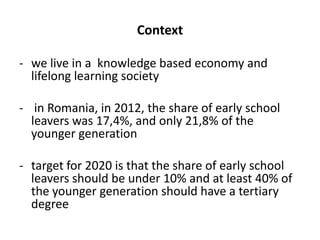
Context
- we live in a knowledge based economy and
lifelong learning society
- in Romania, in 2012, the share of early school
leavers was 17,4%, and only 21,8% of the
younger generation
- target for 2020 is that the share of early school
leavers should be under 10% and at least 40% of
the younger generation should have a tertiary
degree
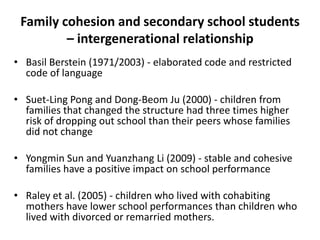
Family cohesion and secondary school students
– intergenerational relationship
• Basil Berstein (1971/2003) - elaborated code and restricted
code of language
• Suet-Ling Pong and Dong-Beom Ju (2000) - children from
families that changed the structure had three times higher
risk of dropping out school than their peers whose families
did not change
• Yongmin Sun and Yuanzhang Li (2009) - stable and cohesive
families have a positive impact on school performance

• Raley et al. (2005) - children who lived with cohabiting
mothers have lower school performances than children who
lived with divorced or remarried mothers.
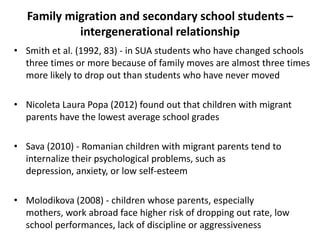
Family migration and secondary school students –
intergenerational relationship
• Smith et al. (1992, 83) - in SUA students who have changed schools
three times or more because of family moves are almost three times
more likely to drop out than students who have never moved
• Nicoleta Laura Popa (2012) found out that children with migrant
parents have the lowest average school grades
• Sava (2010) - Romanian children with migrant parents tend to
internalize their psychological problems, such as
depression, anxiety, or low self-esteem
• Molodikova (2008) - children whose parents, especially
mothers, work abroad face higher risk of dropping out rate, low
school performances, lack of discipline or aggressiveness
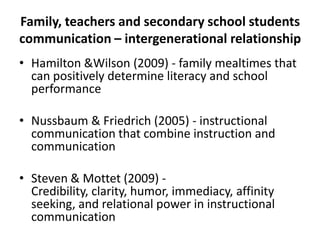
Family, teachers and secondary school students
communication – intergenerational relationship
• Hamilton &Wilson (2009) - family mealtimes that
can positively determine literacy and school
performance
• Nussbaum & Friedrich (2005) - instructional
communication that combine instruction and
communication
• Steven & Mottet (2009) Credibility, clarity, humor, immediacy, affinity
seeking, and relational power in instructional
communication
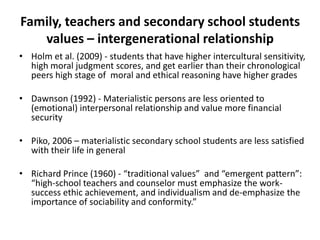
Family, teachers and secondary school students
values – intergenerational relationship
• Holm et al. (2009) - students that have higher intercultural sensitivity,
high moral judgment scores, and get earlier than their chronological
peers high stage of moral and ethical reasoning have higher grades
• Dawnson (1992) - Materialistic persons are less oriented to
(emotional) interpersonal relationship and value more financial
security
• Piko, 2006 – materialistic secondary school students are less satisfied
with their life in general
• Richard Prince (1960) - “traditional values” and “emergent pattern”:
“high-school teachers and counselor must emphasize the worksuccess ethic achievement, and individualism and de-emphasize the
importance of sociability and conformity.”
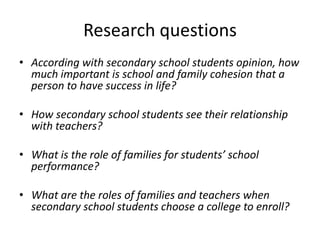
Research questions
• According with secondary school students opinion, how
much important is school and family cohesion that a
person to have success in life?
• How secondary school students see their relationship
with teachers?
• What is the role of families for students’ school
performance?

• What are the roles of families and teachers when
secondary school students choose a college to enroll?
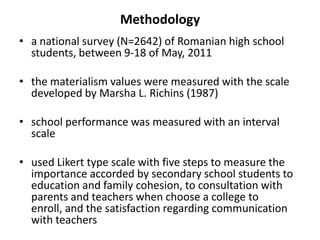
Methodology
• a national survey (N=2642) of Romanian high school
students, between 9-18 of May, 2011

• the materialism values were measured with the scale
developed by Marsha L. Richins (1987)
• school performance was measured with an interval
scale
• used Likert type scale with five steps to measure the
importance accorded by secondary school students to
education and family cohesion, to consultation with
parents and teachers when choose a college to
enroll, and the satisfaction regarding communication
with teachers
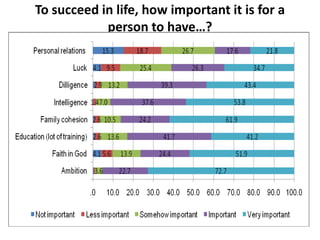
To succeed in life, how important it is for a
person to have…?
Think about your secondary school,
how happy are you with the [...]
Relationship between school performance and
parents characteristics (chi square)
School performance
Parents education

137.79*** (df=6)

If parents work abroad

16.19* (df=12)

Supported by family

22.93** (df=15)

*** significant for p<.001
** significant for p<.01
* significant for p<.05
In choosing college/university to what extent a young
person have to take into account the opinion of…?
Conclusions
Intergenerational relationship between teachers, parents
and secondary school students is very important in
order that the later ones to integrate into lifelong
learning society.
• secondary school students need the parents and
teachers support, and family cohesion
• parents and teachers have to have a better
communication with children, to support and to
transmit them values that can help them be integrated
into society and happier

Romanian secondary school students

  • 1.
    International Conference Transforming theeducational relationship: intergenerational and family learning for the lifelong learning society Romanian secondary school students, parents and teachers. Intergenerational relationship and lifelong learning society Associate Professor Valeriu Frunzaru, PhD National University of Political Studies and Public Administration Bucharest, 24-25 October 2013
  • 2.
    Context - we livein a knowledge based economy and lifelong learning society - in Romania, in 2012, the share of early school leavers was 17,4%, and only 21,8% of the younger generation - target for 2020 is that the share of early school leavers should be under 10% and at least 40% of the younger generation should have a tertiary degree
  • 3.
    Family cohesion andsecondary school students – intergenerational relationship • Basil Berstein (1971/2003) - elaborated code and restricted code of language • Suet-Ling Pong and Dong-Beom Ju (2000) - children from families that changed the structure had three times higher risk of dropping out school than their peers whose families did not change • Yongmin Sun and Yuanzhang Li (2009) - stable and cohesive families have a positive impact on school performance • Raley et al. (2005) - children who lived with cohabiting mothers have lower school performances than children who lived with divorced or remarried mothers.
  • 4.
    Family migration andsecondary school students – intergenerational relationship • Smith et al. (1992, 83) - in SUA students who have changed schools three times or more because of family moves are almost three times more likely to drop out than students who have never moved • Nicoleta Laura Popa (2012) found out that children with migrant parents have the lowest average school grades • Sava (2010) - Romanian children with migrant parents tend to internalize their psychological problems, such as depression, anxiety, or low self-esteem • Molodikova (2008) - children whose parents, especially mothers, work abroad face higher risk of dropping out rate, low school performances, lack of discipline or aggressiveness
  • 5.
    Family, teachers andsecondary school students communication – intergenerational relationship • Hamilton &Wilson (2009) - family mealtimes that can positively determine literacy and school performance • Nussbaum & Friedrich (2005) - instructional communication that combine instruction and communication • Steven & Mottet (2009) Credibility, clarity, humor, immediacy, affinity seeking, and relational power in instructional communication
  • 6.
    Family, teachers andsecondary school students values – intergenerational relationship • Holm et al. (2009) - students that have higher intercultural sensitivity, high moral judgment scores, and get earlier than their chronological peers high stage of moral and ethical reasoning have higher grades • Dawnson (1992) - Materialistic persons are less oriented to (emotional) interpersonal relationship and value more financial security • Piko, 2006 – materialistic secondary school students are less satisfied with their life in general • Richard Prince (1960) - “traditional values” and “emergent pattern”: “high-school teachers and counselor must emphasize the worksuccess ethic achievement, and individualism and de-emphasize the importance of sociability and conformity.”
  • 7.
    Research questions • Accordingwith secondary school students opinion, how much important is school and family cohesion that a person to have success in life? • How secondary school students see their relationship with teachers? • What is the role of families for students’ school performance? • What are the roles of families and teachers when secondary school students choose a college to enroll?
  • 8.
    Methodology • a nationalsurvey (N=2642) of Romanian high school students, between 9-18 of May, 2011 • the materialism values were measured with the scale developed by Marsha L. Richins (1987) • school performance was measured with an interval scale • used Likert type scale with five steps to measure the importance accorded by secondary school students to education and family cohesion, to consultation with parents and teachers when choose a college to enroll, and the satisfaction regarding communication with teachers
  • 9.
    To succeed inlife, how important it is for a person to have…?
  • 10.
    Think about yoursecondary school, how happy are you with the [...]
  • 11.
    Relationship between schoolperformance and parents characteristics (chi square) School performance Parents education 137.79*** (df=6) If parents work abroad 16.19* (df=12) Supported by family 22.93** (df=15) *** significant for p<.001 ** significant for p<.01 * significant for p<.05
  • 12.
    In choosing college/universityto what extent a young person have to take into account the opinion of…?
  • 13.
    Conclusions Intergenerational relationship betweenteachers, parents and secondary school students is very important in order that the later ones to integrate into lifelong learning society. • secondary school students need the parents and teachers support, and family cohesion • parents and teachers have to have a better communication with children, to support and to transmit them values that can help them be integrated into society and happier