Parent Involvement and
Dropout Prevention
Dr. Rose A. Hall
Challenges on the Road to School Success for Low
Socioeconomic and Minority Students
2
Introduction
As the United States struggles to keep its
students competitive in a global society,
reducing dropout rates has been a major
priority for large urban school districts.
Students in big-city school districts like
New York and Chicago have a less than a
50-50 chance of graduating from high
school with their peers and graduate far
fewer than half each spring, according to
a 2006 research study (Toppo, 2006).
The promotion and implementation of
parent involvement is a major key to
challenging students’ beliefs about
achieving school success, especially low-
income, minority students who leave
school early without graduating.
A School System without
parents at its foundation is just
like a bucket with a hole in it....
-Rev. Jesse L. Jackson
Significance
Parent involvement is a major force
within school systems, necessary for the
effective implementation of strategies
that increase the number of students
experiencing school success.
Henry, Knight & Thornberry (2012) report
that school dropouts have very negative
consequences, not just for the student, but
for his or her family and society at large.
Failure to graduate from high school results
in a lifetime of lower wages, poorer health,
dependency on public assistance, possible
involvement in crime and incarceration
(Henry, Knight & Thornberry, 2012).
3
Method of Inquiry
A qualitative action research case
study was chosen for its focus on educational
interventions that provide insight into practice
issues in a real world context (Joseph, 2004).
Yin (2003) states, qualitative case studies
facilitate the development of theoretical
propositions to direct the data collection and
analysis in ways that seek to explain causality
in real-life interventions that are too complex
for survey and experimental strategies. The
focus on taking research from theory to
practical implementation seems to be a logical
progression. Action Research case studies
place actual interventions in the real world
environment for testing (Joseph, 2004).
The research focuses on engaging parents; teachers
and students in building meaningful productive
relationships based on interventions that foster
open communication as a way to improve student
achievement.
Epstein (1997), Typology of Parent Involvement
and Wehlage (1989), School Impediments,
provided balance in examining Parent
Involvement and School Success among low
socioeconomic and minority students.
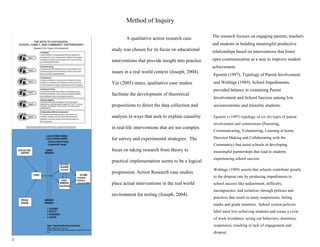
Epstein’s (1997) typology of six (6) types of parent
involvement and connections (Parenting,
Communicating, Volunteering, Learning at home,
Decision Making and Collaborating with the
Community) that assist schools in developing
meaningful partnerships that lead to students
experiencing school success.
Wehlage (1989) asserts that schools contribute greatly
to the dropout rate by producing impediments to
school success like (adjustment, difficulty,
incongruence, and isolation) through policies and
practices that result in many suspensions, failing
marks and grade retention. School system policies
label most low-achieving students and create a cycle
of work avoidance, acting out behaviors, detention,
suspension, resulting in lack of engagement and
dropout.
4
Research Questions
1) How does parent involvement affect the academic school success of
minority, low socio-economic students?
2) How does parent involvement affect the behavioral school success of
minority, low socio-economic students?
3) What are some forms of nontraditional parent involvement?
4) What are the effects of nontraditional forms of parent involvement, i.e.
instilling cultural pride, encouragement and school expectations?
Demographics
The study participants’ demographics were diverse in ethnicity (African
American, Arab, Bengali, Haitian, and South American Countries), languages
(Arabic, Bengali, English, Creole, French, and Spanish), level of education and
household income. Nevertheless, the teachers and parents shared the same goals
and aspirations regarding the students’ school success.
Setting
The study was conducted in Broward Public School District, Florida at an
elementary school. The school is located in an urban community of minority
(Hispanic, Haitian and African American) and low socio-economic families, 76%
of who are recipients of public assistance support services (Broward County
Property and Census, 2012). The neighborhood consists of a high percentage of
individuals who have left school early and dropped out (Broward County, Florida
Census).
Involvement
(Traditional / Non Traditional)
 Parent Teacher Association (PTA)
 School Conference & Meeting
 Verbal and Written Corresponding
 Chaperone School Trips
 Athletic Events
 Attendance & Financial School Support
 Ve
 Cu
Aw
 Pro
Edu
 Pro
Sch
Are
Ho
 Go
 Set
Exp
 Ve
 Cu
Aw
 Pro
Edu
 Pro
Sch
Are
Ho
 Go
 Set
Exp
 Parent Teacher  Verbal Praise
5
Recommendations
Future Research
Future research should focus on the implementation of
programs at the district level of certified professional training
teams like “Schools and Parents Partnership” to train schools
year round on how to develop relationships with parents.
Study on: The effects of Parent Involvement Longitudinal
study (3-5) years, starting in elementary – secondary
education. Pre & Post Survey Attitudes (Parents/Students) and
academics
Study on Motivation - Develop an instrument that identifies
and examines the benefits of motivation and school success.
Targeting elementary school children
Study on: Examining School Culture and Climate of Students
experiencing little to no school success
Results
The students’ reading grades improved (75% of the group), while their
math grades only improved for a portion of the group (25%). In math, the
majority of students were able to maintain their grades (69% of the group).
There were no declines in reading grades, however, there was a 6% decline
in math grades.
The data suggests a positive connection between parent involvement and
school success among low socioeconomic and minority students.
Correlation does not denote causation. Many other variables that may have
played a role where peer interaction, school personnel taking a greater
interest.
Teachers reported observing greater effort and motivation among the
students experiencing an increase in parent involvement.
Parents reported an increase in teacher instruction to help them assist their
child with class work/homework. Parents reported initially not knowing
how to assist their child in achieving academic growth.
Students reported feeling safe in a caring environment with teachers who
knew their parents personally and had a friendly relationship with their
families.
Dr. Rose A. Hall
Lynn University
3601 N. Military Trail
Boca Raton, FL 33431
The importance of conducting research on strategies to involve parents in their children’s school life and its connection to students experiencing
school success cannot be underestimated. Building a bridge of meaningful partnerships is a two way process between schools and parents that
requires participation from both sides. Partnerships are only successful when both parties are committed, share mutual respect, and are vigilant
and dedicated to a common goal.

Hall

  • 1.
    Parent Involvement and DropoutPrevention Dr. Rose A. Hall Challenges on the Road to School Success for Low Socioeconomic and Minority Students
  • 2.
    2 Introduction As the UnitedStates struggles to keep its students competitive in a global society, reducing dropout rates has been a major priority for large urban school districts. Students in big-city school districts like New York and Chicago have a less than a 50-50 chance of graduating from high school with their peers and graduate far fewer than half each spring, according to a 2006 research study (Toppo, 2006). The promotion and implementation of parent involvement is a major key to challenging students’ beliefs about achieving school success, especially low- income, minority students who leave school early without graduating. A School System without parents at its foundation is just like a bucket with a hole in it.... -Rev. Jesse L. Jackson Significance Parent involvement is a major force within school systems, necessary for the effective implementation of strategies that increase the number of students experiencing school success. Henry, Knight & Thornberry (2012) report that school dropouts have very negative consequences, not just for the student, but for his or her family and society at large. Failure to graduate from high school results in a lifetime of lower wages, poorer health, dependency on public assistance, possible involvement in crime and incarceration (Henry, Knight & Thornberry, 2012).
  • 3.
    3 Method of Inquiry Aqualitative action research case study was chosen for its focus on educational interventions that provide insight into practice issues in a real world context (Joseph, 2004). Yin (2003) states, qualitative case studies facilitate the development of theoretical propositions to direct the data collection and analysis in ways that seek to explain causality in real-life interventions that are too complex for survey and experimental strategies. The focus on taking research from theory to practical implementation seems to be a logical progression. Action Research case studies place actual interventions in the real world environment for testing (Joseph, 2004). The research focuses on engaging parents; teachers and students in building meaningful productive relationships based on interventions that foster open communication as a way to improve student achievement. Epstein (1997), Typology of Parent Involvement and Wehlage (1989), School Impediments, provided balance in examining Parent Involvement and School Success among low socioeconomic and minority students. Epstein’s (1997) typology of six (6) types of parent involvement and connections (Parenting, Communicating, Volunteering, Learning at home, Decision Making and Collaborating with the Community) that assist schools in developing meaningful partnerships that lead to students experiencing school success. Wehlage (1989) asserts that schools contribute greatly to the dropout rate by producing impediments to school success like (adjustment, difficulty, incongruence, and isolation) through policies and practices that result in many suspensions, failing marks and grade retention. School system policies label most low-achieving students and create a cycle of work avoidance, acting out behaviors, detention, suspension, resulting in lack of engagement and dropout.
  • 4.
    4 Research Questions 1) Howdoes parent involvement affect the academic school success of minority, low socio-economic students? 2) How does parent involvement affect the behavioral school success of minority, low socio-economic students? 3) What are some forms of nontraditional parent involvement? 4) What are the effects of nontraditional forms of parent involvement, i.e. instilling cultural pride, encouragement and school expectations? Demographics The study participants’ demographics were diverse in ethnicity (African American, Arab, Bengali, Haitian, and South American Countries), languages (Arabic, Bengali, English, Creole, French, and Spanish), level of education and household income. Nevertheless, the teachers and parents shared the same goals and aspirations regarding the students’ school success. Setting The study was conducted in Broward Public School District, Florida at an elementary school. The school is located in an urban community of minority (Hispanic, Haitian and African American) and low socio-economic families, 76% of who are recipients of public assistance support services (Broward County Property and Census, 2012). The neighborhood consists of a high percentage of individuals who have left school early and dropped out (Broward County, Florida Census). Involvement (Traditional / Non Traditional)  Parent Teacher Association (PTA)  School Conference & Meeting  Verbal and Written Corresponding  Chaperone School Trips  Athletic Events  Attendance & Financial School Support  Ve  Cu Aw  Pro Edu  Pro Sch Are Ho  Go  Set Exp  Ve  Cu Aw  Pro Edu  Pro Sch Are Ho  Go  Set Exp  Parent Teacher  Verbal Praise
  • 5.
    5 Recommendations Future Research Future researchshould focus on the implementation of programs at the district level of certified professional training teams like “Schools and Parents Partnership” to train schools year round on how to develop relationships with parents. Study on: The effects of Parent Involvement Longitudinal study (3-5) years, starting in elementary – secondary education. Pre & Post Survey Attitudes (Parents/Students) and academics Study on Motivation - Develop an instrument that identifies and examines the benefits of motivation and school success. Targeting elementary school children Study on: Examining School Culture and Climate of Students experiencing little to no school success Results The students’ reading grades improved (75% of the group), while their math grades only improved for a portion of the group (25%). In math, the majority of students were able to maintain their grades (69% of the group). There were no declines in reading grades, however, there was a 6% decline in math grades. The data suggests a positive connection between parent involvement and school success among low socioeconomic and minority students. Correlation does not denote causation. Many other variables that may have played a role where peer interaction, school personnel taking a greater interest. Teachers reported observing greater effort and motivation among the students experiencing an increase in parent involvement. Parents reported an increase in teacher instruction to help them assist their child with class work/homework. Parents reported initially not knowing how to assist their child in achieving academic growth. Students reported feeling safe in a caring environment with teachers who knew their parents personally and had a friendly relationship with their families.
  • 6.
    Dr. Rose A.Hall Lynn University 3601 N. Military Trail Boca Raton, FL 33431 The importance of conducting research on strategies to involve parents in their children’s school life and its connection to students experiencing school success cannot be underestimated. Building a bridge of meaningful partnerships is a two way process between schools and parents that requires participation from both sides. Partnerships are only successful when both parties are committed, share mutual respect, and are vigilant and dedicated to a common goal.