HOW CAN TEACHERS CONTRIBUTE
TO DEVELOP EXECUTIVE FUNCTIONS
THROUGH MOTOR ACTIVITY?
Tortella P.*, Fumagalli G.+, Tessaro F.*
* University of Cà Foscari (Venice – Italy)
+ University of Verona - Center for research on motor
development in childhood - - Italy

24-25 October 2013 Bucharest, Rumania
Transforming the educational relationship: intergenerational and
family learning for the lifelong learning society
1
What are the executive functions?
They are top-down mental processes needed when you need to
concentrate and pay attention. The three core EFs are:
Lehto et al. 2003; Miyake et al. 2000)

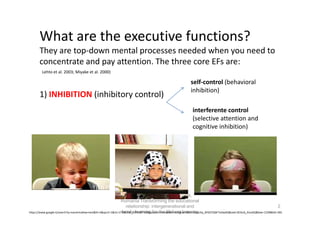
1) INHIBITION (inhibitory control)

self-control (behavioral
inhibition)
interferente control
(selective attention and
cognitive inhibition)

24-25 October 2013 Bucharest,
Rumania Transforming the educational
relationship: intergenerational and
2
family learning for the lifelong learning
https://www.google.it/search?q=marshmallow+test&hl=it&qscrl=1&rlz=1T4ACAW_itIT418IT418&source=lnms&tbm=isch&sa=X&ei=iJ5mUtq_BYSO7QbF7oDwAQ&ved=0CAcQ_AUoAQ&biw=1239&bih=581
society
Core EFs
2) WORKING MEMORY (hold information in mind
and mentally work with it)
3) COGNITIVE FLEXIBILITY (set shifting, mental
flexibility, mental set shifting and closely linked to
creativity):
change perspectives or approaches
to a problem
4) REASONING
5) PROBLEM SOLVING
6) PLENNING
7) ATTENTION
(Collins & Koechlin, 2012)

24-25 October 2013 Bucharest,
Rumania Transforming the educational
relationship: intergenerational and
family learning for the lifelong learning
society

3
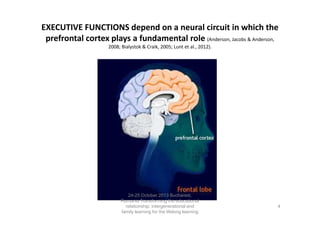
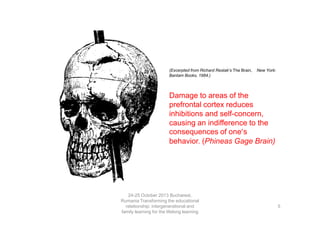
EXECUTIVE FUNCTIONS depend on a neural circuit in which the
prefrontal cortex plays a fundamental role (Anderson, Jacobs & Anderson,
2008; Bialystok & Craik, 2005; Lunt et al., 2012).

24-25 October 2013 Bucharest,
Rumania Transforming the educational
relationship: intergenerational and
family learning for the lifelong learning
society

4
(Excerpted from Richard Restak’s The Brain,
Bantam Books, 1984.)

New York:

Damage to areas of the
prefrontal cortex reduces
inhibitions and self-concern,
causing an indifference to the
consequences of one’s
behavior. (Phineas Gage Brain)

24-25 October 2013 Bucharest,
Rumania Transforming the educational
relationship: intergenerational and
family learning for the lifelong learning
society

5
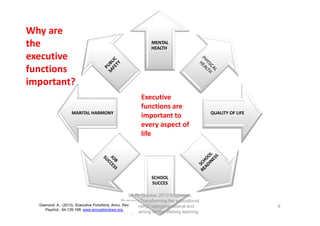
Why are
the
executive
functions
important?
MARITAL HARMONY

MENTAL
HEALTH

Executive
functions are
important to
every aspect of
life

QUALITY OF LIFE

SCHOOL
SUCCES
24-25 October 2013 Bucharest,
Rumania Transforming the educational
Diamond A., (2013). Executive Functions, Annu. Rev.
relationship: intergenerational and
Psychol., 64,135-168. www.annualreviews.org.
family learning for the lifelong learning
society

6
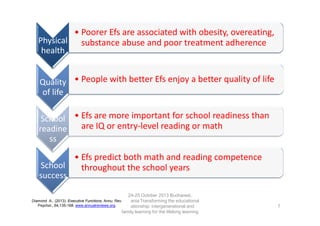
• Poorer Efs are associated with obesity, overeating,
Physical substance abuse and poor treatment adherence
health
Quality • People with better Efs enjoy a better quality of life
of life
School • Efs are more important for school readiness than
are IQ or entry-level reading or math
readine
ss

• Efs predict both math and reading competence
School
throughout the school years
success
24-25 October 2013 Bucharest,
Diamond A., (2013). Executive Functions, Annu. Rev.
Rumania Transforming the educational
Psychol., 64,135-168. www.annualreviews.org.
relationship: intergenerational and
family learning for the lifelong learning
society

7
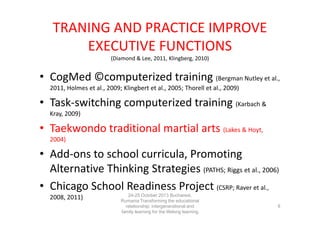
TRANING AND PRACTICE IMPROVE
EXECUTIVE FUNCTIONS
(Diamond & Lee, 2011, Klingberg, 2010)

• CogMed ©computerized training (Bergman Nutley et al.,
2011, Holmes et al., 2009; Klingbert et al., 2005; Thorell et al., 2009)

• Task-switching computerized training (Karbach &
Kray, 2009)

• Taekwondo traditional martial arts (Lakes & Hoyt,
2004)

• Add-ons to school curricula, Promoting
Alternative Thinking Strategies (PATHS; Riggs et al., 2006)
• Chicago School Readiness Project (CSRP; Raver et al.,
2008, 2011)

24-25 October 2013 Bucharest,
Rumania Transforming the educational
relationship: intergenerational and
family learning for the lifelong learning
society

8
OTHER STUDIES
•
•
•
•

AEROBICS (Davis et al., 2011, Kamijo et al., 2011)
Mindfulness (Flook et al., 2010)
Yoga (Manjunath & Telles, 2001)
Tools of the Mind early childhood curriculum
(Diamond et al., 2007)

• Montessori curriculum (Lillard & Else-Quest, 2006)

24-25 October 2013 Bucharest,
Rumania Transforming the educational
relationship: intergenerational and
family learning for the lifelong learning
society

9
Can motor activity contribute to
develop the executive functions?
• Taekwondo traditional martial arts (Lakes & Hoyt,
2004)

• AEROBICS (Davis et al., 2011, Kamijo et al., 2011)
• Yoga (Manjunath & Telles, 2001)
• Exercising bimanual coordination

(Hillman et al., 2008;

Chaddock et al., 2011)

It is reasonable to think that sport might be
very benefit, thanks to challenge EFs
(requiring sustanined attention, working
memory) (Diamond, 2011)
24-25 October 2013 Bucharest,
Rumania Transforming the educational
relationship: intergenerational and
family learning for the lifelong learning
society

10
How can teachers help children in
improving their school readiness?

FEW PRINCIPLES
• The disadvantaged children benefit the most from any EFs
intervention or program (Flook et al., 2010; Karbach & Kray, 2009; Lakes &
Hoyt, 2004)

• If difficulty doesn’t increase, the activity becomes boring
and people lose interest. (Bergman Nutley et al., 2011; Holmes et al.,
2009; Klingberg et al., 2005)

• Repeated practice is necessary. The success dipends on the
amount of time spent working on improving the skills
(Klingberg et al., 2005)
24-25 October 2013 Bucharest,
Rumania Transforming the educational
relationship: intergenerational and
family learning for the lifelong learning
society

11
• At any age EFs can be improved, including in
the elderly and in infants (Erickson & Kramer,
2009; Voss et al., 2011)
• Bilingualism appears to accellerate EF
developent during childhood and preserve EFs
longer during aging (Bialystok & Viswanathan,
2009)
• Exercise plus character development are
efficacious in improving EFs (Lakes & Hoyt,
2004)
24-25 October 2013 Bucharest,
Rumania Transforming the educational
relationship: intergenerational and
family learning for the lifelong learning
society

12
SUMMARY POINTS
• Emotional, social and physical needs are necessary
for academic excellence;
• Stress, sadness, loneliness, lack of sleep, lack of
physical exercise couse suffering in prefrontal cortex
and in EFs;
• Good executive functions in children predict lifelong
achievement, health, wealth and quality of life;
• EFs are trainable and can be improved at any age by
different approaches;
• Repeated practice is the key.
24-25 October 2013 Bucharest,
Rumania Transforming the educational
relationship: intergenerational and
family learning for the lifelong learning
society

13
OPEN QUESTIONS
• What can parents do to aid the development
of EFs in their children?
• Which are the best programs, what are the
best doses, durations, frequency, how long do
benefit last?
• Which activities not yet studied might
improve EFs?
24-25 October 2013 Bucharest,
Rumania Transforming the educational
relationship: intergenerational and
family learning for the lifelong learning
society

14
The playground, a space to improve
motor skills and EFs
• To improve health and motor activity is
important to propose spaces and opportunity
of activity.
• Play in outdoor spaces improves te welfare of
children (Ginsburg, K., R., 2007).
• stay in green park improve childen’s attention
and concentration skills.
• Significative experiences depend on
frequency, intensity and duration of motor
activity (Klingberg et al., 2005).
24-25 October 2013 Bucharest,
Rumania Transforming the educational
relationship: intergenerational and
family learning for the lifelong learning
society

15
• Child perception of difficult in free or structured
motor activity affects on the level of his
motivation and self efficacy (Tortella et al., 2012)
• Extreme requests produce frustration and
abandonment of the game.
• Motor activity contribute to cognitive
development (EFs) when is associated with
awareness and meta cognitive processes,
accompanied by passion and enthusiasm (Hirt, Devers
& McCrea, 2008).
24-25 October 2013 Bucharest,
Rumania Transforming the educational
relationship: intergenerational and
family learning for the lifelong learning
society

16
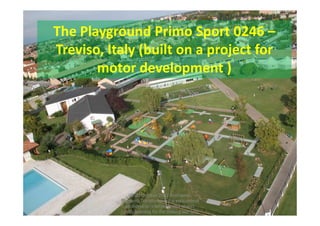
The Playground Primo Sport 0246 –
Treviso, Italy (built on a project for
motor development )

24-25 October 2013 Bucharest,
Rumania Transforming the educational
relationship: intergenerational and
family learning for the lifelong learning
society

17
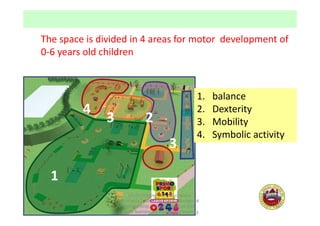
The space is divided in 4 areas for motor development of
0-6 years old children

4

3

2
3

1.
2.
3.
4.

balance
Dexterity
Mobility
Symbolic activity

1
24-25 October 2013 Bucharest,
Rumania Transforming the educational
relationship: intergenerational and
family learning for the lifelong learning
society

18
THE RESEARCH
AIM: TO INDIVIDUATE IF AND HOW CAN
TEACHERS CONTRIBUTE TO DEVELOP
EXECUTIVE FUNCTIONS THROUGH MOTOR
ACTIVITY

24-25 October 2013 Bucharest,
Rumania Transforming the educational
relationship: intergenerational and
family learning for the lifelong learning
society

19
SUBJECTS: 5 Kindergardens of Treviso (Italy) with 190 4-5 years old children;
• A) sperimental group (n. 40, 5 y old children);
teachers encourage verbally and physically the children to play in proximal
zone (Vygotskij, 1978); tell the child to observe the activity of the child
before him and to begin the activity when the other has arrived to a
certain point of the path.
While is waiting every child has his defined place
• B) control group (n. 40, 5 years old children);
teachers don’t encourage the children
every child begins the activity without indications
the children has not a defined place where to stay while waiting

Both groups are attending the Playground, 2 hours a week, for 10 weeks;
each session is organized in 30 minutes of free play and 30 minutes of
structured play in the areas of dexterity and balance.
24-25 October 2013 Bucharest,
Rumania Transforming the educational
relationship: intergenerational and
family learning for the lifelong learning
society

20
METHODOLOGY (QUALITATIVE AND
QUANTITATIVE)
• PRE AND POST MOTOR AND COGNITIVE
TESTS: ABC Movement tests, (Henderson,
Sugden & Barnett, 2007); Day night test
(Gerstandt Hong, Diamond, 1994); Haga M.,
tests (2009);
• Questionnaire, interviews and focus groups
with teachers and parents;
• Focus groups with children
24-25 October 2013 Bucharest,
Rumania Transforming the educational
relationship: intergenerational and
family learning for the lifelong learning
society

21
PRELIMINARY RESULTS
FOCUS GROUPS: after 10 weeks of activity.
Teachers tell that children of group A
(sperimental) are more:
• able to cooperate and collaborate with each
other
• have a greater capacity to wait
• have greater ability to organize space
• more attention
24-25 October 2013 Bucharest,
Rumania Transforming the educational
relationship: intergenerational and
family learning for the lifelong learning
society

22
Motor tests
SIGNIFICANT RESULTS (0,001) in motor
development:
• Balance
• Dexterity
In both A and B groups
24-25 October 2013 Bucharest,
Rumania Transforming the educational
relationship: intergenerational and
family learning for the lifelong learning
society

23
CONCLUSION
Preliminary data seem to indicate that 10 weeks of motor
activity in the playgrounds
contribute to improve:
1) (group A-B)
• motor skills: balance and dexterity
2) (group A)
• Executive Functions
• Motor skills: balance and dexterity
• Inhibition
• Planning
• Attention
24-25 October 2013 Bucharest,
Rumania Transforming the educational
relationship: intergenerational and
family learning for the lifelong learning
society

24
CONCLUSION
• encourage verbally and physically the children;
• play motor activity in proximal zone (Vygotskij,
1978);
• invite the child to observe the activity of the child
before him ;
• autonomously begin the activity to a fixed signal
• Maintain a position while waiting

24-25 October 2013 Bucharest,
Rumania Transforming the educational
relationship: intergenerational and
family learning for the lifelong learning
society

25
Seems to be a good opportunity :
1. To improve motor skills
2. To improve EFs
3. to reduce social disparities, by reducing the
EFs gap before school entry
4. Improve social skills
5. Improve health

24-25 October 2013 Bucharest,
Rumania Transforming the educational
relationship: intergenerational and
family learning for the lifelong learning
society

26
Thank you for your attention!
patrizia.tortella@gmail.com
24-25 October 2013 Bucharest,
Rumania Transforming the educational
relationship: intergenerational and
family learning for the lifelong learning
society

27

How can teachers contribute to develop executive functions

  • 1.
    HOW CAN TEACHERSCONTRIBUTE TO DEVELOP EXECUTIVE FUNCTIONS THROUGH MOTOR ACTIVITY? Tortella P.*, Fumagalli G.+, Tessaro F.* * University of Cà Foscari (Venice – Italy) + University of Verona - Center for research on motor development in childhood - - Italy 24-25 October 2013 Bucharest, Rumania Transforming the educational relationship: intergenerational and family learning for the lifelong learning society 1
  • 2.
    What are theexecutive functions? They are top-down mental processes needed when you need to concentrate and pay attention. The three core EFs are: Lehto et al. 2003; Miyake et al. 2000) 1) INHIBITION (inhibitory control) self-control (behavioral inhibition) interferente control (selective attention and cognitive inhibition) 24-25 October 2013 Bucharest, Rumania Transforming the educational relationship: intergenerational and 2 family learning for the lifelong learning https://www.google.it/search?q=marshmallow+test&hl=it&qscrl=1&rlz=1T4ACAW_itIT418IT418&source=lnms&tbm=isch&sa=X&ei=iJ5mUtq_BYSO7QbF7oDwAQ&ved=0CAcQ_AUoAQ&biw=1239&bih=581 society
  • 3.
    Core EFs 2) WORKINGMEMORY (hold information in mind and mentally work with it) 3) COGNITIVE FLEXIBILITY (set shifting, mental flexibility, mental set shifting and closely linked to creativity): change perspectives or approaches to a problem 4) REASONING 5) PROBLEM SOLVING 6) PLENNING 7) ATTENTION (Collins & Koechlin, 2012) 24-25 October 2013 Bucharest, Rumania Transforming the educational relationship: intergenerational and family learning for the lifelong learning society 3
  • 4.
    EXECUTIVE FUNCTIONS dependon a neural circuit in which the prefrontal cortex plays a fundamental role (Anderson, Jacobs & Anderson, 2008; Bialystok & Craik, 2005; Lunt et al., 2012). 24-25 October 2013 Bucharest, Rumania Transforming the educational relationship: intergenerational and family learning for the lifelong learning society 4
  • 5.
    (Excerpted from RichardRestak’s The Brain, Bantam Books, 1984.) New York: Damage to areas of the prefrontal cortex reduces inhibitions and self-concern, causing an indifference to the consequences of one’s behavior. (Phineas Gage Brain) 24-25 October 2013 Bucharest, Rumania Transforming the educational relationship: intergenerational and family learning for the lifelong learning society 5
  • 6.
    Why are the executive functions important? MARITAL HARMONY MENTAL HEALTH Executive functionsare important to every aspect of life QUALITY OF LIFE SCHOOL SUCCES 24-25 October 2013 Bucharest, Rumania Transforming the educational Diamond A., (2013). Executive Functions, Annu. Rev. relationship: intergenerational and Psychol., 64,135-168. www.annualreviews.org. family learning for the lifelong learning society 6
  • 7.
    • Poorer Efsare associated with obesity, overeating, Physical substance abuse and poor treatment adherence health Quality • People with better Efs enjoy a better quality of life of life School • Efs are more important for school readiness than are IQ or entry-level reading or math readine ss • Efs predict both math and reading competence School throughout the school years success 24-25 October 2013 Bucharest, Diamond A., (2013). Executive Functions, Annu. Rev. Rumania Transforming the educational Psychol., 64,135-168. www.annualreviews.org. relationship: intergenerational and family learning for the lifelong learning society 7
  • 8.
    TRANING AND PRACTICEIMPROVE EXECUTIVE FUNCTIONS (Diamond & Lee, 2011, Klingberg, 2010) • CogMed ©computerized training (Bergman Nutley et al., 2011, Holmes et al., 2009; Klingbert et al., 2005; Thorell et al., 2009) • Task-switching computerized training (Karbach & Kray, 2009) • Taekwondo traditional martial arts (Lakes & Hoyt, 2004) • Add-ons to school curricula, Promoting Alternative Thinking Strategies (PATHS; Riggs et al., 2006) • Chicago School Readiness Project (CSRP; Raver et al., 2008, 2011) 24-25 October 2013 Bucharest, Rumania Transforming the educational relationship: intergenerational and family learning for the lifelong learning society 8
  • 9.
    OTHER STUDIES • • • • AEROBICS (Daviset al., 2011, Kamijo et al., 2011) Mindfulness (Flook et al., 2010) Yoga (Manjunath & Telles, 2001) Tools of the Mind early childhood curriculum (Diamond et al., 2007) • Montessori curriculum (Lillard & Else-Quest, 2006) 24-25 October 2013 Bucharest, Rumania Transforming the educational relationship: intergenerational and family learning for the lifelong learning society 9
  • 10.
    Can motor activitycontribute to develop the executive functions? • Taekwondo traditional martial arts (Lakes & Hoyt, 2004) • AEROBICS (Davis et al., 2011, Kamijo et al., 2011) • Yoga (Manjunath & Telles, 2001) • Exercising bimanual coordination (Hillman et al., 2008; Chaddock et al., 2011) It is reasonable to think that sport might be very benefit, thanks to challenge EFs (requiring sustanined attention, working memory) (Diamond, 2011) 24-25 October 2013 Bucharest, Rumania Transforming the educational relationship: intergenerational and family learning for the lifelong learning society 10
  • 11.
    How can teachershelp children in improving their school readiness? FEW PRINCIPLES • The disadvantaged children benefit the most from any EFs intervention or program (Flook et al., 2010; Karbach & Kray, 2009; Lakes & Hoyt, 2004) • If difficulty doesn’t increase, the activity becomes boring and people lose interest. (Bergman Nutley et al., 2011; Holmes et al., 2009; Klingberg et al., 2005) • Repeated practice is necessary. The success dipends on the amount of time spent working on improving the skills (Klingberg et al., 2005) 24-25 October 2013 Bucharest, Rumania Transforming the educational relationship: intergenerational and family learning for the lifelong learning society 11
  • 12.
    • At anyage EFs can be improved, including in the elderly and in infants (Erickson & Kramer, 2009; Voss et al., 2011) • Bilingualism appears to accellerate EF developent during childhood and preserve EFs longer during aging (Bialystok & Viswanathan, 2009) • Exercise plus character development are efficacious in improving EFs (Lakes & Hoyt, 2004) 24-25 October 2013 Bucharest, Rumania Transforming the educational relationship: intergenerational and family learning for the lifelong learning society 12
  • 13.
    SUMMARY POINTS • Emotional,social and physical needs are necessary for academic excellence; • Stress, sadness, loneliness, lack of sleep, lack of physical exercise couse suffering in prefrontal cortex and in EFs; • Good executive functions in children predict lifelong achievement, health, wealth and quality of life; • EFs are trainable and can be improved at any age by different approaches; • Repeated practice is the key. 24-25 October 2013 Bucharest, Rumania Transforming the educational relationship: intergenerational and family learning for the lifelong learning society 13
  • 14.
    OPEN QUESTIONS • Whatcan parents do to aid the development of EFs in their children? • Which are the best programs, what are the best doses, durations, frequency, how long do benefit last? • Which activities not yet studied might improve EFs? 24-25 October 2013 Bucharest, Rumania Transforming the educational relationship: intergenerational and family learning for the lifelong learning society 14
  • 15.
    The playground, aspace to improve motor skills and EFs • To improve health and motor activity is important to propose spaces and opportunity of activity. • Play in outdoor spaces improves te welfare of children (Ginsburg, K., R., 2007). • stay in green park improve childen’s attention and concentration skills. • Significative experiences depend on frequency, intensity and duration of motor activity (Klingberg et al., 2005). 24-25 October 2013 Bucharest, Rumania Transforming the educational relationship: intergenerational and family learning for the lifelong learning society 15
  • 16.
    • Child perceptionof difficult in free or structured motor activity affects on the level of his motivation and self efficacy (Tortella et al., 2012) • Extreme requests produce frustration and abandonment of the game. • Motor activity contribute to cognitive development (EFs) when is associated with awareness and meta cognitive processes, accompanied by passion and enthusiasm (Hirt, Devers & McCrea, 2008). 24-25 October 2013 Bucharest, Rumania Transforming the educational relationship: intergenerational and family learning for the lifelong learning society 16
  • 17.
    The Playground PrimoSport 0246 – Treviso, Italy (built on a project for motor development ) 24-25 October 2013 Bucharest, Rumania Transforming the educational relationship: intergenerational and family learning for the lifelong learning society 17
  • 18.
    The space isdivided in 4 areas for motor development of 0-6 years old children 4 3 2 3 1. 2. 3. 4. balance Dexterity Mobility Symbolic activity 1 24-25 October 2013 Bucharest, Rumania Transforming the educational relationship: intergenerational and family learning for the lifelong learning society 18
  • 19.
    THE RESEARCH AIM: TOINDIVIDUATE IF AND HOW CAN TEACHERS CONTRIBUTE TO DEVELOP EXECUTIVE FUNCTIONS THROUGH MOTOR ACTIVITY 24-25 October 2013 Bucharest, Rumania Transforming the educational relationship: intergenerational and family learning for the lifelong learning society 19
  • 20.
    SUBJECTS: 5 Kindergardensof Treviso (Italy) with 190 4-5 years old children; • A) sperimental group (n. 40, 5 y old children); teachers encourage verbally and physically the children to play in proximal zone (Vygotskij, 1978); tell the child to observe the activity of the child before him and to begin the activity when the other has arrived to a certain point of the path. While is waiting every child has his defined place • B) control group (n. 40, 5 years old children); teachers don’t encourage the children every child begins the activity without indications the children has not a defined place where to stay while waiting Both groups are attending the Playground, 2 hours a week, for 10 weeks; each session is organized in 30 minutes of free play and 30 minutes of structured play in the areas of dexterity and balance. 24-25 October 2013 Bucharest, Rumania Transforming the educational relationship: intergenerational and family learning for the lifelong learning society 20
  • 21.
    METHODOLOGY (QUALITATIVE AND QUANTITATIVE) •PRE AND POST MOTOR AND COGNITIVE TESTS: ABC Movement tests, (Henderson, Sugden & Barnett, 2007); Day night test (Gerstandt Hong, Diamond, 1994); Haga M., tests (2009); • Questionnaire, interviews and focus groups with teachers and parents; • Focus groups with children 24-25 October 2013 Bucharest, Rumania Transforming the educational relationship: intergenerational and family learning for the lifelong learning society 21
  • 22.
    PRELIMINARY RESULTS FOCUS GROUPS:after 10 weeks of activity. Teachers tell that children of group A (sperimental) are more: • able to cooperate and collaborate with each other • have a greater capacity to wait • have greater ability to organize space • more attention 24-25 October 2013 Bucharest, Rumania Transforming the educational relationship: intergenerational and family learning for the lifelong learning society 22
  • 23.
    Motor tests SIGNIFICANT RESULTS(0,001) in motor development: • Balance • Dexterity In both A and B groups 24-25 October 2013 Bucharest, Rumania Transforming the educational relationship: intergenerational and family learning for the lifelong learning society 23
  • 24.
    CONCLUSION Preliminary data seemto indicate that 10 weeks of motor activity in the playgrounds contribute to improve: 1) (group A-B) • motor skills: balance and dexterity 2) (group A) • Executive Functions • Motor skills: balance and dexterity • Inhibition • Planning • Attention 24-25 October 2013 Bucharest, Rumania Transforming the educational relationship: intergenerational and family learning for the lifelong learning society 24
  • 25.
    CONCLUSION • encourage verballyand physically the children; • play motor activity in proximal zone (Vygotskij, 1978); • invite the child to observe the activity of the child before him ; • autonomously begin the activity to a fixed signal • Maintain a position while waiting 24-25 October 2013 Bucharest, Rumania Transforming the educational relationship: intergenerational and family learning for the lifelong learning society 25
  • 26.
    Seems to bea good opportunity : 1. To improve motor skills 2. To improve EFs 3. to reduce social disparities, by reducing the EFs gap before school entry 4. Improve social skills 5. Improve health 24-25 October 2013 Bucharest, Rumania Transforming the educational relationship: intergenerational and family learning for the lifelong learning society 26
  • 27.
    Thank you foryour attention! patrizia.tortella@gmail.com 24-25 October 2013 Bucharest, Rumania Transforming the educational relationship: intergenerational and family learning for the lifelong learning society 27