What makes the stumbling block for
early adolescents in their academic
interests?
Guide
Dr B. William Dharma Raja
B. Viji, Ph.D Scholar Associate Professor & Head
Department of Education
Manonmaniam Sundaranar University
Introduction
47% of high school dropouts
A major reason for leaving school
 boredom and
 lack of interest in their classes
Bridgeland, DiJulio & Morison, 2006
Understanding the correlates of academic interests
and school dropouts – important part of research
School Transition: The Stumbling Block
1. A critical issue in early adolescence
2. Adolescents typically enter their middle school
 heightened self-focus
 rising desire for autonomy and
 self-determination, and
 an increased ability to use higher level cognitive strategies
 view peer relations as being especially important
 in need of close adult relationships outside the home.
 School transitions contribute to declines in motivation and
achievement-related outcomes (Seidman, Aber, & French, 2004).
 Substantial declines in academic motivation and achievement
across adolescence (Barber & Olsen, 2004)
 Fredricks and Eccles (2002) examined changes in students’ interest
in math across grades 1 through 12 and found that math interests
declined significantly over time
Changes in Academic Motivation and Academic
Interest
Crosnoe (2001) studied changes in adolescents’ academic
orientations during the high school years. Results
indicated that, although students began high school with
moderate levels of academic orientation, they
experienced significant declines in academic orientation
over time.
Parents play a key role in their offspring’s achievement-
related beliefs and academic outcomes (Eccles-Parsons,
Adler, & Kaczala, 1982; Linver & Davis-Kean, 2005;
Wentzel, 1998)
Decline in the Academic Interest
Factors that put early adolescents at risk
for negative motivational and behavioral changes
• Teachers exerting greater control
• Less personal student-teacher relationships
• Less small-group attention
• Classwork requires lower level skills
• Teachers use higher standards
• Pubertal development at approximately the same time
Reasons for undermined students’ academic motivation
(Eccles, Wigfield, & Sciefele, 1998)
 High schools tend to be larger and even more bureaucratic than
junior high schools
 There is little opportunity for students to form close
relationships with teachers and Little effort to make instruction
relevant to the students.
Barber and Olsen (2004)
 Adolescents had lower grades when youth were in sixth grade,
but that they did not have significantly lower grades, when
youth entered in ninth grade.
Parental Characteristics in Academic Interest
Academic motivation and achievement, both parents’
socialization practices and their education levels are
important for youth’s academic motivation and achievement
Reviews Supporting……
a) A growing body of literature supports the idea that parents play an important
role in students’ academic motivation and achievement (Davis-Kean, 2005; Eccles,
Adler, & Kaczala, 1982; Jacobs, et al. 2005)
b) Jacobs and Bleeker (2004) examined parents’ math-promotive behaviors and
found that mothers who purchased more math and science toys and were more
involved in their children’s math and science activities had children who reported
greater interest in math six years later.
c) Parental expectations also have been positively related to youth’s
academic motivation and achievement (Chen & Stevenson,
1995; Davis-Kean, 2005; Patrikakou, 1997)
d) Davis-Kean (2005) for example, asked parents how much schooling
they expected their offspring to complete.
e) Results showed that children had higher reading and math
achievement scores when their parents expected them to go
farther in school (Simkins, Davis-Kean, & Eccles, 2005)
f) Parents’ reports of their own participation in math, science, and
computer activities were positively associated with their children’s
participation in these same activities
(Simkins, Davis-Kean, & Eccles, 2005)
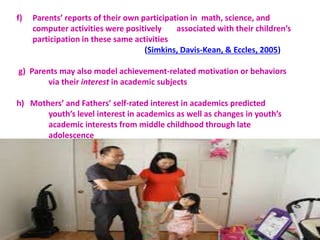
g) Parents may also model achievement-related motivation or behaviors
via their interest in academic subjects
h) Mothers’ and Fathers’ self-rated interest in academics predicted
youth’s level interest in academics as well as changes in youth’s
academic interests from middle childhood through late
adolescence
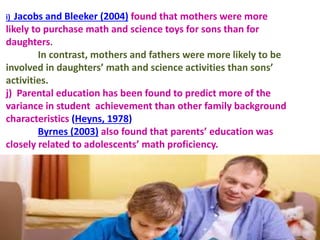
i) Jacobs and Bleeker (2004) found that mothers were more
likely to purchase math and science toys for sons than for
daughters.
In contrast, mothers and fathers were more likely to be
involved in daughters’ math and science activities than sons’
activities.
j) Parental education has been found to predict more of the
variance in student achievement than other family background
characteristics (Heyns, 1978)
Byrnes (2003) also found that parents’ education was
closely related to adolescents’ math proficiency.
k) Using a multi-ethnic sample, Chen and Stevenson (1995)
showed that adolescents whose fathers had a postgraduate
degree scored 10 points higher on a math achievement test
than adolescents whose fathers had junior high school
educations or less.
l) Davis-Kean (2005) also found that parents’ education was
positively related to their offspring’s reading and math
achievement.
Early adolescents'  academic interest

Early adolescents' academic interest

  • 1.
    What makes thestumbling block for early adolescents in their academic interests? Guide Dr B. William Dharma Raja B. Viji, Ph.D Scholar Associate Professor & Head Department of Education Manonmaniam Sundaranar University
  • 2.
    Introduction 47% of highschool dropouts A major reason for leaving school  boredom and  lack of interest in their classes Bridgeland, DiJulio & Morison, 2006 Understanding the correlates of academic interests and school dropouts – important part of research
  • 4.
    School Transition: TheStumbling Block 1. A critical issue in early adolescence 2. Adolescents typically enter their middle school  heightened self-focus  rising desire for autonomy and  self-determination, and  an increased ability to use higher level cognitive strategies  view peer relations as being especially important  in need of close adult relationships outside the home.
  • 5.
     School transitionscontribute to declines in motivation and achievement-related outcomes (Seidman, Aber, & French, 2004).  Substantial declines in academic motivation and achievement across adolescence (Barber & Olsen, 2004)  Fredricks and Eccles (2002) examined changes in students’ interest in math across grades 1 through 12 and found that math interests declined significantly over time Changes in Academic Motivation and Academic Interest
  • 6.
    Crosnoe (2001) studiedchanges in adolescents’ academic orientations during the high school years. Results indicated that, although students began high school with moderate levels of academic orientation, they experienced significant declines in academic orientation over time. Parents play a key role in their offspring’s achievement- related beliefs and academic outcomes (Eccles-Parsons, Adler, & Kaczala, 1982; Linver & Davis-Kean, 2005; Wentzel, 1998)
  • 7.
    Decline in theAcademic Interest Factors that put early adolescents at risk for negative motivational and behavioral changes • Teachers exerting greater control • Less personal student-teacher relationships • Less small-group attention • Classwork requires lower level skills • Teachers use higher standards • Pubertal development at approximately the same time
  • 8.
    Reasons for underminedstudents’ academic motivation (Eccles, Wigfield, & Sciefele, 1998)  High schools tend to be larger and even more bureaucratic than junior high schools  There is little opportunity for students to form close relationships with teachers and Little effort to make instruction relevant to the students. Barber and Olsen (2004)  Adolescents had lower grades when youth were in sixth grade, but that they did not have significantly lower grades, when youth entered in ninth grade.
  • 9.
    Parental Characteristics inAcademic Interest Academic motivation and achievement, both parents’ socialization practices and their education levels are important for youth’s academic motivation and achievement Reviews Supporting…… a) A growing body of literature supports the idea that parents play an important role in students’ academic motivation and achievement (Davis-Kean, 2005; Eccles, Adler, & Kaczala, 1982; Jacobs, et al. 2005) b) Jacobs and Bleeker (2004) examined parents’ math-promotive behaviors and found that mothers who purchased more math and science toys and were more involved in their children’s math and science activities had children who reported greater interest in math six years later.
  • 10.
    c) Parental expectationsalso have been positively related to youth’s academic motivation and achievement (Chen & Stevenson, 1995; Davis-Kean, 2005; Patrikakou, 1997) d) Davis-Kean (2005) for example, asked parents how much schooling they expected their offspring to complete. e) Results showed that children had higher reading and math achievement scores when their parents expected them to go farther in school (Simkins, Davis-Kean, & Eccles, 2005)
  • 11.
    f) Parents’ reportsof their own participation in math, science, and computer activities were positively associated with their children’s participation in these same activities (Simkins, Davis-Kean, & Eccles, 2005) g) Parents may also model achievement-related motivation or behaviors via their interest in academic subjects h) Mothers’ and Fathers’ self-rated interest in academics predicted youth’s level interest in academics as well as changes in youth’s academic interests from middle childhood through late adolescence
  • 12.
    i) Jacobs andBleeker (2004) found that mothers were more likely to purchase math and science toys for sons than for daughters. In contrast, mothers and fathers were more likely to be involved in daughters’ math and science activities than sons’ activities. j) Parental education has been found to predict more of the variance in student achievement than other family background characteristics (Heyns, 1978) Byrnes (2003) also found that parents’ education was closely related to adolescents’ math proficiency.
  • 13.
    k) Using amulti-ethnic sample, Chen and Stevenson (1995) showed that adolescents whose fathers had a postgraduate degree scored 10 points higher on a math achievement test than adolescents whose fathers had junior high school educations or less. l) Davis-Kean (2005) also found that parents’ education was positively related to their offspring’s reading and math achievement.