Roles I’ll Have In
The Classroom
First, Let Me Recall My
Philosophy Of Education
What They Mean...
As An Inspired Educator
Of And For All Students
1.Progressivism:
Student-centered; aims to
focus on students and their
experiences
2.Essentialism:
Teaching a specific set of
skills and knowledge to all
students is critical
*Over the course of this class my
philosophy has remained the same*
Why?
“I have a strong belief that
school is very important and its
objective is to teach all students
a basic set of skills/knowledge.
This a prior assumption/bias of
mine that was forged from my
past as a student.
However at the same time, I am
also an advocate of seeing each
student as the individual they
are. I know I cannot expect all
students to have the same
beliefs about school as I do. I
aim to find a balance of my two
philosophies for the betterment
of my students.”
Mediator
Facilitator
Protector
Assessor
Planner
Instructor
Counselor
Role Model
Learner
Coach
Observer
Leader
Gatekeeper
Collaborator
Supervisor
My Responsibilities
As An Educator
What I’ve learnedabout myself as afuture teacher andmy place in the U.S.educational system
3. Skills/Abilities
Maintain the
required S/A,
including mastery
of the TPEs, in
order to be the
knowledgeable
teacher my
students deserve
4. Ethical Conduct:
Challenge my own biases
and that of others around me
1.Student Wellbeing
Foster a safe
environment for all
students by promoting
inclusion and
individuality. Be open
and show empathy in
hopes that students
will feel they can trust
me
2. Equal
Opportunities:
Recognize the
differences in
cultures and
struggles
among students
and work to
reduce the
barriers to
success they
may face
My Growth And Development...
“Throughout my teaching career I plan on continuous self
reflection. The only way to ensure professional growth is by
assessing my own actions and making changes where
necessary. This means reflecting back on my philosophy of
education, my biases, if I’m providing my students with an
equal opportunity to learn, and so much more. I must observe
how my students are doing in my class and ask myself what I
can do better. Am I playing the role my students need? Am I
following through with all my responsibilities as a teacher? Am
I still trying to learn more? Only by questioning myself can I
push my own limits and not be complacent.“
Assessor: Evaluates the quality of work done
Coach: Give specialized teaching to students
Collaborator: Work with my peers
Counselor: Give guidance or advice when asked
Facilitator: Make the learning process easier
Gatekeeper: Provide access to new knowledge
Instructor: Present new topics and curriculum
Leader: Take control of situations in the classroom
Learner: Continue learning from everyone
Mediator: Resolve conflict
Observer: Allow students to lead while I watch
Planner: Create lessons and activities
Protector: Watch out for the welfare of my class
Supervisor: Manage activities in the classroom
Role Model: Be an ethical example to my class
5.Professionalism:
Display proper
interactions and
communication with
peers, students and
parents

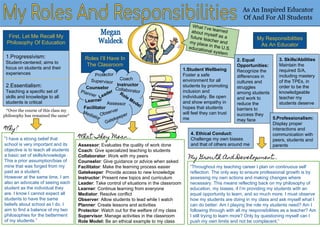
Roles and Responsibilities Infographic

  • 1.
    Roles I’ll HaveIn The Classroom First, Let Me Recall My Philosophy Of Education What They Mean... As An Inspired Educator Of And For All Students 1.Progressivism: Student-centered; aims to focus on students and their experiences 2.Essentialism: Teaching a specific set of skills and knowledge to all students is critical *Over the course of this class my philosophy has remained the same* Why? “I have a strong belief that school is very important and its objective is to teach all students a basic set of skills/knowledge. This a prior assumption/bias of mine that was forged from my past as a student. However at the same time, I am also an advocate of seeing each student as the individual they are. I know I cannot expect all students to have the same beliefs about school as I do. I aim to find a balance of my two philosophies for the betterment of my students.” Mediator Facilitator Protector Assessor Planner Instructor Counselor Role Model Learner Coach Observer Leader Gatekeeper Collaborator Supervisor My Responsibilities As An Educator What I’ve learnedabout myself as afuture teacher andmy place in the U.S.educational system 3. Skills/Abilities Maintain the required S/A, including mastery of the TPEs, in order to be the knowledgeable teacher my students deserve 4. Ethical Conduct: Challenge my own biases and that of others around me 1.Student Wellbeing Foster a safe environment for all students by promoting inclusion and individuality. Be open and show empathy in hopes that students will feel they can trust me 2. Equal Opportunities: Recognize the differences in cultures and struggles among students and work to reduce the barriers to success they may face My Growth And Development... “Throughout my teaching career I plan on continuous self reflection. The only way to ensure professional growth is by assessing my own actions and making changes where necessary. This means reflecting back on my philosophy of education, my biases, if I’m providing my students with an equal opportunity to learn, and so much more. I must observe how my students are doing in my class and ask myself what I can do better. Am I playing the role my students need? Am I following through with all my responsibilities as a teacher? Am I still trying to learn more? Only by questioning myself can I push my own limits and not be complacent.“ Assessor: Evaluates the quality of work done Coach: Give specialized teaching to students Collaborator: Work with my peers Counselor: Give guidance or advice when asked Facilitator: Make the learning process easier Gatekeeper: Provide access to new knowledge Instructor: Present new topics and curriculum Leader: Take control of situations in the classroom Learner: Continue learning from everyone Mediator: Resolve conflict Observer: Allow students to lead while I watch Planner: Create lessons and activities Protector: Watch out for the welfare of my class Supervisor: Manage activities in the classroom Role Model: Be an ethical example to my class 5.Professionalism: Display proper interactions and communication with peers, students and parents