Signature Assignment:
Lesson Plan
Megan Waldeck
National University
Analyzing/Reflecting on &
Applying What I
Observed
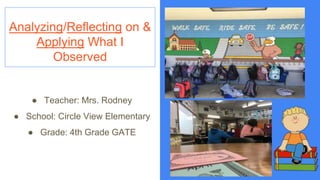
● Teacher: Mrs. Rodney
● School: Circle View Elementary
● Grade: 4th Grade GATE
Overview of Observation
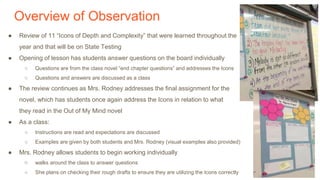
● Review of 11 “Icons of Depth and Complexity” that were learned throughout the
year and that will be on State Testing
● Opening of lesson has students answer questions on the board individually
○ Questions are from the class novel “end chapter questions” and addresses the Icons
○ Questions and answers are discussed as a class
● The review continues as Mrs. Rodney addresses the final assignment for the
novel, which has students once again address the Icons in relation to what
they read in the Out of My Mind novel
● As a class:
○ Instructions are read and expectations are discussed
○ Examples are given by both students and Mrs. Rodney (visual examples also provided)
● Mrs. Rodney allows students to begin working individually
○ walks around the class to answer questions
○ She plans on checking their rough drafts to ensure they are utilizing the Icons correctly
Analyzing / Reflecting / Applying
What information did I gain on the learners?
● No English Language Learners
● Many students with IEPs and BIPs
● More than half of the class consistently raises hands to share
● They do a good deal of class discussion and individual work, though the students themselves
often ask to work with a partner
● They sometimes need “move around time” to get refocused
● Diverse class of White, Hispanic and Asian-American students
What have I learned about Mrs. Rodney as teacher?
● Keeps high expectations for all students
● Dispositions: promotes positive view of self, empathetic, flexible
● Aims to give students choices in assignments
Analyzing / Reflecting / Applying
What understanding do I have about Mrs. Rodney’s teaching practices?
● She tends to use student-centered instructional strategies
● Has a focus on social-emotional learning for her students
● Uses a Behavioral Style approach to teaching. *Example seen when
Mrs. Rodney reinforces desired behavior by saying she “appreciates
those that are doing blank.”
Analyzing / Reflecting / Applying
How effective were Mrs. Rodney's practices?
● In the post interview she said that from “reading the room” it seemed effective (informal
assessment)
● Additional reasons that the lesson seemed effective:
- Quality of classroom discussion
- Amount of students raising hands to answer questions and overall answer
correctness
- Type of additional questions students are asking
● I did notice however, some of the students who have the IEPs/BIPs weren’t as engaged in the
lesson
*Also note no formal assessment had been completed while I was there
What will I keep, improve, discard?
● Keep: The Indirect Instructional Approach to teaching/Student-Centered Strategies
● Improve: Add additional elements of UDL
Stage: Planning
Grade: 4th Grade GATE
Content Area: 11 Icons of Depth and
Complexity
Standard
*The 11 Icons of Depth and Complexity are
connected to a number of different standards.
Below are examples:
CCSS.ELA-LITERACY.RL.4.2
Determine a theme of a story, drama, or poem
from details in the text; summarize the text.
CCSS.ELA-LITERACY.RL.4.6
Compare and contrast the point of view from
which different stories are narrated, including the
difference between first- and third-person
narrations.
CCSS.ELA-LITERACY.RL.4.1
Refer to details and examples in a text when
explaining what the text says explicitly and when
drawing inferences from the text.
Target
Big Questions (Q’s to
frame student learning)
● When we are reading a
piece of literature, what
is the purpose of
thinking about Icons?
● How can the 11 Icons
help us have a deeper
understanding of what
we read?
Skills (What you will
explicitly teach)
● The concepts in the last
section have already
been explicitly taught over
the year, therefore this
lesson is more of a review
● Method:
○ Recall past learned
knowledge through:
class discussion,
game, and partner
work
Knowledge (Concepts to be
understood and applied)
● Students will be able to
demonstrate their
understanding of the 11
Icons’ literary definitions
● Students will understand
how the Icons are important
to having a deeper
understanding of literary
pieces
● Students will be able to read
a text and answer questions
about the Icons as they
relate to what they read
Student Goals
Student Learning Goal:
Students will be able to use their knowledge of
the 11 Icons of Depth and Complexity to answer
comprehension questions from literary pieces
they read.
Student Social-Emotional Goal:
Students will use cooperative learning strategies
and show patience and responsibility when they
work with partners to review the Icons.
Additionally, students will also show good
sportsmanship when the class plays the “Icons
game.”
Barriers To
Learning
● In this GATE class, all students have reached
a certain level of literacy and language
proficiency, though there are still differences
in ability.
● All students have been exposed to the Icons
before in this class, but not all students will
have retained the same amount of knowledge.
● Behavioral Problems: Some students in this
class have BIPs and may get frustrated with
the work and shutdown. Additionally, some
students have a hard time staying engaged
and on task.
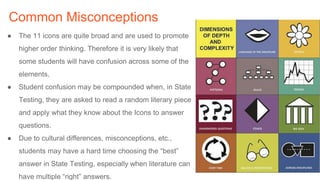
Common Misconceptions
● The 11 icons are quite broad and are used to promote
higher order thinking. Therefore it is very likely that
some students will have confusion across some of the
elements.
● Student confusion may be compounded when, in State
Testing, they are asked to read a random literary piece
and apply what they know about the Icons to answer
questions.
● Due to cultural differences, misconceptions, etc.,
students may have a hard time choosing the “best”
answer in State Testing, especially when literature can
have multiple “right” answers.
Classroom Composite (Teacher & Learner)
(25 students: 13 boys; 12 girls) Mrs. Rodney's students are very gifted and most
love to interact and answers any questions she has. They are also a very enthusiastic
group that have a great deal of energy. When they are good or if she feels they need it,
the students get 2-3 minutes of movement time to walk around the class, talk to
friends, and get their built-up antsiness out. Additionally, the class culture seems very
strong. All students show a large amount of respect toward Mrs. Rodney, and she
works hard to make them feel included, safe, and good about themselves. A good
portion of the students have IEPs and/or BIPs for the GATE class, in Mrs. Rodney's
words, is similar to a special education class. Additionally, I noticed that the students
love to work on the computers when they have freetime. I do not know the class
average or any specific details on how students are doing in the subject area of
language arts.
Accommodations/Ada
ptation
Students with IEPs:
In the peer work part of the lesson, there
won’t be any predetermine
accommodations made. We are continuing
our review and because they will be
working with a partner, this assignment
should be doable for all students. Plenty of
time will be given, and I will be walking
around assessing and checking for
understanding.
Students with BIPs and certain
types of IEPs:
We will have a review game as a class to
help engage those students who normally
get frustrated with too much written or
individual work. This fun and more
interactive activity will also be helpful
and a good way to review for those
students who get off task easily and
have a hard time finishing written
work.
Multiple Means of Representation
Content presented in multiple ways:
The first day of review focused on class discussion and individual work (new project)
Day 2: Students will get into pairs (one team of three) to play a “Know Your Icons” game. I will ask
students to write down on individual whiteboards the answer to questions I ask. The questions will be on
the 11 Icons, with some questions relating to the Icons found in the Out of My Mind novel. Students have
the chance to utilize the Icon posters at the front of the class if they wish. I will records points and the top
team(s) will win a predetermine prize.
After the game students will stay in their pairs to read a short literary piece similar to something they
may find on State Testing. The piece will be read individually and then aloud by myself. Students will
work together to read and discuss the questions and then record their answers on the provided handout
(Cooperative Learning). Students will turn in one paper with both names on the paper. Finally, we will
have another class discussion and go over answers. I will be sure to let the students know that this is the
format they may see on testing (in regards to the Icons).
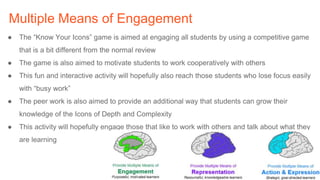
Multiple Means of Engagement
● The “Know Your Icons” game is aimed at engaging all students by using a competitive game
that is a bit different from the normal review
● The game is also aimed to motivate students to work cooperatively with others
● This fun and interactive activity will hopefully also reach those students who lose focus easily
with “busy work”
● The peer work is also aimed to provide an additional way that students can grow their
knowledge of the Icons of Depth and Complexity
● This activity will hopefully engage those that like to work with others and talk about what they
are learning
Multiple Means of Action/Expression & Assessment
The day 2 lesson allows students to show what they know about the 11 Icons when they provide the right
answers to the game and earn points. Additionally, the peer work part of the lesson gives students the
chance to discuss with one another before turning in written work.
Assessment:
● Informal: Students will be informally assessed when they provide answers during the game, when
I walk around and check for understanding during peer work, and when we discuss some answers
as a class
● Formal: Students will be assessed by the peer work activity on completeness and accuracy of the
work they turn.
The assessment(s) will be used to determine who of the class is where I would like them to be and
those that are not. I will use both informal and formal assessment to decide if more time needs to
be spent reviewing the 11 Icons and if what in the future should be kept, tweaked, or fully
discarded.
Managing The Classroom Environment
● Expectations for how students are to act during peer work and games have already been
established earlier in the year. Example: Students understand that inside voices are always
used.
● Students may need to have some reminders to keep their discussions focused on the topic and
to stay steady during the game.
○ Therefore I will remind them of classroom expectations, especially for how we treat one another in fun
game situations if needed.
● Both of the activities in this lesson rely on student
cooperation and self-management.
● Materials for the game will be distributed at the start of
the lesson and collected after the game is over.
Stage 2:
Teaching
What materials will you use?
● Individual whiteboards (12)
● Dry erase markers (12)
● Tissues to erase
● Game questions printout
● Peer work handout
● Literary piece for students to read
(handout)
Sequence For Day 2
*This will be placed on a 3x5 card to
keep me focused on what needs to be
done today
● Introduce and play the game (tell
students to switch who writes on the WB)
● Have students read piece individually
● I read it aloud (tell students how this may
be similar to State Testing)
● Have students discuss the questions
before they write their answers down
● Discuss some answers to the Q’s to get
a sense of how students did
Stage 3: Assessing
Student Learning What evidence of student learning
will be collected?
As noted before:
● Informal: class game answers, walking
around during peer work, and class
discussion
● Formal: students will be formally graded
on completeness and accuracy of the
peer work handout they turn in
Assessing Student Learning Questions
How will you analyze this evidence?
The informal assessment of the game allows me to see if students are understanding the ideals of the
Icons and the Icons in relation to our class book, Out of My Mind. If some peer teams didn’t do as well as others
on the game, it lets me know which student groups to walk over to when they are working together to finish the
handout. Although we did some review yesterday as well, the cooperative learning assignment (formal
assessment) does also let me know if students are recalling the past learned information and are able to apply it
to a new piece of literature (similar to what they will find on State Testing). All assessments throughout the day
will hopefully provide me a better understanding of where students are in comparison to each other, and who
many need additional support finishing their individual projects on Icons discussed on the day 1 observation.
What instructional decisions can be made as a result of this analysis of
evidence?
As this is a review and the school year is coming to a close, I don’t have much if any additional time to spend on
reviewing the 11 Icons of Depth and Complexity. However, I can still modify some aspects of the final individual
assignment (discussed in the day 1 observation) to help guide those students who need more clarity on the
Icons. Additionally, the analysis allows me to reflect on what I should kept, tweak, and fully discard next year in
order to 1.) teach the Icons throughout the year and 2.) review the Icons at the end of the year in a more effective
way.
Reflection on Feedback and Modifications
Feedback Suggestions From Peers:
● Double check spelling, grammar, and consistency of words used throughout the presentation.
● Double check formatting so the text doesn’t go off the slide.
● Possibly “break up the slides a little so there is not so much on one slide.”
Modification:
● Additional time was spent proofreading my work.
● Additional time was spent checking the formatting of my work so no
writing was blocked by photos or fell off the slide entirely.
● Instead of creating more slides, I decided to critically look at what I had
wrote and delete unnecessary pieces of information. I had already felt that
my presentation was on the long side, so that appeared to be the more
appropriate modification to making the presentation more readable.
Resources
Burden, P. (2016). Methods for Effective Teaching: Meeting the Needs of All Students
English Language Arts Standards. (n.d.). Retrieved from
http://www.corestandards.org/ELA-Literacy/
Meyer, A., Rose, D. H., & Gordon, D. (2014). Universal design for learning: Theory and practice.
Wakefield, MA: CAST Professional Publ.

Signature Assignment Learning Plan

  • 1.
    Signature Assignment: Lesson Plan MeganWaldeck National University
  • 2.
    Analyzing/Reflecting on & ApplyingWhat I Observed ● Teacher: Mrs. Rodney ● School: Circle View Elementary ● Grade: 4th Grade GATE
  • 3.
    Overview of Observation ●Review of 11 “Icons of Depth and Complexity” that were learned throughout the year and that will be on State Testing ● Opening of lesson has students answer questions on the board individually ○ Questions are from the class novel “end chapter questions” and addresses the Icons ○ Questions and answers are discussed as a class ● The review continues as Mrs. Rodney addresses the final assignment for the novel, which has students once again address the Icons in relation to what they read in the Out of My Mind novel ● As a class: ○ Instructions are read and expectations are discussed ○ Examples are given by both students and Mrs. Rodney (visual examples also provided) ● Mrs. Rodney allows students to begin working individually ○ walks around the class to answer questions ○ She plans on checking their rough drafts to ensure they are utilizing the Icons correctly
  • 4.
    Analyzing / Reflecting/ Applying What information did I gain on the learners? ● No English Language Learners ● Many students with IEPs and BIPs ● More than half of the class consistently raises hands to share ● They do a good deal of class discussion and individual work, though the students themselves often ask to work with a partner ● They sometimes need “move around time” to get refocused ● Diverse class of White, Hispanic and Asian-American students What have I learned about Mrs. Rodney as teacher? ● Keeps high expectations for all students ● Dispositions: promotes positive view of self, empathetic, flexible ● Aims to give students choices in assignments
  • 5.
    Analyzing / Reflecting/ Applying What understanding do I have about Mrs. Rodney’s teaching practices? ● She tends to use student-centered instructional strategies ● Has a focus on social-emotional learning for her students ● Uses a Behavioral Style approach to teaching. *Example seen when Mrs. Rodney reinforces desired behavior by saying she “appreciates those that are doing blank.”
  • 6.
    Analyzing / Reflecting/ Applying How effective were Mrs. Rodney's practices? ● In the post interview she said that from “reading the room” it seemed effective (informal assessment) ● Additional reasons that the lesson seemed effective: - Quality of classroom discussion - Amount of students raising hands to answer questions and overall answer correctness - Type of additional questions students are asking ● I did notice however, some of the students who have the IEPs/BIPs weren’t as engaged in the lesson *Also note no formal assessment had been completed while I was there What will I keep, improve, discard? ● Keep: The Indirect Instructional Approach to teaching/Student-Centered Strategies ● Improve: Add additional elements of UDL
  • 7.
    Stage: Planning Grade: 4thGrade GATE Content Area: 11 Icons of Depth and Complexity Standard *The 11 Icons of Depth and Complexity are connected to a number of different standards. Below are examples: CCSS.ELA-LITERACY.RL.4.2 Determine a theme of a story, drama, or poem from details in the text; summarize the text. CCSS.ELA-LITERACY.RL.4.6 Compare and contrast the point of view from which different stories are narrated, including the difference between first- and third-person narrations. CCSS.ELA-LITERACY.RL.4.1 Refer to details and examples in a text when explaining what the text says explicitly and when drawing inferences from the text.
  • 8.
    Target Big Questions (Q’sto frame student learning) ● When we are reading a piece of literature, what is the purpose of thinking about Icons? ● How can the 11 Icons help us have a deeper understanding of what we read? Skills (What you will explicitly teach) ● The concepts in the last section have already been explicitly taught over the year, therefore this lesson is more of a review ● Method: ○ Recall past learned knowledge through: class discussion, game, and partner work Knowledge (Concepts to be understood and applied) ● Students will be able to demonstrate their understanding of the 11 Icons’ literary definitions ● Students will understand how the Icons are important to having a deeper understanding of literary pieces ● Students will be able to read a text and answer questions about the Icons as they relate to what they read
  • 9.
    Student Goals Student LearningGoal: Students will be able to use their knowledge of the 11 Icons of Depth and Complexity to answer comprehension questions from literary pieces they read. Student Social-Emotional Goal: Students will use cooperative learning strategies and show patience and responsibility when they work with partners to review the Icons. Additionally, students will also show good sportsmanship when the class plays the “Icons game.” Barriers To Learning ● In this GATE class, all students have reached a certain level of literacy and language proficiency, though there are still differences in ability. ● All students have been exposed to the Icons before in this class, but not all students will have retained the same amount of knowledge. ● Behavioral Problems: Some students in this class have BIPs and may get frustrated with the work and shutdown. Additionally, some students have a hard time staying engaged and on task.
  • 10.
    Common Misconceptions ● The11 icons are quite broad and are used to promote higher order thinking. Therefore it is very likely that some students will have confusion across some of the elements. ● Student confusion may be compounded when, in State Testing, they are asked to read a random literary piece and apply what they know about the Icons to answer questions. ● Due to cultural differences, misconceptions, etc., students may have a hard time choosing the “best” answer in State Testing, especially when literature can have multiple “right” answers.
  • 11.
    Classroom Composite (Teacher& Learner) (25 students: 13 boys; 12 girls) Mrs. Rodney's students are very gifted and most love to interact and answers any questions she has. They are also a very enthusiastic group that have a great deal of energy. When they are good or if she feels they need it, the students get 2-3 minutes of movement time to walk around the class, talk to friends, and get their built-up antsiness out. Additionally, the class culture seems very strong. All students show a large amount of respect toward Mrs. Rodney, and she works hard to make them feel included, safe, and good about themselves. A good portion of the students have IEPs and/or BIPs for the GATE class, in Mrs. Rodney's words, is similar to a special education class. Additionally, I noticed that the students love to work on the computers when they have freetime. I do not know the class average or any specific details on how students are doing in the subject area of language arts.
  • 12.
    Accommodations/Ada ptation Students with IEPs: Inthe peer work part of the lesson, there won’t be any predetermine accommodations made. We are continuing our review and because they will be working with a partner, this assignment should be doable for all students. Plenty of time will be given, and I will be walking around assessing and checking for understanding. Students with BIPs and certain types of IEPs: We will have a review game as a class to help engage those students who normally get frustrated with too much written or individual work. This fun and more interactive activity will also be helpful and a good way to review for those students who get off task easily and have a hard time finishing written work.
  • 13.
    Multiple Means ofRepresentation Content presented in multiple ways: The first day of review focused on class discussion and individual work (new project) Day 2: Students will get into pairs (one team of three) to play a “Know Your Icons” game. I will ask students to write down on individual whiteboards the answer to questions I ask. The questions will be on the 11 Icons, with some questions relating to the Icons found in the Out of My Mind novel. Students have the chance to utilize the Icon posters at the front of the class if they wish. I will records points and the top team(s) will win a predetermine prize. After the game students will stay in their pairs to read a short literary piece similar to something they may find on State Testing. The piece will be read individually and then aloud by myself. Students will work together to read and discuss the questions and then record their answers on the provided handout (Cooperative Learning). Students will turn in one paper with both names on the paper. Finally, we will have another class discussion and go over answers. I will be sure to let the students know that this is the format they may see on testing (in regards to the Icons).
  • 14.
    Multiple Means ofEngagement ● The “Know Your Icons” game is aimed at engaging all students by using a competitive game that is a bit different from the normal review ● The game is also aimed to motivate students to work cooperatively with others ● This fun and interactive activity will hopefully also reach those students who lose focus easily with “busy work” ● The peer work is also aimed to provide an additional way that students can grow their knowledge of the Icons of Depth and Complexity ● This activity will hopefully engage those that like to work with others and talk about what they are learning
  • 15.
    Multiple Means ofAction/Expression & Assessment The day 2 lesson allows students to show what they know about the 11 Icons when they provide the right answers to the game and earn points. Additionally, the peer work part of the lesson gives students the chance to discuss with one another before turning in written work. Assessment: ● Informal: Students will be informally assessed when they provide answers during the game, when I walk around and check for understanding during peer work, and when we discuss some answers as a class ● Formal: Students will be assessed by the peer work activity on completeness and accuracy of the work they turn. The assessment(s) will be used to determine who of the class is where I would like them to be and those that are not. I will use both informal and formal assessment to decide if more time needs to be spent reviewing the 11 Icons and if what in the future should be kept, tweaked, or fully discarded.
  • 16.
    Managing The ClassroomEnvironment ● Expectations for how students are to act during peer work and games have already been established earlier in the year. Example: Students understand that inside voices are always used. ● Students may need to have some reminders to keep their discussions focused on the topic and to stay steady during the game. ○ Therefore I will remind them of classroom expectations, especially for how we treat one another in fun game situations if needed. ● Both of the activities in this lesson rely on student cooperation and self-management. ● Materials for the game will be distributed at the start of the lesson and collected after the game is over.
  • 17.
    Stage 2: Teaching What materialswill you use? ● Individual whiteboards (12) ● Dry erase markers (12) ● Tissues to erase ● Game questions printout ● Peer work handout ● Literary piece for students to read (handout) Sequence For Day 2 *This will be placed on a 3x5 card to keep me focused on what needs to be done today ● Introduce and play the game (tell students to switch who writes on the WB) ● Have students read piece individually ● I read it aloud (tell students how this may be similar to State Testing) ● Have students discuss the questions before they write their answers down ● Discuss some answers to the Q’s to get a sense of how students did
  • 18.
    Stage 3: Assessing StudentLearning What evidence of student learning will be collected? As noted before: ● Informal: class game answers, walking around during peer work, and class discussion ● Formal: students will be formally graded on completeness and accuracy of the peer work handout they turn in
  • 19.
    Assessing Student LearningQuestions How will you analyze this evidence? The informal assessment of the game allows me to see if students are understanding the ideals of the Icons and the Icons in relation to our class book, Out of My Mind. If some peer teams didn’t do as well as others on the game, it lets me know which student groups to walk over to when they are working together to finish the handout. Although we did some review yesterday as well, the cooperative learning assignment (formal assessment) does also let me know if students are recalling the past learned information and are able to apply it to a new piece of literature (similar to what they will find on State Testing). All assessments throughout the day will hopefully provide me a better understanding of where students are in comparison to each other, and who many need additional support finishing their individual projects on Icons discussed on the day 1 observation. What instructional decisions can be made as a result of this analysis of evidence? As this is a review and the school year is coming to a close, I don’t have much if any additional time to spend on reviewing the 11 Icons of Depth and Complexity. However, I can still modify some aspects of the final individual assignment (discussed in the day 1 observation) to help guide those students who need more clarity on the Icons. Additionally, the analysis allows me to reflect on what I should kept, tweak, and fully discard next year in order to 1.) teach the Icons throughout the year and 2.) review the Icons at the end of the year in a more effective way.
  • 20.
    Reflection on Feedbackand Modifications Feedback Suggestions From Peers: ● Double check spelling, grammar, and consistency of words used throughout the presentation. ● Double check formatting so the text doesn’t go off the slide. ● Possibly “break up the slides a little so there is not so much on one slide.” Modification: ● Additional time was spent proofreading my work. ● Additional time was spent checking the formatting of my work so no writing was blocked by photos or fell off the slide entirely. ● Instead of creating more slides, I decided to critically look at what I had wrote and delete unnecessary pieces of information. I had already felt that my presentation was on the long side, so that appeared to be the more appropriate modification to making the presentation more readable.
  • 21.
    Resources Burden, P. (2016).Methods for Effective Teaching: Meeting the Needs of All Students English Language Arts Standards. (n.d.). Retrieved from http://www.corestandards.org/ELA-Literacy/ Meyer, A., Rose, D. H., & Gordon, D. (2014). Universal design for learning: Theory and practice. Wakefield, MA: CAST Professional Publ.

Editor's Notes

  • #2 Stage 1 planning Stage 2 teaching Stage 3 assess and reflect / analyzing reflecting (the teacher said assessing student learning) Stage 4 applying (teacher said reflecting on teaching and assessing)
  • #4 (learnner) What new information did i get about my students regarding their learning preferences? ----bc its a review, direct teaching wasnt really needed or used. Instead the utilized
  • #5 How will I use this information to plan my future instruction? Take these factors into consideration when planning the day two lesson and potentially provide the students a chance to work with one another.
  • #7 students raising hands to contribute examples and the type of additional questions students are asking
  • #12 Builtup built-up antsyiness antsiness
  • #13 IEPs :In the groupwork there won’t be any accommodations.. With the help of the peer, this review assignment should be doable for all students, though I will be sure to walk around the class to check work. Plenty of time will be given.. on the specific assignmentBecuase this is a review for the state testing there won’t be any accomodations/adaptations in the Students with BIPs
  • #14 Modeling and practice Now lets play a game! Whiteboards… switch with teammate Qs on the icons (basic questions and qs from the novel) I will record points Top teams win a prize. Icons You read it, Lets read it Now i read the quesiotns.. Now you discuss the questions with your partner work in pairs to answer the qs… you take turn writing answers (both names on paper for credit) Lets go over some answers! Explain this is how state testing is like When done you can work on the individual assignment again.
  • #16 Practice and assessment
  • #18 How will you assess student learning? Modeling and practice Now lets play a game! Whiteboards… switch with teammate Qs on the icons (basic questions and qs from the novel) I will record points Top teams win a prize. Icons You read it, Lets read it Now i read the quesiotns.. Now you discuss the questions with your partner work in pairs to answer the qs… you take turn writing answers (both names on paper for credit) Lets go over some answers! Explain this is how state testing is like When done you can work on the individual assignment again.
  • #19 Informal: Students will be informally assessed when they provide answers during the game, when I walk around and check for understanding during peer work, and when we discuss some answers as a class Formal: Students will be assessed by the peer work activity on completeness and accuracy of the work they turn.
  • #20 The informal assessment of the game allows me to see if students are understanding the ideals of the Icons and the Icons in relation to our class book, Out of My Mind. If some peer teams didn’t do as well as others on the game, it lets me know which student groups to walk over to when they are working together to finish the handout. Although we did some review yesterday as well, the cooperative learning assignment (formal assessment) does also let me if students are recalling the past learned information and are able to apply it to a new piece of literature, similar to what they will find on State testing. All assessments throughout the day will hopefully provide me a better understanding of where students are in comparison to each other, and who many need additional support finishing their individual projects on Icons discussed on the day 1 observation.
  • #22 Added on from stage 4