Good evening my fellow Steemians!
I'm a Music Specialist first and foremost and also help out in other subject areas at a special
school in the UK. I found a passion for teaching after delivering a drumming workshop
nearly 10 years ago. So I decided to retrain and share my knowledge with others.
I hope you find my post a useful read and please feel free to use any of the resources that
I've created, as I'll be posting more over the next few days.
Thanks.
Review your role, responsibilities andboundaries as a teacher in terms of the
teaching/training cycle.
“It is the supreme art of the teacher
To awaken joy in creative expression and knowledge”
Albert Einstein
As a music specialist and tutor at a special educational needs school, my role is to teach the
students rhythm and drumming techniques that will enable them to get the best use out of
their instruments. I am responsible for their development as far as getting them ready to
perform in a live performance at the end of the school term, for instance, the Christmas
production or a special event in the school calendar.
In order to do this, I must build a strong professional relationship between myself and the
students which enable them to feel confident and safe, overcoming the boundaries often
faced by teachers in my field is also an important skill to learn as the behavioural, emotional
and physical demands can become a real issue if they are not addressed early.
In order to carry out my roles and responsibilities inthis positioneffectively,
there are certainprofessional skillsrequired.
These can be dividedinto4 differentcategories
Teacher as a person:
Confident in communication
Flexible and patient
Empathetic and engaging
Approachable and humorous
Teacher as a classroom manager and organiser:
Good behaviour management
Consistent and fair
Lesson control
Time management
Teacher teaching:
Passionate about the subject
Allow for equal opportunities
Fun and engaging lessons for all
Student centered activities
Teacher monitoring student progress and potential:
A good range of assessment methods
Aware of student well being
Realistic target setting
Give written and verbal feedback where necessary
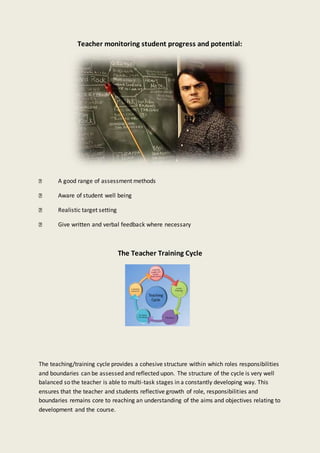
The Teacher Training Cycle
The teaching/training cycle provides a cohesive structure within which roles responsibilities
and boundaries can be assessed and reflected upon. The structure of the cycle is very well
balanced so the teacher is able to multi-task stages in a constantly developing way. This
ensures that the teacher and students reflective growth of role, responsibilities and
boundaries remains core to reaching an understanding of the aims and objectives relating to
development and the course.
Roles, responsibilities and boundaries
Teacher Roles
• Deliver course content
• Become role model
• Design schemes of work
• Catering for different learning styles
• Implement and deliver
• Plan and design
• Identify needs
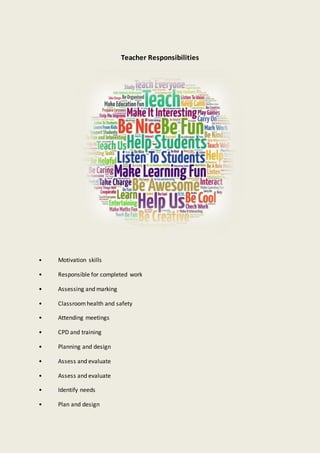
Teacher Responsibilities
• Motivation skills
• Responsible for completed work
• Assessing and marking
• Classroom health and safety
• Attending meetings
• CPD and training
• Planning and design
• Assess and evaluate
• Identify needs
• Plan and design
Teacher Boundaries
 Mutual respect
• Safeguarding issues
• Managing communication and relationships in the establishment
• Setting boundaries and needs
• Implement deliver
• Identify needs
• Plan and design
• Implement and deliver
Identify needs
There are different procedures for identifying learning needs. Many times, in trying to
identify the needs of students, a Teacher can find their selves going back to student records
which contain personal details and learning needs with information on their preferred
learning styles. Students’ gender, age, moral, social, cultural and spiritual backgrounds do
vary, so are their reasons for the course. This is why as a teacher in my subject area I look at
students’ motivation and behaviour closely in order to identify their needs.
Plan and design
From what I have learnt from my subject area and the School where I teach, planning and
designing what is to be taught needs careful planning. Designing lesson objectives, creating
different teaching methods and using media based tools really help the students with the
overall learning experience which is in line with the organisation and evaluative procedures.
Deliver
The stage of delivery for me as a special needs music teacher is vital. This is where, after all
the planning and design is done, I have to deliver the content of the lesson to students
successfully, as any failure here means the whole process is in jeopardy, which can
ultimately cause behaviour issues.
Assess
Assessing students in my subject has to do with how well students have learnt a particular
bespoke set of skills. My satisfaction therefore would be if my students have learnt what I
intended them to learn during my teaching session. I assess this by asking themquestions
on the topic taught, giving out fun quizzes and encouraging them to make contributions in a
group discussion. In doing this, one has to make sure that there are boundaries. Testing
should be fair for all students, it should reflect capabilities as regards differentiation (if
possible, a dyslexic student whose writing in scruffy and hard to understand should be given
a laptop to use word to process his thoughts), testing should not be used to discriminate
between and among students. Assessment should also be valid to the subject.
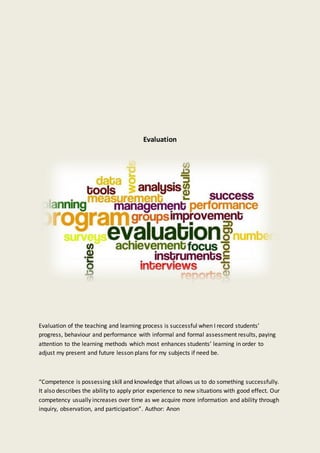
Evaluation
Evaluation of the teaching and learning process is successful when I record students’
progress, behaviour and performance with informal and formal assessment results, paying
attention to the learning methods which most enhances students’ learning in order to
adjust my present and future lesson plans for my subjects if need be.
“Competence is possessing skill and knowledge that allows us to do something successfully.
It also describes the ability to apply prior experience to new situations with good effect. Our
competency usually increases over time as we acquire more information and ability through
inquiry, observation, and participation”. Author: Anon
To summariseall of the abovefactors would be to say that these roles,
responsibilities and boundaries assistteachers in delivering and enabling
learning not only as a teacher teaching, but as a classroommanager and
organiser and when monitoring student progress and potential. The personal
qualities and skills acquired with the useof a model such as the Teacher
Training Cycle enables continuous improvementin their procedures through
assessmentand reflection, this also allows the teacher to overcomepossible
boundaries they may face; this in essence ensures that the learner has a
positive learning experience which aids the development of knowledgeand
understanding in their chosen subjectarea.
Bibliography
1) AlbertEinsteinquotes.2012. AlbertEinsteinquotes.[ONLINE] Availableat:
http://thinkexist.com/quotation/it_is_the_supreme_art_of_the_teacher_to_awaken/222006.html.
[Accessed22 June 2012].
2. Competence Quotes|WisdomCommons.2012. Competence Quotes|WisdomCommons.
[ONLINE] Available at:http://www.wisdomcommons.org/virtue/23-competence/quotes.[Accessed
22 June 2012]
Darren Claxton
22/06/2012

Teaching and Learning

  • 1.
    Good evening myfellow Steemians! I'm a Music Specialist first and foremost and also help out in other subject areas at a special school in the UK. I found a passion for teaching after delivering a drumming workshop nearly 10 years ago. So I decided to retrain and share my knowledge with others. I hope you find my post a useful read and please feel free to use any of the resources that I've created, as I'll be posting more over the next few days. Thanks. Review your role, responsibilities andboundaries as a teacher in terms of the teaching/training cycle. “It is the supreme art of the teacher To awaken joy in creative expression and knowledge” Albert Einstein As a music specialist and tutor at a special educational needs school, my role is to teach the students rhythm and drumming techniques that will enable them to get the best use out of their instruments. I am responsible for their development as far as getting them ready to perform in a live performance at the end of the school term, for instance, the Christmas production or a special event in the school calendar. In order to do this, I must build a strong professional relationship between myself and the students which enable them to feel confident and safe, overcoming the boundaries often faced by teachers in my field is also an important skill to learn as the behavioural, emotional and physical demands can become a real issue if they are not addressed early.
  • 2.
    In order tocarry out my roles and responsibilities inthis positioneffectively, there are certainprofessional skillsrequired. These can be dividedinto4 differentcategories Teacher as a person: Confident in communication Flexible and patient Empathetic and engaging Approachable and humorous Teacher as a classroom manager and organiser: Good behaviour management Consistent and fair Lesson control Time management Teacher teaching: Passionate about the subject Allow for equal opportunities Fun and engaging lessons for all Student centered activities
  • 3.
    Teacher monitoring studentprogress and potential: A good range of assessment methods Aware of student well being Realistic target setting Give written and verbal feedback where necessary The Teacher Training Cycle The teaching/training cycle provides a cohesive structure within which roles responsibilities and boundaries can be assessed and reflected upon. The structure of the cycle is very well balanced so the teacher is able to multi-task stages in a constantly developing way. This ensures that the teacher and students reflective growth of role, responsibilities and boundaries remains core to reaching an understanding of the aims and objectives relating to development and the course.
  • 4.
    Roles, responsibilities andboundaries Teacher Roles • Deliver course content • Become role model • Design schemes of work • Catering for different learning styles • Implement and deliver • Implement and deliver • Plan and design • Identify needs
  • 5.
    Teacher Responsibilities • Motivationskills • Responsible for completed work • Assessing and marking • Classroom health and safety • Attending meetings • CPD and training • Planning and design • Assess and evaluate • Assess and evaluate • Identify needs • Plan and design
  • 6.
    Teacher Boundaries  Mutualrespect • Safeguarding issues • Managing communication and relationships in the establishment • Setting boundaries and needs • Implement deliver • Identify needs • Plan and design • Implement and deliver Identify needs There are different procedures for identifying learning needs. Many times, in trying to identify the needs of students, a Teacher can find their selves going back to student records which contain personal details and learning needs with information on their preferred learning styles. Students’ gender, age, moral, social, cultural and spiritual backgrounds do vary, so are their reasons for the course. This is why as a teacher in my subject area I look at students’ motivation and behaviour closely in order to identify their needs.
  • 7.
    Plan and design Fromwhat I have learnt from my subject area and the School where I teach, planning and designing what is to be taught needs careful planning. Designing lesson objectives, creating different teaching methods and using media based tools really help the students with the overall learning experience which is in line with the organisation and evaluative procedures. Deliver The stage of delivery for me as a special needs music teacher is vital. This is where, after all the planning and design is done, I have to deliver the content of the lesson to students successfully, as any failure here means the whole process is in jeopardy, which can ultimately cause behaviour issues.
  • 8.
    Assess Assessing students inmy subject has to do with how well students have learnt a particular bespoke set of skills. My satisfaction therefore would be if my students have learnt what I intended them to learn during my teaching session. I assess this by asking themquestions on the topic taught, giving out fun quizzes and encouraging them to make contributions in a group discussion. In doing this, one has to make sure that there are boundaries. Testing should be fair for all students, it should reflect capabilities as regards differentiation (if possible, a dyslexic student whose writing in scruffy and hard to understand should be given a laptop to use word to process his thoughts), testing should not be used to discriminate between and among students. Assessment should also be valid to the subject.
  • 9.
    Evaluation Evaluation of theteaching and learning process is successful when I record students’ progress, behaviour and performance with informal and formal assessment results, paying attention to the learning methods which most enhances students’ learning in order to adjust my present and future lesson plans for my subjects if need be. “Competence is possessing skill and knowledge that allows us to do something successfully. It also describes the ability to apply prior experience to new situations with good effect. Our competency usually increases over time as we acquire more information and ability through inquiry, observation, and participation”. Author: Anon
  • 10.
    To summariseall ofthe abovefactors would be to say that these roles, responsibilities and boundaries assistteachers in delivering and enabling learning not only as a teacher teaching, but as a classroommanager and organiser and when monitoring student progress and potential. The personal qualities and skills acquired with the useof a model such as the Teacher Training Cycle enables continuous improvementin their procedures through assessmentand reflection, this also allows the teacher to overcomepossible boundaries they may face; this in essence ensures that the learner has a positive learning experience which aids the development of knowledgeand understanding in their chosen subjectarea. Bibliography 1) AlbertEinsteinquotes.2012. AlbertEinsteinquotes.[ONLINE] Availableat: http://thinkexist.com/quotation/it_is_the_supreme_art_of_the_teacher_to_awaken/222006.html. [Accessed22 June 2012]. 2. Competence Quotes|WisdomCommons.2012. Competence Quotes|WisdomCommons. [ONLINE] Available at:http://www.wisdomcommons.org/virtue/23-competence/quotes.[Accessed 22 June 2012] Darren Claxton 22/06/2012