Education Portfolio
Ivy Tech Community College
Spring Semester, 2013
Click to Proceed
Resume
Teaching Philosophy
Letter of Recommendation
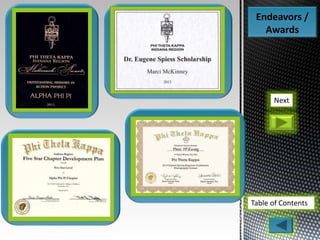
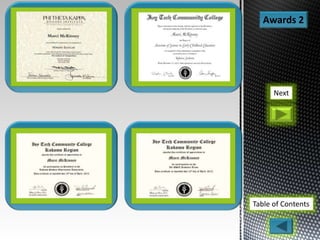
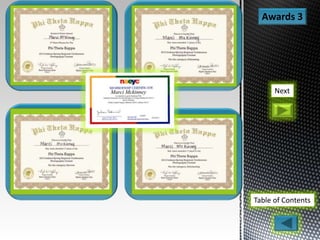
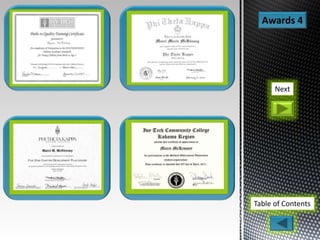
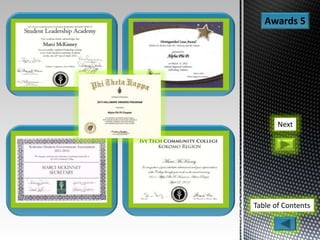
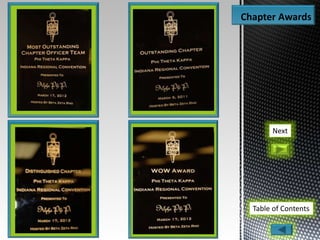
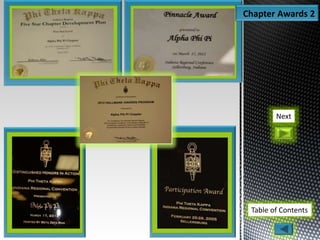
Endeavors / Awards
INSTAC Standards
Press Arrow to Navigate to Specific areas
Marci M. McKinney
1416 N. Waugh Street ∙ Kokomo, IN 46901 ∙ (765) 457-3906 ∙ mmckinney39@ivytech.edu
Summary of Qualifications
Dedicated to support children’s curiosity to discover in a diverse learning environment, while offering a curriculum that meets
the needs of each individual child. Strong belief in the National Association for the Education of Young Children (NAEYC)
standards as being a basis for insuring a loving, supportive and safe environment for children and their families. Areas of
expertise include: Knowledge of Child Growth and Development, Awareness of Early Childhood Administration, Health, Safety
and Nutrition, Understanding in Developmentally Appropriate Guidance (DAP), Appreciation for Authentic Assessment.
Skills Summary
 Microsoft PowerPoint 2010  Task Stream  Microsoft Access 2010
 Microsoft Word 2010  Microsoft Excel 2010
Education
Ivy Tech Community College Kokomo, IN
Associate of Applied Science in Early Childhood Education
 Dean’s List recipient with a cumulative GPA of 3.75
 Global Studies Certificate and Indorsed Career Ready Graduate Certificate in progress
 Awarded Patsy Daily Scholarship, The City of Kokomo Community Development Block Grant, Sycamore Recreation
Scholarship, Nominated for the 2013 All-USA & Coca-Cola Community College Academic Team, Paths to Quality
Training Certificate, Five Star Chapter Development Plan Leader, S.T.A.R.S. Academy Association Degree
Qualified Skills
EARLY CHILDHOOD DEVELOPMENT
 Curriculum and organization development
 Conflict resolution with a aptitude for problem solving effectively and quickly
 Ability to teach and train individuals from diverse populations and learning styles
 Ability to provide project coordination and strategic planning
INTERPERSONAL AND COMMUNICATION
 Strong organizational and interpersonal skills with excellent active listening skills
 Professional and amicable demeanor with an inter-cultural awareness
 Exemplary leadership and organization skills
 Trustworthy, accountable, highly responsible and easily approachable
RELEVANT COURSEWORK
 Relevant coursework including Health, Safety and Nutrition, Curriculum in the Early Childhood Classroom, Child
Growth and Development, Developmentally Appropriate Guidance in a Cultural Context, Families in Transition, Early
Childhood Administration, The Exceptional Child, Emerging Literacy, Cognitive Curriculum, Early Childhood
Professional, Preschool Practicum, Family Teacher Partnerships
Activities and Leadership
 Student Leadership Academy Alumni, InSAI School Improvement Community Committee, Bon Air Elementary
School’s Parent Academy, National Association for the Education of Young Children, Science and Math Club -
Secretary and Treasurer, President of the Student Government after Secretary term, Parents as Partners Committee,
Human Services Student Organization - member, (iaeyc)North Central Indiana Board Member and Treasurer
 Nominated and appointed to President of Phi Theta Kappa Honors Society after Vice Precedency term
Employment History
Kokomo Tribune – Paper Carrier Kokomo, IN- 1999 to Present
Horizon – Assistant Teacher Kokomo, IN- 1997 to 2010
Preschool/Kindergarten Practicum (288) hours Kokomo, IN – 2010 to 2011
Resume
Table of Contents
Teaching
Philosophy
Table of Contents
Ever since I can remember I have held aspirations to become an educator, as I enjoy supporting children’s curiosity to
learn and grow. However, my philosophies and views on education have changed significantly over the years. Since I have
become a student, I have observed many approaches to teaching by many different educators. I have also studied the
theories of many educational philosophers such as Reggio Emilia, Jean Piaget, Maria Montessori, Eric Ericson, and Howard
Gardner. Over time, I have taken bits and pieces of each of their theories and ideas and have come up with a philosophy
of my own.
As an educator, I am committed to offering a curriculum that meets the needs of each individual child. I believe every
child is unique and therefore, needs a secure, caring, and stimulating atmosphere in which to grow and develop
emotionally, intellectually, physically, and socially. My objective as an educator is to find creative ways to use tools in
order to help children meet their full potential. Once I have implemented a strategy, or technique, I will use both
observation and evaluation as a guide to determining whether each child has benefited from my efforts. If needed, I will
adjust the curriculum design to insure that every child is being challenged. I believe that teachers are lifelong learners;
therefore, it is important to continue to develop my teaching skills throughout my career.
I believe knowledge is acquired through interaction. I have faith in the fact that each child develops skills and awareness
through direct, hands-on experiences. They need to be provided opportunities to develop and learn through use of their
senses. I also believe that there is more to intelligence than what is measured by IQ tests. As a teacher, my objective will
be to find creative ways to discover each of my students’ strengths and weaknesses, and then design effective activities
to sharpen their skills. Furthermore, I believe children are influenced by the people they come in contact with, materials
and resources they are exposed to, occurrences that happen in their day to day experiences, and the environment they
live in. Therefore, it is my job as an educator to ensure my classroom provides learning activities that encourage and
challenge children to meet their full potential.
I believe that children should eventually develop accountability for their learning and have freedom of expression.
Therefore, education should be student-centered. Children should have the opportunity to study things they find
interesting and are meaningful and relevant to their lives. It is my job to develop a curriculum that not only addresses the
core standards, but is also structured around student’s interests while fostering essential enthusiasm, stimulating a
passion for learning and a desire to experience challenges.
I believe that parents are a child’s first teacher. Subsequently, it is vital that parents are involved in their children’s
education. Parental involvement can give a child a sense of reassurance that they can trust their teacher. With our

diverse and changing community, parent-teacher interactions are essential in helping to create a nurturing atmosphere.
It is also important that I collaborate with other personnel in the school district such as the reading specialist, the speech
therapist, the paraprofessionals, and anyone else the children many come into contact with on a daily basis. It is vital that
I work with colleagues to share ideas, develop and implement plans, and to evaluate each student’s outcomes for goals
and objectives.
Ongoing assessment will be necessary to identify prior knowledge, skills, strengths, and weaknesses. I believe this type of
information is more accurate than standard grading, because it can be used to create appropriate learning opportunities.
Understanding the diverse learning styles of children will empower me to create learning activities that challenge all
students. I believe all types of assessments have value and plan on using a variety of these tools to track student progress.
In conclusion, professional growth will affect my views of teaching and learning. Therefore, my teaching philosophy will
continue to evolve as I strive to become a master teacher, able to meet the ever-changing needs of my students and
community.
Table of Contents
Next
Letter of
Recommendation
Endeavors /
Awards
Table of Contents
Next
Table of Contents
Next
Awards 2
Table of Contents
Next
Awards 3
Table of Contents
Next
Awards 4
Table of Contents
Awards 5
Next
Chapter Awards
Table of Contents
Next
Chapter Awards 2
Table of Contents
Next
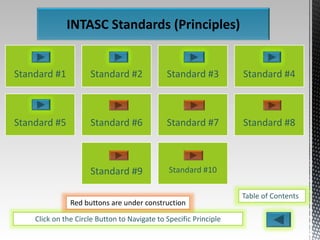
INTASC Standards (Principles)
Table of Contents
Standard #1 Standard #2 Standard #3 Standard #4
Standard #5 Standard #6 Standard #7 Standard #8
Standard #9 Standard #10
Click on the Circle Button to Navigate to Specific Principle
Red buttons are under construction
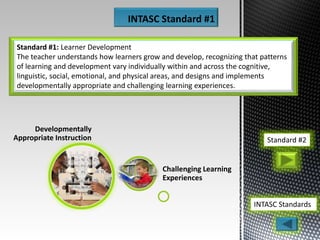
Standard #1: Learner Development
The teacher understands how learners grow and develop, recognizing that patterns
of learning and development vary individually within and across the cognitive,
linguistic, social, emotional, and physical areas, and designs and implements
developmentally appropriate and challenging learning experiences.
INTASC Standards
Standard #2
INTASC Standard #1
Developmentally
Appropriate Instruction
Challenging Learning
Experiences
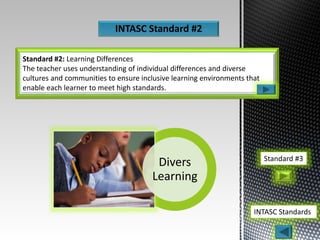
Standard #2: Learning Differences
The teacher uses understanding of individual differences and diverse
cultures and communities to ensure inclusive learning environments that
enable each learner to meet high standards.
INTASC Standards
Standard #3
Divers
Learning
INTASC Standard #2
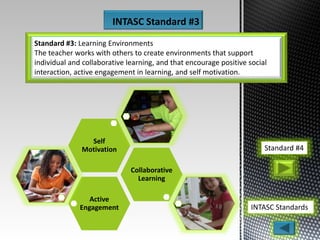
Standard #3: Learning Environments
The teacher works with others to create environments that support
individual and collaborative learning, and that encourage positive social
interaction, active engagement in learning, and self motivation.
INTASC Standards
Standard #4
Active
Engagement
Collaborative
Learning
Self
Motivation
INTASC Standard #3
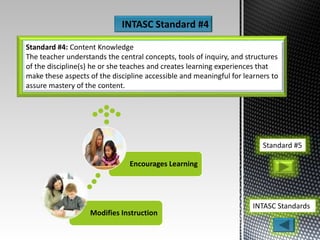
Standard #4: Content Knowledge
The teacher understands the central concepts, tools of inquiry, and structures
of the discipline(s) he or she teaches and creates learning experiences that
make these aspects of the discipline accessible and meaningful for learners to
assure mastery of the content.
INTASC Standards
Standard #5
Modifies Instruction
Encourages Learning
INTASC Standard #4
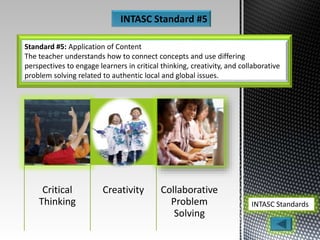
Standard #5: Application of Content
The teacher understands how to connect concepts and use differing
perspectives to engage learners in critical thinking, creativity, and collaborative
problem solving related to authentic local and global issues.
INTASC Standards
INTASC Standard #5
Critical
Thinking
Creativity Collaborative
Problem
Solving
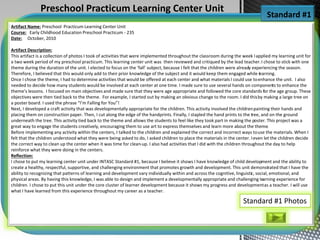
Artifact Name: Preschool Practicum Learning Center Unit
Course: Early Childhood Education Preschool Practicum - 235
Date: October, 2010
Artifact Description:
This artifact is a collection of photos I took of activities that were implemented throughout the classroom during the week Iapplied my learning unit for
a two week period of my preschool practicum. This learning center unit was then reviewed and critiqued by the lead teacher.I chose to stick with one
theme during the duration of the unit. I elected to focus on the ‘fall’ subject, because I felt that the children were already experiencing the season.
Therefore, I believed that this would only add to their prior knowledge of the subject and it would keep them engaged while learning.
Once I chose the theme, I had to determine activities that would be offered at each center and what materials I could use toenhance the unit. I also
needed to decide how many students would be involved at each center at one time. I made sure to use several hands on components to enhance the
theme’s lessons. I focused on main objectives and made sure that they were age appropriate and followed the core standards for the age group. These
objectives were then tied back to the theme. For example, I started out by making an obvious change to the room. I did thisby making a large tree on
a poster board. I used the phrase “I’m Falling for You”!
Next, I developed a craft activity that was developmentally appropriate for the children. This activity involved the childrenpainting their hands and
placing them on construction paper. Then, I cut along the edge of the handprints. Finally, I stapled the hand prints to the tree, and on the ground
underneath the tree. This activity tied back to the theme and allows the students to feel like they took part in making the poster. This project was a
great way to engage the students creatively, encouraging them to use art to express themselves and learn more about the theme.
Before implementing any activity within the centers, I talked to the children and explained the correct and incorrect ways touse the materials. When I
felt that the children understood what they were being asked to do, I asked children to place the materials in the center. Ieven let the children decide
the correct way to clean up the center when it was time for clean-up. I also had activities that I did with the children throughout the day to help
reinforce what they were doing in the centers.
Reflection:
I chose to put my learning center unit under INTASC Standard #1, because I believe it shows I have knowledge of child development and the ability to
create a healthy, respectful, supportive, and challenging environment that promotes growth and development. This unit demonstrated that I have the
ability to recognizing that patterns of learning and development vary individually within and across the cognitive, linguistic, social, emotional, and
physical areas. By having this knowledge, I was able to design and implement a developmentally appropriate and challenging learning experience for
children. I chose to put this unit under the core cluster of learner development because it shows my progress and developmentas a teacher. I will use
what I have learned from this experience throughout my career as a teacher.
Standard #1
Preschool Practicum Learning Center Unit
Standard #1 Photos
Dramatic Play Center
Standard #1 Artifact
Math Center
Art Center
Writing Center
Science Center
Collage Activity
Nature Walk Bulletin Board
Art Activity
Block Center
Reading Center
Artifact Name: China’s Children
Course: Early Childhood Education Development Appropriate Guidance - 130
Date: February, 2O1O
Artifact Description:
This is a research project I did during my Early Childhood Education Development Appropriate Guidance class. While doing
this project, I was able to study and learn about the Chinese culture. I learned many interesting facts about China and its
people by researching their gender roles, education, and economics.
Reflection:
I chose to put this project under the INTASC Standards 2, because it gave me a better awareness and understanding of
diverse cultures and communities and the importance of ensuring inclusive learning environments that enables each
learner. Furthermore, my research revealed that America’s children are falling behind. The children in China are working
much harder than most of the children in America. We need to find a way to give our children a high quality education while
at the same time making education affordable and assessable to all children.
America must place more focus on educating our children for a very different world. If they are not competitive in world
industry, they will fall behind, and that threatens the stability of our country.
This assignment contributed to my professional growth as an educator, because it helped me realize children are raised in
many different environments; therefore, it is my job as a teacher to be informed about the importance of diversity. I will use
what I have learned from this artifact throughout my teaching career. I will also challenge each of my students to meet their
full potential. This artifact fits under the core cluster of “Learning Differences” because it is important that I share with
parents and the community the importance of education and that America has a chance to maintain a strong economy if
more emphasis is placed on effective education as we interact with world-wide cultures.
Standards 2
I am a mother of a fifteen-year-old boy, and two eight year old girls. I find myself
shuffling from one activity to the next and wondering what happened to my day. During a
normal week I wake up, get my children off to school, pick them up from school, get them to
their gymnastics practice, baseball practice, tutoring, or whatever else they have scheduled for
that particular day. When we get home, they have homework. Luckily, we have the weekends
and summer break for a little down time.
Chinese children, mostly in urban areas, do not have the luxury of having any down
time. Their "down time" is their makeup time. Now that China has implemented the One Child
Policy, parents feel the pressure to have a child prodigy. Therefore, many Chinese parents are
using every second possible to give their, one-and-only, child the edge that they need to be
ahead of the game. Hence, they feel it necessity to give their child a high quality education.
Most Chinese parents pay big money to see that their children receive the best education
possible. According to a website by CHINA.ORG.CN, "A recent survey conducted by China
National Statistics Bureau show that more than 60 percent of Chinese families spend one third
of their income on their children's education. According to the survey in Beijing, a family's
spending on their children's education is second only to their spending on
food."(Nov.2001).This shows how important education is to many Chinese people.
With such a demand for a high quality education, prices of education are very high; and
these parents are willing to pay the price. They are paying more for early childhood education
than they are for college tuition. The website, CHINA.ORG.CN, went on to say that, "Many
parents try sending their children to the best kindergarten regardless of higher fees. The tuition
fees charged by a kindergarten in Beijing can amount to 9,600 yuan (USS1,160) per year, even
Standard # 2 Artifact
Standard 3
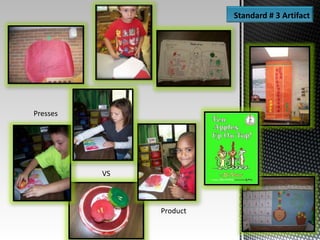
Standard # 3 Artifact
Presses
Product
VS
Standards 4
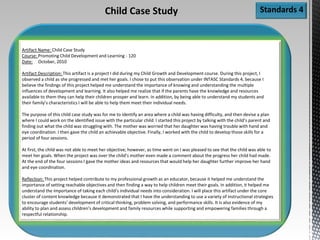
Artifact Name: Child Case Study
Course: Promoting Child Development and Learning - 120
Date: October, 2010
Artifact Description: This artifact is a project I did during my Child Growth and Development course. During this project, I
observed a child as she progressed and met her goals. I chose to put this observation under INTASC Standards 4, because I
believe the findings of this project helped me understand the importance of knowing and understanding the multiple
influences of development and learning. It also helped me realize that if the parents have the knowledge and resources
available to them they can help their children prosper and learn. In addition, by being able to understand my students and
their family’s characteristics I will be able to help them meet their individual needs.
The purpose of this child case study was for me to identify an area where a child was having difficulty, and then devise a plan
where I could work on the identified issue with the particular child. I started this project by talking with the child’s parent and
finding out what the child was struggling with. The mother was worried that her daughter was having trouble with hand and
eye coordination. I then gave the child an achievable objective. Finally, I worked with the child to develop those skills for a
period of four sessions.
At first, the child was not able to meet her objective; however, as time went on I was pleased to see that the child was able to
meet her goals. When the project was over the child’s mother even made a comment about the progress her child had made.
At the end of the four sessions I gave the mother ideas and resources that would help her daughter further improve her hand
and eye coordination.
Reflection: This project helped contribute to my professional growth as an educator, because it helped me understand the
importance of setting reachable objectives and then finding a way to help children meet their goals. In addition, it helped me
understand the importance of taking each child’s individual needs into consideration. I will place this artifact under the core
cluster of content knowledge because it demonstrated that I have the understanding to use a variety of instructional strategies
to encourage students’ development of critical thinking, problem solving, and performance skills. It is also evidence of my
ability to plan and assess children’s development and family resources while supporting and empowering families through a
respectful relationship.
Child Case Study
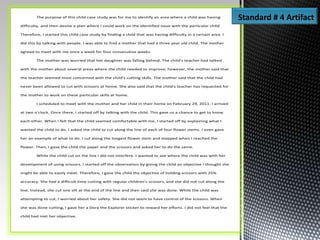
The purpose of this child case study was for me to identify an area where a child was having
difficulty, and then devise a plan where I could work on the identified issue with the particular child.
Therefore, I started this child case study by finding a child that was having difficulty in a certain area. I
did this by talking with people. I was able to find a mother that had a three year old child. The mother
agreed to meet with me once a week for four consecutive weeks.
The mother was worried that her daughter was falling behind. The child's teacher had talked
with the mother about several areas where the child needed to improve; however, the mother said that
the teacher seemed most concerned with the child's cutting skills. The mother said that the child had
never been allowed to cut with scissors at home. She also said that the child's teacher has requested for
the mother to work on these particular skills at home.
I scheduled to meet with the mother and her child in their home on February 29, 2011. I arrived
at two o'clock. Once there, I started off by talking with the child. This gave us a chance to get to know
each other. When l felt that the child seemed comfortable with me, I started off by explaining what I
wanted the child to do. I asked the child to cut along the line of each of four flower stems. I even gave
her an example of what to do. I cut along the longest flower stem and stopped when I reached the
flower. Then, I gave the child the paper and the scissors and asked her to do the same.
While the child cut on the line I did not interfere. I wanted to see where the child was with her
development of using scissors. I started off the observation by giving the child an objective I thought she
might be able to easily meet. Therefore, I gave the child the objective of holding scissors with 25%
accuracy. She had a difficult time cutting with regular children's scissors, and she did not cut along the
line. Instead, she cut one slit at the end of the line and then said she was done. While the child was
attempting to cut, I worried about her safety. She did not seem to have control of the scissors. When
she was done cutting, I gave her a Dora the Explorer sticker to reward her efforts. I did not feel that the
child had met her objective.
Standard # 4 Artifact
Standard 5
Standard # 5 Artifact
http://teacherweb.com/IN/IvyTech/MrsMcKinney/apt1.aspx
Task Stream Link
If you would like to see more of my
work, you may click on the link
below and to be directed to my
Task stream web page.
https://www.taskstream.com/ts/mckinney59/MarciMcKinneyPortfolio

EDU - 260 Educational Portfolio Final

  • 1.
    Education Portfolio Ivy TechCommunity College Spring Semester, 2013 Click to Proceed
  • 2.
    Resume Teaching Philosophy Letter ofRecommendation Endeavors / Awards INSTAC Standards Press Arrow to Navigate to Specific areas
  • 3.
    Marci M. McKinney 1416N. Waugh Street ∙ Kokomo, IN 46901 ∙ (765) 457-3906 ∙ mmckinney39@ivytech.edu Summary of Qualifications Dedicated to support children’s curiosity to discover in a diverse learning environment, while offering a curriculum that meets the needs of each individual child. Strong belief in the National Association for the Education of Young Children (NAEYC) standards as being a basis for insuring a loving, supportive and safe environment for children and their families. Areas of expertise include: Knowledge of Child Growth and Development, Awareness of Early Childhood Administration, Health, Safety and Nutrition, Understanding in Developmentally Appropriate Guidance (DAP), Appreciation for Authentic Assessment. Skills Summary  Microsoft PowerPoint 2010  Task Stream  Microsoft Access 2010  Microsoft Word 2010  Microsoft Excel 2010 Education Ivy Tech Community College Kokomo, IN Associate of Applied Science in Early Childhood Education  Dean’s List recipient with a cumulative GPA of 3.75  Global Studies Certificate and Indorsed Career Ready Graduate Certificate in progress  Awarded Patsy Daily Scholarship, The City of Kokomo Community Development Block Grant, Sycamore Recreation Scholarship, Nominated for the 2013 All-USA & Coca-Cola Community College Academic Team, Paths to Quality Training Certificate, Five Star Chapter Development Plan Leader, S.T.A.R.S. Academy Association Degree Qualified Skills EARLY CHILDHOOD DEVELOPMENT  Curriculum and organization development  Conflict resolution with a aptitude for problem solving effectively and quickly  Ability to teach and train individuals from diverse populations and learning styles  Ability to provide project coordination and strategic planning INTERPERSONAL AND COMMUNICATION  Strong organizational and interpersonal skills with excellent active listening skills  Professional and amicable demeanor with an inter-cultural awareness  Exemplary leadership and organization skills  Trustworthy, accountable, highly responsible and easily approachable RELEVANT COURSEWORK  Relevant coursework including Health, Safety and Nutrition, Curriculum in the Early Childhood Classroom, Child Growth and Development, Developmentally Appropriate Guidance in a Cultural Context, Families in Transition, Early Childhood Administration, The Exceptional Child, Emerging Literacy, Cognitive Curriculum, Early Childhood Professional, Preschool Practicum, Family Teacher Partnerships Activities and Leadership  Student Leadership Academy Alumni, InSAI School Improvement Community Committee, Bon Air Elementary School’s Parent Academy, National Association for the Education of Young Children, Science and Math Club - Secretary and Treasurer, President of the Student Government after Secretary term, Parents as Partners Committee, Human Services Student Organization - member, (iaeyc)North Central Indiana Board Member and Treasurer  Nominated and appointed to President of Phi Theta Kappa Honors Society after Vice Precedency term Employment History Kokomo Tribune – Paper Carrier Kokomo, IN- 1999 to Present Horizon – Assistant Teacher Kokomo, IN- 1997 to 2010 Preschool/Kindergarten Practicum (288) hours Kokomo, IN – 2010 to 2011 Resume Table of Contents
  • 4.
    Teaching Philosophy Table of Contents Eversince I can remember I have held aspirations to become an educator, as I enjoy supporting children’s curiosity to learn and grow. However, my philosophies and views on education have changed significantly over the years. Since I have become a student, I have observed many approaches to teaching by many different educators. I have also studied the theories of many educational philosophers such as Reggio Emilia, Jean Piaget, Maria Montessori, Eric Ericson, and Howard Gardner. Over time, I have taken bits and pieces of each of their theories and ideas and have come up with a philosophy of my own. As an educator, I am committed to offering a curriculum that meets the needs of each individual child. I believe every child is unique and therefore, needs a secure, caring, and stimulating atmosphere in which to grow and develop emotionally, intellectually, physically, and socially. My objective as an educator is to find creative ways to use tools in order to help children meet their full potential. Once I have implemented a strategy, or technique, I will use both observation and evaluation as a guide to determining whether each child has benefited from my efforts. If needed, I will adjust the curriculum design to insure that every child is being challenged. I believe that teachers are lifelong learners; therefore, it is important to continue to develop my teaching skills throughout my career. I believe knowledge is acquired through interaction. I have faith in the fact that each child develops skills and awareness through direct, hands-on experiences. They need to be provided opportunities to develop and learn through use of their senses. I also believe that there is more to intelligence than what is measured by IQ tests. As a teacher, my objective will be to find creative ways to discover each of my students’ strengths and weaknesses, and then design effective activities to sharpen their skills. Furthermore, I believe children are influenced by the people they come in contact with, materials and resources they are exposed to, occurrences that happen in their day to day experiences, and the environment they live in. Therefore, it is my job as an educator to ensure my classroom provides learning activities that encourage and challenge children to meet their full potential. I believe that children should eventually develop accountability for their learning and have freedom of expression. Therefore, education should be student-centered. Children should have the opportunity to study things they find interesting and are meaningful and relevant to their lives. It is my job to develop a curriculum that not only addresses the core standards, but is also structured around student’s interests while fostering essential enthusiasm, stimulating a passion for learning and a desire to experience challenges. I believe that parents are a child’s first teacher. Subsequently, it is vital that parents are involved in their children’s education. Parental involvement can give a child a sense of reassurance that they can trust their teacher. With our diverse and changing community, parent-teacher interactions are essential in helping to create a nurturing atmosphere. It is also important that I collaborate with other personnel in the school district such as the reading specialist, the speech therapist, the paraprofessionals, and anyone else the children many come into contact with on a daily basis. It is vital that I work with colleagues to share ideas, develop and implement plans, and to evaluate each student’s outcomes for goals and objectives. Ongoing assessment will be necessary to identify prior knowledge, skills, strengths, and weaknesses. I believe this type of information is more accurate than standard grading, because it can be used to create appropriate learning opportunities. Understanding the diverse learning styles of children will empower me to create learning activities that challenge all students. I believe all types of assessments have value and plan on using a variety of these tools to track student progress. In conclusion, professional growth will affect my views of teaching and learning. Therefore, my teaching philosophy will continue to evolve as I strive to become a master teacher, able to meet the ever-changing needs of my students and community.
  • 5.
  • 6.
  • 7.
  • 8.
  • 9.
  • 10.
  • 11.
  • 12.
    Chapter Awards 2 Tableof Contents Next
  • 13.
    INTASC Standards (Principles) Tableof Contents Standard #1 Standard #2 Standard #3 Standard #4 Standard #5 Standard #6 Standard #7 Standard #8 Standard #9 Standard #10 Click on the Circle Button to Navigate to Specific Principle Red buttons are under construction
  • 14.
    Standard #1: LearnerDevelopment The teacher understands how learners grow and develop, recognizing that patterns of learning and development vary individually within and across the cognitive, linguistic, social, emotional, and physical areas, and designs and implements developmentally appropriate and challenging learning experiences. INTASC Standards Standard #2 INTASC Standard #1 Developmentally Appropriate Instruction Challenging Learning Experiences
  • 15.
    Standard #2: LearningDifferences The teacher uses understanding of individual differences and diverse cultures and communities to ensure inclusive learning environments that enable each learner to meet high standards. INTASC Standards Standard #3 Divers Learning INTASC Standard #2
  • 16.
    Standard #3: LearningEnvironments The teacher works with others to create environments that support individual and collaborative learning, and that encourage positive social interaction, active engagement in learning, and self motivation. INTASC Standards Standard #4 Active Engagement Collaborative Learning Self Motivation INTASC Standard #3
  • 17.
    Standard #4: ContentKnowledge The teacher understands the central concepts, tools of inquiry, and structures of the discipline(s) he or she teaches and creates learning experiences that make these aspects of the discipline accessible and meaningful for learners to assure mastery of the content. INTASC Standards Standard #5 Modifies Instruction Encourages Learning INTASC Standard #4
  • 18.
    Standard #5: Applicationof Content The teacher understands how to connect concepts and use differing perspectives to engage learners in critical thinking, creativity, and collaborative problem solving related to authentic local and global issues. INTASC Standards INTASC Standard #5 Critical Thinking Creativity Collaborative Problem Solving
  • 19.
    Artifact Name: PreschoolPracticum Learning Center Unit Course: Early Childhood Education Preschool Practicum - 235 Date: October, 2010 Artifact Description: This artifact is a collection of photos I took of activities that were implemented throughout the classroom during the week Iapplied my learning unit for a two week period of my preschool practicum. This learning center unit was then reviewed and critiqued by the lead teacher.I chose to stick with one theme during the duration of the unit. I elected to focus on the ‘fall’ subject, because I felt that the children were already experiencing the season. Therefore, I believed that this would only add to their prior knowledge of the subject and it would keep them engaged while learning. Once I chose the theme, I had to determine activities that would be offered at each center and what materials I could use toenhance the unit. I also needed to decide how many students would be involved at each center at one time. I made sure to use several hands on components to enhance the theme’s lessons. I focused on main objectives and made sure that they were age appropriate and followed the core standards for the age group. These objectives were then tied back to the theme. For example, I started out by making an obvious change to the room. I did thisby making a large tree on a poster board. I used the phrase “I’m Falling for You”! Next, I developed a craft activity that was developmentally appropriate for the children. This activity involved the childrenpainting their hands and placing them on construction paper. Then, I cut along the edge of the handprints. Finally, I stapled the hand prints to the tree, and on the ground underneath the tree. This activity tied back to the theme and allows the students to feel like they took part in making the poster. This project was a great way to engage the students creatively, encouraging them to use art to express themselves and learn more about the theme. Before implementing any activity within the centers, I talked to the children and explained the correct and incorrect ways touse the materials. When I felt that the children understood what they were being asked to do, I asked children to place the materials in the center. Ieven let the children decide the correct way to clean up the center when it was time for clean-up. I also had activities that I did with the children throughout the day to help reinforce what they were doing in the centers. Reflection: I chose to put my learning center unit under INTASC Standard #1, because I believe it shows I have knowledge of child development and the ability to create a healthy, respectful, supportive, and challenging environment that promotes growth and development. This unit demonstrated that I have the ability to recognizing that patterns of learning and development vary individually within and across the cognitive, linguistic, social, emotional, and physical areas. By having this knowledge, I was able to design and implement a developmentally appropriate and challenging learning experience for children. I chose to put this unit under the core cluster of learner development because it shows my progress and developmentas a teacher. I will use what I have learned from this experience throughout my career as a teacher. Standard #1 Preschool Practicum Learning Center Unit Standard #1 Photos
  • 20.
    Dramatic Play Center Standard#1 Artifact Math Center Art Center Writing Center Science Center Collage Activity Nature Walk Bulletin Board Art Activity Block Center Reading Center
  • 21.
    Artifact Name: China’sChildren Course: Early Childhood Education Development Appropriate Guidance - 130 Date: February, 2O1O Artifact Description: This is a research project I did during my Early Childhood Education Development Appropriate Guidance class. While doing this project, I was able to study and learn about the Chinese culture. I learned many interesting facts about China and its people by researching their gender roles, education, and economics. Reflection: I chose to put this project under the INTASC Standards 2, because it gave me a better awareness and understanding of diverse cultures and communities and the importance of ensuring inclusive learning environments that enables each learner. Furthermore, my research revealed that America’s children are falling behind. The children in China are working much harder than most of the children in America. We need to find a way to give our children a high quality education while at the same time making education affordable and assessable to all children. America must place more focus on educating our children for a very different world. If they are not competitive in world industry, they will fall behind, and that threatens the stability of our country. This assignment contributed to my professional growth as an educator, because it helped me realize children are raised in many different environments; therefore, it is my job as a teacher to be informed about the importance of diversity. I will use what I have learned from this artifact throughout my teaching career. I will also challenge each of my students to meet their full potential. This artifact fits under the core cluster of “Learning Differences” because it is important that I share with parents and the community the importance of education and that America has a chance to maintain a strong economy if more emphasis is placed on effective education as we interact with world-wide cultures. Standards 2
  • 22.
    I am amother of a fifteen-year-old boy, and two eight year old girls. I find myself shuffling from one activity to the next and wondering what happened to my day. During a normal week I wake up, get my children off to school, pick them up from school, get them to their gymnastics practice, baseball practice, tutoring, or whatever else they have scheduled for that particular day. When we get home, they have homework. Luckily, we have the weekends and summer break for a little down time. Chinese children, mostly in urban areas, do not have the luxury of having any down time. Their "down time" is their makeup time. Now that China has implemented the One Child Policy, parents feel the pressure to have a child prodigy. Therefore, many Chinese parents are using every second possible to give their, one-and-only, child the edge that they need to be ahead of the game. Hence, they feel it necessity to give their child a high quality education. Most Chinese parents pay big money to see that their children receive the best education possible. According to a website by CHINA.ORG.CN, "A recent survey conducted by China National Statistics Bureau show that more than 60 percent of Chinese families spend one third of their income on their children's education. According to the survey in Beijing, a family's spending on their children's education is second only to their spending on food."(Nov.2001).This shows how important education is to many Chinese people. With such a demand for a high quality education, prices of education are very high; and these parents are willing to pay the price. They are paying more for early childhood education than they are for college tuition. The website, CHINA.ORG.CN, went on to say that, "Many parents try sending their children to the best kindergarten regardless of higher fees. The tuition fees charged by a kindergarten in Beijing can amount to 9,600 yuan (USS1,160) per year, even Standard # 2 Artifact
  • 23.
  • 24.
    Standard # 3Artifact Presses Product VS
  • 25.
    Standards 4 Artifact Name:Child Case Study Course: Promoting Child Development and Learning - 120 Date: October, 2010 Artifact Description: This artifact is a project I did during my Child Growth and Development course. During this project, I observed a child as she progressed and met her goals. I chose to put this observation under INTASC Standards 4, because I believe the findings of this project helped me understand the importance of knowing and understanding the multiple influences of development and learning. It also helped me realize that if the parents have the knowledge and resources available to them they can help their children prosper and learn. In addition, by being able to understand my students and their family’s characteristics I will be able to help them meet their individual needs. The purpose of this child case study was for me to identify an area where a child was having difficulty, and then devise a plan where I could work on the identified issue with the particular child. I started this project by talking with the child’s parent and finding out what the child was struggling with. The mother was worried that her daughter was having trouble with hand and eye coordination. I then gave the child an achievable objective. Finally, I worked with the child to develop those skills for a period of four sessions. At first, the child was not able to meet her objective; however, as time went on I was pleased to see that the child was able to meet her goals. When the project was over the child’s mother even made a comment about the progress her child had made. At the end of the four sessions I gave the mother ideas and resources that would help her daughter further improve her hand and eye coordination. Reflection: This project helped contribute to my professional growth as an educator, because it helped me understand the importance of setting reachable objectives and then finding a way to help children meet their goals. In addition, it helped me understand the importance of taking each child’s individual needs into consideration. I will place this artifact under the core cluster of content knowledge because it demonstrated that I have the understanding to use a variety of instructional strategies to encourage students’ development of critical thinking, problem solving, and performance skills. It is also evidence of my ability to plan and assess children’s development and family resources while supporting and empowering families through a respectful relationship. Child Case Study
  • 26.
    The purpose ofthis child case study was for me to identify an area where a child was having difficulty, and then devise a plan where I could work on the identified issue with the particular child. Therefore, I started this child case study by finding a child that was having difficulty in a certain area. I did this by talking with people. I was able to find a mother that had a three year old child. The mother agreed to meet with me once a week for four consecutive weeks. The mother was worried that her daughter was falling behind. The child's teacher had talked with the mother about several areas where the child needed to improve; however, the mother said that the teacher seemed most concerned with the child's cutting skills. The mother said that the child had never been allowed to cut with scissors at home. She also said that the child's teacher has requested for the mother to work on these particular skills at home. I scheduled to meet with the mother and her child in their home on February 29, 2011. I arrived at two o'clock. Once there, I started off by talking with the child. This gave us a chance to get to know each other. When l felt that the child seemed comfortable with me, I started off by explaining what I wanted the child to do. I asked the child to cut along the line of each of four flower stems. I even gave her an example of what to do. I cut along the longest flower stem and stopped when I reached the flower. Then, I gave the child the paper and the scissors and asked her to do the same. While the child cut on the line I did not interfere. I wanted to see where the child was with her development of using scissors. I started off the observation by giving the child an objective I thought she might be able to easily meet. Therefore, I gave the child the objective of holding scissors with 25% accuracy. She had a difficult time cutting with regular children's scissors, and she did not cut along the line. Instead, she cut one slit at the end of the line and then said she was done. While the child was attempting to cut, I worried about her safety. She did not seem to have control of the scissors. When she was done cutting, I gave her a Dora the Explorer sticker to reward her efforts. I did not feel that the child had met her objective. Standard # 4 Artifact
  • 27.
  • 28.
    Standard # 5Artifact
  • 29.
  • 30.
    Task Stream Link Ifyou would like to see more of my work, you may click on the link below and to be directed to my Task stream web page. https://www.taskstream.com/ts/mckinney59/MarciMcKinneyPortfolio