Running Head: Project-Based Learning 1
Science Project-Based Learning
Megan Waldeck
National University
Running Head: Project-Based Learning 2
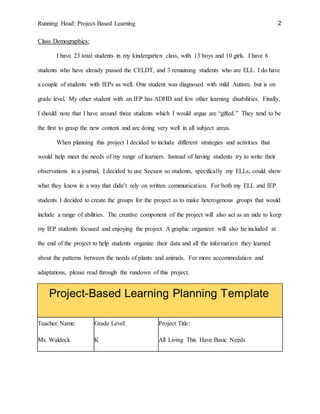
Class Demographics:
I have 23 total students in my kindergarten class, with 13 boys and 10 girls. I have 6
students who have already passed the CELDT, and 3 remaining students who are ELL. I do have
a couple of students with IEPs as well. One student was diagnosed with mild Autism, but is on
grade level. My other student with an IEP has ADHD and few other learning disabilities. Finally,
I should note that I have around three students which I would argue are “gifted.” They tend to be
the first to grasp the new content and are doing very well in all subject areas.
When planning this project I decided to include different strategies and activities that
would help meet the needs of my range of learners. Instead of having students try to write their
observations in a journal, I decided to use Seesaw so students, specifically my ELLs, could show
what they know in a way that didn’t rely on written communication. For both my ELL and IEP
students I decided to create the groups for the project as to make heterogenous groups that would
include a range of abilities. The creative component of the project will also act as an aide to keep
my IEP students focused and enjoying the project. A graphic organizer will also be included at
the end of the project to help students organize their data and all the information they learned
about the patterns between the needs of plants and animals. For more accommodation and
adaptations, please read through the rundown of this project.
Project-Based Learning Planning Template
Teacher Name:
Ms. Waldeck
Grade Level:
K
Project Title:
All Living This Have Basic Needs
Running Head: Project-Based Learning 3
Content Standards Addressed: (National Math Standards or Common Core/NGSS)
K-LS1-1. Use observations to describe patterns of what plants and animals (including humans)
need to survive. (Firsthand orfrommedia)
[Clarification Statement: Examples of patterns could include that animals need to take in food
but plants do not; the different kinds of food needed by different types of animals; the
requirement of plants to have light; and, that all living things need water.]
Cross-Curriculum Connections: What other standards and subjects will you address in this
project
Visual and Performing Arts
THEATRE
2.0 CREATIVE EXPRESSION-Creating, Performing, and Participating in Theatre
 Creation/Invention in Theatre: 2.3 Use costumes and props in role playing.
MUSIC
2.0 CREATIVE EXPRESSION-Creating, Performing, and Participating in Music
 Apply Vocal and Instrumental Skills: 2.1 Use the singing voice to echo short melodic
patterns.
Computer Science Standards
K-2.CS.1: Select and operate computing devices that perform a variety of tasks accurately and
quickly based on user needs and preferences.
STAGE 1: PLANNING:
Driving Question: the
question that drives
the work
What’s the difference between what plants and animals/humans need to
stay alive? Can we observe this in our own classroom?
Running Head: Project-Based Learning 4
Project Summary:
(what students will
do, learn and
accomplish by the
end of the project)
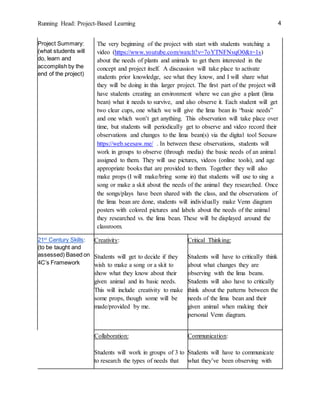
The very beginning of the project with start with students watching a
video (https://www.youtube.com/watch?v=7oYTNFNvqO0&t=1s)
about the needs of plants and animals to get them interested in the
concept and project itself. A discussion will take place to activate
students prior knowledge, see what they know, and I will share what
they will be doing in this larger project. The first part of the project will
have students creating an environment where we can give a plant (lima
bean) what it needs to survive, and also observe it. Each student will get
two clear cups, one which we will give the lima bean its “basic needs”
and one which won’t get anything. This observation will take place over
time, but students will periodically get to observe and video record their
observations and changes to the lima bean(s) via the digital tool Seesaw
https://web.seesaw.me/ . In between these observations, students will
work in groups to observe (through media) the basic needs of an animal
assigned to them. They will use pictures, videos (online tools), and age
appropriate books that are provided to them. Together they will also
make props (I will make/bring some in) that students will use to sing a
song or make a skit about the needs of the animal they researched. Once
the songs/plays have been shared with the class, and the observations of
the lima bean are done, students will individually make Venn diagram
posters with colored pictures and labels about the needs of the animal
they researched vs. the lima bean. These will be displayed around the
classroom.
21st
Century Skills:
(to be taught and
assessed) Based on
4C’s Framework
Creativity:
Students will get to decide if they
wish to make a song or a skit to
show what they know about their
given animal and its basic needs.
This will include creativity to make
some props, though some will be
made/provided by me.
Critical Thinking:
Students will have to critically think
about what changes they are
observing with the lima beans.
Students will also have to critically
think about the patterns between the
needs of the lima bean and their
given animal when making their
personal Venn diagram.
Collaboration:
Students will work in groups of 3 to
to research the types of needs that
Communication:
Students will have to communicate
what they’ve been observing with
Running Head: Project-Based Learning 5
their animal has. They will also
work together to make a song or
skit about the needs of their animal.
the lima beans through a video
recording with the digital tool
Seesaw. They will need to
communicate with their group
information they find about their
given animal, and finally, they will
need to be able to communicate this
information about their animal to
the entire class.
The Hook: How will
you engage the
students and spark
their interest
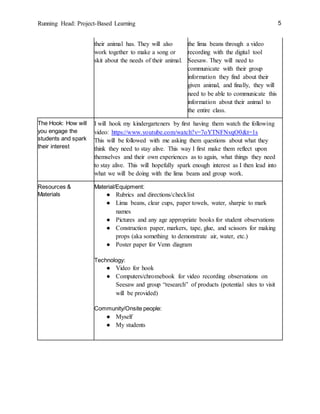
I will hook my kindergarteners by first having them watch the following
video: https://www.youtube.com/watch?v=7oYTNFNvqO0&t=1s
This will be followed with me asking them questions about what they
think they need to stay alive. This way I first make them reflect upon
themselves and their own experiences as to again, what things they need
to stay alive. This will hopefully spark enough interest as I then lead into
what we will be doing with the lima beans and group work.
Resources &
Materials
Material/Equipment:
● Rubrics and directions/checklist
● Lima beans, clear cups, paper towels, water, sharpie to mark
names
● Pictures and any age appropriate books for student observations
● Construction paper, markers, tape, glue, and scissors for making
props (aka something to demonstrate air, water, etc.)
● Poster paper for Venn diagram
Technology:
● Video for hook
● Computers/chromebook for video recording observations on
Seesaw and group “research” of products (potential sites to visit
will be provided)
Community/Onsite people:
● Myself
● My students
Running Head: Project-Based Learning 6
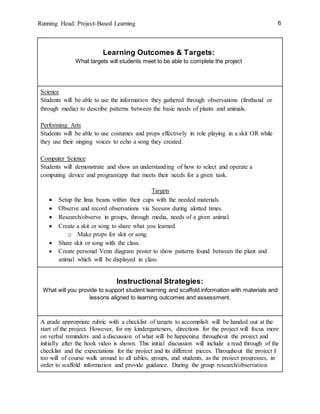
Learning Outcomes & Targets:
What targets will students meet to be able to complete the project
Science
Students will be able to use the information they gathered through observations (firsthand or
through media) to describe patterns between the basic needs of plants and animals.
Performing Arts
Students will be able to use costumes and props effectively in role playing in a skit OR while
they use their singing voices to echo a song they created.
Computer Science
Students will demonstrate and show an understanding of how to select and operate a
computing device and program/app that meets their needs for a given task.
Targets
 Setup the lima beans within their cups with the needed materials.
 Observe and record observations via Seesaw during alotted times.
 Research/observe in groups, through media, needs of a given animal.
 Create a skit or song to share what you learned.
o Make props for skit or song.
 Share skit or song with the class.
 Create personal Venn diagram poster to show patterns found between the plant and
animal which will be displayed in class.
Instructional Strategies:
What will you provide to support student learning and scaffold information with materials and
lessons aligned to learning outcomes and assessment.
A grade appropriate rubric with a checklist of targets to accomplish will be handed out at the
start of the project. However, for my kindergarteners, directions for the project will focus more
on verbal reminders and a discussion of what will be happening throughout the project and
initially after the hook video is shown. This initial discussion will include a read through of the
checklist and the expectations for the project and its different pieces. Throughout the project I
too will of course walk around to all tables, groups, and students, as the project progresses, in
order to scaffold information and provide guidance. During the group research/observation
Running Head: Project-Based Learning 7
time, student friendly sites and online videos, pictures, and books will be provided to ensure
students are gathering the needed information. Additionally, the digital tool Seesaw will be
provided for students to use to record the observations and information they have found. (Note
here students have already used this site, but reminders of how to use will be given). Modeling
will take place during the set up of the lima beans in their cups, as well as during the initial
observation so students know how to use their 5 sense to observe. When students go to record
their observations with Seesaw, sentence stems will be provided for them to use if they need
some help describing what they observed. Finally, a graphic organizer (Venn diagram) will be
given for students to use to organize their final thoughts as they create a poster on the patterns
they found between the needs of plants vs. animals.
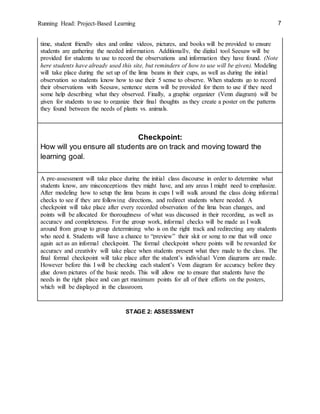
Checkpoint:
How will you ensure all students are on track and moving toward the
learning goal.
A pre-assessment will take place during the initial class discourse in order to determine what
students know, any misconceptions they might have, and any areas I might need to emphasize.
After modeling how to setup the lima beans in cups I will walk around the class doing informal
checks to see if they are following directions, and redirect students where needed. A
checkpoint will take place after every recorded observation of the lima bean changes, and
points will be allocated for thoroughness of what was discussed in their recording, as well as
accuracy and completeness. For the group work, informal checks will be made as I walk
around from group to group determining who is on the right track and redirecting any students
who need it. Students will have a chance to “preview” their skit or song to me that will once
again act as an informal checkpoint. The formal checkpoint where points will be rewarded for
accuracy and creativity will take place when students present what they made to the class. The
final formal checkpoint will take place after the student’s individual Venn diagrams are made.
However before this I will be checking each student’s Venn diagram for accuracy before they
glue down pictures of the basic needs. This will allow me to ensure that students have the
needs in the right place and can get maximum points for all of their efforts on the posters,
which will be displayed in the classroom.
STAGE 2: ASSESSMENT
Running Head: Project-Based Learning 8
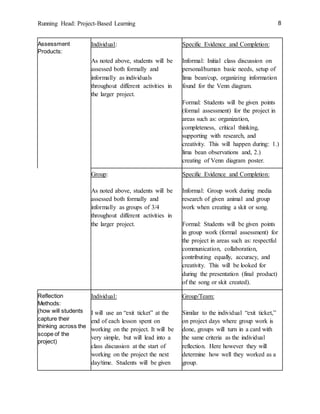
Assessment
Products:
Individual:
As noted above, students will be
assessed both formally and
informally as individuals
throughout different activities in
the larger project.
Specific Evidence and Completion:
Informal: Initial class discussion on
personal/human basic needs, setup of
lima bean/cup, organizing information
found for the Venn diagram.
Formal: Students will be given points
(formal assessment) for the project in
areas such as: organization,
completeness, critical thinking,
supporting with research, and
creativity. This will happen during: 1.)
lima bean observations and, 2.)
creating of Venn diagram poster.
Group:
As noted above, students will be
assessed both formally and
informally as groups of 3/4
throughout different activities in
the larger project.
Specific Evidence and Completion:
Informal: Group work during media
research of given animal and group
work when creating a skit or song.
Formal: Students will be given points
in group work (formal assessment) for
the project in areas such as: respectful
communication, collaboration,
contributing equally, accuracy, and
creativity. This will be looked for
during the presentation (final product)
of the song or skit created).
Reflection
Methods:
(how will students
capture their
thinking across the
scope of the
project)
Individual:
I will use an “exit ticket” at the
end of each lesson spent on
working on the project. It will be
very simple, but will lead into a
class discussion at the start of
working on the project the next
day/time. Students will be given
Group/Team:
Similar to the individual “exit ticket,”
on project days where group work is
done, groups will turn in a card with
the same criteria as the individual
reflection. Here however they will
determine how well they worked as a
group.
Running Head: Project-Based Learning 9
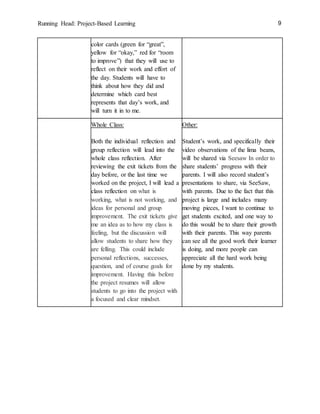
color cards (green for “great”,
yellow for “okay,” red for “room
to improve”) that they will use to
reflect on their work and effort of
the day. Students will have to
think about how they did and
determine which card best
represents that day’s work, and
will turn it in to me.
Whole Class:
Both the individual reflection and
group reflection will lead into the
whole class reflection. After
reviewing the exit tickets from the
day before, or the last time we
worked on the project, I will lead a
class reflection on what is
working, what is not working, and
ideas for personal and group
improvement. The exit tickets give
me an idea as to how my class is
feeling, but the discussion will
allow students to share how they
are felling. This could include
personal reflections, successes,
question, and of course goals for
improvement. Having this before
the project resumes will allow
students to go into the project with
a focused and clear mindset.
Other:
Student’s work, and specifically their
video observations of the lima beans,
will be shared via Seesaw In order to
share students’ progress with their
parents. I will also record student’s
presentations to share, via SeeSaw,
with parents. Due to the fact that this
project is large and includes many
moving pieces, I want to continue to
get students excited, and one way to
do this would be to share their growth
with their parents. This way parents
can see all the good work their learner
is doing, and more people can
appreciate all the hard work being
done by my students.

PBL in science itl 518(1)

  • 1.
    Running Head: Project-BasedLearning 1 Science Project-Based Learning Megan Waldeck National University
  • 2.
    Running Head: Project-BasedLearning 2 Class Demographics: I have 23 total students in my kindergarten class, with 13 boys and 10 girls. I have 6 students who have already passed the CELDT, and 3 remaining students who are ELL. I do have a couple of students with IEPs as well. One student was diagnosed with mild Autism, but is on grade level. My other student with an IEP has ADHD and few other learning disabilities. Finally, I should note that I have around three students which I would argue are “gifted.” They tend to be the first to grasp the new content and are doing very well in all subject areas. When planning this project I decided to include different strategies and activities that would help meet the needs of my range of learners. Instead of having students try to write their observations in a journal, I decided to use Seesaw so students, specifically my ELLs, could show what they know in a way that didn’t rely on written communication. For both my ELL and IEP students I decided to create the groups for the project as to make heterogenous groups that would include a range of abilities. The creative component of the project will also act as an aide to keep my IEP students focused and enjoying the project. A graphic organizer will also be included at the end of the project to help students organize their data and all the information they learned about the patterns between the needs of plants and animals. For more accommodation and adaptations, please read through the rundown of this project. Project-Based Learning Planning Template Teacher Name: Ms. Waldeck Grade Level: K Project Title: All Living This Have Basic Needs
  • 3.
    Running Head: Project-BasedLearning 3 Content Standards Addressed: (National Math Standards or Common Core/NGSS) K-LS1-1. Use observations to describe patterns of what plants and animals (including humans) need to survive. (Firsthand orfrommedia) [Clarification Statement: Examples of patterns could include that animals need to take in food but plants do not; the different kinds of food needed by different types of animals; the requirement of plants to have light; and, that all living things need water.] Cross-Curriculum Connections: What other standards and subjects will you address in this project Visual and Performing Arts THEATRE 2.0 CREATIVE EXPRESSION-Creating, Performing, and Participating in Theatre  Creation/Invention in Theatre: 2.3 Use costumes and props in role playing. MUSIC 2.0 CREATIVE EXPRESSION-Creating, Performing, and Participating in Music  Apply Vocal and Instrumental Skills: 2.1 Use the singing voice to echo short melodic patterns. Computer Science Standards K-2.CS.1: Select and operate computing devices that perform a variety of tasks accurately and quickly based on user needs and preferences. STAGE 1: PLANNING: Driving Question: the question that drives the work What’s the difference between what plants and animals/humans need to stay alive? Can we observe this in our own classroom?
  • 4.
    Running Head: Project-BasedLearning 4 Project Summary: (what students will do, learn and accomplish by the end of the project) The very beginning of the project with start with students watching a video (https://www.youtube.com/watch?v=7oYTNFNvqO0&t=1s) about the needs of plants and animals to get them interested in the concept and project itself. A discussion will take place to activate students prior knowledge, see what they know, and I will share what they will be doing in this larger project. The first part of the project will have students creating an environment where we can give a plant (lima bean) what it needs to survive, and also observe it. Each student will get two clear cups, one which we will give the lima bean its “basic needs” and one which won’t get anything. This observation will take place over time, but students will periodically get to observe and video record their observations and changes to the lima bean(s) via the digital tool Seesaw https://web.seesaw.me/ . In between these observations, students will work in groups to observe (through media) the basic needs of an animal assigned to them. They will use pictures, videos (online tools), and age appropriate books that are provided to them. Together they will also make props (I will make/bring some in) that students will use to sing a song or make a skit about the needs of the animal they researched. Once the songs/plays have been shared with the class, and the observations of the lima bean are done, students will individually make Venn diagram posters with colored pictures and labels about the needs of the animal they researched vs. the lima bean. These will be displayed around the classroom. 21st Century Skills: (to be taught and assessed) Based on 4C’s Framework Creativity: Students will get to decide if they wish to make a song or a skit to show what they know about their given animal and its basic needs. This will include creativity to make some props, though some will be made/provided by me. Critical Thinking: Students will have to critically think about what changes they are observing with the lima beans. Students will also have to critically think about the patterns between the needs of the lima bean and their given animal when making their personal Venn diagram. Collaboration: Students will work in groups of 3 to to research the types of needs that Communication: Students will have to communicate what they’ve been observing with
  • 5.
    Running Head: Project-BasedLearning 5 their animal has. They will also work together to make a song or skit about the needs of their animal. the lima beans through a video recording with the digital tool Seesaw. They will need to communicate with their group information they find about their given animal, and finally, they will need to be able to communicate this information about their animal to the entire class. The Hook: How will you engage the students and spark their interest I will hook my kindergarteners by first having them watch the following video: https://www.youtube.com/watch?v=7oYTNFNvqO0&t=1s This will be followed with me asking them questions about what they think they need to stay alive. This way I first make them reflect upon themselves and their own experiences as to again, what things they need to stay alive. This will hopefully spark enough interest as I then lead into what we will be doing with the lima beans and group work. Resources & Materials Material/Equipment: ● Rubrics and directions/checklist ● Lima beans, clear cups, paper towels, water, sharpie to mark names ● Pictures and any age appropriate books for student observations ● Construction paper, markers, tape, glue, and scissors for making props (aka something to demonstrate air, water, etc.) ● Poster paper for Venn diagram Technology: ● Video for hook ● Computers/chromebook for video recording observations on Seesaw and group “research” of products (potential sites to visit will be provided) Community/Onsite people: ● Myself ● My students
  • 6.
    Running Head: Project-BasedLearning 6 Learning Outcomes & Targets: What targets will students meet to be able to complete the project Science Students will be able to use the information they gathered through observations (firsthand or through media) to describe patterns between the basic needs of plants and animals. Performing Arts Students will be able to use costumes and props effectively in role playing in a skit OR while they use their singing voices to echo a song they created. Computer Science Students will demonstrate and show an understanding of how to select and operate a computing device and program/app that meets their needs for a given task. Targets  Setup the lima beans within their cups with the needed materials.  Observe and record observations via Seesaw during alotted times.  Research/observe in groups, through media, needs of a given animal.  Create a skit or song to share what you learned. o Make props for skit or song.  Share skit or song with the class.  Create personal Venn diagram poster to show patterns found between the plant and animal which will be displayed in class. Instructional Strategies: What will you provide to support student learning and scaffold information with materials and lessons aligned to learning outcomes and assessment. A grade appropriate rubric with a checklist of targets to accomplish will be handed out at the start of the project. However, for my kindergarteners, directions for the project will focus more on verbal reminders and a discussion of what will be happening throughout the project and initially after the hook video is shown. This initial discussion will include a read through of the checklist and the expectations for the project and its different pieces. Throughout the project I too will of course walk around to all tables, groups, and students, as the project progresses, in order to scaffold information and provide guidance. During the group research/observation
  • 7.
    Running Head: Project-BasedLearning 7 time, student friendly sites and online videos, pictures, and books will be provided to ensure students are gathering the needed information. Additionally, the digital tool Seesaw will be provided for students to use to record the observations and information they have found. (Note here students have already used this site, but reminders of how to use will be given). Modeling will take place during the set up of the lima beans in their cups, as well as during the initial observation so students know how to use their 5 sense to observe. When students go to record their observations with Seesaw, sentence stems will be provided for them to use if they need some help describing what they observed. Finally, a graphic organizer (Venn diagram) will be given for students to use to organize their final thoughts as they create a poster on the patterns they found between the needs of plants vs. animals. Checkpoint: How will you ensure all students are on track and moving toward the learning goal. A pre-assessment will take place during the initial class discourse in order to determine what students know, any misconceptions they might have, and any areas I might need to emphasize. After modeling how to setup the lima beans in cups I will walk around the class doing informal checks to see if they are following directions, and redirect students where needed. A checkpoint will take place after every recorded observation of the lima bean changes, and points will be allocated for thoroughness of what was discussed in their recording, as well as accuracy and completeness. For the group work, informal checks will be made as I walk around from group to group determining who is on the right track and redirecting any students who need it. Students will have a chance to “preview” their skit or song to me that will once again act as an informal checkpoint. The formal checkpoint where points will be rewarded for accuracy and creativity will take place when students present what they made to the class. The final formal checkpoint will take place after the student’s individual Venn diagrams are made. However before this I will be checking each student’s Venn diagram for accuracy before they glue down pictures of the basic needs. This will allow me to ensure that students have the needs in the right place and can get maximum points for all of their efforts on the posters, which will be displayed in the classroom. STAGE 2: ASSESSMENT
  • 8.
    Running Head: Project-BasedLearning 8 Assessment Products: Individual: As noted above, students will be assessed both formally and informally as individuals throughout different activities in the larger project. Specific Evidence and Completion: Informal: Initial class discussion on personal/human basic needs, setup of lima bean/cup, organizing information found for the Venn diagram. Formal: Students will be given points (formal assessment) for the project in areas such as: organization, completeness, critical thinking, supporting with research, and creativity. This will happen during: 1.) lima bean observations and, 2.) creating of Venn diagram poster. Group: As noted above, students will be assessed both formally and informally as groups of 3/4 throughout different activities in the larger project. Specific Evidence and Completion: Informal: Group work during media research of given animal and group work when creating a skit or song. Formal: Students will be given points in group work (formal assessment) for the project in areas such as: respectful communication, collaboration, contributing equally, accuracy, and creativity. This will be looked for during the presentation (final product) of the song or skit created). Reflection Methods: (how will students capture their thinking across the scope of the project) Individual: I will use an “exit ticket” at the end of each lesson spent on working on the project. It will be very simple, but will lead into a class discussion at the start of working on the project the next day/time. Students will be given Group/Team: Similar to the individual “exit ticket,” on project days where group work is done, groups will turn in a card with the same criteria as the individual reflection. Here however they will determine how well they worked as a group.
  • 9.
    Running Head: Project-BasedLearning 9 color cards (green for “great”, yellow for “okay,” red for “room to improve”) that they will use to reflect on their work and effort of the day. Students will have to think about how they did and determine which card best represents that day’s work, and will turn it in to me. Whole Class: Both the individual reflection and group reflection will lead into the whole class reflection. After reviewing the exit tickets from the day before, or the last time we worked on the project, I will lead a class reflection on what is working, what is not working, and ideas for personal and group improvement. The exit tickets give me an idea as to how my class is feeling, but the discussion will allow students to share how they are felling. This could include personal reflections, successes, question, and of course goals for improvement. Having this before the project resumes will allow students to go into the project with a focused and clear mindset. Other: Student’s work, and specifically their video observations of the lima beans, will be shared via Seesaw In order to share students’ progress with their parents. I will also record student’s presentations to share, via SeeSaw, with parents. Due to the fact that this project is large and includes many moving pieces, I want to continue to get students excited, and one way to do this would be to share their growth with their parents. This way parents can see all the good work their learner is doing, and more people can appreciate all the hard work being done by my students.