Running head: PHILOSOPHY OF EDUCATION 1
My Philosophy of Education
Emily Branch
American College of Education
5/13/2018
PHILOSOPHY OF EDUCATION 2
My Philosophy of Education
Developing a philosophy of education is important because it helps build a strong foundation for
professional growth and practice. As an educator, I hope to provide the best learning
opportunities for all my students and instill a sense of confidence in them that will flourish as
they grow.
Personal Philosophy of Education
Growing up, I have always wanted to be a teacher and I owe that to my kindergarten teacher.
She was kind, sweet, engaging, and genuinely cared for all of her students. I want to be an
educator because I want all of my past, present, and future students to realize their potential and
self-worth. All students should be presented with equal opportunities to learn and grow and they
should be held to high standards. I strive to be the kind of teacher who never gives up on her
students and one that provides a safe learning environment where students are not afraid to take
academic risks. As an educator, I want my students to experience the “light bulb moment” when
they realize all of their hard work was worth it. I want America to be the global leader in
education. A country where students are thriving and pursuing their dreams. While earning my
degree, I had a professor who taught us about risk taking in the classroom. I hope to instill a love
of risk taking in my students. I do not want them to be afraid to raise their hand and say the
wrong answer. I want them to be confident learners who trust their own brains.
Currently, I teach a diverse group of learners ranging from well above grade level to well below
grade level. I also work with English language learners and students who are living in poverty.
No matter their differences, my goal as an educator is meet the needs of these learners to the best
of my abilities. I believe these students should receive the same, high quality education that is
available to everybody else.
PHILOSOPHY OF EDUCATION 3
Parent support in the classroom is crucial for student success. Encouraging parents to take an
active role in their child’s education is a high priority for me. I have seen the positive effects of
parent involvement and cannot stress enough the impact it has on student achievement. My goal
is to effectively communicate successes and concerns with parents, so they are aware of their
child’s progress.
The changing times influence education in many ways. 21st century learners need to be prepared
for the high-tech world they will enter as adults. Incorporating technology in my classroom is
key in preparing students to be college and career ready. As mentioned earlier, I have students
who come from low-income homes. Those students do not have access to computers and tablets
like others do. Exposing them to technology on a daily basis helps level the playing field for all
students. Due to the rapid growth of technology, I think it is important to include STEM
education in the curriculum. It has the potential to spark interests in students that could point
them in the direction of obtaining a career in the 21st century.
Experience in the classroom has taught me that utilizing different teaching strategies allows me
to meet the needs of all students. The most important strategy I strive to implement includes
hands-on learning. Students learn best when they are actively engaged in their own learning.
Developing critical thinking skills is a stepping-stone in the foundation of a successful education.
Hands-on curriculum fosters these skills by providing trial and error learning experiences. This
supports my hope of students becoming risk takers in their own education. Students need to
develop self-perseverance in order to become successful with rigorous standards. I believe my
role as the teacher is to facilitate student discussions and guide them as learning takes place.
Knowing students learn and obtain information in different ways, I will implement multiple
modalities of teaching and assessing my students.
PHILOSOPHY OF EDUCATION 4
Assessments and data should drive classroom instruction. Assessments can be informal,
summative, or simple observations. Regardless of the type, I will use assessments to guide my
instruction and to determine the pace of my class. Data will be collected frequently to monitor
student growth and achievement. I will use this data to hold myself accountable for adequate
progress of student learning.
Educating students to be successful contributors to our society is a top priority. Successful
contributors include those who are ready to enter the workforce or attend college to obtain a
degree. In order to do so, students need to be exposed to rigorous standards and held to high
expectations. My final goal is to teach my students to be kind, compassionate human beings.
The golden rule I have in my classroom is to treat others the way you want to be treated. I can
only hope that teaching these character traits will help combat the rising depression and suicide
rates in America.
Conclusion
It is my duty as an educator, to prepare all students for the challenges and success that await
them. I will continue to grow as a professional and refine my philosophy of education.
Educators shape the minds and hearts of our future leaders, doctors, teachers, nurses, policemen
and firefighters, just to name a few. I am proud to call myself a teacher and I look forward to
what lies ahead of me in my career.
PHILOSOPHY OF EDUCATION 5
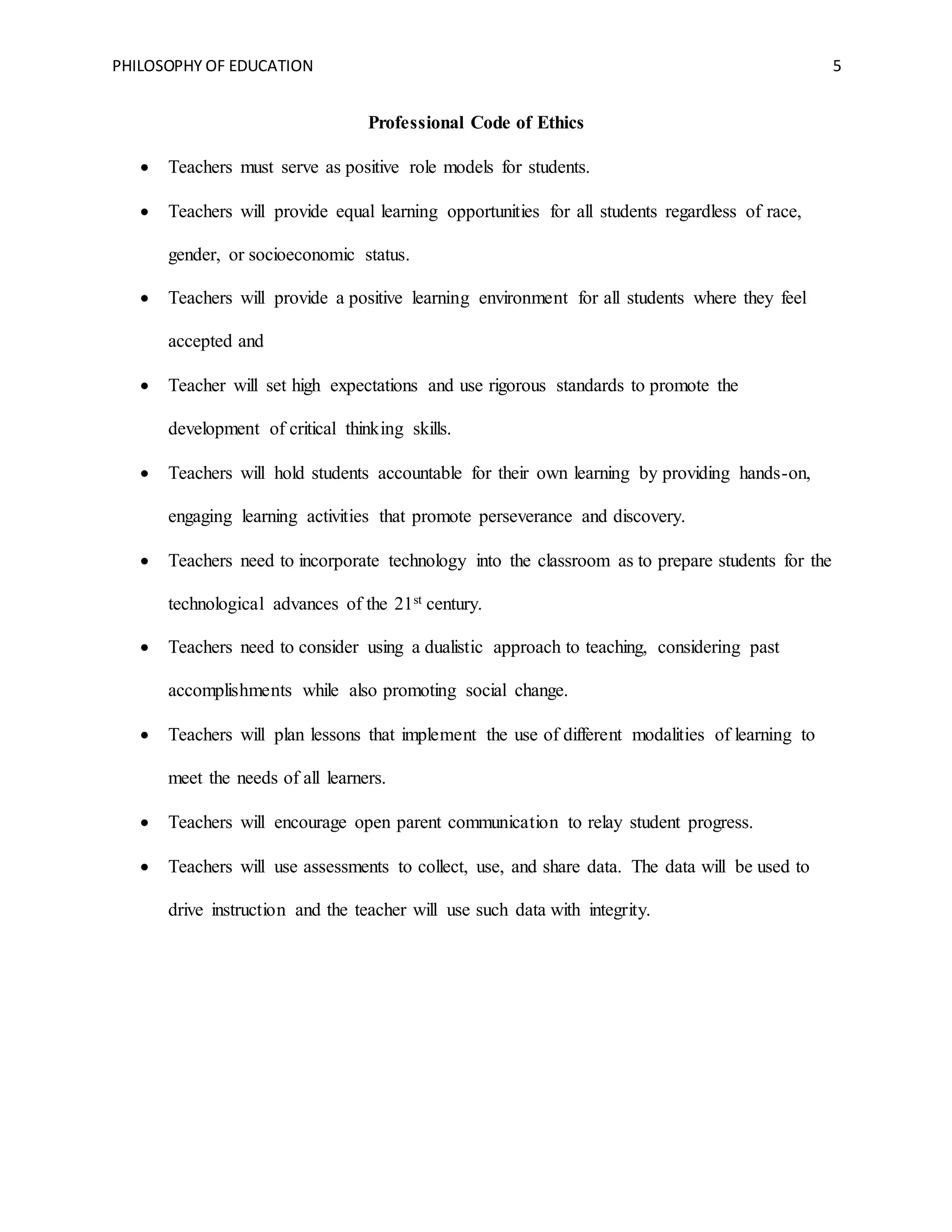
Professional Code of Ethics
 Teachers must serve as positive role models for students.
 Teachers will provide equal learning opportunities for all students regardless of race,
gender, or socioeconomic status.
 Teachers will provide a positive learning environment for all students where they feel
accepted and
 Teacher will set high expectations and use rigorous standards to promote the
development of critical thinking skills.
 Teachers will hold students accountable for their own learning by providing hands-on,
engaging learning activities that promote perseverance and discovery.
 Teachers need to incorporate technology into the classroom as to prepare students for the
technological advances of the 21st century.
 Teachers need to consider using a dualistic approach to teaching, considering past
accomplishments while also promoting social change.
 Teachers will plan lessons that implement the use of different modalities of learning to
meet the needs of all learners.
 Teachers will encourage open parent communication to relay student progress.
 Teachers will use assessments to collect, use, and share data. The data will be used to
drive instruction and the teacher will use such data with integrity.

My philosophy of education

  • 1.
    Running head: PHILOSOPHYOF EDUCATION 1 My Philosophy of Education Emily Branch American College of Education 5/13/2018
  • 2.
    PHILOSOPHY OF EDUCATION2 My Philosophy of Education Developing a philosophy of education is important because it helps build a strong foundation for professional growth and practice. As an educator, I hope to provide the best learning opportunities for all my students and instill a sense of confidence in them that will flourish as they grow. Personal Philosophy of Education Growing up, I have always wanted to be a teacher and I owe that to my kindergarten teacher. She was kind, sweet, engaging, and genuinely cared for all of her students. I want to be an educator because I want all of my past, present, and future students to realize their potential and self-worth. All students should be presented with equal opportunities to learn and grow and they should be held to high standards. I strive to be the kind of teacher who never gives up on her students and one that provides a safe learning environment where students are not afraid to take academic risks. As an educator, I want my students to experience the “light bulb moment” when they realize all of their hard work was worth it. I want America to be the global leader in education. A country where students are thriving and pursuing their dreams. While earning my degree, I had a professor who taught us about risk taking in the classroom. I hope to instill a love of risk taking in my students. I do not want them to be afraid to raise their hand and say the wrong answer. I want them to be confident learners who trust their own brains. Currently, I teach a diverse group of learners ranging from well above grade level to well below grade level. I also work with English language learners and students who are living in poverty. No matter their differences, my goal as an educator is meet the needs of these learners to the best of my abilities. I believe these students should receive the same, high quality education that is available to everybody else.
  • 3.
    PHILOSOPHY OF EDUCATION3 Parent support in the classroom is crucial for student success. Encouraging parents to take an active role in their child’s education is a high priority for me. I have seen the positive effects of parent involvement and cannot stress enough the impact it has on student achievement. My goal is to effectively communicate successes and concerns with parents, so they are aware of their child’s progress. The changing times influence education in many ways. 21st century learners need to be prepared for the high-tech world they will enter as adults. Incorporating technology in my classroom is key in preparing students to be college and career ready. As mentioned earlier, I have students who come from low-income homes. Those students do not have access to computers and tablets like others do. Exposing them to technology on a daily basis helps level the playing field for all students. Due to the rapid growth of technology, I think it is important to include STEM education in the curriculum. It has the potential to spark interests in students that could point them in the direction of obtaining a career in the 21st century. Experience in the classroom has taught me that utilizing different teaching strategies allows me to meet the needs of all students. The most important strategy I strive to implement includes hands-on learning. Students learn best when they are actively engaged in their own learning. Developing critical thinking skills is a stepping-stone in the foundation of a successful education. Hands-on curriculum fosters these skills by providing trial and error learning experiences. This supports my hope of students becoming risk takers in their own education. Students need to develop self-perseverance in order to become successful with rigorous standards. I believe my role as the teacher is to facilitate student discussions and guide them as learning takes place. Knowing students learn and obtain information in different ways, I will implement multiple modalities of teaching and assessing my students.
  • 4.
    PHILOSOPHY OF EDUCATION4 Assessments and data should drive classroom instruction. Assessments can be informal, summative, or simple observations. Regardless of the type, I will use assessments to guide my instruction and to determine the pace of my class. Data will be collected frequently to monitor student growth and achievement. I will use this data to hold myself accountable for adequate progress of student learning. Educating students to be successful contributors to our society is a top priority. Successful contributors include those who are ready to enter the workforce or attend college to obtain a degree. In order to do so, students need to be exposed to rigorous standards and held to high expectations. My final goal is to teach my students to be kind, compassionate human beings. The golden rule I have in my classroom is to treat others the way you want to be treated. I can only hope that teaching these character traits will help combat the rising depression and suicide rates in America. Conclusion It is my duty as an educator, to prepare all students for the challenges and success that await them. I will continue to grow as a professional and refine my philosophy of education. Educators shape the minds and hearts of our future leaders, doctors, teachers, nurses, policemen and firefighters, just to name a few. I am proud to call myself a teacher and I look forward to what lies ahead of me in my career.
  • 5.
    PHILOSOPHY OF EDUCATION5 Professional Code of Ethics  Teachers must serve as positive role models for students.  Teachers will provide equal learning opportunities for all students regardless of race, gender, or socioeconomic status.  Teachers will provide a positive learning environment for all students where they feel accepted and  Teacher will set high expectations and use rigorous standards to promote the development of critical thinking skills.  Teachers will hold students accountable for their own learning by providing hands-on, engaging learning activities that promote perseverance and discovery.  Teachers need to incorporate technology into the classroom as to prepare students for the technological advances of the 21st century.  Teachers need to consider using a dualistic approach to teaching, considering past accomplishments while also promoting social change.  Teachers will plan lessons that implement the use of different modalities of learning to meet the needs of all learners.  Teachers will encourage open parent communication to relay student progress.  Teachers will use assessments to collect, use, and share data. The data will be used to drive instruction and the teacher will use such data with integrity.