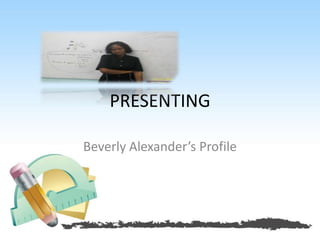
PRESENTING
Beverly Alexander’s Profile
MY FAMILY
MY RESUME
A highly motivated teacher with a verifiable record of many contributions spanning
sixteen years. Highly creative, recognized as a results-oriented and solution-focused
individual. Areas of strength include:
•Organizational Skills
•Computer Literacy
•Work as Team Player
•Lesson planning
•Classroom management
•EDUCATION
•Teacher’s Diploma (Valsayn Teachers’ College) 2001
•Certificate in Administrative Professional Office Management (University of the West
Indies)
•Bachelors in Educational Leadership & Management (pursuing 3rd year
MY RESUME CONT’D
COMPUTER SKILLS
• Microsoft Office User Specialist (2002)
SOFTWARE EXPERIENCE
• Microsoft Word, Excel and Power point
• Microsoft Publisher
• Educational software including the one used with intellikeys
PROFESSIONAL EXPERIENCE
• On-The Job Training
• Assistant Teacher 2
• Teacher 1
MY RESUME CONT’D
SPECIAL INTERESTS include:-
• Singing, listening to music, computer games, going to movies,
sports, dancing and avid gym member.
WORKSHOPS ATTENDED
• Disability Sport Education Workshop
• Training of Special Needs Resource Trainers’
• Developing emotional literacy
• Anglicanism TodayKnow Your Faith
• Professional days sponsored by TTAPPS
MY RESUME CONT’D
SPECIFIC CONTRIBUTIONS
• Acts as senior teacher when the principal or other superiors are
absent
• Co-ordinates POWERGEN Sports for the Princess Elizabeth
Special School
• Currently a member of Very Special Arts
• Computer teacher for the school
• Instrumental in initiating a summer camp at the St. James The
Just Anglican Church
MY PHILOSOPHY ON EDUCATION
"A person's a person, no matter how
small." - Dr. Seuss
• I believe in making
learning meaningful to
my students
• I believe in treating all
students with respect
• I believe that all
students can learn
• I believe in getting to
know my students e,g,
strengths, weaknesses
• I believe in group work
• I believe in student
centred, constructivist
learning.
• I believe in behaviour
modification
• I believe in treating all
students fairly
MY PHILOSOPHY ON EDUCATION CONT’D
"A nation, as a society, forms a moral person, and every member of it is
personally responsible for his society.“
Thomas Jefferson
• I believe in making
learning meaningful to
my students
• I believe in treating all
students with respect
• I believe that all
students can learn
• I believe in getting to
know my students e,g,
strengths, weaknesses
• I believe in group work
• I believe in student
centred, constructivist
learning.
• I believe in behaviour
modification
• I believe in treating all
students fairly
To be an effective teacher I
• Plan and instruct each subject area using a wide
variety of teaching aids, motivational and
implementation strategies to engage.
• Involve students in active learning.
• Incorporate learning modality principles into
classroom and individual instruction.
• Implement technological approaches to subject
material.
• Research educational resources on the Internet
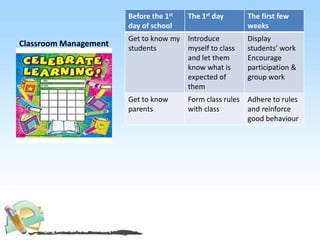
Classroom Management
Before the 1st
day of school
The 1st day The first few
weeks
Get to know my
students
Introduce
myself to class
and let them
know what is
expected of
them
Display
students’ work
Encourage
participation &
group work
Get to know
parents
Form class rules
with class
Adhere to rules
and reinforce
good behaviour
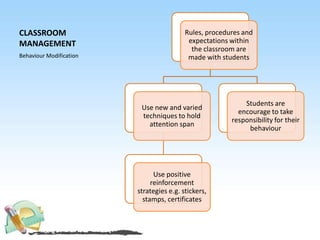
CLASSROOM
MANAGEMENT
Rules, procedures and
expectations within
the classroom are
made with students
Use new and varied
techniques to hold
attention span
Use positive
reinforcement
strategies e.g. stickers,
stamps, certificates
Students are
encourage to take
responsibility for their
behaviour
Behaviour Modification
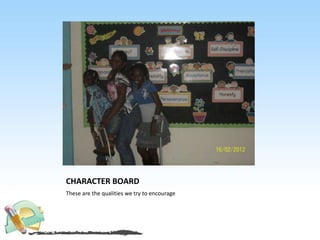
CHARACTER BOARD
These are the qualities we try to encourage
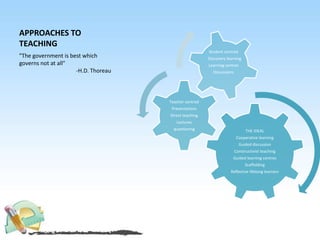
APPROACHES TO
TEACHING
THE IDEAL
Cooperative learning
Guided discussion
Constructivist teaching
Guided learning centres
Scaffolding
Reflective lifelong learners
Teacher centred
Presentations
Direct teaching
Lectures
questioning
Student centred
- Discovery learning
Learning centres
Discussions
"The government is best which
governs not at all"
-H.D. Thoreau
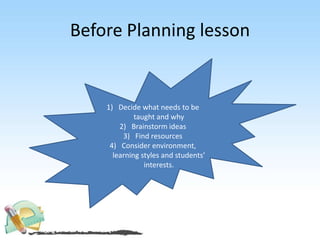
Before Planning lesson
1) Decide what needs to be
taught and why
2) Brainstorm ideas
3) Find resources
4) Consider environment,
learning styles and students’
interests.
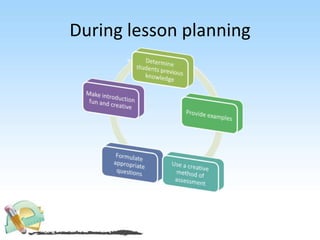
During lesson planning
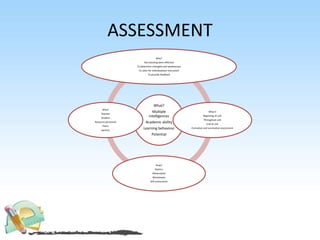
ASSESSMENT
What?
Multiple
intelligences
Academic ability
Learning behaviour
Potential
Why?
Has teaching been effective
To determine strengths and weaknesses
To cater for individualized instruction
To provide feedback
When?
Beginning of unit
Throughout unit
End of unit
Formative and summative assessment
How?
Rubrics
Observation
Worksheets
Self assessment
Who?
Teacher
Student
Resource personnel
Peers
parents
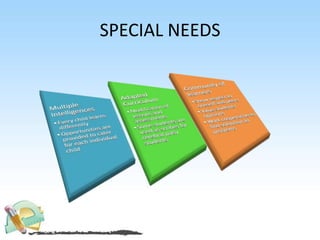
SPECIAL NEEDS
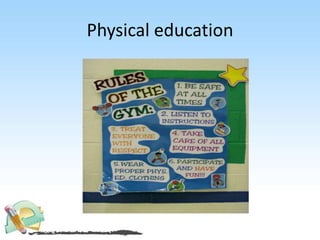
Physical education
FUN WITH THE STUDENTS
VACATION BIBLE SCHOOL
REFLECTION IS
a window through which the practitioner can view and focus
self within the context of his own lived experience in ways
that enable him to confront, understand and work towards
resolving the contradictions within his practice between what
is desirable and actual practice
Roth (1989) summarized the basic elements of
reflective process as follows,
Keeping an open mind about what, and how we do
things.
Awareness of what, why and how we do things.
Questioning what, why and how we do things.
Asking what, why and how other people do things.
Generating choices, options and possibilities.
Comparing and contrasting results.
Seeking to understand underlying mechanisms and
rationales.
Viewing our activities and results from various
perspectives.
Asking “What if …..?”
Seeking feedback and other people’s ideas and
viewpoints.
Using prescriptive (advice) models only when
carefully adapted to the individual situation.
Analyzing, synthesizing and testing.
Searching for, identifying and resolving problems
and result limitation
The 10 C’s of Reflection
Commitment – believing that self and practice
matter; accepting responsibility for self; the
openness, curiosity and willingness to
challenge normative ways of responding to
situations.
Contradiction – exposing and understanding
the contradiction between what is desirable
and actual practice.
Conflict – harnessing the energy of conflict
within contradiction to become empowered to
take appropriate action.
Challenge and Support – confronting the
practitioner’s normative attitudes, beliefs and
actions in ways that do not threaten the
practitioner .Beverly's Professional
Portfolio.pptx
Catharsis – working through negative
feelings.
Creation – moving beyond self to see and
understand new ways of viewing and
responding to practice.
Connection – connecting new insight within
the real world of practice; appreciating the
temporality over reality.
Caring – realizing desirable practice as
everyday reality.
Congruence - reflection as a mirror for
caring.
Constructing Personal Knowing in practice –
weaving personal knowing
with relevant extant theory in constructing
knowledge.
Johns' (2000b)
A poem on reflection
Ris for the concept of reflective practice
E aims to achieve it everyday
F means only the framework for the models of reflection
Lmeans a lifelong learner I’ll always be
E stands for experiential learning
C is for the construction of new knowledge.
T tells of the importance of time management
I is for individual reflection
Omeans that reflection will not grow old
N means dealing with negative feelings
Put them all together we get reflection. A concept that will forever reign
Beverly's professional portfolio

Beverly's professional portfolio

  • 1.
  • 2.
  • 3.
    MY RESUME A highlymotivated teacher with a verifiable record of many contributions spanning sixteen years. Highly creative, recognized as a results-oriented and solution-focused individual. Areas of strength include: •Organizational Skills •Computer Literacy •Work as Team Player •Lesson planning •Classroom management •EDUCATION •Teacher’s Diploma (Valsayn Teachers’ College) 2001 •Certificate in Administrative Professional Office Management (University of the West Indies) •Bachelors in Educational Leadership & Management (pursuing 3rd year
  • 4.
    MY RESUME CONT’D COMPUTERSKILLS • Microsoft Office User Specialist (2002) SOFTWARE EXPERIENCE • Microsoft Word, Excel and Power point • Microsoft Publisher • Educational software including the one used with intellikeys PROFESSIONAL EXPERIENCE • On-The Job Training • Assistant Teacher 2 • Teacher 1
  • 5.
    MY RESUME CONT’D SPECIALINTERESTS include:- • Singing, listening to music, computer games, going to movies, sports, dancing and avid gym member. WORKSHOPS ATTENDED • Disability Sport Education Workshop • Training of Special Needs Resource Trainers’ • Developing emotional literacy • Anglicanism TodayKnow Your Faith • Professional days sponsored by TTAPPS
  • 6.
    MY RESUME CONT’D SPECIFICCONTRIBUTIONS • Acts as senior teacher when the principal or other superiors are absent • Co-ordinates POWERGEN Sports for the Princess Elizabeth Special School • Currently a member of Very Special Arts • Computer teacher for the school • Instrumental in initiating a summer camp at the St. James The Just Anglican Church
  • 7.
    MY PHILOSOPHY ONEDUCATION "A person's a person, no matter how small." - Dr. Seuss • I believe in making learning meaningful to my students • I believe in treating all students with respect • I believe that all students can learn • I believe in getting to know my students e,g, strengths, weaknesses • I believe in group work • I believe in student centred, constructivist learning. • I believe in behaviour modification • I believe in treating all students fairly
  • 8.
    MY PHILOSOPHY ONEDUCATION CONT’D "A nation, as a society, forms a moral person, and every member of it is personally responsible for his society.“ Thomas Jefferson • I believe in making learning meaningful to my students • I believe in treating all students with respect • I believe that all students can learn • I believe in getting to know my students e,g, strengths, weaknesses • I believe in group work • I believe in student centred, constructivist learning. • I believe in behaviour modification • I believe in treating all students fairly
  • 9.
    To be aneffective teacher I • Plan and instruct each subject area using a wide variety of teaching aids, motivational and implementation strategies to engage. • Involve students in active learning. • Incorporate learning modality principles into classroom and individual instruction. • Implement technological approaches to subject material. • Research educational resources on the Internet
  • 10.
    Classroom Management Before the1st day of school The 1st day The first few weeks Get to know my students Introduce myself to class and let them know what is expected of them Display students’ work Encourage participation & group work Get to know parents Form class rules with class Adhere to rules and reinforce good behaviour
  • 11.
    CLASSROOM MANAGEMENT Rules, procedures and expectationswithin the classroom are made with students Use new and varied techniques to hold attention span Use positive reinforcement strategies e.g. stickers, stamps, certificates Students are encourage to take responsibility for their behaviour Behaviour Modification
  • 12.
    CHARACTER BOARD These arethe qualities we try to encourage
  • 13.
    APPROACHES TO TEACHING THE IDEAL Cooperativelearning Guided discussion Constructivist teaching Guided learning centres Scaffolding Reflective lifelong learners Teacher centred Presentations Direct teaching Lectures questioning Student centred - Discovery learning Learning centres Discussions "The government is best which governs not at all" -H.D. Thoreau
  • 14.
    Before Planning lesson 1)Decide what needs to be taught and why 2) Brainstorm ideas 3) Find resources 4) Consider environment, learning styles and students’ interests.
  • 15.
  • 16.
    ASSESSMENT What? Multiple intelligences Academic ability Learning behaviour Potential Why? Hasteaching been effective To determine strengths and weaknesses To cater for individualized instruction To provide feedback When? Beginning of unit Throughout unit End of unit Formative and summative assessment How? Rubrics Observation Worksheets Self assessment Who? Teacher Student Resource personnel Peers parents
  • 17.
  • 18.
  • 19.
    FUN WITH THESTUDENTS
  • 20.
  • 21.
    REFLECTION IS a windowthrough which the practitioner can view and focus self within the context of his own lived experience in ways that enable him to confront, understand and work towards resolving the contradictions within his practice between what is desirable and actual practice
  • 22.
    Roth (1989) summarizedthe basic elements of reflective process as follows, Keeping an open mind about what, and how we do things. Awareness of what, why and how we do things. Questioning what, why and how we do things. Asking what, why and how other people do things. Generating choices, options and possibilities. Comparing and contrasting results. Seeking to understand underlying mechanisms and rationales. Viewing our activities and results from various perspectives. Asking “What if …..?” Seeking feedback and other people’s ideas and viewpoints. Using prescriptive (advice) models only when carefully adapted to the individual situation. Analyzing, synthesizing and testing. Searching for, identifying and resolving problems and result limitation
  • 23.
    The 10 C’sof Reflection Commitment – believing that self and practice matter; accepting responsibility for self; the openness, curiosity and willingness to challenge normative ways of responding to situations. Contradiction – exposing and understanding the contradiction between what is desirable and actual practice. Conflict – harnessing the energy of conflict within contradiction to become empowered to take appropriate action. Challenge and Support – confronting the practitioner’s normative attitudes, beliefs and actions in ways that do not threaten the practitioner .Beverly's Professional Portfolio.pptx Catharsis – working through negative feelings. Creation – moving beyond self to see and understand new ways of viewing and responding to practice. Connection – connecting new insight within the real world of practice; appreciating the temporality over reality. Caring – realizing desirable practice as everyday reality. Congruence - reflection as a mirror for caring. Constructing Personal Knowing in practice – weaving personal knowing with relevant extant theory in constructing knowledge. Johns' (2000b)
  • 24.
    A poem onreflection Ris for the concept of reflective practice E aims to achieve it everyday F means only the framework for the models of reflection Lmeans a lifelong learner I’ll always be E stands for experiential learning C is for the construction of new knowledge. T tells of the importance of time management I is for individual reflection Omeans that reflection will not grow old N means dealing with negative feelings Put them all together we get reflection. A concept that will forever reign

Editor's Notes

  • #3 My comprises of both my personal and professional life. So my husband and grandmother are family but my pets are also included as they enhance my life as well.
  • #4 This section deals with my profession. It reveals the length of time I have been in active teaching. I believe I was born to teach. This also demonstrates how much I am willing to upgrade my skills so I can improve my competency in the field.
  • #5 I not only depend on training through the Government but have used my initiative and received proficiency in computer skills.
  • #6 As any normal adult I engage in leisure activities. I also willingly attend workshops that will prove beneficial to me so that not only my professional but emotional and spiritual life can be enhanced.
  • #7 As a teacher I take advantage of opportunities that can make me feel better about myself. In this way I feel more enthused when I can make valid contributions. I also try to assist students in need. Hence the co-ordination of a vacation camp in church.
  • #8 That quote means a lot to me. Since education lies in respecting the student no matter the size. I always consider the students I teach be it infants or grade 6 as my biological children. In this way I take more interest in their learning and cater for their individual needs.
  • #10 As a teacher appropriate planning must be done before, during and after a lesson and the students must be actively engaged with the content
  • #11 When I begin the first term with students I aim to get to know them better and let them know what my policy is on discipline. Communicating with the parents is also essential as knowing what affects the child’s home life help solve some school related issues.
  • #12 Classroom management policies are essential to effective teaching.
  • #13 Students see this display each time they enter class. Three of my physically challenged pupils.
  • #14 Some approaches to teaching. The ideal situation is what works the best as it has the holistic child in mind.
  • #20 We not only have fun learning in the classroom but prepared for Powergen Sports and won best dressed.
  • #21 Sample item during a talent show at the vacation class in church.A student receives a certificate of completion upon graduation.