
Role of Technology
in Service Marketing

           Presented by :-
           Nair Venkatesh Ravidranath
           S3 MBA
           IMT
Technology in Banking

ď‚§ Automated Teller Machines (ATM)
                 It has been estimated that there are
 around 400,000 ATMs worldwide out of which 1,00,000
 are located in Japan alone. ATMs allow the user to
 perform upto 150 kinds of transactions ranging from
 simple cash withdrawals and deposits, to fund transfer
 to trading in stocks to buying mutual funds to
 something mundane like payment of electricity bills,
 booking air-tickets and making hotel reservations.
ď‚§ 'Virtual' Bank
          The customer activated terminal (CAT) or
 Kiosk is an interactive multimedia display unit, housed
 in a small enclosure, typically consisting of a computer
 workstation, monitor, video disk player and a card
 reader. It allows the customers to browse through
 information and use the available banking services at
 their own speed.
ď‚§ Image Processing
         As financial services including capital markets
 and banking are highly document intensive, image
 processing technology can have a far reaching impact
 for such applications for its 'Less paper ' handling
 characteristics.
ď‚§ Home Banking
    Smart phones with screen built-in modems and
  programmable microprocessors let the customer
  access a variety of financial services from home.
ď‚§ Electronic Funds Transfer at Point of Sale
  (EFTPOS)
               While travelers' cheques meant 'pay-now-
  buy-later' and credit cards had 'buy-now-pay-
  later' advantages, EFTPOS or debit cards signify 'buy-
  now-pay-now' but without cash transaction. The user
  presents his ATM card when he buys goods and the
  EFTPOS system immediately debits his bank account.
ď‚§ Smart Cards
           The 'Processor' type smart cards with in-built
 integrated circuits (ICs) or micro-chips offer a wide
 range of transactional opportunities even from remote
 areas. The smart cards are extensively being used for
 employee 'clocking in', withdrawing cash from ATM,
 using pay-phones, payment of various bills, etc.
ď‚§ Electronic Data Interchange (EDI)
   EDI typically denotes paperless financial transactions
 across the locations. The companies can now operate
 their bank accounts through corporate banking
 terminals in their own offices which are linked to the
 bank computers. Companies can thus carry out
 transactions like transferring funds, managing its cash
 flow, opening letters of credit, etc.without any paper
 work.
Technology in
  Education
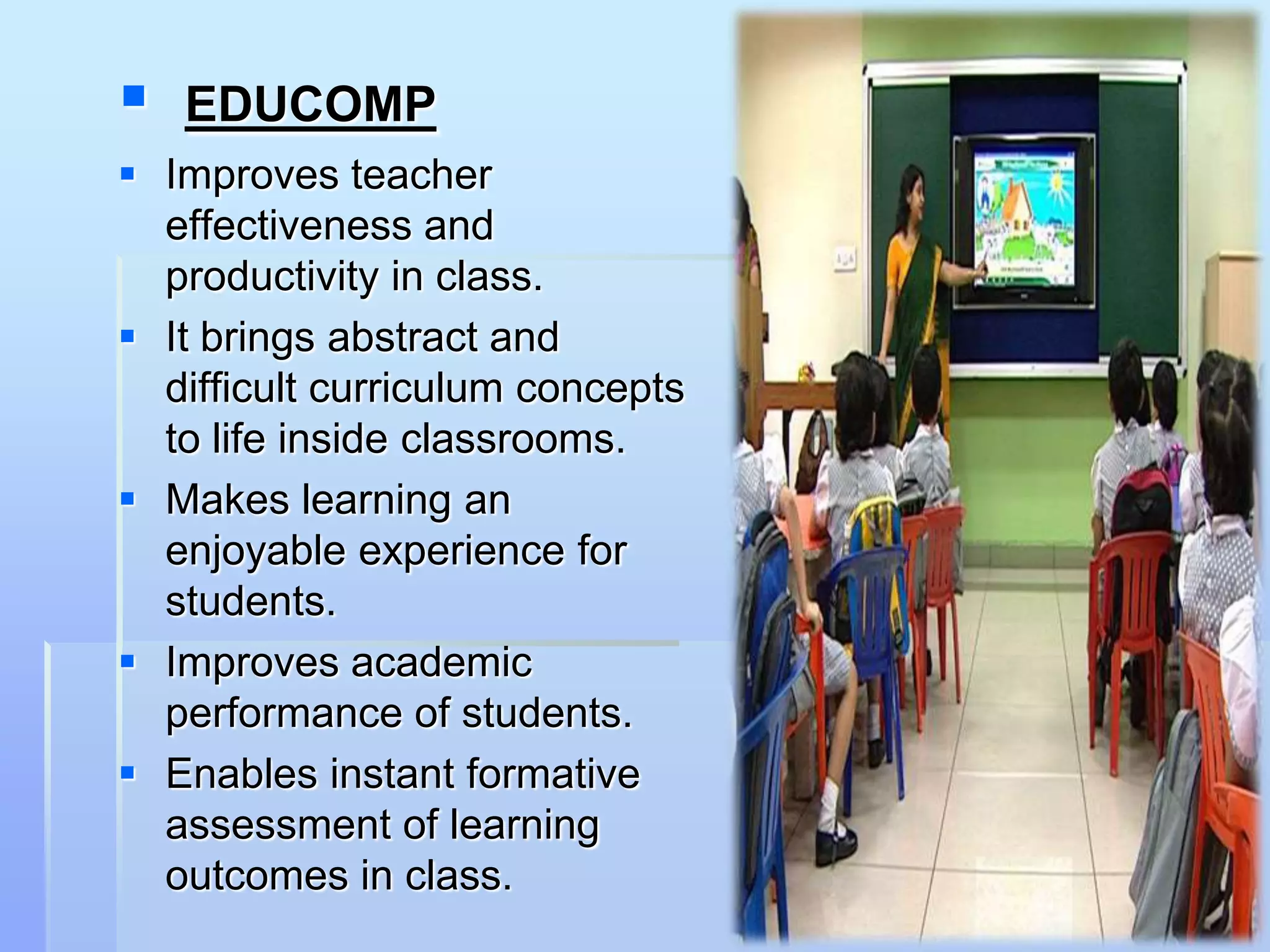
ď‚§   EDUCOMP
ď‚§ Improves teacher
  effectiveness and
  productivity in class.
ď‚§ It brings abstract and
  difficult curriculum concepts
  to life inside classrooms.
ď‚§ Makes learning an
  enjoyable experience for
  students.
ď‚§ Improves academic
  performance of students.
ď‚§ Enables instant formative
  assessment of learning
  outcomes in class.
ď‚§ Projectors
              Projectors are a basic way to introduce
  technology to students in the classroom. The projector
  is hooked up to the teacher's laptop and projects the
  screen from the laptop to the white board in the front of
  the room. This enables students to see a larger version
  of what is on the laptop screen.
ď‚§ SMART Technologies
               A SMART board is an interactive white
  board that allows the teacher to project an image from
  a laptop to the front of the room. The amazing part is
  that the teacher can then digitally draw on that image.
ď‚§ Mimio Boards (Interactive-white boards)
          They are interactive white boards that allow
 the teacher to manipulate computer functions on the
 white board in the front of the room. Sensors are in
 place in the board that allows the teacher to use a
 special pen that acts like a mouse. Teachers maneuver
 through websites, graphs and other lessons using this
 technology.
ď‚§ Classroom PCs
                  Some educators are lucky enough to
 have individual PCs for every student in the class.
 When every student has his or her own laptop, learning
 takes on a whole different dynamic.
Technology in Insurance
ď‚§ E-CRM
               Insurance industry is a data-rich industry, and thus,
  there is a need to use the data for trend analysis and
  personalization. It is very difficult to interact with each and every
  person to whom the insurer wants, and in the insurance sector the
  customer relationship management is base. Thus with the help of
  e-crm insurer are taking knowledge about their customer and
  providing information directly to them. It also reduces the cost of
  marketing which increases the profit of business.
ď‚§ E-Insurance
               Today various insurance companies are providing
  facilities to their clients. They can check the balance premium,
  maturity date, dues and outstanding of their policy. They are
  provided various new information regarding new policy. The
  customer can pay the premium amount of there policy from the e-
  insurance option.
Technology in Health Care

 ď‚§ Electronic Medical Record (EMR)
        This digital record can hold the full details of an
  individual’s medical history, which ultimately helps to
  direct diagnostic and therapeutic decisions when a
  patient enters the healthcare system.
Role of technology in service marketing

Role of technology in service marketing

  • 1.
    Role of Technology inService Marketing Presented by :- Nair Venkatesh Ravidranath S3 MBA IMT
  • 2.
    Technology in Banking ď‚§Automated Teller Machines (ATM) It has been estimated that there are around 400,000 ATMs worldwide out of which 1,00,000 are located in Japan alone. ATMs allow the user to perform upto 150 kinds of transactions ranging from simple cash withdrawals and deposits, to fund transfer to trading in stocks to buying mutual funds to something mundane like payment of electricity bills, booking air-tickets and making hotel reservations.
  • 3.
    ď‚§ 'Virtual' Bank The customer activated terminal (CAT) or Kiosk is an interactive multimedia display unit, housed in a small enclosure, typically consisting of a computer workstation, monitor, video disk player and a card reader. It allows the customers to browse through information and use the available banking services at their own speed. ď‚§ Image Processing As financial services including capital markets and banking are highly document intensive, image processing technology can have a far reaching impact for such applications for its 'Less paper ' handling characteristics.
  • 4.
    ď‚§ Home Banking Smart phones with screen built-in modems and programmable microprocessors let the customer access a variety of financial services from home. ď‚§ Electronic Funds Transfer at Point of Sale (EFTPOS) While travelers' cheques meant 'pay-now- buy-later' and credit cards had 'buy-now-pay- later' advantages, EFTPOS or debit cards signify 'buy- now-pay-now' but without cash transaction. The user presents his ATM card when he buys goods and the EFTPOS system immediately debits his bank account.
  • 5.
    ď‚§ Smart Cards The 'Processor' type smart cards with in-built integrated circuits (ICs) or micro-chips offer a wide range of transactional opportunities even from remote areas. The smart cards are extensively being used for employee 'clocking in', withdrawing cash from ATM, using pay-phones, payment of various bills, etc. ď‚§ Electronic Data Interchange (EDI) EDI typically denotes paperless financial transactions across the locations. The companies can now operate their bank accounts through corporate banking terminals in their own offices which are linked to the bank computers. Companies can thus carry out transactions like transferring funds, managing its cash flow, opening letters of credit, etc.without any paper work.
  • 6.
    Technology in Education
  • 7.
    ď‚§ EDUCOMP ď‚§ Improves teacher effectiveness and productivity in class. ď‚§ It brings abstract and difficult curriculum concepts to life inside classrooms. ď‚§ Makes learning an enjoyable experience for students. ď‚§ Improves academic performance of students. ď‚§ Enables instant formative assessment of learning outcomes in class.
  • 8.
    ď‚§ Projectors Projectors are a basic way to introduce technology to students in the classroom. The projector is hooked up to the teacher's laptop and projects the screen from the laptop to the white board in the front of the room. This enables students to see a larger version of what is on the laptop screen. ď‚§ SMART Technologies A SMART board is an interactive white board that allows the teacher to project an image from a laptop to the front of the room. The amazing part is that the teacher can then digitally draw on that image.
  • 9.
    ď‚§ Mimio Boards(Interactive-white boards) They are interactive white boards that allow the teacher to manipulate computer functions on the white board in the front of the room. Sensors are in place in the board that allows the teacher to use a special pen that acts like a mouse. Teachers maneuver through websites, graphs and other lessons using this technology. ď‚§ Classroom PCs Some educators are lucky enough to have individual PCs for every student in the class. When every student has his or her own laptop, learning takes on a whole different dynamic.
  • 10.
    Technology in Insurance ď‚§E-CRM Insurance industry is a data-rich industry, and thus, there is a need to use the data for trend analysis and personalization. It is very difficult to interact with each and every person to whom the insurer wants, and in the insurance sector the customer relationship management is base. Thus with the help of e-crm insurer are taking knowledge about their customer and providing information directly to them. It also reduces the cost of marketing which increases the profit of business. ď‚§ E-Insurance Today various insurance companies are providing facilities to their clients. They can check the balance premium, maturity date, dues and outstanding of their policy. They are provided various new information regarding new policy. The customer can pay the premium amount of there policy from the e- insurance option.
  • 11.
    Technology in HealthCare  Electronic Medical Record (EMR) This digital record can hold the full details of an individual’s medical history, which ultimately helps to direct diagnostic and therapeutic decisions when a patient enters the healthcare system.